
 100% FREE ACCESS
12th Standard CBSE Syllabus & Materials
12th Standard CBSE
CBSE 12th Economics Government Budget and the Economy Previous year Question Papers Study Material - QB365 Set A
NEW12th Standard CBSE
CBSE 12th Computer Science Interface Python with MySQL - New Previous year Question Papers Study Material - QB365 Set A
NEW12th Standard CBSE
CBSE 12th Computer Science Database Concept - New Previous year Question Papers Study Material - QB365 Set A
NEW12th Standard CBSE
CBSE 12th Computer Science Data Communication - New Previous year Question Papers Study Material - QB365 Set A
NEW12th Standard CBSE
CBSE 12th Computer Science Data Structures - New Previous year Question Papers Study Material - QB365 Set A
NEW12th Standard CBSE
CBSE 12th Computer Science Functions - New Previous year Question Papers Study Material - QB365 Set A

Published on: 05/03/2026
Download CBSE Class 12th Standard CBSE Biology question papers, sample papers, important questions, and previous year solved papers in PDF format. Get free study materials, NCERT solutions, and exam preparation resources for Class 12th Standard CBSE Biology
Questions + Answers key
Take MCQ Biology Test
1.
2.
3.
4.
We have so far seen the effect of a gene on a single phenotype or trait. There are however instances where a single gene can exhibit multiple phenotypic expression. Such a gene is called a pleiotropic gene. The underlying mechanism of pleiotropy in most cases is the effect of a gene on metabolic pathways which contributes towards different phenotypes. An example of this is the disease phenylketonuria (PKU; Foiling, 1934) which occurs in humans. The disease is caused by mutation in the gene that codes for the enzyme phenyl alanine hydroxylase i.e., single gene mutation. Pleiotropism is defined as a phenomenon when single gene may produce more than one effect i.e., the multiple effect of a gene or control several phenotypes depending on its position. This results in a phenotypic expression characterized by mental retardation and a reduction in hair and skin pigmentation (albinism). In Drosophila white eye mutation leads to depigmentation in many other parts of the body, giving a pleiotropic effect. In transgenic organisms, the introduced gene can produce different effects depending on where the gene has introgressed.
1.Single gene is controlling multiple phenotypic expression is referred as
A) Monogene
B) Polygenes
C) Pleiotropic
D) Digenes
2.In phenylketonuria (PKU) disease of human being, there is deficiency of enzyme -
A) Phenyl alanine oxidase
B) Phenyl alanine hydroxylase
C) Phenyl alanine tyrosinase
D) Phenyl alanine reductase
3.Symptoms of phenylketonuria (PKU) disease is
A) Mental retardation
B) Albinism
C) Reduction in hair
D) All of the above
4.Phenylketonuria disease is first recorded by
A) F. Galton, 1883
B) Follin, 1934
C) Hugo de Vries, 1901
D) John Otto, 1803
5.Phenylketonuria (PKU) disease is due to which chromosome
A) Chromosome number 10
B) Chromosome number 11
C) Chromosome number 12
D) Chromosome number 13
5.
Though the genotypic ratios can be calculated using mathematical probability, but simply looking at the phenotype of a dominant trait, it is not possible to know the genotypic composition. That is, for example, whether a tall plant from F1 or F2 has TT or Tt composition, cannot be predicted. Therefore, to determine the genotype of a tall plant at F2 Mendel crossed the tall plant from F1with a dwarf plant i.e., recessive parent. This he called a test cross. In a typical test cross an organism like Pea plants showing a dominant phenotype and whose genotype is to be determined is crossedwith the recessive parent instead of self-crossing or selfing. The progenies of such a cross can easily be analysed to predict the genotype of the test organism.
1.What ratio did you get during test cross of a Pea plant?
A) 1 : 2 : 1
B) 1 : 1
C) 3 : 1
D) 2 : 1
2.With the help of Punnett square, try to find out the nature of offsprings of a test cross?
A) 25 % hybrid tall and 25 % dwarf
B) 75 % hybrid tall and 25 % dwar
C) 50 % hybrid tall and 50 % dwarf
D) 15 % hybrid tall and 85 % dwarf
3.Using the genotypes of test cross, can you give a general definition for a test cross?
A) TT ×tt
B) Tt ×tt
C) Tt ×Tt
D) tt ×tt
4.Test cross is a cross between
A) F1 tall plant and F1 dwarf plant
B) F1 tall plant and F1 recessive parent
C) F1 tall plant and F1 dominant parent
D) F1 dwarf plant and F1 dominant parent
5.Significance of the test cross in the genetics is to determine
A) Genotype of a hybrid Pea plant
B) Genotype of a tall Pea plant
C) Genotype of a dwarf Pea plant
D) Phenotype of a hybrid Pea plant
6.
7.
Read the following and answer any four questions from (i) to (v) given below:
Ginkgo tree has been saved from extinction by selective breeding followed by channeling into trade of nature lovers. This is an ex-situ conservation, where endangered species are protected from all adverse factors. Offspring produced in captive breeding are released in natural habitat for acclimatisation.
(i) What is the Significance of offsite collections?
| (a) Restock depleted populations | (b) Protection of endangered species |
| (c) Reintroduce species in wild | (d) All of these |
(ii) Which of the following is not an ex-situ conservation?
| (a) Wetlands | (b) Orchards | (c) Aquaria | (d) Botanical gardens |
(iii) Select the incorrect statements for ex-situ conservation.
| (a) It is conservation of species outside their natural habitats. |
| (b) Endangered species are kept under human supervision and provided all the essentials. |
| (c) The species population recovers in natural environment. |
| (d) Both (b) and (c) |
(iv) Conditions maintained in seed banks for orthodox seeds are
| (a) low moisture content | (b) anaerobic conditions | (c) low temperature | (d) all of these. |
(v) Assertion: Animal species which have become extinct in wild continue to be maintained in zoological parks.
Reason: Captive breeding is the conservation of those cases where these is no realistic chance of in-situ survival.
| (a) Both assertion and reason are true and reason is the correct explanation of assertion. |
| (b) Both assertion and reason are true but reason is not the correct explanation of assertion. |
| (c) Assertion is true but reason is false. |
| (d) Both assertion and reason are false. |
8.
Read the following and answer any four questions from (i) to (v) given below :
Turner's syndrome is an example of mono somy. It is formed by the union of an allosome free egg and a normal 'X' containing sperm or a normal egg and an allosome free sperm. The individual has 2n = 45 chromosomes (44 + X0) instead of 46. Such individuals are sterile females who have rudimentary ovaries, under developed breasts, small uterus, short stature, webbed neck and abnormal intelligence. They may not menstruate or ovulate. This disorder can be treated by giving female sex hormone to the women from the age of puberty to make them develop breasts and have menstruation. This makes them feel more normal.
(i) Number of Barr body present in a female with Turner's syndrome is
| (a) 0 | (b) 1 | (c) 2 | (d) < 2. |
(ii) Turner's syndrome is an example of
| (a) aneuploidy | (b) euploidy | (c) polyploidy | (d) autosomal abnormality |
(iii) Turner's syndrome is a/an
| (a) autosomal recessive Mendelian disorder | (b) autosomal dominant Mendelian disorder |
| (c) sex linked Mendelian disorder | (d) chromosomal disorder |
(iv) Which of the following statements regarding Turner's syndrome is incorrect?
| (a) It is a case of monosomy of chromosomes |
| (b) The suffering individual is a sterile female having one 'X' chromosome missing in the cells |
| (c) The problem is due to an extra chromosome |
| (d) The individual are of short stature |
(v) Assertion : Turner's syndrome is caused due to absence of anyone of the X and Y sex chromosome.
Reason : Individuals suffering from Turner's syndrome show masculine as well as feminine development
| (a) Both assertion and reason are true and reason is the correct explanation of assertion. |
| (b) Both assertion and reason are true but reason is not the correct explanation of assertion |
| (c) Assertion is true but reason is false |
| (d) Both assertion and reason are false |
9.
Read the following and answer any four questions from (i) to (v) given below:
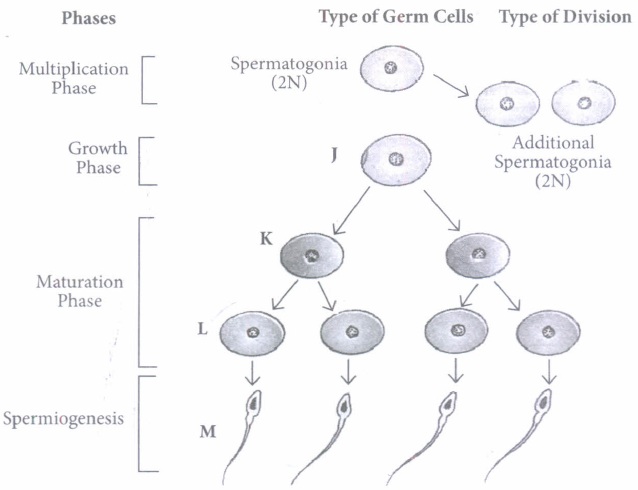
In testis, the immature male germ cells produce sperms by spermatogenesis that begins at puberty. It occurs in the seminifer.o•. us tubules of the testes. Seminiferous tubules are lined by germinal epithelium. Study the schematic representation of spermatogenesis and answer the following questions.
(i) Which cell division occurs during multiplication phase?
| (a) Mitosis | (b) Meiosis I | (c) Meiosis II | (d) Both (b) and (c) |
(ii) How many chromosomes are present in secondary spermatocyte and spermatid respectively?
| (a) 46,23 | (b) 46,46 | (c) 23,23 | (d) 23, XY |
(iii) Transformation of L into M is known as
| (a) spermiation | (b) spermateliosis | (c) spermatogenesis | (d) none of these |
(iv) Select the correct option
| (a) Type A spermatogonia grows to larger primary spermatocyte. | (b) One spermatogonium forms two spermatids. | (c) Spermiation is the release of sperms from seminiferous tubules. | (d) Primary spermatocyte undergoes mitosis to form secondary spermatocytes. |
(v) Which hormone acts on spermatogonia to stimulate sperm production?
| (a) LH | (b) GnRE | (c) ABP | (d) FSH |
10.
Study the table given below and answer the questions that follow:
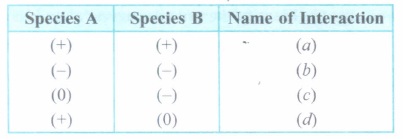
(+ = Beneficial interaction)
(- = Detrimental interaction)
(0 = Neutral interaction)
(i) Identify the type of interaction (a), (b), (c) and (d).
(ii) Why are predators 'prudent' in nature?
11.
A youth in his twenties met with an accident and succumbed to the injuries. His parents agreed to donate his organs. Answer the following questions:
(a) List any two essential clinical steps to be undertaken before any organ transplant.
(b) Why is the organ transplant rejected sometimes? Name the kind of immunity responsible for this.
12.
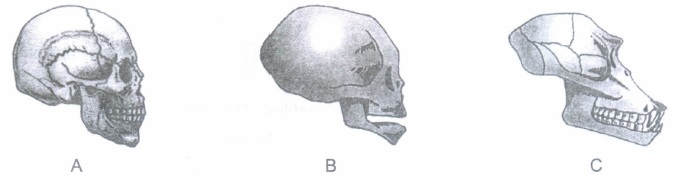
(a) Identify the respective animal to which each of the following skulls, A, Band C belongs. Which two among them resemble more closely?
(b) Name the (I) ape-like and (ii) man-like primates that existed 15 million years ago.
13.
Study the pedigree chart given below showing the inheritance pattern of a human trait and answer the questions that follow:
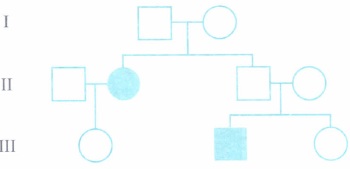
(a) Is the trait autosomal dominant or recessive or sex-linked? Why?
(b) Give the genotypes of the parents in generation I and of the son in generation II.
(c) Give the genotype of the first grand daughter.
14.
15.
16.
17.
18.
Assertion : Lichens are used as indicators of pollution.
Reason : A polluted environment accelerates the growth of lichens by providing them with more nutrition.
Codes:
(A) Both A and R are true, and R is the correct explanation for A.
(B) Both A and R are true, but R is not the correct explanation for A.
(C)A is true, but R is false
(D) A is false, but R is true.
19.
Assertion : Diversity observed in the entire geographical area, is called gamma diversity.
Reason : Bio-diversity decreases from high altitude to low altitude.
Codes:
(a) If both Assertion and Reason are true and Reason is the correct explanation of Assertion.
(b) If both Assertion and Reason are true but Reason is not the correct explanation of Assertion.
(c) If Assertion is true but Reason is false.
(d) If both Assertion and Reason are false.
20.
Assertion (A) : When the two genes in a dihybrid cross are situated on the same chromosome, the proportion of parental gene combinations is much higher than non-parental type.
Reason (B) : Higher parental gene combination can be attributed to crossing over between two genes.
(a) If both A and Rare true and R is the correct explanation of A
(b) It both A and R are true, but R is not the correct explanation of A
(c) If A is true, but R is false
(d) If A is false, but R. is true
21.
Assertion (A) : The first form of life arose gradually through evolutionary forces from non-living molecules
Reason (B) : This is called as alnogenesis
(a) lf both A and R are true and R is the correct explanation of A
(b) If both A and R are true, but R is not the correct explanation of A
(c) If A is true, but R is false
(d) If A is false, but R is true
22.
Assertion (A) Antibody mediated imnmune response is provided by B-cells.
Reason (R) B-cells work chiefly by secreting substances called antibodies into the body fluids.
(a) If both A and R are true and R is the correct explanation of A
(b) If both A and R are true, but R is not the correct explanation of A
(c) If A is true, but R is false
(d) If A is false, but R is true
23.
The diagram given below shows the event of cleavage. Refer to the diagram and comment upon the appropriateness of assertion and Reason.
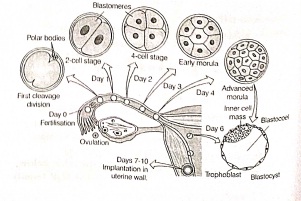
Assertion (A) : During cleavage, the cells divide and continue to rise in number, but the mass of protoplasm remains same.
Reason (R) : With each consecutive subdivision there is approximately half the cytoplasm in each daughter cell.
(a) If both A and R are true and R is the correct explanation of the A
(b) If both A and R are true, but R is not the correct explanation of the A
(c) If A is true, but R is false
(d) If A is false, but R is true
24.
Assertion (A) Lactational amenorrhea is the natural method of contraception.
Reason (R) It increases the phagocytosis of sperm.
(a) If both A and R are true and R is the correct explanation of the A
(b) If both A and R are true, but R is not the correct explanation of the A
(c) If A is true, but R is false.
(d) If A is false, but R is true
25.
Assertion (A) Amniocentesis is often misused.
Reason (R) It is meant for determining the genetic disorders in the foetus, but it is being used to determine the sex of the foetus, leading to increase in the female foeticide.
(a) If both A and R are true and R is the correct explanation of the A
(b) If both A and R are true, but R is not the correct explanation of the A
(c) If A is true, but R is false
(d) If A is false, but R is true
26.
Assertion: The rate of extinction of organisms have increased in recent years.
Reason: Human activities like deforestation, industrialisation, etc., have destroyed the natural habitat of plants and animals.
Codes:
(a) Both assertion and reason are true and reason is the correct explanation of assertion.
(b) Both assertion and reason are true but reason is not the correct explanation of assertion.
(c) Assertion is true but reason is false.
(d) Both assertion and reason are false.
27.
Assertion: Emigration is outward movement of some individuals from local population.
Reason: Emigration is caused by occurrence of deficiencies and calamities.
Codes:
(a) Both assertion and reason are true and reason is the correct explanation of assertion.
(b) Both assertion and reason are true but reason is not the correct explanation of assertion.
(c) Assertion is true but reason is false.
(d) Both assertion and reason are false.
28.
Assertion: Kangaroo rat can live without drinking water.
Reason: This is an adaptation to water scarcity in arid conditions.
Codes:
(a) Both assertion and reason are true and reason is the correct explanation of assertion.
(b) Both assertion and reason are true but reason is not the correct explanation of assertion.
(c) Assertion is true but reason is false.
(d) Both assertion and reason are false.
29.
Assertion : Hybrids are generally back crossed.
Reason : Back cross is done to increase the traits of the parent.
Codes :
(a) Both assertion and reason are true and reason is the correct explanation of assertion.
(b) Both assertion and reason are true but reason is not the correct explanation of assertion.
(c) Assertion is true but reason is false.
(d) Both assertion and reason are false
30.
Assertion: Smack is a by-product of heroin synthesis.
Reason: Heroin is an opium alkaloid.
Codes:
(a) Both assertion and reason are true and reason is the correct explanation of assertion.
(b) Both assertion and reason are true but reason is not the correct explanation of assertion.
(c) Assertion is true but reason is false.
(d) Both assertion and reason are false.
31.
Assertion: Immunoglobulin functions as antibody.
Reason: Different immunoglobulins molecules have different antigen binding properties.
Codes:
(a) Both assertion and reason are true and reason is the correct explanation of assertion.
(b) Both assertion and reason are true but reason is not the correct explanation of assertion.
(c) Assertion is true but reason is false.
(d) Both assertion and reason are false.
1.
2.
3.
4.
1.C) Pleiotropic
2.C) Phenyl alanine tyrosinase
3.D) All of the above
4.B) Follin, 1934
5.C) Chromosome number 12
5.
1.B) 1 : 1
2.C) 50 % hybrid tall and 50 % dwarf
3.B) Tt ×tt
4.B) F1 tall plant and F1 recessive parent
5.B) Genotype of a tall Pea plant
6.
7.
(i) (d)
(ii) (a) : Wetlands are called Ramsar sites. They are low lying marshy areas which get filled up during rains due to run off and overflow from other water bodies.
(iii) (c) : In case of in situ conservation procedure, species population recovers in natural environment. In ex situ conservation, offspring produced in captive breeding are released in natural habitat for acclimatisation.
(iv) (d)
(v) (a)
8.
(i) (a) : Barr body is a structure consisting of a condensed X chromosome that is found in nondividing nuclei of female mammals. The presence of Barr body is used to confirm the sex of athletes in sex determination tests. It is named after the Canadian anatomist M.L. Barr, who identified it. The number of Barr bodies is one less than total number of X chromosomes. In Turner's syndrome genotype is 45 + X0,so, the number of Barr body is O.
(ii) (a) : Failure of segregation of chromatids during cell division result in the gain or loss of a chromosomes called aneuploidy. For example, Turner's syndrome results due to loss of X chromosome in human females.
(iii) (d) : Turner's syndrome is a chromosomal disorder that occurs due to absence of one chromosome.
(iv) (c) : In Turner's syndrome individual lacks one X chromosome. This situation is known as monosomy.
(v) (d): Turner's syndrome occurs due to absence of X chromosome. Individuals having a single X chromosome 22A + X0 (45) have female sexual differentiation but ovaries are rudimentary. Other associated phenotypes of this condition are short stature, webbed-neck, broad chest, lack of secondary sexual characteristics and sterility. Thus, any imbalance in the copies of the sex chromosomes may disrupt the genetic information necessary for normal sexual development.
9.
(i) (a): In multiplication phase, the undifferentiated primordial germ cells divide several times by mitosis to produce large number of spermatogonia
(ii) (c)
(iii) (b) : Transformation of spermatids (L) into spermatozoa (M) is known as spermiogenesis or spermateliosis
(iv) (c)
(v) (d) : FSH acts on spermatogonia to stimulate sperm production
10.
(i) (a) - Mutualism
(b) - Competition
(c) - Amensalism
(d) - Commensalism
(ii) If a predator is too efficient and overexploits its prey, then the prey might become extinct and following it, the predator may face extinction for lack of food; hence, predators are prudent in nature.
11.
(a) Blood group matching and tissue matching are necessary before organ transplantation.
(b) (i) The transplant is rejected sometimes because our immune system is able to differentiate between 'self and 'non-self cells.
(ii) The cell-mediated immunity is responsible for this.
12.
(a) A. Modern man
B. Baby Chimpanzee
C. Adult Chimpanzee.
Skull of baby chimpanzee resembles more closely the skull of modern man.
(b) (i) Dryopitheeus
(ii) Ramapitheeus.
13.
(a) It is an autosomal recessive trait.
(i) The trait that is hidden in the parents (generation 1) has appeared in the daughter (generation II).
(b) (i) Parents - Mother Aa, Father Aa
(ii) Son (generation II) - Aa.
(c) First grand daughter - Aa.
14.
15.
16.
17.
18.
(A) Both A and R are true, and R is the correct explanation for A.
19.
(c) If Assertion is true but Reason is false.
Explanation:
Biodiversity is not uniform on the earth. It varies with change in latitude or altitude. Biodiversity increase, when we move from high to low latitude (i.e. from the poles to the equator).
20.
(c) If A is true, but R is false
21.
(c) If A is true, but R is false
22.
(a) If both A and R are true and R is the correct explanation of A
23.
(b) If both A and R are true, but R is not the correct explanation of the A
24.
(c) If A is true, but R is false.
25.
(a) If both A and R are true and R is the correct explanation of the A
26.
(a) Both assertion and reason are true and reason is the correct explanation of assertion.
27.
(b) Both assertion and reason are true but reason is not the correct explanation of assertion.
28.
(a): Two types of adaptations are prominent in animals living in arid regions, viz.lowering of water loss as much as possible and adapting to arid conditions. The kangaroo rat conserves water by excreting solid urine, and can live from birth to death without even drinking water. The camels show unique adjustments to desert conditions, being very economical in water use, tolerant to wide fluctuations in body temperature and are able to maintain blood stream moisture even during extreme heat stress.
29.
(a) : Back cross is a cross which is performed between hybrid and one of its parents. In plant breeding, back cross is performed a few times in order to increase the traits of that parent. For example, a crop plant is crossed with a wild variety in order to obtain its disease resistance. In the process, most good traits of the crop plant get diluted. The hybrid is, therefore, repeatedly crossed with parent crop plant in order to transfer the good traits back into it.
30.
(c): Heroin is diamorphine or diacetylmorphine - C17H17 (OC2H3O)2NH, which is also called smack. Opium is semisynthetic opiate (opium-derivative) which is most dangerous of all the opiates. Heroin is formed from acetylation of morphine.
31.
(b) : Immunoglobulins are a complex heterogeneous mixture of proteins that are produced by plasma cells in response to an immunogen. It generally assume one of two roles - (i) plasma membrane bound antigen receptors on the surface of B cell, or (ii) as antibodies free in cellular fluids functioning to intercept and eliminate antigenic determinants. It exhibit two fundamental types of structural variation. Subtle structural differences in their antigen combining sites, or variable regions, account for their unique antigen binding specificities. Structural differences outside their antigen combining sites, in the socalled constant regions, correlate with the different effector functions mediated by antibodies, such as complement activation or binding to one or more of the antibody Fc receptors expressed on monocytes and granulocytes. The variable and constant regions of antibodies arise from distinct structural domains. Each antibody class is distinguished by certain effector functions and structural features including a unique heavy (H) chain isotype, designated \(\alpha\)(lgA), δ(lgD), ε (lgE), γ (lgG), or μ (lgM).

12th Standard CBSE Syllabus & Materials
12th Standard CBSE
CBSE 12th Computer Science Python Revision Tour I - New Previous year Question Papers Study Material - QB365 Set A
NEW12th Standard CBSE
CBSE 12th Business Studies Planning Important Questions And Answers Study Material - QB365 Set A
NEW12th Standard CBSE
CBSE 12th Business Studies Business Environment Important Questions And Answers Study Material - QB365 Set A
NEW12th Standard CBSE
CBSE 12th Business Studies Principles of Management Important Questions And Answers Study Material - QB365 Set A



NCERT Books

Syllabus

Exam Pattern

Sample Question Papers

Previous year Question Papers

Important Notes

MCQ Practice test

NCERT Exemplers

Case study Questions

Image Based Questions

Passage based Questions

HOT Questions

Value Based Questions

Model Questions Papers
NCERT ( Book Back ) Questions

Assertion and Reason
Important Questions And Answers

CBSE 12th Standard CBSE Subjects
CBSE Standards








