
 100% FREE ACCESS
12th Standard CBSE Syllabus & Materials
12th Standard CBSE
CBSE 12th Economics Government Budget and the Economy Previous year Question Papers Study Material - QB365 Set A
NEW12th Standard CBSE
CBSE 12th Computer Science Interface Python with MySQL - New Previous year Question Papers Study Material - QB365 Set A
NEW12th Standard CBSE
CBSE 12th Computer Science Database Concept - New Previous year Question Papers Study Material - QB365 Set A
NEW12th Standard CBSE
CBSE 12th Computer Science Data Communication - New Previous year Question Papers Study Material - QB365 Set A
NEW12th Standard CBSE
CBSE 12th Computer Science Data Structures - New Previous year Question Papers Study Material - QB365 Set A
NEW12th Standard CBSE
CBSE 12th Computer Science Functions - New Previous year Question Papers Study Material - QB365 Set A

Published on: 05/03/2026
Download CBSE Class 12th Standard CBSE Biology question papers, sample papers, important questions, and previous year solved papers in PDF format. Get free study materials, NCERT solutions, and exam preparation resources for Class 12th Standard CBSE Biology
Questions + Answers key
Take MCQ Biology Test
1.
Write the basic steps followed in the Assisted Reproductive Technologies (ART) programme to help childless couples. Why is it also known as test-tube baby programme?
2.
A farmer while working on his farm was bitten by a poisonous snake. He was rushed to a nearby health centre where the doctor gave him an injection to save his life.
(i) What did the doctor inject and why?
(ii) Name the kind of immunity provided by this injection.
3.
The graph given below shows the number of primordial follicles per ovary in women at different ages. Study the graph and answer the questions that follow.
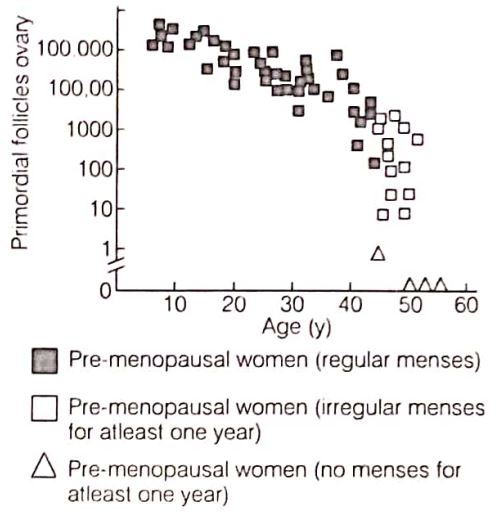
(i) What is the average age of the women at the onset of menopause?
(ii) At what age are maximum primordial follicles present in the ovary, according to the given graph?
4.
Give reasons why family planning techniques are not adopted by all in our country.
5.
How does CuT act as an effective contraceptive for human females?
6.
Why is Cu-T considered a good contraceptive device to space children?
7.
Why are Copper-containing intrauterire devices considered an ideal contraceptive for human females?
8.
Explain the mode of action of contraceptive pills taken by human females. Mention the schedule to be followed for effective outcome.
9.
The extraembryonic or foetal membranes are not a part of embryonal body but plays an essential role in supporting foetal growth. These are (i) amnion (ii) yolk sac (iii) allantois (iv) chorion.
Identify the which layer performs the functions listed below.
(a) Protects embryo from shocks, etc.
(b) Facilitates exchange of nutrients, gases, etc., between embryo and mother's body.
10.
'Penetration of ovum layers by a human sperm is a chemical mechanism'. Compile and describe your interpretation based on the above statement.
11.
Mention any six reproduction-related problems/issues.
12.
How are assisted reproductive technologies helpful to humans? How are ZIFT and GIFT different from intra uterine transfers? Explain.
13.
Suggest and explain any three Assisted Reproductive Technologies(ART) to an infertile couple
14.
Assertion : Chlamydia trachomatis is a human pathogen that causes trachoma, sexually transmitted and perinatal infection.
Reason : Chlamydia trachomatis has DEFGHIJK serotypes.
Codes :
(a) Both assertion and reason are true and reason is the correct explanation of assertion.
(b) Both assertion and reason are true but reason is not the correct explanation of assertion.
(c) Assertion is true but reason is false.
(d) Both assertion and reason are false.
15.
Assertion : Rhythm contraceptive method can be beneficial to the couple facing fertility problem.
Reason : Rhythm method is based on the ICSI technique.
(a) Both assertion and reason are true and reason is the correct explanation of assertion.
(b) Both assertion and reason are true but reason is not the correct explanation of assertion.
(c) Assertion is true but reason is false.
(d) Both assertion and reason are false.
16.
Assertion : To achieve zero population growth rate, the replacement level should be slightly higher than 2.
Reason : Replacement level means the number of children that can replace parent equally.
Codes :
(a) Both assertion and reason are true and reason is the correct explanation of assertion.
(b) Both assertion and reason are true but reason is not the correct explanation of assertion.
(c) Assertion is true but reason is false.
(d) Both assertion and reason are false.
17.
Assertion: Corpus luteum contains blood clot and fibrin.
Reason: Corpus luteum is formed by the germinal epithelium
(a) Both assertion and reason are true and reason is the correct explanation of assertion.
(b) Both assertion and reason are true but reason is not the correct explanation of assertion.
(c) Assertion is true butreason is false.
(d) Both assertion and reason are false.
18.
Assertion : At the time of implantation, which takes place in 14days, the human embryo is called blastocyst.
Reason: Implantation occurs in the gastrula stage.
(a) Both assertion and reason are true and reason is the correct explanation of assertion.
(b) Both assertion and reason are true but reason is not the correct explanation of assertion.
(c) Assertion is true butreason is false.
(d) Both assertion and reason are false.
19.
Assertion: The second meiotic division of the developing ovarian follicles is completed just after conception.
Reason: Conception is the onset of pregnancy when the implantation of blastocyst take place
(a) Both assertion and reason are true and reason is the correct explanation of assertion.
(b) Both assertion and reason are true but reason is not the correct explanation of assertion.
(c) Assertion is true butreason is false.
(d) Both assertion and reason are false.
20.
Assertion: Clitoris offemale is homologous to tip of penis.
Reason: Both have same origin and richly supplied with nerves and blood vessels.
(a) Both assertion and reason are true and reason is the correct explanation of assertion.
(b) Both assertion and reason are true but reason is not the correct explanation of assertion.
(c) Assertion is true butreason is false.
(d) Both assertion and reason are false.
21.
Assertion: Cilia lining the fallopian tube helps to pick up and push the released ovum into the oviduct.
Reason: Cilia of fallopian tubes beat towards uterus.
(a) Both assertion and reason are true and reason is the correct explanation of assertion.
(b) Both assertion and reason are true but reason is not the correct explanation of assertion.
(c) Assertion is true butreason is false.
(d) Both assertion and reason are false.
22.
Assertion: At puberty human male develops secondary sexual characters.
Reason: At puberty there is decreased secretion of testosterone in male.
(a) Both assertion and reason are true and reason is the correct explanation of assertion.
(b) Both assertion and reason are true but reason is not the correct explanation of assertion.
(c) Assertion is true butreason is false.
(d) Both assertion and reason are false
23.
Assertion: In human male, testis are extra abdominal and lie in scrotal sacs.
Reason : Scrotum acts as thermoregulator and keeps testicular temperature lower by 2°C for normal spermatogenesis.
(a) Both assertion and reason are true and reason is the correct explanation of assertion.
(b) Both assertion and reason are true but reason is not the correct explanation of assertion.
(c) Assertion is true butreason is false.
(d) Both assertion and reason are false.
24.
25.
Read the following and answer any four questions from (i) to (v) given below:
A technique knowa as amniocentesis is used to determine fetal abnormalities. This test is based on the chromosomal pattern in amniotic fluid. However, this technique is legally banned now.
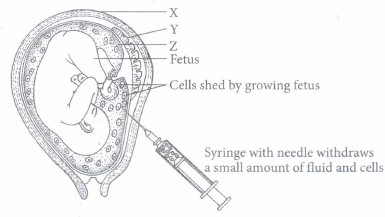
(i) Identify X and Y in the above given figure.
| X | y | |
| (a) | Amnion | Chorion |
| (b) | Uterine wall | Placenta |
| (c) | Placenta | Uterine wall |
| (d) | Uterine wall | Amnion |
(ii) What is the function of Z?
| (a) Z is an amniotic fluid which prevents dessication of an embryo. | (b) Z is yolk sac which functions as site of early blood cell formation |
| (c) Z is amnion which takes part in placenta formation. | (d) None of these |
(iii) Which of the following diseases can not be diagnosed by amniocentesis?
| (a) Down's syndrome | (b) Sickle cell disease | (c) Jaundice | (d) Cystic fibrosis |
(iv) Assertion: Amniocentesis is legally banned for sex determination.
Reason: Amniocentesis was being misused for aborting normal female fetus
| (a) Both assertion and reason are true and reason is the correct explanation of assertion | (b) Both assertion and reason are true but reason is not the correct explanation of assertion |
| (c) Assertion is true but reason is false. | (d) Both assertion and reason are false. |
(v) Which of these is a non-invasive technique of detecting fetal disorder?
| (a) Fetoscopy | (b) Chorionic villi sampling | (c) Amniocentesis | (d) Ultrasound imaging |
1.
Assisted Reproductive Technologies (ARTs) programmes or In Vitro Fertilisation (IVF) is very helpful to such couples who cannot have a baby by natural means.
The steps of ART are as follows
(i) The sperm from male donor and ova from female donor is collected.
(ii) They are fertilised outside the body in similar condition as that of the body.
(iii) Embryo transfer takes place.
The early embryo sac upto 8 blastomeres is transferred into the Fallopian tube and more than 8 blastomeres embryos are transferred into uterus.
(iv) Further development of embryo takes place inside the womb of mother in usual manrner.
The baby formed by ARTs is called test tube baby because embryo is formed in the lab in a test tube, instead of the woman's Fallopian tube. The programme is thus called test tube baby programme.
2.
(i) The doctor injected anti-venom into the farmer's body as it contains preformed antibodies against the snake venom. These ready-made antibodies are directly given to protect the body against foreign agents.
(ii) When ready-made antibodies are provided by a patient to fight against foreign antigen, it is called passive immunity.
3.
(i) It is clear from the graph that the primordial follicles per ovary starts decreasing rapidly after the age of 35-40 years and reaches almost zero by the age of 50 years. Therefore, the average age of women at the onset of menopause can be estimated to be around 50 years.
(ii) According to the given graph, the maximum number of primordial follicles per ovary is present at birth, which is approximately 7 million. After birth, this number decreases gradually and by the age of 20 years, the number of follicles reduces to approximately 4,00,000. After the age of 20 years, the number of follicles decreases at a faster rate and by the age of 40 years, the number of follicles reduces to approximately 25,000. Therefore, the maximum number of primordial follicles per Ovary is present at birth.
4.
Family planning techniques are not adopted by all because of the following reasons:
(i) not fully aware of the methods.
(ii)fear of some of the possible ill-effects.
(iii)religious beliefs
(iv)emotional and social factors
5.
Cut is an intra-uterine device (IUD) and functions as follows:
1. It suppresses sperm motility and the fertilising capacity of sperms.
2. It increases phagocytosis of sperms within the uterus.
6.
Cut is an intra-uterine device (IUD) and functions as follows:
1. It suppresses sperm motility and the fertilising capacity of sperms.
2. It increases phagocytosis of sperms within the uterus.
7.
Cut is an intra-uterine device (IUD) and functions as follows:
1. It suppresses sperm motility and the fertilising capacity of sperms.
2. It increases phagocytosis of sperms within the uterus.
8.
Contraceptive pills contain snall dosage of either progestogens or progestogen - oestrogen combinations. These pills inhibit ovulation and implantation as well as alter the quality of cervical mucus to prevent/retard entry of sperms.
These pills have to be taken daily for a period of 21 days starting preferably within the first five days of menstrual cycle. After a gap of 7 days ( during which menstruation occurs) it has to be repeated in the same pattern till the female desires to prevent conception. Saheli, a new oral contraceptive pill is 'once a week pill'.
9.
(a) (i) Amnion
(b) (iv) Chorion
10.
The penetration of an ovum by a human sperm is a chemical mechanism. In this process, the acrosome of sperm undergoes an acrosomal reaction and releases certain sperm lysins, which dissolve the egg layers locally and make the path for the penetration of sperm. These sperm lysins contain corona penetrating enzyme, acrosin and a lytic enzyme such as hyaluronidase that dissolves the hyaluronic acid polymers in the intercellular spaces,which holds the granulosa cells of corona radiata.
11.
(i)Pregnancy
(ii)Delivery
(iii)STDs
(iv)Abortions
(v)Contraception
(vi)Menstrual problems
(vii)Infertility
12.
The assisted reproductive technologies enable the infertile couples to have children.
lIFT refers to the method of embryo transfer in the test tube baby programme, in which the zygote or embryo upto 8-blastomeres is transferred into the fallopian tube.
GIFT refers to the transfer of an ovum collected from a donor female into the fallopian tube of another female, who cannot produce an ovum, but can provide suitable conditions for fertilisation and pregnancy.
Intrauterine transfer refers to the transfer of embryo with more than 8-blastomeres into the uterus of a female.
13.
(i) Test tube baby programme - In this method, the ovum of the woman and the sperm of her husband or a donor, are made to fuse ,under laboratory conditions; it is called in vitro fertilisation (IVF). - The zygote or early embryo is implanted in the fallopian tube or uterus respectively for further development.
(ii) Intra Cytoplasmic Sperm Injection (ICSI) - In this method, the sperm is injected directly into the ovum to form the zygote and then embryo transfer is carried out.
(iii) Gamete Intra Fallopian Transfer (GIFn - This method involves the transfer of an ovum collected from a donor female into another female for fertilisation and further development of foetus.
(iv) Artificial insemination - In this method, the semen collected from the husband or a healthy XII donor, is artificially introduced into the vagina or into the uterus (intra uterine insemination). - It is carried out when infertility is due to the inability of the male partner to inseminate the female or due to very low sperm count in the semen.
14.
(b) Both assertion and reason are true but reason is not the correct explanation of assertion.
15.
(d) : Rhythm method is a natural method of birth control in which the couples avoid or abstain from coitus (intercourse) from the day 10 to 17 of the menstrual cycle as ovulation occurs during this period. It is also known as periodic abstinence.
16.
(a) Both assertion and reason are true and reason is the correct explanation of assertion.
17.
(c): Corpus luteum is formed after the release of secondary oocyte from the Graafian follicle
18.
(d): Implantation is the attachment of the early embryo called blastocyst, to the lining of womb. It begins between the fifth and seventh day after the ovulation and is enabled by the secretion of enzymes. that digest a portion of the endometrium. A blastocyst is composed of a hollow sphere of trophoblast cells, inside of which is a small cluster of cells called the inner cell mass. Trophoblast goes on to contribute to fetal membrane systems. While the inner cell mass is destined largely to become the embryo and fetus
19.
(b) Both assertion and reason are true but reason is not the correct explanation of assertion.
20.
(a) : Clitoris of female is the small, spongy and erectile structure which hangs freely from the front end of vulva. It represents the underdeveloped penis. Whereas penis is a finger-like cylindrical outgrowth of abdomen projecting in between the scrotal sacs. Clitoris and penis both originate from the same origin, therefore are homologous.
Homologous organs are those organs which have the same origin and mayor may not have the same function. Clitoris and penis both are the reproductive organs present in female and male respectively. They are originated from the mesoderm layer and both are supplied with the nerves and blood vessels.
21.
(a) Both assertion and reason are true and reason is the correct explanation of assertion.
22.
(c) : Puberty is the period of life at which the ability to reproduce begins and reproductive organs become functional. In male, the puberty is the period between 13-16 years. Puberty in male is controlled by male sex hormone called testosterone, which is secreted by interstitial or Leydig's cells of the testes under the stimulation of interstitial cells stimulating hormone (ICSH) secreted by anterior pituitary. After puberty the seminiferous tubules start producing sperms. The development of secondary sex organs like prostate, scrotum, penis, etc., starts and secondary sexual characters like growth of hair on face, chest, pubis and axillae, broadening of shoulders, deepening of voice due to enlargement of voice box occurs. In puberty (male), height increases due to rapid growth of muscles and bones.
23.
(a) : Scrotum is a place where testes begins to descend during the third month with a concomitant shortening of gubernaculum. Proper descend of testes is essential for complete fertility because sperms needs low temperature by about 2°C from normal body temperature (37°C) to mature. The scrotal sacs has dartos muscles which constantly contracts and relaxes the loose scrotal skin. The loose scrotal skin helps to keep the testicular temperature at 35°C. If the testes do not descend from the abdominal cavity to the scrotum, the high temperature will destroy the sperm producing seminiferous tubules which results in sterility. So, scrotum acts as a thermoregulator and helps in spermatogenesis.
24.
25.
(i) (b)
(ii) (a)
(iii) (c) : Amniocentesis is a fetal disorder test based on the chromosomal pattern in the amniotic fluid surrounding the developing embryo. It detects genetic disorders like Down syndrome, sickle cell anaemia
and cystic fibrosis.
(iv) (a)
(v) (d) : Non invasive techniques are available to determine the fetal condition. These techniques do not pose any risk to fetus. Ultrasound imaging is a non-invasive technique.

12th Standard CBSE Syllabus & Materials
12th Standard CBSE
CBSE 12th Computer Science Python Revision Tour I - New Previous year Question Papers Study Material - QB365 Set A
NEW12th Standard CBSE
CBSE 12th Business Studies Planning Important Questions And Answers Study Material - QB365 Set A
NEW12th Standard CBSE
CBSE 12th Business Studies Business Environment Important Questions And Answers Study Material - QB365 Set A
NEW12th Standard CBSE
CBSE 12th Business Studies Principles of Management Important Questions And Answers Study Material - QB365 Set A



NCERT Books

Syllabus

Exam Pattern

Sample Question Papers

Previous year Question Papers

Important Notes

MCQ Practice test

NCERT Exemplers

Case study Questions

Image Based Questions

Passage based Questions

HOT Questions

Value Based Questions

Model Questions Papers
NCERT ( Book Back ) Questions

Assertion and Reason
Important Questions And Answers

CBSE 12th Standard CBSE Subjects
CBSE Standards








