
 100% FREE ACCESS
12th Standard CBSE Syllabus & Materials
12th Standard CBSE
CBSE 12th Economics Government Budget and the Economy Previous year Question Papers Study Material - QB365 Set A
NEW12th Standard CBSE
CBSE 12th Computer Science Interface Python with MySQL - New Previous year Question Papers Study Material - QB365 Set A
NEW12th Standard CBSE
CBSE 12th Computer Science Database Concept - New Previous year Question Papers Study Material - QB365 Set A
NEW12th Standard CBSE
CBSE 12th Computer Science Data Communication - New Previous year Question Papers Study Material - QB365 Set A
NEW12th Standard CBSE
CBSE 12th Computer Science Data Structures - New Previous year Question Papers Study Material - QB365 Set A
NEW12th Standard CBSE
CBSE 12th Computer Science Functions - New Previous year Question Papers Study Material - QB365 Set A

Published on: 02/11/2025
Download CBSE Class 12th Standard CBSE Biology question papers, sample papers, important questions, and previous year solved papers in PDF format. Get free study materials, NCERT solutions, and exam preparation resources for Class 12th Standard CBSE Biology
Questions + Answers key
Take MCQ Biology Test
1.
List two essential roles of ribosomes during translation.
2.
Very briefly explain Gene mutations
3.
What is Morgan's concept of linkage? List the salient features of linkage.
4.
Name four non-human organisms whose genomes have been sequenced.
5.
Give two reasons why both the strands of DNA are not copied during transcription
6.
Name the category of codons UGA belongs to.Mention another codon of the same category.Explain their role in protein synthesis.
7.
(a) Differentiate between repetitive and satellite DNA.
(b) How can satellite DNA be isolated? Explain.
(c) List two forensic application ofthis technology
8.
Describe the process of transcription in a bacterium.
9.
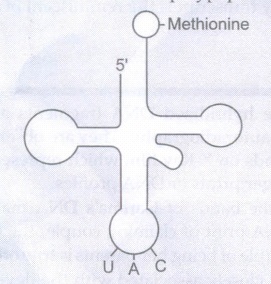
(a) Name the scientist who postulated the presence of an adapter molecule that can assist in protein synthesis.
(b) Describe its structure with the help of a diagram. Mention its role in protein synthesis.
10.
(a) A couple with blood group 'A' and 'B' respectively have a child with blood group '0'. Work out a cross to show how it is possible and the probable blood groups that can be expected in their other off-springs.
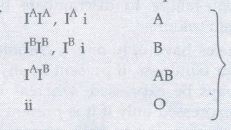
(b) Explain the genetic basis of blood groups in human population.
11.
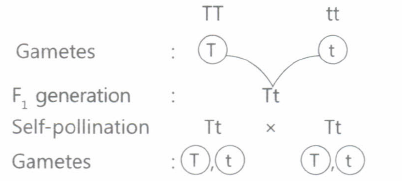
State and explain with the help of a cross the law of segregation as proposed by Mendel.
12.
(a) State the cause and symptoms of Down's syndrome. Name and explain the event responsible for causing this syndrome.
(b) Haemophilia and Thalassemia are both examples of Mendelian disorders, but show differences in their inheritance pattern. Explain how.
13.
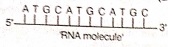
Construct and label a transcription unit from which the RNA segment given below has been transcribed.
Write the complete name of the enzyme that transcrìbed this RNA.
14.
Name the type of linkage between
(i) Nitrogen base and pentose sugar
(ii) Pentose sugar and phosphate
(iii) Twoadjacent nucleotides
(iv) N-bases of both the strands of DNA
15.
(i) Name tbe enzyme that catalyses the transcription of hnRNA
(ii) Why does the hnRNA need to undergo changes? List the changes hnRNA undergoes and where in the cell such changes take place.
16.
Write the genotypes of both the parents, who have produced sickle-celled anaemic offsprings.
17.
Explain the mechanism of sex determination in insects like Drosophila nad grasshopper.
18.
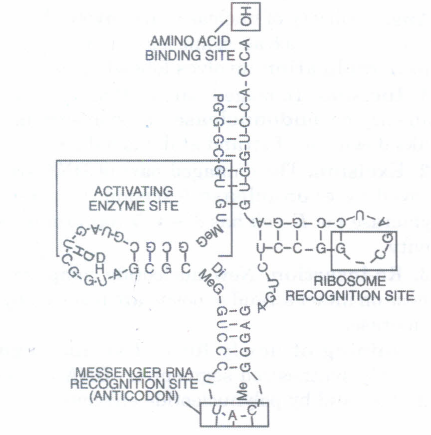
Sketch and explain clover leaf model of tRNA
19.
Study the pedigree chart given below showing the inheritance pattern of a human trait and answer the questions that follow:
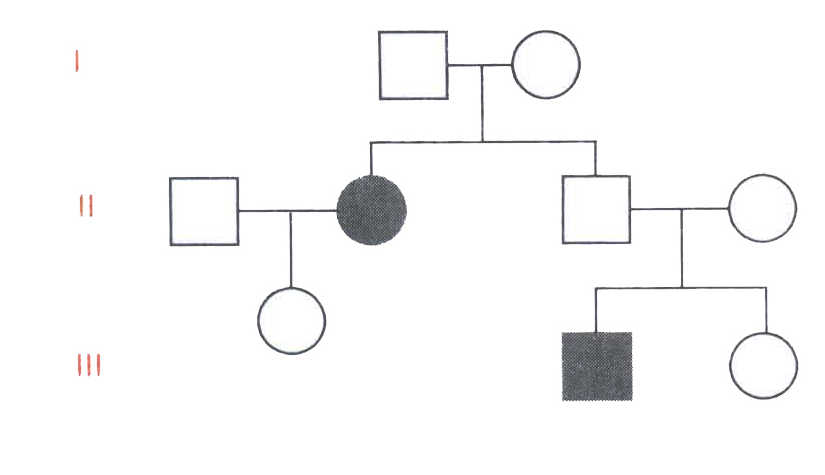
(a) Give the genotype of the parents shown in generation I and of the son and daughter shown in generation II.
(b) Give the genotype of the daughter shown in generation III.
(c) Is the trait sex-linked or autosomal?Justify your answer.
20.
Study the following pedigree chart of a family, starting with mother with AB blood group and father with O blood group.
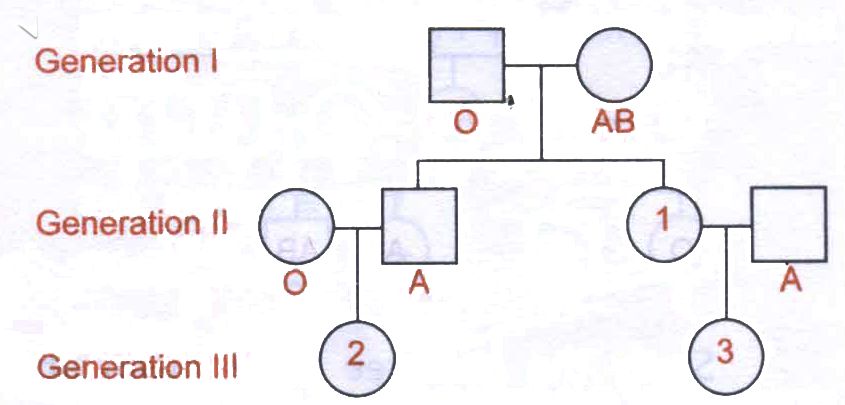
(a) Mention the blood group as well as the genotype of the offspring numbered 1 in generation II.
(b) Write the possible blood groups as well as their genotypes of the offspring numbered 2 and 3 in generation III.
21.
How many base pairs will be there in 20 nucleosomes in a DNA double helix?
4000
40
20
2000
22.
In Pisum sativum, the flower position may be axial (allele A) or terminal (allele a).What would be the percentage of the offspring with respect to axial flower position, if a cross is made between parents Aa x aa?
25 %
50 %
75 %
100 %
23.
The DNA site where DNA dependent RNA polymerase binds for transcription, is called
operator
promotor
regulator
receptor
24.
The amino acid attaches to the tRNA at its:
5' - end
3' - end
Anti codon site
DHU loop
25.
During replication of DNA, Okazaki fragments are formed in the direction of
3'→5'
5'→3'
5'→5'
3'→3'
26.
DNA sequences that code for protein are known as
Intron
Exons
Control regions
Intervening sequences
27.
Select the correct statement from the ones given below with respect to dihybrid cross.
Tightly linked geneson the same chromosome show very few recombinations
Tightly linked genes on the same chromosome show higher recombinations
genes far apart on the same chromosome show very few recombinations
genes loosely linked on the same chromosome show similar recombination as the tightly linked one
28.
Select the incorrect statement from the following :
Linkage is an exception to the principle of independent assortment in heredity.
Galactosemia is an inborn error of metabolism.
Small population size result in random genetic drift in a population.
Baldness is a sex-linked trait.
29.
During transcription, RNA polymerase holoenzyme binds to a gene promoter and assumes a saddle-like structure. What is its DNA-binding sequence?
AATT
CACC
TATA
TTAA
30.
Balance theory of sex determination was proposed by
Waldeyar
T.H. Morgan
Strassburger
Calvin B. Bridges
31.
When a cluster of genes show linkage behaviour they
Do not show independent assortment
Do not show a chromosome map
Show recombination during meiosis
Induce cell division
32.
A self-fertilizing trihybrid plant forms
4 different gametes and 16 different zygotes
8 different gametes and 16 different zygotes
8 different gametes and 32 different zygotes
8 different gametes and 64 different zygotes
33.
Read the following and answer any four questions from (i) to (v) given below :
X and Yare communicable diseases whereas Wand Z are non-communicable diseases. X is transmitted through vectors whereas Y is transmitted through droplet infection. W is caused due to a hormone deficiency whereas Z is a degenerative disease.
Based on the above information, answer the following questions.
(i) Identify W, X, Y and Z.
| W | X | Y | Z | |
| (a) | Coronary artery disease . | Cholera | Chikungunya | Hypertension |
| (b) | Diabetes | Malaria | Rhinitis | Alzheimer's disease |
| (c) | Arthritis | AIDS | Shigella | Plague |
| (d) | Gonorrhea | Diphtheria | Pertussis | Anthrax |
(ii) Select the correct statement.
| (a) If X is sleeping sickness then its vector is Leishmania |
| (b) If Y is diphtheria then it is caused by Bacillus anthracis |
| (c) If W is hypothyroidism then it is caused by deficiency of thyroxine hormone. |
| (d) If Z is myocardial infarction then patient develops acute rheumatic fever, joint pain and throat infection |
(iii) If X and Y both are usual diseases then which of the following holds true?
| (a) X could be dengue caused by flavivirus and Y could be AIDS caused by HIV. |
| (b) X could be.chikungunya whereas Y could be rhinitis. |
| (c) X could be hepatitis whereas Y could be rabies. |
| (d) X could be chicken pox caused by Varicella zoster virus whereas Y could be yellow fever caused by flavivirus. |
(iv) If X and Y both are bacterial diseases then select the correct match from the following.
| (a) X- Bubonic plague - Yersinia pestis | (b) Y - Leprosy - Mycobacterium leprae |
| (c) X - Whooping cough - Bordetella pertussis | (d) Y - Botulism - Clostridium botulinum |
(v) Assertion: Communicable diseases could be contagious or non-contagious.
Reason: Diseases that spread through vectors are non-contagious disease.
| (a) Both assertion and reason are true and reason is the correct explanation of assertion. | (b) Both assertion and reason are true but reason is not the correct explanation of assertion. |
| (c) Assertion is true but reason is false. | (d) Both assertion and reason are false. |
34.
Prior to a sports event, blood and urine samples are collected for drug tests.
(a) Name the drugs the authorities usually look for.
(b) Write the scientific names of the plants from which these drugs are obtained.
(c) Name two other plants which have hallucinogenic properties too.
35.
Assertion: A good example of multiple alleles is ABO blood group system.
Reason: When IA and IB alleles are present together in ABO blood group system, they both express their own types.
Codes:
(a) If both Assertion and Reason are true and Reason is the correct explanation of Assertion.
(b) If both Assertion and Reason are true but Reason is not the correct explanation of Assertion.
(c) If Assertion is true but Reason is false.
(d) If both Assertion and Reason are false.
36.
Assertion (A) : In transcription, the strand with 5'→ 3' polarity acts as the template strand.
Reason (R) : The enzyme RNA polymerase catalyses the polymerisation in only one direction, i.e. 5'→3
(a) If both A and Rare true and R is the correct explanation of A
(b) If both A and R are true, but R is not the correct explanation of A
(c) If A is true, but R is false
(d) If A is false, but R is true
37.
Assertion (A) The sugar-phosphate backbone of two chains in DNA double helix show anti-parallel polarity.
Reason (R) The phosphodiester bonds in one strand go from a 3' carbon of one nucleotide to a 5' carbon of adjacent nucleotide, whereas those in complementary strand go vice versa.
(a) Both Assertion (A) and Reason (R) are true and Reason (R) is the correct explanation of Assertion (A).
(b) Both Assertion (A) and Reason (R) are true, but Reason (R) is not the correct explanation of Assertion (A),
(c) Assertion (A) is true, but Reason (R) is false
(d) Assertion (A) is false, but Reason (R) is true
38.
Assertion : Haplodiploidy occurs in some insects.
Reason : Male insects develop parthenogenetically, while females grow from fertilised eggs.
Codes :
(a) Both assertion and reason are true and reason is the correct explanation of assertion.
(b) Both assertion and reason are true but the reason is not the correct explanation of assertion.
(c) Assertion is true but reason is false.
(d) Both assertion and reason are false.
1.
Two essential roles played by ribosomes during translation are:
(i) One of the ribosomal RNA (rRNA, 23S in prokaryotes)acts as a transferase ribozyme for the formation of peptide bonds.
(ii) The mRNA and changed tRNAs are attached to ribosomal sites.Thus, these provide sites for the attachment during protein synthesis.
2.
It is a sudden, stable, inheritable alteration in the sequence of a gene capable of changeing the phenotype of an organism.
3.
Morgan's Concept of Linkage
Morgan (1910) while working on Drosophila concluded from his experiments and defined linkage as:
The tendency of genes present on the same chromosome to remain in their original combination and enter together in the same gamete."
Salient features of the theory of Linkage
1. Genes are arranged in a linear fashion on the chromosome.
2. Genes that show linkage are present on the same chromosome.
3. Linked genes remain in their original combination during course of inheritance.
4. The genes which are closely located show strong linkage while those widely separated have more chances of separation during crossing over.
4.
(i)Bacteria
(ii)Yeast
(iii)Caenorhabditis
(iv)Drosophila
(v)Rice
(vi)Arabidopsis
5.
Both the strands of DNA are not copied during transcription for the following reasons:
(i) If both the strands of DNA are copied, two different RNAs (complementary to each other) and hence two different polypeptides would be formed; if a segment of DNA produces two polypeptides, the genetic information machinery becomes complicated.
(ii) The two complementary RNA molecules (produced simultaneously) would form a double-stranded RNA rather than getting translated into polypetides.
(iii) RNA polymerase carries out polymerisation in the 5' ~ 3' direction and hence the DNA strand with 3' ~ 5' polarity acts as the template strand.
6.
It is a stop/termination codon
UAA or UAG
They terminate the translation process i.e they stop the elongation of the polypeptide chain during translation.
7.
(b) Satellite DNA is separated from the genomic DNA by density gradient centrifugation; the satellite DNA forms smaller peaks, while the genomic DNA forms a major peak.
(c) (i) They form very useful tools in identification of criminals.
(ii) It is the basis of paternity testing, in case of disputes.
8.
(i) Transcription unit in a bacterium consists of a promoter, structural genes, terminator and the enzyme DNA-dependent RNA-Polymerase.
(ii) In bacteria, there is a single RNA polymerase, which catalyses transcription of all the three types ofRNAs (mRNA, tRNA and rRNA)
(iii) It binds transiently with the initiation factor (sigma factor), binds to the promoter and initiates transcription.
(iv) It also facilitates opening of the double helical DNA and only the DNA strand with 3'⇢ 5' polarity is transcribed, as the enzyme can polymerise the nucleotides only in 5' ⇢ 3' direction; it catalyses elongation using the ribonucleotides.
(v) Once the polymerase reaches the terminator sequence, it associates with the termination factor and the nascent RNA falls off and termination of transcription occurs.
9.
(a) Francis Crick
b) Clover leaf / inverted L,
Anticodon loop (complementary to codon of mRNA), acceptor end (to bind amino acid).
It reads the codons on rnRNA with the help of anticodon loop, brings the corresponding amino acid for the formation of polypeptide chain.
10.
(a)Father = lAi
Child=ii
Father = lAi X IBi
| IA | IBi | |
| IB | IAIB Blood Group AB |
IBi Blood Group B |
| I | IAi Blood Group A |
ii Blood Group O |
Phenotypes of all off springs = AB, B, A and 0 blood group
(b) Genetic basis of blood group
Three alleles of one gene/multiple alleles/gene lA, IB,l
A and B are co-dominant /expressed together
11.
1. Law of segregation states that the members of the allelic pair that remained together in the parent/hybrid, segregate during gamete formation and enter different gametes.
2.As a result, gametes have only one allele for a trait and are pure for a character,
Parents : Tall plant X Dwarf plant
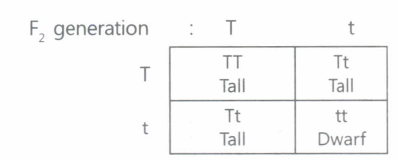
3. Tall plants: Dwarf plants
3 1
4. In this case, tallness is dominant and dwarfness is recessive.
5. The \(F_{ 1 }\) hybrid is tall (dominant character).
6. The recessive character, dwarfness, remains hidden in the \(F_{ 1 }\) but reappeared in the \(F_{ 2 }\) generation without any change.
7. This' is because the factors T and t remained together in the hybrid, but segregated during gamete formation and entered different gametes.
Diploid condition is restored during fertilisation.
12.
(a) It is due to trisomy of 21st chromosome.
The symptoms include
Short stature and small round head with a flat back.
Rartially open mouth with furrowed tongue.
Broad, flat face with slanting eyes.
Broad palm with characteristic palm crease.
Retarded physical, mental and psychomotor development.
It is caused by the non-segregation of the 21st chromosomes during meiosis in the gamete formation; when such an ovum is fertilised by a normal sperm, the individual comes to possess three copies (trisomy) of 21st chromosome.
(b)
| Haemophilia | Thalassemia |
| The gene for haemophilia is present on the X-chromosome. A female passes the X-chromosome to the male offspring while the male parent passes it to the female progency. It appears more in males than in females. |
The gene is present on the autosomes. Since it is autosomal, both the parents can pass it on to the male and female offspring with equal chances. It occurs in equal frequency among male and females. |
13.
The RNA molecule given in question should be
.jpg)
As RNA have uracil in the place of thymíne, for given RNA, the transcription unit will be
.jpg)
Transcription is catalysed by 'DNA-dependent RNA polymerase
14.
(i) Glycosidic bond (C-N-C)
(ii) Phospho-ester bond
(iii) Phospho-diester bond
(iv) Hydrogen bond [Double hydrogen bond between A & T (A=T) & Triple hydrogen gas bond between C & G (C\(\equiv \)G)]
15.
(1) RNA polymerase II
(ii) Has (non-functional) introns
(Methyl guanosine tri-phosphate is added to 5' end) capping, tailing (Poly A tail at 3' end added), splicing (introns are removed and exons are joined).
16.
The genotypes of parents must be HbA HbS and HbA HbS .
17.
A large number of insects show XO type of sex determination while some of the sperms bear an X chromosome and others do not have an X chromosome; X chromosome become female and those fertilized by sperms that lacks X chromosome becomes male.Rest of the chromosome are named autosomes.In Drosophila melanogaslar and human being, the males have XY chromosomes & females have XX chromosomes.
18.
It constitutes 15% of total RNA and is smallest out of three with only 70-85 nucleotides having sedimentation coefficient 45. It is of 100 types. Nitrogen bases of some nucleotides are modified to provide coiling to the otherwise single stranded RNA. The tRNA has two models clover leaf and L-form model. It has different specific loops as shown:
19.
(a) Genotype of the parents in generation I:
Male (Father) - Aa'
Female (Mother) - Aa Son (Generation II) - Aa Daughter (Generation II) - aa
(b) Genotype of the daughters in generation III - Aa
(c) It is an autosomal trait, because if the sex-linked trait has to appear in the daughter (generation II), the father must have it; but he does not show the trait and so it is not sex-linked.
20.
(a) Offspring 1 may have blood groUP
\(A(I^{ \wedge }i)\)or blood group \(B(I^{ \wedge }i)\)
(b) Offspring 2 may have blood group
\(A(I^{ \wedge }i)\) or blood group 0
Offspring 3 may have: If offspring 1is of blood group A
=> blood group A (may be \(A(I^{ \wedge }i)\) or \(A(I^{ \wedge }i)\)
=> blood group o(ii), if father is heterozygous for A If offspring 1 is of blood group B
=> blood group AB (IAIB)
=> blood group A \(A(I^{ \wedge }i)\)
=> blood group B \(B(I^{ \wedge }i)\) ,if father is heterozygous for A
=> blood group 0 (ii), if father is heterozygous for A
21.
(a)
4000
22.
(b)
50 %
23.
(b)
promotor
24.
(b)
3' - end
25.
(b)
5'→3'
26.
(b)
Exons
27.
(a)
Tightly linked geneson the same chromosome show very few recombinations
28.
(d)
Baldness is a sex-linked trait.
29.
(c)
TATA
30.
(d)
Calvin B. Bridges
31.
(a)
Do not show independent assortment
32.
(d)
8 different gametes and 64 different zygotes
33.
(i) (b) : X is a communicable disease that is transmitted through vectors. It could be malaria, chikungunya, etc. Y is communicable disease that is transmitted through droplet infection. It could be rhinitis, diphtheria, pertussis, etc.
W is a non-communicable disease like diabetes that is caused by deficiency of insulin hormone. Z is a non-communicable degenerative disease like Alzheimer's disease.
(ii) (c) : Sleeping sickness is caused by Trypanosoma. Diphtheria is caused by Corynebacterium diphtheriae. In myocardial infarction a large portion of heart muscle is deprived of blood due to coronary thrombosis and patient develops heart attack.
(iii) (b)
(iv) (a) : Leprosy is a bacterial infection that spreads through prolonged contact with the infected person. Whooping cough spreads through droplet infection. Botulism spreads through faecal oral route.
(v) (b)
34.
(a) Cannabinoids and cocaine/coca alkaloids.
(b) (i) Cannabinoids are obtained from Cannabis sativa.
(ii) Cocaine is obtained from Erythroxylum coca.
(c) Atropa bel/adona and Datura show hallucinogenic properties.
35.
(b) If both Assertion and Reason are true but Reason is not the correct explanation of Assertion.
Explanation:
In the ABO system, consists four blood groups A, B, AB and O. ABO blood groups are controlled by gene I. The gene has three alleles IA, IB and i. This phenomenon is known as multiple allelism. IA and IB are completely dominant over i. When IA and IB are present together, they both express themselves and produce AB blood group. This phenomenon is known as codominance.
36.
d) If A is false, but R is true
37.
(a) Both A and R are true and R is the correct explanation of A.
The backbone of a DNA strand is built up of alternate deoxyribose sugar and phosphate group. The phosphate group is connected to carbon 5 of the sugar residue of its own nucleotide and carbon 3 of the sugar residue of the next nucleotide by 3' \(\rightarrow\) 5' phosphodiester bonds. The two DNA chains are antiparallel, i.e. they run in opposite direction. In one chain, the direction is 5' \(\rightarrow\) 3', while in the opposite one, it is 3' \(\rightarrow\) 5'.
38.
(a) : Haplodiploidy is a type of sex determination in which the male is haploid while the female is diploid. It occur in some insects like bees, ants and wasps. Male insects are haploid because they develop parthenogenetically from unfertilised eggs. Meiosis does not occur from fertilised eggs and hence diploid.

12th Standard CBSE Syllabus & Materials
12th Standard CBSE
CBSE 12th Computer Science Python Revision Tour I - New Previous year Question Papers Study Material - QB365 Set A
NEW12th Standard CBSE
CBSE 12th Business Studies Planning Important Questions And Answers Study Material - QB365 Set A
NEW12th Standard CBSE
CBSE 12th Business Studies Business Environment Important Questions And Answers Study Material - QB365 Set A
NEW12th Standard CBSE
CBSE 12th Business Studies Principles of Management Important Questions And Answers Study Material - QB365 Set A



NCERT Books

Syllabus

Exam Pattern

Sample Question Papers

Previous year Question Papers

Important Notes

MCQ Practice test

NCERT Exemplers

Case study Questions

Image Based Questions

Passage based Questions

HOT Questions

Value Based Questions

Model Questions Papers
NCERT ( Book Back ) Questions

Assertion and Reason
Important Questions And Answers

CBSE 12th Standard CBSE Subjects
CBSE Standards








