
 100% FREE ACCESS
12th Standard CBSE Syllabus & Materials
12th Standard CBSE
CBSE 12th Economics Government Budget and the Economy Previous year Question Papers Study Material - QB365 Set A
NEW12th Standard CBSE
CBSE 12th Computer Science Interface Python with MySQL - New Previous year Question Papers Study Material - QB365 Set A
NEW12th Standard CBSE
CBSE 12th Computer Science Database Concept - New Previous year Question Papers Study Material - QB365 Set A
NEW12th Standard CBSE
CBSE 12th Computer Science Data Communication - New Previous year Question Papers Study Material - QB365 Set A
NEW12th Standard CBSE
CBSE 12th Computer Science Data Structures - New Previous year Question Papers Study Material - QB365 Set A
NEW12th Standard CBSE
CBSE 12th Computer Science Functions - New Previous year Question Papers Study Material - QB365 Set A

Published on: 02/11/2025
Download CBSE Class 12th Standard CBSE Biology question papers, sample papers, important questions, and previous year solved papers in PDF format. Get free study materials, NCERT solutions, and exam preparation resources for Class 12th Standard CBSE Biology
Questions + Answers key
Take MCQ Biology Test
1.
A boy of ten years had chicken pox.He is not expected to have the same disease for the rest of his life.Mention how it is possible.
2.
Malaria, typhoid, pneumonia and amoebiasis are some of the human infectious diseases. Which of these are transmitted through mechanical carriers?
3.
Why are the wings of a butterfly and of a bat called analogous?
4.
'Sweet potato tubers and potato tubers are the result of convergent evolution'. Justify the statement.
5.
Name the two basic amino acids that provide positive charge to histone proteins.
6.
Select two pairs from the following which exhibit divergent evolution. Give reasons for your answers.
(i) Forelimbs of cheetah and mammals
(ii) Flippers of dolphins and penguins.
(iii) Wings of butterflies and birds.
(iv) Forelimbs of whale and mammals.
7.
Name the first human like hominid. Mention his food habit and brain eapacity
8.
Explain when is a genetic code said to be
(i) Degenerate (ii) Universal
9.
Write a note on Typhoid.
10.
Identify a,b,c,and d in the following table:
|
Name of the human disease |
Name of the casual bacteria/virus |
Specific organ or its part affected |
|---|---|---|
|
1. Typhoid |
Salmonella typhi |
a |
|
2. Common cold |
b |
c |
|
3. Pneumonia |
Streptococcus pneumoniae |
d |
11.
Name and explain the two types of immune response in humans.
12.
What are the functions of
(i) methylated guanosine cap and
(ii) poly A-tail in a mature mRNA?
13.
How does industrial melanism support Darwin's theory of Natural Selection? Explain.
14.
Why is DNA a better genetic material when compared to RNA?
15.
What kind of evolution has brought similarity in the following:
(i) Placental cat and a marsupial cat
(ii) Fishes and whales
(iii) Darwin's finches
16.
Match the items in column I with appropriate items (one or more) of column II.
| Column I | Column II |
| (i) Connecting link between annelids and arthropods | (a) Impression or imprints of past animals and plants in the sedimentary rocks. |
| (ii) Vestigial organ in man. | (b) Peripatus |
| (iii) Fossils | (c) Auricular muscles |
| (iv) Extinct bird | (d) Seymouria |
| (v) Missing link between amphibian and reptiles. | (e) Coccyx (tail bone) |
| (f) Archaeopteryx | |
| (g) Vermiform appendix |
17.
Study a part of the life cycle of malarial parasite given below. Answer the questions that follows:
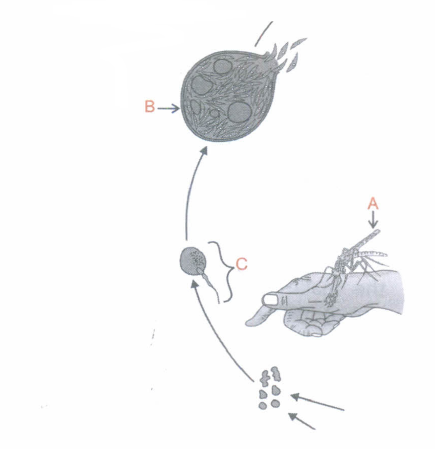
(a) Mention the roles of 'A' in the life cycle of the malarial parasite.
(b) Name the event 'c' and the organ where the event occurs.
(c) Identify the organ 'B' and name the cells being released from it.
18.
Name two diseases each,which are transmitted in the following ways:
(i) Through contaminated food and water.
(ii) Through insect vectors.
(iii) Through the air/droplet inhaled.
19.
An antibody molecule is represented as H2 L2 Explain.
20.
(a) Name the agent that causes amoebiasis and the human body organ that it infects.
(b) Write the symptoms and the mode of transmission of the disease.
21.
How are the structural genes activated in the lac operon in E.coli?
22.
The biology teacher asked her students to verify the experiment on transformation principle in bacteria to establish DNA as genetic material.The class was divided into groups.The teacher asked them to submit the reports.Group 2 did not use mouse and did not repeat GRiffith's experiment.The teacher praised them.
(i) Which experiment did they perform?
(ii) Explain the experiment in brief.
(iii) Who and when performed the transformation principle experiment?
(iv) What values did students of group 2 exhibit?
23.
Explain divergent evolution in detail. What is driving force behind it?
1.
()
His body develops antibodies,that circulate in the body fluids and neutralise the pathogenic agent during subsequent encounters.
Memory B cells and memory T cells are retained inthe system.
2.
()
Amoebiasis and typhoid.
3.
()
They are called analogous, as they perform similar function (flying), but are dissimilar in their basic structural plan and development.
4.
()
Sweet potato tubers and potato tubers are analogous structures, evolved for the same function; analogous structures result from convergent evolution.
5.
()
Lysine and Arginine
6.
(i) Forelimbs of cheetah and mammals
(ii) Forelimbs of whales and mammals All these animals show similarities in Pattern of bones of forelimb but they perform different functions. They have similar anatomical structure. Hence, the same structural organs in these animals have developed in different directions because of adaptations to their different requirements. This shows thus the divergent evolution & that the structures/organs are homologous.
7.
Homo habilis where first human like homind. They probably did not eat meat/vegetarian, and their brain capacities were between 650-800cc.
8.
The differences between unambiguous and universal genetic codes are as follows
| Unambiguous | Universal |
| In genetic code, one codon codes for only one amino acid hence, it is unambiguous | The genetic code is universal.i.e. each codon codes for same amino acid in all organisms |
(ii) The differences between degenerate and initiator codes are as follows
| Degenerate | Initiator |
| Some amino acids are coded by more than one codon, hence the code is degenerate, e.g. serine, leucine, arginine are encoded by 6 codons. | These codons act as start signal for translation. e.g. AUG acts as initiator codon and it codes for methionine |
9.
Typhoid.
1.it is an infectious disease caused by bacteria,Salmonella typhi.
2.The infection is by contaminated food and water.
3.The pathogen enters the small intestine and then the other parts through body fluids.
4.Its symptoms include:(a) sustained high fever (\({ 103 }^{ 0 }-{ 104 }^{ 0 }\) F),(b)stomach pain,(c)loss of appetite, (d) constipation and (e)headache.
5.Intestinal perforation leading to death in severe cases.
6.Typhoid can be confirmed by Widal test.
10.
a - Small intestine.
b - Rhino viruses
c - Nose,respiratory passage
d - Alveoil of lungs
11.
The two types of immune responses are.
(i) Primary immune response
(ii) The immune response that occurs as a result of the first encounter of the animal with an antigen is called primary immune response.
(iii) It takes longer time to establish immunity.
(iv) It declines rapidly.
(d) Secondary immune response
(i) The immune response that occurs at the second and subsequent encounters of the animal with the antigen,is called secondary immune response.
(ii) It is more rapid and results in hightened immunity.
(iii) It lasts for longer periods.
12.
(i) The methylated guanosine cap helps in the binding of mRNA to the smaller subunit of ribosome during initiation of translation.
(ii) Poly-A tail has a direct relatioship with the logevity of mRNA.
13.
Industrial melanism is an example of Darwin's theory of natural selection. Before industrial revolution in England the environment was unpolluted. The lichens on the barks of trees were pale. The white-winged moths could easily camouflage, while the dark winged were spotted out by the birds for food. Hence, they could not survive. After industrial revolution the lichens became dark disappeared (due to pollution and soot deposit). This favoured the dark-winged moths while the white-winged were picked by birds. The population of the former which was naturally selected increased This shows that in a mixed population those which can adapt in abetter way with the changing environment survive and increase in population, Thus industrial melanism in this way supports Darwin's theory of natural selection.
14.
| S.No | DNA | RNA |
| (i) | Stable molecule because of having 2'H group at every nucleotide. |
Unstable molecule (more reactive because of .having 2'OH group at every nucleotide. |
| (ii) | Presence of thymine. | Presence of uracil |
| (iii) | Occasional mutation. | Prone to faster mutation resulting in shorter life span. |
15.
(i) Parallel evolution.
(ii) Convergent evolution.
(ii) Divergent evolution.
16.
(i) b (ii) c, e and g (iii) a (iv) f (v) d.
17.
(a) A part of the life cycle of the parasite occurs in the body of female Anopheles mosquito; these mosquitoes act as vectors and transmit the disease from patients to healthy individuals.
(b) Fertilisation; it occurs in the intestinal wall of mosquito.
(c) Salivary gland. Sporozoites are the cells released from it.
18.
(i) Typhoid,Polio,Amoebiasis.
(ii) Filariasis,Malaria.
(iii) Pneumonia,common cold.
19.
Each antibody molecule has four polypeptide chains.
Of them,two are small and called light chains (L) and two of them are longer and called heavy chains(H) hence written as H2 L2.
20.
(a) Amoebiasis is caused by Entamoeba histolytica.
(b) Symptoms:
(i) Constipation
(ii) Abdominal cramps and pain.
(iii) Stool with excess mucus and blood clots.
Transmission
Drinking water and food contaminated with the faeces of infected persons.
Houseflies act as mechanical carriers and transmit the parasite from faeces to food and water.
21.
The lac operon consists of
(i) three structural genes (z,y and a) which code for \(\beta \) -galactosidase, permease and transacetylase, respectively.
(ii) an operator; which controls the structural genes as a unit.
(iii) a regulatory gene ti.e., inhibitor gene) and
(iv) a promoter, where the RNA polymerase binds for transcription.
The regulatory gene codes for the repressor protein, all the time (constitutively): the repressor binds to the operator to inactivate the operon.
Lactose enters the cell with the help of permease and the active form of lactose binds to the repressor and prevents it from binding to the operator.
This allows RNA polymerase an access to the promoter and transcription continues, i.e. lac operon is activated.
22.
(i) The students repeated the experiment performed by Oswald Avery, Colin |MacLeod and Maclyn McCarty (1933-44), who worked to determine the biochemical nature of 'transforming principle' in Griffith's experiment.
(iii) Frederick Griffith in 1928 performed the transformation experiment.
(iv) Scientific attitude, awareness and love for animals and respect towards government policies.
23.
Divergent evolution involves the differences in apearance and functioning of those structures which are similar in their basic structural plan and similar developmental origin e.g. force limbs of vertebrates like seal, bird, cat's paw, horse and man look different and perform different functions as shown in the table.
| Appearance | Function | |
| Seal | As flipper | Swimming |
| Bird | As wings | Flying |
| Cat's paw | Clawed digits | running and tearing |
| Horse | Elongated | Running |
| Man | Thumb opposable to fingers | Grasping |
They have same pentadactyl plan and similar arrangement of bones, blood vessels, nerves, ect., This confirms that forelimbs have undergone divergent evolution, but are homologous to one another.
Driving force for divergent evolution is adaptive radiation to perform different functions

12th Standard CBSE Syllabus & Materials
12th Standard CBSE
CBSE 12th Computer Science Python Revision Tour I - New Previous year Question Papers Study Material - QB365 Set A
NEW12th Standard CBSE
CBSE 12th Business Studies Planning Important Questions And Answers Study Material - QB365 Set A
NEW12th Standard CBSE
CBSE 12th Business Studies Business Environment Important Questions And Answers Study Material - QB365 Set A
NEW12th Standard CBSE
CBSE 12th Business Studies Principles of Management Important Questions And Answers Study Material - QB365 Set A



NCERT Books

Syllabus

Exam Pattern

Sample Question Papers

Previous year Question Papers

Important Notes

MCQ Practice test

NCERT Exemplers

Case study Questions

Image Based Questions

Passage based Questions

HOT Questions

Value Based Questions

Model Questions Papers
NCERT ( Book Back ) Questions

Assertion and Reason
Important Questions And Answers

CBSE 12th Standard CBSE Subjects
CBSE Standards








