
 100% FREE ACCESS
12th Standard CBSE Syllabus & Materials
12th Standard CBSE
CBSE 12th Economics Government Budget and the Economy Previous year Question Papers Study Material - QB365 Set A
NEW12th Standard CBSE
CBSE 12th Computer Science Interface Python with MySQL - New Previous year Question Papers Study Material - QB365 Set A
NEW12th Standard CBSE
CBSE 12th Computer Science Database Concept - New Previous year Question Papers Study Material - QB365 Set A
NEW12th Standard CBSE
CBSE 12th Computer Science Data Communication - New Previous year Question Papers Study Material - QB365 Set A
NEW12th Standard CBSE
CBSE 12th Computer Science Data Structures - New Previous year Question Papers Study Material - QB365 Set A
NEW12th Standard CBSE
CBSE 12th Computer Science Functions - New Previous year Question Papers Study Material - QB365 Set A

Published on: 28/11/2025
Download CBSE Class 12th Standard CBSE Biology question papers, sample papers, important questions, and previous year solved papers in PDF format. Get free study materials, NCERT solutions, and exam preparation resources for Class 12th Standard CBSE Biology
Questions + Answers key
Take MCQ Biology Test
1.
Why is the strand of DNA with 3'-5' polarity transcribed and not the other strand with 5'--> 3' polarity?
2.
Point out the place where amino acid chain will separate from the given mRNA 5' ACG,GCA, UCG,GGA,UUU, UAG,UAC 3'
3.
Name the phenotypic/genotypic disorder of following genotype
(i) HbA/HbA
(ii) HbA/HbS
(iii) HbS/HbS
(iv) XhX
(v) XhY
4.
Give one similarity and one difference between RNA polymerase and DNA polymerase.
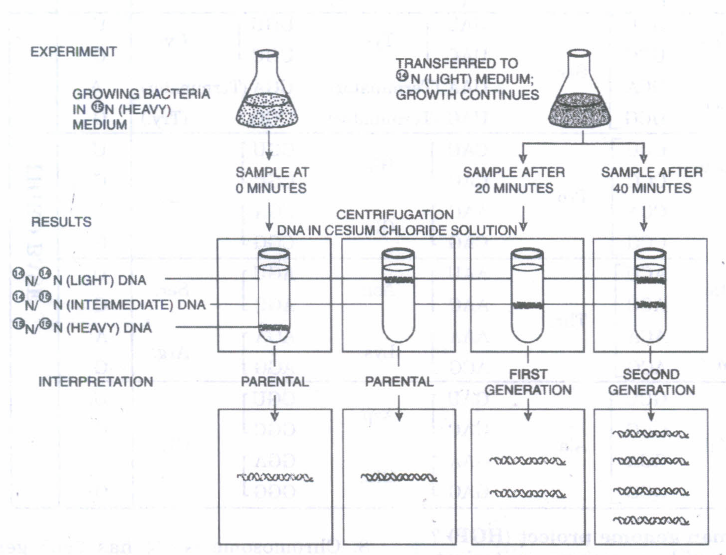
5.
Do both the strands of DNA have the same biological information? Explain
6.
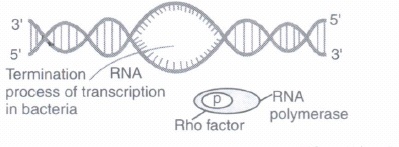
Describe the termination process of transcription in bacterium.
7.
Following the collision of two trains a large number of passenger are killed. A majority of them are beyond recognition. Authorities want to hand over the dead to their relatives. Name a modern scientific method and write the procedure that would help in the identification of kinship.
8.
(a) What do 'Y' and 'B' stand for in 'YAC' and 'BAC"used in Human Genome Project (HGP). Mention their role in the project.
(b) Write the percentage of the total human genome that codes for proteins and the percentage of discovered genes whose functions are known as observed during HGP.
(c) Expand 'SNPs' identified by scientists in HGP..
9.
Given below is the diagram of agarose gel kept under UV light
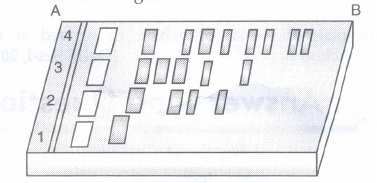
(a) Mark the positive and negative terminals.
(b) What is the charge carried by DNA molecule and how does it help in its separation?
(c) How are the separated DNA fragments finally isolated?
10.
Write any three goals of Human Genome Project.
11.
(a) How many codons code for amino acids and how many are unable to do so ?
(b) Why are codes said to be
(i) degenerate and
(ii) unambiguous?
12.
Whereisan 'operator' locatedinaprokaryote DNA? How does an operator regulate gene expression at transcriptional level in a prokaryote? Explain.
13.
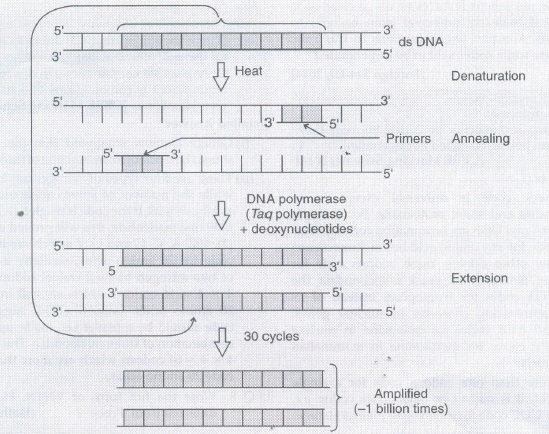
Suggest and describe a technique to obtain multiple copies of a gene of interest in vitro
14.
Calculate the length of DNA of bacteriophase lambda that has 48502 base pairs.
15.
Name the type of linkage between
(i) Nitrogen base and pentose sugar
(ii) Pentose sugar and phosphate
(iii) Twoadjacent nucleotides
(iv) N-bases of both the strands of DNA
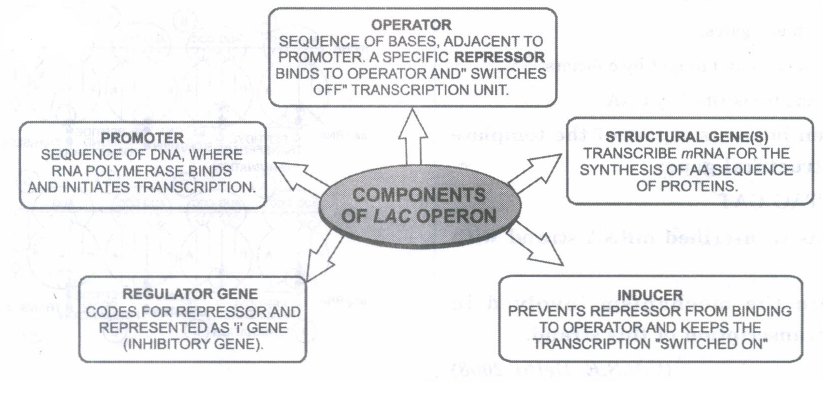
16.
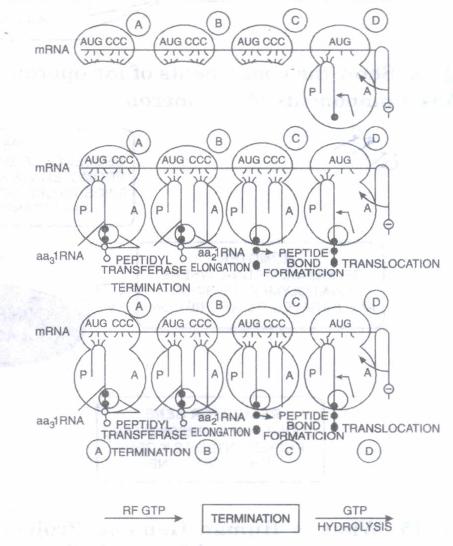
How does the flow of information in HIV deviate from the Central Dogma proposed by Francis Crick
17.
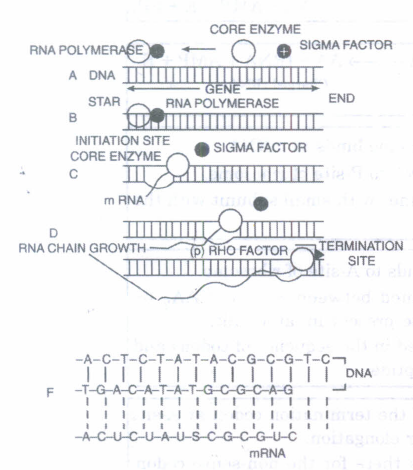
A DNA segment has a total of 1500 nucleotides out of which 410 are guanine containing nucleotides. How many Pyrimidine bases this DNA segment possesses.
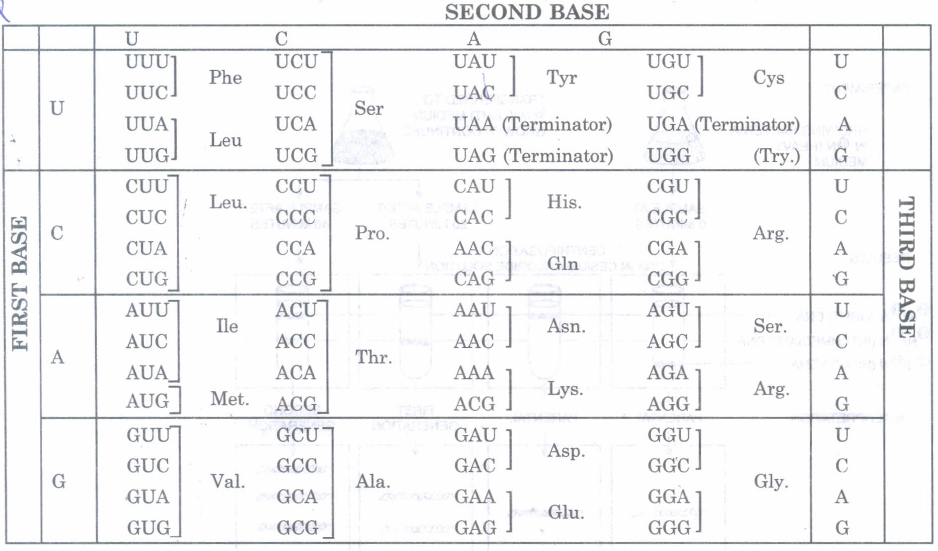
18.
Name negatively charged and positively charged components of nucleosomes
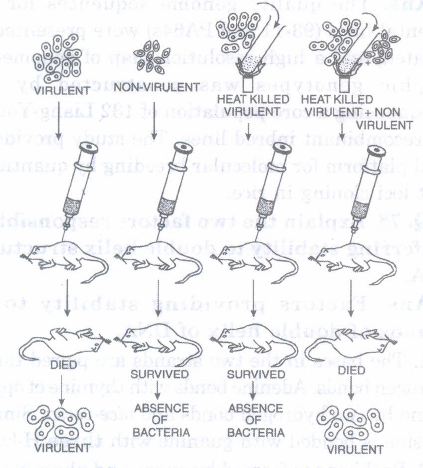
19.
(a) Explain with the help of Griffith's experiment how the search for genetic material was conducted and what was the conclusion drawn?
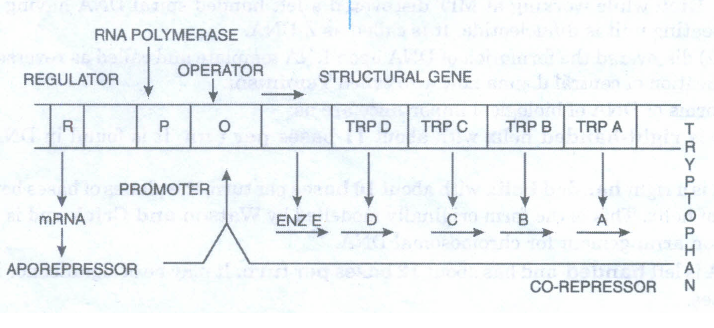
(b) How did Macleod, Mc Carty and Avery establish the Bio-Chemical nature of the so called "genetic material" identified by Griffith in his experiment.
20.
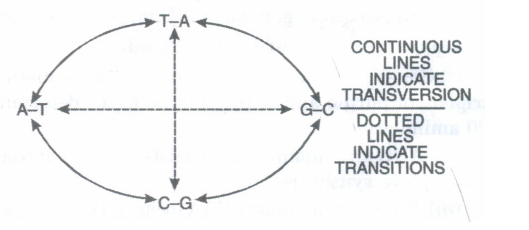
Mention what enables his tones to acquire a positive charge.
21.
(i) Name tbe enzyme that catalyses the transcription of hnRNA
(ii) Why does the hnRNA need to undergo changes? List the changes hnRNA undergoes and where in the cell such changes take place.
22.
(a) Why did Meselson and Stahl use 14N and 15N isotopes in the sources of nitrogen present in the culture medium in their experiment? Explain.
(b) Write the conclusion drawn by them from the experiment.
23.
(a) Given below is a single stranded DNA molecule. Frame and label its sense and antisense RNA molecule.
5' ATGGGGCTC3' sense
(b) How the RNA molecules made from above DNA strand help in silencing of the specific RNA molecules?
24.
(a) Write what DNA replication.
(b) State the properties of DNA replication model.
(c) List any three enzymes involved in the process alongwith their functions
25.
Differentiate between a template strand and a coding strand of DNA
26.
Why is DNA a better genetic material when compared to RNA?
27.
(a) A DNA segment has a total of 2,000 nucleotides, out of which 520 are adenine containing nucleotides. How many purine bases this DNA segment possesses?
(b) Draw a diagrammatic sketch of a portion of DNA segment to support your answer.
28.
Describe a palindrome with the help of an example
29.
Study the diagram given below:
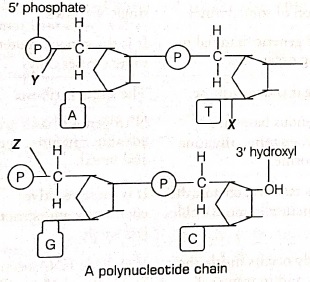
Name the linkages X, Y, Z, and the respective molecules formed by them.
30.
(a) Why did Hershey and Chase use radioactive sulfur and radioactive phosphorus in their experiment?
(b) Write the conclusion they arrived at and how.
31.
Describe the experiment that helped demonstrate the semi-conservative mode of DNA Replication.
32.
Would it be appropriate to use DNA probes such as VNTR in DNA fingerprinting of a bacteriophage?
33.
Cattle or even human beings, sometimes give to their young ones having extremely different sets of organs like limbs/position of eye(s) etc.Comment with respect of genetics involved in it.
34.
The generic code is, for the most part, universal, with few exceptions.Explain it by giving the example of mitochondria, the power house of cell.
35.
Do you think that the alternate splicing of exons may enable a structural gene to code for several isoproteins from one and the same gene ?If yes.how?If not, why so?
36.
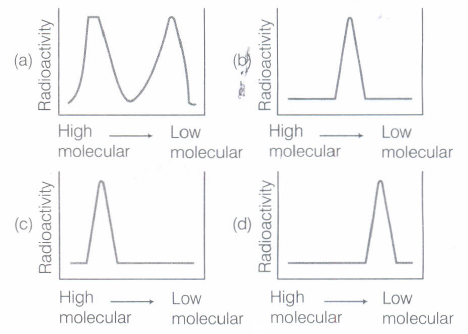
Replication was allowed to take place in the presence of radioactive deoxynucleotide precursors in E.coli that was mutant for DNA ligase.
Newly synthesised radioactive DNA was purified and strands were separated by denaturation.
These were centrifuged using density gradient centrifugation.Which of the following would be a correct result?
37.
There is a paternity dispute for a child.Which technique can solve the problem?Discuss the principal involved.
38.
'A very small sample of tissue or even a drop of blood can help determine paternity.'Provide a scientific explanation to substantiate the statement.
39.
(i) Explain DNA polymorphism as the basis of genetic mapping of human genome.
(ii) State the role of VNTR in DNA fingerprinting.
40.
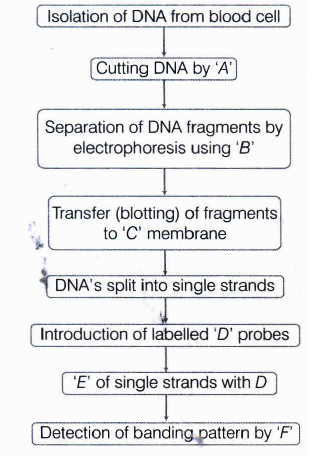
The following is the flowchart highlights the steps in DNA fingerprints technique.Identify A,B,C,D,E and F.
41.
(i) Construct a complete transcription unit with promoter and terminator on the basis of hypothetical template strand given below.

(ii) Write the RNA strand transcribed from the above transcription unit along with its polarity.
42.
Explain the significance of satellite DNA in DNA fingerprinting technique.
43.

Given above is the schematic representation of lac operon of E. coli. Explain the functioning of this operon when lactose is provided in the growth medium of the bacteria.
(OR)
A considerable amount of lactose is added to the growth medium of E.coil.How is the lac operon switched on in the bacteria?Mention the state operon when lactose is digested.
44.
Given below is a schematic representation of a lac operon.
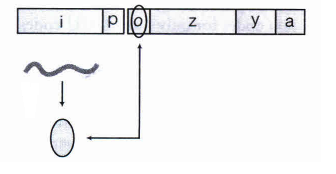
(i) Identify i and p.
(ii) Name the inducer for this operon and explain its function.
45.
(i) A DNA segment has a total of 1000 nucleotides, out of which 240 of them are adenine containing nucleotides. How many pyrimidine bases this DNA segment possesses?
(ii) Draw a diagrammatic sketch of a portion of DNA segment to support your,answer.
46.
(i) Name the scientist who called tRNA an adapter molecule.
(ii) Draw a clover -leaf structure of tRNA showing the following:
(a) Tyrosine attached to its amino acid in its correct site(codon for tyr]osine is UCA).
(c) What does the actual structure of tRNA look like?
47.
Identify by giving reasons, the salient features of genetic code by studying the following nucleotide sequence of mRNA strand and the polypeptide translated from it.
(AUG UUU UCU UUU UUU UCU UAG)
(Met - Phe - Ser-Phe - Phe - Ser)
48.
(i) Difference between unambiguous and degenerate codons.
(ii) Write two functions of the cotton AUG.
49.
What do you understand by 5'-end and 3'-end?
50.
(a)Name a genetic RNA and a non-genetic RNA
(b)Differntiate between prokaryotic mRNA and eukaryotic mRNA on the basis of any one character.
51.
Correct the following figure of replication fork.
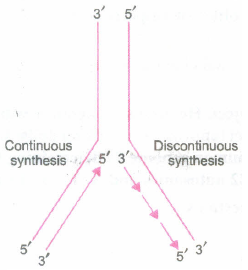
52.
Here some correct and some wrong statements.Correct only those statements which are wrong:
(a) The genetic code is universal
(b)The genetic code is ambiguous
(c)The genetic code is regenerated.
(d)Transfer RNA(tRNA)carry amino acids to mRNA codons and used again and again in transcription.
(e)UAA, UAG and UGC are terminator codon
(f)Lac operon consists of regulatory genes, operator gene,structural and promoter gene
53.
Write the principle involved in the separation of DNA fragments by gel electrophoresis
54.
How many histones make the core part of a nucleosome.What is the basis of binding DNA molecule to the histones?
55.
Calculate the total number of thymine-based present in the double strand DNA if it transcribes a mRNA which reads as follows:
5'-AUGCAUGCAUGCAUGCAGG-3'
56.
A primer comprising of 5 bases is required to allow copying of the following single standard DNA sequence 5'-ATGCCTAGGTC
Name the appropriate primer that should start DNA replication
57.
Match the items given in column I and with appropriate items(one or more) of column II:
| Column I | Column II |
| (i)m-Rna | (a)UAA |
| (ii)Initiation codon | (b)Beadle and Tatum |
| (iii)Termination codon | (c)AUG |
| (iv)Anticodon | (d)Hetrogenoous nuclear RNA(hn RNA) |
| (v)One gene one enzyme hypothesis | (e)GUG |
| (vi)Semiconservative mode of DNA replication | (f)UAG |
| (g)t-RNA | |
| (h)Meselson and Stahl |
58.
Draw a labelled schematic sketch of replication fork of DNA.Explain the role of the enzyme involved in DNA replication.
59.
Given below is a part of the template strand of a structural gene
\(\overline { TAC\quad CAT\quad TAG\quad GAT } \)
(a)Write its transcribed mRNA strand with its polarity
(b)Explain the mechanism involved in initiation of the transcription of this strand.
60.
Which molecule bears codons and which molecule bear anticodons?
61.
What are the following of mRNA and tRNA ?What anticodons will be required to recognize the following codons?
(i)AAU
(ii)CGA
(iii)UAC
(iv)GCA
62.
Why is genetic code a triplet one?
63.
Discuss the sequencing of rice genome
64.
What is principle of DNA fingerprinting
65.
Show the components of Lac operon
66.
Explain the process of charging of tRNA
67.
Explain translation in detail
68.
What are the two main events of protein synthesis? Describe transcription
69.
Make a table showing genetic codes and the corresponding amino acids coded by the genetic codes.
70.
Provide experimental evidence for semi-conservative mode of replication of DNA
71.
What is the chemical that brings about transformation?
72.
Describe Griffith's experiment to demonstrate that DNA is the basic genetic material. What was an explanation for Griffith's observation given by Avery, McCarty and MacCleod?
73.
Explain repressible system of gene regulation.
74.
How does an excess of tryptophan cause a "switching off" of the tryptophan operon?
75.
What are the kinds of base pairing substitutions?
76.
Show the transcription in eukaryotes with the help of sketches only
77.
Give a schematic structure of transcription unit. explain each component.
C.B.S.E.2008 and Delhi 2008 S
78.
Explain central dogma of flow of information
79.
Write a note on messenger RNA
80.
One of the codon on mRNA is AUG. Draw the structure of tRNA adapter molecule for this codon. explain the uniqueness of this tRNA?
81.
Sketch and explain clover leaf model of tRNA
82.
Sketch a double helix of DNA
83.
Make a simple sketch to show polynucleotide chain
84.
What is DNA polymerisation? Why is it important to study it
85.
(a) Name the type of synthesis
(b) Occurrence in the types of synthesis and as shown below:
86.
Briefly, discuss the new finding of rice genome sequencing.
87.
Make a list of tool and services used in rice genome sequencing
88.
What is rice genome sequencing?
89.
What are the aims of bioinformatics?
90.
What is satellite DNA? Name their two types, mention the basis for their classification
91.
Differentiate induction and repressor
92.
Differentiate aporepressor and corepressor
93.
Differentiate between introns and exons
94.
Give the chief characteristic of a eukaryotic operon.
95.
What is the inducer in the lac operon? How does it ensure the "switching on" or of genes?
(a) Draw a schematic representation of lac operon.
(b) Explain how does this operon get switched 'on' or 'off'
96.
"The genes and the polypeptide it codes for are said to be collinear"? Explain
97.
What were constitutive and non-constitutive genes?
98.
How is the wrong base removed before proceeding to add new bases in 5'->3' direction during replication of DNA
99.
DNA segment GAA, CAG, GCC, AGG, CTC was translated into polypeptide: Leucine, Valine, Arginine, Serine, Glutamine.
(i) What was the codon of the five amino acids?
(ii) What was the mRNA transcribed?
(iii) What would be the sequence of amino acids in the new polypeptide if in the first triplet adenine gets substituted by Guanine?
100.
How do mutations affect proteins structure and functions?
101.
Differentiate
(i) Translation and Translocation
(ii) Transformation and Transduction
102.
Briefly, describe termination of a polypeptide chain.
103.
What is the role of the ribosome during translation?
104.
Explain initiation of polypeptide chain
105.
Briefly, explain wobble hypothesis
106.
Explain briefly the genetic code
107.
Define cistron, codon, anticodon, start signal and stop signal.
108.
Write briefly on each the following:
(i) oncogenes
(ii) reverse transcription
109.
Write difference between replication and transcription
110.
Describe the initial process of transcription in bacteria.
111.
Explain briefly transcription
112.
List the requirements for transcription
113.
What are the three types of RNA molecule? How is each related to the concept of information flow?
114.
List three main differences between DNA and RNA
115.
RNA was first genetic material, DNA evolved later on. Explain
116.
What is the role of m-RNA, t-RNA and r-RNA in protein synthesis?
117.
Briefly, discuss the enzymes and steps involved in repair replication
118.
Write a note on repair replication
119.
Write a note on DNA synthesis in vitro
120.
Differentiate between leading strand and lagging strand
121.
DNA polymerase I of E.coli is a single polypeptide of molecular weight 109,000. (a)What enzymatic activity other than polymerase activity does this polypeptide possess? (b) What are the in vivo function of these activities?
122.
Differentiate between DNA polymerase and RNA polymerase
123.
Write a note on semiconservative mode of DNA replication
124.
(A) Why is RNA considered as first genetic material
125.
Write difference between prokaryotic DNA and eukaryotic DNA
126.
Give in brief characteristics of DNA molecule.
127.
Why is the DNA molecule compared to a spiralling staircase?
128.
Which three components make up the nucleotides?
129.
How is the length of DNA defined? Illustrate with example
130.
What are nucleic acids?
131.
Make a table showing genetic material of different organisms
132.
What was the rationale of using and,\({ 32 }_{ P }\) \({ 35 }_{ S }\) by Hershey and chase? Instead, if we use radiolabelled C and N, will the results be any different?
133.
Describe transformation.
134.
What chemical properties do DNA and protein possess that allow researchers to specifically label one or the other of these macromolecules with a radioactive isotope?
135.
(a) What is the contribution of Avery, MacCleod and McCarty?
(b) How did the transformation experiments of Griffith differ from those of Avery and MacCleod?
(c) What was the significance of each?
136.
Why was it believed earlier that proteins could be genetic material?
137.
Compare the primary structure of nucleic acid and protein
138.
Comments on the utility of variability in a number of tendons repeat during DNA fingerprinting.
139.
What did background information Watson and crick had with them for developing a model of DNA? What was their own contribute
140.
Now, Sequencing of total genome is getting less expensive day by day. soon it may be affordable for a common man to get his genome sequenced. what is your opinion could be advantage and disadvantage of this development
141.
The total number of genes in humans is far less (<25000) than the previous estimate (up to 140000 genes).Comment
142.
How has the sequencing of human genome opened new windows for the treatment of various genetic disorders? Discuss amongst your classmates.
143.
You are repeating the hershey-chase experiment and are provided with two isotope \( 32_{ P }\) and \({ 15 }_{ N }\) (in place of \(35_{ S }\) in the original experiment). How does yoou expect your results to be different
144.
Recall the experiment done by frederick Griffith, Avery, MacLeod and McCarty, where DNA was speculated to be the genatic material. If RNA, Instead of DNA was the genetic material, would the heat killed strain of Pneumococcus have tranformed the R-strain into virulent strain? Explain
145.
Retroviruses do no follow central dogma comment
146.
During DNA replication, why is it that the entire molecule does not open in one go? Explain replication fork. what is the two function that the monomers (dNTPs) play?
147.
Differences between polycistronic mRNA and monocistronic mRNA.
148.
Discuss the significance of heavy isotope of nitrogen.in Melson and Stahl's experiment.
149.
Who revealed biochemical nature of transforming principle? How was it done?
150.
Define transformation in Griffith's experiment. Discuss how it helps in the identification of DNA as the genetic material.
151.
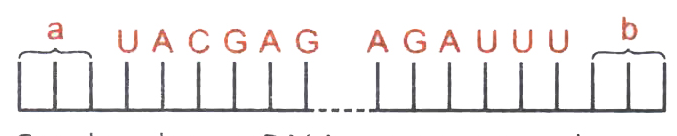
Study the mRNA segment given above which is complete to be translated into a polypeptide chain.
(i) Write the codons 'a' and 'b'.
(ii) What do they code for?
(iii) How is peptide bond formed between two amino acids in the ribosome?
152.
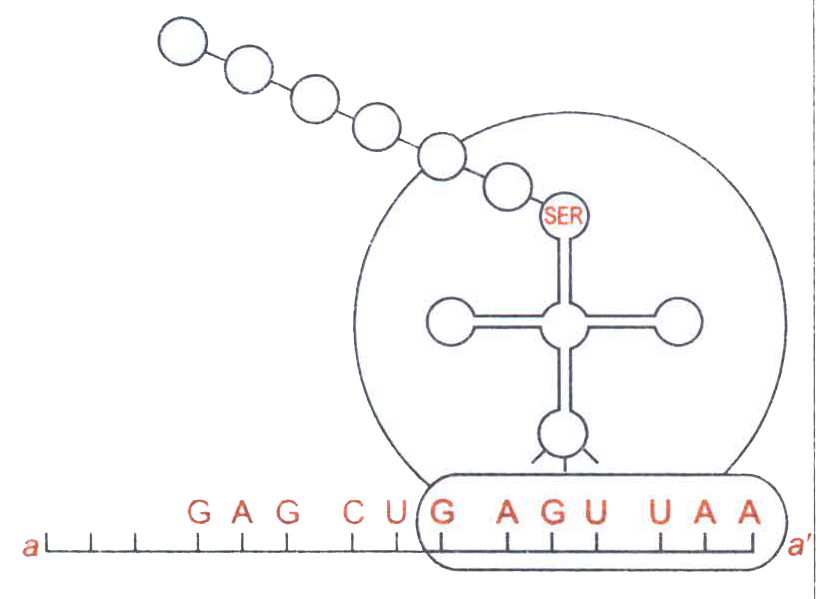
(a) Identify the polarity from a to a', in the above diagram and mention how many more amino acids are expected to be added to this polypeptide chain.
(b) Mention the DNA sequence coding for serine and the anticodon of tRNA for the same amino acid.
(c) Why are some untranslated sequence of bases seen in mRNA coding for a polypeptide? Where exactly are they present on mRNA?
153.
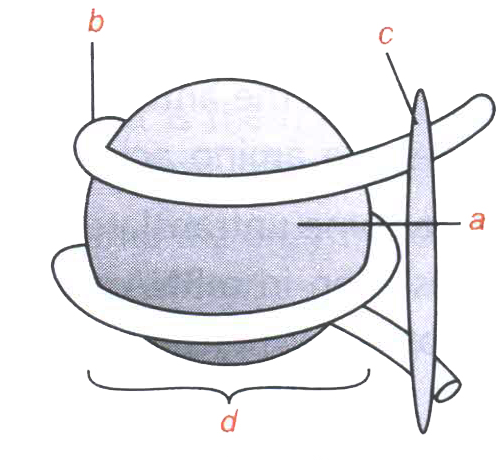
(a) What is this diagram representing?
(b) Name the parts a,b and c.
(c) In eukaryotes, the DNA molecules are organised within the nucleus. How is the DNA molecule organised in a bacterial cell in absence of a nucleus?
154.
(a) Identify the polarity at A and B respectively in the figure given below:
(b) Explain the mechanism the figure represents
.png)
155.
Write down the possible levels of regulation of gene expression in eukaryotes.
156.
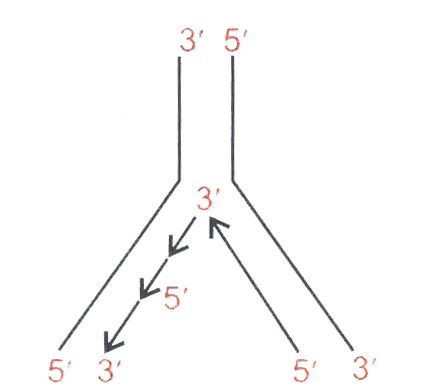
Why do you see two different types of replicating strands in the given DNA replication fork? Name these strands.
157.
What is DNA fingerprinting? Mention its application.
158.
Why is the Human Genome Project called a mega project?
159.
Explain (in one or two lines) the function of the followings:
(a) Promoter
(b) tRNA
(c) Exons
160.
Group the following as nitrogenous bases and nucleosides: Adenine, Cytidine, Thymine, Guanosine, Uracil and cytosine.
161.
(a)One of the codons of mRNA in AUG.Draw the structure of tRNA adapter molecule for this codon.
(b)Name the RNA polymerase that transcribes tRNA in eukaryotes.
(c)What is unique about the amino acid this tRNA binds with.
162.
Explain the process of charging of tRNA. Why is it essential in translation?
163.
(i)Why does DNA replication occur in small replication forks and not in its entire length?
(ii)Why is DNA replication countinuous and discountinuous in a replication fork?
(iii)Explain the importance of 'origin of replication' in a replication fork.
164.
Explain the role of 35S and 32P in the experiments conducted by Hershey and Chase.
165.
The length of a DNA molecule in a typical mammalian cell is calculated to be approximately 2.2m. How is the packing of this molecule done to accommodate it within the nucleus of the cell?
166.
A typical mammalian cell has 2.2m long DNA molecule,Whereas the nucleus in which it is packed measures about 10-6m.Explain how such a long DNA molecule is packed within a tiny nucleous in the cell.
167.
(a)In a human genome,Which one of the chromosomes has the most genes and which one has the fewest?
(b)Scientists have identified about 1.4 million single nucleotide polymorphs in human genome. How is the information of their existence going to help the scientists?
168.
What are satellite DNA in a genome?
Explain their role in DNA fingerprinting.
169.
How do initiation and termination of translation process occur in bacteria? Where are untranslated regions located in mRNA? Mention their role.
170.
(a)Why is tRNA called an 'adopter'?
(b)Draw and label a secondary strucuture of tRNA.How does the actual structure of tRNA look like?
171.
(a)List the structural genes involved in the digestion o lactose in E.Coli. Highlight the function of any one
(b)What triggers the transcription of these genes?
172.
Explain the role of regulatory gene in lac operon.Why is the regulation of the operon called negative regulation?
173.
Draw a schematic representation of a dinucleotide.Lable the following
(i)The components of a nucleotide
(ii)5' end
(iii)N-glycosidic linkge.
(iv)Phosphodiester linkage
174.
Describe the elongation process of transcription in bacteria.
175.
Expand 'BAC' and 'YAC'.Explain how they were used in sequencing o human genome.ss
176.
Monocistronic structural genes in eukaryotes have interrupted coding sequences. Explain. How are they different in prokaryotypes.
177.
Differentiate between the following
(i)Promoter and Terminator in a transcription unit.
(ii)Exon and intron in an unprocessed eukaryotic mRNA.
(ii)Inducer and Repressor in operons.
178.
(a)Name the scientist who called tRNA an adptor molecule.
(b)Draw a clover leaf structure of tRNA showing the following:
(i)tyrosine attached to its amino acid site
(ii)anticodon for this amino acid in its correct site.
(c)What does the actual structure of tRNA look like?
179.
Answer the following questions based on Meselson and Stahl's experiment
(a) Write the name of the chemical substance used as a source of nitrogen inthe experiment by them.
(b) Why did the scientist synthesise light and the heavy DNA molecules in the organism in the experiment?
(c) How did the scientists make it possible to distinguish the heavy DNA molecule from the light DNA molecule?Explain
(d) Write the conclusion the scientists arrived at after completing the experiment.
180.
The base sequence in one of the strands of DNA is TAGCATGAT
(i)Give the base sequence of its complementry strand.
(ii)How are these base pairs held together in a DNA molecule?
(iii)Explain the base complementarity rule.Name the scientist who framed this rule.
181.
Explain the process of transcription in a bacterium
182.
State the conditions when 'genetic code' is said to be
(i)degenerate
(ii)unambiguous and specific
(iii)universal
183.
What is hnRNA?Explain the changes hnRNA undergoes during the processing to from mRNA
184.
How are the structural genes activated in the lac operon in E.coli?
185.
(a)Name the enzyme responsible for the transcription of tRNA and the amino acid the initiator tRNA gets linked with
(b)Explain the role of initiator tRNA in initiation of protein synthesis.
186.
Why is RNA regarded as the first genetic material? Explain
187.
It is established that RNA is the first genetic material.Explain giving three reasons.
188.
Given below are the sequences of nucleoides in a particular mRNA and amino acids coded by it
UUU AUG UUC GAC UUA GUG UAA
Phe - Met - Phe - Glu - Leu - Val
Write the properties of genetic code that can be and cannot be correlated from the above given data.
189.
Explain the role DNA-dependent RNA-polymerase in transcription
190.
Explain the role of RNA polymerase in transcription in bacteria
191.
Describe the structure of an RNA polynucleotide chain having four different types of nucleotides.
192.
Name the components 'a' and 'b' in the nucleotide with a purine, given below
193.
If the sequence of coding strand in a transcription unit is written as follows:
5'- ATGCATGCATGCATGCATGCATGCATGC -3'
Write down the sequence of mRNA.
194.
Study the given portion of double stranded polynucleotide chain carefully. Identify a,b,c and 5' end of the chain.
195.
Explain the two factors responsible for conferring stability to double helix structure of DNA
1.
The DNAstrand with 3'-5' polarity only is trancribed and not the other because the RNA-polymerase can polymerize RNA only in 5'-3' direction.
2.
Amino acid chain will separate from mRNA at the place of codon UAGbecause it is the stop codon i.e. it does not code for any amino acid.
3.
(i) Normal haemoglobin
(ii) Sickle cell anemia carrier haemoglobin (Heterozygous)
(iii) Sickle cell anaemia (Homozygous condition)
(iv) Carrier woman for Haemophilia
(v) Haemophilic man
4.
Both are enzymes and both bring about the polymerization of nucleotides in 5'-3' direction. RNA polymerase polymerizes ribonucleotides during transcription whereas DNA polymerase polymerizes deoxyribonucleotides during DNA replication.
5.
Both the strands of DNA are complimentary but however do not contain the same biological information. One strand of DNA contains the information and is called as the template strand while the other strand is called as the coding strand. The template strand codes for protein molecule while cdtling strand does not code for anything.
6.
(1) RNA polymerase binds to the promotor and initiates transcription. It uses nucleotide triphosphates as substrates and polymerises in a template dependent fusion following the rule of complementary. It somehow also facilitates opening
of the helix structure and continues elongation. Only a short stretch of RNA remains bound to the enzyme. Once the polymerase reaches the terminator region, the nascent RNA falls off, so also the RNA polymerase. This results into termination
of the transcription.
(2) RNA polymerase associates transiently with termination factor (rho) to terminate the transcription. Association of this factor alters the specificity of the RNA polymerase to terminate.
7.
DNA fingerprinting is used for identification of kinship.
Procedure:
1. Variable number of tanden repeats (VNTR's) are satellite DNA's that show high degree of polymorphism. They are used as probes in DNA fingerprinting.
2. Fragments of DNA from an individual are isolated and cut with restriction endonucleases.
3. Fragments are separated according to their size and molecular weight through gel electrophoresis.
4. Fragments separated through electrophoresis gel are blotted (immobilised) on a synthetic membrane such as nylon or nitrocellulose.
5. Immobilised fragments are hybridised with a VNTR probe.
6. Hybridised DNA fragments can be detected by autoradiography.
7. VNTRs are different in size, ranging from .1 to 20 kb. Hence, in the autoradiogram, a band of different sizes will be obtained.
8. These bands are the characteristic feature of an individual. They are different in each and ever} individual except identical twins.
8.
(i) Y stands for yeast in the word YAC(Yeast Artificial Chromosomes) and B stands for bacteria in the word BAC (Bacterial Artificial Chromosomes). These are vectors used in cloning of DNA.
(ii) Less than 2% of the total human genome codes for protein, 50% of discovered genes are not known for their functions.
(iii) SNPs stands for Single Nucleotide Polymorphisms.
9.
(a) Positive terminal-'B'
Negative terminal-A'
(b) 'DNA being negatively charged, moves towards the positive electrode (anode).
(c) By elution-separated bands of DNA are cut out from the agarose gel and extracted from the gel piece.
10.
The three main goals of HGP are-
(i) To determine the sequences of 3 billion base pairs that make up the human DNA.
(ii) To identify all the estimated genes in human DNA.
(iii) To store this information in databases
11.
(i) Degenerate-One amino acid may be coded by several codons.
(ii) unambiguous or specific-each codon codes for a specific amino acid.
12.
1. The operator region is located adjacent to promoter elements / prior to structural gene
2. In regulation of gene expression.
switch off - the repressor binds to the operator region, & prevents transcription.
switch on - In the presence of inducer the repressor is inactivated, (by the interaction with the inducer) and operator allows
3. RNA polymerase access to the promoter & transcription proceeds.
13.
PCR/ polymerase chain reaction.
Separation/ denaturation of two strands of two dsDNA, using two sets of primers /small chemically synthesised oligonucleotides complementary to regions of DNA and (thermostable) DNA polymerase / Taq polymerase, extension of the primers, by enzyme using nucleotides replicates the DNA and if the process of replication is repeated many times multiple copies of DNA are produced.
(The following diagram can be considered in view of the explanation).
14.
Distance between two consecutive base pair
=0.34 x 10⁻⁹ m
\(\therefore \) The length of bacteriophage lambda DNA
=0.34 x 10-9 m x 48502
=16.49 x 10⁻⁶ m
15.
(i) Glycosidic bond (C-N-C)
(ii) Phospho-ester bond
(iii) Phospho-diester bond
(iv) Hydrogen bond [Double hydrogen bond between A & T (A=T) & Triple hydrogen gas bond between C & G (C\(\equiv \)G)]
16.
According to Central Dogma of molecular biology there is unidirectional flow of genetic information from DNA to m RNA and from here to protein.
\(DNA\underset { Transcription }{ \longrightarrow } mRNA\quad \underset { Translation }{ \longrightarrow } Protein\)
But in HIV (Human immuno-dificiency virus) there is central dogma reverse i.e. the flow of genetic information is in reverse direction. It is because the virus contains the genetic RNA and produces an enzyme reverse transcriptase. This enzyme helps to synthesize DNA from genetic RNA of HIV by a process called as reverse transcription or Teminism. This newly synthesized DNA functions as master copy producing mRNA through transcription & RNAs controlling translation to synthesize protein.
\(RNA\quad \overset { Reverse }{ \underset { Transcriplase }{ \longrightarrow } } DNA\quad \overset { Transcription }{ \longrightarrow } mRNA\quad \overset { Translation }{ \longrightarrow } Protein\)
The phenomenon of reverse transcription was discovered by Temin & Baltimore (1970) in Retrovirus.
17.
G = 410 \(\therefore \) C=410 (because C = G)
\(\therefore \) G+C=410+410=820
\(\therefore \) A+T=1500-820=680
\(\therefore \) T=680/2=340
Thus the pyrimidine bases C+T
=410+340
=750
18.
In nucleosome the positively charged component is histone octamer and negatively charged component is DNA.
19.
(a) Streptococcus pneumoniae:
S - Strain (virulent) injected into mice ---> mice die
R - strain injected into mice ---> mice alive
S - strain (heat killed) injected into mice ---> mice alive
R - strain (alive) + S (heat killed) strain inject into mice ---> mice die
As the R strain (non-virulent) picked up genetic material from S strain (virulent) and get transformed.
(b) They (worked on the bio-chemical nature of transforming principle in Griffith's experiment) purified proteins DNA and RNA from heat killed S cells, they discovered protein digesting enzyme (protease) RNA digesting enzyme (RNese) did
not affect transformation, Digestion with DNase inhibited transformation, concluded DNA is the heredity material.
20.
Basic ammo acid residues of lysines, arginines.
21.
(1) RNA polymerase II
(ii) Has (non-functional) introns
(Methyl guanosine tri-phosphate is added to 5' end) capping, tailing (Poly A tail at 3' end added), splicing (introns are removed and exons are joined).
22.
(a) Meselson and Stahl use 14N and 15N isotopes in the sources of nitrogen present in the culture medium in their experiment as nitrogen is a major constituent of DNA. Moreover 15N is by far the most abundant isotope of nitrogen, and DNA with the heavier 15N isotope is also functional. E.coli can be grown for several generations in a medium with 15N easily. When DNA is extracted from these cells and centrifuged on a salt density gradient, the DNA separates out at the point at which its density equals that of the salt solution.
(b) The experiment proves the semi-conservative nature of replication of DNA. In this type of replication of DNA. In this type of replication one strand is old. It means, one strand of daughter duplex is derived from the old DNA, while the other strand is formed new. It proves semi-conservative replication of DNA..
23.
(a) 5' ATGGGGCTC 3' sense
3' TACCCCGAG 5' antisense
RNA 5' AUGGGGCUC 3' sense
3' UACCCCGAG 5' antisense
(b) The two strands of RNA (i.e. sense and antisense) being complementary will bind with each other and form double stranded RNA. As a result its translation and protein expression would be inhibited.
24.
(a) DNA synthesis.
(b) (i) Semi-conservative.
(ii) Semi-discontinuous.
(iii) Unidirectional.
(c)DNA polymerase III - adds nucleotides.
DNA polymerase I - fills the gaps.
RNA primase - brings primers.
Topoisomerase - causes unwinding.
DNA ligase - joins Okazaki fragments.
(Any 3 enzymes and their functions)
25.
| Template strand | Coding strand |
|
(i)This is the strand of DNA with 3o->5opolarity |
(i)This is the strand DNA with 5o>3o polarity |
| (ii) it functions as the template for transcription and codes for RNA |
(ii) It does not code for any region of RNA during transcription. |
26.
| S.No | DNA | RNA |
| (i) | Stable molecule because of having 2'H group at every nucleotide. |
Unstable molecule (more reactive because of .having 2'OH group at every nucleotide. |
| (ii) | Presence of thymine. | Presence of uracil |
| (iii) | Occasional mutation. | Prone to faster mutation resulting in shorter life span. |
27.
(a) Number of Nucleotides = 2000
Number of Adenine (A-purine) containing nucleotides = 520
\(\therefore \) Number of Thymine (T-pyrimidine) nucleotides =520
\(\therefore \) Total number of A + T = 520+520
= 1040
\(\therefore \) Number of G + C nucleotides = 2000- 1040
= 480
\(\therefore \) Number of guanine nucleotides = 960/2
= 480
\(\therefore \) Number of purine bases (A + G) = 520 + 480
= 1000
28.
A DNA sequence that reads the same, on the two strands from 5'- 3' direction or 3' - 5' direction.
5'-GAATIC-3'
3'-CTIAAG-5'
29.
X : N-glycosidic linkage.
Y : Phosphoester linkage.
Z : 3'- 5' phosphodiester linkage.
X forms nucleoside.
Y forms nucleotide.
Z forms polynucleotide.
30.
(a) In order to label protein coat of virus with radioactive sulfur, label DNA with radioactive phosphorus.
(i) Bacteria which were infected with viruses having radioactive DNA were found to contain radioactive DNA later on
(ii) Bacteria which were infected with viruses having radioactive protein coat were not found to contain radioactivity.
Conclusion-DNA is the genetic material.
31.
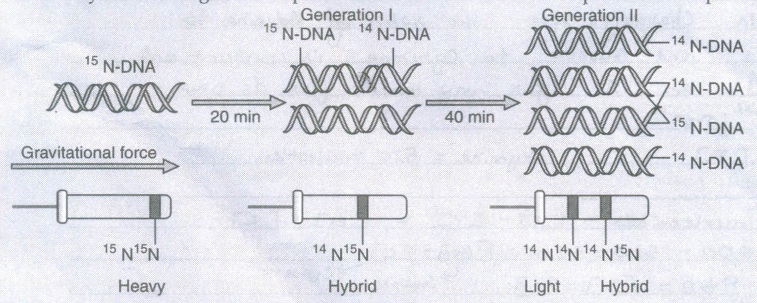
Grown E.coli in 15NH4Cl for many generations to get 15N incorporated into DNA, Then the cells are transferred into 14NH4Cl, The extracted DNA are centrifuged in CsCI and measured to get their densities, DNA extracted from the culture after one generation (20minutes), showed intermediate hybrid density, DNA extracted after two generations (40 minutes) showed light DNA and hybrid DNA.
A correctly labelled diagramatic representation in lieu of the above explanation of experiment to be considered.
32.
Bacteriophage does not repetitive sequences such as (i.e. 5386bp) and have all the coding sequence.Therefore, DNA fingerprint is not done for phages.
33.
Sometimes cattle or human beings give birth to their young ones that are having different sets of oranges like limbs/position of eye, etc.It happens due to the disturbance in coordinated regulation of expression in sets of genes, which are associated with organ development
34.
1. The genetic codes are universal, with few exceptions and mitochondrial DNA includes some of these exceptions.For most organisms the 'stop codons are 'UAA',UAG and 'UGA'.In vertebrate mitochondria 'UGA', which codes for tryptophan instead.Another codon 'AUA' codes for isoleucine in most organisms but for methionine in vertebrate mitochondrial mRNA.
2. There are many variations among the codes used by other mitochondrial mRNA, which are not harmful to these organisms,and can be used as atool (along with other mutations among the mtDNA/RNA of different species) to determine relative proximity of common ancestry of related species.
3. The more related any two species are, the more mtDNA/RNA mutations will be the same in their mitochondrial genome.From this, it is estimated that the first mitochondria arose around 1.5 billion years ago.A generally accepted hypothesis is that mitochondria originated as an aerobic prokaryote in a symbiotic relationship within an anaerobic eukaryote.
35.
1. Functional mRNA of structural genes need not always include all of its exons.This alternate splicing of exons is sex-specific , issue-specific and even development stage-specific.
2. By such alternate splicing of exons, a single gene may encode for several ios proteins and/ or proteins of similar class.In absence of such a kind od splicing, there should have been new genes for every protein/isoprotein.Such an extravagance has been avoided in natural phenomena by alternative splicing.
36.
1. In the given case, as E.coli is a mutant for DNA ligase, it will result in no further joining of Okazaki fragments on lagging strand.
2. This will ultimately result into the formation of both high molecular weight fragments (on leading strands) and low molecular weight fragments (on lagging strand). Hence, only the graph (a) could be the appropriate result after centrifugation.
37.
DNA fingerprinting is the technique used in solving the paternity dispute for a child.DNA fingerprinting involves determining nucleotide sequence of certain areas of DNA which are unique to each individual.
The DNA sample can be taken from a very small tissue or even a drop of blood can be used.The basis of DNA fingerprinting is DNA polymorphism.
38.
DNA fingerprinting is the technique used in solving the paternity dispute for a child.DNA fingerprinting involves determining nucleotide sequence of certain areas of DNA which are unique to each individual.
The DNA sample can be taken from a very small tissue or even a drop of blood can be used.The basis of DNA fingerprinting is DNA polymorphism.
39.
(i) Polymorphism is inherited from parents to children.So, it is useful for the identification(forensic application) and paternity testing. It arises due to mutations and also plays an important role in evolution and speciation.These mutations in the evolution in the non-coding sequences have piled up with time and form the basis of DNA polymorphism.IT is basis of genetic of human genome as well as DNA fingerprinting.
(ii) Variable Number of Tandem Repeats(VNTRs) belong to a class of satellite DNA called as minisatellite.VNTR are used as probes in DNA fingerprinting..
40.
A - Restriction endonuclease
B - Agarose
C - Nylon/Nitrocellulose
D - VNTR
E - Hybridisation
F - Autoradiography
41.
(i) Transcription unit

(ii) RNA transcribed

42.
Significance of satellite DNA in DNA fingerprinting
A DNA satellite is a region that consists of short DNA sequence repeated many times. The variation between individuals in the lengths of their DNA satellites forms the basis of DNA fingerprinting.
DNA satellite are of two types, i.e microsatellites and minisatellites.Their characteristic that makes them useful for identification is that they are highly polymorphic.The length of each satellite in DNA is inherited.
The length of satellite regions are highly variable between people.These form small peaks during density gradient centrifugation and thus are invaluable for identification purpose.
43.
In lac operon, when lactose is added, it enters the cell wall with the help of permease, a small amount of which is already present in cell.Lactose binding to activates repressor and changes its structure. The repressor now fails to bind to the operator.then, RNA polymerase starts transaction of operon by binding to promoter site-P.All the three enzymes for lactose metabolism are synthesised.
Finally, all the lactose molecules are used up.After sometime, when whole of lactose is consumed, there is no inducer present to bind to the repressor.Then the repressor becomes active again ,attaches itself to the operator and finally switches off the operon.
.jpg)
44.
(i) i-Regulatory gene, p - Promotor gene.
(ii) Inducer is lactose.
Functions
(a) Enters the cell and binds to the repressor and inactivates it.
(b) As a result, repressor cannot bind to the operator .This allows RNA polymerase to have access to the promotor and transactions proceeds.
45.
(i) According to Chargaff's rule, ratio of purines to pyrimidines is equal, i.e A+G=C+T
Since, the number of adenine (A) is equal to the number of thymine (T) and A=140 (given)
Therefore, T = 240
Also, the number of guanine (G) is equal to cytosine (C). Thus, G+C=1000-(A+T)
G + C = 1000 - 480 = 520
Hence, G = 260, C = 260
The number of pyrimidine bases, i.e. C + T = 240 + 260 = 500
(ii)
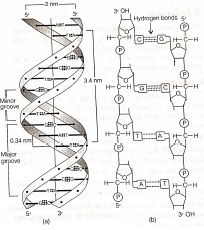
46.
(i) Francis Crick
(ii) (a) ,(b)

(c) tRNA looks like inverted L.
47.
| Salient Feature of Genetic Code | Reason |
| The codon is triplet | AUG,UUU,etc.,are triplets. |
| One codon codes for only one amino, so it is unambiguous and specific. |
UUU codes for serine, AUGcodes for methionine, etc. |
| AUG has dual function as it codes fo r methionine and if also acts as initiator codon. |
AUG is seen at the beginning of the polypeptide chain. |
| UAG act as a stop codon. | No amino acid is coded by UAG in the polypeptide chain given. |
48.
(i) Difference and degenerate codons are:
| Unambiguous Codon | Degenerate Codon |
| No ambiguity for a particuler codon. | Code is degenerate for a particular amino acid. |
| A particular codon will always code for same amino acid, where it is found. |
One amino acid often has more than one code triplet. |
| e.g, GGA is an unambiguous codon, it codes only for glycine and no other amino acid. |
e.g.Phenylalanine has two codons i.e UUU and UUc |
(ii) Functions of codon AUG is as follows:
(a) Codes for methionine
(b) Serves as a signal to initiate protein synthesis(initiator codon).
49.
A polynucleotide chain comprises of a long chain of nucleotides joined by 3'-5' phosphodiester linkages.Such a polymer has at one a free phosphate moiety at 5'-end of ribose sugar.This end of polymer is referred to as 5'-end.Similarly, at the other end of the polymer, the pentose sugar has a free 3'-OH group.This end of polymer is referred to as 3'-end.
50.
(a) Genetic RNA-Double stranded RNA of mammalian reovirus
Non-genetic RNA-Ribosomal RNA, messenger RNA or transfer RNA
(b)Prolaryotic mRNA is short lived and hardly undergoes processing(capping, methylation and polyadenylation)to from comparatively stable mRNA.
51.
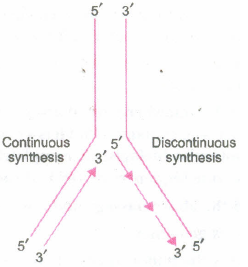
52.
(a)Correct
(b)The genetic code is non-ambiguous
(c)The genetic code is degenerate
(d)Transfer RNA(tRNA) carry amino acids to mRNA codons and used again and again in translation
(e)Correct
(f)Correct
53.
The gel electrophoresis is carried out by loading the slab of agarose gel with DNA fragments and placing in an electric field.DNA, being negatively charged moves towards positively charged electrode.Larger fragments move slowly than smaller ones.Thus, the DNA fragments get separated into individual bands according to their molecular size.
54.
The core part of nucleosome comprises of 8 Histone molecules.DNA molecules is negatively charged whereas histone octomer is positively charged.Therefore, negatively charged DNA binds with the positively charged histone octomer
55.
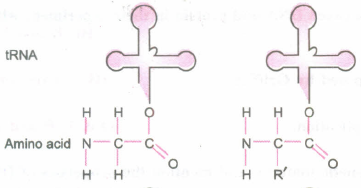
The template strand as 3'-TACGTAGTACGTTAGTCC-5' and the coding strand reads as 5'-ATGCATGCATGCAATCAGG-3' Therefore,the total number of Thymine are=10.
The Carboxyl group(-COOH) of one amino acids reacts with an amino group(-NH2)of other amino acid to form a peptide bond(-CO-NH).Make a peptide bond between the two amino acids by removing water molecule in the given figure
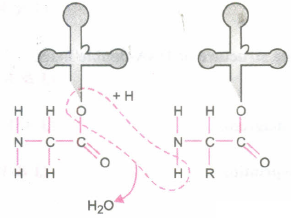
56.
The 3' end of template DNA (parental strand) starts the 5' of the newly synthesised DNA.Therefore, a primer of 5 base required to start DNA replication will be-5'-GACCU
57.
(i) d
(ii)c
(iii)a
(iv)g
(v)b
(vi)h
58.
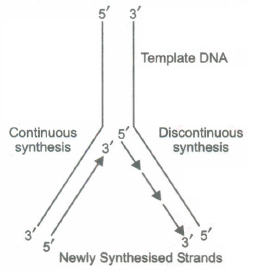
Role of the enzymes:
1.DNA-dependent DNA polymerase catalyses the polymerisation the polymerisation od deoxynucleotides in 5'---->3' direction
2.DNA ligase-Joins discontinuously synthesised fragments.
59.
(a)
\(\\ \overline { ^{ 3' }TAC\quad CAT\quad TAG\quad GAT\\ _{ 5' }\underline { AUG\quad GUA\quad AUC\quad CUA } _{ mRNA } } ^{ 5' }\)
60.
mRNA bears codons and tRNA molecules bear anticodons
61.
mRna caries a message from DNA to ribosome sin the form of sequence of triplet codes.It acts as a plateform where protein synthesis takes place.tRNA transfer aminoacids to protein synthesizing apparatus.mRNA possess codons and tRNA possess anticodons.The anticodons are---(i)UUA,(ii)GUC,(iii)AUA,(iv)CGU
62.
Genetic code consists of a sequence of three nucleotides called triplet.It can easily code for 20 amino acids.The duplet genetic code can accomodate only 16 aminoacids
63.
Sequencing of the Rice Genome: Rice has the smallest genome of the common cereals (Khush GS, 1997). Rice was the first cereal to be fully sequenced, and both the indica and japonica genome sequences were published in 2002 (Yu J, et. al. and Goff SA, et. aZ.). The inica genome is 420 Mb in size and contains between 32,000 to 50,000 genes. The japonica variety is larger, at 466 Mb, and contains around 46,022-55,615 genes. For this landscape, we analyzed the japonica rice genome. The genome was sequenced by both public and private groups, as described below:
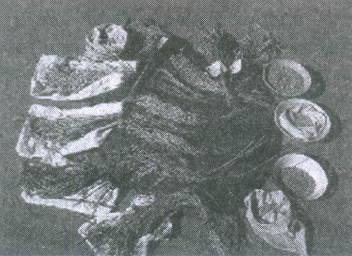
1. Public Efforts at Sequencing - the IRGSP In 1997, a consortium of publicly funded laboratories called International Rice Genome Sequencing' Project (IRGSP) was established to map the rice genome. The consortium includes labs from ten countries: Japan, the United States of America, China, Taiwan, Korea, India, Thailand, France, Brazil, and the United Kingdom. The IRGSP adopted the "clone-by-clone shotgun sequencing strategy" so that each specific position on the genetic map was associated with a sequenced clone. IRGSP's policy is that all rice sequence data must be released into the public domain. In December 2004, the completed rice genome sequence was made available through the NCBI database.
Research such as the genome-sequencing project has provided a wealth of molecular marker data, together with phenotypic, ecological, and archaeological data and has significantly helped our understanding of the evolutionary history of the genus Oryza (Khush GS, 1997). It has also assisted efforts to assimilate useful genes from wild species to cultivated rice through inter-specific hybridisation. Organizations such as IRRI have been using the knowledge to help modify rice in an endeavour to reduce poverty and hunger and to improve the health of rice farmers and consumers. More information about the IRGSP participants are provided on the next page of the landscape.
2. Private Efforts at Sequencing Private firms and other interested parties have also contributed to the sequencing Private firms and other interested parties have also contributed to the sequencing of the rice genome. Key players in the private sphere were Monsanto, Syngenta and Myriad Genomics. Monsanto released all of its data into the public sphere, but not before they had filed patent applications on more than 200,000 sequences. Syngenta also released their sequence information, but not exactly in a timely manner. More information about the role or these companies in provided later in this landscape.
64.
Principle of DNA fingerprinting.
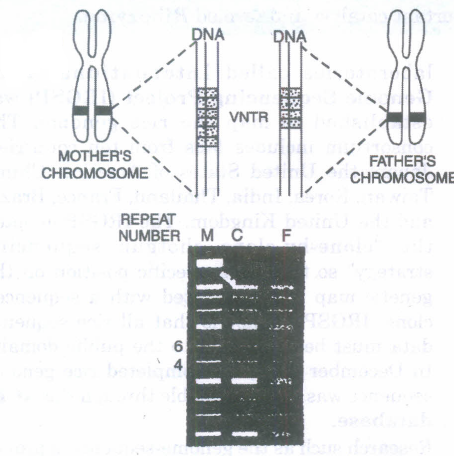
Human genome possesses numerous small non-coding sequences which are repeated many times. They can be separated as satellite bulk DNA during density DNAs from the gradient centrifugation. Depending upon length, base composition and numbers. of repetitive units, satellite DNAs have sub-categories like microsatellites and minisatellites, Satellite DNAs show polymorphism. If a variant at a locus is present with a frequency of more than 0.01 population it is called DNA polymorphism. Variations occur due to mutations. Therefore, DNA polymorphism is the occurrence of mutations in a population at high frequency. While mutations in genes produce alleles with different expressions, mutations in non-coding repetitive DNA have no immediate impact. These mutations have piled up with time and form the basis of polymorphism.
65.
66.
Translation. During translation process proteins are made by the ribosomes on mRNA strand.
The main steps are:
1. Activation of amino acid.
2. Transfer of activated amino acid to tRNA.
3. Initiation of synthesis.
4. Elongation of polypeptide chain.
5. Termination of chain.
6. Release of polypeptide chain.
Mechanism of Translation:
.png)
67.
Translation. During translation process proteins are made by the ribosomes on mRNA strand.
The main steps are:
1. Activation of amino acid.
2. Transfer of activated amino acid to tRNA.
3. Initiation of synthesis.
4. Elongation of polypeptide chain.
5. Termination of chain.
6. Release of polypeptide chain.
Mechanism of Translation:
68.
1. It consists of two main events
(A) Transcription and (B) Translation.
2. Transcription. It is the copying of a complementary messenger RNA strand on DNA strand, the strand which acts as template is termed master strand or sense strand. The base pairing follow A = U and G == C. In eukaryotes transcription occurs in the nucleus. The mRNA synthesized come out into cytoplasm through nuclear pore.
3. Transcription requires a template (double stranded DNA), ribonucleoside triphosphates (ATP, GTP, CTP and UTP (RNA polymerase II and divalent metal ion.)
4. RNA chain start at promoter region and end at terminator region and synthesized in 5'---3' direction. Chain termination is brought by Rho factor
A.Sigma factor and coenzyme join to form RNA polymerase
B. RNA polymerase attaches to initiation site \(\delta \) factor help in detecting the promoter or initiation site.
C. DNA unwinds, core enzyme catalyzes the synthesis of mRNA 0 factor separates out.
D. mRNA chain elongates.
E. Termination of chain brought by \(\delta \) factors.
F. mRNA strand transcribed by DNA
69.
Table showing genetic codes.
70.
Meselson and Stahl (1958) experimentally proved that the DNA replication is semi-conservative.
1. E. coli bacterium was grown for many generations in a culture medium in which the nitrogen source contained heavy isotope \({ N }^{ 15 }\) thus the labelling of bacterial DNA was done.
2. Later on these bacteria were cultured in \({ N }^{ 14 }\) non-radioactive isotope.
3. DNA was analysed to determine the distribution of radioactivity.
4. The experiment showed that one strand of each daughter DNA molecule was radioactive whereas the other was non-radioactive.
5. During second replication in \({ N }^{ 14 }\) medium the radioactive and non-radioactive strand separated and served as template for the synthesis of non-radioactive strands.
6. Out of four DNA molecules two are completely non-radioactive and the other two have half of molecule as non-radioactive.
7. This evidence shows that DNA replication is semiconservative.
8. This biochemical evidence was supported by direct cytological observation of duplicating DNA of E. coli.
71.
Griffith's experiment to demonstrate
DNA as genetic material.
Transformation experiments were initially conducted by F. Griffith in 1928.
1. He injected a mixture of two strains of Pneumococcus (Diplococcus pneumoniae) into mice. One of these two strains S III as virulent and the other strain R II was non-virulent, i.e., causes no infection.
2. The S III type bacteria when injected into mice cause pneumonia and ultimately to death. The R II type bacteria when injected, no pneumonia occurred.
3.The S III bacteria, prior to injection are killed by heating. It is then injected into the mice. It did not cause the disease.
4. Heat killed S III and R II (non-virulent) bacteria, when injected into mice, caused pneumonia. Finally death occurred.
This proved that DNA of S III type bacteria has transformed the DNAofR II type bacteria into virulent type S III. This phenomenon of transferring characters of one strain to another by using a DNA extract of former is called transformation.
Conclusion. Griffith concluded that virulence was transferred fromS-Typedead cells to R-Type living cells in the form of capsule (some component of cell) rather than the whole cells.
Contribution of Avery, MacCleod and McCarty
Avery, MacCleod and McCarty gave the proof that transforming agent is DNA. They carried out the experiments with Diplococcus and showed transformation of type R-U to type S-III. They gave proof that active component was DNA and not the RNA or Proteins or Polysaccharides.
72.
Griffith's experiment to demonstrate
DNA as genetic material.
Transformation experiments were initially conducted by F. Griffith in 1928.
1. He injected a mixture of two strains of Pneumococcus (Diplococcus pneumoniae) into mice. One ofthese two strains S III as virulent and the other strain RII was non-virulent, i.e., causes no infection.
2. The S III type bacteria when injected into mice cause pneumonia and ultimately to death. The R II type bacteria when injected, no pneumonia occurred.
3.The S III bacteria, prior to injection are killed by heating. It is then injected into the mice. It did not cause the disease.
4. Heat killed S III and R II (non-virulent) bacteria, when injected into mice, caused pneumonia. Finally death occurred.
5. This proved that DNA of S III type bacteria has transformed the DNA of R II type bacteria into virulent type S III. This phenomenon of transferring characters of one strain to another by using a DNA extract of former is called transformation.
Conclusion. Griffith concluded that virulence was transferred fromS-Typedead cells to R-Type living cells in the form of capsule (some component of cell) rather than the whole cells.
Contribution of Avery, MacCleod and McCarty
6. Avery, MacCleod and McCarty gave the proof that transforming agent is DNA. They carried out the experiments with Diplococcus and showed transformation of type R-U to type S-III. They gave proof that active component was DNA and not the RNA or Proteins or Polysaccharides.
73.
1. It consists of five genes coding for five enzymes catalysing the synthesis of tryptophan and thus constitute an anabolic pathway.
2. The structure of the operon is more or less similar to that the lac operon and control of regulator gene R, promoter gene, operator gene O and structural gene. It manifests a functional variation. -
3. Here the R gene product (equivalent to the gene of lac operon) produces protein which by itself unable to operate. This is referred to as apo-repressor.
4. In presence of tryptophan (co-repressor), the functional repressor is formed that now binds to the operator, preventing the transcription of the operon and production of tryptophan.
74.
1. It consists of five genes coding for five enzymes catalysing the synthesis of tryptophan and thus constitute an anabolic pathway.
2. The structure of the operon is more or less similar to that the lac operon and control of regulator gene R, promoter gene, operator gene O and structural gene. It manifests a functional variation. -
3. Here the R gene product (equivalent to the gene of lac operon) produces protein which by itself unable to operate. This is referred to as apo-repressor.
4. In presence of tryptophan (co-repressor), the functional repressor is formed that now binds to the operator, preventing the transcription of the operon and production of tryptophan.
75.
1. Base pairing substitution is of two main types-Transitions and transversions.
2. Transitions. Most common type. If a purine base is replaced by another purine base (A by G) or (G by A) or a pyrimidine by another pyrimidine(T by C or C by T).
3. Transversions. If a purine base by another pyrimidine and vice versa of gene of point mutation occurs, few codons are changed.
76.
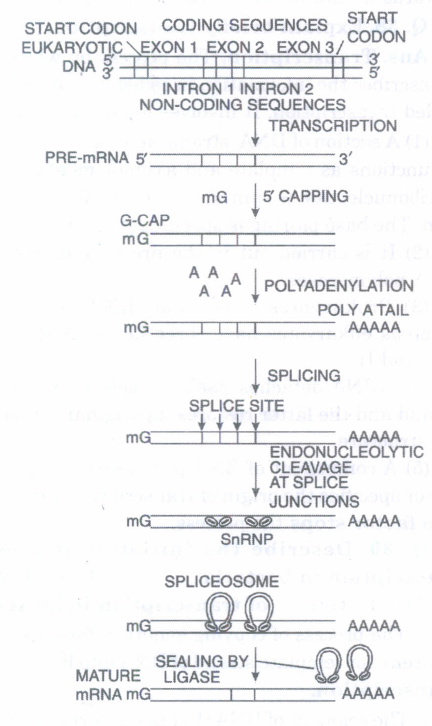
77.
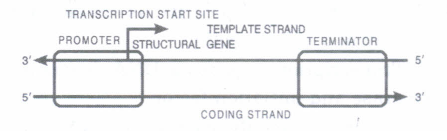
Transcription Unit
The three major components of a transcription unit are:
1. Promoter 2. The structural gene(s) 3. Terminator.
1. Promoter. Promoter is a DNA sequence that provides binding site for RNA polymerase. It is located towards 5' end (upstream) of coding strand.
2. The structural gene(s). The structural genes contain the information for the enzymes. They transcribe the mRNA for the polypeptide.
3. Terminator. A terminator is a sequence on DNA that defines the end of transcription; it is located towards 3' end (downstream) of coding strand.
78.
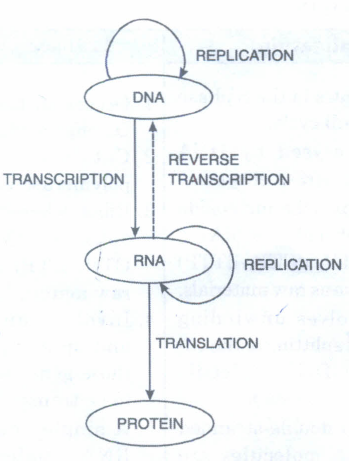
Central Dogma
1. It is the flow of information from DNA to mRNA (transcription) and then decoding information present in mRNA in the formation of polypeptide chain or protein (Translation). It was proposed by Crick 1958.
Replication
\(DNA\xrightarrow { Transcription } RNA\xrightarrow { Translation } Protein\left( Polypeptide \right) \)
2. In other words the four letter language of DNA is transcribed into 4 letter language ofmRNA in the form of triplet (codons) which is then translated in 20 letter language of protein. The structural proteins form the protoplasm whereas functional proteins constitute the enzyme, hormones, interferons and antibodies. Thus DNA directs various characters in the form of synthesis of a particular protein.
79.
1. It forms only 5% of total RNAbut is longest of all. It brings instructions from DNA for the formation of a particular polypeptide. The instructions are coded in the form of base sequence called genetic code. Three adjacent nitrogen bases specify a particular amino acid. Formation of polypeptides occur over the ribosomes. mRNA gets attached to ribosomes.
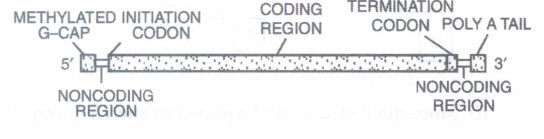
2. It starts as a cap for attachment with ribosome. It is followed by initiation codon(AUG) either immediately or after a small non-coding region. It is followed by coding region followed by termination codon (UAA, UAG and UGA). Then there is a small non-coding region and poly A area at 3 terminus. The mRNA may specify only a single polypeptide or number of them called monocistronic and polycistronic respectively. Life span of mRNA may be a few minutes to an hour or even days in case of RBC.
80.
It constitutes 15% of total RNA and is smallest out of three with only 70-85 nucleotides having sedimentation coefficient 45. It is of 100 types. Nitrogen bases of some nucleotides are modified to provide coiling to the otherwise single stranded RNA. The tRNA has two models clover leaf and L-form model. It has different specific loops as shown:
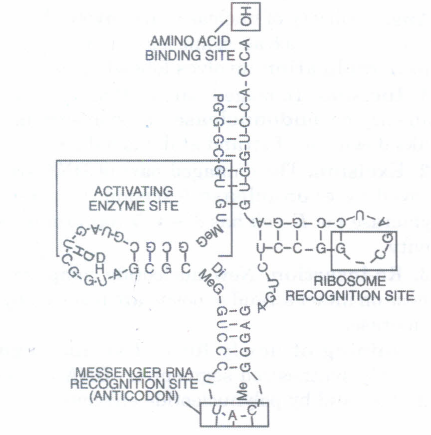
81.
It constitutes 15% of total RNA and is smallest out of three with only 70-85 nucleotides having sedimentation coefficient 45. It is of 100 types. Nitrogen bases of some nucleotides are modified to provide coiling to the otherwise single stranded RNA. The tRNA has two models clover leaf and L-form model. It has different specific loops as shown:
82.
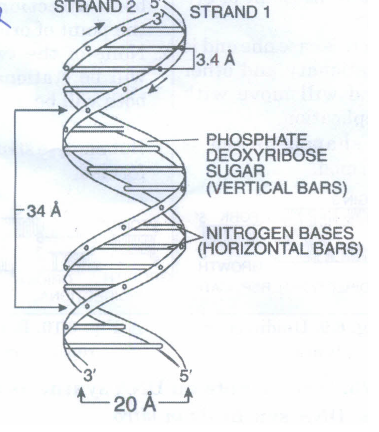
83.
Polynucleotide chains
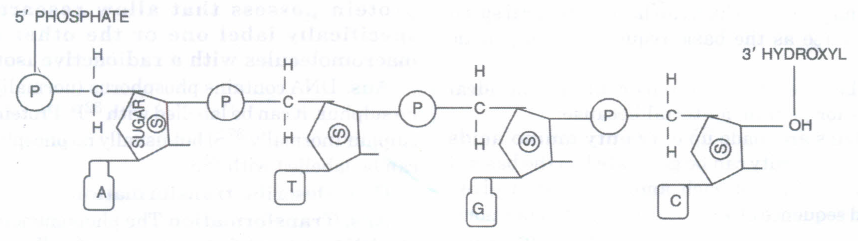
84.
(a) Transcription.
(b) Polymorphism.
1. Polymorphism (variation at genetic level) appears due to mutations. In simple terms, if inheritable mutation is observed in population at high frequency, it is referred to as DNA polymorphism.
2. The sequences which do not code for any proteins constitute bulk of human genome. Such sequences exhibit plenty of polymorphism.
3. DNA from tissues like skin, bone, saliva, sperm, blood, hair follicle represent the same type of polymorphism is responsible for forming the basis of DNA fingerprinting and Human Genome Project (HGP).
4. Paternity testing can be carried out by DNA fingerprinting because polymorphism is transmitted from parents to offspring.
5. Allelic sequence variation is called as DNA polymorphism if one allele or variant at a locus is found in human population with a frequency higher than 0.01.
6. There is a variety of types of polymorphism, ranging from single nucleotide change to very large scale change.
7. Such polymorphism plays very important role in speciation and evolution.
(c) Translation.
(d) Bioinformatics. Bioinformatics is a computer-assisted interdisciplinary science which deals with acquisition, storage, management, access and processing of moiecular biological data. The term Bioinformatics is derived from two words: "Biology" and "Informatics" so bioinformatics concerns the creation and maintenance of databases of biological informations. It involves the application of computer science and information technology to analyse and manage biological data. The majority of such databases are in the form of nucleic acid sequences and the protein sequences derived from them. These databases are very essential for current and future biotechnology research. In the last few decades, advances in molecular biology and computer technology have led to rapid sequencing of large portions of genomes of several species and are responsible for the revolution in bioinfofmatics. Thus two main components of bioinformatics are:
1. Computational biology
2. Bioinformatics infrastructure.
85.
(a) Continuous synthesis of DNA
(b) Discontinuous synthesis of DNA
86.
The quality genome sequences for both parental lines (93-11 and PA64s) were presented and updated, and a high-resolution map of genome-wide graphic genotypes was constructed by deep resequencing a core population of 132 Liang-You-Pei_Jiu recombinant inbred lines. The study provided an ideal platform for molecular breeding by quantitative trait loci cloning in rice
87.
Tool and service:
1) RePS: The first bioinformatics software developed by BGI, which mask exact repeats identified from the shotgun data and plays an essential role in rice genome assembling
2) BGF (Beijing Gene finding), developed by the gene-finding team at BGI, is a program for gene identification in eukaryotic genomic DNA sequence. It is based on Dynamic programming and HSMM (Hidden semi-Markov model) algorithm with a special emphasis on rice genomes. (Mirror in Fudan university).
3) Blast
4) Blat
88.
1. Rice is a major food staple for the world's population and serves as a model species in cereal genome research. The Beijing genomics institute (BGI) has long been devoting itself to sequencing, information, analysis and biological research of the rice genome. our rice information system (BGI-RIS) is targeted to be the most up-to-date integrated information resources for the rich genome as well as a workbench for comparative genomic analysis among cereal crops.
In addition to the comprehensive data of Oryza Sativa L.ssp. indica sequenced by BGI, BGI-RIS will host carefully curated genome information of Oryza sativa L.n Japonica (Syngenta)
2. In BGI-RIS, sequence contigs of Beijing indica and Syngenta japonica have been further assembled and anchored onto the rich chromosome. scientist have annotated the rice genomes for gene content, repetitive elements, and SNPs. sequence polymorphisms between different rice subspecies have also been identified. Designed as a basic platform for rice study, BGI-RIS presents the sequenced genome and related information in systematic and graphical ways for the convenience of in-depth comparative studies.
89.
Aims of bioinformatics:
1) To spread scientifically investigated knowledge for the benefit of the research community
2) To transform the biological polymeric sequence into sequence of digital symbols and to store them as databases
3) To develop a variety of methods and tools of software for data analysis.
90.
satellite DNA: satellite DNA refers to the repetitive DNA sequence, which does not code for any proteins, but forms a large portion of the human genome; they show the high degree of polymorphism,
Types of satellite DNA:
(I) Microsatellite
(2) Minisatellite
The criteria for their classification include:
(i) Base composition -A:T rich or G:C rich
(ii) Length of segment
(iii) Number of repetitive units
91.
Difference between induction and repressor
| .induction | repressor |
| 1) It is the switching on an operon which normally remains turned off during catabolic pathway 2) Induction is caused by a new substrate which is to be handled and metabolised 3) In this case, regulator gene produces a repressor that blocks the operator gene Induction is removal of repressor of an operon by the inducer metabolite |
1) It is the turned off an operon which normally remains switched on during catabolic pathway 2) Repressor is caused by increased formation of a metabolite 3) Regulator gene produces an aporepressor that cannot block the operator gene 4) Repressor is blocking of an operator through complex repressor formed by aporepressor and corepressor which is normally the end product |
92.
Difference between aporepressor and corepressor
| Aporepressor | Co-repressor |
| It is proteinaceous substance synthesised by regulator genes and forms a constitute of repressor for blocking the working of this it requires corepressor | It is a non-proteinaceous component of a repressor which is also an end product of reactions catalysed by an enzyme produced through the activity of a structural gene. The end product rarely accumulates. however, wherever, it accumulates it functions as co-repressor. |
93.
Differences between introns and exons
Introns: The region of a gene which does not form part of mRNA and is removed during RNA processing before mRNA formation are referred to introns
Exons: The region of a gene which becomes part of mRNA and code for different regions of the protein are referred to exons
94.
Characteristic of a eukaryotic operon:
1) They have several thousand genes
2) The information is coded in the linear sequence in DNA
3) The information in eukaryotic DNA for assembling a protein is not continuous but split
4) only exons code the mRNAs and introns do not code
5) The gene expression is regulated by changing the environment in a cell.
95.
(b) Inducer, It is a chemical which may be a substrate hormone or some other metabolic which after coming in contact with the repressor, changes the latter into non-DNA binding state so as to free the operator gene. Thus the "switch on" occurs
The expression of the genes is usually controlled to achieve maximum cellular economy. This mean that gene will be turned on or off as per requirement. A set of gene will be switched on when there is necessity to handle and metabolise a new subtrate. when these genes are turned on enzymes are produced, which metabolise the new subtrate. The phenomenon is known as induction
96.
Collinearity of gene (DNA) and polypeptide structure. Charles yonofsky and his associates have proved that gene and the polypeptide. it codes for, both are collinear. The nucleotide is arranged in the gene (DNA) in a linear segment and similarly, amino acids are linked with an each other by peptide bonds in a polypeptide strand. The sequence of amino acid in a polypeptide is determined by nucleotide base in the mRNA transcribed by DNA. Thus, The sequence of amino acid in a polypeptide chain corresponds to the sequence of nitrogen bases in the gene that codes for it
97.
Constitutive genes, The genes which are constantly expressing themselves because their products are required regularly for the normal coil metabolism. They are also called "housekeeping genes"
Non-Constitutive genes, These are not regularly required in the cells. They switch on and off according to the state of metabolism and their requirement for cellular activities. They are of two types: Inducible and repressible
98.
The 3'->5' exonuclease proofreads the nascent DNA strand during its synthesis. if a mismatched base pair occurs at 3' -OH end of the primer, the 3'->5' exonuclease removes the incorrect terminal nucleotide before polymerization proceeds again. The 5'->3' exonuclease is responsible for the removal od RNA primer during replication of DNA
99.
(i) List of codon CUU, GUC, CGG, UCC, GAG
(ii) Sequence of mRNA CUU, GUC, CGG, UCC, GAG
(iii) If in the first triplet adenine gets substituted by Guanine, the mRNA transcribe will be AAA, GUC, CGG, UCC, GAG
The sequence of amino acids in the polypeptide will be Lysine, Valine, Arginine, Serine and Glutamine
100.
The mutation affects proteins structure and functions: The effects of all mutation will be reflected in protein structure and function. It is grouped into three categories
(i) Frameshift mutation. If the mutation involves loss or addition (deletion and insertion) of one or more nucleotide of a cistron then the entire reading framework will change from the site of mutation and protein with a new set of amino acid will be obtained. it is called frameshift mutation. An example of frameshift mutation is thalassemia (Inherited blood disorder resulting in anaemia) the \(\beta \) -chain of haemoglobin is changed due to frame-shift mutation
(2) Gene or point mutation Inversion and substitution change a few nitrogen bases without altering the reading of subsequent bases. As a result, one or a few codon are changed
(3) Jumping genes when a segment of chromosome gets attached to another non-homologous chromosome, it is termed jumping genes or transposons
Transposons (jumping gene) are genetic elements which have the ability to join with DNA segment completely unrelated. thus giving the opportunity to illegitimate recombinations. These genetic elements are transposable and can occupy different sites on the main DNA molecule
These transposons are mostly present in bacteria but first B. McMlintock (1956) discovered them in maize. He called transposons in maize as controlling elements as these are responsible for turning genes on or off.
Jumping genes (Transposons) They change their position from one chromosome to another due to similarity of DNA sequence flanking them, cancers are often observed to be related to jumping genes.
101.
(i) The difference between translation and translocation:
| Translation | Translocation |
| 1) It is the complex biochemical phenomenon where transfer of information from RNA transcripts (mRNA) to polypeptide and occur during protein synthesis in the cytoplasm at ribosomal sites 2) It is phenomenon of expression of gene activity as expressed through co-ordinated activity of nucleus and cytoplasm |
1) It is the structural change chromosome; where transposition of one chromosomal segment of mutual exchange of chromosome in crossing over takes place in the dividing cells as an abnormal development 2) It has selective value in evolution of plants and animals |
(ii) Transformation and Transduction:
Transformation is permanent, inheritable changes produced in one strain of bacteria by a substance isolated from another strain of the same kind of bacteria.
Transduction: Transfer of genetic material between bacterial cells by bacteriophages is termed transduction
102.
Termination of a polypeptide synthesis:
1)When one of the termination codons (UAA, UAG, UGA) comes at the A-site, it does not code for any amino acid and there is no tRNA molecule for it
2) As a Result, the polypeptide synthesis (or elongation of polypeptide) stops
3)The polypeptide synthesised is released from the ribosome, catalysed by a 'release factor'.
103.
The role of the ribosome: Ribosomes usually form linear or helical group during active protein synthesis called polyribosomes or polysomes. The mRNA strand having coded information join along smaller subunits of the ribosome. The adjacent ribosome is 360 An apart, The different parts of ribosome connected with protein synthesis are:
(a) A tunnel for mRNA
(b) A groove for passage of newly synthesised polypeptide (larger subunit).
(c) Two active sites ( P-site- peptidyl transfer or donor site and A-site or aminoacyl or acceptor site)
(d) A binding site for tRNA near A-site
(e) The presence of enzyme peptidyl transferase.
(f) Recognition point of smaller subunit for mRNA
(g) Presence of GTase, binding sites for elongation factor and translocases
104.
initiation of polypeptide synthesis:
1) The ribosome, in its inactive state, exists as two subunits-a large subunits and a small subunit.
2) When the small subunit encounter the mRNA translation begins
3) The mRNA binds to the small subunit of ribosomes, following base pair rule, between the bases of mRNA and those on rRNA. It is catalyst by certain 'initiation factors
4) There are two sites on the larger subunits, the P site and the A-site
5) The small subunit (with the tRNA attaches to the large subunits in such a way that the initiation codon (AUG) comes on the P-site
6) The Initiator tRNA (methionyl-tRNA) binds to the P-site
Function: It starts the transcription
In eukaryotes, there is at least three RNA polymerase in addition to those found in cell organelles.
(a) RNA-Polymerase I transcribe RNAs (28 S, 18 S and 5,8 S
(b) RNA-Polymerase II transcribe the processor of mRNA called heterogeneous nuclear RNA (tRNA)
(c) RNA-Polymerase III transcribe tRNA (5S rRNA, %S nRNAs)
105.
wobble hypothesis:
1. Crick proposed a hypothesis to explain the degeneracy of code called as wobble hypothesis
2. According to this, the major degeneracy occurs at the third position, i.e. the third base of the triplets codon, while first two bases do not change. This third base is called wobble base.
3. This wobble base lacks specificity and the base in the first position of anticodon is usually abnormal, e.g. inosine, pseudouridine, tyrosine, etc.
4. These abnormal bases are able to pair with more than one nitrogen base at the same position, e.g., Inosine (I) can pair up with A, C and U etc
106.
Genetic code:
1. The sequence of the base on the DNA molecule determines the structure of mRNA which in turn governs the sequences of tRNA molecule each carrying a specific amino acid. The sequence of amino acid determines the structure of protein.
2. The mRNA molecule contains a series of nucleotides, in triplets which code the synthesis of proteins, Gamow (1954) first suggested triplets code. Each triplets containing three nucleotides is called a codon.
3.DNA contains four kinds of nucleotides and there are 20 different amino acids.
107.
Cistron. A signal of DNA which is bounded by a start and stop signal contains enough information for one complete RNA or polypeptide molecule is called cistron.
Codon. A sequence of three bases which determined one amino acid during protein synthesis is called codon.
Anticodon. A definite sequence of three nitrogenous bases of RNA which recognise the codon on mRNA is called anticodon
Initiation codon or start signal. The codon present in the beginning of the mRNA is initiation codon as AUG
Termination codon or start signal. The last codon of the mRNA at the 3 termination end are known as termination codon, i.e., UAA, UAG
108.
(i) Oncogenes are cancer causing genes. They are formed from proto-oncogenes which are present in a normal cell. oncogenes responsible for inducing uncontrolled cell divisions in a cell as a result of which cancer is caused
(ii) Reverse transcription The synthesis of a DNA molecule from the single-stranded RNA in the presence of an enzyme reverse transcriptase is called reverse transcription
A group of viruses referred to as Retroviruses has RNA as the genetic material
The single-stranded RNA of the virus gives rise to double-stranded DNA through the reverse transcription mechanism involving the enzyme reverse transcriptase. The original viral RNA is degraded and the double-stranded DNA is integrated into the host chromosome giving rise to the provirus. Transcription of the provirus may lead to the expression of viral oncogenes causing cancer. It is also possible that the provirus gives rise to the RNA and proteins leading to the information and release of more retroviral particles.
Thus, these viruses carry the genes for reverse transcription and the enzyme reverse transcriptase catalyses the conversion of RNA to DNA. Retroviruses are connected with one or the other type of cancer
109.
The difference between replication and transcription:
| Replication | Transcription |
| 1) Occurs in the S shape of cell cycle 2) Catalyst by DNA polymerase enzymes 3) Deoxyribonucleoside triphosphate (dATP, dGTP, dCTP, dTTP) serve as raw materials 4) Involves unwinding and splitting of the entire DNA molecule (chromosome). 5) Two double-stranded DNA molecules are formed from one DNA molecule |
1) Occurs in the \({ G }_{ 1 }\) and phases of cell cycle 2) Catalyst by RNA polymerase enzymes 3) Rribonucleoside triphosphate (ATP, GTP, CTP, UTP) serve as raw materials 4) Involves unwinding and splitting off only those genes which are to be transcribed 5) Single one-stranded DNA molecules are formed from a segment of one DNA strand |
110.
Initial process of transcription in bacteria:
1) The process of copying genetic information from antisense or template strand of DNA into RNA is called transcription.
2) The segment of DNA that takes part in transcription is called transcription unit, It has three components
(i) A promoter
(ii) The structural gene
(iii) A terminator
3) Structural gene is component of that strand of DNA which has 3'->5' polarity as transcription can occur only in 5'->3' direction
4) Transcription requires a DNA-dependent RNA polymerase and initiation factor
5) Bacteria have only one type of RNA polymerase which transcribes all the three types of RNAs
6) Ribonucleotides of ribose series are activated through phosphorylation (ATP, GTP, CTP, UTP)
7) Transcription begins at initiation site. A promotor has RNA polymerase recognition site and it binds to the specific site.
8)Enzymes required for unwinding of chain are unwindase and single cell binding proteins
9) Nucleotides are added as per base pairing rule
111.
The process by which DNA transcribes the information in coded form on mRNA is called transcription. It involves following steps:
(1) A section of DNA strand separates and one of it function as the template and a complementary strand of ribonucleotide is synthesised in the 5'->3' direction. The base pairing is specific A= U; C=G.
(2) It is carried out in the presence of \(Mg^{ ++ }\) and RNA polymerases
(3) Prokaryotes have one RNA polymerase whereas eukaryotes have three i.e., RNA polymerase I, II, III
(4) mRNA detaches itself actively from the DNA strand and the latter restores its original double helical structure
(5) A component of RNA polymerase called sigma factor specifies the origin of transcription and later on rho factor stops the process.
112.
Requirements for transcription:
(1) The enzyme RNA polymerase
(2) A DNA template
(3) All four types of ribonucleoside triphosphates (ATP, CTP, GTP and UTP)
(4) Divalent metal ions or as a \({ Mg }^{ 2+ }\)\({ Mn }^{ 2+ }\) cofactor. No primer is needed for RNA synthesis
113.
Three types of RNA:
(1)rRNA (ribosomal RNA)
(2)mRNA (Messenger RNA
(3)tRNA (Transfer RNA
Relationship between three types of RNA with respect to concept of information flow
1()mRNA: brings the information in the coded form of triplets called genetic code. During protein synthesis (translation) it joins smaller subunits of ribosome
(2)rRNA: is synthesised in the nucleolar region from DNA. It is associated with ribosomes which are sites of protein synthesis
(3)tRNA works as an adaptor molecule for carrying amino acid to the mRNA template during protein synthesis. It bears anticodon and recognises the specific codon on mRNA
114.
Differences between DNA and RNA
| DNA | RNA |
| 1) It is a double-stranded helical structure and genetic material of most of animals and plants 2) Deoxyribose is the sugar 3) Thymine is the pyrimidine |
1) It is a single-stranded molecule and genetic material of certain viruses 2) Ribose is the sugar in RNA 3) Uracil is the pyrimidine in the RNA |
115.
RNA was first genetic material: There is now enough evidence to suggest that essential life processes ( such as metabolism, translation, splicing etc.) evolved around RNA. RNA is used to act as a genetic material as well as a catalyst (there are some important biochemical reactions in living systems that are catalyst by RNA catalyst and not by protein enzymes). But, RNA being a catalyst was reactive and hence unstable. Therefore, DNA has evolved from RNA with chemical modification that the make it a more stable. DNA being double stranded and having complementary strand further resists changes by evolving a process of repair
116.
The role of m-RNA:mRNA is formed from DNA under the influence of enzyme RNA polymerase. It carries information from nucleus to cytoplasm on ribosomes. mRNA has the sequence of bases in form of triplets called genetic code
the role of t-RNA: tRNA is present in the cytoplasm. It combines with activated amino acid in the presence of ATP and forms amino acid tRNA. tRNA has 3 bases called anticodon which is opposite to codon on mRNA, tRNA carries amino acid to mRNA, wherein the sequence it helps a polypeptide chain
The role of ribosomal rRNA: rRNA is present in ribosomes. it helps in providing a site for protein synthesis.
117.
A variety of nuclease are involved in the repair replication such as exonuclease and endonuclease repair replication involves following steps
1) Incision: Damaged part of DNA is recognised by an enzyme, endonuclease (incision enzyme). This breakdown one of strand at damaged part
2) Excision: Damaged part of DNA strand is removed by an exonuclease (Excision enzyme). DNA polymerase I of E.coli has 3'->5' has exonucleolytic activity
3) Re-insertion: New nucleotide complementary to those on intact strand opposite are inserted by DNA polymerase
4) Joining of newly formed strand segment: The newly synthesised segment of DNA is attached to the main strand by polynucleotide enzyme
118.
Repair Replication: DNA is capable of self-proofreading. If by chance one base pair is formed incorrectly (chance one in 10,000) It can find the mistake and correct itself during replication. The enzymes involved are endonuclease and exonuclease.
DNA can be damaged from a variety of environment factors, such as radiation, chemicals, physical stimulants etc. The survival of cell depend upon the ability of DNA to repair itself
119.
DNA synthesis in vitro
A. Kornberg DNA in vitro and was awarded Nobel prize in 1959. A single stranded DNA is added to a reaction mixture containing dGTP, dATP, dCTP and dTTP and DNA polymerase enzyme also called Kornberg enzyme A single stranded DNA acts as a template. The DNA polymerase takes instruction from DNA template in some unknown manner but unique and forms complementary strand
120.
| leading strand | lagging strand |
| (i) The replicated strand of DNA which grows continuously without any gap |
(i) The replicated strand of DNA formed of short Okazaki fragments |
| (ii) DNA ligase enzyme is not required for its growth | (ii) DNA ligase enzyme is required for joining Okazaki fragments |
| (iii) It is synthesized in the 5' ⟶ 3' direction | (iii) In Okazaki fragments direction is 5'->3' but overall direction is 3'⟶ 5' |
121.
(a) Both 3' -> 5' and 5' ->3' exonuclease activities
(b) The 3' -> 5' exonuclease proofreads the nascent DNA strand during its synthesis. If mismatched base pair occurs at 3' -OH end of the primer. the 3' -> 5' exonuclease removes the incorrect terminal nucleotide before polymerization proceeds again. The 5' ->3' exonuclease is responsible for the removal of RNA primer during replication of DNA
122.
Difference between DNA polymerase and RNA polymerase
| DNA polymerase | RNA polymerase |
| 1) It requires deoxyribonucleotides (A,T,G,C) 2) It requires a primer for one of the strands to be synthesised 3) It can carry out proofreading |
1) It requires ribonucleotides (A,U,G, C) 2) It does not require primer 3) It does not carry out proofreading |
123.
Semiconservative model of DNA replication:
1) Watson and crick suggested that the two strand serves as a template for the synthesis of a new strand alongside it
2) The sequence of bases which should be present in the new strand can be easily predicted because these would be complementary to the bases present in old strands, A will pair with T, T with A, C with G and G with c
3) Thus, two daughter molecules are formed from the parent molecule and these are identical to the parent molecule
4) Each daughter DNA molecule consists of one old (parent) strand and one new strand.
5) Since only one parent strand is conserved in each daughter molecule, This mode of replication is said to be semi-conservative.
124.
RNA was the first genetic material
1) There is now enough evidence to suggest that essential life processes (such as metabolism, translation, splicing etc) evolved around RNA
2) RNA used to act as a genetic material as well as catalyst (there is some important biochemical reaction in a living system that is catalyst by RNA catalyst and not by protein enzyme).
3) But, RNA being a catalyst was reactive and hence unstable
4) Therefore, DNA has evolved from RNA with chemical modification that makes it a more stable DNA being double stranded and having complementary strand further resists changes by evolving a process of repair
125.
Difference between prokaryotic DNA and eukaryotic DNA
| Prokaryotic DNA | Eukaryotic DNA |
| 1) Occurs in the cytoplasm and much less in amount than in eukaryotic cells 2) Circular in form 3) It has little protein associated with it 4) Can code for fewer (3 to 4,000) proteins. 5) Dentures into a tangled mass 6) No non-coding introns within the coding regions |
1) Occurs in the nucleus mitochondria and plastids and much more in amount than prokaryotic cells 2) linear in form in the nucleus, Circular in form in mitochondria and plastids 3) Nuclear DNA is associated with proteins, extranuclear DNA is not. 4) Can code for more proteins. 5) Nuclear DNA denatures into 2 distinct strands, extranuclear DNA denatures into a tangled mass 6) Non-coding introns occur within the coding regions |
126.
Structure of DNA, Watson and crick (1953) proposed the "double helix" model of DNA molecule and shared Nobel pr4ize with Wilkins of Britain
The DNA molecule consists of two polynucleotide chains of deoxyribose series twisted about each other in the form of a double helix or spiral. The nucleotides join each other by phosphodiester bonds to forms polynucleotides. The linkage between adjacent nucleotides is of ester type in which the 5' and 3' hydroxyls of two adjacent sugars from double ester with phosphoric acid, The two polynucleotide strands are held together by hydrogen bonds.
Phosphate and sugar form vertical bars of the spiral and the horizontal steps are formed by specific base pair i.e. A=T, T=A, C=G and G=C.
The two complementary to each other and run in antiparallel direction
127.
DNA molecule is "Double helical" structure as shown by X-ray crystallography. It is formed of two unbranched polynucleotide complementary strands are spirally coiled around a central axis. The nitrogen bases are paired forming horizontal steps of ladder whereas the vertical bars are formed of sugar and phosphate.
128.
Components of nucleotides
1) Pentose sugar (Deoxyribose in DNA and Ribose sugar in RNA)
2) Phosphoric acid as phosphate.
3) Nitrogen Bases, purines adenine (A) and Guanine (G), and Pyrimidines-cytosine (C), Thymine (T) and Uracil (U) in RNA instead of Thymine.
129.
1. DNA is a long polymer of deoxyribonucleotides, The length of DNA is usually defined as a number of nucleotides (or a pair of nucleotide referred to as base pairs) present in it. This also is the characteristic of an organism.
2. For eg, A bacteriophage is known as \(\phi \) \(\times \)174 has 5386 nucleotides, Bacteriophage lambda has 48502 base pair (bp), Escherichia coli has 4.6\(\times \) \({ 10 }^{ 6 }\) bp, and haploid content of human DNA is 3.3 \(\times \) \({ 10 }^{ 9 }\) bp
130.
Nucleic acids, The polynucleotide chains of very high molecular weight are called nucleic acids. They were first observed by meischer (1868) in the nuclei of pus cells. hence their name. They are the highly complex compound of carbon, oxygen, hydrogen, nitrogen and phosphorus. They are the genetic material of living organism
They are two types:
(1) Deoxyribose nucleic acid (DNA)
(2) Ribose nucleic acid (RNA)
131.
| Linear double-stranded DNA | Higher animals and plants, Adenovirus type 12, Herpes simplex virus |
| Circular double-stranded DNA | Bacteria, polyma viruses, SV 40 virus |
| Linear single-stranded DNA | Infuenza virus. |
| Circular single-stranded DNA | \(\phi \)\(\times \) 174 coliphage |
| Linear single-stranded RNA | Tobacco virus, Poliomyelitis virus, Bacterial viruses \({ F }^{ 2 }Q\beta -MS\quad 13\quad { R }^{ 17 }\) |
| Linear double-stranded RNA | Rheovirus, wound tumour viruses |
132.
Phosphorus exist in the backbone of the DNA strands and sulphur is constituted of amino acid or protein thus rationale of this experiment is different than c and N isotopes
133.
Transformation, The phenomenon by which the DNA isolated from one type of cell when introduced to another type of cell, is able to bestow some of its properties to the former, it is termed transformation
A transformation was experimentally proved by Griffith with his experiments on Diplococcus pneumoniae. These experiments were further continued by Avery, MacCleod and McCarty and proved that transforming agent is DNA. It led to prove that DNA is the genetic material.
134.
DNA contains phosphorus (normally \({ 13 }_{ P } \) ) but no sulphur, it can be labelled with \({ 32 }_{ P }\) proteins contain sulphur (normally \({ 32 }_{ S }\)) but usually no phosphorus, They cab be labelled with \({ 35 }_{ S }\)
135.
(a) Avery, MacCleod and McCarty gave the proof that "Transforming agent" is DNA
Avery, MacCleod and McCarty experiment:
1) Oswald Avery, colin MacCleod and McCarty in 1933-34 revealed the chemical nature of the transforming substance to be DNA
2) They purified DNA, RNA, Protein from heat-killed S-strain to see which of them could transform R-cells \(\rightarrow \)S-cells.
3) They also observed that protein digesting enzyme (protease) and RNA digesting enzyme (RNAase) have no effect on transformation whereas digestion of DNA with DNAase would not cause transformation
4) This finding established that transforming genetic material is DNA
Result of experiment
| Mixture | Result |
| 1) R-type bacteria + carbohydrates of S-type bacteria 2) R-type + protein of S-type 3) R-type + DNA of S-type 4) R-type + DNA of S-type + Deoxyribonuclease |
R-type R-type S-type R-type |
(b) Griffith's in vitro experiments demonstrated the occurrence of transformation in Pneumococcus. They provide no indication as to the molecular basis of the transformation phenomenon. Avery and MacCleod carried their experiments in vitro employing biochemical analysis to demonstrate that transformation was mediated by DNA
(c) Griffith showed that a transforming substance existed. Avery et.al. defined it as DNA
136.
Living organisms are composed of various biomolecules and there are two main macromolecules, i.e., DNA and proteins which can have structural specificity as diverse as the basic requirement of genetic material
It was believed that proteins could be the ideal candidates for genetic material because:
(1) Proteins are made up of twenty amino acids thus the diversity can be generated on the basis of the number of residues of each amino acid in a given protein and sequence of amino acid would be enormous.
(2) They are macromolecules and universally present.
137.
primary structure of nucleic acid and protein
| Nucleic acid | Protein |
| 1) Polynucleotid | 1)Polpeptide |
| 2) a) Four types of nucleotides in DNA (dAMP, dCMP, dGMP and dTMP) are present b) Four types of nucleotides in RNA (AMP, CMP, GMP, and UMP are present |
2) Twenty amino acids present in innumerable numbers and sequences |
| 3) A polynucleotide strand has a polarity (5' end and 3' end). | 3) Polypeptide would have a free-COOH group at C-Terminal, one \({ NH }_{ 2 }\) group at N-Terminal. |
| 4) Nucleotides are linked with phosphodi-ester bonds | 4) Amino acid are linked with peptide bonds |
138.
Tandemness in repeats provides many copies of the sequence for DNA fingerprinting and variability in nitrogen base sequences presents in them. Being individual-specific, this proves to be useful in the process of DNA fingerprinting.
139.
Watson and crick had the following information which helped them to develop a model of DNA.
(i) Chargaff's law suggestion A=T and C=G.
(ii) Wilkins and Roseland Franklins worked on DNA and obtained very fine X-rays photographs of DNA by X-ray diffraction method.
Watson and crick proposed
(a) The pattern of complementary bases pair
(b) Semi-conservative replication
(c)Mutation through tautomerism.
140.
Human genome helps to find out the complete genome sequence of the human. It has many advantage and disadvantage
Advantages:
1) It provides the knowledge of the effect of variation of DNA among individuals can revolutionise the ways to diagnose, treat and prevent many diseases that affect humans.
2) It also provides clues to the understanding of human biology. It helps to find out the human evolution. Identification through DNA forensics is also possible
3) Metabolic defects can be taken care of
Disadvantages:
1) Prior Knowledge of proneness to certain disease will make oneself a worried a lot.
2) Many marriages will breakdown for fear of passage of defects to the offspring
3) Person with a good resistance will become careless
141.
The estimate of a total number of human genes was very high (about 1,40,000 genes) because of a large size of the human genome. However, most of the human genome is made of noncoding repetitive sequences and single nucleotides. Only 2% of the genome actually consist of structural genes which are now estimated to be <25000. some of them are believed to form more than one type of proteins due to alternating splicing.
142.
1. The sequence of human genome helped in enhancing the basic understanding of genetics and immunity to various disorders. various genes that cause genetic disorders were identified with the help of this project
2. It was found that more than 1200 genes are responsible for the common human cardiovascular disease, endocrine disease (like diabetes), neurological, disorder (like Alzheimer's disease), cancers and much more. These diseases can be treated easily by knowing the particular gene responsible for the particular disease.
143.
1. Use of \({ 15 }_{ N }\) will not give any conclusive result because it is only a heavy isotope of nitrogen
2. \({ 15 }_{ N }\) will be incorporated into proteins as well as in DNA and hence it would appear both in the supernatant and in the sediment
144.
RNA is more liable and prone to degradation (owing to the presence of 2'OH group in its ribose) Hence, heat-killed S-strain may not have retained its ability to transform the R-strain into virulent form if RNA was its genetic material.
145.
Retroviruses do no follow central dogma of (DNA->RNA->Protein) because their genetic material is not DNA. Instead they have RNA that is converted to DNA by the enzyme reverse transcriptase. It is termed reverse transcription. It was proposed by Temin
146.
(i) While replicating, the entire DNA molecule to keep the whole molecule stabilised does not open in one go because it would be highly expense energetically. Actually un unwidinsg creates tension in the molecule as uncoiled parts.
Actually, unwinding creates tension in the molecule as uncoiled parts starts forming super coils due to the interaction of exposed nucleotides.
(ii) Replication fork: Instead helicase enzyme, acts on the double strand at or site (origin of replication and a small stretch is unzipped. Immediately. It is held and stabilised by single strand binding protein.
Slowly with the help of enzymes, exposed strands are copied as a point of unwinding moves and ahead in both direction
It gives an appearence of Y-shaped structure which is called replication fork.
The two functions that the monorner units of NTPs play are:
1. They pair up with exposed nucleotides of the template strand and make phosphodiester linkages and release a pyrophosphate.
2. Hydrolysis of his pyrophosphate by enzyme pyrophosphate release energy that will facilitate making hydrogen bonds between free nucleotides and bases of the template strand
147.
Differences between polycistronic mRNA and monocistronic mRNA:
| Monocistronic mRNA | Polycistronic mRNA |
| 1. It is the mRNA that can code for only one polyeptide i.e., it has one sictron 2. It is normally found in eukaryotic |
1. It is the mRNA that can code for more than one polypeptide i.e., it has more than one cistron, 2. It is found in prokaryotic cells |
148.
1) By using the heavy isotope of nitrogen.they could find out the semiconservative nature of DNA replication as the densities of DNA having in\( { 15 }_{ N }\) both the strands \( { 15 }_{ N }/{ 14 }_{ N }\) DNA and \( { 14 }_{ N }/{ 14 }_{ N }\) DNA were all different.
2) The hybrid DNA (\( { 15 }_{ N }/{ 14 }_{ N }\) DNA ) had a density intermediate between that of heavy DNA (\({ 15 }_{ N }/{ 15 }_{ N }\) DNA) and that of light/normal DNA (\({ 14 }_{ N }/{ 14 }_{ N }\) DNA)
149.
The biochemical nature of transforming principle was discovered by Avery, Mcleod and McCarty (1944). They incubated non-virulent pneumonia bacteria (streptococcus pneumonia) with carbohydrate, protein, DNA and DNA+ DNAase (nucleotides only) of virulent bacteria in different cultures. some bacteria of the culture having DNA of virulent form became virulent indicating that the bacteria have picked up the gene from the culture medium which is made of DNA
150.
Transformation is a genetic change due to an incorporation of a gene from outside source. In Griffith's experiment, the live non-virulent pneumonia bacteria became virulent by picking up the factor of virulence from their dead relatives. The transforming material was found out to be DNA by Avery et al (1944)
151.
(i) a - AUG
b - UAA/UAG/UGA.
(ii) AUG codes for methionine.
UAA/UAG/UGA does not code for any amino acid, but brings about termination of polypeptide synthesis.
(iii)There are two sites in the large subunit of ribosome, where the subsequent amino acids bind to and come close enough for formation of peptide bond; it is catalysed by peptidyl transferase.
The ribosome also acts as a catalyst (in bacteria) for the formation of peptide bond.
152.
(a) a to a' is \({ 5 }^{ ' }\longrightarrow { 3 }^{ ' }\)
No more amino acid will be added.
(b) TCA; anticodon is UCA.
(c) The untranslated regions are required for efficient translation process.
They are present before the initiation codon at the 5'-end and after the stop/termination codon, at the 3'-end.
153.
(a) It is a nucleosome.
(b) a - Histone octamer;
b - DNA;
c - \({ H }_{ 1 }\) Histone.
(c) In prokaryotes, the DNA is held with some positively-charged proteins to form a nucleoid.
154.
(a) A-5', B-3'
(b) The figure represents the continuous and discontinuous synthesis of DNA strands at the replication fork, during replication of DNA.
(c) Replication fork is the y-shaped structure formed with small opening of DNA double helix.
(d) DNA polymerase catalyses polymerisation of nucleotides only in \({ 5 }^{ ' }\longrightarrow { 3 }^{ ' }\) direction.
(e) Both the strands of (parental)DNA act as templates for the synthesis of new strands.
(f) On the template strand with \({ 3 }^{ ' }\longrightarrow { 5 }^{ ' }\) polarity, the new strand is synthesised as a continuous stretch; it is called continuous synthesis.
(g) On the other strand with \({ 5 }^{ ' }\longrightarrow { 3 }^{ ' }\) polarity, DNA is synthesised as short stretches; it is called discontinuous synthesis.
Later the short stretches of DNA are joined by DNA-ligases into a continuous strand.
155.
The possible levels of regulation in eukaryotes could be at
(i) Transcriptional level i.e. formation of primary transcript.
(ii) Processing level i.e. regulation of splicing
(iii) During transport of mRNA from the nucleus to the cytoplasm
(iv) translation level
156.
1.Both the strands of parent DNA function as template strands.
2. On the template strand with \({ 3 }^{ ' }\longrightarrow { 5 }^{ ' }\) polarity, the new strand is synthesised as a continuous stretch as the DNA polymerase can carry out polymerisation of the nucleotides only in \({ 5 }^{ ' }\longrightarrow { 3 }^{ ' }\)direction; this is called continuous synthesis and the strand is called leading strand.
3. On the other template strand with \({ 5 }^{ ' }\longrightarrow { 3 }^{ ' }\) polarity, the new strand is synthesised from the point of replication fork, also in \({ 5 }^{ ' }\longrightarrow { 3 }^{ ' }\) direction, but in short stretches; they are later joined by DNA - ligases to form a strand, called lagging strand.
157.
DNA-fingerprinting
It is a method of comparing the DNA sequences of any two individuals, by identifying the differences in some specific regions of DNA.
DNA fingerprinting is used for the following:
(i) To identify criminals in the forensic laboratory.
(ii) To determine the real or biological parent in case of disputes.
(iii) To verify whether an immigrant is really a close relative of the mentioned resident.
(iv) To identify racial groups to rewrite the biological evolution.
158.
Human Genome Project
It is a mega project for the following facts:
(i) The human genome has approximately \(3.3\times { 10 }^{ 9 }\) bp; if the cost of sequencing is US $3 per bp. the approximate cost is about US $9 billions.
(ii) If the sequences obtained were to be stored in typed form in books and if each page contained 1000 letters and each book contained 1000 pages, then 3300 such books would be needed to store the information.
(iii) The enormous quantity of data expected to be generated also necessitates the use of high speed computational devices for data storage, retrieval and analysis.
159.
(a) Promoter
This is the sequence of DNA/gene, that provides place for binding of RNA polymerase.
(b) tRNA
It acts as an adapter molecule, that reads the code on the mRNA on one hand and binds to a specific amino acid on the other hand.
By its anticodon, it recognises the codon of the amino acid it carries, and transports the amino acid to the site of protein synthesis.
(c) Exons
These are the regions of eukaryotic gene/DNA, which form parts of RNA and code for different regions in the proteins.
160.
Nitrogenous bases are adenine, cytosine, thymine and uracil. Nucleosides are guanosine and cytidine.
161.
(a)
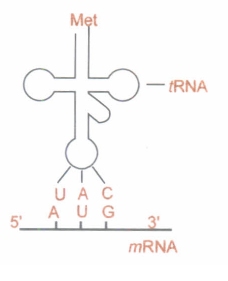
(b) RNA polymerase III.
(c) The amino acid methionine is the initiator amino acid.
162.
Charging of tRNA
1. The amino acids are activated in the presence of ATP and linked to their cognate tRNA; this process is called charging of tRNA or amino acylation of tRNA.
2. This process is necessary as the formation of peptide bond between the amino acids is favoured energetically, when they are brought together
3. The activation of amino acids by ATP provides the energy for the formation of peptide bond.
163.
(i) Replication of DNA occurs in small replication forks, because DNA is such a long molecule that the separation of the two strands along its entire length requires a very high amount of energy.
(ii) DNA polymerase can catalyse the polymerisation of nucleotides only in \({ 5 }^{ ' }\rightarrow { 3 }^{ ' }\) direction.So on the template strand with \({ 3 }^{ ' }\rightarrow { 5 }^{ ' }\) polarity, DNA replication is continuous.On the template strand with \({ 5 }^{ ' }\rightarrow { 3 }^{ ' }\) polarity, DNA synthesis occurs in short stretches as the opening of replication fork continues; later these short stretches are joined by the action of DNA ligases
(iii) Replication of DNA does not initiate randomly, and DNA polymerases on their own cannot initiate replication.So, there is a specific sequence on DNA, called origin of replication; DNA polymerase binds to it and continues the process.
164.
1. The viruses/bacteriophages grown on radioactive sulphur \(\left( ^{ 35 }{ S } \right) \) contained radioactive protein but not radioactive DNA, because DNA does not contain sulphur.
2.When these viruses were allowed to infect bacteria, the bacteria did not contain radioactivity, because proteins did not enter the bacteria; hence protein is not the genetic material.
3. The viruses grown on radioactive phosphorus \(\left( ^{ 32 }{ P } \right) \) contained radioactive DNA, becauseDNA contains phosphorus and not proteins.
4. When these viruses were allowed to infect the bacteria, the bacteria were radioactive, indicating that DNA is the genetic material that has passed from the virus into bacteria.
165.
Refer to text on page no. 123-124
166.
1. In the mammalian cells (or eukaryotes) there is a set of positively-charged basic proteins, called histones.
2. Histones are organised to form a unit of eight molecules, called histone octamer.
3. The negatively charged DNA is wrapped around the positively charged histone octamer to form a structure, called nucleosome.
4. A typical nucleosome contains 200 bp of DNA helix.
5. The nucleosomes constitute the repeating units of chromatin, which appear as beads-on-string structure under an electron microscope.
6. These are further packaged to form the chromatin fibres, which condense to form chromosomes.
7. The packaging of chromatin at higher levels requires additional set of proteins called non-histone chromosomal (NHC) proteins.
167.
(a) Chromosome 1 has the most genes and V-chromosome has the fewest.
(b) It is expected to help in:
(i) locating the disease-associated sequences of DNA on the chromosomes.
(ii) tracing human history.
168.
1. Satellite DNA refers to the bulk of the genomic DNA, whose sequences do not code for proteins, but form major peaks during density gradient centrifugation.
2. The sequences of satellite DNA show high degree of polymorphism.
3. Since DNA from every tissue of an individual shows the same degree of polymorphism, it forms the basis of DNA fingerprinting.
4. Since the polymorphism is also inherited by children from the parents, it helps in paternity testing in case of disputes.
169.
Initiation of translation
1. When the small subunit of ribosome binds to the mRNA the process of translation starts; in bacteria the ribosome also acts as a catalyst (23S rRNA is ribozyme) for peptide bond formation.
2. The ribosome binds to mRNA at the start codon (AUG), that is recognised by the initiator tRNA; it involves certain initiation factors. Termination of translation
1. When the ribosome falls on a termination codon, a release factor binds to it, and translation is terminated and the polypeptide is released from the ribosome.
2. Untranslated regions are present at the 5' end before the start codon and also at the 3' end after the termination codon.
They are required for efficient translation.
170.
(a) Since tRNA on one hand binds to a specific amino acid and on the other hand reads the codon of the amino acid bound to it through its anticodon, it is called an 'adapter'.
(b)
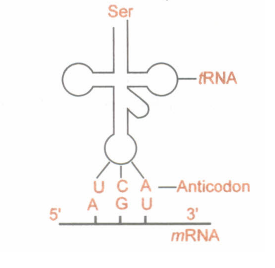
It actually looks like an inverted L.
171.
(a) Structural genes of lac operon
There are three structural genes, z, y and a in lac operon.
Gene z codes for \(\beta \) -galactosidase (\(\beta \) gal), that hydrolyses lactose into glucose and galactose.
Gene y codes for permease that helps lactose to enter the cell.
Gene a codes for transacetylase that makes lactose into its active form.
(b) Lactose acts as inducer.
(i) It binds to the repressor coded by the regulatory (i) gene and prevents it from binding to the operator. So,the RNA polymerase gains access to promoter and transcription of the structural genes is triggered .
(ii) Since, the repressor inhibits the transcription, the regulation of lac operon by repressor is called negative regulation.
172.
(i) The regulatory gene in lac operon (also called i gene or inhibitor gene) codes for a protein, called repressor; the repressor is synthesised all the time constitutively.
(ii) The repressor has high affinity to the operator; it binds to the operator region and prevents the RNA polymerase from transcribing the structural genes of the operon.
173.
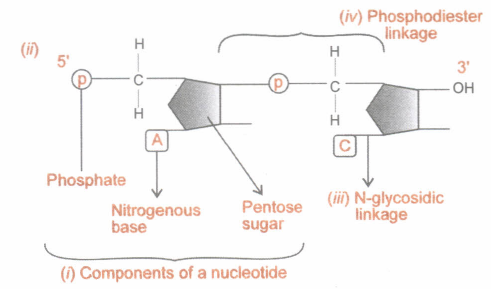
174.
Elongation Process of Transcription in bacteria.
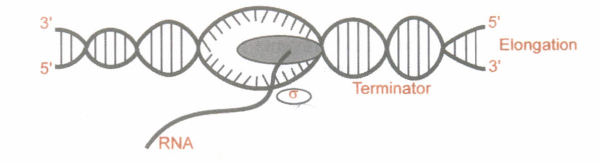
1..After binding to the promoter, the RNA polymerase facilitates the opening of the DNA.
2. It uses nucleoside triphosphates as substrate and polymerises the nucleotides in a template-dependent fashion following complementarity of bases in the \({ 5 }^{ ' }\longrightarrow { 3 }^{ ' }\) direction.
3. The process continues till the RNA polymerase reaches the terminator region on the DNA strand.
175.
(i) 'BAC' - Bacterial Artificial Chromosome.
'YAC' - Yeast Artificial Chromosome.
(ii) They are the commonly used vectors for cloning the DNA fragments in the hosts like bacteria and yeast.
(iii) The cloning results into amplification of each fragment of DNA, so that they could be sequenced with ease.
176.
(i) In eukaryotes, the hnRNA (primary transcript of mRNA) has coding sequences, called exons as well as non-coding sequences, called introns, i.e. the information is split.
(ii) It undergoes a process, called splicing, in which the introns are removed and the exons are joined together in a particular manner, to form the functional mRNA.
(iii) In prokaryotes, the mRNA is polycistronic, i.e. codes for more than one polypeptide.
(iv) The information is continuous and no splicing is required.
177.
(i) Differences
| Promoter | Terminator |
| It is the sequence of DNA that provides binding site for RNA polymerase for transcription. It is located towards 5' end (upstream) of the structural gene. |
It is the sequence of DNA that defines the end of the process of transcription. It is located towards the 3' end (down-stream) of the structural gene. |
(ii) Differences
| Exon | Intron |
| Exons are the coding sequences of DNA that form part of mRNA and code for different regions of the poly-peptide. |
Introns are the non-coding sequences of DNA that are removed during splicing of hnRNA and they do not form a part of mRNA. |
(iii) Differences
| Inducer | Repressor |
| Inducer is the substance that binds to the repressor and 'switches on' or induce the operon. Regulation of the operon is positive. |
Repressor is the protein coded by regulatory (i) gene, that binds to the operator and 'switches' off' the operon. Regulation of the operon is negative. |
178.
(a) Francis Crick.
(b)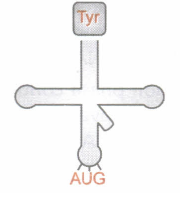
(c) It looks like inverted L.
179.
(a) \({ NH }_{ 4 }Cl\) (ammonium chloride).
(b) It was done to show that after one generation of Escherichia coli with \(^{ 15 }{ N }-DNA,\) in a medium of \(^{ 14 }{ N }\), the DNA was of intermediate density between the light and heavy DNAs; it shows that of the two strands, only one strand is synthesised newly, using the \(^{ 14 }{ N }\)-nitrogen source in the medium.
(c) The heavy and light DNA molecules can be distinguished by centrifugation in a caesium chloride (CsCI) density gradient; the \(^{ 15 }{ N }-DNA,\) was heavier than \(^{ 14 }{ N }-DNA\) and the \(^{ 15 }{ N }-^{ 14 }{ N }-DNA\) hybrid was intermediate between the two.
(d) They concluded that DNA replication is semiconservative, i.e., of the two strands of DNA, one is the parental strand while the other is synthesised new.
180.
(i) ATCGTACTA.
(ii) Base pairs are held together by weak hydroyen bodsin a DNA molecule. Adenine pairs with thymine by two H-bonds and guanine pairs with cytosine by three H-bonds.
(iii) According to basc complementarity rule proposed by Erwin Chargalf for a double-stranded DNA, the ratios between adenine-thymine and guanine-cytosine are constant and equal to one.
181.
1. Transcription unit in a bacterium consists of a promoter, structural genes, terminator and the enzyme DNA dependent RNA-Polymerase.
2. In bacteria, there is a single RNA polymerase, which catalyses transcription of all the three types of RNAs (mRNA, tRNA and RNA)
3. It also facilitates opening of the double helical DNA and only the DNA strand with \({ 3 }^{ ' }\longrightarrow { 5 }^{ ' }\) polarity is transcribed, as the enzyme can polymerise the nucleotides only in \({ 5 }^{ ' }\longrightarrow { 3 }^{ ' }\) direction.
4. Once the polymerase reaches the terminator sequence, the nascent RNA falls off and termination of transcription occurs.
182.
1. Genetic code is degenerate as some amino acids are coded by more than one codon, e.g. proline and glycine are coded by four codons each.
2. Genetic code is unambiguous and specific as each codon codes only for a particular amino acid; e.g. GUG codes for valine, UUU codes for phenylalanine, AUG codes for methionine.
3. Genetic code is universal as one codon codes for the same amino acid in all organisms, be it a bacterium or a human. e.g. AUG codes for methionine in all organisms.
183.
In Eukaryotes:
1. The structural genes are split. They have coding sequences (exons) interspersed with non-coding sequences (introns).
2. The primary transcript of RNA undergoes a process called splicing, by which the introns are removed and the exons are joined together.
3. The hnRNA (precursor of mRNA) undergoes capping and tailing to become mRNA.
4. In capping, methyl guanosine triphosphate is added to the 5' end of hnRNA.
5. In tailing, adenylate residues (about 200-300) are added at the 3' end.
6. The fully processed mRNA is released from the nucleus into the cytoplasm.
184.
The lac operon consists of
(i) three structural genes (z,y and a) which code for \(\beta \) -galactosidase, permease and transacetylase, respectively.
(ii) an operator; which controls the structural genes as a unit.
(iii) a regulatory gene ti.e., inhibitor gene) and
(iv) a promoter, where the RNA polymerase binds for transcription.
The regulatory gene codes for the repressor protein, all the time (constitutively): the repressor binds to the operator to inactivate the operon.
Lactose enters the cell with the help of permease and the active form of lactose binds to the repressor and prevents it from binding to the operator.
This allows RNA polymerase an access to the promoter and transcription continues, i.e. lac operon is activated.
185.
(a) RNA polymerase III transcribes, tRNA. Methionine is the amino acid.
(b) The initiator tRNA binds to the amino acid, methionine; at its amino acid acceptor site.
At its anticodon loop, it has the anticodon for methionine, i.e. UAC; it recognises the start codon (AUG) at the P site and binds to it following complementarity of bases.
186.
RNA is the first genetic material because:
(i) RNA can directly code for the synthesis of proteins and hence can easily express the character; it is the genetic material in many viruses.
(ii) RNA can also act as a catalyst; there are some important biochemical reactions in living systems that are catalysed by RNAs and not proteins.
(iil) Many essential life processes like splicing, translation, etc. have evolved around RNA.
187.
RNA is the first genetic material because:
(i) It is capable of both storing genetic information and catalysing chemical reactions.
(ii) Essential life processes such as metabolism, translation, splicing, etc., have evolved around RNA.
(ii) It can directly code for protein synthesis and hence can easily express the character.
188.
(i) UAA does not code for any amino acid; it is a termination codon.
(ii) Genetic code is specific and unambiguous, i.e. one codon codes for a particular amino acid only.
(iii) Genetic code is degenerate, as one amino acid is coded by more than codon, e.g. UUU and UUC code for phenylalanine.
(iv) Genetic code is read in a contiguous manner without any punctuation (any three) AUG has a dual function; it is initiation codon as well as codes for methionine.
189.
1. A single DNA dependent RNA polymerase catalyses the formation of mRNA, tRNA and rRNA in bacteria.
2. The enzyme is capable of catalysing only the elongation step of transcription.
3. It combines transiently to the initiation or sigma factor and binds to the promoter and initiates transcription.
4. It somehow facilitates the opening of the DNA helix and catalyses the polymerisation of ribonucleoside triphosphates in a template-depended fashion, i.e. elongation.
5. When it reaches the terminator sequence, the enzyme associates transiently with the termination or rho(p) factor and terminates transcription, the RNA and the enzyme fall off the template.
190.
1. A single DNA dependent RNA polymerase catalyses the formation of mRNA, tRNA and rRNA in bacteria.
2. The enzyme is capable of catalysinq only the elongation step of transcription.
3. It combines transiently to the initiation or sigma factor and binds to the promoter and initiates transcription.
4. It somehow facilitates the opening of the DNA helix and catalyses the polymerisation of ribonucleoside triphosphates in a template-depended fashion, i.e. elongation.
5. When it reaches the terminator sequence, the enzyme associates transiently with the termination or rho(p) factor and terminates transcription, the RNA and the enzyme fall off the template.
191.
(i) A nucleotide has three components a nitrogenous base, a pentose (ribose) sugar and a phosphate group.
(ii) There are two types of nitrogenous bases-purines and pyrimidines.
(iii) The purines are adenine and guanine.
(iv) The pyrimidines are cytosine and uracil.
(v) A nitrogenous base is linked to the ribose sugar through aN-glycosidic linkage, to form a nucleoside (adenosine, guanosine, cytidine or uridine).
(vi) When a phosphate group is attached to 5'-OH of a nucleoside, through a phosphoester linkage, a nucleotide is formed.
(vii) Two nucleotides are linked through 3'-5' phosphodiester linkage to form a dinucleotide.
(viii) When more nucleotides are joined in this manner, it becomes a polynucleotide.
(ix) A polynucleotide has at one end a free phosphate moiety at 5' end of ribose sugar; it is referred to as the 5'-end of the polynucleotide.
(x) The other end of the polymer has a free 3'-OH group of ribose; it is called the 3'-end of the polynucleotide chain.
(xi) The backbone of the polynucleotide chain is formed by the sugar and phosphates and the nitrogenous bases project from the backbone.
192.
(a) Phosphate.
(b) Adenine.
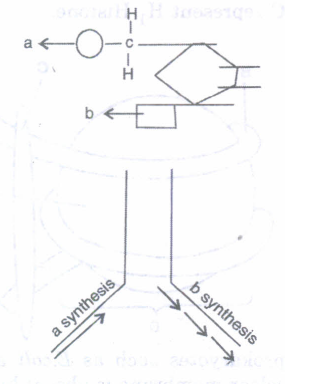
193.
5' - AUGCAUGCAUGCAUGCAUGCAUGCAUGC - 3'
194.
(i) (a) Hydrogen bonds.
(b) Purine base
(c) Deoxyribose sugar.
(ii) 'd' represents 5' end of the chain,
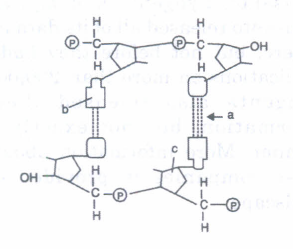
195.
The factors responsible for conferring stability of double helix structure of DNA are as follows
(i) Stacking of one base pair over other.
(ii) H-bond between nitrogenous bases.

12th Standard CBSE Syllabus & Materials
12th Standard CBSE
CBSE 12th Computer Science Python Revision Tour I - New Previous year Question Papers Study Material - QB365 Set A
NEW12th Standard CBSE
CBSE 12th Business Studies Planning Important Questions And Answers Study Material - QB365 Set A
NEW12th Standard CBSE
CBSE 12th Business Studies Business Environment Important Questions And Answers Study Material - QB365 Set A
NEW12th Standard CBSE
CBSE 12th Business Studies Principles of Management Important Questions And Answers Study Material - QB365 Set A



NCERT Books

Syllabus

Exam Pattern

Sample Question Papers

Previous year Question Papers

Important Notes

MCQ Practice test

NCERT Exemplers

Case study Questions

Image Based Questions

Passage based Questions

HOT Questions

Value Based Questions

Model Questions Papers
NCERT ( Book Back ) Questions

Assertion and Reason
Important Questions And Answers

CBSE 12th Standard CBSE Subjects
CBSE Standards








