
 100% FREE ACCESS
12th Standard CBSE Syllabus & Materials
12th Standard CBSE
CBSE 12th Economics Government Budget and the Economy Previous year Question Papers Study Material - QB365 Set A
NEW12th Standard CBSE
CBSE 12th Computer Science Interface Python with MySQL - New Previous year Question Papers Study Material - QB365 Set A
NEW12th Standard CBSE
CBSE 12th Computer Science Database Concept - New Previous year Question Papers Study Material - QB365 Set A
NEW12th Standard CBSE
CBSE 12th Computer Science Data Communication - New Previous year Question Papers Study Material - QB365 Set A
NEW12th Standard CBSE
CBSE 12th Computer Science Data Structures - New Previous year Question Papers Study Material - QB365 Set A
NEW12th Standard CBSE
CBSE 12th Computer Science Functions - New Previous year Question Papers Study Material - QB365 Set A

Published on: 28/11/2025
Download CBSE Class 12th Standard CBSE Biology question papers, sample papers, important questions, and previous year solved papers in PDF format. Get free study materials, NCERT solutions, and exam preparation resources for Class 12th Standard CBSE Biology
Questions + Answers key
Take MCQ Biology Test
1.
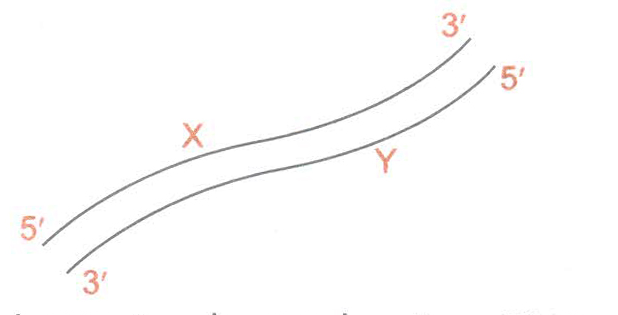
A structural gene has two DNA strands X and Y shown above. Identify the template strand.
2.
Mention the unique feature with respect to flowerin and fruiting in bamboo species.
3.
In the diagram given below
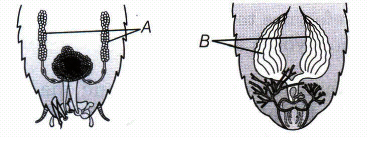
i) Label the parts A and B.
ii) Is the animal shown above unisexual or bisexual?
iii)Which type of animals are called hermaphrodite?
4.
Explain when is a genetic code said to be
(i) Degenerate (ii) Universal
5.
The pedigree chart given below shows a particular trait which is absent in parents but present in the next generation irrespective of sexes.
Draw your conclusion on the basis of the pedigree.

6.
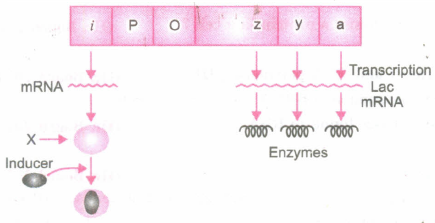
(a) Name the molecule 'X' synthesised by 'i' gene.How does this molecule get inactivated?
(b)Which one of the structural genes code for \(\beta \)-galactosidase?
(c)When will the transcription of this gene stop?
7.
A black colour cock when bred with a white coloured hen produced steel blue coloured offspring and when inbred, black, white and steel blue coloured progeny were obtained:
(a) This result is genetically explained as.
(b) What will be the expected ratio of black, steel blue and white progeny?
8.
Name two hormones that are constituents of contraceptive pills. Why do they have high and effective contraceptive value? Name a commonly prescribed non-steroidal oral pill.
9.
Name the scientist who had used the set-up shown below:
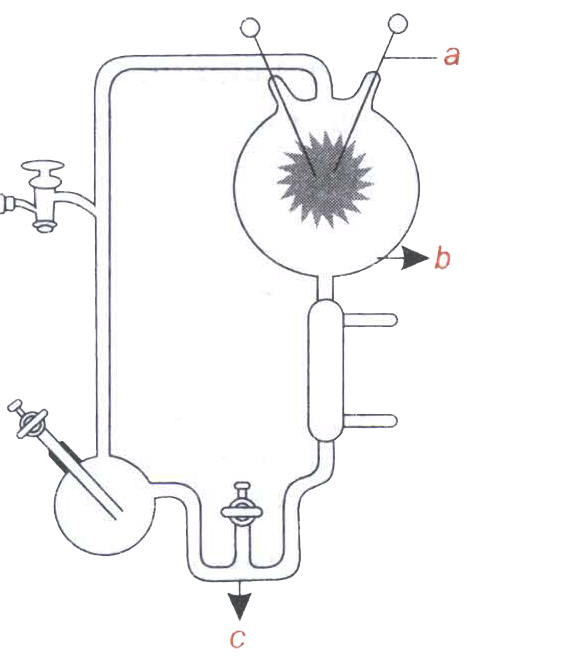
Write the purpose of 'a' in the set-up and the conclusion, the scientist arrived at.
10.
Match between the following representing parts of the sperm and the functions:
|
Column A |
Column B |
|
A. Head |
(i) Enzymes |
|
B. Middle piece |
(ii) Sperm motility |
|
C. Acrosome |
(iii) Energy |
|
D. Tail |
(iv) Genetic material |
11.
Name the blank spaces a,b,c and d from the table given below:
| Item | What it represents in the plant |
|
(i) Pericarp |
a |
| (ii) b | cotyledon in seeds of grass family |
| (iii) Embryonal axis | c |
| (iv) d | remains of nucellus in a seed |
12.
Given below is a schematic representation of a lac operon.
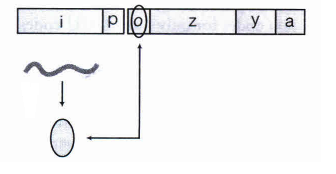
(i) Identify i and p.
(ii) Name the inducer for this operon and explain its function.
13.
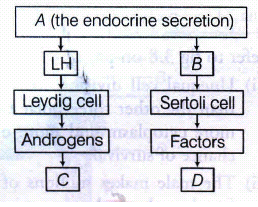
Identify A,B,C and D with reference to gametogenesis in humans in the flow chart given below.
14.
View the figure and fill in the following blanks :
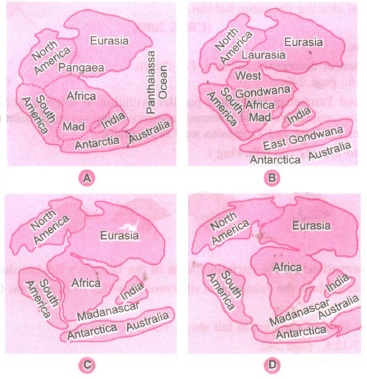
(i) About ........ years ago, present day continents formed a single large, irregular land mass called ......
(ii) As the continents drifted away, the ........ separated them forming ...... to free intercontinental movements of organisms.
(iii) The earth has been divided into ....... biogeographical realm namely, Australian, Neotropical, ........., Oriental, palearctic and Nearctic.
(iv) Biogeographical realms were first proposed by P.L. Sclater for specific group of animals called ...... and were later recognized by A.R. Wallace for ..........
(v) .......... had a voyage to Galapagos group of islands and later gave concept of ........
15.
Match the items in column I with appropriate items (one or more) of column II.
| Column I | Column II |
| (i) Connecting link between annelids and arthropods | (a) Impression or imprints of past animals and plants in the sedimentary rocks. |
| (ii) Vestigial organ in man. | (b) Peripatus |
| (iii) Fossils | (c) Auricular muscles |
| (iv) Extinct bird | (d) Seymouria |
| (v) Missing link between amphibian and reptiles. | (e) Coccyx (tail bone) |
| (f) Archaeopteryx | |
| (g) Vermiform appendix |
16.
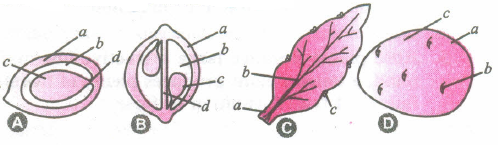
In the following figures label the parts responsible for production of new plants
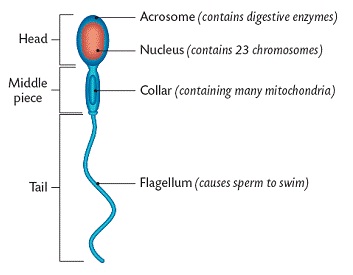
17.
Draw a mammalian sperm and label its four major parts.
18.
Name the organisms with respect to their diverse sexuality
1. Bisexual flower
2.Monoecious plant
3. Dioecious plant
4. Bisexual animal
5. Unisexual animal
19.
Explain the increase in the numbers of melanic (dark-winged) moths in the urban areas of post-industrialisation period in England.
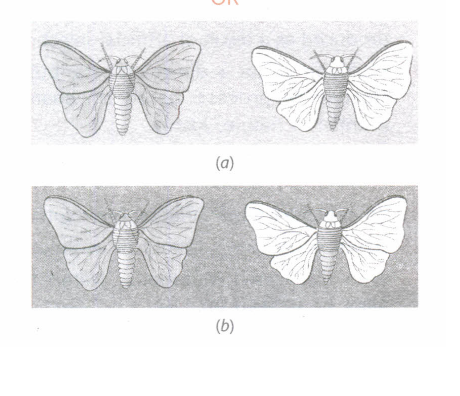
What do these picture 'a' and 'b' illustrate with reference to evolution?Explain.
20.
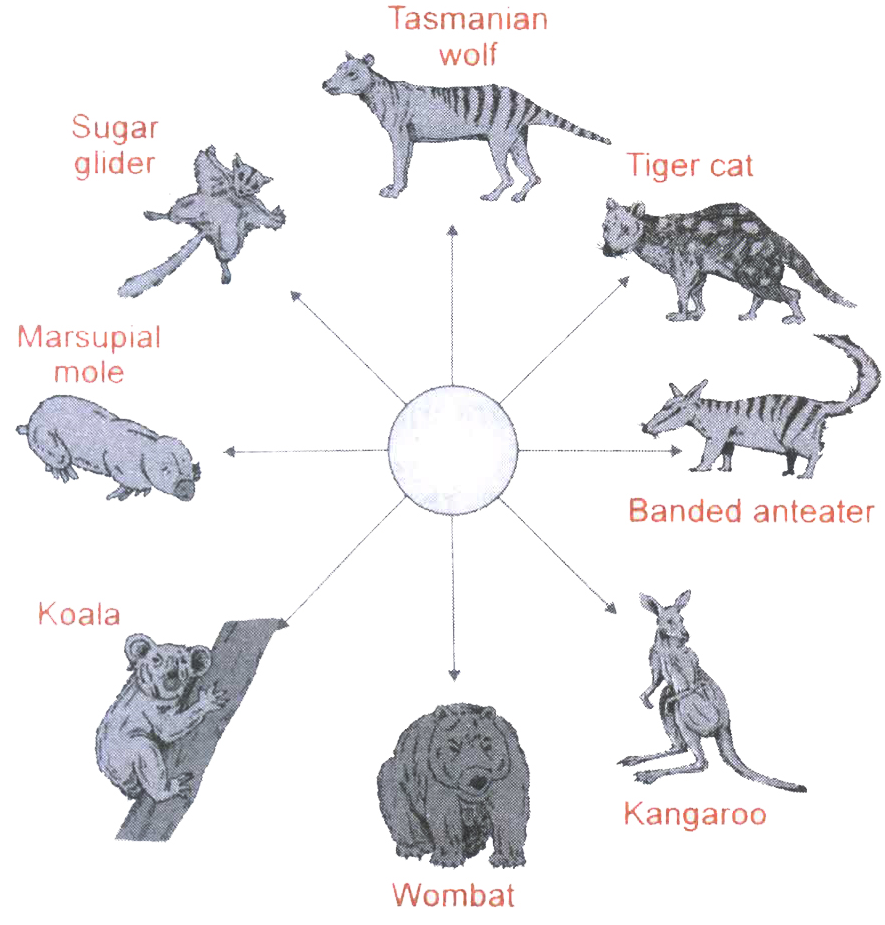
(a) Mention the specific geographical region where these organisms are found.
(b) Name and explain the phenomenon that has resulted in the evolution of such diverse species in the region.
(c) Explain giving reasons the existence of placental wolf and Tasmanian wolf sharing the same habitat.
21.
Write down the possible levels of regulation of gene expression in eukaryotes.
22.
Differentiate between the following
(i)Promoter and Terminator in a transcription unit.
(ii)Exon and intron in an unprocessed eukaryotic mRNA.
(ii)Inducer and Repressor in operons.
23.
In peas, tallness is dominant over dwarfness and red colour of flowers is dominant over the white colour. When a tall plant bearing red flowers was pollinated with a dwarf plant bearing white flowers, the different phenotypic groups were obtained in the progeny in human mentioned against them:
Tall, Red = 138
Tall, White = 132
Dwarf, Red = 136
Dwarf, White = 128
Mention the genotypes of the two parents and of the four offspring types.
24.
Answer the following questions related to Down's syndrome.
(i) When was Down's syndrome first described?
(ii) What is its frequency in human and does it also occur in other animals?
(iii) How does Down's syndrome arise?
(iv) Related it with chromosome dysfunctions.
25.
While travelling, Arvind noticed that in his city every public transport, whether bus or train, was full of passengers and there was no space even in the markets or other public places. He shared his observation with his grandfather. Grandfather told him that the situation was not so worse when he was a child. Population has increased so much that we do not have sufficient resources to provide basic amenities needed in a civillized society.
Read the above passage and answer the following questions:
(i) Whar are the possible reasons of population explosion?
(ii) What are the adverse effect of such population explosion?
(iii) As an educated citizen, what are your suggestion to reserve the trend?
26.
Explain the events taking place at the time of fertilisation of an ovum in human female.
27.
Draw the diagram of a microsporangium and label its wall layers. Write briefly about the wall layers.
28.
Let us assume in a given plant, the genotype symbol 'Y' stands for dominant yellow seed colour and 'Y' for recessive green seed colour; symbol 'R' for round seed shape and 'r' for wrinkled seeds. Two homozygous parents (plant) with genotypes 'RRYY' and 'rryy' are crossed and their F1 generation progeny is then
(a) Phenotype of F1 progeny
(b) Genotype of F1 Progeny
(c) Gamete genotypes of F1 progeny
(d) Phenotypic ratio of F2 population
(e) Phenotypic ratio of yellow seeds to green seeds and round seeds to wrinkled seeds in F2 population.
1.
()
Y
2.
()
Bamboo flowers only once in its life time, generally after 50-100 years. It produces large number of fruits and dies.
3.
i) Part A is tested and B is ovaries
ii)The animal shown above is unisexual as both the sexes are separate with distinct male and female individuals.
iii)The animals that possess both male and female reproductive organs in the same individual are called hermaphrodite animals, e.g. earthworm.
4.
The differences between unambiguous and universal genetic codes are as follows
| Unambiguous | Universal |
| In genetic code, one codon codes for only one amino acid hence, it is unambiguous | The genetic code is universal.i.e. each codon codes for same amino acid in all organisms |
(ii) The differences between degenerate and initiator codes are as follows
| Degenerate | Initiator |
| Some amino acids are coded by more than one codon, hence the code is degenerate, e.g. serine, leucine, arginine are encoded by 6 codons. | These codons act as start signal for translation. e.g. AUG acts as initiator codon and it codes for methionine |
5.
It is an autosomal recessive trait that is not found in the parents, but has appeared irrespective of sex in the offspring. It this case, both the parents are heterozygous for the trait.
6.
(a)Molecule 'X' synthesised by 'i ' gene is repressor of the Lac operon.The repressor is inactivated by interaction with the inducer(i.e.,lactose)
(b)The gene 'Z' codes for beta-galactosidase
(c)Transcription of this stops as soon as the inducer is usedup i.e in absence of inducer.Once whole of lactose is consumed and there is no inducer present to blind to the repressor,the repressor becomes active and switches off the operon.
7.
(a) Incomplete dominance or mosaic inheritance.
(b) The expected ratio will be 1:2:1. i.e. 1 black, 2 steel blue and 1 white.
8.
(a) Oral contraceptive pills contain
1. Progesterone alone or a combination of
2. progesterones and estrogen hormones.
(b) Effective contraceptive pills
1. Inhibition of ovulation
2. Inhibition of motility and secretory activity of fallopian tubes.
3. Changes in the endometrium layer of uterus to make it unsuitable for implantation.
(c) 'Saheli' contains a non-steroidal preparation called centchroman.
9.
1. S.L. Miller used this.
2. The electrodes (a) are used to create an electric discharge, similar to the lightning in the primitive earth; it was to provide energy.
3. He observed formation of amino acids; it proved the chemical evolution.
10.
A - iv; B - iii; C - i; D - ii
11.
(a) Fruit wall
(b) Scutellum
(c) Plumule and radicle
(d) Perisperm
12.
(i) i-Regulatory gene, p - Promotor gene.
(ii) Inducer is lactose.
Functions
(a) Enters the cell and binds to the repressor and inactivates it.
(b) As a result, repressor cannot bind to the operator .This allows RNA polymerase to have access to the promotor and transactions proceeds.
13.
A - GnRH
B - FSH
C - Spermatogenesis
D - Spermiogenesis
14.
(i) 250 million ; pangaea
(ii) seas ; barriers
(iii) six ; Ethiopian
(iv) birds ; all animals and plants
(v) Charles Darwin ; organic evolution.
15.
(i) b (ii) c, e and g (iii) a (iv) f (v) d.
16.
(A) c is a seed that produces new plant.
(B) c is a seed that produces new plant.
(C) c is an adventitious bud that produces a new plant.
(D) b is an eye that has a bud.
17.
Structure of a mammalian
18.
1. Sweet potato
2. Chara
3. Marchantia
4. Tapeworm
5. Rabbit.
19.
1. In England, before industrial revolution, there were more white-winged or dull-grey moths on the tree trunks, than the dark-winged or melanic moths.
2. In the collection of moths, carried out in the same area after industrial revolution, there were more dark-winged moths.
3. The explanation given for this observation was that predators will spot a month against a contrasting background.
4. During the post-industrialisation period, the trunks became dark with the industrial smoke and soot.
5. Under this condition, white-winged moths did not survive as predators could easily spot these, while dark-winged or melanic moths survived better.
6. Before industrialisation, there used to be a thick growth of the almost white coloured lichens on the tree trunks and in that background, the white-winged moths survived better; the dark coloured moths were easily spotted and picked up by their predators.
7. In this case,the moths which were able to camouflage and hide in the background survived and increased their population size through reproduction.
20.
(a) Australia.
Adaptive radiations. Evolutionary process of giving rise to new species adapted to new habitats, conditions and ways of life is called adaptive radiations.
It can be explained with an example of marsupial mammals present in Australia due to different geographical locality have. similar habitat but have different species.
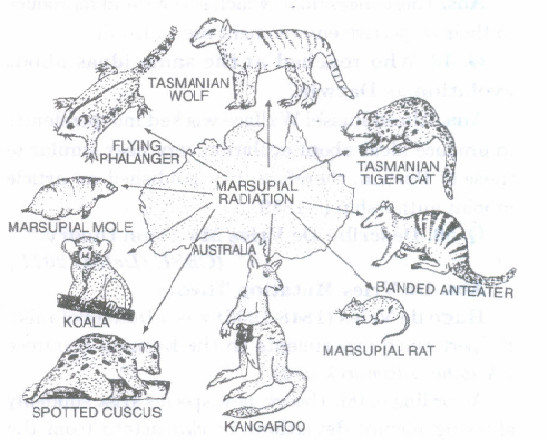
Adaptive radiations of Australian marsupials.
21.
The possible levels of regulation in eukaryotes could be at
(i) Transcriptional level i.e. formation of primary transcript.
(ii) Processing level i.e. regulation of splicing
(iii) During transport of mRNA from the nucleus to the cytoplasm
(iv) translation level
22.
(i) Differences
| Promoter | Terminator |
| It is the sequence of DNA that provides binding site for RNA polymerase for transcription. It is located towards 5' end (upstream) of the structural gene. |
It is the sequence of DNA that defines the end of the process of transcription. It is located towards the 3' end (down-stream) of the structural gene. |
(ii) Differences
| Exon | Intron |
| Exons are the coding sequences of DNA that form part of mRNA and code for different regions of the poly-peptide. |
Introns are the non-coding sequences of DNA that are removed during splicing of hnRNA and they do not form a part of mRNA. |
(iii) Differences
| Inducer | Repressor |
| Inducer is the substance that binds to the repressor and 'switches on' or induce the operon. Regulation of the operon is positive. |
Repressor is the protein coded by regulatory (i) gene, that binds to the operator and 'switches' off' the operon. Regulation of the operon is negative. |
23.
The phenotypes obtained in the progeny fall i'1to a ratio of 1 : 1 : 1 : 1, which is Mendelian dihybrid test cross ratio.
It is a cross between a dihybrid (heterozygous for both traits) and a double recessive plant.
The cross is as follows:
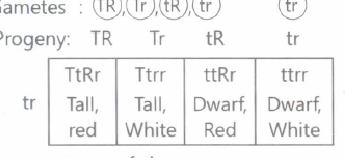
The genotypes of the parents:
TtRr and ttrr
The genotypes of the offspring:
TtRr, Ttrr, ttRr, and ttrr
24.
(i) It was first described in 1866 by J Langdon Down, so it is called Down's syndrome.
(ii) About 1 in every 750 children exhibits Down's syndrome throughout the world. It is also seen in chimpanzees and other related primates.
(iii) In humans, it comes as a result of non-disjunction of chromosome 21 during egg formation. The cause of this primary non-disjunction is not known.
(iii) The defect is associated with a particular small portion of chromosome 21. When this particular chromosome segment is present due to translation in three copies, instead of two, Down's syndrome occur.
25.
(i) A sudden increase in population in the recent past is due to decrease in death rate and increased longevity as a result of recent advances in medical science.
(ii) As resources are limited, it will not be possible to provide food, shelter, education, medical facilities and other public facilities to all our citizens.
(iii) We should popularise the advantage of small family and method of birth control.
26.
Fertilisation is the fusion of two gametic nuclei to form a diploid zygote.It involves a series of chemical and physical steps as follows:
The cortical cytoplasm of ovum shows the physicochemical reactions called the cortical reactions.
1.Sperm lysins dissolve the membranes around egg.centriole physically passes into ovum.
3.Normally these reactions result in the formation of fertilisation membrane outside the egg plasma membrane.
4.In man, cortical granules burst and release their contents between egg plasma membrane and zona pellucida i.e. perivitelline space (No fertilisation membrane formation).The plasma membrane shows increased permeability for water, phosphate and potassium.
5.Electrical potentiality of plasma membrane changes from positive to negative, NAD kinase enzyme becomes activated after fertilisation for the oxidation and reduction reaction of the cell.
6.Rate of DNA synthesis increases with great pace after fertilisation.Hence the ovum is now ready for mitosis(cleavage).
7.Cleavage results in multicellular in dividual.
27.
A typical microsporangium is surrounded by four wall layers, i.e. the epidermis, endothecium, middle layers and the tapetum. The outer three wall layers are protective in function and help in dehiscence of anther to release pollen grains.
The innermost layer (tapetum) nourishes the developing microspores or pollen grains. The cells of tapetum possess dense cytoplasm and generally have more than one nucleus.
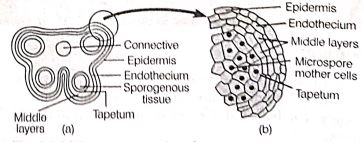
When the anther is young, a group of compactly arranged homogenous cells called the sporogenous tissue occupies the centre of each microsporangium.
28.
(a) Round and yellow seeds
(b) Rr Yy

(d) 9 round, yellow seeded: 3 Round, green-seeded: 3 wrinkled, yellow seeded: 1 green, wrinkled - seeded
(e) Yellow-seeds: green seeds = 3 : 1 Round seeds: Wrinkled seeds = 3 : 1

12th Standard CBSE Syllabus & Materials
12th Standard CBSE
CBSE 12th Computer Science Python Revision Tour I - New Previous year Question Papers Study Material - QB365 Set A
NEW12th Standard CBSE
CBSE 12th Business Studies Planning Important Questions And Answers Study Material - QB365 Set A
NEW12th Standard CBSE
CBSE 12th Business Studies Business Environment Important Questions And Answers Study Material - QB365 Set A
NEW12th Standard CBSE
CBSE 12th Business Studies Principles of Management Important Questions And Answers Study Material - QB365 Set A



NCERT Books

Syllabus

Exam Pattern

Sample Question Papers

Previous year Question Papers

Important Notes

MCQ Practice test

NCERT Exemplers

Case study Questions

Image Based Questions

Passage based Questions

HOT Questions

Value Based Questions

Model Questions Papers
NCERT ( Book Back ) Questions

Assertion and Reason
Important Questions And Answers

CBSE 12th Standard CBSE Subjects
CBSE Standards








