
 100% FREE ACCESS
12th Standard CBSE Syllabus & Materials
12th Standard CBSE
CBSE 12th Economics Government Budget and the Economy Previous year Question Papers Study Material - QB365 Set A
NEW12th Standard CBSE
CBSE 12th Computer Science Interface Python with MySQL - New Previous year Question Papers Study Material - QB365 Set A
NEW12th Standard CBSE
CBSE 12th Computer Science Database Concept - New Previous year Question Papers Study Material - QB365 Set A
NEW12th Standard CBSE
CBSE 12th Computer Science Data Communication - New Previous year Question Papers Study Material - QB365 Set A
NEW12th Standard CBSE
CBSE 12th Computer Science Data Structures - New Previous year Question Papers Study Material - QB365 Set A
NEW12th Standard CBSE
CBSE 12th Computer Science Functions - New Previous year Question Papers Study Material - QB365 Set A

Published on: 02/11/2025
Download CBSE Class 12th Standard CBSE Biology question papers, sample papers, important questions, and previous year solved papers in PDF format. Get free study materials, NCERT solutions, and exam preparation resources for Class 12th Standard CBSE Biology
Questions + Answers key
Take MCQ Biology Test
1.
Name two interspecific interactions where one partner is neutral i.e. not affected.
2.
Why are cattle and goats not seen browsing on calotropis growing in the field?
3.
In a pond there were 200 frogs. 40 more frogs were born in a year. Calculate the birth rate of the population.
4.
Define stages zero population growth rate. Draw an age pyramid for the same.
5.
State the type of interaction that exists between ticks and dogs.
6.
Name the type of interaction that exists between barnacles and whale.
7.
Provide an instance where the population size of a species can be estimated indirectly, without actually counting them or seeing them
8.
How do seed-bearing plants tide over dry and hot weather conditions?
9.
Why are mango tress unable to grow in temperate climate?
10.
Name the type of association that the genus Glomus exhibits with higher plants.
11.
Name the kind of interaction between alga and fungus
12.
Name the interaction that exists between sucker fish and shark.
13.
Give the name of two parasitic plants and two parasitic animals.
14.
Name the two intermediate hosts on which the human liver fluke depends to complete its life cycle so as to facilitate parasitisation of its primary host.
15.
Mention how closely related species of warblers are able to co-exist in a competitive environment.
16.
Why the Calotropis plants are not grazed by goats and cattle?
17.
What are the organisms that feed on plant sap and other plant parts called?
18.
An exotic variety of prickly pear introduced in Australia turned out to be invasive. How was it brought under control?
19.
How do fishes in Antarctica region remain active in sea water?
20.
Mention the adaptation of mammals in polar seas
21.
Why do small mammals of the of the polar region have short ears and short limbs?
22.
Name a plant group which exhibits vivipary.
23.
Name the amino acid which is normally accumulated by xerophytes.
24.
Aquatic animals that change the osmotic concentration of their body fluids according to the environment are known by which name?
25.
Name two 'photoperiod' dependent processes, one each in plants and in animals.
26.
'Green algae are not likely to be found in the deepest strata of the ocean'. Give atleast one reason.
27.
Give an example of an organism that enters 'diapause' and why?
28.
How is 'stratification' represented in a forest ecosystem?
29.
In a pond there were 30 Hydrilla plants. Through reproduction 10 new Hydrilla plants were added in a year. Calculate the birth rate of population.
30.
Why is the polar region not a suitable habitat for tiny humming birds?
31.
List two negative interactions between two species.
32.
List the factors affecting the population size.
33.
Apart from mammals what class of animals has highly developed societies.
34.
From where are individual organisms derived?
35.
What does stratification of community depict?
36.
Give the equation for representing J-shaped growth curve.
37.
What is metapopulation?
38.
List two physical barriers which check interbreeding amongst population.
39.
What are the major sources of water on the earth?
40.
Why do plants in the water logged soil?
41.
What causes animal variations in the intensity and duration of temperature?
42.
What is significance of adaptations?
43.
What are osmoconformers? Give one example.
44.
What is osmoregulation? Name the osmoregulatory apparatus of human environment.
45.
What are ectotherms?
46.
List any two unique habitats
47.
Define habitat and niche.
48.
List key elements that lead to variations in the physical and chemical conditions of different habitats.
49.
What is the basic unit of ecology?
50.
What is brood parasitism? Explain with the help of an example.
51.
Define ectoparasite and endoparasite and give suitable examples.
52.
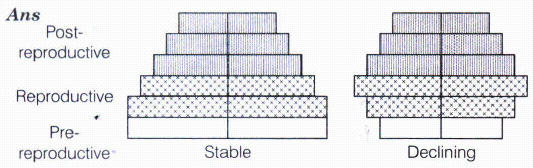
Give a suitable example for commensalism
53.
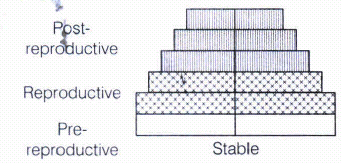
What is high altitude sickness ? Write its symptoms.
54.
What is diapause and its significance?
55.
Define aestivation.
56.
What is homeostasis ?
57.
Why do high altitude areas have brighter sunlight and lower temperatures as compared to the plains.
58.
What is mycorrhiza ?
59.
What is commensalism?
60.
Define stenohaline species.
61.
What are eurythermic species ?
62.
Species that can tolerate narrow range of temperature are called ------------
63.
If a population of 50 Paramoecium present in a pool increases to 150 after an hour, what would be the growth rate of the population?
64.
What will happen to a well-growing herbaceous plant in the forests, it it is transplanted outside the forest in a park?
65.
What is interaction between two species called?
66.
What would be the growth curve pattern, when the resources are unlimited?
67.
Name the association in which one species produces poisonous substance or a change in environmental conditions that is harmful to another species.
68.
What does ecological niche of an organism represent?
69.
In a pond, there were 24 lotus plants. 8 new plants were added by way of reproduction in one year. Calculate the birth rate of the lotus plants.
70.
Give one example where population estimation of an organism is done indirectly without actually counting the organisms.
71.
Give an example where percentage cover is a more meaningful measure of the population size.
72.
Define homeostasis.
73.
Why many of the freshwater animals cannot live for long in sea water or vice-versa?
74.
List any two physiological responses that help you to gradually get acclimatised to high altitudes, when you go from the plains.
75.
How do herbs and shrubs survive under the shadow of big canopied trees in forests?
76.
Between amphinbians and birds, which will be stable to cope with global warming? Give reason.
77.
Mention any two significants roles predation plays in nature.
78.
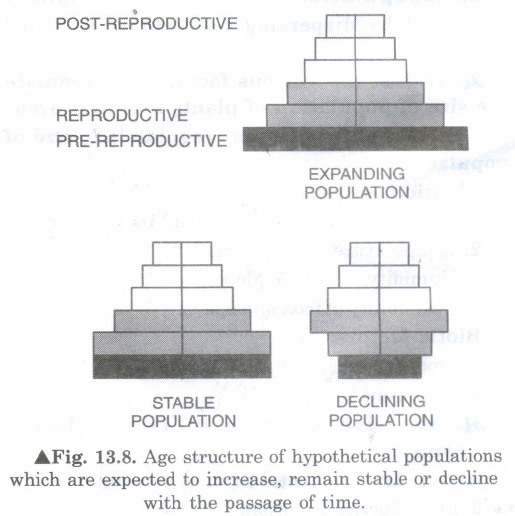
Which of the two, stenothermals or eury-thermal, show wide range of distribution on earth and why?
79.
When and why do some animals like snails go into aestivation?
80.
When and why do some animals go into hibernation?
81.
When and why do some animals like frogs hibernate?
82.
Give one example where animal-plant interaction involves co-evolution.
83.
How does comouflage help an insect?
84.
How do spines help cactus survive in the desert? Give two methods.
85.
Why do predators avoid eating monarch butterfly? How does the butterfly develop this protective features?
86.
If 8 individuals in a laboratory population of 80 fruit died in a week, then what would be the death rate of the population for the said period?
87.
Mention any two activities of animals which get cues from diurnal and seasonal variations in light intensity.
88.
Why are some organisms called eurythermals and some others stenohaline?
89.
Comment on the interaction between certain species of fig trees and wasps.
90.
Pollinating species of wasps show mutualism with specific fig plants. Mention the benefits the female wasps derive from the fig trees from such an interaction.
91.
Mention the effect of global warming on the geographical distribution of stenothermals like amphibians.
92.
Comment on the interaction between a clown fish living among the tentacles of a sea anemone.
93.
Name the interaction between sea anemone and the hermit crab that grows on it.
94.
Name the type of interaction between a whale and the barnacles growing on its back.
95.
What is an interaction called, when an orchid grows on a mango plants?
96.
What is the interaction between Cuscuta and shoe-flower bush called?
97.
Write what the phytophagous insects feed on.
98.
Name the interspecific interaction in which one is detrimental while the other is neutral.
99.
How do animals like fish and snails avoid summer-related unfavorable conditions?
100.
How do snails escape from the stressful time in summer?
101.
Mention how bears escape from stressful time in winter.
102.
Name a 'Photoperiod' - dependent process, one each in plants and in animals.
103.
Why are green plants not found beyond a certain depth in the ocean?
104.
Construct an age pyramid which reflects an expanding growth status of human population
105.
Apart from being part of the food chain, predators play other important roles. Mention any two such roles supported by examples
106.
Differentiate between commensalism and mutualism by taking one example each from plants only.
107.
Why do algae and fungi shift to sexual mode of reproduction just before the onset of adverse conditions?
108.
Many fresh Water animals cannot survive in marine environment. Explain
109.
Koel is clever enough to lay eggs in a crew's nest. Write the reason for this peculiar behaviour. Name the type of interaction.
110.
How do mammals living in colder regions and seals living in polar regions able to reduce the loss of their body heat?
111.
Shark is eurythermal while polar bear is stenothermal. What advantage does the former have and what is the constraint the later has?
112.
Heat loss or heat gain depends upon the surface area of the organism's body. Explain with the help of a suitable example.
113.
Why are the plants that inhabit a desert not found in a mangrove? Give reasons.
114.
What is mutualism? Mention any two examples where the organisms involved are commercially exploited in agriculture.
115.
What advantage does the sea anemone get in the sea anemone-hermit crab interaction as facultative mutualis. Give an alternative term for this kind of mutualism.
116.
Lichen is considered as a good example of obligate mutualism. Explain.
117.
Describe the mutual relationship between the fig tree and wasp and comment on the phenomenon that operates in their relationship.
118.
In an association of two animal species, one is a termite which feeds on wood and the other is a protozoan Trichonympha present in the gut of the termite. What type of association they establish?
119.
Lianas are vascular plants rooted in the ground and maintain erectness of their stem by making use of other trees for support.They do not maintain direct relation which those trees. Discuss the type of association the lianas have with the trees.
120.
What are the different ways in which parasite can alter the population of hosts?
121.
Draw labelled diagrams of stable and declining age pyramids of human population.
122.
Write the exponential equation for J-shaped growth form.
123.
Construct an age pyramid which reflects a stable growth status of human population.
124.
List any four characteristics that are employed in human population census.
125.
What is the ecological principle behind the biological control method of managing pest insects?
126.
Why do people suffer from altitude sickness after reaching the high altitude regions? How does their body acclimatise after a couple of days?
127.
List the features that make a stable biological community.
128.
Give two example each of the following:
(i) Ephemerals (drought escapers)
(ii) Succulents (drought resistants)
(iii) Free floating hydrophytes
(iv) Submerged floating hydrophytes
(v) Mangrove plants
129.
The 'clown' fish lives among the tentacles of sea anemone.What is this interaction? Give a reason for this association
130.
How is a biotic community named? given examples.
131.
What is a mimic?
132.
What are producers and consumers?
133.
List the ecological principles operating in a pond.
134.
How is a monoculture disadvantageous?
135.
What is meant by the term plankton?
136.
Differentiate between saprotrophs and phagotrophs.
137.
what are hyperparasites? Mention a specific case.
138.
What is allelopathy? Cite one example.
139.
How do protocooperation and mutualism resemble and differ?
140.
What are saprobionts? give examples.
141.
Give two examples of symbiosis among humans.
142.
what are antagonistic interactions. Cite a few examples.
143.
How do the genus and community differ?
144.
Give the formula for the change in population size.
145.
Briefly give characteristic zones of a aquatic body,e.g., lake.
146.
Write characteristics of A-horizon of soil.
147.
What are heliophytes? Given their major characteristics.
148.
Write adaptations of submerged, rooted hydrophytes.
149.
Given the ecological adaptation of succulents.
150.
Distinguish between habitat and ecological niche.
151.
Define the following terms: (a) Mimicry (b)Acclimatization (c) Ectotherms (d)Endotherms
152.
Define the following terms;(a)migration (b) Stratosphere (c)community (d)Biosphere
153.
Define the term 'adaptation.'
154.
Give the meaning and examples of epizoic animals.
155.
What are crepusucular animals?cite an example.
156.
What are day-neutral plants?
157.
Name one organism from each of the 3 categories of organisms regarding their mode of obtaining food.
158.
Give an example for:
(a) an endothermic animal
(b) an endothermic animal
(c)an organism of benthic Zone.
159.
In certain seasons we sweat profusely while in some other season we shiver. Explain.
160.
Plants that inhabit a rain-forest are not found in wetlands explain.
161.
Explain parasitism and co-evolution with the help of one example of each.
162.
A moss plant is unable to complete its life cycle in a dry environment. State reason.
163.
Differentiate the following:
(i) Mutualism and Commensalism.
(ii) Commensalism and amensalism.
(iii) Predators and Parasites.
164.
Justify the statement "Predators and scavengers are markedly different.".
165.
Define mutualism. Give examples. Define mutualism.
166.
What is parasitism? Define parasite, host. What are kinds of parasite?
167.
"Herbivores are the predators of plants". Discuss a few defence mechanisms of plants against herbivory.
168.
Many prey organisms have developed different defence mechanism. Give a few examples.
169.
Discuss role of predators in an ecosystem.
170.
What is predator-prey relationship? Give example.
171.
Discuss life history traits of an organism have evolved in relation to the constraints imposed by biotic and abiotic factors in their habitat.
172.
How does population size increase or decrease?
173.
How does age distribution help in study of population.
(b) How does an age pyramid, for human population at a given point of time helps in the policy makers in planning the future?
174.
Differentiate natality rate and death rate.
175.
Write a note on natality.
176.
What is demography?
177.
Explain population density.
178.
Compare J-shaped pattern with the S-shaped pattern of population growth.
179.
Explain J-Shaped pattern of population growth.
180.
Members of the population do not breed with other population. Why?
181.
Distinguish between population and community.
182.
List the characteristics of population.
183.
Give example of two isolating mechanisms.
184.
List the various factors that regulate the size of population of plants in a unit area.
185.
Explain the term population with reference to ecology. Define metapopulation.
186.
What are three criteria that are required to define population?
187.
Explain the following terms:
(a) Mimicry
(b) Acclimatisation
188.
How is the halophyte Rhizophora adapted to survive in its habitat? Explain.
189.
What are
(a) ephemerals
(b) succulents?
Give an example of each.
190.
How does the burrowing habit help desert animals to survive in scarcity of water?
191.
Why has camel survived and bred in desert but not frog?
192.
Explain how buoyant conditions are obtained by aquatic plants.
193.
List the different kinds of plant communities.
194.
How do human beings maintain a constant body temperature despite changes in the surrounding?
195.
How do desert lizards maintain a fairly constant body temperature?
196.
Mention two adaptations the mammals of colder regions have, to minimise the loss of body heat.
197.
What are
(a) Hydrophytes
(b) Xerophytes?
198.
What is humus?
199.
Write a brief note on soil importance.
200.
What is top soil?
201.
What is soil?
202.
Differentiate eurythermal, stenothermal and euryhaline animals.
203.
Depict the temperature based thermal stratification in lakes.
204.
Show the zones in lake water as determined by gardients of light, oxygen and temperature.
205.
What are the effects of organisms on habitat?
206.
Write a short note on microclimate.
207.
What is the difference between climate and weather?
208.
Differentiate habitat and microhabitat.
209.
List the biological factors of environment
210.
List the physical conditions which determine the nature of a habitat.
211.
How do you differentiate habitat from environment?
212.
Define a species. What is difference between a species and a population?
213.
What is the most concrete and easily observable unit in the environment?
214.
Show how do organism interact with the physical environment with a simple sketch.
215.
What is tree line?
216.
Give the scientific names of any two microorganisms inhabiting the human intestine.
217.
Categories the following plants into hydrophytes, halophytes, mesophytes and xerophytes. Give reasons for your answers.
(a) Salvinia
(b) Opuntia
(c) Rhizophora
(d) Mangifera.
218.
In a sea shore, the benthic animals live in sandy, muddy and rocky substrata and accordingly developed the following adaptations.
(a) Burrowing
(b) Building cubes
(c) Holdfasts/peduncle
Find the suitable substratum against each adaptation.
219.
Why do submerged plants receive weaker illuminations than exposed floating plants in a lake?
220.
Define heliophytes and sciophytes. Name plant from your locality that is either heliophyte or sciophyte.
221.
Why do all the freshwater organisms have contractile vacuoles whereas majority of marine organisms lack them?
222.
If a freshwater fish is placed in an aquarium containing sea water, will the fish be able to survive? Explain giving reasons.
223.
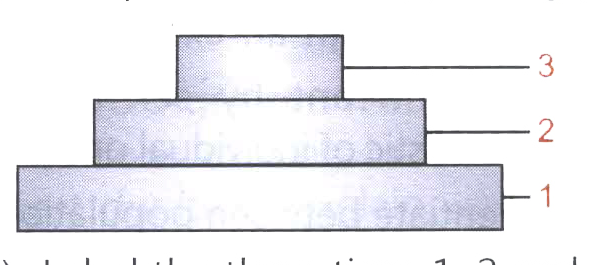
(a) Label the three tiers, 1, 2 and 3 given in the above age pyramid.
(b) What type of population growth is represented by the above age pyramid?
224.
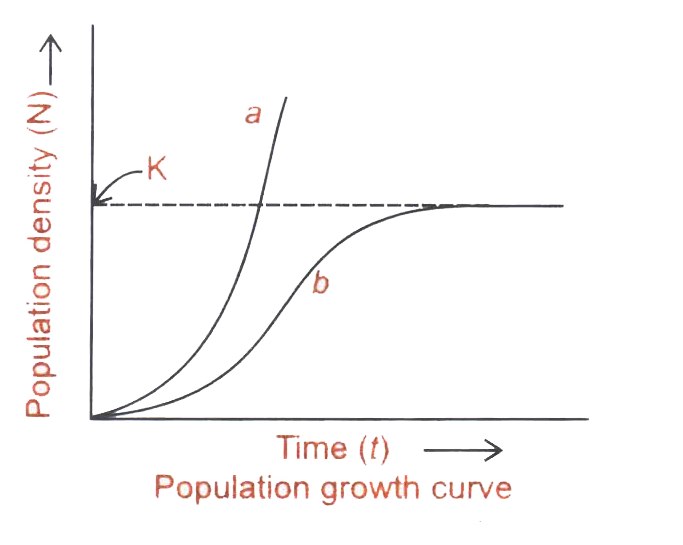
Identify the curves 'a' and 'b' shown in the graph given below. List the conditions responsible for growth patterns 'a' and 'b'.
225.
A population of 100 spotted deer was living without any carnivores in an enclosure of a few hectares of rich tropical forest land. Deer census was taken after a few years. Now study the graph given below and answer the questions that follow:
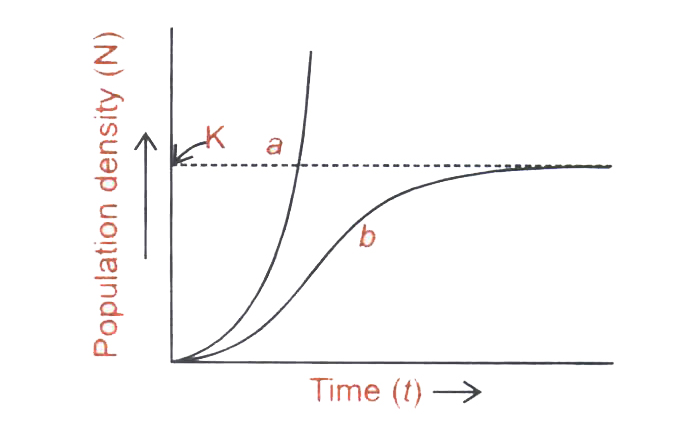
(a) Identify the curve that represents the deer population.
(b) Is it a realistic one? Justify.
226.
In an aquarium two herbivorous species of fish are living together and feeding on phytoplanktons. As per the Gause's principle, one of the species is to be eliminated in due course of time, but both are surviving well in the aquarium. Give possible reasons.
227.
Define 'zero population growth rate'. Draw an age pyramid for the same.
228.
The density of a population in a habitat per unit area is measured in different units. Write the unit of measurement against the following.
(a) Bacteria : __________
(b) Banyan : __________
(c) Deer : _________
(d) Fish : _________
229.
Categorise the following plants into hydrophytes, halophytes, mesophytes and xerophytes.
(a) Salvinia
(b) Opuntia
(c) Rhizophora
(d) Mangifera
230.
Write a short note on the behavioural adaptations in animals.
231.
Define population and community.
232.
Distinguish between ectotherms and endotherms.
233.
List the various abiotic environmental factors.
234.
Write a short note on the adaptations of plant to water scarcity.
235.
Name important defence mechanisms in plants against herbivory.
236.
List the attributes that populations possess but not individuals.
237.
Define phenotypic adaptation. Give one example.
238.
If a marine fish in placed in a frest water aquarium, will the fish be able to survive Why or why not?
239.
How is diapause different from hibernation?
240.
Name the interaction in each of the following:
(a) Ascaris worms living in the intestine of humans.
(b) Sucker fish attached to the shark.
(c) Smaller barnacles disappeared when Balanus dominated in the coast of Scotland.
(d) Wasp pollinating fig inflorescence.
241.
Name the interaction in each of the following;
(a) Cuscuta growing on a shoe-flower tree.
(b) Mycorrhizae living on the roots of higher plants.
(c) Clown fish living among the tentacles of sea anemone.
(d) Koel laying its eggs in crow's nest.
242.
Name the interaction in each of the following:
(a) Cuckoo lays her eggs in the crow's nest.
(b) Orchid grows on a mango tree.
(c) Ticks live on the skin of dogs.
(d) Sea anemone is often found on the shells of hermit crab.
243.
In a pond, there were 40 lotus plants, After a year, the number rose to 56. Calculate the birth rate of lotus plants.
244.
How do organisms which cannot migrate tend to overcome adverse environmental conditions? Explain taking one example each from vertebrates and angiosperms, respectively.
245.
How does the human body maintain a constant temperature both in summers and winners? Explain.
246.
(a) How is Cuscuta adapted to be a parasitic plant?
(b) Why do cattle avoid browsing on Calotropis plants? Explain.
247.
(a) What is 'r' in the population equation given below:
dN/dt = rN.
(b) How does the increase and the decrease in the value of 'r' affect the population size?
248.
Egrets are often seen along with grazing cattle. How do you refer to this interaction? Give a reason for this association.
249.
Explain the defence mechanisms evolved in preys to avoid overpopulation of their predators.
250.
Mention the changes the koel must have undergone in order to achieve brood parasitism, during the course of evolution.
251.
How do seals adapt to their natural habitat? Explain.
252.
How doea the Mediterranean orchid, Ophrys ensure is pollination by bees?
253.
How does the floral pattern of Mediterranean Orchid, Ophrys guarantee cross pollination?
254.
Why do we experience shivering during winters when the temperature is very low?
255.
How does our body adapt to low oxygen availability at high altitudes?
256.
Bear hibernates, whereas some species of zooplanktons enter diapause to avoid streesful esternal conditions. How are these two ways different from each other?
257.
Explain the response of all communities to environment over time.
258.
When is an organism called a 'conformer'? Explain with the help of an example.
259.
Write the normal body temperature of humans. How is it maintained during summers?
260.
How do desert lizards cope with temperature variations in their environment? Explain.
261.
Some organisms suspend their metabolic activities to survive in unfavorable conditions. Explain with the help of any four examples.
262.
Why do clown first and sea-anemone pair up? What is this relationship called?
263.
Very small-sized animals are rarely found in polar regions. Give two reasons.
264.
Why are small animals rarely found in the polar regions? Explain.
265.
Explain why very small animals are rarely found in polar region.
266.
Why are a fig tree and its partner wasp considered a good example of mutualism?
267.
How does Monarch butterfly defend itself from predators? Explain.
268.
Most living organisms cannot survive at temperatures above 45 oC. How are some microbes able to live in habitats with temperatures exceeding 100o C?
269.
Give examples of following categories:
(a) Solitary animals
(b) Monogamous
(c) Polygamous
(d) Flocks
(e) Herds
(f) Female leader of herd
(g) Polymorphic
(h) Colonial.
270.
How thermoregulation is achieved in the polar bears?
271.
What do we study in ecology?
272.
Emergent land plants that can tolerate the salinity of the sea are called ----------
273.
Species that can tolerate wide range of salinity are called ------------
1.
()
Amensalism and commensalism.
2.
()
Cattle and goats are not seen browsing on calotropis because Ca/otropis produces the highly poisonous cardiac glycosides
3.
()
Birth rate = 0.2 frogs/yr.
4.
()
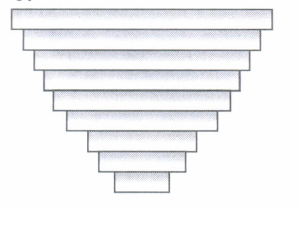
When in a population the individuals in the prereproductive age group are comparatively fewer and the individuals both in the reproductive and post reproductive stages are almost equal, it is called zero population growth rate.
For zero population growth rate an inverted bell shaped pyramid is obtained.
5.
()
Ecto (Parasitism)
6.
()
Commensalism
7.
()
Tiger census in National parks and Tiger reserves was done on the basis of counting pug marks and faecal pellets
8.
()
In seed - bearing plants, seed and some other vegetative reproductive structures serve as a means to tide over periods of stress besides helping in dispersal. They do so by reducing their metabolic activity and going into a state of 'dormancy'. They germinate to form new plants under favourable moisture and temperature conditions.
9.
()
Because temperature affects the basal metabolism/ physiological function of the organism/ not adapted to low temperature of temperate climate
10.
()
Mycorrhizae/mutualism.
11.
()
Mutualism.
12.
()
Relationship between sucker fish and shark is commensalism. The sucker fish gets protection from predators while the shark is neither harmed nor benefitted.
13.
()
Parasitic plants are Cuscuta and Viscum and parasitic animals are mites and lice.
14.
()
The human liver fluke requires two intermediate hosts, i.e. freshwater snail and fish to complete its life cycle and facilitate parasitation of its primary host.
15.
()
Due to behavioural differences in their foraging activities.
16.
()
Calotropis produces highly poisonous cardiac glycosides that can make the herbivore sick and hence they are not grazed by goats and cattle.
17.
()
The organisms that feed on plant sap and other parts of plants are termed as phytophagous.
18.
()
By introducing its predator, i.e. cactus-feeding moth in the country.
19.
()
Fishes in Antarctica region accumulate anti - freeze proteins and glycerol, which lower the freezing point of body fluids, making them capable to survive in adverse conditions.
20.
()
Mammals have a thick layer of fat, which is called blubber below their skin that acts as an insulator and reduces loss of body heat (e.g. seals).
21.
()
They have short ears and short limbs in order to minimise the heat loss in colder climates.
22.
()
Vivipary means germination of seeds, while still attached to the tree. It is exhibited in halophytes.
23.
()
Amino acid normally accumulated by xerophytes is proline.
24.
()
Osmoconformers.
25.
()
Flowering in plants and migration in animals.
26.
()
Green algae or plants are not found beyond a certain depth, as light (not all colour components of visible spectrum) can reach only till a certain depth in seas and oceans.
27.
()
Under unfavourable conditions many zooplanktonic species in lakes and ponds enter a stage of suspended development called diapause.
28.
()
Stratification is a grouping of plants in a forest into two or more defined layers depending upon height like tall trees, medium sized trees, small trees, bushes and herbs, In rainforest, it is multistoreyed.
29.
()
Number of individuals added =10 per 20 Hydrilla plants.
\(\frac { 10 }{ 30 } \) = 0.3 offsprings per hydrilla plant per year.
30.
()
In polar regions only animals with thick layer of fat below the skin can survive.
31.
()
Parasitism, Predation.
32.
()
Natality rate, mortality rate, immigration, emigration and environmental factors (natural calamities, food, shelter, etc.)
33.
()
Insects (Honeybee, ants)
34.
()
Individual organisms are always derived from pre-existing organisms through the mechanism of reproduction-may be vegetative, asexual or sexual.
35.
()
Stratification of a community depicts vertical layering of vegetation.
36.
()
\(\frac { dN }{ dt } =rN\)
dN/dt = rate of change in population size
r = Biotic potential
N = Population size
37.
()
A set of local populations connected by dispersing individuals is called metapo-pulation.
38.
()
Habitat and geographical isolation.
39.
()
Ocean, river, lakes and ground water.
40.
()
Due to absence of air, plants die in the water logged soils.
41.
()
1.Rotation of earth around the Sun.
2.Tilt of the earth on its axis.
42.
()
Significance of adaptations. Make the organisms more fit to their environment and increase their chances of survival.
43.
()
Osmoconformers. Animals which can change the osmolarity of their body fluids according to that of surrounding medium are termed osmoconformers. e.g. Myxine.
44.
()
Osmoregulation. Regulation of water level and osmotic concentration of body fluids. Human have kidneys as osmoregulatory organs.
45.
()
Ectotherms are those animals, whose body temperature is maintained relatively constant by physiological regulations.
46.
()
1. Thermal springs and
2. deep sea hydrothermal where temperature exceeds \({ 100 }^{ \circ }\)C.
47.
()
Habitat is the native environment of an animal or place.
Niche. The position or function of an organism in a community of plants and animals.
48.
()
Temperature, water, light and soil.
49.
()
Organism
50.
()
Brood parasitism is the phenomenon in which an organism (parasite) lays eggs on the nest of other organism (host).
Example. Eudynamys Cuckoo (koel) bird lays its eggs in the nest of its host and lets the host incubate them. The eggs of the parasitic bird resemble the host's egg in size and colour to reduce the chances of the host bird detecting the foreign eggs and ejecting them from the nest.
51.
()
Ectoparasites are those parasites which are found temporarily or permanently on the outer surface or their host's body e.g. bugs, lice, ticks, mites fleas, leeches, Petromyzon (sea lamprey), Cuscuta, etc.
Endoparasites are those parasites which are found inside some body part of their host e.g. Taenia, Ascaris and Entamoeba in the intestine of man, Plasmodium in liver calls and RBCs of man, Schistosoma in blood of man, etc.
52.
()
Sea anemone and clown fish.
53.
()
High altitude sickness is the disorder which a plain dweller surfaces when he/she goes to a high altitude area like Andes and Himalayas. It is characterized by nausea, fatigue, heart palpitation, etc.
54.
()
The suspended stage of development by an organism inorder to overcome the unfavourable environment conditions is called diapause.
Significance. Passing unfavourable conditions without any harm to the organism.
55.
()
It is the condition of rest or summer sleep in a cool shady place during the hot dry period of the summer day.
56.
()
Homoeostasis is the maintenance of the constant internal environmental of a body despite changes in the external environmental.
57.
()
Brighter Sunlight. Fewer dust particles are present at high altitudes so that there is little absorption of incoming sunlight by the atmosphere.
Lower Temperature. Atmospheric temperature depends upon trapping of infra-red radiations and their re-radiations back to earth. At high altitude the atmosphere is thinner with lesser trapping of infra-red radiations.
58.
()
It is symbiotic or mutually beneficial association between a fungus and roots of higher plants.
59.
()
It is interspecific interaction in which one species is benefited while the other is neither harmed nor benefitted.
60.
()
It is a species which lives within a narrow range of salinity.
61.
()
Species that can tolerate wide range of temperature variations are called eurythermic.
62.
()
Stenothermic
63.
()
100 per hour.
64.
()
It may not grow well because of chage in its microlimate.
65.
()
Symbiosis.
66.
()
J - shaped growth curve.
67.
()
Amensalism
68.
()
Ecological niche of an organism represents the range of conditions it can tolerate, the resources it utilises and its functional role in the ecosystem.
69.
()
The birth rate of lotus plants is 8/24, i.e. 333 per thousand or 33.3 per cent or 0.33 per individual.
70.
()
Tiger census in national parks and tiger reserves is carried out by counting the pug marks or faecal pellets.
71.
()
In case of a single huge banyan tree with a large canopy growing in an area with a number of small herbs.
72.
()
Homestasis refers to a constant internal environment maintained by the organisms.
73.
()
The freshwater animals face osmotic problems in the marine water.
74.
()
(i) Increase in the production of red blood cells.
(ii) Decrease in the binding capacity of haemoglobin.
(iii) Increase in the breathing rate. (any two)
75.
()
The herbs and shrubs growing in the forests are adapted to photosynthesise optimally under very low light conditions.
76.
()
Birds will be able to cope with global warming; they are eurythermals and can tolerate a wide range of temperatures.
77.
()
(i) Predators act as 'conduits' of energy transfer through trophic levels.
(ii) Predation keeps the pray populations under control.
(iii) Predation helps in maintaing species diversity in a community and ecosystem. (any two)
78.
()
Eurythermals show a wide range of distribution on earth, as they can tolerate and thrive in a wide range of temperatures.
79.
()
When the snails are not able to migrate from the stressful conditions in the habitat, they undergo aestivation to avoid stress by escaping in time.
80.
()
If the unfovourable (stressful) conditions are for a short duration and if the animals are not able to migrate, they hibernate to avoid the stress by escaping in time.
81.
()
If the unfovourable (stressful) conditions are for a short duration and if the animals are not able to migrate, they hibernate to avoid the stress by escaping in time.
82.
()
The mediterranean orchid, Ophrys and its pollinators (bumble bees and bees) have co-evolved.
83.
()
By comouflage, they avoid being detected by their predators.
84.
()
(i) Leaves are reduced to spines to check transpiration.
(ii) Spines keep away the browsing animals.
85.
()
Fish migrate and snails go into aestivation to avoid summer-related problems.
86.
()
The death rate of fruit flies is 8/80, i.e. 100 per thousand or 10 per cent or 0.1 per individual.
87.
()
(i) Timing their foraging.
(ii) Migratory activities.
(iii) Reproduction. (any two)
88.
()
- Those organisms which can tolerate and thrive in a wide range of temperatures, are called eurythermals.
- Those organisms which are restricted to a narrow range of salinities, are called stenohaline.
89.
()
It is a case of mutualism, where a given fig species is pollinated only by its 'partner' wasp species; the female wasp uses the fruit for oviposition (egg-laying) and the developing seeds to nourish the larvae.
90.
()
It is a case of mutualism, where a given fig species is pollinated only by its 'partner' wasp species; the female wasp uses the fruit for oviposition (egg-laying) and the developing seeds to nourish the larvae.
91.
()
Stenothermal animals have tolerances to a narrow range of temperatures and hence their geographical distribution would be much affected.
92.
()
Commensalism.
93.
()
Commensalism.
94.
()
Commensalism.
95.
()
Commensalism.
96.
()
Parasitism.
97.
()
Phytophagous insects feed on the sap and other parts of the plants.
98.
()
Amensalism.
99.
()
Snails go into aestivation in summers.
100.
()
Snails go into aestivation in summers.
101.
()
Bears go into hibernation in winter.
102.
()
- Flowering in plants.
- Timing their foraging or mingration in animals.
103.
()
Green algae or plants are not found beyond a certain depth, as light (not all colour components of visible spectrum) is not available
104.
.JPG)
.JPG)
105.
1.Keeps prey population under control
2.Biological control methods
3.Maintains species diversity
4.Reduces intensity of competition among prey species
106.
Commensalism : In this interaction one species is benefitted and the other species is neither benefitted nor harmed.
e.g. an orchid growing as an epiphyte on the branch of a mango.
Mutualism: In this interaction both the interacting species are benefitted.
e.g. Lichens exhibit mutualistic relationship between a fungus that absorbs water and nutrients from soil and photosynthesizing algae / cyanobacteria.
107.
For survival during unfavourable conditions / Fusion of gametes helps to pool their resources for survival (hunger theory of sex) / Zygote develops a thick wall that is resistant to dessication and damage, undergoes a period of rest before germination.
108.
Fresh Water animals are not able to maintain their osmotic concentration in marine conditions. If' they are transferred in marine conditions; their body will shrink due to exosmosis. Hence, they cannot survive in marine environment.
109.
So that the crow can incubate the Koel's eggs. Interaction - Brood parasitism
110.
Mammals from colder climates generally have shorter ears and limbs which minimise heat loss (Allen's rule).
In polar region seals have thick layer of fat (blubber) below their skin that acts as insulator and reduce loss of body heat.
111.
Shark: tolerates wide range of temperature so wide spread / survives in all waters.
Polar bear: restricted occurrence in narrow range of temperature so constraint to live in very cold icy environment.
112.
Small animal like hummingbird/shrew, have a larger surface area relative to their volume, they tend to loose heat when it is cold outside, hence spend much energy to generate body heat through metabolism.
113.
Desert plants are not adapted to survive in saline/ aquatic conditions.
Plants are conformers/stenothermal/cannot maintain constant internal environmentl temperature/osmotic concentration of the body fluids affects kinetics of enzymes through basal metabolism/activity and other physiological functions of the organisms.
In mangroves the soil is deficient of oxygen because of the presence of excess of water in it. Mangroves plants develop special apogeotropic root called Pneumatophores for respiration as an adaption. Such an adaption is not found in desert plants therefore they are not found in mangroves.
114.
Mutualism is an interaction that confers benefits on both the interacting species. Two examples where organisms involved are commercially exploited in agriculture are:
(i) Mycorrhizae close mutual association between fungi and the roots of higher plants.
Fungi help the plant in absorption of nutrients, while the plant provides food for the fungus.
(ii) Lichens represent an intimate mutualistic relationship between a fungus and photo synthesising algae or cyanobacteria.
Here, the fungus helps in the absorption of nutrients and provides protection, while algae prepare the food.
115.
The sea anemone is transported on the back of hermit crab for reaching new food sources.Alternative term for this type of mutualism is proto cooperation.
116.
Lichen is considered as a good example of obligate mutualism due to the mutualistic relationship between the fungi and algae or cyanobacteria in the association.
The alga prepares food, while fungus helps in the absorption of nutrients and also provides protection.
117.
The relationship between fig tree and wasp shows mutualism. The wasp while searching for sites to lay its eggs, pollinates the fig's inflorescence. On the other hand, the fig not only provides shelter (fruit) for oviposition but also allows wasp's larva to feed on its seeds.
118.
The termite provides shelter and space for the protozoan Trichonympha to live. The protozoan present in gut digests the wood, which termite feeds upon.
In the absence of Trichonympha, the termite is unable to digest wood and hence dies. Thus, the association of two given animal species represents mutualism.
119.
The type of association the lianas have with the trees is commensalism because the plant gets the support of tree without affecting, harming or providing any benefit to the tree.
120.
Following are the ways in which parasite can alter the population of host:
(i) They can shorten the life cycle of the host and can weaken it.
(ii) They can drastically reduce the reproduction to the extent of causing sterility.
(iii) They reduce its population density.
121.
122.
Exponential equation for J-shaped growth form is
\(\frac { dN }{ dt } =rN\)
Where, \(\frac { dN }{ dt } \) is the rate of change in population size, 'r' is intrinsic rate of natural increase and 'N' is the population size.
123.
The age pyramid that reflects a stable growth status if human population can be represented as follows:
124.
A population has the following characteristics that are employed in human population census:
(i) Natality and mortality
(ii) Sex ratio
(iii) Population density
(iv) Age distribution
125.
The ecological principle behind the biological control of pest insects is based on the ability of predator to reduce prey population in that habitat
126.
People visiting high altitude regions experience altitude sickness. This is because the body does not get enough oxygen. The person shows symptoms of nausea, fatigue and heart palpitations. After couple of days, the body responds gradually by physiological adaptation. The body compensates low O2 availability by
(i) increasing RBCs production.
(ii) decreasing binding capacity of haemoglobin.
(iii) increased breathing rate.
127.
(i) unchanged environmental parameter
(ii) climax biotic community.
128.
(i) Euphorbia prostata, Argimone maxicana
(ii) Opuntia, Asparagus (also Euphorbia)
(iii) Lwmna, Wolffia (also pistia,Trapa)
(iv) Ceratophylum, Utricularia
(v) Avicennia, Aegiatills.
129.
Commensalism. It is so because clown fish derives benefit by taking shelter in tentacles os sea anemone but the latter species is not affected
130.
After dominants (e.g., pine forests where pine tree are dominants) or after habitat (e.g., desert community, marine community ).
131.
An organism that resembles another organic food from simple inorganic compounds by photosynthesis, consumers are organisms that get food by eating producers or their products.
132.
Producers are organisms that manufacture organic food from simple inorganic compounds by photosynthesis, consumers are organisms that get food by eating producers or their products.
133.
Food relationship, interactions, and recycling of nutrients
134.
Monoculture is likely to be completely destroyed by an infestation of an insect pest or by an insect pest or by an epidemic of a fungal disease.
135.
Microscopic floating organisms constitute plankton. these include diatoms, blue-green algae, green flagellates forming phytoplankton; and protozoans, rotifers, tiny crustaceans forming zooplankton.
136.
Saprotrophs absorb predigested food through their body surface.Phagotrophs take food via mouth and digest it is in their body.
137.
Parasites living on other parasites, Plasmodium in females Anopheles mosquito.
138.
Suppression of growth of other species by chemicals (called allelochemicals) released from a plant.A substance juglone from walnut tree inhibits the growth of seedlings, including its own, under it.
139.
The two participating species are benefitted in both protocooperation and mutualism, but they can live equally well separately in the former and not in the latter
140.
saprobionts are animals that feed on the remains of dead animals and other refuse,r.g., vultures, crows.
141.
Interdependence of mother and infant, husband and wife.
142.
An interaction harmful to one species is antagonistic interaction, e.g., amensalism, parasitism, predation.
143.
Species of a genus have a common ancestry and occur in different geographic regions. species in a community do not have a common ancestry and inhabit common environment.
144.
Change in population size =(birth+immigration)-(death+emigration).
145.
Various zone of a lake are littoral zone (shallow water zone), limnetic zone (of variable depth up to which light can penetrate), dark zone,i.e., profundal zone and bottom called benthic zone.Littoral zone has producers; limnetic zone both producers and macroconsumers, profundal zone has consumers and benthic zone has microconsumers and macroconsumers.
146.
Horizon-A is the topsoil it is darker and of a loose texture than the underlying horizon-B. Plant and animal matter collect at the surface of it, forming the litter is partially decomposed organic matter (humus).Rest of horizon is rich in organic and mineral contents.
147.
Plants that are adapted to bright sunlight are called heliophytes (sun plants), These have higher temperature optima for Photosynthesis and also have a high rate of respiration.
148.
To withstand movement of water, submerged, rooted hydrophytes have ribbon-Shaped or greatly dissected leaves.The stems are soft, spongy and with long internodes.
149.
succulents are also called drought resistants.These have fleshy organs to store large amounts of water.succulence result from the proliferation of parenchyma cells, enlargement of vacuoles in cell and due to a reduction in intercellular spaces. These have fleshy stems which are green and photosynthetic with leaf scales or leaf-spines.These also have thick cuticle and sunken stomata that open during the night only.
150.
Habitat is the place where an organism lives and ecological niche means a place where it performs functions.Odum has differentiated these by saying that habitat is organism's 'address' and the ecological niche is its 'profession'.
151.
(a) It can be defined as the superficial but close resemblance of one organism to another or to the natural object among which it lives, that secures its concealment, protection or some other advantage.
(b) The gradual physiological adjustments to slow changing environmental conditions is called acclimatization.
(c) cold-blooded animals are called ectotherms. Their body temperature tends to match with the environmental temperature in which they live.
(d) Warm-blooded animals are called endotherms as they can regulate their body temperature by physiological means.
152.
(a) migration refers to movement of animal populations from one place to another and their subsequent return to avoid unfavorable climatic conditions.
(b) It is the layer of atmosphere that extends between altitudes of about 16-50 kilometers.it has an ozone layer (ozonosphere)between altitudes 25-50 kilometer
(c)Groups of organisms belonging to several different species that live togeather in the same area or habitat and interact through trophic and spatial relationship to form a self-sustained unit is called a biotic community.
(d)All the ecosystems of the word togeather from a biosphere
153.
Adjustment of an organism by having certain features that increase its capacity to withstand a particular environment
154.
Animals which live in on other animals without getting food from them (barnacle).
155.
Which are active at dusk and dawn (rabbit).
156.
That are not affected by duration of day length (tomato).
157.
Plants, animals, and bacteria and fungi.
158.
(a)Human beings
(b)frog
(c)bacteria(decomposers).
159.
Humans are warm blooded or hemeothermal are endothermal organism. They maintain a fixed body temperature despite changes in the surrounding. optimum temperature for maximum efficiency of enzymes is \({ 37 }^{ \circ }C\). Thus human body maintains a body temperature near it.
Homeostasis is the phenomenon of maintaining a constant internal environment. Thus during heavy exercise or summer, sweating occurs. It helps in cooling the body. During winter shivering helps in retaining heat within the body.
160.
Habitat is a specific place or area or locality having a combination of factors, physical features and barrier where a community reside. In rain forest plants adapt themselves to the specific conditions of their habitat the characteristics adaptations related to a particular habitat are not found in those plants living in wetland and vice versa. Thus they can inhabit in a new habitat.
161.
1. Many prasites have evolved to be host-specific. They can live as parasite only a single species of host.
2. These organisms parasitize in such a way that both host and the parasite tend to co-evolve that is, if the host evolve special mechanism for rejecting or resisting the parasite in such conditions parasite has to evolve mechanism to counteract and neutralise then, in order to be successful with the same host species.
3. In accordance with their mode of living, parasite evolve special adaptations such as loss of unnecessary sense organs, presence of adhesive organs or sucker so as to cling to the host. It also loses digestive system.
4. The human liver fluke depends on intermediate host (a snail and a fish) to complete life cycle.
5. The malarial parasite needs female anopheles mosquite as vector to spread to other hosts.
162.
(a) Due to absence of vascular tissue, water and minerals cannot be transported to various parts.
(b) Transfer of flagellated antherozooids to oosphere of archaegonium depends upon water.
163.
(i) Differences between mutualism and commensalism
| Mutualism | Commensalism |
| 1.It is the interspecific interaction, in which both the interacting species are benefitted. | 1. It is the interspecific interaction, in which one species is benefitted while the other is neither benefitted nor harmed. |
| 2. It may or may not involve physical association. | 2.The two individuals come in close physical contact. |
(ii) Differences between Commensalism and Amensalism
| Commensalism | Amensalism |
| It is the interspecific interaction in which one species is benefited while the other one is neither harmed nor benefitted. | It is the interspecific interaction in which one species is harmed/affected, while the other is neither benefited nor harmed. |
(iii) Difference between Predators and Parasites
| Predators | Parasites |
| 1. Predators are larger and stronger animals which kill and consume the prey. | 1. Parasites are the small or microscopic organisms that depend on the host. |
| 2. They do not take shelter on the prey. | 2. They take shelter on the host. |
| 3. Their biotic potential is low. | 3. They have higher biotic potential. |
| 4. They are mobile to capture the prey. | 4. They have poor means of dispersal. |
| 5. They are not specific for the prey. | 5. They are host-specific. |
164.
Predators feed on another organism. i.e. prey whereas scavenger feeds on dead animals or an animal killed by another animal. A predator can be a prey also e.g. a frog eats insects and the frog may be eaten by rat. But a scavenger such as jackals, hyenas and vultures cannot kill zebra of Giraffe or deer but a loin kills them and leaves a part of it to be eaten by animals such as vultures, jackal etc.
165.
Mutualism. It is a symbiotic relationship between the members of two species in which the two partners are mutually benefited. There is a complete dependence of the partners on each other, and one cannot survive in the absence of the other. Sometimes the term symbiosis is used as synonym with mutualism.
Example: 1. Mycorrhizal association between roots of higher plants and fungal hyphae.
2.Pollination of flowering plants by insects.
3. Mutualism between animal and bacteria.
Symbiotic bacteria like Ruminococcus are found in the rumen part of compound stomach of cud-chewing mammals like cattle, sheep, goat, camel etc. and secrete cellulase enzyme to digest the cellulose of plant food eaten by the runminants which provide food and shelter to the bacteria.
4. Mutualism between crab and Sea anemone.
In this case sea anemone gets attached to back of hermit crab.
5. Mutualism between plants and fungus.
Lichens involve the symbiotic interspecific association of a green alga (phycobiont) and a fungus (mycobiont).
6. The mediterranean Orchid, Ophrys employs sexual deceit to get its flowers pollinated. In this orchid, one petal of the flower resembles the female of a bee species in size, colour, markings, etc. The male bee perceives it as a female and pseudo copulates with it. During the process, the pollen grains become dusted on its body.
When the bee is attracted by another flower of this species and repeats the process, the pollen grains fall on the stigma, i.e. pollination is achieved.
166.
Parasitism. This is relationship between two organisms in which one obtains its nourishment from the other.
Parasite. The organism, which obtains its food from the other without directly killing it, is known as parasite. Parasites are host specific and parasite and host tend to co-evolve.
Host. The second organism which provides food to the parasite is named as host.
Endoparasite. The parasite lives inside the body of the host. It is known as endoparasite.
Ectoparasite. The parasite which lives on the outside of the body of the host e.g. Leech, Louse, Bedbug.
167.
Herbivores are the predators for plants. The problem of predation is more severe for plants than animals as the plants cannot move away from the predators. About 25% of the known insects are phytophagous and feed on the sap and other parts of plants.
Plants have developed certain morphological and chemical defence mechanisms against herbivores; a few of them are listed as follows:
1. Morphological. Thorns (Bougainvillea) and spines (Acacia, Cactus etc.) are the most common morphological means of defence.
2. Chemical. Plants produce and store certain chemicals which function is one or more of the following ways:
(a) They make the animal feel sick.
(b) They inhabit them from feeding.
(c) They interface with digestion.
(d) They even directly kill them e.g. Calotropis produces a highly poisonous glycoside, that is a cardiac poison.
(e) Nicotine, caffiene strychinine, opium, quinine, etc are the chemicals produced by plants for their defence against herbivores.
168.
Prey species have developed various defence mechanisms to reduce the impact of predation; some of them are listed below:
(i) Certain insect species and frogs have camouflage (cryptic colouration) to avoid detection by their predators
(ii) Some animals (e.g., monarch butterfly) are highly distasteful to their predators.
(iii) This butterfly species accumulates a chemical by feeding on a poisonous weed during its caterpillar stage.
(iv) Some prey are poisonous and hence are avoided by predators e.g., Dart frogs like Phyllobates bicolour and Dendrobats.
169.
Predators are of great importance as they play the following imp[ortant roles in an ecosystem:
1. They act as 'conduits' for energy transfer to higher trophic levels.
2. They keep the prey population under control, which otherwise can reach very high population density and cause imbalance in the ecosystem.
3. They help in maintaining species diversity in a community by reducing the intensity of competition among the competing prey species.
170.
Predation. It is an interspecific interation, where one animal (called predato) kills and consumes the other weaker animal (called prey). Herbivores are predators of plants.
Definition. It is a kind of direct food relationship between two species of animals in which larger species, called predator, attacks, kills and feeds on the smaller species, called prey. It was proved by G.F. Gause (1934).
Although predation is a nature's way of transferring the energy fixed by plants, to higher trophic levels.
Examples.
(i) A tiger killing and eating a deer.
(ii) A snake eating a frog.
(iii) A sparrow eating a fruit/seed.
171.
According to ecologists, life history traits of an organism have evolved in relation to the constraints imposed by the biotic and abiotic factors in their habitats.
It can be illustrated with vast variations and life history.
Evolution of populations aims at improving the reproductive fitness or Darwinian fitness to the maximum in their habitats.
They evolve towards the most efficient reproductive strategy.
Organisms like Pacific Salmon fish and bamboo breed only once in their life time.
Most birds and mammals breed many times during their life time.
Oysters and pelagic fishes produce a large number os small-sized offspring.
Birds and mammals produce a small number of large-sized offspring.
172.
Population (size/density) increases by birth/hatching/germination and immigration that add individuals. Population (size/density) decreases by death and emigration. Population is regulated by food, space, disease, natural calamities and environmental factors.
173.
1. Age distribution (Age composition). The relative abundance of the organisms of various age groups in the population is called age distribution of population. With regard to age distribution, there are three kinds of populations:
(a) Rapidly growing (expanding) population. It has high birth rate and low death rate, so there are more number of young individuals in the population.According to a recent survey, more than 42% of the Indian population consists of children below the age of 14years, so Indian populationis called young population.
174.
Differences between Natality Rate and Mortality Rate
| Character | Natality Rate | Mortality Rate |
|---|---|---|
| 1. Definition |
Number of births 1,000 individuals per individuals of year. |
Number of death per per 1,000 of a population a population per year. |
| 2. Population size and population density. | Increases | Decreases |
175.
Natality. The birth, hatching or germination is called natality. It is one factor which determines the population and population density of an area at a time. It adds number of individuals to the population and increases it at a given time. If the birth rate is high, population increases.
176.
Demography. The study of trends of human population growth and prediction of future development constitutes a special branch known as demography.
177.
Population density. An ecologist measures the changing population by counting and recording individuals from a larger area for various studies. This measure of population density is expressed as number of individuals in a definite area at a specific time. Thus population density can be measured as follows:
\(D=\frac { Total\quad number\quad of\quad people\quad in\quad a\quad region }{ Total\quad area\quad of\quad region } =\frac { N }{ S } \)
For aquatic organism and organism suspended in medium, space is expressed in three dimension \(({ m }^{ 3 })\)while for terrestrial organism usually two dimensional units are used \(({ m }^{ 2 })\).
178.
Differences between S-shaped and J-shaped growth curves
| S-shaped growth curve | J-shaped growth curve |
| 1. It is formed of 5 phases: lag phase, positive acceleration phase, exponential phase, negative acceleration phase and stationary phase. | 1. It is formed of 2 phase: lag phase and exponential phase. |
| 2. Finally, the population shows zero growth rate as birth rate equals death rate. | 2. Finally, the population shows a population crash due to rapid increase in mortality rate. |
| 3. Example. Yeast cells in a culture medium. | 3. Examples. Reindeers, algae blooms, lemmings of Tundras. |
179.
J-shaped Growth curve. Population grows exponentially and after obtaining peak value the population may abruptly decrease. It is shown by small population of reindeer experimentally reared in a natural environmental with plenty of food but no predators. It has only two phases:
1. Lag phase .It is period of adaptation of animals to new environment so is characterized by slow or no growth in population.
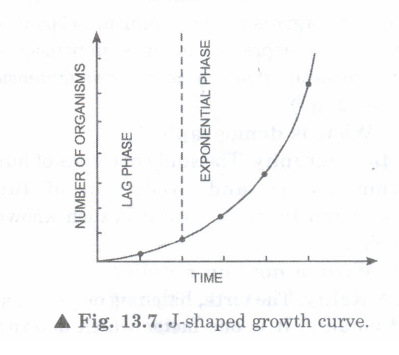
2. Logarithmic or Exponential phase. It is characterized by rapid growth in population which continues till enough food is available. But with the increase in reindeer population, there is corresponding decrease in the availability of food which finally becomes exhausted, which leads to mass starvation and mortality. This sudden increase in mortality is called population crash.
180.
Population is a group of interbreeding individuals of the same species which is isolated from other group. Organisms in a population undergo the same life cycle. Thus different populations have different life cycle, biological and physical barrier, hence they cannot breed.
181.
Differences between population and community
| Population | Community |
| 1. Group of individuals of same species inhabiting same area. | 1. Group of species living in same area. |
| 2. Organism in a population undergo same life cycle. | 2. Different species have different life cycle. |
182.
Density, Birth rate, Death rate, Dispersal, Age distribution, Biotic potential and Growth form.
183.
1. Environmental barrier isolation.
2. Reproductive isolation.
184.
List the various factors that regulate the size of population
Abiotic factors:
1.Daily duration of sunlight and its intensity.
2. Temperature.
3. Rainfall.
4. Humidity.
5. Floods.
6. Availability of food and space.
Biotic factors:
1. Producer-consumer relationship.
2. Pathogens.
185.
Population is a group of individuals of the same species inhabiting the same area and functioning as a unit of biotic community. For example, all individuals of the common grass, Cynodon, in a given area constitute its populations. A group of snails of the same species present in a given area represent a population. Similarly all pine trees occurring in a habitat, constitute a population. Organism in a population undergo the same life cycle. They experience similar ecological processes at a particular stage for the life cycle.
Metapopulation. Set of local populations connected by dispersing individuals is called metapopulation.
186.
Criteria for defining population:
1. The number and kind of individuals of a species.
2. The given space or area.
3. The given time.
187.
(a) Mimicry. It is phenomenon in which a living organism modifies its form, appearance, structure or behaviour and looks like another living organism or some inanimate (non-living) object so as to defined from its predators, or to increase the chances of capturing they prey.
The individual which shows mimicry is called mimic while the animate or inanimate object with which a mimic resembles is called model. The concept of mimicry was first observed by an English naturalist, Henry Bates (1862 A.D.) so the phenomenon is also called Batesian mimicry.
Types: Mimicry is three types:
(i) Protective mimicry,
(ii) Aggressive mimicry,
(iii) Feigning death or Conscious mimicry.
(b) Acclimatisation. The gradual physiological adjustment to slowly changing new environmental conditions is known as acclimatisation. If some factors shift beyond the tolerance range, the organism can come to tolerance range or migrate to acclimatise.
188.
(i) Due to appearance of butteress roots which appear from the basal part of trunk and spread horizontally.
(ii) Pneumatophores or respiratory roots appear. They are provided with respiratory pores.
(iii) Rhizophora show the phenomenon of vivipary. The seed germinates inside the fruit while the latter is still inside the fruit. The radicle elongates to a certain length and swells up at the lower end.
189.
(a) Ephemerals. Those plants which live for short periods are called ephemerals e.g. Argemone.
(b) Succulents. These xerophytic plants accumulate water in their body parts e.g. Opuntia, Aloe, Agave.
190.
Animals like desert rats and snakes dig burrows in the sand and live within. They dug burrows below the hot sand surface. Thus burrows offer desert rats and snakes etc. moist and cool place. During night, when the conditions are comparatively cooler outside, these animals come up on surface and become active.
191.
The camel adjusts itself with desert environment and can use it as a habitat. The physical conditions prevailing in the desert and biological endowments of camel suit each other nicely e.g., it can easily move on hot sand and run at the speed of 25 kilometres per hour. Hump at the back of camel contains fats in the form of reserve food. Such adaptations are not found in the case of frog.
192.
Buoyancy in aquatic plants.
Buoyancy in hydrophytes is brought about in them by following features:
1. Plants are supported on the surface of water by their flattened bodies that stay afloat on the surface.
2. The special large air cavities are made up of aerenchyma.
3. Presence of floating roots in Jussiaca.
4. Presence of huge circular disc-like leaves.
5. Presence of stalk with hole for air help it to float and the stalk to stay up.
193.
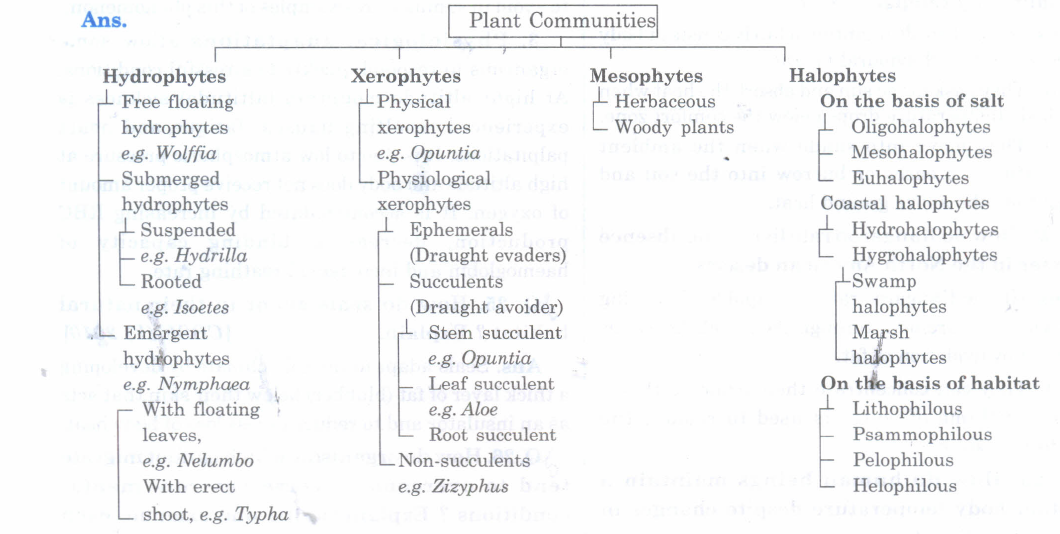
194.
Human beings maintain a constant body temperature in the following two ways:
(i) In summer, we sweat profusely; the evaporation of the sweat cause a cooling and brings down the body temperature.
(ii) In winter, we shiver and that produce more heat, to raise the body temperature.
195.
Desert lizards maintain a fairly constant body temperature by behavioural means.
(i) They bask in the sun and absorb the heat when their body temperature drops below the comfort zone.
(ii) They move into shade when the ambient temperature increases or burrow into the soil and escape from the above ground heat.
196.
The adaptations are as follows:
1. Mammals of colder regions have shorter ears and limbs (called as Allen's rule).
2. Aquatic mammals of colder seas have a thick layer of fat, called blubber, below the skin, which acts as an insulator and reduces the loss of body heat.
197.
(a) Hydrophytes. These are the plants that grow completely under water or a part of the body in water. They may by (a) free floating (b) attached floating (c) submerged hydrophytes (d) amphibious hydrophytes.
(b) Xerophytes. The plants growing on places characterized extremely dry air, high temperature, much sunshine, frequent winds, few clouds, non-availability of moisture/water, are called xerophytes. They are of three categories i.e.
(a) drought escaping
(b) drought enduring and
(c) drought resident.
198.
Humus is the most important part of the soil. It consists of partially decayed organic matter. It makes the soil porous, thereby increasing its air and water-holding capacity. Humus is rich in nutrients that promote plant growth. Being black, humus absorbs heat to warm up the soil.
199.
Importance of top soil.
Soil plays a multiple role in the life of organisms.
1. It provides water and mineral nutrients to the terrestrial plants.
2. It is the medium in which plant and animal materials are decomposed. The inorganic components, namely \({ CO }_{ 2 }\) and \({ H }_{ 2 }O\), formed as the end products of decomposition are released into the environment for reuse by plants.
3. It provides habitat for microbes.
200.
Top soil. Horizon A is the top soil. It is darker and of a looser texture than the underlying horizon B. Plant and animal matter collects at the surface of this horizon, forming the litter. Below the litter is the humus, i.e. organic matter undergoing decay by microbial action. The rest of horizon is rich in organic and mineral contents.
201.
Soil. Soil is the most important component of land. It is fertile surface layer of the earth capable of supporting plant growth. It is mixture of animal matter, air, water, organic matter (humus) and organisms. Soil provides water and minerals to plants and serves as a habitat for bacteria, fungi and many kinds of animals. Human activities have aggravated soil erosion, salinisation, water logging, acidification, alkalination, leaching, impoverishment and silting. These phenomena are a serious threat to land as a resource. Productive land is reducing due to coming up of dams, roads, railways, urban settlements, factories, canals, mines, playgrounds and other things. Man should seriously take effective steps for the conservation of soil. Nature also restores soil fertility in various ways.
202.
Difference between eurythermal, stenothermal and euryhaline animals.
| Eurythermal Animals | Stenothermal Animals | Euryhaline Animals |
|---|---|---|
| These are the animals/organisms which can tolerate a wide range of temperatures. | These are the animals/organisms which can tolerate only a narrow range of temperatures. | These are the animals which can tolerate a wide range of salinity of the medium. |
203.
Thermal stratification in lakes.
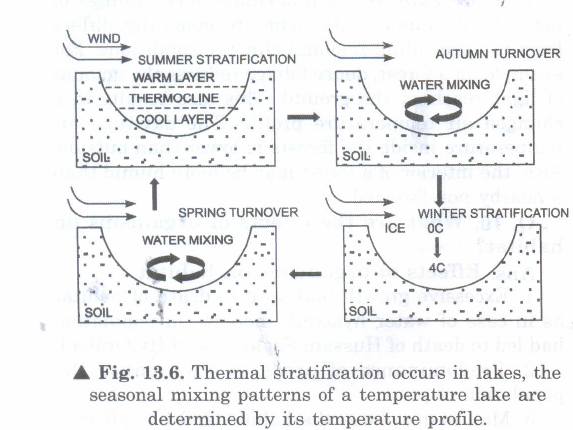
204.
Zones in the lake.
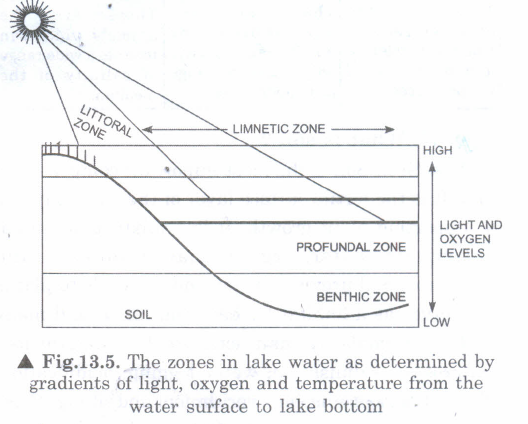
205.
Effects of organisms on habitat
1. Excessive growth may lead to death of habitat as in case of water hyacinth increase in population had led to death of Hussain Sagar lake of Hyderabad.
2. Predominance of predator will reduce the population of prey.
3. Man manipulates the habitat and has affected the forest causing serious problems due to deforestation. More so man has resulted in pollution of air, water and land
206.
Microclimate. It represents the climatic conditions that prevail at a local scale, or in areas of limited size such as the immediate surroundings of plants and animals. Microclimate generally difers from the prevailing regional climate conditions. For example, in a forest, dense foliage reduces the amount of light reaching the ground. This also results in a changed air temperature profile. The day-time air temprature inside the forests is lower than outside. Also, the interior of a forest may be more humid than a nearby non-forested area.
207.
Differences between climate and weather
| Climate | Weather |
|---|---|
| 1. Average weather of an area is called climate. | 1. The short term properties of atmosphere at a given place and time are termed weather. |
| 2. if entails changes of long term. | 2. If reflects hourly, daily |
208.
Differences between Habitat and Microhabitat
| Habitat | Microhabitat |
| 1. It is a living place of an organism. | 1. It is a specific region within the environment. |
| 2. It is a part of the total environment of the region. | 2. It is a part of habitat. |
|
3. It has a common climate for all organism. |
3. It has a special condition suitable for specific organisms. |
209.
Biological factors.
1. Green plants.
2. Non-green plants.
3. Animals including man
4. Microorganisms.
210.
Physical conditions which determine the nature of a habitat
Climate factors
1. Light (Energy) Radiation
2. Temperature
3. Rainfall
4. Humidity
5. Atmospheric gases and wind
6. Soil.
Physiographic factors
1. Altitude
2. Steepness
3. Exposure of slopes.
211.
Differences between Habitat and Environment
| Habitat | Environment |
| 1.It is the living place of organism. | 1. It is the surrounding of a place. |
| 2. It is a part of the total environment. | 2. Environment supports many habitats in itself. |
| 3. It must offer food, shelter and climate condition suitable for the organism to lie and flourish. | 3. It may or may not be suitable for an organism to live in. |
212.
Species. Species is defined as a group of closely related, structurally and functionally similar organisms which interbreed among themselves in nature, and produce fertile young ones of its own kind, nut not with the organisms of other groups.
Population is subordinate to a species. It is relatively permanent aggregation of individuals of the same species occupying a definite space or area at a given time.
Difference. A species my be present at different places but population is confined only to a specific area.
213.
Individual organism, the most concrete and easily observable unit in the environment, because it is a distinct package carrying out life processes within its body as distinct entity.
214.
Interaction between organism and physical environment.
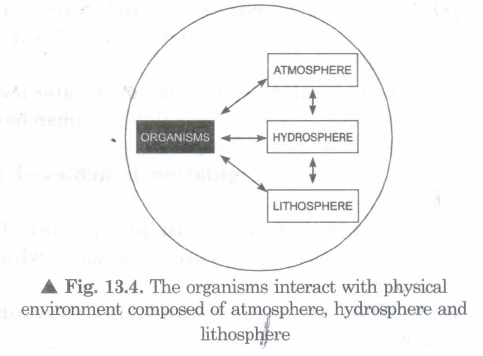
215.
It is altitude as well as latitude beyond which no tree grows. Only shrubs and herbs are found.
216.
Streptococcus faecalis, Escherichia coli.
217.
(a) Hydrophyte. Because it is not able to tolerate deficiency of water. It is partially or completely submerged.
(b) Xerophyte. Because it prefers dry and hot climate with low rainfall. Thus have succulent leaves.
(c) Halophyte. Because it grows in saline habitat.
(d) Mesophyte. Because it prefers the areas with high moisture content
218.
In a sea shore, the benthic animals adapt to their mode of life according to the nature of sea floor e.g.
(a) Benthic animals become fossorial (burrowing) in sandy substratum e.g worm.
(b) Benthic animals build cubs in muddy substratum.
(c) Benthic animals develop hold fast/peduncle if substratum is rocky.
219.
Because light intensities of stronger illuminations are absorbed by the exposed floating plants of the lake/water bodies so only the weaker illuminations reach the submerged, some light is reflected at water surface and a part is absorbed by upper layer of water.
220.
Heliophytes are those plants which grow in strong light so are commonly called Sun plants e.g. sunflower, while sciophytes are those plants which prefer to grow in lower light intensities or shade loving plants e.g. money plant, fir etc.
221.
Contractile vacuole helps in maintaining salt and water level called osmoregulation. Because of the cellular environment of a freshwater organism such as Amoeba, Paramecium being hypertonic, the water diffuses inside the cell constantly and gets collected in the contractile vacuole, which squeezes the extra water out of the periodically.
Thus, keeping the internal environment constant. While in case of marine protozoans organisms, this does not occur due to high salt concentration. These organism live in isotonic conditions in sea water. Thus there is no need for contractile vacuole.
222.
No, a freshwater fish placed in the aquarium containing sea water, will not be able to survive. Because its body system is adapted to function normally in a narrow range of salinity and it cannot survive in the high salinity of sea water.
223.
(a) .png)
(b) It is an expanding population.
224.
'a' is Exponential growth curve.
When the resources are not limiting, this form of curve appears.
'b' is Logistic growth curve.
When the resources are limiting, this form of growth curve appears; where K is the carrying capacity.
225.
(a) Curve 'a'
(b) It is not realistic as resources become limiting sooner or later.
226.
(i) There must be 'resource partitioning', i.e. by feeding on the same resource at different times.
(ii) They must have changed the pattern of foraging.
227.
Zero population growth rate refers to the situation when the number of deaths and emigration is equal to the number of births and immigration in a give period of time.
228.
(a) Number of cells/ml. of medium
(b) Per cent cover/Biomass
(c) Pug marks
(d) Number per trap.
229.
(a) Hydrophyte
(b) Xerophyte
(c) Halophyte
(d) Mesophyte
230.
Behavloural adaptations:
To cope up with the extremes in their environment or unfavourable conditions, animals show modified behaviour to suit the environmental conditions.
Some animals burrow into the soil to hide and escape from the above ground heat.
The desert lizards bask in the sun to increase its body temperature of remain inside.
231.
Population. A population is a unit of biotic community made up of near permanent group of interbreeding individuals of a species found in a geographical area or space at a particular time.
Community. It is a grouping of different but independent and interacting populations of different species which live in a specific locality, e.g., pond community.
232.
| Ectotherms | Endotherms |
| Ectotherms are those animals whose body temperature changes to match with that of the environment in which they are living. | Endotherms are those animals whose body temperature is maintained relatively constant by physiological regulation. |
233.
(i) Light
(ii) Temperature
(iii) Water
(iv) Salinity of soil
(v) Type of soil
(vi) Humidity
234.
(I) The plants develop a thick cuticle to check transpiration.
(il) They have sunken stomata.
(iii) The leaves are modified into spines or scales.
(iv) The stem becomes a phylloclade and helps in photosynthesis and storage of food and water.
(v) Sorne have their stomata open at night and dosed at day.
(vi) They may have deep tap root to reach the water available at lower layers of soil or even water table
235.
Defence mechanism of plants against herbivorous animals
(i) Formation of thick cuticle on their leaf surface.
(ii) Formation of leaf spines e.g. leaf spines in Opuntia
(iii) Modification of leaves into thorns. e.g, Bougainvillea and Duranta
(iv) Development of spiny margins on leaves.
(v) Development of sharp silicated edges in leaves.
(vi) Many plants produce and store toxic chemicals which cause discomforts to herbivores e.g. cardiac glucoside by Calotropis, Nicotine by tobacco.
236.
Population attributes :
(i) Birth rate and death rate.
(ii) Age-Sex ratio.
237.
Phenotypic adaptation refers to a characteristic feature in the external appearance/mainfestation of a characteristic that is genetically controlled, e.g. leaves are modified into spines in Opuntia.
238.
There will be passive entry of water into its body cells, since the osmolarity of its body fluids is stronger than fresth water. But the animal with start excreting its sodium and chloride by ionocytes and regulate its osmolarity.
239.
| Diapause | Hibernation |
| It is a stage of suspended development shown by zooplanktons under unfavourable conditions in their habitat. | Hibernation is the phenomenon of escaping in time the stressful condition of the winter |
240.
(a) Parasitism; Ascaris is an endoparasite.
(b) Commensalism.
(c) Competition.
(d) Mutualism.
241.
(a) Parasitism
(b) Mutualism
(c) Commensalism
(d) Brood parasitism.
242.
(a) Brood parasitism.
(b) Commensalism; orchid is an epiphyte.
(c) Parasitism; ticks are ectoparasites.
(d) Commensalism.
243.
The birth rate of lotus is 16-40 = 40 per cent or 400 per thousand or 0.4 per individual.
244.
Vertebrates like bear undergo hibernation, to escape in time.
Angiosperms produce seeds and certain other vegetative structures to tide over unfavourable conditions in the habitat.
245.
(i) In summer, we sweat profusely; the evaporation of sweat causes a cooling and brings down the body temperature.
(ii) In winter, we shiver, and that produces heat to raise the body temperature.
246.
(a) Cuscuta produces haustoria to derive nutrition from the host plant.
(b) Calotropis produces highly poisonous cardiac glycosides and hence it is not browsed by cattle.
247.
(a) 'r' is intrinsic rate of natural increase.
(b) With increases while a decrease in 'r' decreases the population size.
248.
The interaction is called commensalism.
The egrets always, forage close to where the cattle are grazing.
As they move, thJ cattle stir up and flush out from the vegetation the insects which otherwise might be difficult for the egrets to find and catch.
Thus, the egrets are benefitted while the cattle are neither benefitted nor harmed.
249.
(i) Certain insect species and frogs have camouflage (cryptic colouration) to avoid detection by their predators.
(ii) Some animals are highly distasteful to their predators, e.g. monarch butterfly accumulates a chemical by feeding on a poisonous weed during its caterpillar stage.
(iii) Some prey are poisonous and hence are avoided by predators.
(iv) Plants have developed thorns and spines as defence mechanism against browsing animals.
(v) Some plants produce certain chemicals which affect the metabolism of the herbivores.
250.
The eggs of koel have evolved to resemble the eggs of host bird in colour and size, to reduce chances of the host bird detecting the foreign egg and throwing them out.
251.
Seals have thich layer of fat, called blubber below their skin.
The blubber acts as an insulator and reduces loss of body heat.
252.
In the flowers of Ophrys, one petal resembles the female of a bee species in size, colour, markings, etc.
The male bee perceives it as a female and pseudocopulates with it.
During the process, the pollen grains from the anthers become dusted on the body of the bee.
When the bee is attracted to another flower of this orchid species, the process is repeated and the pollen grains from the body of the bee get dusted on the stigma, i.e. pollination is achieved.
253.
In the flowers of Ophrys, one petal resembles the female of a bee species in size, colour, markings, etc.
The male bee perceives it as a female and pseudocopulates with it.
During the process, the pollen grains from the anthers become dusted on the body of the bee.
When the bee is attracted to another flower of this orchid species, the process is repeated and the pollen grains from the body of the bee get dusted on the stigma, i.e. pollination is achieved.
254.
Shivering is a form of exercise which produces heat and raises the body temperature, so we shiver during winters at low temperature.
255.
The mountain dwellers have
(i) higher red blood cell count.
(ii) higher haemoglobin content.
(iii) faster breathing rate.
(iv) decreased binding capacity of haemoglobin.
256.
| Hibernation | Diapause |
|---|---|
| Hybernation is the process of spending winter/extreme cold conditions in a dormant condition by some animals, to escape in time. | It is a stage of supended development shown by zooplanktons under unfavourable conditions. |
257.
(i) Some organisms have evolved a constant internal environment and are able to maintain homeostasis by physiological or behavioural means.
(ii) Many animals and nearly all plants change their internal environment of the body with tho e of the external environment, i.e. they are conformers.
(iii) Some organisms move away temporarily from the stressful conditions in their habitats and return when the stressful period is over.
(iv) Some animals suspend their metabolic activities and avoid stress by escaping in time; hibernation and aestivation are examples of such suspension.
258.
When an organism cannot maintain a constant internal environment, but changes the temperature, osmotic concentration of body fluids, etc. with those of the ambient environment, it is called a conformer, e.g. freshwater fishes maintain the osmolarity of their body fluid.
259.
It is \(37^{ \circ }C\)( or \(98.4^{ \circ }F\))
During summer, when the outside temperature is higher than our body temperature, we sweat profusely.
260.
Desert lizards cope with the temperature variations in their habitat by behaviour means.
They bask in the sun and absorb heat when their body temperature drops below the comfort zone.
They move into the shade when the temperature starts increasing.
261.
(i) Bacteria, fungi and lower groups of plants produce various kinds of thick-walled spores, which help them to survive unfavourable conditions; they germinate when favourable conditions return.
(ii) In higher plants, seeds and certain vegetative reproductive structures serve as means to tide over the stress periods.
(iii) Animals which are not able to migrate avoid the stress by escaping I in time during extreme winters/cold conditions (hibernation as in bears) and during extreme hot conditions (aestivation, as in snails)
(iv) Many zooplanktons in lakes and ponds enter diapause, a stage of suspended developments.
262.
The sea anemone as stinging tentacles and the clown fish gets protection from predators which stay away from the stinging tentacles; sea anemone does not derive any benefit from this interaction.
This relationship is called commensalism, as one of the partners (clown fish) is benefitted and the other (sea anemone)is not benefitted.
263.
Heat loss or heat gain is a function of surface area.
Since small animals (like humming birds) have a larger surface area relative to their volume, they tend to lose body heat very fast, when it is cold outside.
They spend more energy to generate body heat through metabolism; considering the cost and benefit of maintaining a constant internal temperature, small animals (humming birds) are not found in polar regions.
264.
Heat loss or heat gain is a function of surface area.
Since small animals (like humming birds) have a larger surface area relative to their volume, they tend to lose body heat very fast, when it is cold outside.
They spend more energy to generate body heat through metabolism; considering the cost and benefit of maintaining a constant internal temperature, small animals (humming birds) are not found in polar regions.
265.
Heat loss or heat gain is a function of surface area.
Since small animals (like humming birds) have a larger surface area relative to their volume, they tend to lose body heat very fast, when it is cold outside.
They spend more energy to generate body heat through metabolism; considering the cost and benefit of maintaining a constant internal temperature, small animals (humming birds) are not found in polar regions.
266.
It is a case of mutualism because both the fig tree and the wasp are benefitted by this interaction.
The female wasp uses the ovary as a site for oviposition and the developing seeds within the fruit for nourishing the larvae.
The fig inflorescence is pollinated while the wasp is searching for the suitable place for egg-laying.
267.
The monarch butterfly is highly distasteful to its predators because of a chemical present in its body.
It has acquired it at the caterpillar stage by feeding on a poisonous weed.
268.
They have a heat resistant protein.
269.
()
(a) Wood pecker and species;
(b) Wolves, foxes and swans;
(c) Seals, walruses and deer;
(d) Ducks,geese and parrots;
(e) Antelopes, deer, zebras, elephants and monkeys;
(f) Red deer;
(g) Honey bee and Wasps;
(h) Termites, Obelia.
270.
()
Thermoregulation in polar bear. By developing blubber in subcutaneous zone which prevents loss of body heat.
271.
()
To study reciprocal relationship between organism and environment.
272.
()
Mangrove plants.
273.
()
Euryhaline.

12th Standard CBSE Syllabus & Materials
12th Standard CBSE
CBSE 12th Computer Science Python Revision Tour I - New Previous year Question Papers Study Material - QB365 Set A
NEW12th Standard CBSE
CBSE 12th Business Studies Planning Important Questions And Answers Study Material - QB365 Set A
NEW12th Standard CBSE
CBSE 12th Business Studies Business Environment Important Questions And Answers Study Material - QB365 Set A
NEW12th Standard CBSE
CBSE 12th Business Studies Principles of Management Important Questions And Answers Study Material - QB365 Set A



NCERT Books

Syllabus

Exam Pattern

Sample Question Papers

Previous year Question Papers

Important Notes

MCQ Practice test

NCERT Exemplers

Case study Questions

Image Based Questions

Passage based Questions

HOT Questions

Value Based Questions

Model Questions Papers
NCERT ( Book Back ) Questions

Assertion and Reason
Important Questions And Answers

CBSE 12th Standard CBSE Subjects
CBSE Standards








