
 100% FREE ACCESS
12th Standard CBSE Syllabus & Materials
12th Standard CBSE
CBSE 12th Economics Government Budget and the Economy Previous year Question Papers Study Material - QB365 Set A
NEW12th Standard CBSE
CBSE 12th Computer Science Interface Python with MySQL - New Previous year Question Papers Study Material - QB365 Set A
NEW12th Standard CBSE
CBSE 12th Computer Science Database Concept - New Previous year Question Papers Study Material - QB365 Set A
NEW12th Standard CBSE
CBSE 12th Computer Science Data Communication - New Previous year Question Papers Study Material - QB365 Set A
NEW12th Standard CBSE
CBSE 12th Computer Science Data Structures - New Previous year Question Papers Study Material - QB365 Set A
NEW12th Standard CBSE
CBSE 12th Computer Science Functions - New Previous year Question Papers Study Material - QB365 Set A

Published on: 02/11/2025
Download CBSE Class 12th Standard CBSE Biology question papers, sample papers, important questions, and previous year solved papers in PDF format. Get free study materials, NCERT solutions, and exam preparation resources for Class 12th Standard CBSE Biology
Questions + Answers key
Take MCQ Biology Test
1.
Name two 'photoperiod' dependent processes, one each in plants and in animals.
2.
What is metapopulation?
3.
Why is population ecology considered an important area of ecology?
4.
What does ecological niche of an organism represent?
5.
Why do predators avoid eating monarch butterfly? How does the butterfly develop this protective features?
6.
Name a 'Photoperiod' - dependent process, one each in plants and in animals.
7.
what are hyperparasites? Mention a specific case.
8.
Differentiate between immigration and emigration.
9.
In an aquarium two herbivorous species of fish are living together and feeding on phytoplanktons. As per the Gause's principle, one of the species is to be eliminated in due course of time, but both are surviving well in the aquarium. Give possible reasons.
10.
Name the interaction in each of the following;
(a) Cuscuta growing on a shoe-flower tree.
(b) Mycorrhizae living on the roots of higher plants.
(c) Clown fish living among the tentacles of sea anemone.
(d) Koel laying its eggs in crow's nest.
11.
Explain why very small animals are rarely found in polar region.
12.
Explain co-evolution with reference to parasites and their hosts. Mention any four special adaptive features evolved in parasites for their parasitic mode of life.
13.
A population of paramoecium caudatum was grown in a culture medium. After 5 days, the culture medium became over-crowed wth paramoecium and had depleted nutrients. What will happen to the population and what type of growth curve will the population attain? Draw the growth curve.
14.
Describe any three reproductive strategies that organisms have evolved in relation to a particular set of selective pressures.
15.
A group of students visited a botanical garden, where they saw fungus growing on roots of higher plants only. They were confused seeing it then, their teacher told them that it is an interspecific interaction in which both species can be benefitted.
(i) Write the name of this particular association
(ii) How both are benefitted from each other?
(iii) State use of this interaction to a farmer
(iv) What values are shown by students
16.
No species can exist alone in a habitat. Any species has a minimal requirement of at least one more species, on which it can feed. Interspecific interactions arise from the interaction of populations of two different species.
(a) What term is given to the interaction, where one species is benefitted and the other is neutral?
(b) Give four examples of the above kind of interaction.
(c) How do you call the interaction where one species is neutral and the other is harmed? Give an example of such an interaction.
(d) What value do you learn from this?
17.
Community is defined as aggregation of:
Individuals of the same kind
individuals of different kinds
Individuals of a population
Populations of different species
18.
The change in population size at a given time interval t, is given by the expression
Nt = N 0 + B + I - D - E
I, B and D stand respectively for
rate of immigration, mortality rate, natality rate
rate of emigration, natality rate, mortality rate
mortality rate, rate of immigration, natality rate
morality rate, natality rate, rate of immigration
rate of immigration, natality rate, mortality rate
19.
Animals undergo inactive stage during winter is known as
aestivation
hibernation
adaptation
acclimitisation
20.
Adaptation to low temperature and freezing in animal occurs due to the production of :
Antifreeze proteins
Chaperonins
Proline
Analine
21.
Select the statement which explains best parasitism.
One organism is benefitted.
Both the organisms are benefitted
One organism is benefitted, other is not affected
One organism is benefitted, other is affected.
22.
The term ecology was coined by
Odum
E. Munch
Tansley
Reiter
23.
Maximum growth rate occurs in
senescent phase
lag phase
exponential phase
stationary phase
1.
()
Flowering in plants and migration in animals.
2.
()
A set of local populations connected by dispersing individuals is called metapo-pulation.
3.
()
Population ecology is an important area of ecology, because it links ecology with population genetics and evolution; natural selection operates at the level of population.
4.
()
Ecological niche of an organism represents the range of conditions it can tolerate, the resources it utilises and its functional role in the ecosystem.
5.
()
Fish migrate and snails go into aestivation to avoid summer-related problems.
6.
()
- Flowering in plants.
- Timing their foraging or mingration in animals.
7.
Parasites living on other parasites, Plasmodium in females Anopheles mosquito.
8.
| Immigration | Emigration |
| Immigration refers to the number of individuals of the same species coming into a habitat from elsewhere during the time period under consideration. This adds to the population size. | Emigration refers to the number of individuals of the same species that have left the given population during the time period under consideration. This reduces the population size |
9.
(i) There must be 'resource partitioning', i.e. by feeding on the same resource at different times.
(ii) They must have changed the pattern of foraging.
10.
(a) Parasitism
(b) Mutualism
(c) Commensalism
(d) Brood parasitism.
11.
Heat loss or heat gain is a function of surface area.
Since small animals (like humming birds) have a larger surface area relative to their volume, they tend to lose body heat very fast, when it is cold outside.
They spend more energy to generate body heat through metabolism; considering the cost and benefit of maintaining a constant internal temperature, small animals (humming birds) are not found in polar regions.
12.
Co-evolution is a phenomenon where many parasites have evolved to be host-specific in such a way that both the host and parasite tend to co-evolve, i.e.if the host develops/evolves special mechanism for rejecting or resisting the parasite the latter has to evolve mechanism to counteract and neutralise them to succeed with the same host species, e.g. malarial parasite.
Parasites have special adaptations according to their lifestyles such as; loss of unnecessary sense organs, presence of adhesive organs or suckers, loss of digestive system and high reproductive system
13.
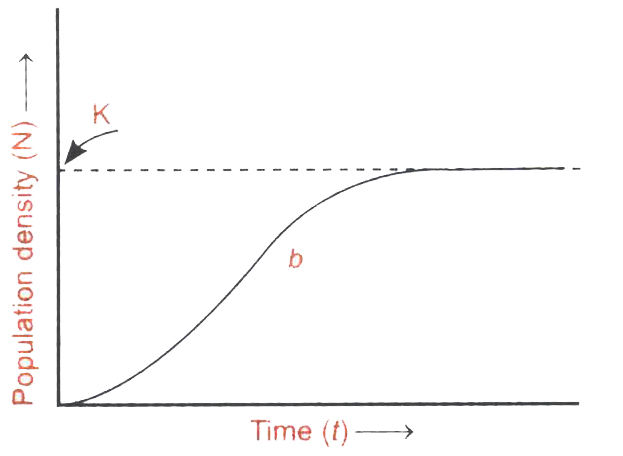
14.
Reproductive strategies:
(i) Some organisms breed only once in their life time-e.g. Bamboo, Pacific Salmon.
(ii) Some produce a large number of small-sized offspring-Oysters.
(iii) Some breed many times during their life time-e.g. birds.
(iv) Some produce a small number of large sized offspring, e.g. Mammals.
15.
(i) Mycorrhizae
(ii) In this association, fungi help the plants in absorption of nutrients, while plants provide food for the fungus.
(iii) (a) It optimises the use of fertilisers, especially phosphorus
(b) It increases crop yield and plant tolerance to saline environments.
(iv) Students are curious towards science and biological aspects.
16.
(a) Commensalism
(b) (i) Orchids grow as epiphytes on mango tree or other fruit trees.
Orchids are benefitted by getting a shelter, while the tree is neither benefitted nor damaged.
(ii) Barnacles growing on the whale are benefitted to move where food is available.
(iii) The cattle egrets always forage near to where the cattle animals graze; the cattle animals stir up the ground and the insects are flushed out from the vegetation and make it easy for the egrets to catch them.
(iv) The clown fish living among sea anemones get protection from their predators, which stay away from the stinging tentacles of the sea anemone:
(c) Amensalism
Roots of certain plants secrete chemicals, which are harmful to the soil organisms.
The antibiotics secreted by certain soil fungi are harmful to soil fungi bacteria. (anyone)
(d) Interactions should be beneficial to all concerned. Avoid selfish or selfcentered people.
17.
(d)
Populations of different species
18.
(e)
rate of immigration, natality rate, mortality rate
19.
(b)
hibernation
20.
(a)
Antifreeze proteins
21.
(d)
One organism is benefitted, other is affected.
22.
(d)
Reiter
23.
(c)
exponential phase

12th Standard CBSE Syllabus & Materials
12th Standard CBSE
CBSE 12th Computer Science Python Revision Tour I - New Previous year Question Papers Study Material - QB365 Set A
NEW12th Standard CBSE
CBSE 12th Business Studies Planning Important Questions And Answers Study Material - QB365 Set A
NEW12th Standard CBSE
CBSE 12th Business Studies Business Environment Important Questions And Answers Study Material - QB365 Set A
NEW12th Standard CBSE
CBSE 12th Business Studies Principles of Management Important Questions And Answers Study Material - QB365 Set A



NCERT Books

Syllabus

Exam Pattern

Sample Question Papers

Previous year Question Papers

Important Notes

MCQ Practice test

NCERT Exemplers

Case study Questions

Image Based Questions

Passage based Questions

HOT Questions

Value Based Questions

Model Questions Papers
NCERT ( Book Back ) Questions

Assertion and Reason
Important Questions And Answers

CBSE 12th Standard CBSE Subjects
CBSE Standards








