
 100% FREE ACCESS
12th Standard CBSE Syllabus & Materials
12th Standard CBSE
CBSE 12th Economics Government Budget and the Economy Previous year Question Papers Study Material - QB365 Set A
NEW12th Standard CBSE
CBSE 12th Computer Science Interface Python with MySQL - New Previous year Question Papers Study Material - QB365 Set A
NEW12th Standard CBSE
CBSE 12th Computer Science Database Concept - New Previous year Question Papers Study Material - QB365 Set A
NEW12th Standard CBSE
CBSE 12th Computer Science Data Communication - New Previous year Question Papers Study Material - QB365 Set A
NEW12th Standard CBSE
CBSE 12th Computer Science Data Structures - New Previous year Question Papers Study Material - QB365 Set A
NEW12th Standard CBSE
CBSE 12th Computer Science Functions - New Previous year Question Papers Study Material - QB365 Set A

Published on: 28/11/2025
Download CBSE Class 12th Standard CBSE Biology question papers, sample papers, important questions, and previous year solved papers in PDF format. Get free study materials, NCERT solutions, and exam preparation resources for Class 12th Standard CBSE Biology
Questions + Answers key
Take MCQ Biology Test
1.
Give two evidences for the occurence of competition.
2.
How do predators help in maintaining species diversity in a community? Give an example.
3.
What is meant by sex ratio? Is it a characteristi of individual or population?
4.
Why is the thermoregulation more effective achieved in larger animals than in smaller ones?
5.
Explain the following terms:
(a) Acclimatization
(b) Ectotherms
(c) Endotherms
6.
Study the three different age pyramids for human population given below and answer questions that follows:
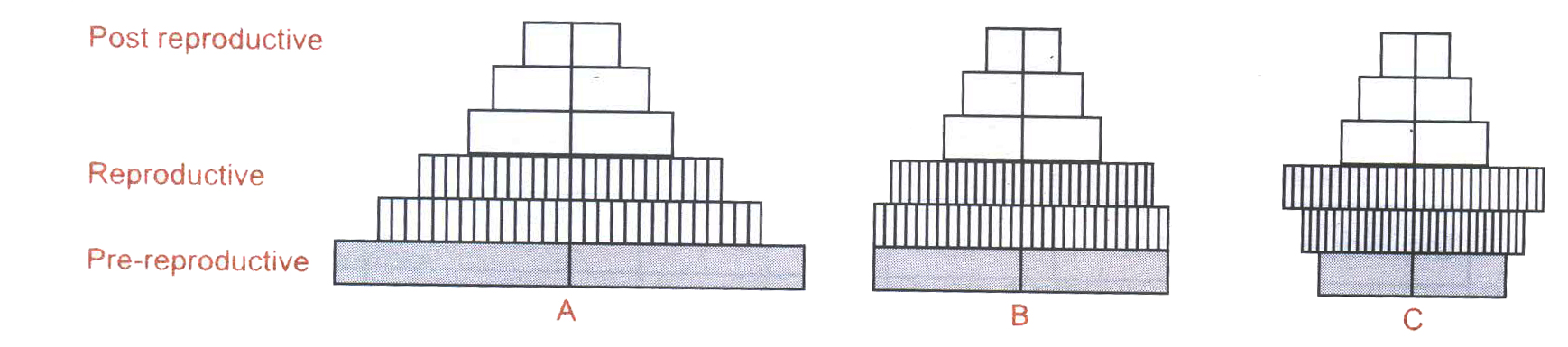
(a) Write the names given to each of these age pyramids.
(b) Mention the one which is ideal for human population and why?
(c) What would be the growth rate pattern when the resources are limited?
7.
Write a short note on adaptations of desert plants and animals.
8.
Why is predation required in a community of different organism?
9.
List three symptoms of high altitude sickness and state three adaptations to overcome it.
10.
(i) List the different attributes that a population has and not an individual organism.
(ii) What is population density? Explain any three different ways the population density can be measured, with the help of an example each.
11.
No species can exist alone in a habitat. Any species has a minimal requirement of at least one more species, on which it can feed. Interspecific interactions arise from the interaction of populations of two different species.
(a) What term is given to the interaction, where one species is benefitted and the other is neutral?
(b) Give four examples of the above kind of interaction.
(c) How do you call the interaction where one species is neutral and the other is harmed? Give an example of such an interaction.
(d) What value do you learn from this?
12.
Organisms remain as individuals but interact as a group with other organisms and physical habitats and behave as population, community, ecosystem, etc.
(a) What according to you, are the factors that account for the formation of major biomes?
(b) Name any four major biomes of India.
(c) What value is learnt from this statement?
13.
A country with a high rate of population growth took measures to reduce it. The figure shows age-sex pyramids of population A and B twenty years apart. Select the correct interpretation about them.
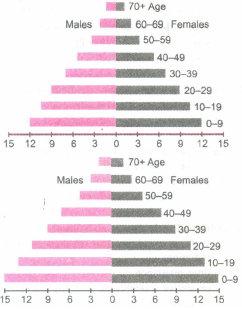
'A' is the earlier pyramid and no change has occurred in the growth rate.
'A' is more recent and shows slight reduction in the growth rate.
'B' is earlier pyramid and shows stabilized growth rate
'B' is more recent showing that population is very young
14.
Ornithophily refers to pollination by which of the following:
insects
birds
snails
air
15.
Match the following with correct combination
| Column I | Column II |
| A. Mutualism | 1. Tiger and Deer |
| B. Commensalism | 2. Cuscuta and Cissus |
| C. Parasitism | 3. Sucker fish and shark |
| D. Predation | 4. Crab and sea anemone |
A-1,B-2,C-3,D-4
A-4,B-3,C-2,D-1
A-1,B-3,C-2,D-4
A-2,B-3,C-1,D-4
A-4,B-2,C-3,D-1
16.
A high density of elephant population in an area can result in
intra-specific competition
inter-specific competition
predation on one another
mutualism
17.
Praying mantis is a good example of
camouflage
mullerian mimicry
warning colouration
social insects
18.
Niche overlap indicates
mutualism between two species
active cooperation between two species
two different parasites on the same host
sharing of one or more resources between the two species
19.
The formula for exponential population growth is
\(d{ N }/{ dt }=\gamma N\)
\(d{ t }/dN=\gamma N\)
\({ dN }/\gamma N=dt\)
\(\gamma \quad { N }/{ dN }=dt\)
20.
The ability of the venus fly trap to capture insects is due to
specialized 'muscle-like' cells
chemical stimulation by the prey
a passive process requiring no special ability on the part of the plant
rapid turgor pressure changes
21.
Animals have the innate ability to escape from predation. Examples for the same are given below. Select the incorrect example.
colour change in chamaeleon
enlargement of body size by swallowing air in puffer fish
poison fangs in snakes
melanism in months
22.
Lichens are well known combination of an alga and a fungus where fungus has
an epiphytic relationship with the alga
a parasitic relationship with the alga
a symbiotic relationship with the alga
a saprophytic relationship with alga
1.
(i) In some shallow South American lakes, visiting flamingoes and resident fishes compete for their common food, zooplanktons.
(ii) Abingdon tortoise of Galapagos island became extinct when goats were introduced into the island,
2.
Predators help in maintaining species diversity in a community by reducing the intensity of competition among competing prey species. In the rocky intertidal communities of the American Pacific Coast, the starfish Pisaster is a predator. When all the starfish was removed experimentally, more than 10 species of invertebrates became extinct within a year, because of interspecific competition.
3.
Sex ratio refers to the ratio between the number of males and the number of females of a given population, at a given time. It is characteristic of a population.
4.
Larger animals such as birds and mammals are able to maintain body temperature by physiological means.These have more volume and smaller surface area as compared to smaller animals.
5.
Acclimatization. The gradual physiological adjustment to shoe changing environmental conditions is called acclimatization.
Ectotherms are the cold-blooded animals who can not regulate their body temperature.
Endotherms are the warm-blooded animals who are capable of regulating their body temperatures.
6.
(a) A - Expanding, B - Stable, C- Declining.
(b) Stable population is preferred. It is helpful for planning any welfare activity.
(c) Logistic growth curve.
7.
(a) Adaptations of desert plants and animals.
Adaptations of desert animals.
1. Animals faced with water scarcity as found in arid or desert areas, show two types of adaptations, reducing water loss and ability to tolerate arid conditions KangaroolDesert Rat seldom drinks water. It has a thick coat to minimise evaporative desiccation. The animal seldom comes out of its comparatively humid and cool burrow during the day time. 90%of its water requirement is met from metabolic water (water produced by respiratory breakdown) while 10% is obtained from food.
2. Loss of water is minimised by producing nearly solid urine and feces.
3. Spiny skin and highly cornified in Phrynosoma (horned toad) and Maloch horridus.
Adaptations of desert plants.
1. Plants have thick cuticle, succulent organs where water and mucilage are stored.
2. Stomata are sunken.
3. They have well developed branched root system.
4. They possess waxy coating on surface.
5. Crassilucean pathway of photosynthesis.
6. They \({ C }_{ 4 }\) are plants.
(b) Adaptations of plants to water scarcities. They are called xerophytes. The above mentioned adaptation of plants are applicable (see part (a)))
(c) Behavioural adaptations in animals.
(i) Hibernation
(ii) Aestivation
(iii) Periodic activity
(iv) Camouflage migration.
(d) Importance of light to plants.
(1) Source of energy
(2) Photoperiodism
(3) Pigmentation
(4) Daily rhythm
(5) Plant movements and
(6) Growth.
(e) Effect of temperature or water scarcity and adaptation of animals. As discussed in(c) and reducing loss of water from body, and ability to tolerate arid condition.
8.
(i) Predation acts as a conduit for energy transfer across trophic levels.
(ii) It keeps the prey population under control.
(iii) It helps in maintaining species diversity in a community, by reducing the intensity of competition.
(iv) Biological control of pests is based on the principle of predation.
9.
Symptoms include:
(i) nausea
(ii) fatigue, and
(iii) heart palpitations.
Adaptations are:
(i) Increase in breathing rate.
(ii) Increased production of red blood cells.
(iii) Decreasing binding capacity of haemoglobin.
10.
(i) Population attributes are certain characteristic of a population. Some of them are as follows:
(a) Population size or density is the number of individuals of a species per unit area or volume.
Population Density
\((PD)=\frac { Number\quad of\quad individuals\quad in\quad a\quad region\quad (N) }{ Size\quad of\quad unit\quad area\quad in\quad the\quad region\quad (S) } \)
\(\\ or, \quad PD\quad =\quad \frac { N }{ S } \)
(b) Birth rate or natality is expressed as the number of births per 1000 individuals of a population per year, e.g. if in a pond, there are 20 lotus plants last year and through reproduction 8 new plants are added
Birth rate = \(\frac { 8 }{ 20 } \) = 0.4 offspring per lotus per year
(c) Death rate or mortality is expressed as the number of deaths per 1000 individuals of a population per year, i.e. if 4 individuals in a population of 40 fruitflies died during a specified time interval (say a week).
Death rate =\(\frac { 4 }{ 40 } \)=0.1 individuals per fruitfly per week
(d) Sex ratio is expressed as the number of females and males per 1000 individuals of a population in a given time, e.g. 60% females and 40% males in population.
(e) Age pyramid When the age distribution (percent individuals of a given age or age group) is plotted for the population, this is called age pyramid.
(ii) Population density is the number of people living per unit of an area.
Three ways of measuring population density of a habitat.
(a) Biomass or percentage cover, e.g. hundred Parthenium plants and one huge banyan tree.
(b) By measuring relative density, e.g. the number of fish caught per trap from a lake.
(c) Indirect estimation, e.g. without seeing or actually counting population sizes, e.g. the tiger census is often based on pug marks and faecal pellets.
11.
(a) Commensalism
(b) (i) Orchids grow as epiphytes on mango tree or other fruit trees.
Orchids are benefitted by getting a shelter, while the tree is neither benefitted nor damaged.
(ii) Barnacles growing on the whale are benefitted to move where food is available.
(iii) The cattle egrets always forage near to where the cattle animals graze; the cattle animals stir up the ground and the insects are flushed out from the vegetation and make it easy for the egrets to catch them.
(iv) The clown fish living among sea anemones get protection from their predators, which stay away from the stinging tentacles of the sea anemone:
(c) Amensalism
Roots of certain plants secrete chemicals, which are harmful to the soil organisms.
The antibiotics secreted by certain soil fungi are harmful to soil fungi bacteria. (anyone)
(d) Interactions should be beneficial to all concerned. Avoid selfish or selfcentered people.
12.
(a) The factors include
(i) The rotation of the earth around the sun and the tilt of its axis cause annual variation in the intensity and duration of temperature, which affects distinct reasons.
(ii) Annual variation in precipitation.
(b) (i) Scorching deserts of Rajasthan.
(ii) Rain-soaked Meghalaya forests
(iii) Deep ocean trenches.
(iv) Tropical rain forests
(v) High mountain tops. (any four)
(c) Interactions are necessary; they should be beneficial to all.
13.
(b)
'A' is more recent and shows slight reduction in the growth rate.
14.
(b)
birds
15.
(b)
A-4,B-3,C-2,D-1
16.
(a)
intra-specific competition
17.
(a)
camouflage
18.
(d)
sharing of one or more resources between the two species
19.
(a)
\(d{ N }/{ dt }=\gamma N\)
20.
(d)
rapid turgor pressure changes
21.
(c)
poison fangs in snakes
22.
(c)
a symbiotic relationship with the alga

12th Standard CBSE Syllabus & Materials
12th Standard CBSE
CBSE 12th Computer Science Python Revision Tour I - New Previous year Question Papers Study Material - QB365 Set A
NEW12th Standard CBSE
CBSE 12th Business Studies Planning Important Questions And Answers Study Material - QB365 Set A
NEW12th Standard CBSE
CBSE 12th Business Studies Business Environment Important Questions And Answers Study Material - QB365 Set A
NEW12th Standard CBSE
CBSE 12th Business Studies Principles of Management Important Questions And Answers Study Material - QB365 Set A



NCERT Books

Syllabus

Exam Pattern

Sample Question Papers

Previous year Question Papers

Important Notes

MCQ Practice test

NCERT Exemplers

Case study Questions

Image Based Questions

Passage based Questions

HOT Questions

Value Based Questions

Model Questions Papers
NCERT ( Book Back ) Questions

Assertion and Reason
Important Questions And Answers

CBSE 12th Standard CBSE Subjects
CBSE Standards








