
 100% FREE ACCESS
12th Standard CBSE Syllabus & Materials
12th Standard CBSE
CBSE 12th Economics Government Budget and the Economy Previous year Question Papers Study Material - QB365 Set A
NEW12th Standard CBSE
CBSE 12th Computer Science Interface Python with MySQL - New Previous year Question Papers Study Material - QB365 Set A
NEW12th Standard CBSE
CBSE 12th Computer Science Database Concept - New Previous year Question Papers Study Material - QB365 Set A
NEW12th Standard CBSE
CBSE 12th Computer Science Data Communication - New Previous year Question Papers Study Material - QB365 Set A
NEW12th Standard CBSE
CBSE 12th Computer Science Data Structures - New Previous year Question Papers Study Material - QB365 Set A
NEW12th Standard CBSE
CBSE 12th Computer Science Functions - New Previous year Question Papers Study Material - QB365 Set A

Published on: 02/11/2025
Download CBSE Class 12th Standard CBSE Biology question papers, sample papers, important questions, and previous year solved papers in PDF format. Get free study materials, NCERT solutions, and exam preparation resources for Class 12th Standard CBSE Biology
Questions + Answers key
Take MCQ Biology Test
1.
The unit of natural selection is
an individual
a species
a genus
a population
2.
The correct sequence of spermatogenic stages leading to the formation of sperms in a mature human testis is
spermatogonia-spermatid-spermatocyte-sperms
spermatocyte-spermatogonia-spermatid-sperms
spermatogonia-spermatocyte-spermatid-sperms
spermatid-spermatocyte-spermatogonia-sperms
3.
In which of the following organism, self-fertilization is seen?
Fish
Roundworm
Earthworm
Liver fluke
4.
Medical Termination of Pregnancy (MTP) is considered safe up to how many weeks of pregnancy?
8 weeks
12 weeks
18 weeks
6 weeks
5.
Which of the following statements is true of Bryophyllum?
Germinating bud appears from the eye of the stem tuber.
Germinating bud appears from the node of the rhizome.
Geminating bud appears from the notch at the leaf margin.
6.
What changes happen during processing of RNA?
7.
What are the events taking place in the ovary and uterus during follicular phase of the menstrual cycle?
8.
Describe the role of lymph nodes in providing immunity.
9.
What is the difference between a breed and a species? Give an example for each category.
10.
How is Darwin's concept of evolution different from that of de Vries?
11.
Explain any two methods of Assisted Reproductive Technology (ART) that have helped childless couples to bear children.
12.
What is parturition? Which hormones are involved in induction of parturition?
13.
Name the cell from which the endosperm of coconut develops. Give the characteristic features of endosperm of coconut.
14.
(a) Name the organisms that reproduce throught the following structures.
(i) Conidia
(ii) Zoospores
(b) Mention one similarity and one difference between these two reproductive structures.
15.
Micropropagation is the tissue culture technique used for vegetative multiplication.
(a) Name the plants propagated by micropropagation.
(b) What is the other name of the technique?.
(c) Write two advantages of micropropagation.
16.
(a) Draw a diagram of a mature embryo sac of an angiosperm and label the following parts in it:
(i) Filiform apparatus
(ii) Synergids
(iii) Central cell
(iv) Egg cell
(v) Polar nuclei
(vi) Antipodals
(b) Write the fate of egg cell and polar nuclei after fertilisation.
17.
(i) How many primary follicles are left in each ovary in a human female at puberty?
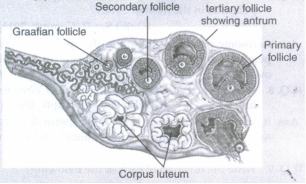
(ii) Draw a sectional view of the ovary showing the different follicular stages of a human female in her preovulatory phase of menstrual cycle.
18.
A group of students went on excursion in a park. It had small ponds, a few birds in a cage in one corner. They were surprised to observe small fish like tadpoles of the frog swimming in the pond; young chicks hatching out of the eggs and the female dog giving birth to four or five puppies.
(a) Name the process and the product, formed by the fusion of male and female gametes.
(b) Name the term for animals which lay eggs. What is the special feature of the eggs? Are the eggs released in unfertilised state?
(c) Name the group of animal which give birth to young ones? What is the source of nutrition fro the developing embryo?
19.
A woman has certain queries as listed below, before starting with contraceptive pills. Answer them.
(a) What do contraceptive pills contain and how do they act as contraceptives?
(b) What schedule should be followed for taking these pills?
20.
Study the sectional view of human testis showing seminiferous tubules given below. Answer the questions that follow.
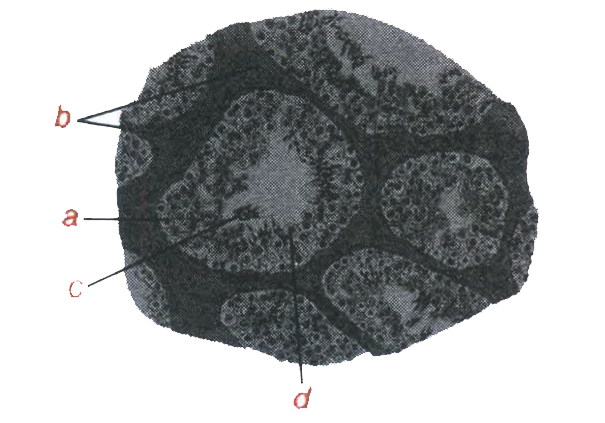
(i) Identify a, b and c.
(ii) Write the functions of a and d.
21.
An antibody molecule is represented as H2 L2 Explain.
22.
Explain the process of transcription in a bacterium
23.
(a) A normal couple gave birth to one haemophilic son and two normal daughters. Work out the cross to show the genotypes of the parents and their progeny.
(b) Give the possible genotypes of the parents who can give birth to haemophilic daughters.
24.
(a) Mention the exact location or the site in a flowering plant, where the following developments take place:
(i) Deposition of sporopollenin
(ii) Triple fusion
(iii) Release of male gametes
(iv) Megasporogenesis.
(b) Draw a labelled diagram of a male gametophyte of an angiosperm.
25.
Which is the vital link between organisms of one generation and the next generation?
26.
What is cultural eutrophication?
27.
Write the food chain of a non-vegetarian.
1.
(a)
an individual
2.
(c)
spermatogonia-spermatocyte-spermatid-sperms
3.
(d)
Liver fluke
4.
(b)
12 weeks
5.
(c)
Geminating bud appears from the notch at the leaf margin.
6.
During RNA processing
(i)unwanted nucleotides are removed
(ii)useful regions are rejoined
(iii)certain nucleotides are added
(iv)some nucleotides are modified, and
(v)folding of molecule
7.
1.The primary follicle grows and becomes fully mature Graafian follicle.
2. Secretion of estrogen hormone.
3. Endometrium of uterus regenerates through proliferation.
8.
The lymph nodes serve to trap the microorganisms and other antigens which have entered the lymph and tissue fluid.
These trapped antigens activate the lymphocytes present in the lymph nodes to cause immune response.
9.
| Breed | Species |
|---|---|
| A breed is a group of animals of a species that are related by descent and similar in most characters and general appearance features, etc. |
A species is a group of individuals/or ganisms, that have similar traits and can interbreed among themselves to produce fertile offspring.. |
10.
| Darwinian Concept | de Vries' Concept |
|---|---|
|
Variations causes minor heritable changes in characters among the individuals of a species. |
Mutations are large differences in the characteristics of organisms, that occur suddenly and causes spcciation. |
| Evolution was gradual. | Evolution occurs in a large single-step mutation. |
11.
(i)Test-tube baby program
In this method ova from the wife or a donor female and the sperms from the husband or a donor male are allowed to fuse under simulated conditions in the laboratory.
The zygote or early embryo is implanted into the fallopian tube or uterus for further development.
(ii)Intracytoplasmic sperm injection(ICSI)
In this method the sperm is directly injected into the ovum to form the zygote and then embryo transfer is cerried out.
12.
Partiruition refers to the process of delivery if the fully-developed foetus,i.e.,childbirth.
Relaxin and oxytocin are the hormones involved in the process.
13.
Primary endosperm cell forms the kernel of coconut.
Difference
The kernel of coconut is the cellular endosperm, while the coconut water is the free-nuclear endosperm.
14.
(a) (i) Penicillium
(ii) Chlamydomonas
(b)
| Zoospores | Conidia |
| Zoospores are motile cells with flagella, | Conidia are non-motile and dispersed by wind. |
| Zoospores are produced endogenously, i.e. within zoosporangium. | They are produced exogenously on the condiosporangium |
15.
(a) Orchids, carnation Gladiolus chrysanthemum and other ornamental plants.
(b) Tissue culture technique.
(c) Advantages of vegetative propagation
1.Ther is rapid multiplication of plants.
2. This technique has been applied for production of disease free plants.
16.
(b) (i) The egg cell on fertilisation becomes the zygote, which later forms the embryo
(ii) The polar nuclei fuse to form a diploid secondary nucleus; on fertilisation by a male gamete, it forms the primary endosperm nucleus, which later forms the endosperm.
17.
(i) 60000-80000 primary follicles
(ii)
18.
(a) Process-Fertilization
Product-Zygote
(b) (i) Oviparous animals
(ii) These eggs are either shelled or covered by protective coverings.
(iii) In frog (amphibians) Unfertilized eggs are released. In reptiles and birds, fertilized eggs are released.
(c) (i) Viviparous animals.
(ii) Developing embryo draws nutrition from mother through placenta.
19.
(i) Oral pills contain hormones such as progestron and estrogen.Oral administration of small doses of either progestron or progesterone-estrogen combinations is another contraceptive method used by the females.They are used in the form of tablets and hence are popularly called the 'pills'.
Functions.
1. They inhibit ovulation and implantation as well as alter the quality of cervical mucus to prevent/retard entry of sperms.
2. Pills are very effective with lesser side effects and are well accepted by the females.
Advantages of Saheli. 'Saheli', the new oral contraceptive for the female contains a non-steroidal preparation called 'centchroman'. It is a 'once a week' pill with very few side effects and high contraceptive value.
(ii) Schedule. Pills have to be taken daily for a period of 21 days starting preferably within the first five days of menstrual cycle. After a gap of 7 days (during which menstruation occurs) it has to be repeated in the same pattern till the desired period on contraception.
20.
(i) a- Spermatogonia
b-Interstitial cells or Leydig cells
c-Spermatozoa.
(ii)a-Spermatogonia produce the spermatozoa (sperms).
d-Sertoli cells provide nutrition to the germ cells.
21.
Each antibody molecule has four polypeptide chains.
Of them,two are small and called light chains (L) and two of them are longer and called heavy chains(H) hence written as H2 L2.
22.
1. Transcription unit in a bacterium consists of a promoter, structural genes, terminator and the enzyme DNA dependent RNA-Polymerase.
2. In bacteria, there is a single RNA polymerase, which catalyses transcription of all the three types of RNAs (mRNA, tRNA and RNA)
3. It also facilitates opening of the double helical DNA and only the DNA strand with \({ 3 }^{ ' }\longrightarrow { 5 }^{ ' }\) polarity is transcribed, as the enzyme can polymerise the nucleotides only in \({ 5 }^{ ' }\longrightarrow { 3 }^{ ' }\) direction.
4. Once the polymerase reaches the terminator sequence, the nascent RNA falls off and termination of transcription occurs.
23.
The doctor must have used Pedigree analysis; which refers to the analysis of distribution and movement of traits in a series of generations of a family. Since the non-haemophilic parents give rise to a haemophilic child, the genotypes of them should be
24.
(a) (i) On the exine of pollen grains while in the microsporangia.
(ii) In the central cell of embryo sac of the ovule.
(iii) From the pollen sacs.
(iv) In the ovule.
25.
()
Zygote.
26.
()
Faster ageing of a lake due to presence of large amounts of industrial and agricultural wastes and domestic sewage produced by human activities is called Cultural or Accelerated Eutrophication.
27.
()
The food chain for a non-vegetarian may be written as:\(Plants\rightarrow Goat\rightarrow Man\)

12th Standard CBSE Syllabus & Materials
12th Standard CBSE
CBSE 12th Computer Science Python Revision Tour I - New Previous year Question Papers Study Material - QB365 Set A
NEW12th Standard CBSE
CBSE 12th Business Studies Planning Important Questions And Answers Study Material - QB365 Set A
NEW12th Standard CBSE
CBSE 12th Business Studies Business Environment Important Questions And Answers Study Material - QB365 Set A
NEW12th Standard CBSE
CBSE 12th Business Studies Principles of Management Important Questions And Answers Study Material - QB365 Set A



NCERT Books

Syllabus

Exam Pattern

Sample Question Papers

Previous year Question Papers

Important Notes

MCQ Practice test

NCERT Exemplers

Case study Questions

Image Based Questions

Passage based Questions

HOT Questions

Value Based Questions

Model Questions Papers
NCERT ( Book Back ) Questions

Assertion and Reason
Important Questions And Answers

CBSE 12th Standard CBSE Subjects
CBSE Standards








