
 100% FREE ACCESS
12th Standard CBSE Syllabus & Materials
12th Standard CBSE
CBSE 12th Economics Government Budget and the Economy Previous year Question Papers Study Material - QB365 Set A
NEW12th Standard CBSE
CBSE 12th Computer Science Interface Python with MySQL - New Previous year Question Papers Study Material - QB365 Set A
NEW12th Standard CBSE
CBSE 12th Computer Science Database Concept - New Previous year Question Papers Study Material - QB365 Set A
NEW12th Standard CBSE
CBSE 12th Computer Science Data Communication - New Previous year Question Papers Study Material - QB365 Set A
NEW12th Standard CBSE
CBSE 12th Computer Science Data Structures - New Previous year Question Papers Study Material - QB365 Set A
NEW12th Standard CBSE
CBSE 12th Computer Science Functions - New Previous year Question Papers Study Material - QB365 Set A

Published on: 28/11/2025
Download CBSE Class 12th Standard CBSE Biology question papers, sample papers, important questions, and previous year solved papers in PDF format. Get free study materials, NCERT solutions, and exam preparation resources for Class 12th Standard CBSE Biology
Questions + Answers key
Take MCQ Biology Test
1.
Differentiate a test cross and a reciprocal cross.
2.
Is an aquarium a complete ecosystem?
3.
Why are a fig tree and its partner wasp considered a good example of mutualism?
4.
How is Darwin's concept of evolution different from that of de Vries?
5.
How is the translation of mRNA terminated?
6.
Seeing a crowd of students in one corner of the school: the principal rushed to see the matter and found some children beating and chasing a small lizard. On seeing the principal, all the children fled to their classes except Alok who requested the principal to arrange for some medical assistance for the injured animal. The principal rewarded Alok for his attitude to save guard our biodiversity.
(i) What do you understand by biodiversity?
(ii) Mention the factors resulting in loss of biodiversity.
(iii) Was Alokan indisciplined boy,who did not run to the class on seeing the principal? What values does the act promote?
7.
Write the formula for the change in population density.
8.
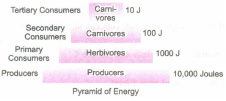
Construct an ideal pyramid of energy when 1,000,000 joules of sunlight is available. Label all its trophic levels.
9.
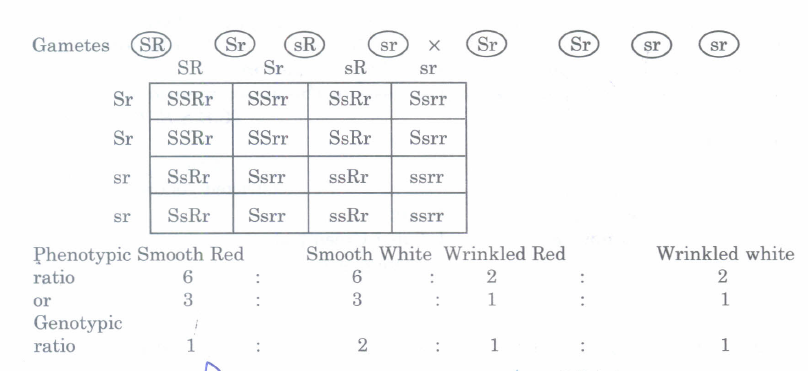
A smooth seeded and red flowered pea plant (Ss Rr) is crossed with a smooth seeded and white flowered pea plant(Ss rr).Determine the phenotype and genotypic ratios of the progeny\({ F }_{ 1 }\).
10.
Recall the experiment done by frederick Griffith, Avery, MacLeod and McCarty, where DNA was speculated to be the genatic material. If RNA, Instead of DNA was the genetic material, would the heat killed strain of Pneumococcus have tranformed the R-strain into virulent strain? Explain
11.
Explain the increase in the numbers of melanic (dark-winged) moths in the urban areas of post-industrialisation period in England.
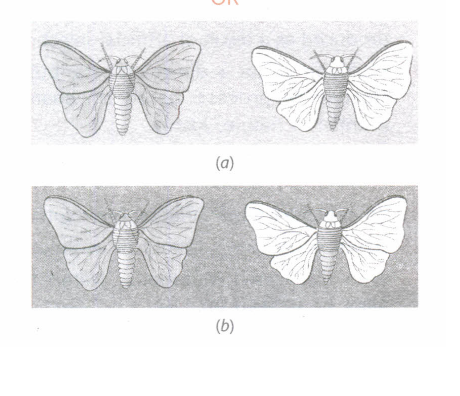
What do these picture 'a' and 'b' illustrate with reference to evolution?Explain.
12.
Why is RNA regarded as the first genetic material? Explain
13.
(a) What is Central dogma? Who proposed it ?
(b) Describe Meselson and Stahl's experiment to prove that the DNA replication is semi-conservative.
14.
Explain briefly the 'rivet popper hypothesis' of Paul Ehrlich.
15.
(a) Why is human ABO blood group gene considered a good example of multiple alleless?
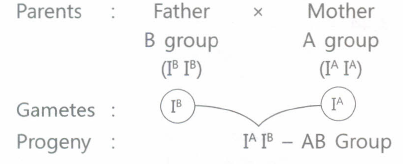
(b) Work out a cross up to F1 Generation only, between a mother with blood group A (homozygous) and the father with blood group B (homozygous). Explain the pattern of inheritance exhibited.
16.
17.
18.
If the base sequence of a codon in mRNA is 5' - AUG-3', the sequence of tRNA pairing with it must be:
5' - UAC -3'
5' - CAU -3'
5' - AUG -3'
5' - GUA -3'
19.
3-5 billion years ago, which flora dominated the earth?
Archaebacteria
Mosses
Lichens
Blue-green algae
20.
The biogenetic law of Hackel is
Omnis vivum-e-vivum
Omnis cellula-e-cellula
Ontogeny repeats phylogeny
Phylogeny repeats ontogeny
21.
These belong to the category of primary consumers
Insects and cattle
Eagle and snakes
Water insects
Snakes and frogs
22.
Amensalism is an association between two species where:
one species is harmed and other is benefitted
one species is harmed and other is unaffected
one species is benefitted and other is unaffected
both the species are harmed
23.
A gene of operon which synthesizes a repressor protein is
regulator gene
operator gene
structural gene
promotor gene
24.
Turner syndrome is
XO
XXY
XXX
XYY
25.
How many codons code for amino acids?
64
61
68
60
26.
Two crosses between the same pair of genotype or phenotypes in which the sources of the gametes are reversed in one cross, is known as
Reverse cross
Dihybrid cross
Test cross
Reciprocal cross
27.
Superiority of hybrid over parents is
Digantism
Lethality
Heterosis
Dwarfism
28.
Hardy-Weinberg Principle As per Hardy-Weinberg Principle, "Allele and genotype frequencies in a population will remain constant from generation to generation in the absence of other evolutionary influences. These influences include mate choice, mutation, selection, genetic drift, gene flow and meiotic drive". The gene pool remains a constant. The total genes and their alleles in a population make the gene pool. Sum total of all the allelic frequencies is 1. Hence, p²+2pq + q² = 1 When frequency differs from expected values, the difference (direction) indicates the degree of evolutionary change. Thus, disturbance in Hardy- Weinberg Equilibrium would then be said to result in evolution. Factors that affect Hardy-Weinberg Equilibrium are Gene Migration or Gene Flow, Genetic Drift, Mutation, Genetic Recombination and Natural Selection
Q1. What is the importance of Hardy-Weinberg law?
a. Evolution
b. Gene pool
c. Genetics
d. Genetic variation
Q2. The sum total of genes present in a Mendelian population is called:
a. gene pool
b. gene frequency
c. genetic variation
d. genetics
Q3. How many years ago the earth was originated?
a. 6000
b. 5500
c. genetic variation
d. 6500
Q4. Random genetic drifts in a population are a result of:
a. small size of population
b. major genetic differences in individuals.
c. interspecific hybridisation.
d. slower rate of mutation.
29.
In the ex-situ conservation approach, the threatened plants and animals are taken out from their natural habitat and placed in special settings, where they can be protected and given special care. In recent times, ex-situ conservation has advanced beyond keeping the threatened species in enclosures.
(a) Mention any four advanced techniques of ex-situ conservation.
(b) Name two International conventions held in relation to biodiversity conservation.
30.
Assertion : Whales, bats, cheetah and human share similarities in the pattern of bones of forelimb.
Reason : All of them have humerus, radius, ulna, carpals, metacarpals and phalanges.
Codes:
(A) If both assertion and reason are true and the reason is the correct explanation of the assertion.
(B) If both assertion and reason are true but reason is not the correct explanation of the assertion.
(C) If assertion is true but reason is false.
(D) If both assertion and reason are falsely.
31.
Assertion: Predation and parasitism are considered to be negative interactions.
Reason: Predators and parasites limit the population of their host species.
Codes:
(a) Both assertion and reason are true and reason is the correct explanation of assertion.
(b) Both assertion and reason are true but reason is not the correct explanation of assertion.
(c) Assertion is true but reason is false.
(d) Both assertion and reason are false.
32.
Assertion : Hybrids are generally back crossed.
Reason : Back cross is done to increase the traits of the parent.
Codes :
(a) Both assertion and reason are true and reason is the correct explanation of assertion.
(b) Both assertion and reason are true but reason is not the correct explanation of assertion.
(c) Assertion is true but reason is false.
(d) Both assertion and reason are false
33.
Assertion: B-DNA has a constant diameter of 20 Â.
Reason: A pyrimidine always pairs with a purine.
Codes :
(a) Both assertion and reason are true and reason is the correct explanation of assertion.
(b) Both assertion and reason are true but reason is not the correct explanation of assertion.
(c) Assertion is true but reason is false.
(d) Both assertion and reason are false
1.
A test cross involves the cross between offspring of \({ F }_{ 1 }\) with a homozygous recessive parent to determine the genotype of \({ F }_{ 1 }\) offspring, whereas, reciprocal cross involves the study of same character with reversed sexes.It is made to determine if sex has any role on dominance-recessive relationship.
2.
Yes, aquarium is a man-made ecosystem (artificial). If an ecosystenm possesses all physical and biological components,then it issaid to be complete.
Since, aquarium has both biotic components (plants and fishes) and abiotic components (air and water), so it is a complete ecosystem.
3.
It is a case of mutualism because both the fig tree and the wasp are benefitted by this interaction.
The female wasp uses the ovary as a site for oviposition and the developing seeds within the fruit for nourishing the larvae.
The fig inflorescence is pollinated while the wasp is searching for the suitable place for egg-laying.
4.
| Darwinian Concept | de Vries' Concept |
|---|---|
|
Variations causes minor heritable changes in characters among the individuals of a species. |
Mutations are large differences in the characteristics of organisms, that occur suddenly and causes spcciation. |
| Evolution was gradual. | Evolution occurs in a large single-step mutation. |
5.
1. When one of the termination codons (UAA, UAG, UGA) comes at the A-site, it does not code for any amino acid and there is no tRNA molecule for it.
2. As a result, the polypeptide synthesis (or elongation of polypeptide) stops.
3. The polypeptide synthesised is released from the ribosome, catalysed by a 'release factor'.
6.
(ii) There are four major factors that results in loss of bidiversity and these are
(a) Habitat loss and fragmentation
(b) Over-exploitation.
(c) Alien species invasion
(d) Co-extinction
(iii) No, Alok was a brave and courteous boy. He expressed his love for animals, commitment towards natural resources and their conservation.
7.
The formula for calculating population density is Dp= N/A. In this equation, Dp is the density of population, N is the total population as a number of people, and A is the land area covered by that population.
8.
9.
Phenotypes Smooth seeded X and red flowered Smooth seeded and
Parents SsRr White flowered SsRr
Genotype
10.
RNA is more liable and prone to degradation (owing to the presence of 2'OH group in its ribose) Hence, heat-killed S-strain may not have retained its ability to transform the R-strain into virulent form if RNA was its genetic material.
11.
1. In England, before industrial revolution, there were more white-winged or dull-grey moths on the tree trunks, than the dark-winged or melanic moths.
2. In the collection of moths, carried out in the same area after industrial revolution, there were more dark-winged moths.
3. The explanation given for this observation was that predators will spot a month against a contrasting background.
4. During the post-industrialisation period, the trunks became dark with the industrial smoke and soot.
5. Under this condition, white-winged moths did not survive as predators could easily spot these, while dark-winged or melanic moths survived better.
6. Before industrialisation, there used to be a thick growth of the almost white coloured lichens on the tree trunks and in that background, the white-winged moths survived better; the dark coloured moths were easily spotted and picked up by their predators.
7. In this case,the moths which were able to camouflage and hide in the background survived and increased their population size through reproduction.
12.
RNA is the first genetic material because:
(i) RNA can directly code for the synthesis of proteins and hence can easily express the character; it is the genetic material in many viruses.
(ii) RNA can also act as a catalyst; there are some important biochemical reactions in living systems that are catalysed by RNAs and not proteins.
(iil) Many essential life processes like splicing, translation, etc. have evolved around RNA.
13.
(a) Central dogma:
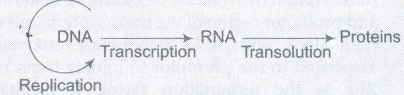
given by Francis Crick.
(b) Messelsont & stanl experiment:
.jpg)
(Same value points to be awarded in an explanation).
14.
Ecologist Paul Ehrlich gave 'rivet popper hypothesis' to understand the contribution of the species richness. He compared each species with rivet in the body of an airplane.
(i) This hypothesis explain that ecosystem to be an airplane and the species to be the rivets joining all parts together.
(ii) If every passenger traveling in the airplane start taking rivets home(causing a species to become extinct), initially it may not affect flight safety (proper functioning of ecosystem), but over a period of time the plane become weak and dangerous (Species become endangered and then extinct).
15.
(a) The gene controlling ABO blood group in human exists in three allelic forms, \(I^{ \wedge }I^{ B }\) and i, i.e. multiple alleles.
(b) Mother-homozygous A group -\(I^{ \wedge }I^{ \wedge }\) Father-homozygous B group \(I^{ \wedge }I^{ \wedge }\)The progeny will be as follows:
16.
(a)
17.
(d)
18.
(b)
5' - CAU -3'
19.
(d)
Blue-green algae
20.
(c)
Ontogeny repeats phylogeny
21.
(a)
Insects and cattle
22.
(c)
one species is benefitted and other is unaffected
23.
(a)
regulator gene
24.
(a)
XO
25.
(b)
61
26.
(d)
Reciprocal cross
27.
(c)
Heterosis
28.
29.
(a) The advanced ex-situ techniques.
(i) Cryopreservation of gametes of threatened species
(ii) In vitro fertilisation of eggs.
(iii) Tissue culture methods of plant propagation.
(iv) Seed banks to store seeds of commercially important plants for long periods.
(b) The International Conventions
(i) Convention on Biological Diversity (Earth Summit), 1992, held in Rio de Janeiro.
(ii) World Summit on Sustainable Development, 2002, held in Johannesberg, South Africa.
30.
(B) If both assertion and reason are true but reason is not the correct explanation of the assertion.
31.
(a): Predation and parasitism are considered to be negative interactions, because in both of these interactions one species gains and the other suffers. Predation is the interaction between species involving killing and consumption of prey. The species which eats the other is called the predator, and the one consumed by other is termed as prey. Predation is commonly illustrated by the herbivore-carnivore interaction.
Parasitism is the interaction in which the species smaller in size (the parasite) lives in or on the larger species (the host) from which it obtains food and shelter. Parasites like leeches, tick, lice, mites feed on the body fluids of the hosts. Parasites, like the predators limit the population of the host species. Parasites are generally host- specific, and do not have choice or alternatives like predators. Parasites are smaller in size and have higher biotic/reproductive potential compared to the predators. Parasites have poor means of dispersal and require specialised structures to reach or invade the host. Predators, on the other hand, are quite mobile and capable of capturing the prey.
32.
(a) : Back cross is a cross which is performed between hybrid and one of its parents. In plant breeding, back cross is performed a few times in order to increase the traits of that parent. For example, a crop plant is crossed with a wild variety in order to obtain its disease resistance. In the process, most good traits of the crop plant get diluted. The hybrid is, therefore, repeatedly crossed with parent crop plant in order to transfer the good traits back into it.
33.
(a): B-DNA is a helical structure with diameter of 20 Â. If pairing occurs between two purines, it would need too much space and if pairing occurs between two pyrimidines, it would occupy too little space. The constancy of DNA diameter is maintained only when a pyrimidine always pairs with a purine

12th Standard CBSE Syllabus & Materials
12th Standard CBSE
CBSE 12th Computer Science Python Revision Tour I - New Previous year Question Papers Study Material - QB365 Set A
NEW12th Standard CBSE
CBSE 12th Business Studies Planning Important Questions And Answers Study Material - QB365 Set A
NEW12th Standard CBSE
CBSE 12th Business Studies Business Environment Important Questions And Answers Study Material - QB365 Set A
NEW12th Standard CBSE
CBSE 12th Business Studies Principles of Management Important Questions And Answers Study Material - QB365 Set A



NCERT Books

Syllabus

Exam Pattern

Sample Question Papers

Previous year Question Papers

Important Notes

MCQ Practice test

NCERT Exemplers

Case study Questions

Image Based Questions

Passage based Questions

HOT Questions

Value Based Questions

Model Questions Papers
NCERT ( Book Back ) Questions

Assertion and Reason
Important Questions And Answers

CBSE 12th Standard CBSE Subjects
CBSE Standards








