
 100% FREE ACCESS
12th Standard CBSE Syllabus & Materials
12th Standard CBSE
CBSE 12th Economics Government Budget and the Economy Previous year Question Papers Study Material - QB365 Set A
NEW12th Standard CBSE
CBSE 12th Computer Science Interface Python with MySQL - New Previous year Question Papers Study Material - QB365 Set A
NEW12th Standard CBSE
CBSE 12th Computer Science Database Concept - New Previous year Question Papers Study Material - QB365 Set A
NEW12th Standard CBSE
CBSE 12th Computer Science Data Communication - New Previous year Question Papers Study Material - QB365 Set A
NEW12th Standard CBSE
CBSE 12th Computer Science Data Structures - New Previous year Question Papers Study Material - QB365 Set A
NEW12th Standard CBSE
CBSE 12th Computer Science Functions - New Previous year Question Papers Study Material - QB365 Set A

Published on: 28/11/2025
Download CBSE Class 12th Standard CBSE Biology question papers, sample papers, important questions, and previous year solved papers in PDF format. Get free study materials, NCERT solutions, and exam preparation resources for Class 12th Standard CBSE Biology
Questions + Answers key
Take MCQ Biology Test
1.
(a)Name the genetic disorder in a human female having 44 + XO karyotype. Mention the diagnostic features of the disorder
(b)Explain the cause of such chromosomal disorder.
2.
In pea plants let symbol Y represent dominant yellow; symbol y, the recessive green; symbol R, the round seed shape and symbol r, the wrinkle seed shape. A typical Mendelian dihybrid cross was carried out in pea plants. Write the genotypes of :
(a) Homozygous dominant and recessive parents.
(b) Gametes produced by both the parents
(c) F1 offspring
(d) Gametes produced by F}offspring
3.
How are dominance, codominance and incomplete dominance patterns of inheritance different from each other?
4.
Differentiate between monosamy and trisomy. Give an example of each from human genetics.
5.
What is the cause of phenylketonuria? Explain the disorder.
6.
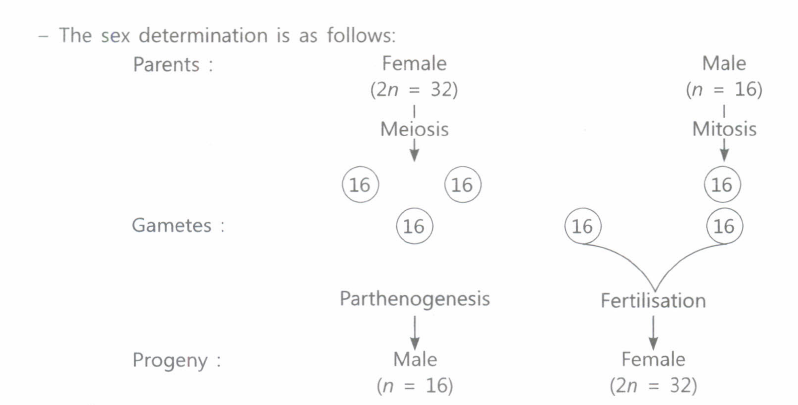
Explain the mechanism of sex-determination in honeybees.
7.
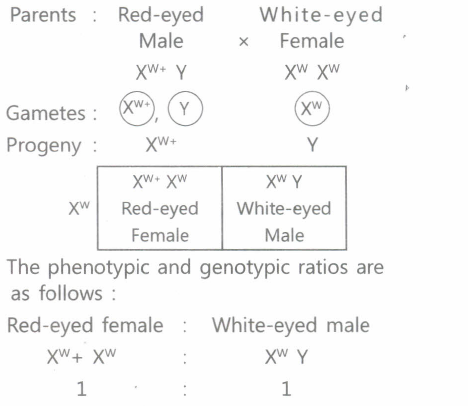
Work out a cross between red-eyed male Drosophila melanogaster fly and a white-eyed female. Give the genotype and phenotype of the progeny. What do you call this pattern of inheritance?
8.
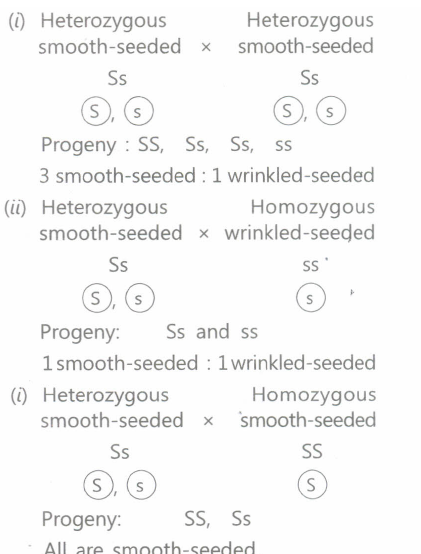
In garden pea, smooth seed coat is dominant over wrinkled seed coat. What will be the expected ratio of phenotypes of the offspring in a cross between:
(i) Heterozygous smooth \(\times\) Heterozygous smooth
(ii) Heterozygous smooth \(\times\) Homozygous wrinkled
(iii) Heterozygous smooth \(\times\) Homozygous smooth.
9.
In a test cross, AaBb \(\times\) aabb, 90 percent of the progeny are like parents. Determine.
(i) the progeny type for the rest of the population?
(ii) Are the genes linked?
(iii) Is there any crossing over of the genes?
10.
Name the genetic disorder caused by an extra 'X' chromosome in a human male. State the diagnostic features of the individual suffering from it.
11.
Name the phenomemon that leads to situations lie 'XO' abnormality in humans. How do humans with 'XO' abnormality suffer? Explain.
12.
Recently a girl baby has been reported to suffer from haemophilia. How is it possible? Explain with the help of a cross.
13.
Why are human females rarely haemophilic? Explain. How do haemophilic patients suffer?
1.
(a)(i) Turner's syndrome.
(ii) 44 with XO chromosomes - such females are sterile as ovaries are rudimentary. Other features include lack of other secondary sexual characters, short stature and under developed feminine characters.
(b) Such a disorder is caused due to the absence of one of X chromosomes
2.
(a) Genotype of
(i) Homozygous dominant parent- YYRR
(ii) Homozygous recessive parent-yyrr
(b) Gametes produced by both the parents
(i) YR and (ii) yr
(c) F1 offsprings
Phenotype - all seeds yellow round and Heterozygous
Genotype - YyRr
(d) Gametes produced by F1 offsprings
4 types - 
3.
Dominance : One allele expresses itself in the hybrid heterozygous condition, other is suppressed.
Codominance : Both the alleles of a gene express in a heterozygous hybrid containing two dominant alleles
Incomplete dominance: Neither of the two alleles of a gene is completely dominant over the other in heterozygous the hybrid is Intermediate
4.
| Monosomy | Trisomy |
| It is the condition where a diploid individual lacks one member of any one pair of chromosomes. |
It is the condition where a diploid individual has an additional copy of a chromosome. |
|
The individual has (2n-1) number of chromosomes. |
The individual has (2n + 1) number of chromosome. |
5.
Phenylketonuria:
It is caused by a recessive mutant allele on chromosome 12.
The affected individuals lack an enzyme that catalyses the conversion of the amino acid phenylalanine into tyrosine.
As a result, phenylalanine is metabolised into phenyl pyruvate, phenyl acetate, etc.
Accumulation of these chemicals in the brain results in mental retardation.
These are also excreted in the urine, as they are not absorbed by the kidney tubules.
6.
Sex-determination in honeybees:
Haplodiploid sex-determination is seen in honeybees; it is based on the number of sets of chromosomes, an individual receives.
When the ovum is fertilised by a male gamete, the zygote (2n = 32) develops into a female, i.e. a queen or worker.
When the ovum develops by parthenogenesis, i.e. without fertilisation, a male individual, called drone is formed.
The male honeybee (drone) is haploid (with n = 16) and forms sperms by mitosis.
7.
8.
9.
(i) The rest of the progeny will be aaBb and Aabb.
(ii) Yes, the genes are linked.
(iii) Yes, there is crossing over, as 10% of the progeny are recombinants.
10.
Klinefelter's syndrome
The individual has 22 pairs of autosome and XY sex chromosomes, i,e. 47 chromosomes.
Symtoms:
The individual is a male.
He shows development of feminine characters like development of breasts.
Body hair is sparse.
The individual is sterile.
11.
Non-disjunction is responsible for chromosomal abnormalities.
Non-disjunction is the phenomenon of failure of segregation of the members of homologous pairs of chromosomes.
XO-abnormality results from fertilisation of an ovum with X-chromosome by a sperm carrying no sex-chromosome.
The individual has underdeveloped feminine characters.
Ovaries are rudimentary.
She is sterile.
12.
The gene for haemophilia is present on the X chromosome, i.e. sex-linked.
The disorder is due to a recessive mutant allele; hence a female with XX sex chromosomes, must be homozygous to produce the disease.
She must receive one of the defective alleles from her haemophilic father and the other X-chromosome with the defective allele from her mother; who is also haemophilic or at least a carrier (heterozygous for the trait, XXh).
The cross is as follows.
13.
1.The gene for haemophilia is present on the X chromosome, i.e. sex-linked.
2.The disorder is due to a recessive mutant allele; hence a female with XX sex chromosomes, must be homozygous to produce the disease.
3.She must receive one of the defective alleles from her haemophilic father and the other X-chromosome with the defective allele from her mother; who is also haemophilic or at least a carrier (heterozygous for the trait, XXh).
4.The cross is as follows.

12th Standard CBSE Syllabus & Materials
12th Standard CBSE
CBSE 12th Computer Science Python Revision Tour I - New Previous year Question Papers Study Material - QB365 Set A
NEW12th Standard CBSE
CBSE 12th Business Studies Planning Important Questions And Answers Study Material - QB365 Set A
NEW12th Standard CBSE
CBSE 12th Business Studies Business Environment Important Questions And Answers Study Material - QB365 Set A
NEW12th Standard CBSE
CBSE 12th Business Studies Principles of Management Important Questions And Answers Study Material - QB365 Set A



NCERT Books

Syllabus

Exam Pattern

Sample Question Papers

Previous year Question Papers

Important Notes

MCQ Practice test

NCERT Exemplers

Case study Questions

Image Based Questions

Passage based Questions

HOT Questions

Value Based Questions

Model Questions Papers
NCERT ( Book Back ) Questions

Assertion and Reason
Important Questions And Answers

CBSE 12th Standard CBSE Subjects
CBSE Standards








