
 100% FREE ACCESS
12th Standard CBSE Syllabus & Materials
12th Standard CBSE
CBSE 12th Economics Government Budget and the Economy Previous year Question Papers Study Material - QB365 Set A
NEW12th Standard CBSE
CBSE 12th Computer Science Interface Python with MySQL - New Previous year Question Papers Study Material - QB365 Set A
NEW12th Standard CBSE
CBSE 12th Computer Science Database Concept - New Previous year Question Papers Study Material - QB365 Set A
NEW12th Standard CBSE
CBSE 12th Computer Science Data Communication - New Previous year Question Papers Study Material - QB365 Set A
NEW12th Standard CBSE
CBSE 12th Computer Science Data Structures - New Previous year Question Papers Study Material - QB365 Set A
NEW12th Standard CBSE
CBSE 12th Computer Science Functions - New Previous year Question Papers Study Material - QB365 Set A

Published on: 05/03/2026
Download CBSE Class 12th Standard CBSE Biology question papers, sample papers, important questions, and previous year solved papers in PDF format. Get free study materials, NCERT solutions, and exam preparation resources for Class 12th Standard CBSE Biology
Questions + Answers key
Take MCQ Biology Test
1.
If a double stranded DNA has 20 percent of cytosine, calculate the percent of adenine in the DNA.
2.
(i) Accoring to Watson and Crick model,the DNA molecule consists of_____long,parellel strands.The two strands are_______around a common axis in a regular manner to form a____helix.
(ii)These strands are made of ___ units.Each such units consists of_____,_____and_____
(iii)In each chain,nitrogenous base molecules are joined to the sugar molecules by_____bonds and project into the space enclosed in the helix at about____to the long axis of the helix
(iv)The nitrogenous bare may be a 9-membered,double ringed____or a 6-membered single ringed___
(v)The double helix of DNA has a constant diameter of___and one complete spiral (turn) of the helix is ___long and has____base pairs.
(vi)The mode of DNA replication is
(vii)Enzyme___cannot initiate the synthesis of a new DNA strand,although it can catalyze the growth of a DNA chain.Therefore,a short chain of ___is formed on the DNA template at the 5' end.This is called___
(viii)During DNA replication,one new strand formed in continuous stretch in the 5'-3' direction.it is called____strand.Other strand is formed in small fragments called_____Which are later joined to form a continuous strand termed___strand
3.
What is homoeostasis?
4.
Find out through internet and popular science articles whether animals other than man has self-consciousness.
5.
If the sequence of one coding strand of DNA is written as follows:
5' - ATGCATGCATGCATGCATGCATGCATGC -3'
write down the sequence of complementary strand in 5'⟶3' direction.
6.
Compare the roles of the enzymes DNA-polymerase and DNA-ligase in the replication fork of DNA.
7.
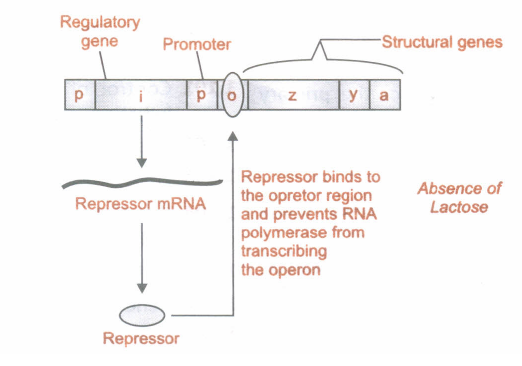
Draw a schematic diagram of lac operon in its 'switched off' position. Label the following:
(i)The structural genes
(ii)Repressor bound to its correct position
(iii)Promoter gene
(iv)Regulatory gene
8.
When a cross is made between tall plant with yellow seeds (TtYy) and tall plant with green seed (Ttyy), what proportions of phenotype in the offspring could be expected to be:
(a) Tall and green
(b) Dwarf and green.
9.
Tallness of pea plant is a dominant trait, while dwarfness is the alternate recessive trait. When a pureline tall is crossed with a pureline dwarf, what fraction of tall plants in F2 shall be heterozygous? Give reasons.
10.
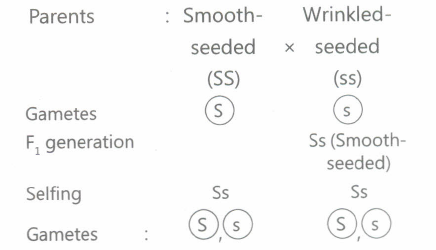
In a typical monohybrid cross, the F2 population ratio is written as 3 : 1 for phenotype, but expressed as 1 : 2 : 1 for phenotype. Explain with the help of an example.
11.
A diploid organism is heterozygous for 4 loci, how many types of gametes can be produced?
12.
Shabana and Shanaaz were discussing about the origin of life on the earth. They exchanged hot arguments at length about, whether or not the life is even to-day still originating on the earth. Prof. Dr. Deepak Gupta a biology teacher who happened to be their neighbour and per chance listening to the girls called them and explained the matter in detail. Answer the following questions on the basis of above information.
(i) What would be your answer to the above problem? Explain giving reasons.
(ii) Recall Miller's experiment which simulated the primitive earth atmosphere.
(iii) What would have been the energy source for the origin of life on the earth. Energy was provided, what products were formed in the experiment.
(iv) What values were exhibited by Dr. Deepak Gupta the Biology teacher.
13.
Let us assume in a given plant, the genotype symbol 'Y' stands for dominant yellow seed colour and 'Y' for recessive green seed colour; symbol 'R' for round seed shape and 'r' for wrinkled seeds. Two homozygous parents (plant) with genotypes 'RRYY' and 'rryy' are crossed and their F1 generation progeny is then
(a) Phenotype of F1 progeny
(b) Genotype of F1 Progeny
(c) Gamete genotypes of F1 progeny
(d) Phenotypic ratio of F2 population
(e) Phenotypic ratio of yellow seeds to green seeds and round seeds to wrinkled seeds in F2 population.
14.
Given below is the represent ation of a relevant part of amino acid composition of the B-chain of haemoglobin,related to the shape of human red blood cells.
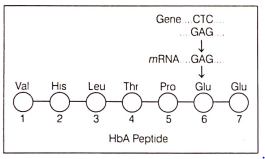
(i) Isthis representation of the sequence of amino acids indicating a normal human or a sufferer from a certain blood related genetic disease? Give reason in support of your answer.
(ii) Why is the disease referred to as a Mendelian disorder? Explain.
15.
The total number of genes in humans is far less (<25000) than the previous estimate (up to 140000 genes).Comment
16.
During DNA replication, why is it that the entire molecule does not open in one go? Explain replication fork. what is the two function that the monomers (dNTPs) play?
17.
Given below is a dihybrid cross performed on Drosophila.
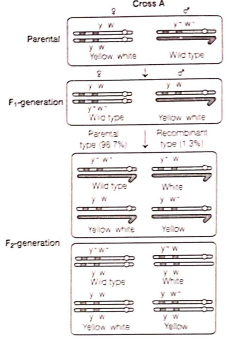
Which of the following conclusions can be drawn on the basis of the cross? When yellow bodied (y), white eyed (w) Drosophila females were hybridised with brown bodied (y), red eyed males (w^) and F₁ progenies were intercrossed, F₂-generation would have shown the following ratio.
1:2:1 because of linkage of genes
9:3:3:1 because of recombination of genes
Deviation from 9:3:3:1 ratio because of segregation of genes
Deviation from 9:3:3:1 ratio because of linkage of genes
18.
Select the incorrect match from the following.
| Human karyotype | Characters |
| 45+XX | Broad palm with characteristic palm crease |
| Human karyotype | Characters |
| 44+XXY | Overall feminine development |
| Human karyotype | Characters |
| 44+XO | Sterile females as ovaries are rudimentary |
| Human karyotype | Characters |
| 44+XY | Normal male |
19.
The figure below shows the normal haemoglobin at genetic level.
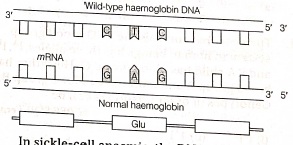
In sickle-cell anaemia, the DNA sequence changes from GAG to GTG on the non transcribed strand of haemoglobin.
Choose the correct result for the given mutation from the given table.
| Resultant mRNA | Resultant polypeptide |
| CAC | Glycine |
| Resultant mRNA | Resultant polypeptide |
| GAC | Analine |
| Resultant mRNA | Resultant polypeptide |
| GUG | Valine |
| Resultant mRNA | Resultant polypeptide |
| GUG | Lysine |
20.
Purine posses nitrogen at
1,2,4,6 position
1,3,5,7 position
1,3,7,9 position
1,2,6 and 8th position
21.
In DNA, guanine and cytosine are bonded with how many hydrogen bonds?
1
2
3
4
22.
The graph given below shows the growth of bacteria over time in the presence of two sugars namely, glucose and lactose.
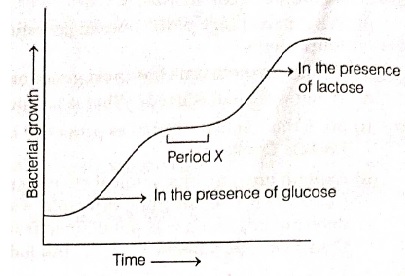
(i) What is the preferred substrate of bacterial growth?
(ii) What does period Xrepresents in graph?
(iii) Why does the growth curve is less steep in case of lactose as compared to glucose?
or
(iii) What would be the consequence of high glucose concentration in the system throughout the regulation of lac operon?
1.
Given, cytosine=20%
\(\therefore \) Percentage of Guanine=20%
Now according to Chargaff's rule, A+T=100-(G+C)
=> A+T=100-40
\(\therefore \) Percentage of Thymine=percentage of Adenine
=\(\frac { 60% }{ 2 } \)% = 30%
2.
(i) two,spirally coiled, double
(ii),phosphate,dexyribose sugar,nitrogenous basedexyirbonucleotide
(iii) glycosidic,900
(iv) purine,pyrimidine
(v)2 nm (20 \(\mathring { A } \)),3.4nm(34 \(\mathring { A } \))
(vi) semiconservative
(vii) DNA polymerase,RNA,RNA primer
(viii) Leading,Okazaki fragments,lagging.
3.
Maintenance of constant internal conditions by organisms for survival. This is achieved by regulating metabolic processes.
4.
Yes.
Many animals other than human have self-consciousness. For example, dolphins are highly intelligent. They have a sense of self and they also recognise others among themselves. They can communicate with each other by whistles, tail slapping, and other body movements. Besides dolphins some other animals such as parrots, chimpanzees, orangutans, gorilla, etc. are also found to have self-consciousness.
5.
The sequence of strand in 3' ⟶ 5' direction
3' - TACGTACGTACGTACGTACGTACGTACG - 5'
The sequence of strand in 5' ⟶ 3' direction
5' - AUGCAUGCAUGCAUGCAUGCAUGCAUGC - 3'
6.
1. The enzyme DNA polymerase polymerises the nucleotides in the 5' -> 3' direction in both continues and discontinuous synthesis.
2. The enzyme DNA-ligase joins the short stretches of DNA of discontinuous synthesis.
7.
8.
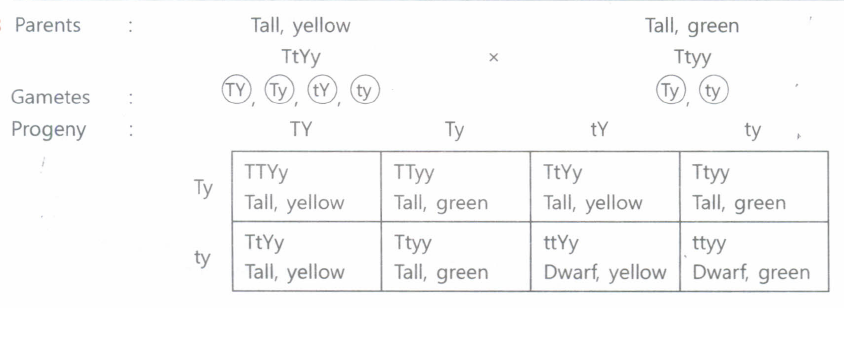
(a) Tall and green 3/8 or 6/16
(b) Dwarf and green 1/8 or 2/16
Phenotype ratio = 3:1
9.
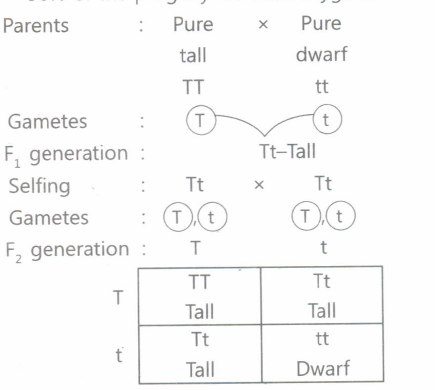
Phenotypic ratio : 3 Tall : 1 Dwarf Genotypic ratio : 1 TT : 2 Tt : 1 tt
Two-thirds of the tall progeny is heterozygous.
It is because the gene for tallness (T) is dominant and expresses itself in the heterozygous condition, Tt.
10.
A monohybrid cross is as follows:
\(F_{ 2 }\)
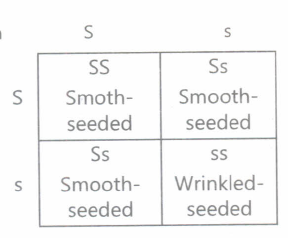
The phenotypic ratio of smooth-seeded to wrinkled-seeded plants, is 3 : 1.
From the Punnett square, it can be seen that one of the smooth-seeded plants is homozygous (55), while the other two are heterozygous (Ss): hence the genotypic ratio is 1 : 2 : 1.
11.
The formula 2n is applied here
where, n = Number of loci
The organism is heterozygous for 4 loci, n =4
So, 2n = 24 =2 x 2 x 2 x 2 = 16
The organism will produce 16 types of gametes.
12.
(i)There is no origin of life on the earth taking place today because the earth atmosphere is not reducing but it is oxidising.
(ii) The .energy was provided by an electric discharge and by heating the water chamber and the products obtained in the experiment were amino acids.
(iii) Solar rediations with UV-rays & lightning (electrical discharges) and other high enet:gy rays etc. should have been the energy sources required for the origin of life on the earth.
(iv) The values exhibited by the biology teacher Deepak Gupta are:
(a) caring for his neighbours.
(b) desire to disseminate knowledge as a teacher and
(c) the sound knowledge of the subject.
13.
(a) Round and yellow seeds
(b) Rr Yy
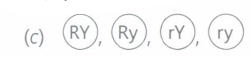
(d) 9 round, yellow seeded: 3 Round, green-seeded: 3 wrinkled, yellow seeded: 1 green, wrinkled - seeded
(e) Yellow-seeds: green seeds = 3 : 1 Round seeds: Wrinkled seeds = 3 : 1
14.
(i) This representation (HbA peptide) indicates a normal human, because the glutamic acid in the sixth position is not substituted by Valine.
(ii) Since, this disease transnmission follows Mendelian principles, it is called Mendelian disorder.
Inheritance pattern I istransmitled from parents to the oflspring,when both the parners are carriers (heterozygous)of the disease. In this discase, RBCs become sickle-shaped.
15.
The estimate of a total number of human genes was very high (about 1,40,000 genes) because of a large size of the human genome. However, most of the human genome is made of noncoding repetitive sequences and single nucleotides. Only 2% of the genome actually consist of structural genes which are now estimated to be <25000. some of them are believed to form more than one type of proteins due to alternating splicing.
16.
(i) While replicating, the entire DNA molecule to keep the whole molecule stabilised does not open in one go because it would be highly expense energetically. Actually un unwidinsg creates tension in the molecule as uncoiled parts.
Actually, unwinding creates tension in the molecule as uncoiled parts starts forming super coils due to the interaction of exposed nucleotides.
(ii) Replication fork: Instead helicase enzyme, acts on the double strand at or site (origin of replication and a small stretch is unzipped. Immediately. It is held and stabilised by single strand binding protein.
Slowly with the help of enzymes, exposed strands are copied as a point of unwinding moves and ahead in both direction
It gives an appearence of Y-shaped structure which is called replication fork.
The two functions that the monorner units of NTPs play are:
1. They pair up with exposed nucleotides of the template strand and make phosphodiester linkages and release a pyrophosphate.
2. Hydrolysis of his pyrophosphate by enzyme pyrophosphate release energy that will facilitate making hydrogen bonds between free nucleotides and bases of the template strand
17.
(c)
Deviation from 9:3:3:1 ratio because of segregation of genes
18.
(c)
| Human karyotype | Characters |
| 44+XO | Sterile females as ovaries are rudimentary |
19.
(c)
| Resultant mRNA | Resultant polypeptide |
| GUG | Valine |
20.
(c)
1,3,7,9 position
21.
(c)
3
22.
(i) The preferred substrate for bacterial growth is glucose. Bacteria use alternative substrates only when glucose has been depleted.
(ii) The phase X represents the period of slow growth when glucose levels are depleted.
(iii) Bacteria have the ability to use a variety of substrates as carbon sources.
Howerver, glucose is preferred source and in the presence of other substrates like lactose, the growth rate slows down. It is indicated by the lower steepness of growth curve.
or
(iii) In the presence of high glucose concentration the repressor protein remain bound to the operator region, thus preventing the gene expression in lac operon.

12th Standard CBSE Syllabus & Materials
12th Standard CBSE
CBSE 12th Computer Science Python Revision Tour I - New Previous year Question Papers Study Material - QB365 Set A
NEW12th Standard CBSE
CBSE 12th Business Studies Planning Important Questions And Answers Study Material - QB365 Set A
NEW12th Standard CBSE
CBSE 12th Business Studies Business Environment Important Questions And Answers Study Material - QB365 Set A
NEW12th Standard CBSE
CBSE 12th Business Studies Principles of Management Important Questions And Answers Study Material - QB365 Set A



NCERT Books

Syllabus

Exam Pattern

Sample Question Papers

Previous year Question Papers

Important Notes

MCQ Practice test

NCERT Exemplers

Case study Questions

Image Based Questions

Passage based Questions

HOT Questions

Value Based Questions

Model Questions Papers
NCERT ( Book Back ) Questions

Assertion and Reason
Important Questions And Answers

CBSE 12th Standard CBSE Subjects
CBSE Standards








