
 100% FREE ACCESS
12th Standard CBSE Syllabus & Materials
12th Standard CBSE
CBSE 12th Economics Government Budget and the Economy Previous year Question Papers Study Material - QB365 Set A
NEW12th Standard CBSE
CBSE 12th Computer Science Interface Python with MySQL - New Previous year Question Papers Study Material - QB365 Set A
NEW12th Standard CBSE
CBSE 12th Computer Science Database Concept - New Previous year Question Papers Study Material - QB365 Set A
NEW12th Standard CBSE
CBSE 12th Computer Science Data Communication - New Previous year Question Papers Study Material - QB365 Set A
NEW12th Standard CBSE
CBSE 12th Computer Science Data Structures - New Previous year Question Papers Study Material - QB365 Set A
NEW12th Standard CBSE
CBSE 12th Computer Science Functions - New Previous year Question Papers Study Material - QB365 Set A

Published on: 02/11/2025
Download CBSE Class 12th Standard CBSE Biology question papers, sample papers, important questions, and previous year solved papers in PDF format. Get free study materials, NCERT solutions, and exam preparation resources for Class 12th Standard CBSE Biology
Questions + Answers key
Take MCQ Biology Test
1.
Meiosis is an essential event in the sexual life cycle of any organism. Give two reasons.
2.
What are sexually transmitted diseases?
3.
Differentiate between : integument and testa
4.
(a) State the difference between meiocyte and gamete with respect to chromosome number.
(b) Why is a whiptail lizard referred to as parthenogenetic?
5.
Explain GIFT and ICSI
6.
Why is banana referred to as a parthenocarpic fruit?
7.
Why are Copper-containing intrauterire devices considered an ideal contraceptive for human females?
8.
What is colostrum?Why are breast-fed babies likely to be healthy?
9.
Geitonogamous flowering plants are genetically autogamous, but functionally cross-pollinated. Justify.
10.
Intensely lactating mothers do not generally conceive. Is it true? If yes, explain the reason.
11.
Name the following structures:
(a) Single cotyledon of the monocotyledonous embryo of grass family.
(b) The portion of embryonal axis above the level of cotyledons in dicotyledonous embryo.
(c) Occurrence of more than one embryo in a seed
(d) Seedless fruits produced without fertilization.
12.
Observe the figure carefully and the answer of the following question:
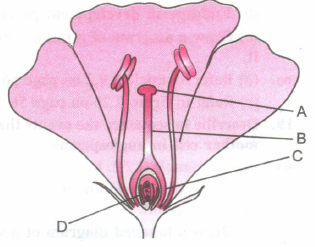
(a) Write whether ovary is superior or inferior?
(b) What is the type of flower - hypogynous, perigynous or epigynous?
(c) What type of ovule is shown the figure?
(d) What changes occur in C after fertilization?
(e) What does A, B, C, D represent in the figure.
13.
Note the relationship between first two words and suggest suitable word/words for the fourth place.
(i) Testis: spermatogenesis :: ovary : ______.
(ii) Male: penis :: female : ______.
(iii) Ovary : mesovarium :: uterus : ______.
(iv) Man: Vasectomy :: Woman: ______.
(v) Interstitial cells: testosterone :: Graafian follicle cells :______.
(vi) Menstrual cycle: human female :: oestrous cycle :______.
14.
Match the items given in column I with appropriate items (one or more) of column II.
| Column I | Column II |
| (i) Vasectomy | (a) Progesterone and estrogens |
| (ii) Tubectomy | (b) Coitus interruptus |
| (iii) Oral pills | (c) Acne |
| (iv) Temporary birth control method | (d) Male |
| (v) Adolescents | (e) Female |
| (f) Vas deferens | |
| (g) Oviduct |
15.
Study the sectional view of human testis showing seminiferous tubules given below. Answer the questions that follow.
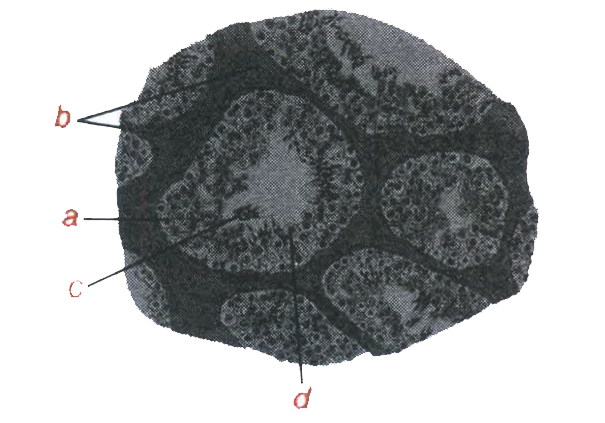
(i) Identify a, b and c.
(ii) Write the functions of a and d.
16.
Enumerate any six adaptive floral characteristics of a wind-pollinated plant.
17.
Suggest and explain any three Assisted Reproductive Technologies(ART) to an infertile couple
18.
(a) Describe the development of a 7-celled female gametophyte from a megaspore mother cell in an angiosperm.
(b) What is the role of endothecium and tapetum in an anther?
19.
(a) Draw a sectional view of a seminiferous tubule of human. Label sertoli cell, spermatogonia and leydig cell on it and write their functions.
(b) Explain the role of pituitary and sex hormones in the process of spermatogenesis.
20.
Vaibhav, 12th class student watched the movie 'Vickey donar'. He was very curious to know the structure and details of sperm. He wondered, why the donation of sperm is considered a taboo irrespective of the fact that it helps childless couples to have children. He discussed this whole thing with his elder brother, who is a biology professor in a university. His brother smiled and explained all his queries.
(i) Name the main parts of a sperm.
(ii) Which part of the human sperm is responsible for facilitating sperm motility? Explain.
(iii) What are the values shown by Vaibhav?
21.
Study the graph given below and answer the questions that follow.
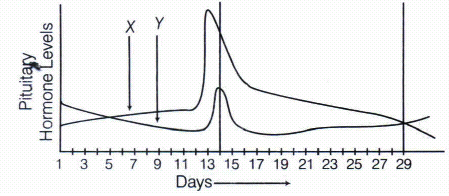
(i) Name the hormones 'X' and 'Y'.
(ii) Identify the ovarian phases during menstrual cycle.
(a) 5th-12th day of the cycle.
(b) 14th day of the cycle.
(c) 16th-25th day of the cycle.
(iii) Explain the ovarian events (a), (b) and (c) under the influence of hormones 'X' and 'Y'
22.
Mrs. Sharma was eager to know the sex of the foetus, which her daughter-in-law was carrying. She was so anxious that she could pay any amount for that. The doctor refused to disclose the result of the test.
(i) How can one know the sex of the foetus?
(ii) How is it done?
(iii) Why is disclosing the sex of the foetus banned in our country?
(iv) What value do you learn from the doctor's act?
23.
'Sperm donation can help infertile couples' Justify. In Which type of cases, such sperm donation is helpful?
24.
Draw the diagram of a microsporangium and label its wall layers. Write briefly about the wall layers.
25.
What do the following parts of a flower develop after fertilization?
(a) Ovary __________
(b) Ovules ____________
1.
Meiosis is an essential event in the sexual cycle of any organism because:
(i) It maintains the number of chromosomes fixed (2n) from generation to generation. Haploid gametes are formed as a result of meiosis. Diploid (2n) condition is restored during fertilization.
(ii) It increases the genetic diversity and variation due to crossing over between homologous chromosomes and their random segregation.
2.
()
Diseases or infections which are transmitted through sexual intercourse with infected persons are called sexually transmitted diseases
3.
()
Integument is the covering of ovule whereas testa is the covering of seed. However, the outer integument of ovule is converted into testa of seed
4.
(a) A meiocyte is diploid cell, while a gamete is haploid.
(b) A whiptail lizard develops from the female gamete, without fertilisation; hence it is parthenognetic.
5.
()
GIFT-Gamete Intra Fallopian Transfer
ICSI-Intra-Cytoplasmic Sperm Injection
6.
()
Banana fruit develops without fertilisation of the ovary; hence it is considered parthenocarpic.
7.
Cut is an intra-uterine device (IUD) and functions as follows:
1. It suppresses sperm motility and the fertilising capacity of sperms.
2. It increases phagocytosis of sperms within the uterus.
8.
Colostrum refers to the milk that comes out of the mammary glands of the mother during the initial few days of lactation following partuirition.
It contains several antibodies,which are essential for developing resistance in the new born babies;hence the breast-fed babies are likely to be healthy.
9.
1. Since geitonogamy involves two different flowers of the same plant, it is genetically similar to autogamy; both autogamy and geitonogamy do not result in genetic variation in the progeny.
2. Geitonogamy and cross-pollination involve different flowers and a pollinating agent.
10.
Yes, breast feeding is one of the natural contraceptive methods. It reduce fecundity by affecting the production of certain reproductive hormones. It is known to suppress the production of Gonadotropin Releasing Hormone (GnRh) and Follicle Stimulating Hormone (FSH).
The release of these hormones triggers ovulation. Breast feeding also leads to increased level of prolactin, a hormone that inhibits ovulation.
So, even when a woman ovulates, her likelihood of conceiving is low if she is breast feeding.
11.
(a) Scutellum
(b) Epicotyl
(c) Polyembryony
(d) Patrhenocarpic fruits.
12.
(a) Ovary is superior
(b) Flower is hypogynous because all the floral arise from thalamus below the level of ovary
(c) Ovule is anatropous because it is completely inverted. The micropyle is near the hilum and faces down towards the placenta.The embryo sac is straight.
(d) The ovary of the flower gets converted into fruit after fertilization.
(e) A = Stigma, B = Style, C = Ovary and D = Ovule
13.
(i) Oogenesis
(ii) Clitoris
(iii) Mesometrium
(iv) Tubectomy
(v) Estrogens
(vi) Female rabbit
14.
(i) d,f (ii) e,g (iii) a (iv) b (v) c
15.
(i) a- Spermatogonia
b-Interstitial cells or Leydig cells
c-Spermatozoa.
(ii)a-Spermatogonia produce the spermatozoa (sperms).
d-Sertoli cells provide nutrition to the germ cells.
16.
In wind pollinated flowers,
(i) The stamens are well-exposed, so that pollen grains are easily dispersed in wind currents.
(ii) The stigma is large and often feathery, to easily trap the air-borne pollen grains.
(iii) The pollen grains are light and non-sticky, to be transported in wind currents.
(iv) Pollen grains are produced in enormous quantity.
(v) Numerous small flowers are packed into an inflorescence.
(vi) There is a single ovule in the ovary of these flowers.
17.
(i) Test tube baby programme - In this method, the ovum of the woman and the sperm of her husband or a donor, are made to fuse ,under laboratory conditions; it is called in vitro fertilisation (IVF). - The zygote or early embryo is implanted in the fallopian tube or uterus respectively for further development.
(ii) Intra Cytoplasmic Sperm Injection (ICSI) - In this method, the sperm is injected directly into the ovum to form the zygote and then embryo transfer is carried out.
(iii) Gamete Intra Fallopian Transfer (GIFn - This method involves the transfer of an ovum collected from a donor female into another female for fertilisation and further development of foetus.
(iv) Artificial insemination - In this method, the semen collected from the husband or a healthy XII donor, is artificially introduced into the vagina or into the uterus (intra uterine insemination). - It is carried out when infertility is due to the inability of the male partner to inseminate the female or due to very low sperm count in the semen.
18.
(a) Development of female gametophyte: The female reproductive part of a flower is gynoecium, which consists of three parts-stigma, style, and ovary. The ovules are formed in the ovary and attach to it through placenta. The ovule is surrounded by one to two protective layers are called integuments leaving a small opening at one end termed as a micropyle. The stalk of the ovule is called funiculus.The ovule is composed of multi-celled cellular tissue called the nucellus. A hypodermal cell of nucellus toward at the micropylar end enlarges and becomes a megaspore mother cell that undergoes meiosis to form a linear tetrad of four megaspores. Out of four, only one remains functional and three megaspores degenerate. The functional megaspore undergoes three successive mitotic divisions to form eight nuclei, which arrange themselves into three groups. Three: nuclei migrate towards the micro-pylar end and form the egg apparatus. Other three nuclei form antipodal cells at chalazal end. The remaining two nuclei come together as polar nuclei which fuse to form secondary nucleus in the centre of the embryo sac.
(b) Role of endothecium: Microsporangium generally surrounded by wall layers like epidermis, endothecium, 2 or 3 middle layers and the tapetum. Endothecium performs the function of protection and helps in dehiscence of anther to release the pollen
Role of tapetum: It nourishes the developing pollen grains.
19.
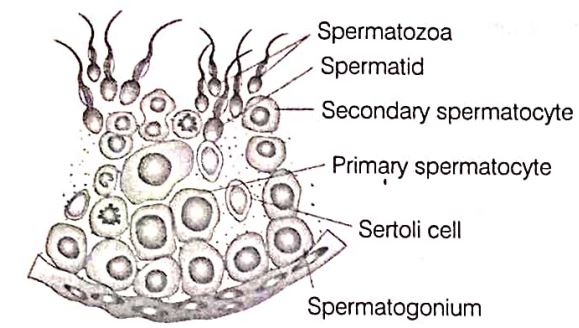
Functions : Sertoli cells - secrete factors which help in the process of spermiogenesis/provide nutrition to germ cells.
Spermatogonia - divide to produce spermatids / sperms.
Leydig cells - synthesis or secretion of androgens / testosterone.
(b) Pituitary hormones - LH (luteinising hormone) - acts on Leydig cells and stimulates synthesis and secretion of androgens.
FSH/follicIe stimulating hormone - acts on sertoli cells and simulates secretion of some factor that help in spermiogenesis.
Sex hormone - (Androgen/testosterone) stimulate process of spermatogenesis.
20.
(i) A sperm consists of a head, neck, middle piece and a tail.
(ii) Middle piece It is cylindrical and known as the power house of the sperm. It possesses many mitochondria to produce energy for the movement of the tail that facilitates sperm motility essential for fertilisation.
(iii) He is curious, intelligent, inquisitive and has scientific attitude.
21.
(i) Horne 'X' is Luteinising Hormone (LH) and 'Y' is Follicle Stimulating Hormone (FSH).
(ii) (a) Follicular phase (proliferative phase).
(b) Ovulatory phase (release of ovum) followed by luteal phase.
(c) Luteal phase.
(iii) (a) FSH is secreted by the anterior pituitary, which stimulates the ovarian follicle to secrete oestrogen, which in turn stimulates the proliferation of the endometrium of the uterine wall.
(b) Both LH and FSH attain a peak level in the middle of cycle (about 14th day). Rapid secretion of LH leading to its maximum level during the mid-cycle is called LH surge. It induces rupture of Graafian follicle and thereby the release of ovum (ovulation). Due to these events, this phase is termed as evulatory phase of menstruate cycle.
(c) The remaining cells of ovarian follicles are stimulated by the LH to develop corpos luteum. The corpus luteum secretes large amount of progesterone, which is essential for the maintenance of endometrium. This is known as luteral phase.
22.
(i) One can know the sex of the foetus by amniocentesis.
(ii) During the process of amniocentesis, a sterile needle is inserted through the abdominal wall into the amniotic sac. Then, a small amount of amniotic fluid is withdrawn through the needle.
The fluid contains cells, which are separated from the amniotic fluid. Tests are then performed on cultured cells by chemical analysis, DNA analysis, and chromosomal analysis.
(iii) Disclosing the sex of the foetus is banned in our country because, in the past, there have been numerous cases, where the female foetud has been aborted. this discrimination for the girl child is considered a crime. the number of females to males ration is thereby reduced.
(iv) the doctor is devoted to his duties and has professional and moral ethics.
23.
Due to change in lifestyle and eating habits, many couples are suffering from infertility, nowadays, i.e. they are not able to conceive. Infertility may occur in both man and woman.
In order to solve the problems related to infertility, the advancement in technologies has come to the rescue.
Sperm donation has become a boon for the couple, who suffer from infertility and want their own child.
Sperm donation is helpful in following cases in males:
(i) When sperms are blocked by an abnormality in the epididymis and in the testis.
(ii) Sexual dysfunction.
(iii) The absence of sperms in males.
24.
A typical microsporangium is surrounded by four wall layers, i.e. the epidermis, endothecium, middle layers and the tapetum. The outer three wall layers are protective in function and help in dehiscence of anther to release pollen grains.
The innermost layer (tapetum) nourishes the developing microspores or pollen grains. The cells of tapetum possess dense cytoplasm and generally have more than one nucleus.
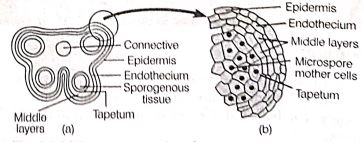
When the anther is young, a group of compactly arranged homogenous cells called the sporogenous tissue occupies the centre of each microsporangium.
25.
()
(a) Fruit
(b) Seeds.

12th Standard CBSE Syllabus & Materials
12th Standard CBSE
CBSE 12th Computer Science Python Revision Tour I - New Previous year Question Papers Study Material - QB365 Set A
NEW12th Standard CBSE
CBSE 12th Business Studies Planning Important Questions And Answers Study Material - QB365 Set A
NEW12th Standard CBSE
CBSE 12th Business Studies Business Environment Important Questions And Answers Study Material - QB365 Set A
NEW12th Standard CBSE
CBSE 12th Business Studies Principles of Management Important Questions And Answers Study Material - QB365 Set A



NCERT Books

Syllabus

Exam Pattern

Sample Question Papers

Previous year Question Papers

Important Notes

MCQ Practice test

NCERT Exemplers

Case study Questions

Image Based Questions

Passage based Questions

HOT Questions

Value Based Questions

Model Questions Papers
NCERT ( Book Back ) Questions

Assertion and Reason
Important Questions And Answers

CBSE 12th Standard CBSE Subjects
CBSE Standards








