
 100% FREE ACCESS
12th Standard CBSE Syllabus & Materials
12th Standard CBSE
CBSE 12th Economics Government Budget and the Economy Previous year Question Papers Study Material - QB365 Set A
NEW12th Standard CBSE
CBSE 12th Computer Science Interface Python with MySQL - New Previous year Question Papers Study Material - QB365 Set A
NEW12th Standard CBSE
CBSE 12th Computer Science Database Concept - New Previous year Question Papers Study Material - QB365 Set A
NEW12th Standard CBSE
CBSE 12th Computer Science Data Communication - New Previous year Question Papers Study Material - QB365 Set A
NEW12th Standard CBSE
CBSE 12th Computer Science Data Structures - New Previous year Question Papers Study Material - QB365 Set A
NEW12th Standard CBSE
CBSE 12th Computer Science Functions - New Previous year Question Papers Study Material - QB365 Set A

Published on: 02/11/2025
Download CBSE Class 12th Standard CBSE Biology question papers, sample papers, important questions, and previous year solved papers in PDF format. Get free study materials, NCERT solutions, and exam preparation resources for Class 12th Standard CBSE Biology
Questions + Answers key
Take MCQ Biology Test
1.
Describe the structure of a seminiferous tubule.
2.
Give the adaptations of male and female gametes.
3.
What is foetal ejection reflex? Explain how it leads to parturition?
4.
Give one function each of histone protein and non-histone chromosomal protein in an eukaryotic cell.
5.
Define spermiogenesis and spermiation
6.
(a) Explain with the help of Griffith's experiment how the search for genetic material was conducted and what was the conclusion drawn?
(b) How did Macleod, Mc Carty and Avery establish the Bio-Chemical nature of the so called "genetic material" identified by Griffith in his experiment.
7.
Difference between male and female gametophyte are:
8.
Explain adaptive radiation with the help of a suitable example.
9.
Human blood groups are genetically inherited.In a family A, B, AB, O blood groups are present.How is it possible to have such type of blood groups.
(i) Explain the phenomenon.
(ii) What are the genotypes of blood group of parents?
(iii) Who discovered ABO blood group?
(iv) Such an inheritance shows which type of phenomenon.
10.
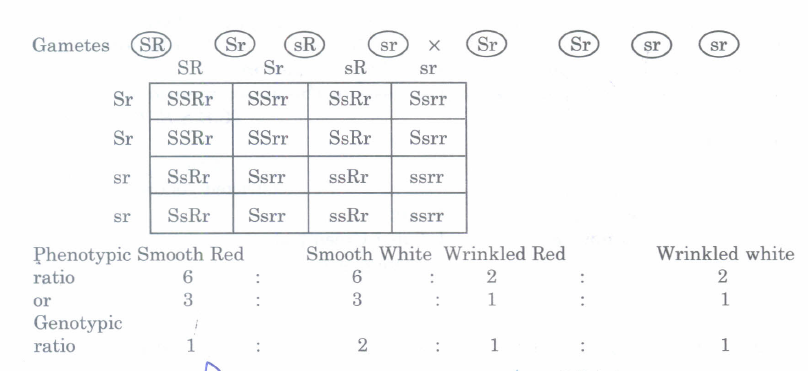
A smooth seeded and red flowered pea plant (Ss Rr) is crossed with a smooth seeded and white flowered pea plant(Ss rr).Determine the phenotype and genotypic ratios of the progeny\({ F }_{ 1 }\).
11.
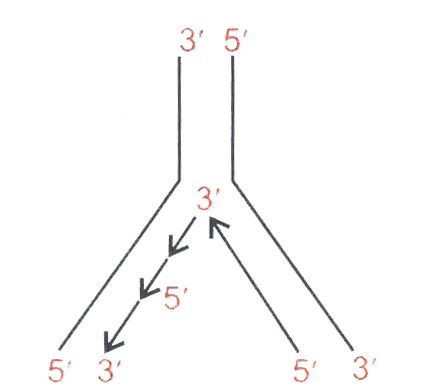
Why do you see two different types of replicating strands in the given DNA replication fork? Name these strands.
12.
Enumerate any six adaptive floral characteristics of a wind-pollinated plant.
13.
Explain the process of divergent evolution in detail. Also, write down the driving force behind it.
14.
Describe the interaction of tRNA, mRNA and ribosomes during the events of translation.
15.
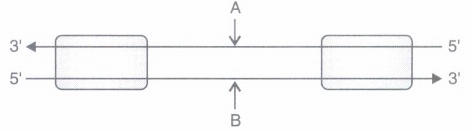
(a) Identify strands 'A' and 'B' in the diagram of transcription unit given above and write the basis on which you identified them.
(b) State the functions of Sigma factor and Rho factor in the transcription process in a bacterium.
(c) Write the functions of RNA polymerase-I and RNA polymerase-Ill in eukaryotes
(OR)
Describe the packaging of DNA helix in a prokaryotic cell and an eukaryotic nucleus.
16.
Draw diagram showing false fruits of apple and strawberry.
17.
We are told that evolution is a continuing phenomenon for all living things. Are humans also evolving? Justify your answer.
18.
Draw a diagram of an enlarged view of T.S. of one microsporangium of an angiosperm and label the following parts:
(i) Tapetum
(ii) Middle layers
(iii) Endothecium
(iv) Microspore mother cells.
(b) Mention the characteristic features and function of tapetum.
(c) Explain the following giving reasons:
(i) Pollen grains are well-preserved as fossils.
(ii) Pollen tablets are in use by people these days.
19.
20.
21.
22.
Wings of pigeon, bat and mosquito exhibit the phenomenon called
Convergent evolution
Divergent evolution
Atavism
All of these
23.
The most accepted line of descent in human evolution is:
Australopithecus -> Ramapithecus -> Homo sapies -> homo habillis
Homo erectus -> homo habilis -> Homo sapiens
Ramapithecus -> Homo habilis -> Homo erectus -> Homo sapiens
Australopithecus -> Ramapithecus -> Homo erectus -> Homo habilis -> Homo sapiens.
24.
A normal-visioned man whose father was colour blind, marries a woman whose father was also colour-blind. They have their first child as a daughter. What are the chance that this child would be colour-blind?
100%
zero per cent
25%
50%
25.
From the statements given below choose the option that is true for a typical female gametophyte of a flowering plant:
i) It is 8-nucleate and 7-celled at maturity
ii) It is free nuclear during development
iii) It is situated inside the integument but outside the nucellus
iv) It has an egg apparatus situated at the chalazal end.
i) and iv)
ii) and iii)
i) and ii)
ii) and iv)
26.
The X/O syndrome is called
Turner's
Klinefelter's
Down's
Cushing's
27.
Cu-T prevents pregnancy by preventing
Fertilization
ovulation
implantation of fertilized egg
none of these
28.
DNA polymerase that helps in DNA replication is of
Two types
Three types
Four types
Only one type
29.
Initiator (starting) codon in eukaryotes is
AUG
AAG
CCU
GGC
30.
That the mode of DNA replication is semiconservative was demonstrated by
Khorana
Watson and Crick
Meselson and Stahl
Tayler
31.
Assertion: Theory of chemical evolution proposed that life comes from pre-existing non-living organic molecules
Reason: The primitive earth conditions led to production of organic molecules.
Codes:
(a) If both Assertion and Reason are true and Reason is the correct explanation of Assertion.
(b) If both Assertion and Reason are true but Reason is not the correct explanation of Assertion.
(c) If Assertion is true but Reason is false.
(d) If both Assertion and Reason are false.
32.
Assertion: In Griffith’s experiment, a mixture of heat-killed virulent bacteria R and live non-virulent bacteria S, lead to the death of mice.
Reason: ‘Transforming principle’ got transferred from heat killed R strain to S strain and made it virulent.
Codes:
(a) If both Assertion and Reason are true and Reason is the correct explanation of Assertion.
(b) If both Assertion and Reason are true but Reason is not the correct explanation of Assertion.
(c) If Assertion is true but Reason is false.
(d) If both Assertion and Reason are false.
33.
Assertion : Y chromosome causes maleness.
Reason : If the number of X chromosome is more than one, femaleness dominates.
Codes :
(a) Both assertion and reason are true and reason is the correct explanation of assertion.
(b) Both assertion and reason are true but the reason is not the correct explanation of assertion.
(c) Assertion is true but reason is false.
(d) Both assertion and reason are false.
34.
Assertion: Most of entomophilous pollination is done by bees.
Reason: Bee-pollinated flowers are highly coloured
Codes:
(a) Both assertion and reason are true and reason is the correct explanation of assertion.
(b) Both assertion and reason are true but reason is not the correct explanation of assertion.
(c) Assertion is true but reason is false.
(d) Both assertion and reason are false
35.
36.
Read the following and answer any four questions from (i) to (v) given below:
Haemophilia is a sex linked disease which is also known as bleeder's disease as the patient will continue to bleed even from a minor cut since he or she does not possess the natural phenomenon of blood clotting due to absence of anti-haemophilic globulin or factor VIII and plasma thromboplastin factor IX essential for it. As a result of continuous bleeding the patient may die of blood loss. Colour blindness is another type of sex linked trait in which the eye fails to distinguish red and green colours. Vision is however, not affected and the colour blind can, lead a normal life, reading, writing and driving (distinguishing traffic lights by their position).(i) If a haemophilic man marries a woman whose father was haemophilic and mother was normal then which of the following holds true for their progenies?
| (a) Of the total number of daughters, 50% daughters are carrier and 50% are haemophilic |
| (b) All the daughters are haemophilic. |
| (c) All sons are haemophilic and all daughters are normal. |
| (d) All sons are normal, all daughters are carriers. |
(ii) A man whose father was colourblind and mother was normal marries a woman whose father was haemophilic and mother was normal. Which of the following is true for their progenies? [Note: Percentage is from the total number of progenies.
| (a) 25% female progenies carry the gene for both haemophilia and colourblindness |
| (b) 25% male progenies carry only the gene of colourblindness |
| (c) 25% female progenies carry only the gene of colourblindness. |
| (d) 25% male progenies and 25% female progenies carry the gene of haemophilia |
(iii) Which of the following statements is incorrect regarding haemophilia?
| (a) It is a dominant disease | (b) A single protein involved in clotting of blood is affected | (c) It is recessive disease | (d) It is Mendelian disorder |
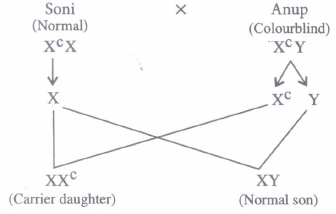
(iv) Anup is having colourblindness and is married to Soni who is normal. What is the chance that their son will have the disease?
| (a) 100% | (b) 50% | (c) 25% | (d) 0% |
(v) Refer to the given cross
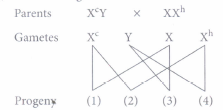
Select the correct option regarding 1, 2, 3 and 4.
| (a) 1. Colourblind carrier female 2. Colourblind haemophilic female 3. Normal male 4. Haemophilic male |
(b) 1.Colourblind people 2.Haemophilic female 3.Normal male 4..Haemophilic male |
(c) 1. Colourblind female 2. Colourblind and haemophilic female 3. Normal male 4. Normal male |
(d) 1.Colourblind carrier female 2.Normal female 3.Normal male 4.Haemophilic male |
1.
Each testicular lobule contains 1-3 highly coiled seminiferous tubules. Each tubule is lined on its inside by two types of cells. The cuboidal cells are called male germ (spermatogenic) cells and few large pyramidal (supporting cells) are called Sertoli or nurse cells.
The former gives rise to sperms while the latter provide nutrition to the germ cells.
2.
Male gamete is minute and motile to move to the female gamete. Female gamete is large and contains food for development of embryo.
3.
Foetal ejection reflex is neuroendocrine mechanism initiated by fully formed foetus and placenta which helps in parturition. It operates as below:
1.Foetus secretes hormone from its adrenal glands. These hormone stimulate the posterior pituitary of the mother to release oxytocin.
2.Oxytocin causes forceful contraction of smooth muscles of myometrium called labour pains, which further stimulates more secretion of oxytocin.
3.The stimulatory reflex between uterine contraction and oxytocin secretion continues which causes more forceful contraction of uterine muscles.
4.Uterine contractions pushes the young gradually out through the dilated cervix(caused by relaxin) and vagina.
4.
1. Histone proteins help in packaging the giant molecules of DNA into nuleosomes to be accomodated into the nucleus
2. Non-histone chromosomal proteins help in packaging of chromotin at higher levels.
5.
(i) Spermiogenesis is the process of transformation of spermatids into flagellated spermatozoa.
(ii) Spermiation is the process of release of spermatozoa from the seminiferous tubules.
6.
(a) Streptococcus pneumoniae:
S - Strain (virulent) injected into mice ---> mice die
R - strain injected into mice ---> mice alive
S - strain (heat killed) injected into mice ---> mice alive
R - strain (alive) + S (heat killed) strain inject into mice ---> mice die
As the R strain (non-virulent) picked up genetic material from S strain (virulent) and get transformed.
(b) They (worked on the bio-chemical nature of transforming principle in Griffith's experiment) purified proteins DNA and RNA from heat killed S cells, they discovered protein digesting enzyme (protease) RNA digesting enzyme (RNese) did
not affect transformation, Digestion with DNase inhibited transformation, concluded DNA is the heredity material.
7.
| Male gramtophyte | Female gametophyte |
| It is derived from a microspore, which is produced inside the pollen chamber of anther. | It is derived from a megaspore, which is formed inside the nucellus of an ovule |
| The microspores are shed at maturity and transferred from anthers to stigma by the process called pollination. | The megaspores do not shed from the ovule. They develop to form embryo sac within the ovule. |
| The mature male gametophyte is 3-celled | The mature female gametophyte is 7-celled. |
8.
Ontogeny is embryonic development, i.e. the origin and development of an organism from an embryo to an adult.
Phylogeny is ancestral history, i.e. the evolutionary development and history of a species or higher taxonomic grouping of organisms.
9.
(i) ABO blood group system is inherited.A and B are dominant over O, but A and B express in the presence of each other.
(ii) Genotypes of parents;\({ I }^{ A }{ I }^{ O }\times { I }^{ B }{ I }^{ O }\)
(iii) Carl Landsteiner
(iv) It shows following three phenomenon
(a) Dominance-recessive
(b) Co-dominance
(c) Multiple alleles
10.
Phenotypes Smooth seeded X and red flowered Smooth seeded and
Parents SsRr White flowered SsRr
Genotype
11.
1.Both the strands of parent DNA function as template strands.
2. On the template strand with \({ 3 }^{ ' }\longrightarrow { 5 }^{ ' }\) polarity, the new strand is synthesised as a continuous stretch as the DNA polymerase can carry out polymerisation of the nucleotides only in \({ 5 }^{ ' }\longrightarrow { 3 }^{ ' }\)direction; this is called continuous synthesis and the strand is called leading strand.
3. On the other template strand with \({ 5 }^{ ' }\longrightarrow { 3 }^{ ' }\) polarity, the new strand is synthesised from the point of replication fork, also in \({ 5 }^{ ' }\longrightarrow { 3 }^{ ' }\) direction, but in short stretches; they are later joined by DNA - ligases to form a strand, called lagging strand.
12.
In wind pollinated flowers,
(i) The stamens are well-exposed, so that pollen grains are easily dispersed in wind currents.
(ii) The stigma is large and often feathery, to easily trap the air-borne pollen grains.
(iii) The pollen grains are light and non-sticky, to be transported in wind currents.
(iv) Pollen grains are produced in enormous quantity.
(v) Numerous small flowers are packed into an inflorescence.
(vi) There is a single ovule in the ovary of these flowers.
13.
Definition
Divergent evolution is a type of evolution where similar body structures have evolved to perform different functions based on the need of the organism.
Cause/driving force
Due to the presence of different environments, certain body parts of organisms have modified their functions so that they can adapt to these habitats. These body parts are called homologous organs as they have similar body structure but different functions.
Significance
Divergent evolution indicates that the organisms have a common ancestor but they develop different characteristics (due to the changing environment) giving rise to new species.
Examples
In animals :
The forelimbs of Whales, Bats, Cheetahs and Humans have a similar bone structure (contain humerus, radius, ulna, carpels, phalanges) but they perform different functions. In whales it is used for swimming, Bats use it for flying, Cheetahs for running and Humans for different functions.
The hearts in various vertebrates (fishes, amphibians, reptiles, birds, and mammals) have similar structure but vary in the number of chambers they have due to diverse habitats and energy requirements.
In plants :
The thorns of Bougainvillea and the tendrils of Cucurbita are modified branches i.e. they have the same basic structure and common ancestor but the functions are different. The thorns are used for protection and the tendrils are used as support to the plant.
14.
(i) The three types of RNA are:
(a) Messenger RNA (mRNA)
(b) Transfer RNA (tRNA)
(c) Ribosomal RNA (rRNA)
(ii) Functions of RNAs
(a) Messenger RNA (mRNA)
1. It brings the genetic information of DNA transcribed on it, to ribosomes for protein synthesis.
2. It decides the sequence of amino acids in a polypeptide chain.
(b) Transfer RNA (tRNA)
1.It acts as an adapter molecule, that reads the code on mRNA on one hand and binds to a specific amino acid on the other hand.
2. By its anticodon, it recognises the codon and leaves the amino acid coded by the mRNA at the site of protein synthesis.
(c) Ribosomal RNA (rRNA)
1. It forms the structure of ribosomes.
2.It also plays a catalytic role; 23S rRNA in bacteria is the enzyme, ribozyme that catalyses the formation of peptide bond.
15.
(a) A-Template strand = 1
B-Coding strand =1
Template strand has polarity 3'-5'
Coding strand has polarity 5'-3'
On the basis of polarity with respect to promoter
(b) In initiation sigma factor associates with RNA polymerase to initiate transcription, Rho factor gets associated to RNA polymerase to terminate transcription.
(e) RNA polymerase I -Transcribes -RNAs
RNA polymerase III-Transcribes tRNA / 5srRNA/5nRNA
(OR)
Prokaryotes : Negatively charged DNA, is held with positively charged proteins, in nucleoid, DNA in nucleoid is organised in large loops held by protein.
Eukaryotes : In nucleus the negatively charged DNA, is wrapped around positively charged histone octomer, to formnucleosome, nucleosomes are repeated, to constitute chromatin, at higher level additional set of non-histone chromosomal protein gets associated with chromatin.
16.
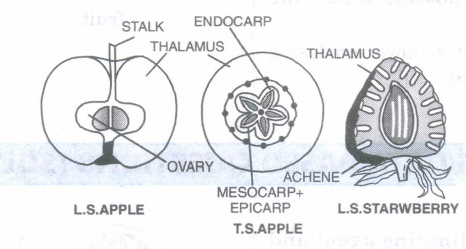
17.
New research suggests that despite modern technology and industrialisation, 'humans continue to evolve'. In the last 10,000 years or so, the pace of our evolution has speeded up 100 times creating more mutations in our genes and hence, greater natural selection.
Some clues that show humans are evolving are
(i) Lactose Tolerance: Historically the gene that regulated human's ability to digets lactose was shut down as infants are weaned off of their mother's breast milk. However, adult human in regions of Africa and Northern Europe developed the ability to tolerate lactose in their diets as recent as 5,000 or 6,000 years ago due to mutations.
(ii) Wisdom Teeth: Our ancestors had much bigger jaws than we do to lactose their eating habits. Today our jaws are much smaller and wisdom teeth are often impact estimates say that they will disappear in the coming population.
18.
(b) Tapetum is the innermost wall layer; whose cells possess dense cytoplasm and more than one nucleus.
It nourishes the developing pollen grains.
(c) (i) The exine of pollen grains is made of sporopollenin, which can withstand high temperature and action of strong acids or alkalies; no enzyme can degrade sporopollenin and hence, pollen grains are well preserved as fossils.
(ii) Pollen grains are rich in nutrients and hence, are used in the form of tablets as food supplements.
19.
(d)
20.
(b)
21.
(c)
22.
(a)
Convergent evolution
23.
(c)
Ramapithecus -> Homo habilis -> Homo erectus -> Homo sapiens
24.
(b)
zero per cent
25.
(c)
i) and ii)
26.
(a)
Turner's
27.
(a)
Fertilization
28.
(d)
Only one type
29.
(a)
AUG
30.
(c)
Meselson and Stahl
31.
(a) If both Assertion and Reason are true and Reason is the correct explanation of Assertion.
Explanation
The primitive earth conditions were so that they led to the production of organic molecules like proteins, RNA, etc.
32.
(d) If both Assertion and Reason are false.
Explanation:
When bacteria Streptococcus pneumoniae are grown on a culture plate, some produce smooth shiny colonies (S) while others produce rough colonies (R). This is because the S strain bacteria have a mucous (polysaccharide) coat, while R strain does not. Mice infected with the S strain (virulent) die from pneumonia infection but mice infected with the R strain do not develop pneumonia. In Griffith’s experiment, some ‘transforming principle’, transferred from the heat-killed S strain, had enabled the R strain to synthesize a smooth polysaccharide coat and become virulent which must be due to the transfer of the genetic material. This is known as transformation.
33.
(c) : In mammals, the presence of a Y chromosome is required for the development of a male sex phenotype. In contrast, the Y chromosome plays no Significant role in sex determination in Drosophila. A Y chromosome is required for maleness, moreover, the presence of a single Y chromosome is sufficient even in the presence of several X chromosomes ie.g., XXXXY).
34.
(b): Of the various insects, bees are the main flower visitors. Bees handle up to 80% of all pollination done by insects. All the bee pollinated flowers are brightly coloured, possess sweet fragrance, and / or produce nectar. Bees are colour blind for red and are fond of yellow, violet and purple. The bees visit flowers to collect their food (pollen and nectar) and in the process prove instrumental in bringing about pollination.
35.
36.
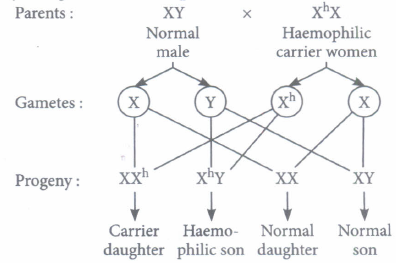
(i) (a) : When a haemophilic man (Xhy) marries a woman whose father was haemophilic and mother was normal i.e., carrier woman (XXh), then 50% daughters are carriers and 50% are haemophilic. This can be explained as follows:

(ii) (d) : When a man whose father was colourblind and mother was normal (i.e., normal man XY) marries a woman whose father was haemophilic and mother was normal (i.e., carrier haemophilic woman XhX), then 25% male progenies and 25% female progenies carry the gene of haemophilia.
(iii) (a) : Haemophilia is sex linked recessive Mendelian disorder.
(iv) (d) : When Anup who is colourblind (Xcy) marries Soni who is normal (XX) then 0%, chances that their son will have colourblindness.
(v) (a)

12th Standard CBSE Syllabus & Materials
12th Standard CBSE
CBSE 12th Computer Science Python Revision Tour I - New Previous year Question Papers Study Material - QB365 Set A
NEW12th Standard CBSE
CBSE 12th Business Studies Planning Important Questions And Answers Study Material - QB365 Set A
NEW12th Standard CBSE
CBSE 12th Business Studies Business Environment Important Questions And Answers Study Material - QB365 Set A
NEW12th Standard CBSE
CBSE 12th Business Studies Principles of Management Important Questions And Answers Study Material - QB365 Set A



NCERT Books

Syllabus

Exam Pattern

Sample Question Papers

Previous year Question Papers

Important Notes

MCQ Practice test

NCERT Exemplers

Case study Questions

Image Based Questions

Passage based Questions

HOT Questions

Value Based Questions

Model Questions Papers
NCERT ( Book Back ) Questions

Assertion and Reason
Important Questions And Answers

CBSE 12th Standard CBSE Subjects
CBSE Standards








