
 100% FREE ACCESS
12th Standard CBSE Syllabus & Materials
12th Standard CBSE
CBSE 12th Economics Government Budget and the Economy Previous year Question Papers Study Material - QB365 Set A
NEW12th Standard CBSE
CBSE 12th Computer Science Interface Python with MySQL - New Previous year Question Papers Study Material - QB365 Set A
NEW12th Standard CBSE
CBSE 12th Computer Science Database Concept - New Previous year Question Papers Study Material - QB365 Set A
NEW12th Standard CBSE
CBSE 12th Computer Science Data Communication - New Previous year Question Papers Study Material - QB365 Set A
NEW12th Standard CBSE
CBSE 12th Computer Science Data Structures - New Previous year Question Papers Study Material - QB365 Set A
NEW12th Standard CBSE
CBSE 12th Computer Science Functions - New Previous year Question Papers Study Material - QB365 Set A

Published on: 02/11/2025
Download CBSE Class 12th Standard CBSE Biology question papers, sample papers, important questions, and previous year solved papers in PDF format. Get free study materials, NCERT solutions, and exam preparation resources for Class 12th Standard CBSE Biology
Questions + Answers key
Take MCQ Biology Test
1.
Mention the location and function of tapetum in the microsporangium of angiosperms. State the characteristic features of the cells forming this layer.
2.
Why is it necessary to emasculate a bisexual flower in a plant breeding programme? Mention the condition under which emasculation is not necessary.
3.
How do plants produce seeds through apomixis? Explain with the help of an example.
4.
Explain any two ways by wich apomictic seeds get developed.
5.
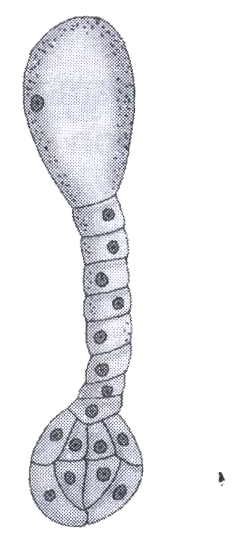
(a) Identify the figure.
(b) Name the initial cell from which this structure has developed.
(c) Draw the next mature stage and label the parts.
6.
What is triple fusion? Where and how does it take place? Name the nuclei involved in triple fusion.
7.
Differentiate between perisperm and endosperm, giving one example of each.
8.
Write the mode of pollination in Vallisneria and water lily. explain the mechanism of pollination in Vallisneria.
9.
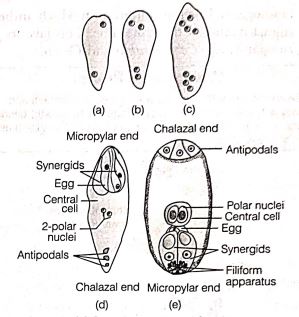
Explain with help of a diagram, the development of a mature embryo sac from a megaspore mother cell in an angiosperm.
10.
(a) Describe the process of megasporogenesis, in angiosperms.
(b) Draw a diagram of a mature embryo sac of angiosperm, label its any six parts.
11.
Explain the development of the zygote into an embryo and of the primary endosperm nucleus into an endosperm in a fertilised embryo sac of a dicot plant.
12.
Explain double fertilisation and trace the post-fertilisation events in sequential order leading to seed formation in a typical dicotyledonous plant.
13.
Identify the wrong statement regarding post-fertilization development
The ovary wall develops into pericarp
The outer integument of the ovule develop into tegmen
The fusion nucleus (triple fusion) develops into endosperm
The ovule develops into seed
The ovary develops into fruit
14.
In some plants anthers and stigma grow and mature at the same time. This phenomenon is called
Homogamy
Syngamy
Allogamy
Fusion
15.
An ovule which becomes curved so that the nucellus and embryo sac lie at right angles to the funicle is
Campylotropous
Anatropous
Orthotropous
Hemitropous
16.
Insect-pollinated flowers are characterized by
Large number of pollens
Dry and smooth pollens
Sticky and rough pollens
Heavy pollens
17.
Intraspecific incompatibility can be overcome by
Wetting of anthers
Mixed pollination
Intraovarian fertilization
Intraspecific competition
1.
Tapetum is the innermost wall layer of the microsporangium.
It nourishes the developing pollen grains.
Characteristics of tapetal cells:
(i) They possess dense cytoplasm.
(ii) They have more than one nucleus.
2.
1.Emasculation is necessary to prevent the self-pollen grains falling on the stigma.
2. Emasculation is not needed when the female parent chosen bears unisexual, i.e. female flowers.
3.
(i) Certain nucellar cells around the embryo sac divide, protrude into embryo sac and develop into embryos, e.g. Citrus, mango, etc.
(ii) The diploid egg cell of the embryo sac, formed without meiosis develops into embryo without fertilisation.
4.
(i) Certain nucellar cells around the embryo sac divide, protrude into embryo sac and develop into embryos, e.g. Citrus, mango, etc.
(ii) The diploid egg cell of the embryo sac, formed without meiosis develops into embryo without fertilisation.
5.
(a) Globular embryo of a dicot plant.
(b) Zygote
6.
Triple fusion:
It is the process of fusion of three nuclei, two polar nuclei (fuse to form a diploid secondary nucleus) and a male gamete.
It occurs in the central cell of the embryo sac of the ovule of angiosperms.
Then nuclei involved are two polar nuclei and a male gamete.
7.
| Perisperm | Endosperm |
|
- It is the remnant of nucellus, formed in the ovule before fertilisation. - The cells are diploid, e.g. black pepper, beet. |
- It is the product formed from the primary endosperm cell, in the ovule after fertilisation. - The cells are triploid, e.g. castor, maize. |
8.
Vallisneria is pollinated by water.
Water lily is pollinated by insects.
In Vallisneria, the male flowers (later pollen grains) are released on the surface of water and keep floating.
The female flowers reach the surface of water by uncoiling of the long stalk
When the passively carried male flowers/pollen grains meet the female flowers, pollination is effected.
The stalk of the female flower coils and the flower is drawn inside the water column.
9.
Development of Female Gametophyte:
- The megaspore mother cell undergoes meiosis to form four megaspores.
- Three of them degenerate and the functional megaspore enlarges to form the embryo sac.
- Its haploid nucleus undergoes a mitotic division and the two daughter nuclei move towards the poles.
- Each of them undergoes two successive mitotic divisions.
- Cell wall formation starts in the 8-nucleate stage.
- Three of them at the micropylar end form the egg apparatus, consisting of a female gamete and two synergids.
- Three of them at the chalazal end form the antipodal cells.
- One nucleus from each of the poles moves to the centre; they are called polar nuclei.
- The two polar nuclei fuse in the centre (now the central cell) to form a diploid secondary nucleus.
- Thus, the mature embryo sac is 7-celled and 8-nucleate.
10.
(i) The process of formation of megaspores from Megaspore Mother Cell or MMC (diploid) is called megasporogenesis.
It occurs inside the nucellus of developing ovule of angiosperms. The process begins very early when nucellus is not conmpletely surrounded by the integuments. The MMC (a large cell containing dense cytoplasm and a prominent nucleus) enlarges in size and divides by meiosis. It first divides transversely into two cells called megaspore dyad.
These two cells apgain divide transversely as a result, a linear row of four haploid cells megaspore tetrad is produced.
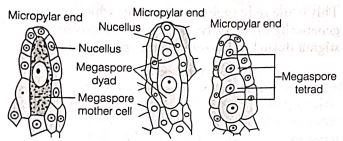
Out of the four megaspores one situated at the chalazal end remains functional and the rest three gradually degenerate. Such a development of embryo sac is called monosporic development, e.g. Pobygonum.
(ii)
11.
(a) A develops into the embryo.
B develops into the endosperm.
(b) - The endosperm development starts from the primary endosperm cell containing the primary endosperm nucleus.
- In the most common type of endosperm development, the primary endosperm nucleus undergoes successive free nuclear divisions to give rise to a number of free nuclei; at this stage, it is called free nuclear endosperm.
- Subsequently wall formation takes place from the periphery and proceeds towards the centre and the endosperm becomes cellular.
- This type of endosperm development is seen in coconut; the water of the tender coconut represents the free nuclear endosperm with thousands of nuclei in it and the white kernel around it represents the cellular endosperm.
- In albuminous seeds,some amount of endosperm persists in the mature seed, as the developing' embryo does not consume it fully, e.g. wheat/maize.
-In exalbuminous seeds, the endosperm is completely consumed by the developing embryo before seed maturation, e.g. groundnut and pea.
Development of primary endosperm nucleus:
- The PEN undergoes successive nuclear divisions to give rise to free nuclei, this stage of endosperm development is known as free-nuclear endosperm.
- Subsequently cell wall formation occurs and the endosperm becomes cellular .
12.
- After entering one of the synergids,the pollen tube discharges the two male gametes into the cytoplasm of that synergid.
- One of the male gametes moves towards the female gamete/egg and fuses with it; this fusion is called syngamy and it results in the formation of a zygote.
- The second male gamete moves towards the two polar nuclei in the central cell.
- The two polar nuclei just fuse to form a secondary nucleus and the second male gamete fuses with the secondary nucleus in the central cell; this fusion is called triple fusion and, it results in the formation of a triploid primary endosperm nucleus.
- Since two fusions, syngamy and triple fusion occur in an ovule, the phenomenon is known as double fertilisation in angiosperms.
Post-fertilisation events:
- The central cell becomes the primary endosperm cell after triple fusion; the primary endosperm nucleus develops into the endosperm.
- Zygote develops into the embryo.
- Antipodals and synergids degenerate.
- The integuments develop into the seed coat.
- The ovule becomes transformed into a seed.
13.
(b)
The outer integument of the ovule develop into tegmen
14.
(b)
Syngamy
15.
(d)
Hemitropous
16.
(c)
Sticky and rough pollens
17.
(b)
Mixed pollination

12th Standard CBSE Syllabus & Materials
12th Standard CBSE
CBSE 12th Computer Science Python Revision Tour I - New Previous year Question Papers Study Material - QB365 Set A
NEW12th Standard CBSE
CBSE 12th Business Studies Planning Important Questions And Answers Study Material - QB365 Set A
NEW12th Standard CBSE
CBSE 12th Business Studies Business Environment Important Questions And Answers Study Material - QB365 Set A
NEW12th Standard CBSE
CBSE 12th Business Studies Principles of Management Important Questions And Answers Study Material - QB365 Set A



NCERT Books

Syllabus

Exam Pattern

Sample Question Papers

Previous year Question Papers

Important Notes

MCQ Practice test

NCERT Exemplers

Case study Questions

Image Based Questions

Passage based Questions

HOT Questions

Value Based Questions

Model Questions Papers
NCERT ( Book Back ) Questions

Assertion and Reason
Important Questions And Answers

CBSE 12th Standard CBSE Subjects
CBSE Standards








