
 100% FREE ACCESS
12th Standard CBSE Syllabus & Materials
12th Standard CBSE
CBSE 12th Economics Government Budget and the Economy Previous year Question Papers Study Material - QB365 Set A
NEW12th Standard CBSE
CBSE 12th Computer Science Interface Python with MySQL - New Previous year Question Papers Study Material - QB365 Set A
NEW12th Standard CBSE
CBSE 12th Computer Science Database Concept - New Previous year Question Papers Study Material - QB365 Set A
NEW12th Standard CBSE
CBSE 12th Computer Science Data Communication - New Previous year Question Papers Study Material - QB365 Set A
NEW12th Standard CBSE
CBSE 12th Computer Science Data Structures - New Previous year Question Papers Study Material - QB365 Set A
NEW12th Standard CBSE
CBSE 12th Computer Science Functions - New Previous year Question Papers Study Material - QB365 Set A

Published on: 02/11/2025
Download CBSE Class 12th Standard CBSE Biology question papers, sample papers, important questions, and previous year solved papers in PDF format. Get free study materials, NCERT solutions, and exam preparation resources for Class 12th Standard CBSE Biology
Questions + Answers key
Take MCQ Biology Test
1.
What is self-incompatibility? Why does self-pollination not lead to seed formation in self-incompatible species?
2.
What are chasmogamous flowers? Can cross-pollination occur in cleistogamous flowers? Give reasons for your answer.
3.
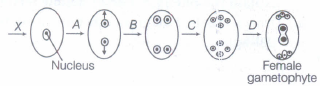
Fill in the following labels with the type of process occurring at each step.
4.
There are two person A & B living in the ONGC colony Siva nagar, they are neighbor and planted bottle gourd plant in their garden but the plant of person A bears fruits while plant of Mr. B has no fruit at all. Although the physical condition same for both. What will be your explanation to them?
5.
Your younger brother becomes confused because mango fruit has only one seed, orange has many seeds while grapes have no seed at all. He wants to know how a fruit has many, one, or no seed at all. What will be your explanation to your brother?
6.
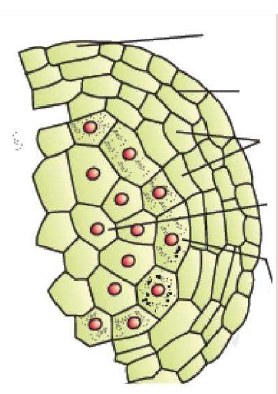
Lable the following.
7.
What is fruit production without fertilisation called?
8.
How many embryo sacs are formed in an ovule?
9.
Name the parts of an angiosperm flower in which development of male and female gametophyte takes place.
10.
Differentiate between perisperm and endosperm, giving one example of each.
11.
(a) Describe the endosperm development in coconut.
(b) Why is tender coconut considered a healthy source of nutrition?
(c) How are pea seeds different from castor seeds with respect to endosperm?
12.
(a) Describe the process of syngamy and triple fusion in angiosperms.
(b) Explain the development of a fertilised egg upto a mature embryo in a dicot plant. draw a labelled diagram of a mature dicot embryo,
13.
(a) Differentiate between: Autogamy, geitonogamy and xenogamy.
(b) Explain the events that occur during pollen-pistil interaction.
14.
How does a pollen mother cell develop into a mature pollen grain? Illustrate the stages with labelled diagrams.
15.
Describe in sequence the events that lead to the development of a 3-celled pollen grain from a microspore mother cell in angiosperms.
16.
(a) How does microspore mother cell develop into mature pollen grain in angiosperms?
(b) Describe the structure of a mature pollen grain and draw a labelled diagram of its two-celled stage.
17.
Select the option that shows the correctly identified U, X, Y and Z in a developing dicot embryo.
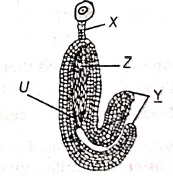
X-Plumule (2n), Y-Suspensor (n), Z-Cotyledon (2n), U-Radicle (2n)
X-Plumule (2n), Y-Suspensor (2n), Z-Radicle (2n), U-Cotyledon (2n)
X-Suspensor (2n), Y-Cotyledon (2n), Z-Radicle (2n), U-Plumule (2n)
X-Cotyledon (2n), Y-Radicle (n), Z-Plumule (n), U-Suspensor (n)
18.
A type angiosperm embryo sac at maturity is
4 nucleate - 2 celled
8 nucleate - 7 celled
4 nucleate - 4 celled
8 nucleate - 4 celled
2 nucleate - 1 celled
19.
Endosperm is consumed by developing embryo in the seed of
Pea
Maize
Coconut
Castor
20.
Identify the wrong statement regarding post-fertilization development
The ovary wall develops into pericarp
The outer integument of the ovule develop into tegmen
The fusion nucleus (triple fusion) develops into endosperm
The ovule develops into seed
The ovary develops into fruit
21.
Which one of the following is surrounded by a callose wall?
Male gamete
Egg
Pollen grain
Microspore mother cell
22.
Double fertilization involves:
Fertilization of the egg by two male gametes
Fertilization of two eggs in the same embryo sac by two sperms brought by one pollen tube.
Fertilization of the egg and the central cell by two sperms brought by different pollen tubes
Fertilization of the egg and the central cell by two sperms brought by same pollen tubes
23.
Egg apparatus consists of
egg
egg and polar nuclei
Egg and synergids
Egg and antipodal cells
1.
Self-incompatibility
It is the third device to prevent inbreeding. It is a genetic phenomenon of preventing the pollen from fertilising ovules of the same flower by inhibiting pollen germination or pollen tube growth in the pistil.
2.
1. Chasmogamous flowers are the bisexual, open flowers with exposed anthers and stigma.
2. Cross-pollination cannot occur in cleistogamous flowers because they remain in bud throughout their life and form seeds via self-pollination.
3.
X-Meiosis (reduction division), A-Mitosis
B-Mitosis, C-Mitosis,
D-Cells reorganised as polar nuclei, antipodals and egg apparatus.
4.
Bottle gourd is unisexual plant and only plant with female reproductive plant can bear fruits.
5.
Mango has only one ovule (apocarpous ovary) while orange has many ovule (syncarpous ovary)
6.
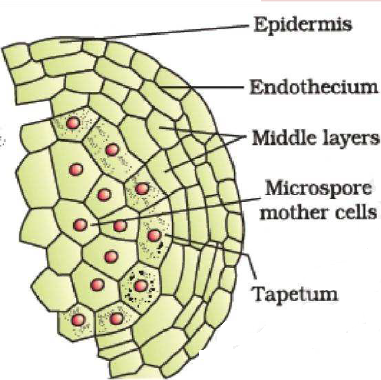
7.
Parthenocarpy.
8.
One
9.
1. Male gametophyte - In the Anther (microsporangia) and later on the stigma and style.
2. Female gametophyte - inside the ovule.
10.
| Perisperm | Endosperm |
|
- It is the remnant of nucellus, formed in the ovule before fertilisation. - The cells are diploid, e.g. black pepper, beet. |
- It is the product formed from the primary endosperm cell, in the ovule after fertilisation. - The cells are triploid, e.g. castor, maize. |
11.
(i) In coconut, endosperm formation is of nuclear type. The primary endosperm nucleus undergoes repeated nuclear division without cell wall formation.
(ii) Tender coconut is an endosperm. It is rich in nutrients like fats, proteins, carbohydrates, minerals, vitamins, etc. Hence, it is considered as a healthy source of nutrition.
(iii) Pea seeds are non-endospermic, while castor seeds are endospermic.
12.
(a) Syngamy
Syngamy refers to the fusion of a male gamete with the female gamete in the embryo sac to form a diploid zygote.
Triple fusion
Triple fusion refers to the fusion of a male gamete with the secondary nucleus (formed by fusion of two haploid polar nuclei) to form the triploid primary endosperm nucleus.
(b) Embryo development
Th'e zygote undergoes mitotic divisions during embryogeny.
The first division is transverse and results in a basal cell and a terminal cell; the basal cell forms the suspensor while the terminal cell forms the embryo proper.
It first, forms a filamentous proembryo, which later forms in sequence a globular embryo, heart-shaped embryo and then a mature embryo.
13.
(a) Differences:
| Autogamy | Getonogamy | Xenogamy |
| It refers to the transfer of pollen grains from the anther of a flower to the stigma of the same flower | It refers to the transfer of pollen grains from the anther of a flower to the stigma of same plant. | It refers to the transfer of pollen grains from the anther of a flower to the stigma of another flower on a different plant of the same species. |
| It does not lead to genetic variation in the progency | It does not lead to genetic variation in the progeny. | It leads to genetic variation in the progeny |
| No pollinating agent is needed. | A pollinating agent is needed. | A pollinating agent is needed. |
(b) Pollen-Pistil Interaction.
The stigma/pistil has the ability to recognise the right type of pollen, i.e. the compatible pollen of the same species and rejects the wrong type of pollen grains.
It is the result of interaction between the chemical components of the pollen and those of stigma. - A compatible pollen grain starts its germination on the stigma.
The intine grows out through one of the germ pores as a protuberance.
The contents of the pollen move into this tube, i.e. the tube nucleus (nucleus of the vegetative cell) and the generative cell (or the two male gametes in those species where pollen is liberated in the three-celled stage).
The pollen tube grows through the tissues of stigma and style and enters the ovule through micropyle.
It enters the embryo sac through the filiform apparatus of one of the synergids to liberate the male gametes.
The events from the deposition of pollen on the stigma till the pollen tube enters the ovule, are collectively referred to as pollen-pistil interaction.
14.
(a) Development of Pollen grain:
- Microsporocytes undergo mitotic divisions to increase the number of functional microspore mother cells.
- Each microspore mother cell undergoes meiosis to form a microspore tetrad.
- All the four microspores remain enclosed in a common wall.
- They start separating from each other.
- The nucleus undergoes a mitotic division resulting in the formation of a large vegetative cell and a small generative cell.
- The spore develops a wall of two layers the outer- exine and inner intine.
- At this stage, the pollen grains are liberated; but in some cereals the generative cell undergoes mitosis and the pollen grain is 3-celled, at the time of liberation.
(b) Mature Pollen Grain:
- A mature pollen grain has a protective covering of two layers.
- The outer is thick, sculptured variously and is made of sporopollenin; this layer is called exine.
- The inner layer, called intine is thin and is made of cellulose.
- A mature pollen grain is two celled with a large vegetative cell and a small generative cell floating in the cytoplasm of the vegetative cell.
- The pollen grains of dicot plants have three germ pores while those of monocots have one.
15.
(a) Development of Pollen grain:
- Microsporocytes undergo mitotic divisions to increase the number of functional microspore mother cells.
- Each microspore mother cell undergoes meiosis to form a microspore tetrad.
- All the four microspores remain enclosed in a common wall.
- They start separating from each other.
- The nucleus undergoes a mitotic division resulting in the formation of a large vegetative cell and a small generative cell.
- The spore develops a wall of two layers the outer- exine and inner intine.
- At this stage, the pollen grains are liberated; but in some cereals the generative cell undergoes mitosis and the pollen grain is 3-celled, at the time of liberation.
(b) Mature Pollen Grain:
- A mature pollen grain has a protective covering of two layers.
- The outer is thick, sculptured variously and is made of sporopollenin; this layer is called exine.
- The inner layer, called intine is thin and is made of cellulose.
- A mature pollen grain is two celled with a large vegetative cell and a small generative cell floating in the cytoplasm of the vegetative cell.
- The pollen grains of dicot plants have three germ pores while those of monocots have one.
16.
(i) The zygote starts dividing only after a certain amount of endosperm is formed as an adaptation to provide assured nutrition to the developing embryo; hence we can say it remains dormant for some time.
(ii) In groundnut, the developing embryo utilises the endosperm completely. There is no residual endosperm in the seed and so the seed is exalbuminous. In castor, the endosperm is not completely used up by the developing embryo, there is some amount of endosperm left in the seeds and the seeds are albuminous.
(iii) The micropyle facilitates the entry of water- and oxygen into the seed during germination.
(iv) The loss of water (up to 10-15% of weight) reduces the metabolic activity and seeds can enter a state of dormancy during unfavorable environment.
(v) Since, the thalamus (part other than ovary) contributes to fruit formation, these fruits are called false fruits and not true fruits.
17.
(c)
X-Suspensor (2n), Y-Cotyledon (2n), Z-Radicle (2n), U-Plumule (2n)
18.
(b)
8 nucleate - 7 celled
19.
(a)
Pea
20.
(b)
The outer integument of the ovule develop into tegmen
21.
(d)
Microspore mother cell
22.
(d)
Fertilization of the egg and the central cell by two sperms brought by same pollen tubes
23.
(c)
Egg and synergids

12th Standard CBSE Syllabus & Materials
12th Standard CBSE
CBSE 12th Computer Science Python Revision Tour I - New Previous year Question Papers Study Material - QB365 Set A
NEW12th Standard CBSE
CBSE 12th Business Studies Planning Important Questions And Answers Study Material - QB365 Set A
NEW12th Standard CBSE
CBSE 12th Business Studies Business Environment Important Questions And Answers Study Material - QB365 Set A
NEW12th Standard CBSE
CBSE 12th Business Studies Principles of Management Important Questions And Answers Study Material - QB365 Set A



NCERT Books

Syllabus

Exam Pattern

Sample Question Papers

Previous year Question Papers

Important Notes

MCQ Practice test

NCERT Exemplers

Case study Questions

Image Based Questions

Passage based Questions

HOT Questions

Value Based Questions

Model Questions Papers
NCERT ( Book Back ) Questions

Assertion and Reason
Important Questions And Answers

CBSE 12th Standard CBSE Subjects
CBSE Standards








