
 100% FREE ACCESS
12th Standard CBSE Syllabus & Materials
12th Standard CBSE
CBSE 12th Economics Government Budget and the Economy Previous year Question Papers Study Material - QB365 Set A
NEW12th Standard CBSE
CBSE 12th Computer Science Interface Python with MySQL - New Previous year Question Papers Study Material - QB365 Set A
NEW12th Standard CBSE
CBSE 12th Computer Science Database Concept - New Previous year Question Papers Study Material - QB365 Set A
NEW12th Standard CBSE
CBSE 12th Computer Science Data Communication - New Previous year Question Papers Study Material - QB365 Set A
NEW12th Standard CBSE
CBSE 12th Computer Science Data Structures - New Previous year Question Papers Study Material - QB365 Set A
NEW12th Standard CBSE
CBSE 12th Computer Science Functions - New Previous year Question Papers Study Material - QB365 Set A

Published on: 28/11/2025
Download CBSE Class 12th Standard CBSE Biology question papers, sample papers, important questions, and previous year solved papers in PDF format. Get free study materials, NCERT solutions, and exam preparation resources for Class 12th Standard CBSE Biology
Questions + Answers key
Take MCQ Biology Test
1.
If the cells in the leaves of a maize plant contain 10 chromosomes each, write the number of chromosomes in its endosperm and zygote. Name and explain the process by which an endosperm and a zygote are formed in maize.
2.
Write the functions of micropyle.
3.
Vivipary automatically limits the number of offsprings in a litter. How?
4.
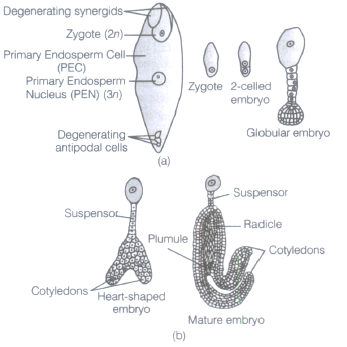
Starting with the zygote, draw the diagrams of the different stages of embryo development in a dicot.
5.
Describe the development of endosperm after double fertilization in an angiosperm. Why does endosperm development precedes that of zygote?
6.
(a) Write the two limitations of traditional breeding technique that led to promotion of micro-propagation.
(b) Mention two advantages of micro-propagation.
(c) Give two examples where it is commercially adopted.
7.
Draw a labelled diagram of the sectional view of a mature pollen grain of angiosperms. Explain the function of any two of its parts.
8.
Name the following structures:
(a) Single cotyledon of the monocotyledonous embryo of grass family.
(b) The portion of embryonal axis above the level of cotyledons in dicotyledonous embryo.
(c) Occurrence of more than one embryo in a seed
(d) Seedless fruits produced without fertilization.
9.
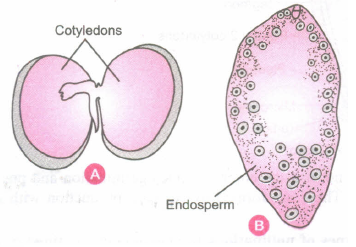
Which one of the following is responsible for nourishment to the developing embryo? Answer giving reasons.
10.
Explain the process of emasculation and bagging of flowers. State their importance in breeding experiments.
11.
Describe the difference between the structures of a dicot embryo and monocot embryo. Also draw LS of monocot and dicot seeds.
12.
Trace the events taking place in a flower from the time of pollen grain entry upto the completion of fertilistion.
13.
2.(a) Explain the post-pollination events leading to seed production in angiosperms.
(b) List the different types of pollination depending upon the source of pollen grain
14.
(a) Draw the longitudinal section of il\flower showing growth of pollen tube upto the embryo sac. Label the following parts :
(i) Stigma (ii) Pollen tube (ill)Integument
(iv) Chalazal end (v) Nucellus (vi) Synergids
(b) What is double fertilisation in Angiosperms? Why is it so called ?
15.
(a) Draw a diagram of a mature embryo sac of an angiosperm and label the following parts in it:
(i) Filiform apparatus
(ii) Synergids
(iii) Central cell
(iv) Egg cell
(v) Polar nuclei
(vi) Antipodals
(b) Write the fate of egg cell and polar nuclei after fertilisation.
16.
(a) Draw a labelled schematic diagram of the transverse section mature anther of an angiospermic plant.
(b) Describe the characteristic features of an insect-pollinated flower.
17.
Describe in sequence the events that lead to the development of a 3-celled pollen grain from a microspore mother cell in angiosperms.
18.
(a) How does microspore mother cell develop into mature pollen grain in angiosperms?
(b) Describe the structure of a mature pollen grain and draw a labelled diagram of its two-celled stage.
19.
20.
21.
22.
23.
In which of the following plants are both male and female flowers born on the same plant and the mode of pollination can be geitonogamy or xenogamy?
Papaya
Date palm
Maize
Spinach
24.
Which of the following outbreeding devices are used by majority of flowering plants to prevent inbreeding depression?
(i) Pollen release and stigma receptivity are not synchronised.
(ii) Different positions of anther and stigma.
(iii) Production of different types of pollen grains.
(iv) Formation of unisexual flowers along with bisexual flowers.
(v) Preventing self-pollen from fertilising the ovules by inhibiting pollen germination.
(i), (ii) and (v)
(ii), (iii) and (v)
(i), (ii) and (v)
(ii), (iv) and (v)
25.
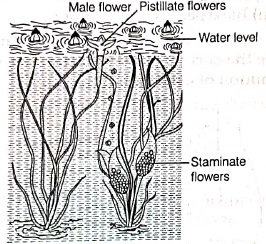
In the dioecious aquatic plant shown, identify the characteristics of the male flowers that reach the female flowers for pollination.
| Size of the flower | Colour of the flower | Characteristic features of pollen grain |
| Small | Brightly coloured | Light weight and non-sticky |
| Size of the flower | Colour of the flower | Characteristic features of pollen grain |
| Large | Colourless | Large and sticky |
| Size of the flower | Colour of the flower | Characteristic features of pollen grain |
| Small | White | Small, covered with mucilage |
| Size of the flower | Colour of the flower | Characteristic features of pollen grain |
| Large | Colourless | Non-sticky |
26.
A botanist studying Viola (common pansy) noticed that one of the two flower types withered and developed no further due to some unfavourable condition, but the other flower type on the same plant survived and it resulted in an assured seed set. Which of the following will be correct?
The flower type which survived is cleistogamous and it always exhibits autogamy
The flower type which survived is chasmogamous and it always exhibits geitonogamy
The flower type which survived is cleistogamous and it exhibits both autogamy and geitonogamy
The flower type which survived is chasmogamous and it never exhibits autogamy
27.
60% of the angiosperms shed their pollens at the
2-celled stage
3-celled stage
4-celled stage
1-celled stage
28.
What is the function of germ pore?
Emergence of radicle
Absorption of water for seed germination
Initiation of pollen tube
Release of male gametes
29.
Even in absence of pollinating agents, seed setting is assured in
Commelina
Zostera
Salvia
Fig
30.
Wind pollination is common in
legumes
lilies
grasses
orchids
31.
A typical dicotyledonous embryo consists of
radical only
embryo axis only
cotyledons only
radical, embryonal axis and cotyledons
32.
Embryo sac is to ovule __________ is to an anther
Stamen
Filament
Pollen grain
Androecium
33.
Seedless banana is
Parthenocarpic fruit
Multiple fruit
Drupe fruit
True fruit
34.
What does the filiform apparatus do at the entrance into ovule?
It brings about opening of the pollen tube
It guides pollen tube from a synergid to egg
It helps in the entry of pollen tube into a synergid
It prevents entry of more than one pollen tube into the embryo sac
35.
Endosperm is consumed by developing embryo in the seed of
Pea
Maize
Coconut
Castor
36.
Through which cell of the embryo sac, does the pollen tube enter the embryo sac?
Egg cell
Persistent synergid
Degenerated synergid
Central Cell
37.
Chiropterophily means...
Pollination by insects
Pollination by the wind
Pollination by bats
Pollination by snails
38.
Anthesis is a phenomenon which refers to
Formation of pollen
Development of anther
the opening of a flower bud
Reception of pollen by stigma
1.
Leaves of a maize plant contains 10 chromosomes each, so 2n =10(as leaf is diploid in nature)
Haploid no.; n =5
Gametes will be \(\rightarrow\) 5, each
Chromosome no. in endosperm (3n) = 3 \(\times\) 5 =15 chromosomes
Chromosome no. in zygote (2n) = 2 \(\times\) 5 = 10 chromosomes Maize is an angiosperm and exhibit double fertilisation as its characteristic feature in which two processes called syngamy and triple fusion occurs to form zygote and endosperm, respectively.
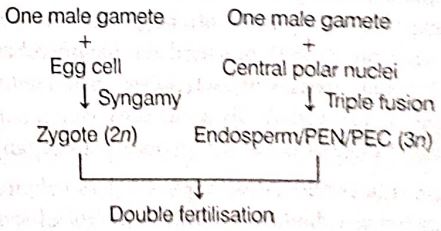
The pollen tube releases two male gametes into the synergids in which one male gamete moves towards egg cell and fuses to form a diploid zygote. The other male gametes move towards the central nuclei and fuses with them to form a triploid Primary Endosperm Nucleus (PEN).
2.
Functions of micropyle
(i) It is the passage through which the pollen tube enters the ovule.
(ii) It remains as a small pore in the seed coat and facilitates the entry of water and oxygen during seed germination.
3.
Vivipary is defined as the seed germination, while the fruit is still attached to the mother plant. Plants which grow in marshy places are called mangroves. In these plants when seeds fall on marshy places, they cannot germinate because of high salinity and more water conditions.
So, in those plants, seeds germinate when they are still attached to the mother plant. Litter is the offspring at one birth of animal usually 3-8 in number. Vivipary automatically limits the number of offspring in litter due to the reason that limited number of egg or ovum are produced and fertilised during reproductive cycle of female.
4.
5.
1. After triple fusion the central cell developer to form primary endosperm nucleus.
2. The primary endosperm cell undergoes successive cell divisions to form triploid endosperm which has abundant food reserves.
3. The primary endosperm nucleus undergoes successive nucleus divisions to form many free nuclei this type of endosperm development is called free nuclei endosperm. After which cell walls are laid, and the endosperm becomes cellular endosperm. Ex: coconut water is nuclear endosperm (containing many free nuclei) while white kernel around is cellular endosperm.
4. The endosperm developent preceeds that of zygote to ensure that endosperm containing abundant food reserves is formed earlier and can nourish the developing embryo
6.
(a) Failed to keep pace with demand, failed to provide fast and efficient system of crop improvement.
(b) Large number of plants can be developed in a short duration/production of genetically identical plants/somaclones/healthy plants can be recovered from diseased plants
(c)Tomato/banana/apple.
7.
Exine: It can withstand high temperature/strong acids/alkali. It protects pollens.
Intine: It is a thin and continuous layer made up of cellulose and pectin. The intine produces pollen tube.
Vegetative cell: It is bigger and has abundant food reserve.
Generative cell: It divides mitotically to give rise to two male gametes
8.
(a) Scutellum
(b) Epicotyl
(c) Polyembryony
(d) Patrhenocarpic fruits.
9.
The part responsible for supplying nourishment to the developing embryo is (B) Endosperm because embryo development occurs in the endosperm which is specially meant food to the developing embryo. Cotyledons are the parts of mature embryo which supply food during seed germination.
10.
(i) Emasculation refers to the practice of removal of anthers/stamens from a bisexual flower before the pollen grains mature.
(ii) It is necessary to prevent the self-pollen from contaminating the stigma.
(iii) Bagging refers to the covering of the emasculated flowers with a suitable bag made of butter paper; it is essential to prevent contamination of the stigma of the emasculated flower with unwanted pollen grains.
(iv) When the stigma becomes receptive, the pollen grains from the selected flowers are dusted on it and the flower is rebagged for the development of fruits and seeds.
(v) If female parent bears unisexual flowers, there is no need for emasculation.
(vi) The female flower buds are bagged before they open.
(vi) When the stigma becomes receptive, pollination is carried out with the desired pollen the flowers are rebagged.
11.
Structure of Dicot and Monocot Embryos
A typical dicotyledonous embryo consists of an embryonal axis and two cotyledons. The portion of the embryonal axis above the level of cotyledons is the epicotyl, which terminates in the plumule or stem tip. The cylindrical portion below the level of cotyledons is hypocotyl that terminates in the radicle or root tip, The root tip is covered with a root cap, e.g. mango, apple, radish, rose, etc
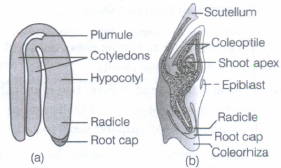
Embryo of monocots possesses only one cotyledon at one end (lateral) of the embryonal axis and this cotyledon is called scutellum.
At the lower end, the embryonal axis has radical and root cap enclosed in an undifferentiated sheath called coleorhiza.
The porrion of the embryonal axis above the level of attachment of scutellum is the epicotyl.
The epicotyl has a shoot apex and a few leaf primordia encdosed in a hollow foliar structure called coleoptile, e.g. grass, banana, bamboo, palm, etc.
12.
Entry of Pollen Tube into the Ovule
After reaching the ovary, the pollen tube can enter the , ovule either through the micropylar end (porogamy) or through chalaza (chalazogamy) or through funicle or integument (mesogamy). It then enters one of the synergids through the filiform apparatus present at micropylar end. The filiform apparatus directs the growth of pollen tube by secreting some chemical substances.
All these events mentioned above together are referred to as pollen-pistil interaction and the knowledge gained in this area helps plant breeders in manipulating this interaction, even in incompatible pollination, to get desired hybrids.
Double Fertilisation
1. The process was demonstrated for the first time by Nawaschin in 1898 in Lilium and Fritillaria. The most important and unique characteristic feature of angiosperms is the participation of both male gametes in the act of fertilisation. The pollen tube releases the two male gametes into the cytoplasm of one of the synergids, then the penetrated synergid starts degenerating. One male gamete fuses with the egg cell to form a diploid (2n) zygote. This process is called syngamy or generative fertilisation.
2. The diploid zygote finally develops into the embryo. The second male gamete fuses with the two polar nuclei or secondary nucleus in the central cell to form the triploid Primary Endosperm Nucleus (PEN). This process is called triple fusion as three haploid nuclei are involved in the fusion.
3. After triple fusion, the central cell becomes the Primary Endosperm Cell (PEC) which gives rise to the endosperm, while the zygote develops into the embryo. As both the fusions, syngamy and triple fusion, occur in an embryo sac, the phenomenon is termed as double fertilisation.
13.
(i) The major events in post-fertilisation include development of endosperm and embryo, maturation of ovules into seeds and ovary into fruit. They take place soon after the double fertilisation. These are as follows
Development of an Endosperm The development of endosperm precedes embryo development. The primary endosperm cell divides repeatedly to form a triploid endospermn tissue.
In most of the cases, the PEN undergoes successive nuclear divisions without cytokinesis, to give rise to free nuclear endosperm. Subsequently, cell wall formation starts from the periphery and the endosperm becomes completely cellular, e.g. coconut, rice, maize, sunflower, etc.
Development of an Embryo The embryo develops at the micropylar end of the embryo sac where the zygote is situated. Most zygotes divide only after certain amount of endosperm is formed. The nutrition for the development of embryo is provided by the endosperm. The zygote gives rise to proembryo and subsequently to the globular, heart-shaped and mature embryo.
Development of a Seed Double fertilisation in angiosperms triggers the transformation of ovule into a seed. Seeds are formed inside the fruits.
Formation of a Fruit A fruit is formed as a result of cell division and differentiation in the ovary, which is transformed into fruit as a result of stimuli received from pollination as well as from developing seed.
(ii) Pollination can be classified into three different types based on the source of pollen grains. They are:
i) Autogamy: It is defined as the transfer of pollen grains from the anther to the stigma of the same flower in the same plant.
ii) Geitonogamy: It is defined as the transfer of pollen grains from the anther of one flower to the stigma of another flower on the same plant.
iii) Xenogamy: This type of pollination brings genetically different types of pollen grains to the stigma of the flower.
14.
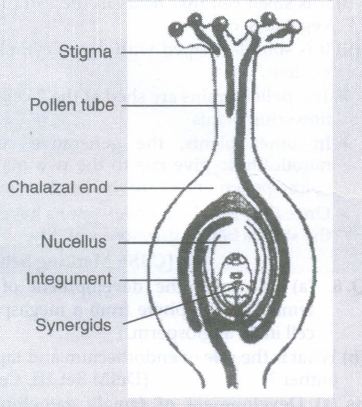
(a) One of the male gametes moves towards the egg cell and fuses with its nucleus thus completing syngamy. This results in the formation of a diploid cell-the zygote, the other male gamete moves
towards the two polar nuclei located in central cell and fuses with them to produce a triploid primary endosperm nucleus Since two types of fusions take place in an embryo sac the phenomenon is known as double fertilization.
(b) There occur two gametic fusions or fertilization in the female gametophyte or embryo sac of angiosperms i.e., one male gamete fuses with the egg to form zygote and the other male gamete fuses with the secondary nucleus to form the primary endosperm nucleus. The former fertilization is called as syngamy and the latter as the triple fusion. Thus, fertilization occurs twice in the same embryo sac, therefore, this is called as the double fertilization. This phenomenon is unique in angiosperms and is not found in any other group of plant kingdom other than angiosperms.
15.
(b) (i) The egg cell on fertilisation becomes the zygote, which later forms the embryo
(ii) The polar nuclei fuse to form a diploid secondary nucleus; on fertilisation by a male gamete, it forms the primary endosperm nucleus, which later forms the endosperm.
16.
(i) Insect-pollinated flowers are large, colourful and showy; if flowers are small, they are clustered into inflorescene to make them conspicuous.
(ii) The pollen grains and stigmatic surface are sticky.
(iii) They are highly fragrant; flowers pollinated by flies and beetle have foul odours to attract them.
(iv) To sustain animal visits, the flowers offer certain rewards like nectar, edible pollen and safe place for laying eggs.
17.
(a) Development of Pollen grain:
- Microsporocytes undergo mitotic divisions to increase the number of functional microspore mother cells.
- Each microspore mother cell undergoes meiosis to form a microspore tetrad.
- All the four microspores remain enclosed in a common wall.
- They start separating from each other.
- The nucleus undergoes a mitotic division resulting in the formation of a large vegetative cell and a small generative cell.
- The spore develops a wall of two layers the outer- exine and inner intine.
- At this stage, the pollen grains are liberated; but in some cereals the generative cell undergoes mitosis and the pollen grain is 3-celled, at the time of liberation.
(b) Mature Pollen Grain:
- A mature pollen grain has a protective covering of two layers.
- The outer is thick, sculptured variously and is made of sporopollenin; this layer is called exine.
- The inner layer, called intine is thin and is made of cellulose.
- A mature pollen grain is two celled with a large vegetative cell and a small generative cell floating in the cytoplasm of the vegetative cell.
- The pollen grains of dicot plants have three germ pores while those of monocots have one.
18.
(i) The zygote starts dividing only after a certain amount of endosperm is formed as an adaptation to provide assured nutrition to the developing embryo; hence we can say it remains dormant for some time.
(ii) In groundnut, the developing embryo utilises the endosperm completely. There is no residual endosperm in the seed and so the seed is exalbuminous. In castor, the endosperm is not completely used up by the developing embryo, there is some amount of endosperm left in the seeds and the seeds are albuminous.
(iii) The micropyle facilitates the entry of water- and oxygen into the seed during germination.
(iv) The loss of water (up to 10-15% of weight) reduces the metabolic activity and seeds can enter a state of dormancy during unfavorable environment.
(v) Since, the thalamus (part other than ovary) contributes to fruit formation, these fruits are called false fruits and not true fruits.
19.
(a)
20.
(a)
21.
(b)
22.
(d)
23.
(c)
Maize
24.
(a)
(i), (ii) and (v)
25.
(c)
| Size of the flower | Colour of the flower | Characteristic features of pollen grain |
| Small | White | Small, covered with mucilage |
26.
(a)
The flower type which survived is cleistogamous and it always exhibits autogamy
27.
(a)
2-celled stage
28.
(c)
Initiation of pollen tube
29.
(a)
Commelina
30.
(c)
grasses
31.
(d)
radical, embryonal axis and cotyledons
32.
(c)
Pollen grain
33.
(a)
Parthenocarpic fruit
34.
(a)
It brings about opening of the pollen tube
35.
(a)
Pea
36.
(c)
Degenerated synergid
37.
(c)
Pollination by bats
38.
(c)
the opening of a flower bud

12th Standard CBSE Syllabus & Materials
12th Standard CBSE
CBSE 12th Computer Science Python Revision Tour I - New Previous year Question Papers Study Material - QB365 Set A
NEW12th Standard CBSE
CBSE 12th Business Studies Planning Important Questions And Answers Study Material - QB365 Set A
NEW12th Standard CBSE
CBSE 12th Business Studies Business Environment Important Questions And Answers Study Material - QB365 Set A
NEW12th Standard CBSE
CBSE 12th Business Studies Principles of Management Important Questions And Answers Study Material - QB365 Set A



NCERT Books

Syllabus

Exam Pattern

Sample Question Papers

Previous year Question Papers

Important Notes

MCQ Practice test

NCERT Exemplers

Case study Questions

Image Based Questions

Passage based Questions

HOT Questions

Value Based Questions

Model Questions Papers
NCERT ( Book Back ) Questions

Assertion and Reason
Important Questions And Answers

CBSE 12th Standard CBSE Subjects
CBSE Standards








