
 100% FREE ACCESS
12th Standard CBSE Syllabus & Materials
12th Standard CBSE
CBSE 12th Economics Government Budget and the Economy Previous year Question Papers Study Material - QB365 Set A
NEW12th Standard CBSE
CBSE 12th Computer Science Interface Python with MySQL - New Previous year Question Papers Study Material - QB365 Set A
NEW12th Standard CBSE
CBSE 12th Computer Science Database Concept - New Previous year Question Papers Study Material - QB365 Set A
NEW12th Standard CBSE
CBSE 12th Computer Science Data Communication - New Previous year Question Papers Study Material - QB365 Set A
NEW12th Standard CBSE
CBSE 12th Computer Science Data Structures - New Previous year Question Papers Study Material - QB365 Set A
NEW12th Standard CBSE
CBSE 12th Computer Science Functions - New Previous year Question Papers Study Material - QB365 Set A

Published on: 11/08/2026
Download CBSE Class 12th Standard CBSE Biology question papers, sample papers, important questions, and previous year solved papers in PDF format. Get free study materials, NCERT solutions, and exam preparation resources for Class 12th Standard CBSE Biology
Questions + Answers key
Take MCQ Biology Test
1.
Mention two strategies evolved to prevent self-pollination in flowers.
2.
If one can induce parthenocarpy through the application of growth substances, which fruits would you select to induce parthenocarpy and why?
3.
Why is apple called a false fruit? Which part(s) of the flower forms the fruit?
4.
What is meant by emasculation? When and why does a plant breeder employ this technique?
5.
What is self-incompatibility? Why does self-pollination not lead to seed formation in self-incompatible species?
6.
What are chasmogamous flowers? Can cross-pollination occur in cleistogamous flowers? Give reasons for your answer.
7.
What is meant by monosporic development of female gametophyte?
8.
What is apomixis and what is its importance?
9.
Why do you think that the zygote is dormant for sometime in a fertilised ovule?
10.
Name the parts of an angiosperm flower in which development of male and female gametophyte takes place.
11.
What is bagging technique? How is it useful in a plant breeding programme?
12.
Explain the role of tapetum in the formation of pollen grain wall.
13.
What is triple fusion? Where and how does it take place? Name the nuclei involved in triple fusion.
14.
(a) Describe the endosperm development in coconut.
(b) Why is tender coconut considered a healthy source of nutrition?
(c) How are pea seeds different from castor seeds with respect to endosperm?
15.
Differentiate between:
(i) Hypocotyl and epicotyl.
(ii) coleoptile and coleorhiza.
(iii) integument and testa.
(iv) perisperm and pericarp
16.
With a neat, labelled diagram, describe the parts of a typical angiosperm ovule.
17.
Differentiate between microsporogenesis and megasporogenesis. Which type of cell division occurs during these events? Name the structures formed at the end of these two events.
18.
Devices for self-pollination are
Dicliny or unisexuality
Dichogamy
heterostyly
None of these
19.
Pollen grains are able to withstand extremes of temperature and desiccation because their exine is composed of
Cutin
Suberin
Sporopollenin
Callose
20.
The plant part which consists of two generations one within the other is
Germinated pollen grain
seed
Unfertilized ovule
Embryo
21.
In a flowering plant, archesporium gives rise to
only the wall of the sporangium
both wall and the sporogenous cells
wall and the tapetum
Only tapetum and sporogenous cells
22.
Insect-pollinated flowers are characterized by
Large number of pollens
Dry and smooth pollens
Sticky and rough pollens
Heavy pollens
23.
In angiosperms, pollen tubes liberate their male gametes into the
Central cell
Antipodal cell
Egg cell
Synergids
24.
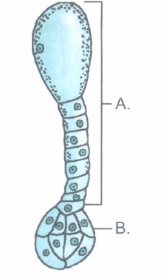
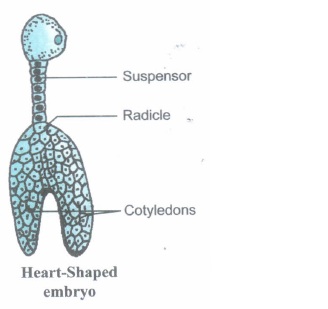
(a) Identify the parts A and B.
(b) Name (i) the initial cell from which it has developed and (ii) stage of embryo prior to this.
(c) Draw a labelled diagram ofthe stage of embryo succeding this.
25.
A flower of a tomato plant produced 200 viable seeds after sexual reproduction. Answer the following questions giving reason for each.
(a) How many ovules must have been there in the ovary?
(b) How many megaspore mother cells were involved?
(c) How many male gametes have been required in the production of 200 viable seeds?
26.
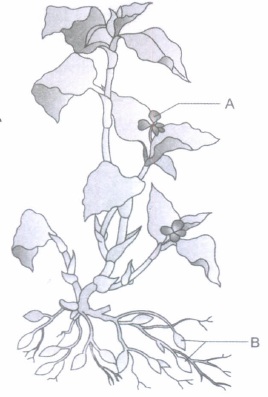
Identify the types of flowers A and B on the Commelina plant shown above.
(b) Mention the type(s) of pollination that can occur in each of them.
27.
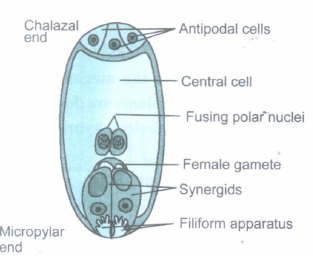
A fully developed embryo sac
A fully-developed and mature embryo sac is shown above.
(a) Name the cell from which it has developed.
(b) What is the ploidy level of its nuclei?
(c) What is filiform apparatus? Mention its significance.
28.
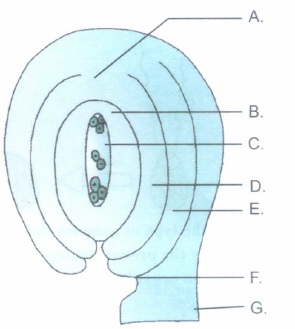
The diagram of an anatropous ovule is presented above.
(a) Give the technical term for ovule.
(b) Identify and name the part that
(i) attaches the ovule to the placenta
(ii) remains as perisperm in some seeds.
(iii) forms the testa of seed.
(iv) represents the basal part of the ovule.
(v) represents the female gametophyte.
29.
Assertion: Nucellus functions as a nutritive tissue.
Reason: Nucellus is always exhausted completely during development of embryo sac.
Codes:
(a) Both assertion and reason are true and reason is the correct explanation of assertion.
(b) Both assertion and reason are true but reason is not the correct explanation of assertion.
(c) Assertion is true but reason is false.
(d) Both assertion and reason are false
30.
Assertion: Pollen grains of many insect pollinated species are sticky.
Reason: In the anemophilous flower, the pollen grains are powdery and non-sticky.
Codes:
(a) Both assertion and reason are true and reason is the correct explanation of assertion.
(b) Both assertion and reason are true but reason is not the correct explanation of assertion.
(c) Assertion is true but reason is false.
(d) Both assertion and reason are false
31.
Assertion: Pollen wall is made up of two walls the intine and the exine.
Reason: Both the walls have depositions of sporopollenin
Codes:
(a) Both assertion and reason are true and reason is the correct explanation of assertion.
(b) Both assertion and reason are true but reason is not the correct explanation of assertion.
(c) Assertion is true but reason is false.
(d) Both assertion and reason are false
32.
Assertion: Mostly in a tetrad, all microspores are free.
Reason: Compound pollen grain and pollinium are formed by grouping of microspores
Codes:
(a) Both assertion and reason are true and reason is the correct explanation of assertion.
(b) Both assertion and reason are true but reason is not the correct explanation of assertion.
(c) Assertion is true but reason is false.
(d) Both assertion and reason are false
33.
Assertion: One pollen mother cell forms four microspores.
Reason: Microspores are formed due to reduction division
Codes :
(a) Both assertion and reason are true and reason is the correct explanation of assertion.
(b) Both assertion and reason are true but reason is not the correct explanation of assertion.
(c) Assertion is true but reason is false.
(d) Both assertion and reason are false
1.
1. Self-incompatibility: A condition wherein the pollen is ineffective in fertilizing the same flower or other flowers on the same plant usually due to inhibition of the growth of the pollen tube in the stigma and style, thereby preventing delivery of male gametes to the ovules.
2. Maturation of pistil before that of stamen (protogyny) or maturation of stamen before that of the pistil (protandry) inhibit self-pollination.
2.
The fruits selected to induce parthenocarpy can be watermelon, papaya, etc. It is because these fleshy fruits have a large number of seeds, which interfere with the preparation of jams, jellies, etc.
3.
Apple is called a false fruit because it develops from the thalamus (enlarged structure at the base of the flower) instead of ovary.
4.
1. Emasculation is the process of removal of stamens from a bisexual flower before they shed pollen in order to prevent self-pollination and permit cross-pollination of stigma with desired pollen. During breeding, the breeder wants to make sure that the desired pollen grains are used for pollination and the stigma is protected from contamination (from unwanted pollen).
2. A plant breeder employs this technique to select and incorporate specific traits in the progeny.
5.
Self-incompatibility
It is the third device to prevent inbreeding. It is a genetic phenomenon of preventing the pollen from fertilising ovules of the same flower by inhibiting pollen germination or pollen tube growth in the pistil.
6.
1. Chasmogamous flowers are the bisexual, open flowers with exposed anthers and stigma.
2. Cross-pollination cannot occur in cleistogamous flowers because they remain in bud throughout their life and form seeds via self-pollination.
7.
An embryo sac is called monosporic because it develops from one of the four megaspores formed from the division of megaspore mother cell.
8.
1. Apomixis is a form of asexual reproduction that mimics sexual reproduction and seeds are formed without fertilisation.
2. Apomictic embryos are genetically identical to the female parent.
3. If hybrid seeds can be made apomictic, the desirable characters can be maintained in the progeny.
4. It is often associated with polyembrony.
9.
There is an adaptation in angiospermic plants to provide assured nutrition to the developing embryo. Most zygotes divide only after certain amount of endosperm is formed. Therefore, zygote remains dormant for sometime in a fertilised ovule.
10.
1. Male gametophyte - In the Anther (microsporangia) and later on the stigma and style.
2. Female gametophyte - inside the ovule.
11.
Bagging The emasculated flower is covered by a bag of suitable size generally made up of butter paper, so as to prevent contamination of the stigma by unwanted pollen grains.
1.When the stigma of bagged flower becomes receptive, the collected pollen grains are dusted onto the stigma, the flower is rebagged and the fruits are allowed to develop.
2. If the female parent is unisexual, emasculation is not necessary. In this case, the female bud is directly bagged and when the stigma turns receptive, suitable pollen grains are dusted onto it so as to allow germination and the flowers are rebagged.
12.
Tapetum is the innermost layer of the microsporangium. It produces the exine layer of the pollen grains, which is composed of the sporopollenin, the most resistant organic material. During microsporogenesis, the cells of tapetum produce various enzymes, hormones, amino acids and other nutritious materials required for the development of pollen grains.
13.
Triple fusion:
It is the process of fusion of three nuclei, two polar nuclei (fuse to form a diploid secondary nucleus) and a male gamete.
It occurs in the central cell of the embryo sac of the ovule of angiosperms.
Then nuclei involved are two polar nuclei and a male gamete.
14.
(i) In coconut, endosperm formation is of nuclear type. The primary endosperm nucleus undergoes repeated nuclear division without cell wall formation.
(ii) Tender coconut is an endosperm. It is rich in nutrients like fats, proteins, carbohydrates, minerals, vitamins, etc. Hence, it is considered as a healthy source of nutrition.
(iii) Pea seeds are non-endospermic, while castor seeds are endospermic.
15.
(i)
| Hypocotyl | Epicotyl |
| Hypocotyl is the region of embryonal axis between the radicle and the point of attachment of cotyledons | Epicotyl is the region of embryonal axis between the plumule and the point of attachment of cotyledons |
(ii)
|
Coleoptile |
Coleorhiza |
| Coleoptile is the foliaceous sheath that covers the plumule in the embryo of cereals. | Coleorhiza is the covering of the radicle in the embryo of cereals |
(iii)
| Integument | Testa |
| It is the protective covering of the ovule. It develops into the seed coat |
Testa is the outer layer of the seed coat. It develops from the outer integument. |
(iv)
| Perisperm | Pericarp |
| Peri sperm is the residual, persistent nucellus (of ovule) in the seed. It is a part of the seed and nutritive in function |
Peri carp is the wall of fruit formed by the ovary wall. It is a part of the fruit and protective in function. |
16.
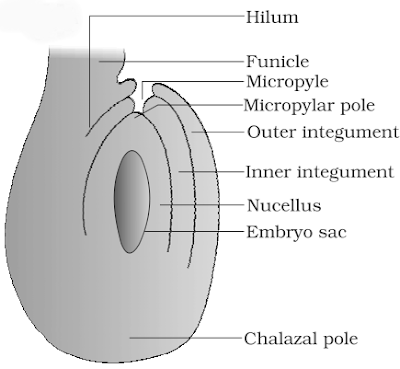
1. The ovule is attached to the placenta by a short stalk called funiculus.
2. The junction between the funiculus and the ovule, is called hilum.
3. The primordium of the ovule grows into a mass of cells, forming the nucellus, the main body of the ovule.
4. It becomes surrounded by two protective envelopes called integuments, which leave a small opening called micropyle, at the tip of the ovule.
5. The basal part of the ovule (opposite to the micropyle) is called chalaza. Cells of the nucellus are rich in reserve food materials.
6. There is a single embryo sac/female gametophyte in the nucellus; it has developed from a megaspore.
7. The embryo sac contains the following cells:
(i) Three antipodal cells at the chalazal end.
(ii) Three cells at the micropylar end, forming egg apparatus, which consists of two synergids and a female gamete.
(iii) Two nuclei in the central cell, called polar nuclei, which fuse to form a diploid secondary nucleus.
17.
|
Microsporogenesis |
Megasporogenesis |
|
It occurs inside the microsporangia of anther. |
It occurs in the nucellus of the ovule/megasporangium. |
Meiosis occurs during sporogenesis.
The structure formed at the end are microspores and megaspores respectively.
18.
(d)
None of these
19.
(c)
Sporopollenin
20.
(b)
seed
21.
(b)
both wall and the sporogenous cells
22.
(c)
Sticky and rough pollens
23.
(d)
Synergids
24.
(a) A - Suspensor
B - Globular embryo
(b) (i) Zygote
(ii) Proembryo
25.
(a) 200 ovules - each ovule becomes a seed after fertilisation; hence, 200 ovules will become 200 seeds.
(b) 200 megaspore mother cells- Though each megaspore mother cell forms four megaspores by meiosis, only one megaspore is functional and forms an embryo sac in an ovule.
(c) 400 male gametes - each ovule requires two male gametes for double fertilisation.
26.
(a) A - Chasmogamous flower
B - Cleistogamous flower
(b) A - Autogamy, geitonogamy and xenogamy
B - Autogamy only.
27.
(a) Megaspore
(b) Haploid
(c) (i) Filiform apparatus refers to the special cellular thickenings in the synergids, towards micropylar tip.
(ii) They play an important role in guiding the pollen tube to enter one of the synergids.
28.
(a) Megasporangium
(b) (i) G. Funicle
(ii) B. Nucellus
(iii) E. Outer integument
(iv) A. Chalaza
(v) C. Embryo sac.
29.
(c) The body of the ovule consists of a mass of parenchymatous cells named nucellus. The nucellus is mostly consumed by the developing embryo sac or endosperm. But in some plants it persists in the mature seed as a nutritive tissue. The persistent nucellus is called perisperm.
30.
(b) Both assertion and reason are true but reason is not the correct explanation of assertion
31.
(c) The pollen wall comprises two principal layers, the inner one is called intine and the outer exine. The intine is pecto-cellulosic in nature as is the primary wall of the somatic cells. The exine is composed chiefly of a class of material called sporopollenin.
32.
(b) Mostly all the four spores within a tetrad are completely isolated from one another and from the spores in other tetrads of the locule. Usually the microspores separate from one another shortly after meiosis. However, in some plants the spores tend to remain together in tetrads for longer period and develop into compound pollen grains. In many members of Orchidaceae and Asclepiadaceae all the microspores in a sporangium remains together to form what is called a pollinium.
33.
(a) The sporogenous cells of anther may directly function as microspore mother cells (also called pollen mother cells or PMCs) or they may undergo a few mitosis to add up to their number before entering meiosis. Each PMC, by a meiotic division, gives rise to a group of four haploid microspores. The aggregates of four microspores are referred to as microspore tetrads.

12th Standard CBSE Syllabus & Materials
12th Standard CBSE
CBSE 12th Computer Science Python Revision Tour I - New Previous year Question Papers Study Material - QB365 Set A
NEW12th Standard CBSE
CBSE 12th Business Studies Planning Important Questions And Answers Study Material - QB365 Set A
NEW12th Standard CBSE
CBSE 12th Business Studies Business Environment Important Questions And Answers Study Material - QB365 Set A
NEW12th Standard CBSE
CBSE 12th Business Studies Principles of Management Important Questions And Answers Study Material - QB365 Set A



NCERT Books

Syllabus

Exam Pattern

Sample Question Papers

Previous year Question Papers

Important Notes

MCQ Practice test

NCERT Exemplers

Case study Questions

Image Based Questions

Passage based Questions

HOT Questions

Value Based Questions

Model Questions Papers
NCERT ( Book Back ) Questions

Assertion and Reason
Important Questions And Answers

CBSE 12th Standard CBSE Subjects
CBSE Standards








