
 100% FREE ACCESS
12th Standard CBSE Syllabus & Materials
12th Standard CBSE
CBSE 12th Economics Government Budget and the Economy Previous year Question Papers Study Material - QB365 Set A
NEW12th Standard CBSE
CBSE 12th Computer Science Interface Python with MySQL - New Previous year Question Papers Study Material - QB365 Set A
NEW12th Standard CBSE
CBSE 12th Computer Science Database Concept - New Previous year Question Papers Study Material - QB365 Set A
NEW12th Standard CBSE
CBSE 12th Computer Science Data Communication - New Previous year Question Papers Study Material - QB365 Set A
NEW12th Standard CBSE
CBSE 12th Computer Science Data Structures - New Previous year Question Papers Study Material - QB365 Set A
NEW12th Standard CBSE
CBSE 12th Computer Science Functions - New Previous year Question Papers Study Material - QB365 Set A

Published on: 05/03/2026
Download CBSE Class 12th Standard CBSE Biology question papers, sample papers, important questions, and previous year solved papers in PDF format. Get free study materials, NCERT solutions, and exam preparation resources for Class 12th Standard CBSE Biology
Questions + Answers key
Take MCQ Biology Test
1.
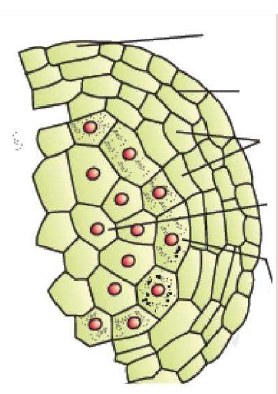
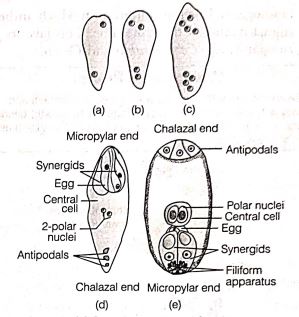
Lable the following.
2.
Write the function of tapetum in anthers
3.
Differentiate between syncarpous and apocarpous pistils with an example for each.
4.
Where is sporopollenin present in plants? State its significance with reference to its chemical nature.
5.
Explain the process of microsporogenesis in angiosperms.
6.
(a) Describe the process of megasporogenesis, in angiosperms.
(b) Draw a diagram of a mature embryo sac of angiosperm, label its any six parts.
7.
(a) Draw a diagram of a mature embryo sac of an angiosperm and label the following parts in it:
(i) Filiform apparatus
(ii) Synergids
(iii) Central cell
(iv) Egg cell
(v) Polar nuclei
(vi) Antipodals
(b) Write the fate of egg cell and polar nuclei after fertilisation.
8.
From the statements given below choose the option that is true for a typical female gametophyte of a flowering plant:
i) It is 8-nucleate and 7-celled at maturity
ii) It is free nuclear during development
iii) It is situated inside the integument but outside the nucellus
iv) It has an egg apparatus situated at the chalazal end.
i) and iv)
ii) and iii)
i) and ii)
ii) and iv)
9.
Male gametes in angiosperms are formed by the division of
Generative cell
vegetative cell
Microspore mother cell
Microspore
10.
In a type of apomixis known as adventive embryology, embryos develop directly from the
Nucellus or integuments
Zygote
Synergids or antipodals in an embryo sac
Accessory embryo sacs in the ovule
11.
Two students A and B received unknown floral parts. Characteristics of the part received by A are --- (i) It is 7 celled 8 nucleate structure, and (ii) It develops from single megaspore. The characteristics of the part received by B are ---(i) It is haploid and contains the male gametophyte, and (ii) It has two wall layers --- the outer is made of sporopollenin and the inner is made of cellulose and pectin.Identify the parts.
12.
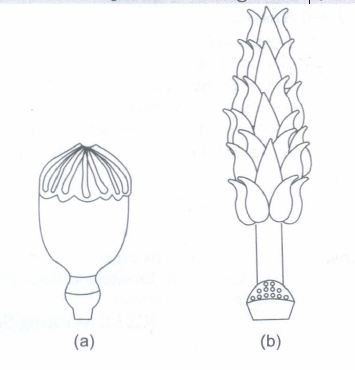
These pictures show the gynoecium of (a) Papaver and (b) Michelia flowers. Write the difference in the structure of their ovaries
13.
Banana is a fruit as well as a parthenocarpic fruit. Give reason.
1.
2.
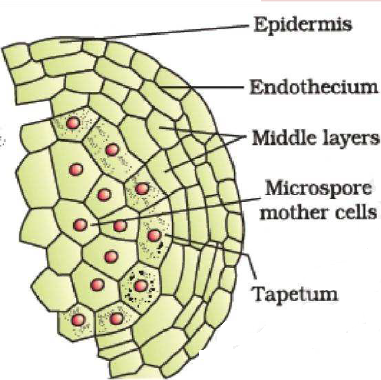
The tapetum is the inner most wall layer of the microsporangia (pollen sacs) in anthers. These cells nourish the developing microspore mother cells and pollen grains. Besides this it forms the exine, secrete pollen kit and special proteins for pollen grains so as to recognize compatible stigmas
3.
| Syncarpous pistils | Apocarpous pistil |
| When the carpels of a multicarpellary pistil are fused together, it is called a syncarpous pistil, e.g. poppy, brinjal, etc | When the carpels of a multicarpellary pistil are free, it is a called an apocarpous pistil, e.g. Michelia |
4.
1. Sporopollenin is found in the exine of pollen grains.
2. It is one of the most resistant organic materials, that can withstand high temperature and action of strong acids and alkali; no enzyme is known to digest it.
5.
Microsporogenesis :
(i)When the anther develops, each cell of sporogenous tissue functions as microspore mother cell (MMC) or pollen mother cell (PMC) and undergoes is meiotic divisions to form microspore tetrads.
(ii) The process of formation of microspores from a pollen mother cell (PMC) through meiosis is called microsporogenesis.
(iii) The microspores get arranged in a cluster of four cells and hence are microspore tetrad.
(iv) As the anthers mature and dehydrate, the microspores dissociate from each other and develop into pollen grains
(v) In each microsporangium, thousands of pollen grains are formed and released with the dehiscence of anther.
6.
(i) The process of formation of megaspores from Megaspore Mother Cell or MMC (diploid) is called megasporogenesis.
It occurs inside the nucellus of developing ovule of angiosperms. The process begins very early when nucellus is not conmpletely surrounded by the integuments. The MMC (a large cell containing dense cytoplasm and a prominent nucleus) enlarges in size and divides by meiosis. It first divides transversely into two cells called megaspore dyad.
These two cells apgain divide transversely as a result, a linear row of four haploid cells megaspore tetrad is produced.
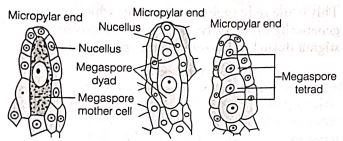
Out of the four megaspores one situated at the chalazal end remains functional and the rest three gradually degenerate. Such a development of embryo sac is called monosporic development, e.g. Pobygonum.
(ii)
7.
(b) (i) The egg cell on fertilisation becomes the zygote, which later forms the embryo
(ii) The polar nuclei fuse to form a diploid secondary nucleus; on fertilisation by a male gamete, it forms the primary endosperm nucleus, which later forms the endosperm.
8.
(c)
i) and ii)
9.
(a)
Generative cell
10.
(a)
Nucellus or integuments
11.
A received the embryo sac and B received the pollen grain.
12.
()
(a) Multicarpellary ovary showing fused syncarpous pistil.
(b) Multicarpellary apocarpous pistil.
13.
()
The fruit of banana is formed from ovary, so it is a fruit. It is also parthenocarpic fruit because ovary develops into fruit without fertilisation, and is seedless

12th Standard CBSE Syllabus & Materials
12th Standard CBSE
CBSE 12th Computer Science Python Revision Tour I - New Previous year Question Papers Study Material - QB365 Set A
NEW12th Standard CBSE
CBSE 12th Business Studies Planning Important Questions And Answers Study Material - QB365 Set A
NEW12th Standard CBSE
CBSE 12th Business Studies Business Environment Important Questions And Answers Study Material - QB365 Set A
NEW12th Standard CBSE
CBSE 12th Business Studies Principles of Management Important Questions And Answers Study Material - QB365 Set A



NCERT Books

Syllabus

Exam Pattern

Sample Question Papers

Previous year Question Papers

Important Notes

MCQ Practice test

NCERT Exemplers

Case study Questions

Image Based Questions

Passage based Questions

HOT Questions

Value Based Questions

Model Questions Papers
NCERT ( Book Back ) Questions

Assertion and Reason
Important Questions And Answers

CBSE 12th Standard CBSE Subjects
CBSE Standards








