
 100% FREE ACCESS
12th Standard CBSE Syllabus & Materials
12th Standard CBSE
CBSE 12th Economics Government Budget and the Economy Previous year Question Papers Study Material - QB365 Set A
NEW12th Standard CBSE
CBSE 12th Computer Science Interface Python with MySQL - New Previous year Question Papers Study Material - QB365 Set A
NEW12th Standard CBSE
CBSE 12th Computer Science Database Concept - New Previous year Question Papers Study Material - QB365 Set A
NEW12th Standard CBSE
CBSE 12th Computer Science Data Communication - New Previous year Question Papers Study Material - QB365 Set A
NEW12th Standard CBSE
CBSE 12th Computer Science Data Structures - New Previous year Question Papers Study Material - QB365 Set A
NEW12th Standard CBSE
CBSE 12th Computer Science Functions - New Previous year Question Papers Study Material - QB365 Set A

Published on: 04/12/2019
Biodiversity and Conservation
Download CBSE Class 12th Standard CBSE Biology question papers, sample papers, important questions, and previous year solved papers in PDF format. Get free study materials, NCERT solutions, and exam preparation resources for Class 12th Standard CBSE Biology
Questions + Answers key
Take MCQ Biology Test
1.
Study-1. A forest that is rich in biodiversity seems to decline in animal population. The government declared it as a biodiversity hotspot and the forest regained its species richness in few years. Study-2. A lake that is rich in marine fishes seems to decline in its species population due to overexploitation. A wise man in the area decided to worship the lake. The species population f the lake again became normal.
(a) Which values are been promoted in the above studies.
(b) Suggest some ways by which you can contribute to this concern.
(c) What would be the effect if the forest was not declared hotspot?
2.
Which strategy of Bioconversation is being taken care of if the endangered species are removed from the unsafe or threatened habitat and placed under the care of humans? How is this strategy different from the other strategy of bio-conservation?
3.
Discuss one example, based on your day-to-day observations, showing how loss of one species may lead to the extinction of another.
4.
Differentiate between in situ and and ex situ approaches of conservation of biodiversity?
5.
Why have certain regions been declared as biodiversity ' hot spots' by environmentalist of the wpold? Name any two hot spot regions of india.
6.
Create an aquatic food chain in a water body into which effluents flow from a pesticide factory. Diagrammatically represent and answer the following questions:
What is the phenomenon called?
7.
When and where was the world summit on sustainable development held? How many countries signed the convention? What was the objective?
8.
Write an account on biodiversity in India.
9.
How is biodiversity important for ecosystem functioning?
10.
Give three hypotheses for explaining why tropics show greatest levels of species richness.
11.
It is our moral duty to ensure the well-being of all the living creatures for the utilization of future generation. Why is it so and how biodiversity is affected?
12.
Define the IUCN Red List categories.
13.
Give the approximate numbers of species which have been described and identified all over the world.
14.
Describe in detail the species-area relationship of biodiversity
15.
Greenhouse effect is due to
CO2
CO
NO
PO4
16.
Which one of the following is an environment related disorder with the correct main cause?
block lung disease (pneumoconiosis) found mainly in workers in stone quarries and crushers.
blue baby disease (methaemoglobinaemia) due to heavy use of nitrogenous fertilizers in the area.
Non-hodgkin's lymphoma found mainly in workers involved in manufacture of neem based pesticides
skin cancer mainly in people exposed to benzene and methane
17.
Which of the following is biogas?
CO2
N2O
CH4
N2
18.
This acts as bioindicator of air pollution
Alga
Lichen
Pinus
Mustard
Fern
19.
The noise produced in office is normally at the level of
20 db
30 db
40 db
60 db
1.
(i) Biodiversity conservation, Ecosystem protection.
(iii) Educate people not to harm biodiversity.
(iii) Forest would be destroyed, many species of plants and animals lost.
2.
Ex-situ. Any two differences between ex-situ and in-situ conservation of biodiversity.
3.
Co-extinction is the extinction of two mutually related or interrelated species for instance a host fish extinction leads to the extinction of all those papsites excusively found on it. Another example is plant-pollinator mutualism, where extinction of one leads to extinction of other.
Insect,aphids are polyphagous (feed on more than one plant species) or monophagous (feed on a particular species of plant). Monophagous insects may become extinct, if the plantspecies upon which they feed becomes extinct.
4.
| In situ Conservation | Ex situ Conservation |
|---|---|
| 1. It is the method of protecting the endangered species of plants or animals in the natural habitat, either by protecting or cleaning up the habitat itself or by defending the species from predators. 2. It helps in recovering populations in the surroundings where they have developed their distinct features. |
1. It is the method of protecting the endangered species of plants or animals by removing them from the unsafe or threatened habitat and placing under the care of humans. 2. It helps in recovering populations or preventing their extinction under simulated conditions that closely resemble their natural habitats. |
5.
Hot spots are the regions with very high levels of species richess and high degree of endemism and need maximum production.
e.g. Western Ghats and himalayas.
6.
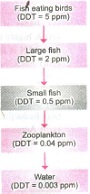
Biomagnification or biological magnification.
7.
1. The world summit on sustainable development was held in 2002, in Johannesburg, south Africa.
2. 190 countries signed the convention.
3. Its objective was achive by 2010, a significant reduction in the current rate of biodiversity loss at global, regional and local levels.
8.
1. India is one of the twelve biodiversity rich countries of the world.
2. Though India has only 2.4% of the land area of the world, it has 8.1% of the global species biodiversity.
3. There are about 45,000 species of plants and 90,000-1,00,000 species of animals, many more species are yet to be discovered and named.
4. If we apply Robert May's global estimate that only 22% of the total species have been recorded, India probably has more than 1,00,000 species of plants and 3,00,000 species of animals to be discovered and described.
9.
Biodiversity is very important for ecosystem functioning. More diverse ecosystems are considered more stable. Stable communities are resilient and resistant to change.
Hence, diversity stabilises the community and also helps in increasing the productivity. Higher the biodiversity of an ecosystem, higher the number of species and therefore, lower is the rate of extinction. While, in case of low biodiversity, there are higher chances of extinction.
Extinction of even one or two key species has negative impacts on the entire ecosystem.
Thus, the diversity ensures the stability and proper functioning of the entire ecosystem as explained via the 'Rivet popper hypothesis'.
Biodiversity is important for ecosystem functioning.
(i) Ecologists believe that communities with more species diversity tend to be more stable than those with less species diversity.
(ii) Plots with increased species diversity show, higher productivity.
(iii) The ecosystem with more diversity becomes resistant to seasonal disturbances.
(iv) They also show resistant to invasion by alien species.
10.
(i) Speciation is a function of time: the temperate regions were subjected to frequent glaciation in the past, while the tropics have remained undisturbed and hence had longer time to evolve more species diversity.
(ii) The tropical environments are less seasonal and relatively more constant and more predictable than temperate regions; speciation has been promoted/favoured by such constant environments and hence there is greater species diversity.
(iii) There is more solar radiation available in the tropical region; this contributes directly to more productivity and indirectly to greater species diversity.
11.
Earth's rich biodiversity is vital for the very survival of mankind. The reasons for conserving biodiversity are narrowly utilitarian, broadly utilitarian and ethical. Besides the direct benefits (food, fibre, firewood, pharamaceuticals, etc.), there are many indirect benefits we receives through ecosystem services such as pollination, pest control, climate moderation and flood control. Each and every living being has some intrinsic value. We derive countless economic benefits from the living things. Living things play a major role in many ecosystems. All the species in the ecosystem are interlinked. When a species becomes extinct, the plant and animal species associated with it in an obligatory way also becomes extinct. When a host fish species becomes extinct, its unique assemblage of parasites also meets the same fate. Another example is the case of coevolved plant-pollinator mutualism where extinction of one leads to extinction of the other.
12.
| Red List Category | Definition |
|---|---|
| Exitnct | A taxon is Extinct when there is no reasonable doubt that the last individual has died. |
| Extinct in the wild | A taxon is Extinct in the wild when exhaustive surveys in known and/or expected habitats, have failed to record an individual. |
| Critically endangered | A taxon is Critically Endangered when it is facing an extremely high risk of extinction in the wild in the immediate future. |
| Endangered |
A Taxon is Endangered when it is not Critically Endangered but is very high risk of extinction in the wild in the near future. |
| vulnerable | A taxon is vulnerable when it is not Critically Endangered, or Endangered, but is facing a high risk of extinction in the wild in the medium term future. |
| Lower risk | A taxon is Lower Risk when it has been evaluated and does not satisfy the criteria for Critically Endangered, Endangered or vulnerable. |
| Data deficient | A taxon is Data Deficient when there is inadequate information to make a direct, or indirect, assessment of its risk of extinction. |
| Not evaluated | A taxon is Not Evaluated when it has not yet been assessed. |
13.
Approximate number of species which have been described and identified from all over the world.
| Group | Number of Species |
| Higher plants | 2,70,000 |
| Algae | 40,000 |
| Fungi | 72,000 |
| Bacteria (including Cyanobacteria) | 4,000 |
| Viruses | 1,550 |
| Mammals | 4650 |
| Birds | 9700 |
| Reptiles | 7150 |
| Fish | 26,959 |
| Amphibians | 4780 |
| Insects | 10,25,000 |
| Crustaceans | 43,000 |
| Molluscs | 70,000 |
| Nematodes and worms | 25,000 |
| Protozoa | 40,000 |
| Others | 1,10,000 |
14.
Species-Area Relationship
1. Alexander Von Humboldt has observed that within a region, species richness increases with increased explored area, but only upto a limit.
2. The relationship between species richness and area for a number of taxa like angiospermic plants, freshwater fishes and birds is found to be a rectangular hyperbola.
3. On a log scale, the relationship becomes linear (straight line) and is described by the equation:
log S = log C + Z log A, where
S = Species Richness
Z = Slope of the line (regression coefficient)
A = Area and C = Y - intercept
4. Ecologists have found that the value of Z-line ranges between 0.1 and 0.2 irrespective of the taxonomic group of the region.
5. But in very large areas, like a continent, the Z value ranges between 0.6 and 1.2 and indicate species richness.
15.
(a)
CO2
16.
(b)
blue baby disease (methaemoglobinaemia) due to heavy use of nitrogenous fertilizers in the area.
17.
(c)
CH4
18.
(b)
Lichen
19.
(d)
60 db

12th Standard CBSE Syllabus & Materials
12th Standard CBSE
CBSE 12th Computer Science Python Revision Tour I - New Previous year Question Papers Study Material - QB365 Set A
NEW12th Standard CBSE
CBSE 12th Business Studies Planning Important Questions And Answers Study Material - QB365 Set A
NEW12th Standard CBSE
CBSE 12th Business Studies Business Environment Important Questions And Answers Study Material - QB365 Set A
NEW12th Standard CBSE
CBSE 12th Business Studies Principles of Management Important Questions And Answers Study Material - QB365 Set A



CBSE 12th Standard CBSE Subjects
CBSE Standards










