
 100% FREE ACCESS
12th Standard CBSE Syllabus & Materials
12th Standard CBSE
CBSE 12th Economics Government Budget and the Economy Previous year Question Papers Study Material - QB365 Set A
NEW12th Standard CBSE
CBSE 12th Computer Science Interface Python with MySQL - New Previous year Question Papers Study Material - QB365 Set A
NEW12th Standard CBSE
CBSE 12th Computer Science Database Concept - New Previous year Question Papers Study Material - QB365 Set A
NEW12th Standard CBSE
CBSE 12th Computer Science Data Communication - New Previous year Question Papers Study Material - QB365 Set A
NEW12th Standard CBSE
CBSE 12th Computer Science Data Structures - New Previous year Question Papers Study Material - QB365 Set A
NEW12th Standard CBSE
CBSE 12th Computer Science Functions - New Previous year Question Papers Study Material - QB365 Set A

Published on: 04/12/2019
Environmental Issues
Download CBSE Class 12th Standard CBSE Biology question papers, sample papers, important questions, and previous year solved papers in PDF format. Get free study materials, NCERT solutions, and exam preparation resources for Class 12th Standard CBSE Biology
Questions + Answers key
Take MCQ Biology Test
1.
How does a scrubber function?
2.
How does an electrostatic precipitator work to remove particulate pollutants released from Thermal Plants
3.
Write critical notes on eutrophication.
4.
Why should the spraying DDT as an insecticide on vegitable crops be banned?Explain
5.
How does eutrophication of a lake take place? Explain
6.
Why industrial effluents are more difficult to manage than municipal sewage? Name a disease that is caused by heavy metal contamination.
7.
Why is ozone layer in stratosphere called a protective layer?
8.
Write a short note on electronic waste. List the various sources of e-wastes and the problems associated with its disposal.
9.
Discuss briefly the defunct ships and e-wastes.
10.
India in last two decades has seen a boom in automobile production and use.
(a) What has been its environmental impact?
(b) What steps are being taken so that the rapid increase in the number of automobiles does not become a curse?
11.
You want to set up a chemical producing unit. What steps will you take that your project does not turn into a hazard to environment?
12.
How has DDT caused decline in bird population?
13.
What is the main idea behind "Joint Forest Management Concept" Introduced by Government of India.
14.
India has only 2-4% of the world's land area but its share of the global species diversity is
1-8%
3-1%
5-1%
8-1%
15.
Total number of identified biodiversity hotspots in the world is
25
24
40
34
16.
the natural habitat of Indian Rhinoceros is found in which Indian state?
Arunachal Pradesh
Assam
Himachal Pradesh
Uttar Pradesh
17.
India became a party to 'Convention on Biological Diversity'in the year
1994
1993
1992
1998
18.
Which one of the following is a pair of endangered species?
Garden lizard and Mexican poppy
Rhesus monkey and sal tree
Indian peacock and Carrot grass
Hornbill and Indian Aconite
1.
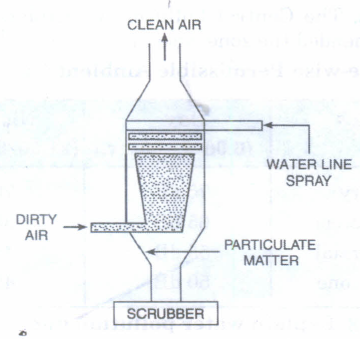
Scrubber. A scrubber can remove gases like sulphur dioxide. In a scrubber, the exhaust is passed through a spray of water or lime. Water dissolves gases and lime reacts with sulphur dioxide to form a precipitate of calcium sulphate or sulphite.
2.
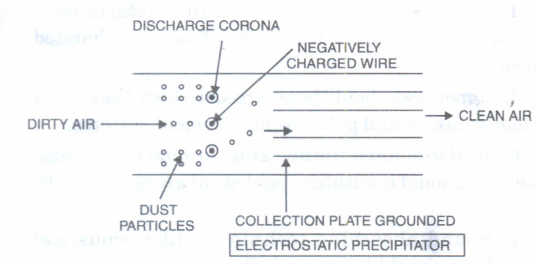
An electrostatic precipitator. It removes over 99% particulate matter present in the exhaust from a thermal power plant. It has electrode wires and a stage of collecting plates. The electrode, wires are maintained at several thousand volts, which produce a corona that releases electrons. These electrons attach to dust particles and give them a net negative charge within a very small fraction of a second. The collecting plates are grounded and attract the charged dust particles. The velocity of air between the plates must be low enough to allow the dust to fall.
3.
Eutrophication
Eutrophication is defined as the process of nutrient enrichment of water and consequent loss of species diversity in water bodies.
1. Increased nutrient content of the water body causes algal bloom, i.e. excess growth of algae, especially cyanobacteria.
2. It covers the water surface, secretes toxins and reduces the dissolved oxygen content of water.
3. These toxins inhibit the growth of other algae and plants and cause death of aquatic animals.
4. Oxygen deficiency may be a cause for death of animals.
4.
1. When DDT is: sprayed on the crop plants, it remains in the soil as it is non-biodegradable and enters the plant.
2. As it travels through food chain, it undergoes biomagnification, i.e. increase in concentration at successive higher trophic levels, as it can neither be metabolised nor excreted; this causes disorders in those organisms.
3. In birds, a high concentration of DDT interferes with calcium metabolism and causes thinning of egg shells leading to their premature breaking; consequently there is a decline in bird population.
5.
1. The natural ageing of a lake is called eutrophication. It is the biological enrichment of its water.
2. In a young lake, there is very little life and the water is cold.
3. As time advances, the streams draining into it start adding nutrients like phosphates and nitrates.
4. They stimulate the growth of algae, phytoplanktons and some small plants.
5. So, the quantity of organic matter increases and the water becomes warmer and shallower; hence the decomposers start flourishing.
6. The decomposers flourish and make use of a large quantity of oxygen for decomposition.
7. This leads to depletion of dissolved oxygen of the water and mortality of fish and other aquatic organisms.
8. The eutrophied water bodies can lead to algal blooms, which further add organic matter and lead to oxygen depletion.
6.
Industrial effluents released into water contain toxic substances, such as cadmium, lead, zinc, copper, mercury and cyanides, besides some salts, acids and alkalies. All these materials can prove harmful for health. They may reach human body.
Tertiary Treatment:
It involved removal of nitrates and phosphates.
The water, after above treatment, is then released. It can be reused.
The sewage treatment is quite expensive, and only the first two steps are followed in many developing countries.
Minamata is disease caused by heavy metal contaminated water.
7.
Ozone layer as protective layer:
The ozone layer in the stratosphere is very useful to human beings because it absorbs the major part of harmful ultraviolet radiation coming from the sun. Therefore, it is called protective layer. However, it has been observed that the ozone layer is getting depleted. One of the reasons for depletion of ozone layer is action of aerosols spray propellants. These are the chemicals such as fluorocarbons and chloro-fluorocarbons. These compounds react with ozone gas in the atmosphere thereby depleting it. Scientists all over the world are worried at the destruction of ozone layer. If the ozone layer in the atmosphere is significantly decreased, these harmful radiations would reach the earth and would cause many damages such as skin cancer, genetic disorders in man and other living forms. Efforts are being made to find substitutes of these chemicals which do not react with ozone.
8.
Solid waste can be biodegradable recyclable non-biodegradable, and can be categorised municipal wastes (sewage), Industrial waste, hospitals and nursing wastes and electronic waste. Irrepairable computers, mobiles and other electronic goods are often known as 'e' waste or electronic waste.
Source of e-waste
Majority of the developing countries like China, Pakistan and India import irrepairable electronic goods for their valuable metals like copper, nickel and gold.
Disposal of e-waste
Such waste should be burried in landfills or incinerated. In developing countries metal from e-waste is extracted manually. So, during working with e-waste, one can expose with toxic substances present in it, and may get affected by skin diseases in future. However, recycling is the only solution for the treatment of electronic waste.
9.
Defunct Ships
1. They constitute a kind of solid waste and require proper disposal. Such ships are broken down in developing countries like India, Pakistan, Bangladesh etc. where cheap labour force is available and they also use the scrap metal. The biggest ship-breaking yard is in Alang (Bhavnagar), Gujarat.
2. The defunct ships contain toxic substances like asbestos, polychlorinated biphenyls (PCBs), Tributylin (TBT), lead, mercury, etc.
3. The workers breaking the ships are not suitably protected and they are exposed to toxic chemicals.
4. The coastal area in the vicinity becomes polluted.
5. Asbestos is carcinogenic; it causes cancer and also an occupational lung disorder called asbestosis.
6. PCBsenter the food chain and cause biological magnification.
E-wastes
1. Irreparable computers and other electronic gadgets are the main source of e-wastes.
2. Incineration and burying in landfills are the two major ways of disposal of e-wastes.
3. E-wastes are recycled to recover metals like copper, iron, silicon, nickel and gold.
4. In developed countries, they are recycled in specifically built chambers, without involving labourers.
5. In developing countries, recycling involves human labourers.
10.
a) Enhance air pollution
b) Proper maintenance of automobiles along with use of lead-free petrol or diesel
c) Use of catalytic converter for reducing emissionof poisonous gases .
d) Use of CNG in place of petrol, diesel.
11.
Treatment of waste material, Use of high chimney, using electrostatic precipitator to remove particulate matter, use scrubber to remove harmful gases like SO2.
12.
DDT is persistent pollutant. It undergoes biomagnification so that concentration rises with each trophic level to over a million times in fish eating birds, e.g. Bald Eagle (25 ppm from 0.003 ppb in water). High concentration of DDT in the body of bird causes liver cirrhosis, cerebral haemorrhage and malfunctioning of sex hormones.Calcium metabolism is disturbed. It results in thinning of egg shells, their premature breaking and death of embryo. As a result there was decline in bird population.
13.
It is government-private enterpreneurship for upkeep of forests. The forest department prepares the plan, procures saplings and equipment for planting and plant protection. The locals take care of the plants till they become mature. For this yet get honorarium and share in plant products. This sort of management provides livelihood to locals and protection to plants against stealing and illegal telling.
14.
(d)
8-1%
15.
(d)
34
16.
(b)
Assam
17.
(a)
1994
18.
(d)
Hornbill and Indian Aconite

12th Standard CBSE Syllabus & Materials
12th Standard CBSE
CBSE 12th Computer Science Python Revision Tour I - New Previous year Question Papers Study Material - QB365 Set A
NEW12th Standard CBSE
CBSE 12th Business Studies Planning Important Questions And Answers Study Material - QB365 Set A
NEW12th Standard CBSE
CBSE 12th Business Studies Business Environment Important Questions And Answers Study Material - QB365 Set A
NEW12th Standard CBSE
CBSE 12th Business Studies Principles of Management Important Questions And Answers Study Material - QB365 Set A



CBSE 12th Standard CBSE Subjects
CBSE Standards










