
 100% FREE ACCESS
12th Standard CBSE Syllabus & Materials
12th Standard CBSE
CBSE 12th Economics Government Budget and the Economy Previous year Question Papers Study Material - QB365 Set A
NEW12th Standard CBSE
CBSE 12th Computer Science Interface Python with MySQL - New Previous year Question Papers Study Material - QB365 Set A
NEW12th Standard CBSE
CBSE 12th Computer Science Database Concept - New Previous year Question Papers Study Material - QB365 Set A
NEW12th Standard CBSE
CBSE 12th Computer Science Data Communication - New Previous year Question Papers Study Material - QB365 Set A
NEW12th Standard CBSE
CBSE 12th Computer Science Data Structures - New Previous year Question Papers Study Material - QB365 Set A
NEW12th Standard CBSE
CBSE 12th Computer Science Functions - New Previous year Question Papers Study Material - QB365 Set A

Published on: 05/10/2019
Evolution
Download CBSE Class 12th Standard CBSE Biology question papers, sample papers, important questions, and previous year solved papers in PDF format. Get free study materials, NCERT solutions, and exam preparation resources for Class 12th Standard CBSE Biology
Questions + Answers key
Take MCQ Biology Test
1.
Give a flow chart to show the different divisions of geological time scale.
2.
(a) How did Darwin explain adaptive radiation. Give another example exhibiting adaptive radiation.
(b) Name the scientist who influenced Darwin and how?
3.
Name the three kinds of selection. Show the three kinds with the help of figure.
4.
Define the following:
(i) Gene flow
(ii) Industrial melanism
(iii) Allopatric speciation
(iv) Sympatric speciation
(v) Balancing selection
(vi) Hybride sterility
(vii) Biological species concept
(viii) Evolutionary species concept.
5.
What is natural selection in modern terms? Elucidate the three different effects of natural selection on variation.
6.
Distinguish between microevolution and macroevolution. Narrate the significance of population genetics in evolution.
7.
How did Louis Pasteur successfully demolish the popular theory of spontaneous generation? What were his conclusions?
8.
State the hypothesis of Oparin and Haldane about the primeval Earth condition. What do you understand by Haldane's hot, dilute soup? State its significance.
9.
Show that Darwin's natural selection is based on factual observations, with an example for each.
10.
Explain in detail the different theories of origin of life.
1.
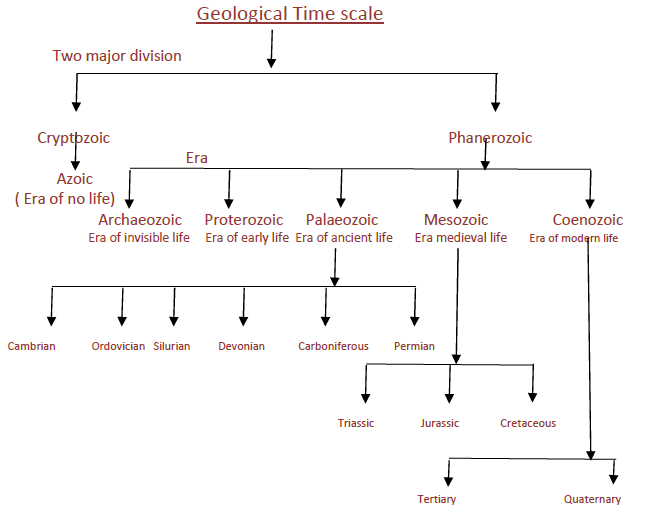
Note-Coenozoic era is divided in to two periods which are Tertiary and Quaternary and these are
further divided into seven Epochs-1.Recent(Holozoic )1-0.6mya
2.Pleistocene 0.6-2.0mya
3.Pliocene 2-13mya
4.Miocene 13-26mya
5.Eocene 38-54mya
6.Palaeocene 54-65mya
2.
(a) Adaptive radiation. Refer to Basis and Basics.
(b) Darwin was influenced by Malthus theory of population growth proposed by T.R. Malthus.
3.
Kinds of selections:
1. Stabilising selection
2. Directional selection
3. Disruptive selection.
4.
(i) Gene flow: The transfer of gene in the hereditary from one generation to next is called gene flow.
(ii) Industrial melanism: Evolution of darker forms of in response to industrial population is known as industrial melanism.
(iii) Allopatric speciation: The speciation by the geographical separation of two population and divergence of the population.
(iv) Sympatric speciation: When a sub-population becomes reproductively isolated in the midst of its parent population this is called sympatric speciation.
(v) Balancing selection: By Heterozygous condition in the sickle cell anaemia(H A/HS) survived the malarial condition and balance the lost by sickle cell anaemia is called balancing selection.
(vi) Hybrid sterility: If the hybrid is sterile which is formed by postmating isolation mechanism.
(vii) Biological species concept: A sexually interbreeding population which is separated from other species by the reproductive isolation.
(viii) Evolutionary species concept: An evolutionary species is a lineage evolving separately from others with its own unitary role and tendencies.
5.
Natural Selection: In modern term natural selection is differential reproduction. Natural selection is main evolutionary process which causes the change of allele frequencies or in other words selection is the consistent differences in contribution of various genotypes to the next generation.
In in a population both small and largest individuals contribute relatively fewer offspring to the next generation then those closer to the averages do, stabilizing selection is operating.
If centre of population contributes more then equilibrium is maintained while if extremes of population work then two peaks in the distribution of a trait produced, while former is disruptive selection.
6.
Evolution on the grand scale of geological time, is called macroevolution while evolution at genetic level is micro-evolution. Micro-evolution is actually is actually operative at genetic level change.
Significance of Population Genetics: The gene frequency of a population is called population genetics. Evolution occurs within populations as the relative frequencies of different variations of DNA change over time. If genes change the enzymes automatically change and represent two different forms of individuals and definitely result in evolution.
7.
(1) Spontaneous generation refers to origin of life from non-living substances like mud, rocks, decaying matter under conditions that now exist on the earth, where as abiogenesis is the origin of life simple from non-living material under different set of conditions from those existed on the primitive earth.
(2) Theory of spontaneous generation was disapproved the finding. "life comes from pre-existing life". Francesco Redi (1668) placed throughly cooked meat in three jar
(i) uncovered
(ii) covered with parchment and
(iii) covered with muslin. Maggots developed only in the uncovered jar. No maggot developed in jar covered by parchment. Files visited the third jar produced maggots. Spallanzani (1765) boiled nutrition broth in glass flasks, sealed the flasks and kept them. The broth remained clear indefinitely with no signs of living beings.
Pasteur (1864) took broth in flasks having swan necks, boiled and allowed the broth to cool. No germs developed in the broth though it was connected with the atmosphere through curved necks of the flasks. The dirt particles could not reach the broth because they got trapped in the bend of the neck. When the swan necks were broken, broth developed colonies of microorganisms, showing that the same have come from air. The theory of biogenesis is, however, not applicable to origin of life.
8.
Alexander I. Oparin (1894-1980), a Russian biochemist and J.B.S. Haldane (1892-1964), a British scientist have put forward the concept of biogenesis. According to Oparin and Haldane primeval earth had reducing condition and atmosphere is free from oxygen. Oxygen remained bound in HO and metallic oxides on the surface of rocks and its particles. The early gas cloud was rich in hydrogen, in form of methane (CH4) and ammonia (NH3) and water (H2O). The organic nolucles formed due to atmospheric reaction accumulated slowly and gradually in sea and constitute what is called "Hot, dilute soup".
Significance of hot dilute soup. Thus conditions of reducing nature are unable to oxidize these organic compounds which form the basis of life.
9.
Darwin's theory of Natural Selection was based on factual observations like:
(i) Natural resources are limited; so populations are stable in size except for seasonal fluctuations.
(ii) Members of a population show variation of every characteristic - no two members of a population are identical even though they show similarities.
(iii) Theoretically population size will grow exponentially, if everybody reproduced to the maximum capacity; it is seen in growing microbial/bacterial populations.
(iv) The population size in reality is limited -it is due to competition among individuals for resources and only those which are better adapted could survive and reproduce at the cost of others, who are less adapted to that habitat.
Darwin asserted that the heritable variations which make resource utilisation better in some individuals will enable them to reproduce and leave more progeny over a period of time; over many generations, there would be a change in the population characteristics, leading to origin of new species.
10.
Theories of Origin of life:
(i) Theory of Special Creation
According to this theory, God, the supernatural being created the earth, light, plants and animals.
All living organisms that we see today were created as such.
The diversity of the life forms was always the same.
Earth is about 4000 years old.
(ii) Theory of Panspermia/Cosmozoic theory
Some scientists believe that life has appeared on earth from other planets or outer space.
Early Greek philosophers thought that units called 'spores' or 'pansperms' came on the earth along with meteorites and they might have evolved into the present day forms.
(ii) Theory of Spontaneous Generations
It was believed that living organisms arose from decaying matter like straw.
But Louis Pasteur demonstrated that life can arise only from pre-existing life.
(iv) Theory of Chemical Evolution
This theory was proposed by Oparin and Haldane.
They proposed that the first life form could have come from the pre-existing non-living organic molecules.
The formation of organic molecules must have been the result of chemical evolution.
The conditions that favoured the chemical evolutions were:
(a) very high temperature,
(b) volcanic stom, and
(c) Reducing atmosphere that contained methane, water vapour, ammonia, etc.

12th Standard CBSE Syllabus & Materials
12th Standard CBSE
CBSE 12th Computer Science Python Revision Tour I - New Previous year Question Papers Study Material - QB365 Set A
NEW12th Standard CBSE
CBSE 12th Business Studies Planning Important Questions And Answers Study Material - QB365 Set A
NEW12th Standard CBSE
CBSE 12th Business Studies Business Environment Important Questions And Answers Study Material - QB365 Set A
NEW12th Standard CBSE
CBSE 12th Business Studies Principles of Management Important Questions And Answers Study Material - QB365 Set A



CBSE 12th Standard CBSE Subjects
CBSE Standards










