
 100% FREE ACCESS
12th Standard CBSE Syllabus & Materials
12th Standard CBSE
CBSE 12th Economics Government Budget and the Economy Previous year Question Papers Study Material - QB365 Set A
NEW12th Standard CBSE
CBSE 12th Computer Science Interface Python with MySQL - New Previous year Question Papers Study Material - QB365 Set A
NEW12th Standard CBSE
CBSE 12th Computer Science Database Concept - New Previous year Question Papers Study Material - QB365 Set A
NEW12th Standard CBSE
CBSE 12th Computer Science Data Communication - New Previous year Question Papers Study Material - QB365 Set A
NEW12th Standard CBSE
CBSE 12th Computer Science Data Structures - New Previous year Question Papers Study Material - QB365 Set A
NEW12th Standard CBSE
CBSE 12th Computer Science Functions - New Previous year Question Papers Study Material - QB365 Set A

Published on: 04/11/2019
Download CBSE Class 12th Standard CBSE Biology question papers, sample papers, important questions, and previous year solved papers in PDF format. Get free study materials, NCERT solutions, and exam preparation resources for Class 12th Standard CBSE Biology
Questions + Answers key
Take MCQ Biology Test
1.
Puneet used to like beautiful flowers but not the insects flying in the garden.He discussed his plan but his father advised him not to do so as it will affect seed formation in ornamental plants of the garden.
Read the above passage and answer the following questions:
(i) Was the decision of Puneet to kill insects of garden with insecticide right?
(ii) Why did his father advise him not to do so?
(iii) Are chemical insecticides safe for living organisms including human beings?
2.
Write the causative organism, mode of infection, symptoms and preventive measures of
(1) Leprosy
(2) Whooping cough
3.
Why is ozone layer in stratosphere called a protective layer?
4.
Give the structure of simple type placenta.
5.
Water is the most important factor influencing the life of organisms. Life on earth originated in water and cannot be sustained without water. Organisms living in water bodies (ocean, lake, river, etc.) also face water-related problems.
(a) How are aquatic animals affected by the quality of water? Explain.
(b) Mention any four adaptations the desert plants have, to live there successfully.
(c) Represent the value learnt.
6.
Describe in detail the species-area relationship of biodiversity
7.
(a)Name two types of satellite DNA.Mention the basis for such a classification.
(ii)Show only diagrammatically the process of transcription in bacteria
8.
Let us assume in a given plant, the genotype symbol 'Y' stands for dominant yellow seed colour and 'Y' for recessive green seed colour; symbol 'R' for round seed shape and 'r' for wrinkled seeds. Two homozygous parents (plant) with genotypes 'RRYY' and 'rryy' are crossed and their F1 generation progeny is then
(a) Phenotype of F1 progeny
(b) Genotype of F1 Progeny
(c) Gamete genotypes of F1 progeny
(d) Phenotypic ratio of F2 population
(e) Phenotypic ratio of yellow seeds to green seeds and round seeds to wrinkled seeds in F2 population.
9.
Explain the development of the zygote into an embryo and of the primary endosperm nucleus into an endosperm in a fertilised embryo sac of a dicot plant.
10.
Name the three events in the sexual reproduction of an angiosperm and mention what major events occur in each of them.
1.
(i)No,it was not a wise decision.
(ii) Insecticides kill the insects.These insects are very important for plants as many of these are helpful in carrying out pollination which is very essential for fertilization and seed formation in sexually reproducing species.
(iii)No,many insecticides pollute and, being non-biodegradable, have harmful effects on living organisms
2.
Common human diseases
| Name of Diseases and Causative agent | Mode of Infection | Symptoms | Preventive measure |
| 1.Leprsoy-Mycobacterium leprae | Chronic infection of skin and nerves |
Ulcers, nodules, scales, deformities of fingers and toes, wasting of body parts. Severe coughing characteristic of a gasping whoop |
1.Rehabilitation of patients 2.Vaccination vaccine may be available shortly. 3.DDS(Diamino Diphenyl Sulphate) treatment. |
| 2.Pertusis-(whooping cough) Bordetella pertusis add matter | By throat discharge and contact | Severe coughing characteristic of a gasping whoop | DPT vaccine.Isolation of patient. |
3.
Ozone layer as protective layer:
The ozone layer in the stratosphere is very useful to human beings because it absorbs the major part of harmful ultraviolet radiation coming from the sun. Therefore, it is called protective layer. However, it has been observed that the ozone layer is getting depleted. One of the reasons for depletion of ozone layer is action of aerosols spray propellants. These are the chemicals such as fluorocarbons and chloro-fluorocarbons. These compounds react with ozone gas in the atmosphere thereby depleting it. Scientists all over the world are worried at the destruction of ozone layer. If the ozone layer in the atmosphere is significantly decreased, these harmful radiations would reach the earth and would cause many damages such as skin cancer, genetic disorders in man and other living forms. Efforts are being made to find substitutes of these chemicals which do not react with ozone.
4.
Structure of Epithelio-chorial placenta. Epithelio-chorial placenta is the simple and basic type of placenta as formed in cow, goat etc. In this case some of the components are derived from the uterine wall of mother while the other parts are derived from the foetus itself.
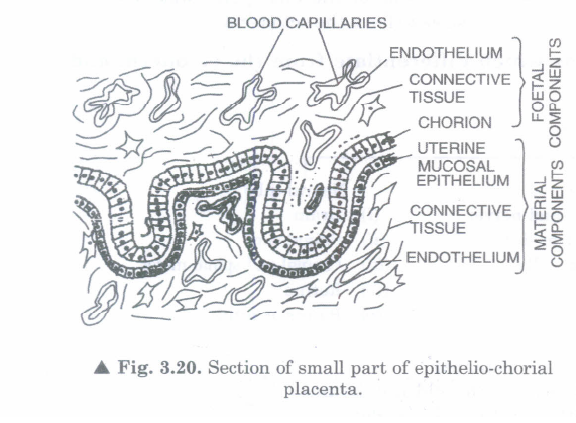
The maternal components of placenta are:
1. Mucous membrane of the uterine wall.
2. Uterine connective tissue.
3. Maternal endothelium (wall of maternal blood capillaries).
Foetal components of placenta are:
1.Wall of foetal blood capillaries.
2. Foetal connective tissue.
3. Foetal chorionic epithelium
5.
The chemical composition and pH of water are important to affect the animals.
Some animals can tolerate only a narrow range of salinity and are called stenohaline.
Some animals can tolerate a wide range of salinity and are called euryhaline.
Many freshwater fishes can not live for long in sea water and vice versa, because of the osmotic problems, they would face in such waters.
(b) (i) The leaves are reduced to spines.
(ii) The stem is green, flattened, spongy and takes over the function of photosynthesis .
(iii) A thick cuticle prevents loss of water.
(iv) They have a special photosynthetic mechanism (CAM), that enables their stomata to remain closed during day and open during night.
(c) Water is the most precious resource, use it judiciously and think of programs for its conservation.
6.
Species-Area Relationship
1. Alexander Von Humboldt has observed that within a region, species richness increases with increased explored area, but only upto a limit.
2. The relationship between species richness and area for a number of taxa like angiospermic plants, freshwater fishes and birds is found to be a rectangular hyperbola.
3. On a log scale, the relationship becomes linear (straight line) and is described by the equation:
log S = log C + Z log A, where
S = Species Richness
Z = Slope of the line (regression coefficient)
A = Area and C = Y - intercept
4. Ecologists have found that the value of Z-line ranges between 0.1 and 0.2 irrespective of the taxonomic group of the region.
5. But in very large areas, like a continent, the Z value ranges between 0.6 and 1.2 and indicate species richness.
7.
(a) Minisatellites and microsatellites
They are classified on the basis of:
(i) base composition, i.e. A- T rich or G-C rich.
(ii) length of the segment.
(iii) number of repetitive units.
8.
(a) Round and yellow seeds
(b) Rr Yy

(d) 9 round, yellow seeded: 3 Round, green-seeded: 3 wrinkled, yellow seeded: 1 green, wrinkled - seeded
(e) Yellow-seeds: green seeds = 3 : 1 Round seeds: Wrinkled seeds = 3 : 1
9.
(a) A develops into the embryo.
B develops into the endosperm.
(b) - The endosperm development starts from the primary endosperm cell containing the primary endosperm nucleus.
- In the most common type of endosperm development, the primary endosperm nucleus undergoes successive free nuclear divisions to give rise to a number of free nuclei; at this stage, it is called free nuclear endosperm.
- Subsequently wall formation takes place from the periphery and proceeds towards the centre and the endosperm becomes cellular.
- This type of endosperm development is seen in coconut; the water of the tender coconut represents the free nuclear endosperm with thousands of nuclei in it and the white kernel around it represents the cellular endosperm.
- In albuminous seeds,some amount of endosperm persists in the mature seed, as the developing' embryo does not consume it fully, e.g. wheat/maize.
-In exalbuminous seeds, the endosperm is completely consumed by the developing embryo before seed maturation, e.g. groundnut and pea.
Development of primary endosperm nucleus:
- The PEN undergoes successive nuclear divisions to give rise to free nuclei, this stage of endosperm development is known as free-nuclear endosperm.
- Subsequently cell wall formation occurs and the endosperm becomes cellular .
10.
The three events in sexual reproduction are:
(i) Pre-fertilisation events (ii) Fertilisation and (iii) Post-fertilisation events.
(i) Pre-fertilisation events:
The two major events in this phase are;
(a) Gametogenesis, the process of formation of gametes. (b) Gamete transfer, i.e. pollination the process by which the pollen grains are deposited on the stigma.
(ii) Fertilisation:
1. It is called double fertilisation in angiosperms.
2. Each pollen grain produces two male gametes; one of them fuses with the female gamete to form zygote while the other fuses with the secondary nucleus to form primary endosperm nucleus.

12th Standard CBSE Syllabus & Materials
12th Standard CBSE
CBSE 12th Computer Science Python Revision Tour I - New Previous year Question Papers Study Material - QB365 Set A
NEW12th Standard CBSE
CBSE 12th Business Studies Planning Important Questions And Answers Study Material - QB365 Set A
NEW12th Standard CBSE
CBSE 12th Business Studies Business Environment Important Questions And Answers Study Material - QB365 Set A
NEW12th Standard CBSE
CBSE 12th Business Studies Principles of Management Important Questions And Answers Study Material - QB365 Set A



CBSE 12th Standard CBSE Subjects
CBSE Standards










