
 100% FREE ACCESS
12th Standard CBSE Syllabus & Materials
12th Standard CBSE
CBSE 12th Economics Government Budget and the Economy Previous year Question Papers Study Material - QB365 Set A
NEW12th Standard CBSE
CBSE 12th Computer Science Interface Python with MySQL - New Previous year Question Papers Study Material - QB365 Set A
NEW12th Standard CBSE
CBSE 12th Computer Science Database Concept - New Previous year Question Papers Study Material - QB365 Set A
NEW12th Standard CBSE
CBSE 12th Computer Science Data Communication - New Previous year Question Papers Study Material - QB365 Set A
NEW12th Standard CBSE
CBSE 12th Computer Science Data Structures - New Previous year Question Papers Study Material - QB365 Set A
NEW12th Standard CBSE
CBSE 12th Computer Science Functions - New Previous year Question Papers Study Material - QB365 Set A

Published on: 04/12/2019
Organisms and Populations
Download CBSE Class 12th Standard CBSE Biology question papers, sample papers, important questions, and previous year solved papers in PDF format. Get free study materials, NCERT solutions, and exam preparation resources for Class 12th Standard CBSE Biology
Questions + Answers key
Take MCQ Biology Test
1.
Write a short note on the adaptations of plant to water scarcity.
2.
How do organisms which cannot migrate tend to overcome adverse environmental conditions? Explain taking one example each from vertebrates and angiosperms, respectively.
3.
How does the human body maintain a constant temperature both in summers and winners? Explain.
4.
Very small-sized animals are rarely found in polar regions. Give two reasons.
5.
Competition does not always occur between closely related species for the same resources. Substantiate the statement with examples.
6.
Describe any three reproductive strategies that organisms have evolved in relation to a particular set of selective pressures.
7.
Why is predation required in a community of different organism?
8.
How do organisms like fungi, zooplanktons and bears overcome the temporary, short-lived climatic stressful conditions? Explain.
9.
List three symptoms of high altitude sickness and state three adaptations to overcome it.
10.
No species can exist alone in a habitat. Any species has a minimal requirement of at least one more species, on which it can feed. Interspecific interactions arise from the interaction of populations of two different species.
(a) What term is given to the interaction, where one species is benefitted and the other is neutral?
(b) Give four examples of the above kind of interaction.
(c) How do you call the interaction where one species is neutral and the other is harmed? Give an example of such an interaction.
(d) What value do you learn from this?
11.
Water is the most important factor influencing the life of organisms. Life on earth originated in water and cannot be sustained without water. Organisms living in water bodies (ocean, lake, river, etc.) also face water-related problems.
(a) How are aquatic animals affected by the quality of water? Explain.
(b) Mention any four adaptations the desert plants have, to live there successfully.
(c) Represent the value learnt.
12.
List the different ways by which organisms cope or manage with abiotic stresses in nature. Explain any three ways listed.
13.
(a) Explain with the help of a graph, the population growth curve when resources are
(i) limiting and
(ii) not limiting.
(b) 'Nature has a carrying capacity for a species'. Explain.
14.
The term ecology was coined by
Odum
E. Munch
Tansley
Reiter
15.
What is a keystone species?
A common species that has plenty of biomass, yet has a fairly low impact on the community's organization
A race species that has minimal impact on the biomass and on other species in the community
A dominant species that constitutes a larger proportion of the biomass and which affects many other species
A species which makes up only a small proportion of the total biomass of community, yet has a huge impact on the community's organization and survival.
16.
A terrestrial animal must be able to
Conserve water
Actively pumps salts out through the skin
Excrete large amounts of salt in urine
Excrete large amounts of water in urine
17.
Zone of atmosphere near the earth surface is
Stratosphere
Mesosphere
Troposphere
Thermosphere
18.
Maximum growth rate occurs in
senescent phase
lag phase
exponential phase
stationary phase
1.
(I) The plants develop a thick cuticle to check transpiration.
(il) They have sunken stomata.
(iii) The leaves are modified into spines or scales.
(iv) The stem becomes a phylloclade and helps in photosynthesis and storage of food and water.
(v) Sorne have their stomata open at night and dosed at day.
(vi) They may have deep tap root to reach the water available at lower layers of soil or even water table
2.
Vertebrates like bear undergo hibernation, to escape in time.
Angiosperms produce seeds and certain other vegetative structures to tide over unfavourable conditions in the habitat.
3.
(i) In summer, we sweat profusely; the evaporation of sweat causes a cooling and brings down the body temperature.
(ii) In winter, we shiver, and that produces heat to raise the body temperature.
4.
Heat loss or heat gain is a function of surface area.
Since small animals (like humming birds) have a larger surface area relative to their volume, they tend to lose body heat very fast, when it is cold outside.
They spend more energy to generate body heat through metabolism; considering the cost and benefit of maintaining a constant internal temperature, small animals (humming birds) are not found in polar regions.
5.
a) These are places at high altitudes, i.e. 73,500 m above sea level.
Tourists may experience altitude sickness, whose symptoms include nausea, heart palpitations and fatigue.
Since the atmospheric pressure is low at high altitude, the body does not get enough oxygen.
But gradually, the body gets acclirnatised and stops experiencing altitude sickness.
(b) Heat loss or gain is a function of the surface area of the body.
Small animals have a larger surface area relative to the volume of the body; hence they tend to lose body heat very fast, when it is cold outside.
They have to spend more energy to generate body heat through metabolism; hence small animals are not found in polar regions.
6.
Reproductive strategies:
(i) Some organisms breed only once in their life time-e.g. Bamboo, Pacific Salmon.
(ii) Some produce a large number of small-sized offspring-Oysters.
(iii) Some breed many times during their life time-e.g. birds.
(iv) Some produce a small number of large sized offspring, e.g. Mammals.
7.
(i) Predation acts as a conduit for energy transfer across trophic levels.
(ii) It keeps the prey population under control.
(iii) It helps in maintaining species diversity in a community, by reducing the intensity of competition.
(iv) Biological control of pests is based on the principle of predation.
8.
Fungi produce various kinds of thick-walled spores to survive under unfavorable conditions; they germinate when conditions become favorable.
Zooplanktons enter diapause, a stage of suspended development, under unfavourable conditions.
Bears go into hibernation during winter to escape in time of unfavourable conditions.
9.
Symptoms include:
(i) nausea
(ii) fatigue, and
(iii) heart palpitations.
Adaptations are:
(i) Increase in breathing rate.
(ii) Increased production of red blood cells.
(iii) Decreasing binding capacity of haemoglobin.
10.
(a) Commensalism
(b) (i) Orchids grow as epiphytes on mango tree or other fruit trees.
Orchids are benefitted by getting a shelter, while the tree is neither benefitted nor damaged.
(ii) Barnacles growing on the whale are benefitted to move where food is available.
(iii) The cattle egrets always forage near to where the cattle animals graze; the cattle animals stir up the ground and the insects are flushed out from the vegetation and make it easy for the egrets to catch them.
(iv) The clown fish living among sea anemones get protection from their predators, which stay away from the stinging tentacles of the sea anemone:
(c) Amensalism
Roots of certain plants secrete chemicals, which are harmful to the soil organisms.
The antibiotics secreted by certain soil fungi are harmful to soil fungi bacteria. (anyone)
(d) Interactions should be beneficial to all concerned. Avoid selfish or selfcentered people.
11.
The chemical composition and pH of water are important to affect the animals.
Some animals can tolerate only a narrow range of salinity and are called stenohaline.
Some animals can tolerate a wide range of salinity and are called euryhaline.
Many freshwater fishes can not live for long in sea water and vice versa, because of the osmotic problems, they would face in such waters.
(b) (i) The leaves are reduced to spines.
(ii) The stem is green, flattened, spongy and takes over the function of photosynthesis .
(iii) A thick cuticle prevents loss of water.
(iv) They have a special photosynthetic mechanism (CAM), that enables their stomata to remain closed during day and open during night.
(c) Water is the most precious resource, use it judiciously and think of programs for its conservation.
12.
The different ways to cope with abiotic stresses are:
(i) Regulation
(ii) Conformation
(iii) Migration and
(iv) Suspending.
(i) Regulation: Some animals maintain homeostasis by physiological means that ensure a constant body temperature, constant osmolarity of body fluids, etc; mammals maintain a constant body temperature.
(ii) Conformation: Those animals called conformers, which cannot maintain homeostasis, change their body temperature or osmolarity of body fluids according to the ambient environment.
(iii) Migration: If the stressful condition is localised, animals move away temporarily from the stressful environment to more hospitable area and return when the stressful conditions is over.
(iv) Suspending: Some animals avoid the stress by escaping in time; bears go into hibernation during winter and snails go into aestivation in summer. (any three)
13.
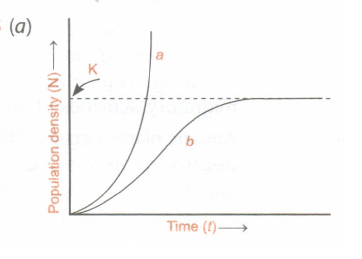
(I) When resources are limiting, the population growth curve is sigmoid and it is represented by the equation:
\(dN/dt=rN\left( \frac { K-N }{ K } \right) \), where
N = population density at time t
r = intrinsic rate of natural increase
K = carrying capacity
When resources are not limiting, the growth curve is J shaped and is represented by the equation: dN/dt = rN
\(N_{ t }={ N }_{ 0 }^{ e^{ rt } },where\)
\(N_{ t }\) =population density after time t
\(N_{ 0 }\)= population density at time zero
r = intrinsic rate of natural increase
e = the base .of natural logarithm (2.71828)
14.
(d)
Reiter
15.
(d)
A species which makes up only a small proportion of the total biomass of community, yet has a huge impact on the community's organization and survival.
16.
(a)
Conserve water
17.
(c)
Troposphere
18.
(c)
exponential phase

12th Standard CBSE Syllabus & Materials
12th Standard CBSE
CBSE 12th Computer Science Python Revision Tour I - New Previous year Question Papers Study Material - QB365 Set A
NEW12th Standard CBSE
CBSE 12th Business Studies Planning Important Questions And Answers Study Material - QB365 Set A
NEW12th Standard CBSE
CBSE 12th Business Studies Business Environment Important Questions And Answers Study Material - QB365 Set A
NEW12th Standard CBSE
CBSE 12th Business Studies Principles of Management Important Questions And Answers Study Material - QB365 Set A



CBSE 12th Standard CBSE Subjects
CBSE Standards










