
 100% FREE ACCESS
12th Standard CBSE Syllabus & Materials
12th Standard CBSE
CBSE 12th Economics Government Budget and the Economy Previous year Question Papers Study Material - QB365 Set A
NEW12th Standard CBSE
CBSE 12th Computer Science Interface Python with MySQL - New Previous year Question Papers Study Material - QB365 Set A
NEW12th Standard CBSE
CBSE 12th Computer Science Database Concept - New Previous year Question Papers Study Material - QB365 Set A
NEW12th Standard CBSE
CBSE 12th Computer Science Data Communication - New Previous year Question Papers Study Material - QB365 Set A
NEW12th Standard CBSE
CBSE 12th Computer Science Data Structures - New Previous year Question Papers Study Material - QB365 Set A
NEW12th Standard CBSE
CBSE 12th Computer Science Functions - New Previous year Question Papers Study Material - QB365 Set A

Published on: 02/11/2025
Download CBSE Class 12th Standard CBSE Chemistry question papers, sample papers, important questions, and previous year solved papers in PDF format. Get free study materials, NCERT solutions, and exam preparation resources for Class 12th Standard CBSE Chemistry
Questions + Answers key
Take MCQ Chemistry Test
1.
Draw the structure of p-methylbenzaldehyde molecule.
2.
Name the reagents you will use to bring about the following conversions.
a. Ethane nitrile to ethanal
b. But-2-ene to ethanal
3.
Anisole is less reactive than phenol towards electrophilic substitution reactions. Justify yours answer with proper reasoning.
4.
Name a compound which is used as antiseptic as well as disinfectant.
5.
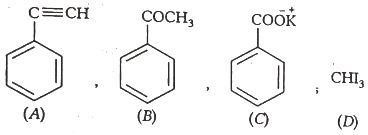
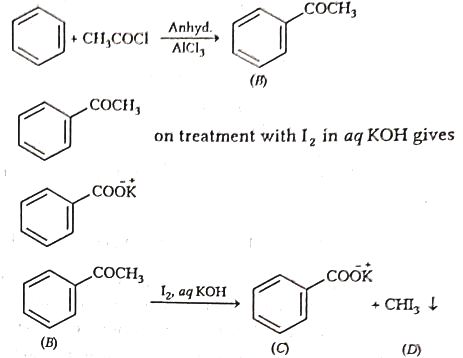
An organic compound 'A' C8H6, on treatment with dilute H2SO4 containing mercuric sulphate gives Compound 'B',This compound 'B' can also be obtaincd from a reaction of benzene vith acetyl chloride in presence of anhy. AlCl3, 'B' on treatment with I2 ín aq KOH gives 'C' and a yellow compound 'D'.
Identify A,B,C and D, Cive the chemícal reactions involved.
6.
(i) How are the following conversions carried out?
(a) Propene -7 Propan-2-ol
(b) Benzyl chloride -7 Benzyl alcohol
(c) Ethyl magnesium chloride -7 Prop an -1-ol
(d) Methyl magnesium bromide -7 2-methyl propan-2-ol.
(ii) Explain why propanol has higher boiling point than that of butane?
7.
An organic compound (A) on treatment with CHCl3 and KOH gives two compounds B and C.Both B and C give the same product (D) when distilled with zinc dust.Oxidation of D gives E having molecular formula C7H6O2.The sodium salt of E on heating with soda-lime gives F which may also be obtained by distilling A with zinc dust.Identify A to F
8.
Write down functional isomers of a carbonyl compound with molecular formula C3H6O. Which isomer will react faster with HCN and why? Explain the mechanism of the reaction also. Will the reaction lead to the completion with the conversion of whole reactant into product at reaction condition. If a strong acid is added to the reaction mixture what will be the effect on concentration of the product and why?
9.
Salicylic acid reacts with Zinc dust on heating to give
Benzene
Benzoic acid
Phenol
None of these
10.
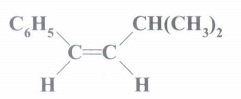
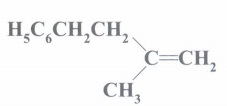
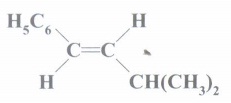
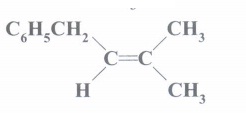
\(\mathrm{C}_{6} \mathrm{H}_{5} \mathrm{CH}_{2} \mathrm{CH}(\mathrm{OH}) \mathrm{CH}\left(\mathrm{CH}_{3}\right)_{2} \stackrel{\text { Conc. } \mathrm{H}_{2} \mathrm{SO}_{4}}{\longrightarrow}\) is
11.
Dipole moment of diethyl ether is lower than that of
CH3OH
C6H5OH
CH3-I
CH3CHO
12.
Trichloroacetaldehyde was subjected to Cannizaro's reaction by using NaOH. The mixture and another products contains sodium trichloroacetate and other compound. The other compound is
trichloromethanol
2,2,2-trichloropropanol
chloroform
2,2,2-trichloromethanol
13.
If the enolate ion combines with the carbonyl group of an ester, we get
aldol
\(\alpha ,\beta\) - unstaurated ester
\(\beta\) - ketoaldehyde
acid
14.
CH3CHO and C6H5CH2 can be distinguished chemically by
Benedict's rect
Iodoform test
Tollens'reagent test
Fehling's solution test
15.
Haloform reaction does not take place with
acetone
2-chloropane
ethanol
methanol
16.
The correct order of basic strength is
H2O<OH-<CH3O-
CH3OH<H2O<CH3O-<OH-
H2O<CH3OH<OH-<CH3O-
OH-H2O<CH3O-<CH3OH
17.
When propionic acid is treated with aqueous sodium bicarbonate, CO2 is liberated. The 'C' of CO2 comes from
methyl group
carboxylic acid group
methylene group
bicarbonate
18.
Chlorination of toluene in presence of light and heat followed by treatment with aqueous NaOH gives :
o-Cresol
p-Cresol
2, 4 - Dihydroxytoluene
Benzoic acid
19.
(i) How can diethyl ether be prepared from the following?
(a) Ethyl iodide (b) Ethyl alcohol
Write the chemical equation in each case.
(ii) Howis ethyl alcohol obtained from molasses?
20.
Explain the following with an example.
(i) Kolbes reaction.
(ii) Reimer-Tiemann reaction.
(iii) Williamson ether synthesis.
(iv) Unsymmetrical ether.
21.
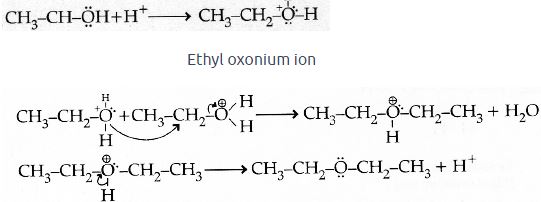
(i) Give mechanism of preparation of ethoxy ethane from ethanol.
(ii) How is toluene obtained from phenol?
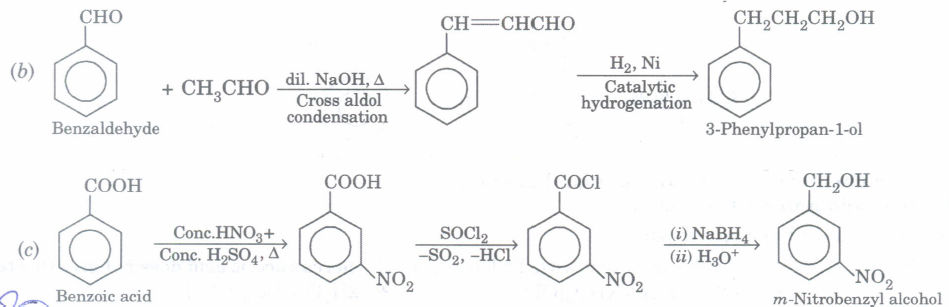
22.
Convert the following:
(a) Bromobenzene to 1-phenylethanol
(b) Benzaldehyde to 3-phenylpropan-1-ol
(c) Benzoic acid to m-Nitrobenzyl alcohol
23.
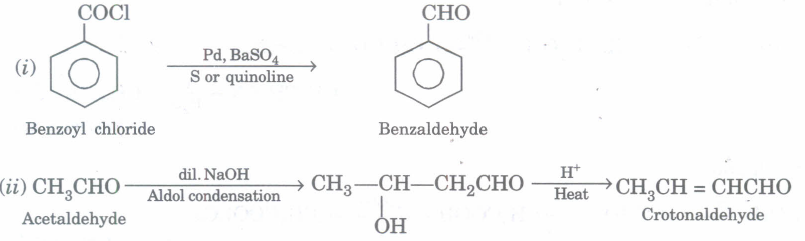
Write the reaction and conditions for the following conversions:
(i) Benzoyl chloride benzaldehyde
(ii) Acetaldehyde to crotonaldehyde
24.
Assertion (A) IUPAC name of the compound

Reason (R) In IUPAC nomenclature, ether is regarded as hydrocarbon derivative in which a hydrogen atom is replaced by -OR or -OAr group [where, R = alkyl group and Ar = aryl group].
(a) Both (A) and (R) are correct, (R) is the correct explanation of (A).
(b) Both (A) and (R) are correct, (R) is not the correct explanation of (A).
(c) (A) is correct; (R) is incorrect.
(d) (A) is incorrect; (R) is correct.
25.
Assertion: Carboxylic acids have higher boiling points than alkanes.
Reason: Carboxylic acids a;e resonance hybrids.
Codes:
(a) Assertion and reason both are correct statements and reason is correct explanation for assertion.
(b) Assertion and reason both are correct statements but reason is not correct explanation for assertion.
(c) Assertion is correct statement but reason is wrong statement.
(d) Assertion is wrong statement but reason is correct statement.
26.
Assertion: Hydrogen bonding in carboxylic acids is stronger than alcohols.
Reason: Highly branched carboxylic acids are more acidic than unbranched acids.
Codes:
(a) Assertion and reason both are correct statements and reason is correct explanation for assertion.
(b) Assertion and reason both are correct statements but reason is not correct explanation for assertion.
(c) Assertion is correct statement but reason is wrong statement.
(d) Assertion is wrong statement but reason is correct statement.
27.
In the following questions. an Assertion (A) is followed by a corresponding Reason (R) Use the following keys to choose the appropriate answer.
Assertion (A) The boiling point of diethyl ether is much less than that of ethanol.
Reason (R) In ethanol, the molecules are associated by the formation of intermolecular hydrogen bonding whereas in diethyl, it is not possible.
Codes:
(a) Both (A) and (R) are correct, (R) is the correct explanation of (A).
(b) Both (A) and (R) are correct, (R) is not the correct explanation of (A).
(c) (A) is correct; (R) is incorrect.
(d) (A) is incorrect; (R) is correct.
28.


29.
Read the passage given below and answer the following questions:
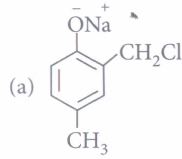
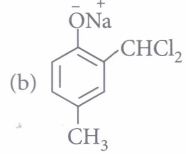
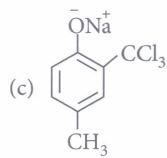
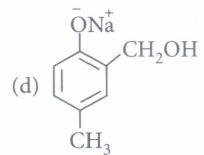
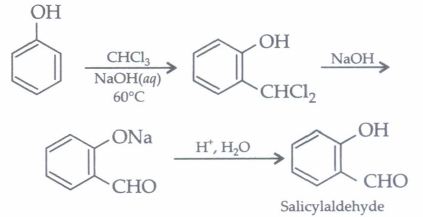
Reimer- Tiemann reaction introduces an aldehyde group, on aromatic ring of phenol, ortho to the hydroxyl group. This is a general method for the synthesis of substituted salicylaldehydes as depicted below.
The following questions are multiple choice questions. Choose the most appropriate answer:
(i) Reimer-Tiemann reaction is an example of
| (a) nucleophilic substitution reaction | (b) electrophilic substitution reaction |
| (c) nucleophilic addition reaction | (d) electrophilic addition reaction |
(ii) Which of the following reagents is used in the given reaction in steps I?
| (a) aq. NaOH + CH3CI | (b) aq. NaOH + CH2Cl2 | (c) aq. NaOH + CHCl3 | (d) aq. NaOH + CCl4 |
(iii) The structure of the intermediate [A] is
 |
 |
 |
 |
(iv) When phenol reacts with chloroform in presence of KOH, the product formed is
| (a) salicylic acid | (b) salicylaldehyde | (c) both (a) and (b) | (d) none of these. |
1.

2.
a. Tertiary butyl ketone does not give precipitate with sodium bisulphate whereas acetone does.
b. Dialkyl cadmium is considered superior to grignard reagent for the preparation of a ketone from an acid chloride.
3.
Both -OH and -OCH3 groups have +Rveffect as shown below:
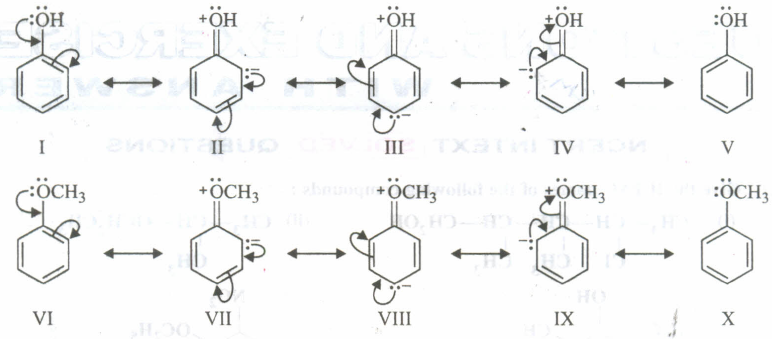
structures (II to IV) involve separation of +ve and -ve charges. Similarly, structures (VII-IX) involve separation of +ve and -ve charges. But structures (II to IV) can stabilize themselves by releasing a proton which is a very stable chemical species.
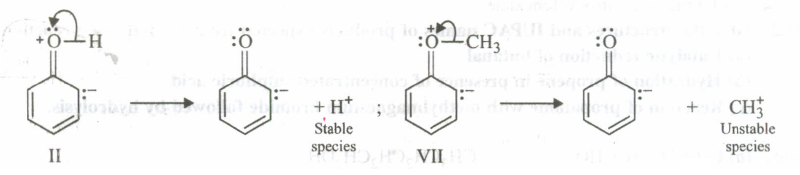
In contrast, structures (VII-IX) cannot stabilize themselves by releasing a methyl carbocation which is a very unstable chemical species. It is because of this extra stability of structures, II-IV through loss of a proton which is responsible for greater reactivity of phenol over anisole. For example, phenol reacts with Br2 water to give 2, 4, 6-tribromophenol but anisole does not react with Br2 water at all.
4.
0.2% solution of phenol is used as antiseptic, 2% solution of phenol is used as disinfectant.
5.
A, B, C and D respectively are
Complete reactions are as follows
C8H6 on reaction with dil. H2SO4, HgSO4 gives
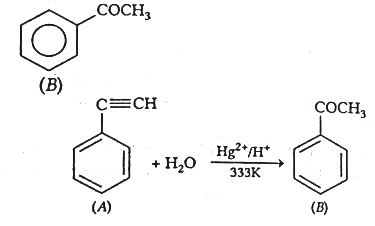
C6H5COCH3 (B) can also be obtained from benzene with acetyl chloride in presence of anhyd. AlCl3.
This reaction is known as Friedel-Crafts acetylation reaction.
6.
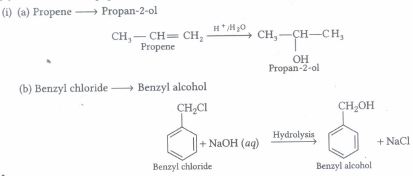


The molecules of butane are held together by weak. van der Waals forces of attraction while those of propanol are held together by stronger intermolecular hydrogen bonding.
\(------\overset { \delta + }{ H } -\overset { \delta - }{ \underset { { | } }{ O } } ----\overset { \delta + }{ H } -\overset { \delta - }{ \underset { | }{ O } } ------\overset { \delta + }{ H } -\overset { \delta - }{ \underset { | }{ O } } -------\)
CH2CH2CH3 CH2CH2CH3 CH2CH2CH3
Therefore, the b.p. of propanol is much higher than that of butane.
7.
(i) Since compound (A) on treatment with CHCI3 and KOH (i.e., Reimer-Tiemann reaction), gives two products Band C, therefore, A must be phenol and Band C must be o-hydroxybenzaldehyde and P: hydroxybenzaldehyde respectively or vice-versa.
(ii) Since both Band C on distillation with Zn dust give the same compound (D), therefore, D must be benzaldehyde.
(iii) Since oxidation of D gives E with M.F. C7R602, therefore, E must be benzoic acid.
(iv) Since sodium salt of E, i.e.benzoic acid upon heating with soda-lime gives compound (F), therefore.
(F) must be benzene. Zn dust distillation of A would also give benzene (F).
8.
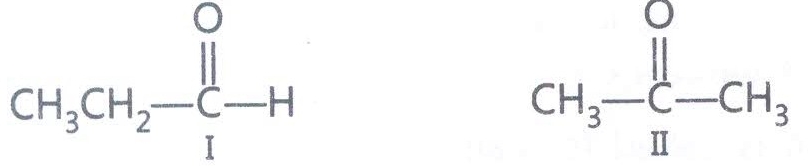
Compound I will react faster with HCN because it is less stearically hindered and has more positive charge on carbonyl compounds.
Mechanism of the reaction:
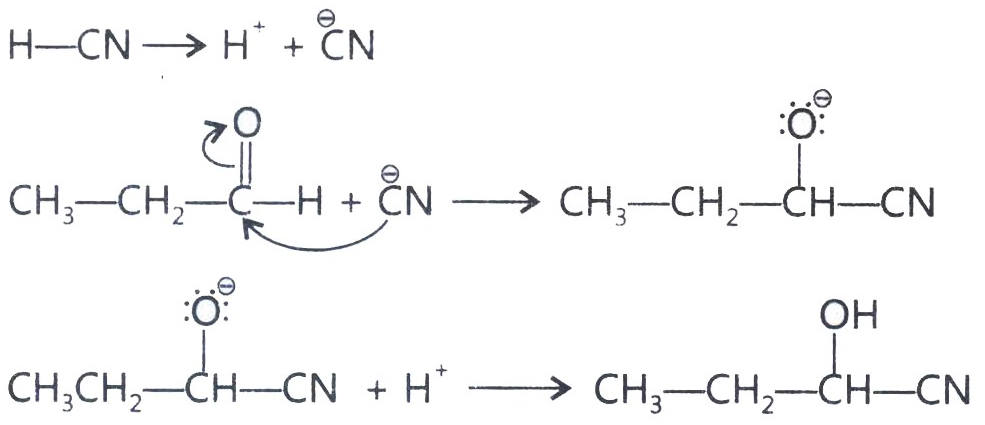
The reaction will not lead to completion.It is reversible reaction, hence equilibrium established.
Addition of strong acid will will inhibit the reaction because dissociation of HCN will be reduced due to common ion effect and formation of CN- is prevented.
9.
(b)
Benzoic acid
10.
(c)
11.
(a)
CH3OH
12.
(d)
2,2,2-trichloromethanol
13.
(c)
\(\beta\) - ketoaldehyde
14.
(b)
Iodoform test
15.
(d)
methanol
16.
(c)
H2O<CH3OH<OH-<CH3O-
17.
(d)
bicarbonate
18.
(d)
Benzoic acid
19.
\(\begin{equation} \mathrm{CH}_{3} \mathrm{CH}_{2} \mathrm{l}+\mathrm{CH}_{3} \mathrm{CH}_{2} \mathrm{OH} \longrightarrow \mathrm{CH}_{3} \mathrm{CH}_{2} \mathrm{OCH}_{2} \mathrm{CH}_{3}+\mathrm{HI} \end{equation}\)
20.
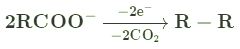
(i) Kolbes reaction.
It is a decarboxylative dimerisation of two carboxylic acids (or carboxylate ions) to form carbon carbon bond of alkane.
(ii) Reimer-Tiemann reaction.
It involves the ortho-formylation of phenols. Phenol is converted to salicylaldehyde.

(iii) Williamson ether synthesis.
Sodium alkoxide reacts with alkyl halide to form an ether.
\(\mathbf{C}_{2} \mathrm{H}_{5} \mathrm{ONa}+\mathrm{C}_{2} \mathrm{H}_{5} \mathrm{Cl} \rightarrow \mathrm{C}_{2} \mathrm{H}_{5}-\mathrm{O}-\mathrm{C}_{2} \mathrm{H}_{5}+\mathrm{NaCl}\)
(iv) Unsymmetrical ether.
Two different alkyl groups are attached to O atom. The general formula is R−O−R′. An example is ethyl methyl ether
\(\mathrm{CH}_{3}-\mathrm{CH}_{2}-\mathrm{O}-\mathrm{CH}_{3}\)
21.
22.

23.
24.
(d) (A) is incorrect statement but (R) is correct statement, Correct (A) The IUPAC name of the given compound is 1-(2-propoxy) propane.
25.
(b): Boiling points of carboxylic acids are higher due to th.eir tendency to associate and form dimers to a greater extent by hydrogen bonding.
26.
(c): Highly branched carboxylic acids are less acidic than unbranched acids. The +I effect of alkyl groups in branched acid increases the magnitude of negative charge. Thus, -COOH group is shielded from solvent molecules and cannot be stabilized by solvation as effectively as in unbranched carboxylic acids.
27.
(a) Both (A) and (R) are correct and (R) is the correct explanation of (A).
28.
29.
(i) (b): It is an electrophilic substitution reaction.
(ii) (c)
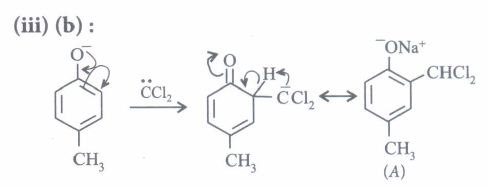
(iv) (b): It is known as Reimer-Tiemann reaction.

12th Standard CBSE Syllabus & Materials
12th Standard CBSE
CBSE 12th Computer Science Python Revision Tour I - New Previous year Question Papers Study Material - QB365 Set A
NEW12th Standard CBSE
CBSE 12th Business Studies Planning Important Questions And Answers Study Material - QB365 Set A
NEW12th Standard CBSE
CBSE 12th Business Studies Business Environment Important Questions And Answers Study Material - QB365 Set A
NEW12th Standard CBSE
CBSE 12th Business Studies Principles of Management Important Questions And Answers Study Material - QB365 Set A



NCERT Books

Syllabus

Exam Pattern

Sample Question Papers

Previous year Question Papers

Important Notes

MCQ Practice test

NCERT Exemplers

Case study Questions

Image Based Questions

Passage based Questions

HOT Questions

Value Based Questions

Model Questions Papers
NCERT ( Book Back ) Questions

Assertion and Reason
Important Questions And Answers

CBSE 12th Standard CBSE Subjects
CBSE Standards








