
 100% FREE ACCESS
12th Standard CBSE Syllabus & Materials
12th Standard CBSE
CBSE 12th Economics Government Budget and the Economy Previous year Question Papers Study Material - QB365 Set A
NEW12th Standard CBSE
CBSE 12th Computer Science Interface Python with MySQL - New Previous year Question Papers Study Material - QB365 Set A
NEW12th Standard CBSE
CBSE 12th Computer Science Database Concept - New Previous year Question Papers Study Material - QB365 Set A
NEW12th Standard CBSE
CBSE 12th Computer Science Data Communication - New Previous year Question Papers Study Material - QB365 Set A
NEW12th Standard CBSE
CBSE 12th Computer Science Data Structures - New Previous year Question Papers Study Material - QB365 Set A
NEW12th Standard CBSE
CBSE 12th Computer Science Functions - New Previous year Question Papers Study Material - QB365 Set A

Published on: 02/11/2025
Download CBSE Class 12th Standard CBSE Chemistry question papers, sample papers, important questions, and previous year solved papers in PDF format. Get free study materials, NCERT solutions, and exam preparation resources for Class 12th Standard CBSE Chemistry
Questions + Answers key
Take MCQ Chemistry Test
1.
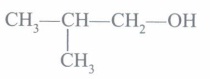
Show how you will synthesise the following alcohol prepared by reaction of a suitable Grignard reagent on methanal?

2.
Suggest one method for carrying out anti-Markovinkov's addition of water indirectly to propylene
3.
Suggest a possible reason for the following observations:
(i) The order of reactivity of haloalkanes is RI > RCI > RBr.
(ii) Neopentyl chloride (CH3)3CCH2CI does not follow SN2 mechanism.
(iii) Ethers have low boiling points.
4.
A hydrocarbon \(C_5H_{12}\) gives only one mono-chlorinated product. Identify the hydrocarbon.
5.
How ethyl chloride is converted to ethanal?
6.
Write one physiological and environmental effect for each of the following
(i) Tetrachloromethane
(ii) DDT
7.
a. R—Cl is hydrolysed to R—OH slowly but the reaction is rapid if a catalytic amount of KI is added to the reaction mixture.
b. What is formed if cylcopentanone is reduced with H2 /Pt . Give equation for the reaction.
8.
How would you distinguish between \({ S }_{ N }1\) and \({ S }_{ N }2\) mechanisms of substitution reactions? Give one example of each.
9.
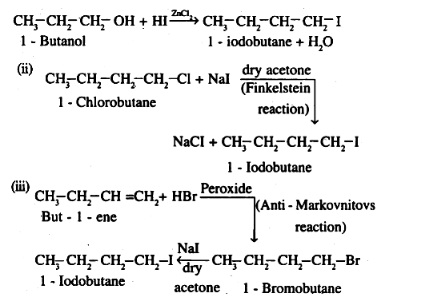
Write the equations for the preparation of 1-iodobutane from:
(a) 1-iodobutane from:
(b) 1-butanol
(c) but-1-ene.
10.
Mark the correct increasing order of reactivity of the following compounds with HBr/HCI.
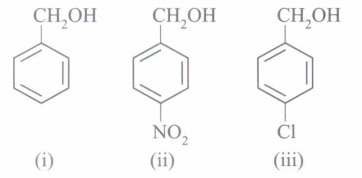
(i) < (ii) < (iii)
(ii) < (i) < (iii)
(ii) < (iii) < (i)
(iii) < (ii) < (i)
11.
Select the strongest acid among the following compounds.
FCH2CH2CH2OH
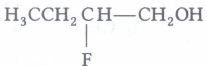
CH3CH2CF2CH2OH
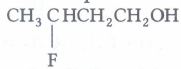
12.
Phenols show the cleavage of C-O bond with
Na
K
Zn
Ca
13.
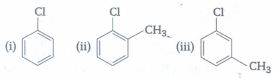
(i) < (ii) < (iii)
(i) < (iii) < (ii)
(iii) < (ii) < (i)
(ii) < (iii) < (i)
14.
Which of the following compounds is resistant to nucleophilic attack y hydroxyl ions?
Methyl acetate
Acetonitrile
Acetamide
Diethyl ether
15.
The reagents used in the preparation DDT from chlorobenzene are
Chloral (CCI3CHO)
Conc.II2SO4
CH3COCCI3
CH2CICOCH2CI
16.
Which of the following compounds can be classified as aryl halides?
p-ClC6H4CH2CH(CH3)2
p-CH3CHCl(C6H4)CH2CH3
o-BrH2C-C6H4CH(CH3)CH2CH3
C6H5-Cl
17.
Which of the following is an example of vic-dihalide?
Dichloromethane
1,2 Dichloroethane
Ethylidene chloride
Allyl chloride
18.
Which one is most reactive towards SN1 reaction ?
C6H5CH2Br
C6H5CH(C6H5)Br
C6H5CH(CH3)Br
C6H5C(CH3)(C6H5)Br
19.
Phenol reacts with bromine in CS2 to give
o-bromophenol
m-bromophenol
o-and p-bromophenol
2, 4, 6-tribromophenol
20.
Some halogen containing compounds are useful in daily life. Some compounds of this class are responsible for exposure of flora and fauna to more and more of UV light which causes destruction to a great extent. Name the class of these halo compounds. In your opinion, what should be done to minimise harmful effects of these compounds.
21.
An organic compound (A) with molecular formula C6H6O gives a characteristic colour with aqueous FeCl3 solution. When (A) is treated with CO2 and NaOH at 410K under pressure, it gives compound (B) which upon acidification gives compound (C). Compound (C) reacts with acetyl chloride to give (D) which is a popular pain killer, Deduce the structures of (A), (B), (C) and (D) and explain all the reactions involved.
22.
Although both allyl alcohol and 1-propanol are primary alcohols,they can still be distinguished by Lucas reagent. Explain how?
23.
Wurtz reaction falils in case of tert-alkyl halides. Explain.
24.
Assertion: o-Nitrophenol is less soluble in water than the m- and p-isomers.
Reason: m- and p-Nitrophenols exist as associated molecules.
Codes:
A) Assertion and reason both are correct and reason is correct explanation of assertion.
B) Both assertion and reason are correct statements but reason is not correct explanation of assertion.
C) Assertion is correct statement but reason is wrong statement.
D) Assertion is wrong statement but reason is correct statement.
25.
26.
Assertion: o-Nitrophenol is more volatile than p-nitrophenol.
Reason: Intramolecular hydrogen bonding is present in o-nitrophenol while intermolecular H-bonding is in p-nitrophenol.
Codes:
(a) Assertion and reason both are correct statements and reason is correct explanation for assertion.
(b) Assertion and reason both are correct statements but reason is not correct explanation for assertion.
(c) Assertion is correct statement but reason is wrong statement.
(d) Assertion is wrong statement but reason is correct statement.
27.
In the following questions. an Assertion (A) is followed by a corresponding Reason (R) Use the following keys to choose the appropriate answer.
Assertion (A) SN1 mechanism is ruled out in case of haloarene.
Reason (R) Phenyl cation is formed as a result of self ionisation which is not stabilised by resonance.
Codes:
(a) Both (A) and (R) are correct, (R) is the correct explanation of (A).
(b) Both (A) and (R) are correct, (R) is not the correct explanation of (A).
(c) (A) is correct; (R) is incorrect.
(d) (A) is incorrect; (R) is correct.
28.
Read the passage given below and answer the following questions:
Williamson's synthesis is used for the preparation of symmetrical as well as unsymmerical ether. It is SN2 reaction mechanism. In Williamson's synthesis, 1° alkyl halide are used for preparation of ethers because 2° and 3°alkyl halide give alkene: Ethers are cleaved by hydrogen halides to alcohol and alkyl halide where alkyl halide is corresponding to that alkyl which has less number of carbon atom (it is because ofless steric hindrance). In polar media unsymmetrical ether like tertiary butyl ethyl ether gives ethyl alcohol and tertiary butyl halide as reaction proceeds via carbocation.
In these questions (i-iv), a statement of assertion followed by a statement of reason is given. Choose the correct answer out of the following choices.
(a) Assertion and reason both are correct statements and reason is correct explanation for assertion.
(b) Assertion and reason both are correct statements but reason is not correct explanation for assertion.
(c) Assertion is correct statement but reason is wrong statement.
(d) Assertion is wrong statement but reason is correct statement.
(i) Assertion: Rate of reaction of alkyl halide in Williamson's synthesis reaction is 1°RX> 2°RX > 3°RX.
Reason: It is a type of bimolecular substitution reaction (SN2).
(ii) Assertion: t-Butyl methyl ether is not prepared by the reaction of t-butyl bromide with sodium methoxide.
Reason: Sodium methoxide is a weak nucleophile.
(iii) Assertion: When isopropyl bromide is treated with sodium isopropoxide, di-isopropyl ether is obtained as a major product. .
Reason: With secondary alkyl halides, both substitution and elimination occur.
(iv) Assertion: Both symmetrical arid unsymmetrical ethers can be prepared by Williamson's synthesis.
Reason: Williamson's synthesis is an example of nucleophilic substitution reaction.
29.
Read the passage given below and a.9swer the following questions:
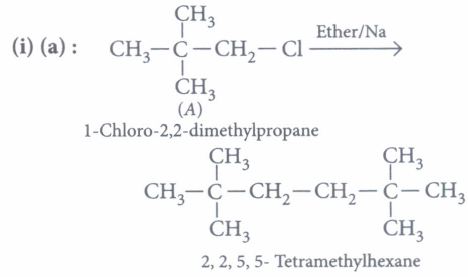
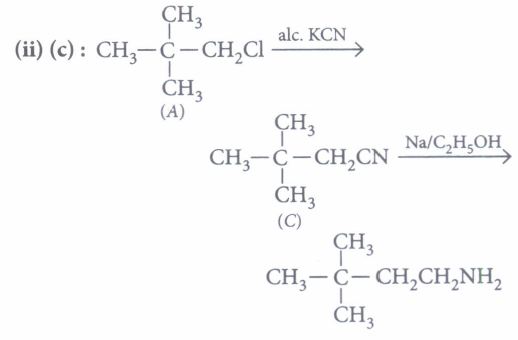
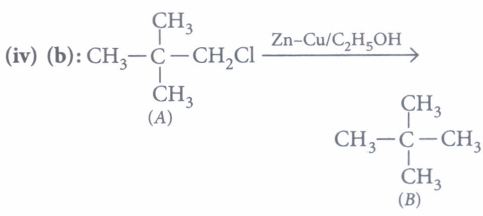
A chlorocompound (A) on reduction with Zn-Cu and ethanol gives the hydrocarbon (B) with five carbon atoms. When (A) is dissolved in dry ether and treated with sodium metal it gave 2,2,5,5 tetramethylhexane. The treatment of (A) with alcoholic KCN gives compound (C).
The following questions are multiple choice questions. Choose the most appropriate answer:
(i) The compound (A) is
| (a) 1-chloro- 2, 2-dimethylpropane | (b) 1-chloro- 2, 2-dimethyl butane |
| (c) 1-chloro-2-methyl butane | (d) 2-chloro-2-methyl butane. |
(ii) The reaction of (C) with Na, C2H5OH gives
| (a) (CH3)3C CH2CONH2 | (b) (CH3)3C NH2 |
| (c) (CH)3C CH2CH2NH2 | (d) (CH3)2CHCH2NH2 |
(iii) The reaction of (C) with Na, C2H5OH is called
| (a) Gilman reaction | (b) Mendius reaction |
| (c) Grooves process | (d) Swart's reaction. |
(iv) Compound (B) is
| (a) n-pentane | (b) 2, 2-dimethylpropane |
| (c) 2-methylbutane | (d) none of these. |
1.
.PNG)
.PNG)
2.
Hydroboration-oxidation gives alcohols which correspond to anti-Markovnikov's addition of H2O to alkenes.
\(\\ 6{ C }H_{ 3 }\underset { Propene }{ { C }H={ C }H_{ 2 } } \underset { (Hydroboration) }{ \overset { H_{ 2 }/Ni }{ \longrightarrow } } 2({ C }H_{ 3 }{ C }H_{ 2 }{ C }H_{ 2 }{ ) }_{ 3 }B\underset { (Oxidation) }{ \overset { H_{ 2 }O_{ 2 }-NaOH }{ \longrightarrow } } 6{ C }H_{ 3 }\underset { Propan-1-ol }{ { { C }H_{ 2 }C }H_{ 2 }OH } \)
3.
(i) It is because of lower bond dissociation energy in the case of \({ R }^{ \_ \_ \_ }{ I }\) than \({ R }^{ \_ \_ \_ }{ Cl }\). \({ R }^{ \_ \_ \_ }{ Cl }\) is more polar than \({ R }^{ \_ \_ \_ }{ Br }\) , therefore, more reactive.
(ii) It is because it forms stable carbocation, therefore , follows SN 1 mechanism.

(iii) Ethers are not associated with H-bonding and have weak van der Waal's forces of attraction, hence they have low boiling point.
4.
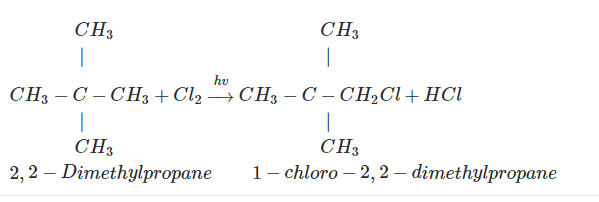
5.
Ethyl chloride to ethanal
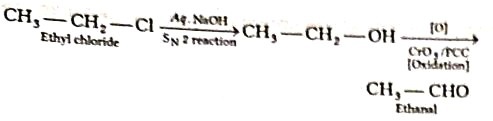
6.
i. Tetrachloromethane:
1. Physiological effect = Damages to liver and kidneys.
2. Environmental = Manufacture of lava lamps.
ii. DDT
1. Physiological = Vomiting, tremors, or shakiness.
2. Environmental = Great accumulation in water and threat to aquatic life
7.
Iodide ion is a powerful nucleophile and hence reacts rapidly with RCl to form RI.
KI ——— K+ + I-; R — Cl + I- ——— R — I + Cl-
Further I- is a better leaving group than CI- ion, therefore, RI is more rapidly hydrolysed than RCl to form ROH.
HO- + R — I ——— R — OH + I-
8.
(I) Unimolecular nucleophilic substitution reaction (SN1): Those substitution reactions in which rate of reaction depends upon the concentration of only one of the reactants, i.e. alkyl halides are called SN1 reactions, e.g. hydrolysis of tertiary butyl chloride follows SN1 reaction. This reaction takes place in two steps. The first step involves formation of carbocation.
The slowest step is rate determining step which involves one species only. Therefore, the rate of reaction depends only on the concentration of tertiary butyl chloride. Tertiary halides follow SN1 mechanism. Polar protic solvents like 'fater and alcohol favour SN1 because they stabilize carbocation by solvation.
(ii) Bimolecular nucleophilic substitution reaction (SN2): The reaction whose rate depends on the concentration of two species, alkyl halide and nucleophile. They involve one step mechanism. Back side attack of nucleophile and departing of leaving group take place simultaneously.
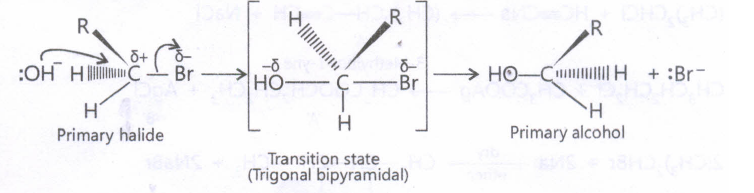
Non-polar solvents favour SN2 mechanism. Primary halides follow SN2 mechanism.
9.
(i) 1-butanol
10.
(c)
(ii) < (iii) < (i)
11.
(c)
CH3CH2CF2CH2OH
12.
(c)
Zn
13.
(d)
(ii) < (iii) < (i)
14.
(d)
Diethyl ether
15.
(a)
Chloral (CCI3CHO)
16.
(a)
p-ClC6H4CH2CH(CH3)2
17.
(b)
1,2 Dichloroethane
18.
(d)
C6H5C(CH3)(C6H5)Br
19.
(c)
o-and p-bromophenol
20.
CFC (chlorofluoro carbons) are responsible for the destruction of ozone layer and UV light can reach earth which may cause skin cancer and affect flora and fauna.
These compounds should be banned and their use should be made to minimum extent.
21.
(i) Since compound (A) with M.F. C6H6O gives characteristic colour with FeCI3, therefore, (A) must be phenol.
(ii) Since compound (A), i.e., phenol reacts with CO2 and NaOR under pressure (i.e., Kolbe's reaction) to give compound (B) which on acidification gives compound (C), therefore, (B) must be sodium salicylate and (C) must be salicylic acid.
(iii) Since (C) reacts with acetyl chloride to form a popular pain killer (D), therefore, (D) must be aspirin.
22.
The allyl carbocation is resonance stabilized and hence is as stable as a 30 carbocation
Therefore, on treatment with Lucas reagent, allyl alcohol gives white turbidity in less than 1 min.l-Propanol, on the other hand, does not react with Lucas reagent.
.JPG)
23.
tert-Alkyl halides prefer to undergo dehydrohalogenation in presence of a strong base such as Na metal instead of undergoing Wurtz reaction as explained below:
\(\underset{tert-Butyl\ bromide}{(CH_3)_3C-Br}+2Na\longrightarrow\underset{tert-Butylsodium}{(CH_3)_3Na^+}+Na^+Br^-\)
Thus, only rand 2° alkyl halides undergo Wurtz reaction while 3° alkyl halides prefer to undergo dehydrohalogenation to form alkenes.
24.
B) Both assertion and reason are correct statements but reason is not correct explanation of assertion.
Explanation:
Intra-molecular hydrogen bonding in o-nitrophenol makes it less soluble in water as compared to m - and p-nitrophenol.
25.
26.
(a) Assertion and reason both are correct statements and reason is correct explanation for assertion.
27.
(a) In case of haloarenes, the phenyl cation formed as a result of self ionisation will not be stabilised by resonance and therefore SN1 mechanism is ruled out. Thus, both (A) and (R) are correct and (R) is correct explanation of (A).
28.
(i) (a): Williamson's synthesis occurs by SN2 mechanism and primary alkyl halides are most reactive in SN2 reactions.
(ii) (c): Sodium methoxide is a strong nucleophile. In presence of a strong base, i.e., sodium methoxide, t-butyl bromide undergoes dehyrohalogenation to form isobutylene.
(iii) (d): Since secondary and tertiary alkyl halides prefer to undergo elimination rather than substitution, therefore, even symmetrical ethers containing secondary and tertiary alkyl groups cannot be prepared in good yields by Williamson synthesis.
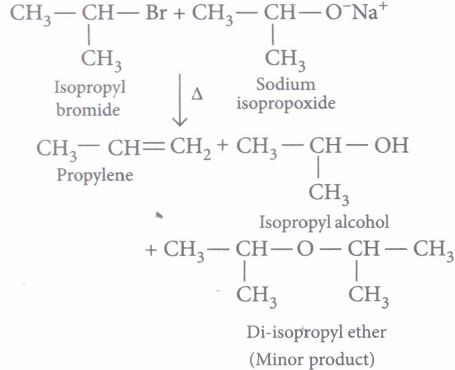
(iv) (b): Depending upon whether the alkyl halide and the alkoxide ion carry the same or different alkyl groups, both symmetrical and unsymmetrical ethers can be prepared by Williamsons synthesis.
29.
(iii) (b)

12th Standard CBSE Syllabus & Materials
12th Standard CBSE
CBSE 12th Computer Science Python Revision Tour I - New Previous year Question Papers Study Material - QB365 Set A
NEW12th Standard CBSE
CBSE 12th Business Studies Planning Important Questions And Answers Study Material - QB365 Set A
NEW12th Standard CBSE
CBSE 12th Business Studies Business Environment Important Questions And Answers Study Material - QB365 Set A
NEW12th Standard CBSE
CBSE 12th Business Studies Principles of Management Important Questions And Answers Study Material - QB365 Set A



NCERT Books

Syllabus

Exam Pattern

Sample Question Papers

Previous year Question Papers

Important Notes

MCQ Practice test

NCERT Exemplers

Case study Questions

Image Based Questions

Passage based Questions

HOT Questions

Value Based Questions

Model Questions Papers
NCERT ( Book Back ) Questions

Assertion and Reason
Important Questions And Answers

CBSE 12th Standard CBSE Subjects
CBSE Standards








