
 100% FREE ACCESS
12th Standard CBSE Syllabus & Materials
12th Standard CBSE
CBSE 12th Economics Government Budget and the Economy Previous year Question Papers Study Material - QB365 Set A
NEW12th Standard CBSE
CBSE 12th Computer Science Interface Python with MySQL - New Previous year Question Papers Study Material - QB365 Set A
NEW12th Standard CBSE
CBSE 12th Computer Science Database Concept - New Previous year Question Papers Study Material - QB365 Set A
NEW12th Standard CBSE
CBSE 12th Computer Science Data Communication - New Previous year Question Papers Study Material - QB365 Set A
NEW12th Standard CBSE
CBSE 12th Computer Science Data Structures - New Previous year Question Papers Study Material - QB365 Set A
NEW12th Standard CBSE
CBSE 12th Computer Science Functions - New Previous year Question Papers Study Material - QB365 Set A

Published on: 02/11/2025
Download CBSE Class 12th Standard CBSE Chemistry question papers, sample papers, important questions, and previous year solved papers in PDF format. Get free study materials, NCERT solutions, and exam preparation resources for Class 12th Standard CBSE Chemistry
Questions + Answers key
Take MCQ Chemistry Test
1.
Rusting of iron is quicker in saline water than in ordinary water. Give reason.
2.
Give simple chemical tests to distinguish between the following pairs of compounds.
(i) Pentan-2-one and Pentan-3-one
(ii) Ethanal and Propanal
3.
Compare the strength of following acids:
(i) Formic acid,
(ii) Acetic acid,
(iii) Benzoic acid.
4.
How many Faradays of charge are required to convert:
1 mole of \({ MnO }_{ 4 }^{ - }\) to Mn2+ ion,
5.
What are the products obtained during electrolysis of CuSO4 using Pt electrode?
6.
What are the signs of \(\Delta G,K\) and \({ E° }_{ cell }\) for a spontaneous cell reaction?
7.
Name the following compounds according to IUPAC system of nomenclature:
(i) CH3CH2COCH(C2H5)CH2CH2Cl
(ii) CH3COCH2COCH3
(iii) (CH3)3CCH2COOH
8.
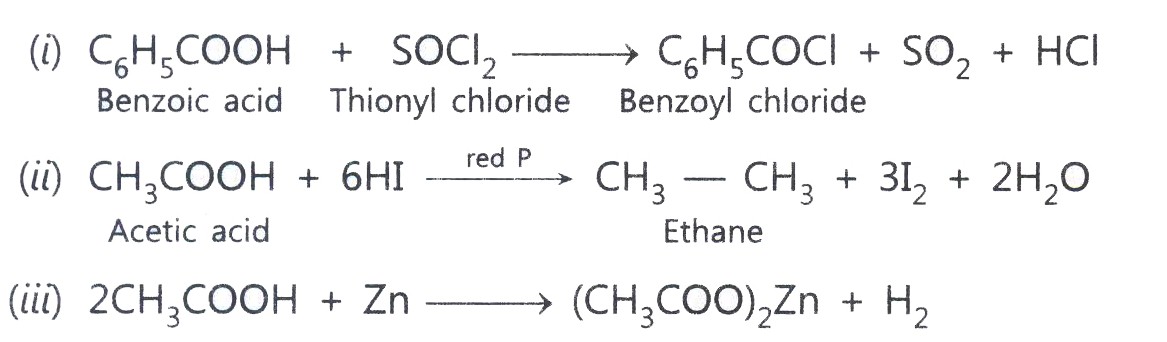
Write balanced chemical equations for the following reactions:
(i) Thionyl chloride reacts with benzoic acid
(ii) Acetic acid is reacted with red phosphorus and HI
(iii) Acetic acid is treated with Zn metal.
9.
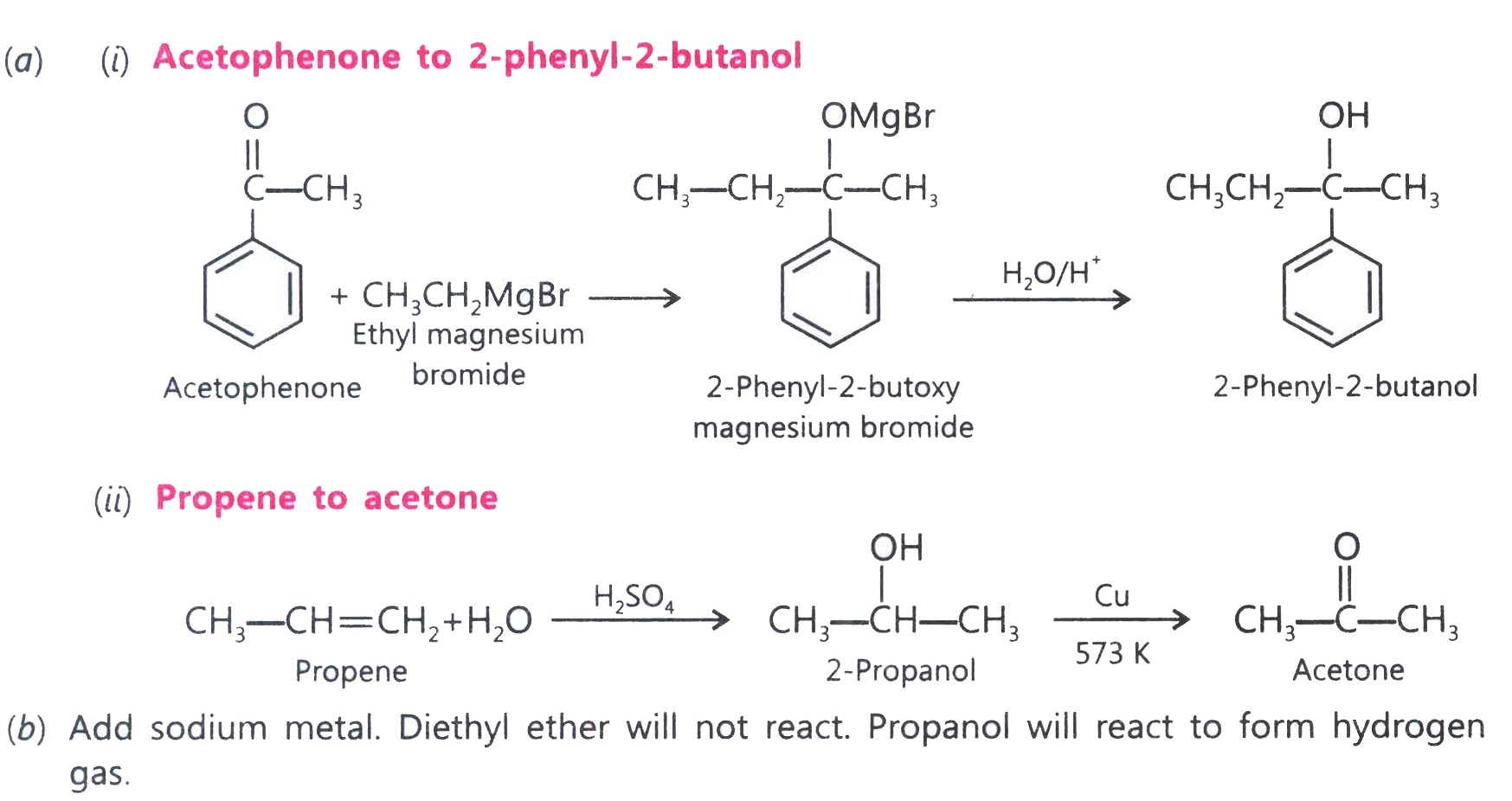
(a) Write the step and conditions involved in the following conversions:
(i) Acetophenone to 2-phenyl-2-butanol
(ii) Propene to acetone
(b) Describe simple chemical tests to distinguish between the following pairs of compounds:
Diethyl ether and Propanol
10.
How long will it take an electric current of 0.15 A to deposit all the copper from 500 ml of 0.15 M copper sulphate solution?
11.
(i) What is limiting molar conductivity? Why there is steep rise in the molar conductivity of a weak electrolyte on dilution?
(ii) Calculate the emf of the following cell at 298K:
Mg(s) I Mg2+(0.1M)|| Cu2+(1.0 X 10⁻³ M) I Cu(s) [Given= Eocell = 2.71 V ]
12.
Calculate the standard electrode potential of Ni2+ II Ni electrode if emf of the cell, Ni (s)1 Ni2+(0.01M) IICu2+(0.1 M) ICu(s) is 0.059 V. (Given \(E^{ 0 }_{ cu2+/cu }=+0.34V)\)
13.
Rahul visited the house of his friend Shyam and found that all the water taps were rusted. On enquiry, he came to know that these were iron taps. Rahul advised his friend to use either chrome plated or nickel plated taps. Shyam accepted his advice.
On the basis of above passage give the answer of following questions.
(i) Why did iron tap get rusted?
(ii) What was the purpose of chrome plating or nickel plating?
(iii) What is the value associated with this?
14.
An organic compound (A) on treatment with ethyl alcohol gives a carboxylic acid (B) and compound (C). Hydrolysis of (C) under acidified conditions gives (B) and (D). Oxidation of (D) with KMnO4 also gives (B). (B) on heating with Ca(OH)2 gives (E) having moleuclar formula C3H6O. (E) does not give TOllens'test and does not reduce Fehiling's solution but forms 2, 4-dinitrophenyhydrazone. Identify (A),(B),(C),(D) and (E).
15.
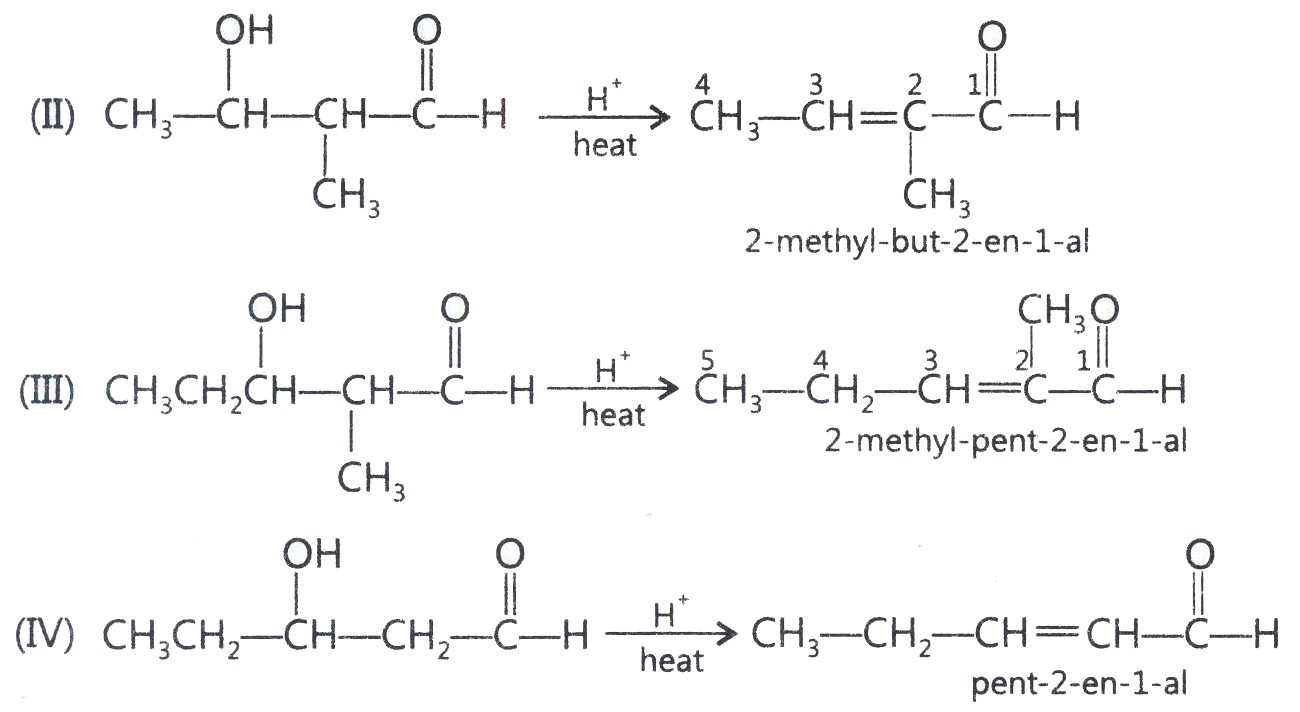
Describe the following reactions
(i) Cannizzaro's reactions.
(ii) Cross aldol condensation
16.
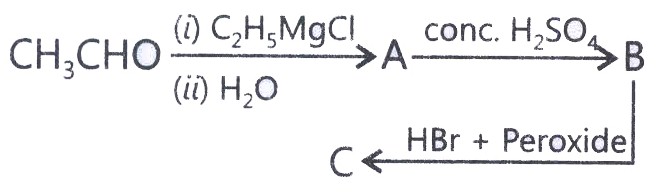
(a) Identify A, B and C in the following sequence of reactions:
(b) Predict the structures of the products formed when benzaldehyde is treated with
(i) conc. NaOH
(ii) HNO3 / H2SO4 (at 273 - 383 k)
17.
Two electrolytes X and Yare diluted. Λm of Y increases 1.5 times and for X it increases 25 times. Predict the strong electrolyte among X and Y.
X
Y
Both (a) and (b)
There is no effect of dilution on nature of electrolyte.
18.
A carbonyl compound reacts with hydrogen cyanic to form a cyanhydrin which on hydrolysis forms a racemic mixture of \(\alpha\) -hydroxy acid. The carbonyl compound is
formaldehyde
acetaldheyde
acetone
diethyl ketone
19.
The compound that does not undergo Cannizzaro reaction is
formaldehyde
acetaldehyde
benzaldehyde
trimethylacetaldehyde
20.
For the cell, TI | TI+ (0.001 M) | Cu2+ (0.1 M) | Cu, Ecell at 25°C is 0.83 V. This can be increased
by increasing [Cu2+]
by increasing [TI+]
by decreasing [Cu2+]
by decreasing [TI+]
21.
The positive value of the standard electrode potential of Cu2+ /Cu indicates that ___________________.
this redox couple is a stronger reducing agent than the H+ /H2 couple.
this redox couple is a stronger oxidising agent than the H+ /H2
Cu can displace H2 from acid
Cu cannot displace H2 from acid
1.
In saline water, the presence of Na+ and Cl- ions increases the conductance of the solution in contact with the metal surface. This accelerates the formation of Fe2+ ion and hence that of rust, Fe2O3 x H2O.
2.
(i) Add I2 and NaOH. P-2- one will give yellow ppt of iodoform, whereas pentan-3- one will not react.
(ii) Add I2 and NaOH. Ethanal will yellow precicipate of iodoform, whereas proponal does not react.
3.
HCOOH > C6H5COOH > CH3COOH
4.
\(\mathrm{MnO}_4^{-} \rightarrow \mathrm{Mn}^{2+}, \mathrm{Mn}^{7+}+5 e^{-} \rightarrow \mathrm{Mn}^{2+} \mathrm{MnO}_4^{-}+5 e^{-}+8 \mathrm{H}^{+} \rightarrow \mathrm{Mn}^{2+}+4 \mathrm{H}_2 \mathrm{O} \text { i.e. }\) when 1 mole of \(\mathrm{MnO}_4^{-} \text {changes to } \mathrm{Mn}^{2+}\) 5 Faradays of charge is required.
5.
\(\mathrm{CuSO}_4 \rightarrow \mathrm{Cu}^{2+}+\mathrm{SO}_4^{2-}\)
\(
\mathrm{H}_2 \mathrm{O} \rightarrow \mathrm{H}^{+}+\mathrm{OH}^{-}
\)
\( \mathrm{Cu}^{2+}+2 e^{-} \rightarrow \mathrm{Cu}(\mathrm{s}) , At\ anode 2 \mathrm{OH}^{-} \rightarrow \mathrm{O}_2+4 \mathrm{H}^{+}+4 e^{-} or 2 \mathrm{H}_2 \mathrm{O} \rightarrow \mathrm{O}_2+4 \mathrm{H}^{+}+4 e^{-}\)
Copper is formed at cathode and oxygen gas is liberated at anode
6.
\(\Delta G=\_ ve,K=+ve,{ E° }_{ cell }=+ve\)
7.
(i) 6-Chloro-4-ethylhexan-3-one
(ii) Pentane-2, 4-dione
(iii) 3, 3-Dimethylbutanoic acid
8.
9.
10.
500 ml of 0.15 M CuSO4 solution contains \(\frac { 500\times 0.15 }{ 1000 } \)
Mass of Cu = 0.075 x 63.5 = 4.7625 g; Eq. wt. of Cu2+ =\(\frac{63.5}{2}\)=31.75
m = Z \(\times\) l \(\times\) t
4.7625 = \(\frac{31.75}{96500}\)\(\times\)0.15 \(\times\) t
t= \(\frac { 4.7625\times 96500 }{ 31.75\times 0.15 } \) = 96500 sec = \(\frac { 96500 }{ 60\times 60 } \) = 26.80 hours.
11.
(i) When concentration approaches zero, the molar conductivity is known as limiting molar conductivity.
The change in Λm with dilution is due to the increase in the degree of dissociation and consequently the number of ions in the total volume of the solution that contains 1 mol of electrolyte, hence Λm increases steeply.
(ii) \(E_{\text {cell }} =E_{\text {cell }}^{\circ}-\frac{0.059}{n} \log \frac{\left[\mathrm{Mg}^{2+}\right]}{\left[\mathrm{Cu}^{2+}\right]} \)
\(=2.71 \mathrm{~V}-\frac{0.059}{2} \log \frac{0.1}{0.001} \)
\(=2.71 \mathrm{~V}-\frac{0.059}{2} \log 10^{2}=2.651 \mathrm{~V} \)
12.
(i) First, find E0cell
(ii) Then find \(E^{ 0 }_{ anode }\) by using the formula
\(E^{ 0 }_{ cell }=E^{ 0 }-_{ cathode }E^{ 0 }_{ anode }\)
Given Ecell = 0.059V; E0cu2+/cu = +0.34V
[Ni2+] = 0.01M and [cu2+] = 0.1M
Ecell = E0cell - \(\frac { 0.059 }{ 2 } log\frac { \left[ Ni^{ 2+ }(aq) \right] }{ \left[ Cu^{ 2+ }(aq) \right] } \)
\(0.059=E^{ 0 }_{ cell }-\frac { 0.059 }{ 2 } log\frac { \left( 0.01 \right) }{ 0.1 } \left( \because n=2 \right) \)
\(0.059=E^{ 0 }_{ cell }-\frac { 0.059 }{ 2 } log\frac { 1 }{ 10 } \left[ \because log10^{ -1 }=-1 \right] \)
\(\because 0.059=E^{ 0 }_{ cell }+0.0295 \times 1\)
\(E^{ 0 }_{ cell }=0.059-0.0295\)
= 0.0295 V = 0.03 V
\(E^{ 0 }_{ cell }=E^{ 0 }_{ cathode }E^{ 0 }_{ anode }\)
0.03 = 0.34 - E0anode
or \(E^{ 0 }_{ anode }=E^{ 0 }_{ Ni2+/Ni }=0.34-0.03\)
= 0.31 V
13.
(i) Iron is p e to rust. It gets rusted when kept in open because it gets oxides in presence air and moisture.
(ii) The purpose of depositing a layer of chromium or nickel on the surface of iron is to check rusting. These metals are not affected by air or moisture.
(iii) (a) General awareness
(b) Friendship
(c) Skill of applying knowledge of chemistry
14.
(i) Since compound (E) with molecular formula, C3H60 does not reduce Tollens' reagent and Fehling's solution but forms 2, 4-dinitrophenylhydrazone, it must be a ketone. But the only possible ketone having the molecular formula, C3H6O is acetone or propanone. Thus, compound (E) is acetone or (propanone) CH3COCH3·
(ii) Since acetone (E) is obtained by heating compound (8) with Ca(OH)2 therefore, (B) must be acetic acid (ethanoic acid), CH3COOH.
(iii) Since (D) on oxidation with KMn04 gives acetic acid (8), therefore, (D) must be ethyl alcohol (ethanol), CH3CH2OH.
(iv) Since acetic acid (8) and ethyl alcohol (D) are obtained by hydrolysis of (C) under acidic conditions, therefore, (C) must be ethyl acetate (ethyl ethanoate), CH3COOC2H5
(v) Since ethyl acetate (C) and acetic acid (8) are obtained by treatment of compound (A) with ethyl alcohol, therefore, compound (A) must be acetic anhydride (ethanoic anhydride), (CH3COO)2O.
(vi) All the reactions involved in this problem can now be explained as follows
15.
16.
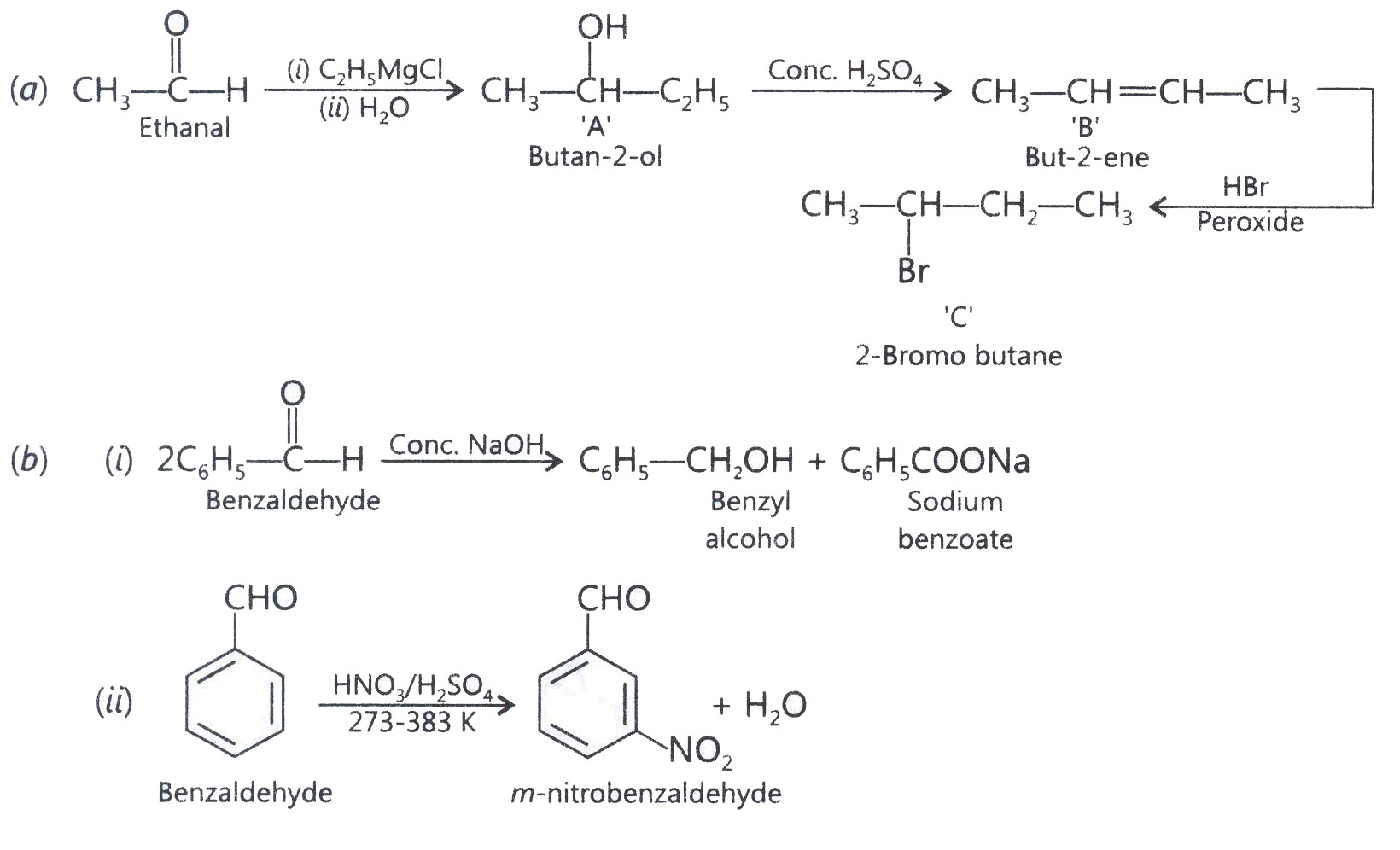
17.
18.
(b)
acetaldheyde
19.
acetaldehyde contains \(\alpha \)- hydrogens and hence does not undergo aldol condensation
20.
(a)
by increasing [Cu2+]
21.
(b)
this redox couple is a stronger oxidising agent than the H+ /H2

12th Standard CBSE Syllabus & Materials
12th Standard CBSE
CBSE 12th Computer Science Python Revision Tour I - New Previous year Question Papers Study Material - QB365 Set A
NEW12th Standard CBSE
CBSE 12th Business Studies Planning Important Questions And Answers Study Material - QB365 Set A
NEW12th Standard CBSE
CBSE 12th Business Studies Business Environment Important Questions And Answers Study Material - QB365 Set A
NEW12th Standard CBSE
CBSE 12th Business Studies Principles of Management Important Questions And Answers Study Material - QB365 Set A



NCERT Books

Syllabus

Exam Pattern

Sample Question Papers

Previous year Question Papers

Important Notes

MCQ Practice test

NCERT Exemplers

Case study Questions

Image Based Questions

Passage based Questions

HOT Questions

Value Based Questions

Model Questions Papers
NCERT ( Book Back ) Questions

Assertion and Reason
Important Questions And Answers

CBSE 12th Standard CBSE Subjects
CBSE Standards








