
 100% FREE ACCESS
12th Standard CBSE Syllabus & Materials
12th Standard CBSE
CBSE 12th Economics Government Budget and the Economy Previous year Question Papers Study Material - QB365 Set A
NEW12th Standard CBSE
CBSE 12th Computer Science Interface Python with MySQL - New Previous year Question Papers Study Material - QB365 Set A
NEW12th Standard CBSE
CBSE 12th Computer Science Database Concept - New Previous year Question Papers Study Material - QB365 Set A
NEW12th Standard CBSE
CBSE 12th Computer Science Data Communication - New Previous year Question Papers Study Material - QB365 Set A
NEW12th Standard CBSE
CBSE 12th Computer Science Data Structures - New Previous year Question Papers Study Material - QB365 Set A
NEW12th Standard CBSE
CBSE 12th Computer Science Functions - New Previous year Question Papers Study Material - QB365 Set A

Published on: 02/11/2025
Download CBSE Class 12th Standard CBSE Chemistry question papers, sample papers, important questions, and previous year solved papers in PDF format. Get free study materials, NCERT solutions, and exam preparation resources for Class 12th Standard CBSE Chemistry
Questions + Answers key
Take MCQ Chemistry Test
1.
Describe the following.
(i) Cannizzaro reaction
(ii) Cross aldol condensation
2.
A first order reaction takes 40 min for 30%. decomposition. Calculate t1/2
3.
What happens when D-glucose is treated with the following reagents ?
(i) HI
(ii) Bromine water
(iii) HNO3.
4.
Why a mercury cell gives a constant voltage throughout its life ?
5.
Mention one commercial use of N, N-Dimethylaniline (DMA).
6.
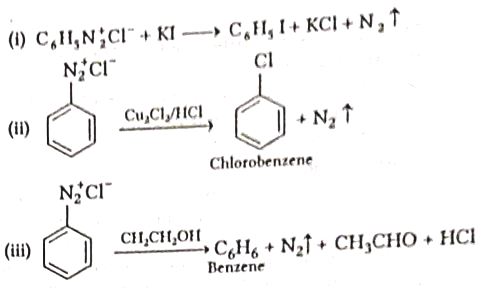
Write the major product(s) in the following reactions.
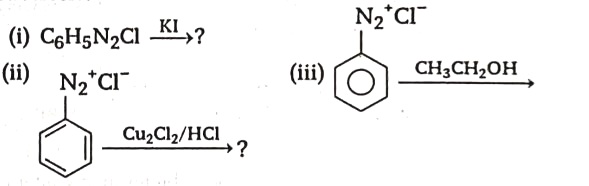
7.
The standard electrode potential for Daniell cell is 1.1V. Calculate the standard Gibbs energy for the reaction:
Zn(s) + Cu2+(aq) → Zn2+(aq) + Cu(s)
8.
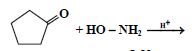
Predict the products of the following reactions:
(i)
(ii)
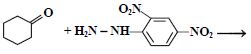
(iii)

(iv)
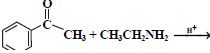
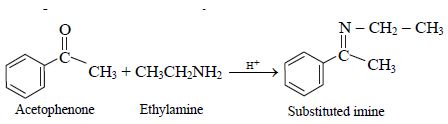
Elimination of H2O from carbonyl and amine group and formation of C= N bond.
9.
The rate of most reactions becomes double when their temperature is raised from 298 K to 308 K. Calculate their activation energy.
10.
A galvanic cell consits of a metalic zinc plate immersed in 0.1 M Zn(NO3)2 solution and metalic plate of lead in 0.02 M Pb(NO3)2 solution. Calculate the emf of the cell Write the chemical equation for the electrode reactions and represent the cell. (Given E0 Zn2+, Zn = -0.76V,E0 Pb2+, Pb = -0.13 V)
11.
Why is carboxyl group in benzoic acid meta directing? Support your answer with two examples.
12.
Answer the following questions briefly:
(i) What are any two good sources of Vitamin A?
(ii) What are nucleotides?
13.
The \(\alpha\)- and \(\beta\)-glucose are
isomers of D( +) glucose and L( -) glucose respectively.
diastereomers of glucose
anomers of glucose
isomers which differ in the configuration of C-2.
14.
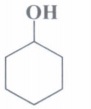
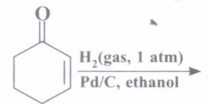 A is
A is
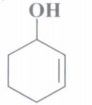
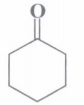
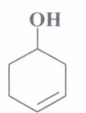
15.
Mechanism of a hypothetical reaction X2 + Y2 \(\rightarrow\)2 x Y is given below
\(\mathrm{a}_{2} \rightleftharpoons x+x(\text { fast })\)
X + Y2 \(\rightarrow\) XY + Y (slow)
X + Y\(\rightarrow\) XY (fast)
The overall order of reaction is
2
0
1.5
1
16.
Which of the following polysaccharide is stored in the cell wall in plant cells?
Cellulose
Amylose
Amylopectin
Glycogen
17.
The correct name for yellow dye is
p-hydroxy azobenzene
p-amino azobenzene
o-hydroxyazobenzene
o-amino azobenzene
18.
The reaction, \(\begin{equation} \mathrm{ArN}_{2}^{+} \mathrm{Cl}^{-} \stackrel{\mathrm{Cu} / \mathrm{HCl}}{\longrightarrow} \mathrm{ArCl}+\mathrm{N}_{2}+\mathrm{CuCl} \end{equation}\) is named as
Sandmeyer reaction
Gattermann reaction
Claisen reaction
Carbylamine reaction
19.
What would be the side products formed with primary amine in the Hofmann bromamide degradation reaction?
Na2CO3 + NaBr
NaBr + H2O + NaOH
NaBr + H2O + Na2CO3
Br2 + H2O + Na2CO3
20.
In the given reaction,
2Cu+(aq) \(\rightleftharpoons\) Cu2+(aq) + Cu(s)
EOCu+/Cu = 0.6 V and EoCu2+/Cu = 0.41 V
Find out the equilibrium constant.
2.76 x 10²
2.76 X 10⁴
2.76 X 10⁶
2.76 x 10⁸
21.
Which functional group participates in disulphide bond formation in proteins ?
Thioether
Thiol
Thioester
Thiolactone
22.
Aldol condensation does not occur between
two different aldehydes
two different ketones
an aldehyde and a ketone
an aldehyde and an ester
23.
Hydrolysis products of lactose are
glucose and glucose
glucose and fructose
glucose and galactose
none of these
24.
The IUPAC name of the compound is
4-methoxy-2-nitrobenzaldehyde
4-formyl-3-nitroanisole
4-methoxy-6-nitrobenzaldehyde
2-formy-5-methoxynitrobenzene
25.
E1 , E2 and E3 are the emf values of the three galvanic cells respectively
(i) Zn | Zn2+ (1 M) || Cu2+ (0.1 M) | Cu
(ii) Zn | Zn2+ (1 M) || Cu2+ (1 M) | Cu
(iii) Zn | Zn2+ (0.1 M) || Cu2+ (1 M) | Cu
Which one of the following is true ?
E2 > E3 > E1
E3 > E2 > E1
E1 > E2 > E3
E1 > E3 > E2
26.
The rate constant of a second order reaction, 2A\(\longrightarrow\) Products, is 10-4 lit mol-1 min-1. The initial concentration of the reactant is 10-2 mol lit-1. What is the half-life (in min) ?
10
1000
100
106
27.
Which of the following statements are in accordance with the Arhenius equation ?
Rate of a reaction increases with decrease in temperature
Rate of a reaction increases with decrease in activation energy
Rate constant decreases exponentially with increase in temperature
Rate of reaction decreases with decrease in activation energy
28.
In the electrolysis of aqueous sodium chloride solution which of the half cell reaction will occur at anode?
\({ Na }^{ + }(aq)+{ e }^{ - }\longrightarrow Na(s);{ E }_{ cell }^{ \circleddash }=-2.71V\)
\(2{ H }_{ 2 }O(l)\longrightarrow { O }_{ 2 }(g)+4{ H }^{ + }(aq)+4{ e }^{ - };{ E }_{ cell }^{ \circleddash }=1.23V\)
\({ H }^{ + }(aq)+{ e }^{ - }\longrightarrow \frac { 1 }{ 2 } { H }_{ 2 }(g);{ E }_{ cell }^{ \circleddash }=0.00V\)
\({ Cl }^{ - }(aq)\longrightarrow \frac { 1 }{ 2 } { Cl }_{ 2 }(g)+{ e }^{ - };{ E }_{ cell }^{ \circleddash }=1.36V\)
29.
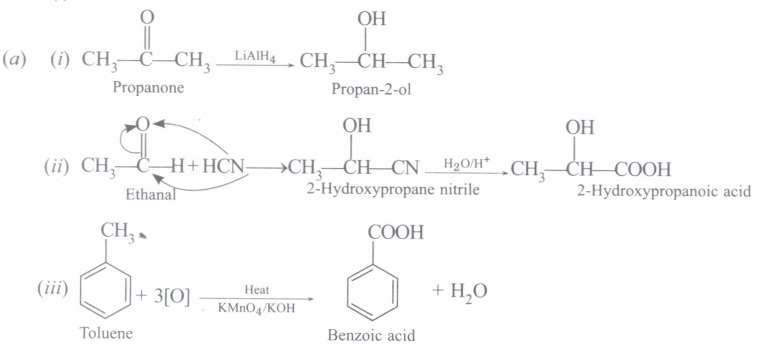
(a) How will you convert the following:
(i) Propanone to Propan-2-ol
(ii) Ethanal to 2-Hydroxypropanoic acid
(iii) Toluene to Benzoic acid
(b) Give simple chemical test to distinguish between:
(i) Pentan-2-one and Pentan-3-one
(ii) Ethanal and Propanal
30.
Write the cell reaction and calculate the emf of the following cell at 298 K.
Sn(s) I Sn2+(0.004 M) II H+(0.020 M) I H2(g) (1 bar) I Pt(s) (Give: EO Sn2+ /Sn = - 0.14 V)
(b) Give reasons: (i) On the basis of EO values, O2 gas should be liberated at anode, but it is Cl2 gas which is liberated in the electrolysis of aqueous NaCl
(ii) Conductivity of CH3COOH decreases on dilution.
31.
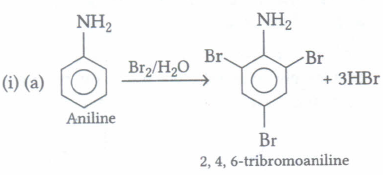
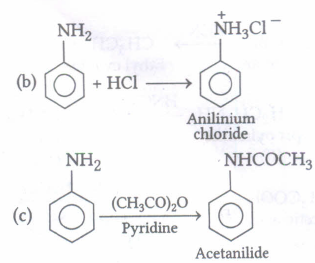
(a) Write the structures of the main products when aniline reacts with the following reagents:
(i) Br2 water
(ii) HCI
(iii) (CH3CO)2O / pyridine
(b) Arrange the following in the increasing order of their boiling point:
C2H5NH2 , C2H5OH, (CH3)3N
(c) Give a simple chemical test to distinguish between the following pair of compounds:
(CH3)2NH and (CH3)3N
32.
Glucose is an aldohexose. It can occur freely as well as in combined form in the nature. It is present in sweet fruits and honey. It is also present in quantities in ripe grapes. As glucose is an aldohexose, it consists of six C-atoms and an aldehyde group. It is the most abundant organic compound on the earth and used as an immediate source of energy for all metabolic reactions in the animals.
It was found that glucose forms a six membered ring in which -OH at C-5 is involved in the ring formation. The cyclic six membered structure of glucose is known as pyranose structure. It is analogous to pyran which is a cyclic organic compound with one oxygen atom and five carbon atoms in the ring.
Write the reaction for the preparation of glucose from sucrose.
33.
Basic character of amines depend upon the ease for the formation of cation by accepting a proton from the acid. The more stable the cation is relative to the amine, more basic is the amine. Basicity of an amine in aqueous solution depends upon stability of ammonium cation formed by accepting proton from water. The stability of ammonium cation depends upon the following three factors:
(i) + I-effect (alkyl group)
(ii) Sterk effect (alkyl group)
(iii) Solvation effect
(CH3)2NH is more basic than (CH3)3N in an aqueous solution. Why?
34.
Carboxylic acids evolve hydrogen with metals and form salts with alkalies similar to phenols. However, unlike phenols, they react with weaker bases like sodium carbonate and hydrogen carbonate to evolve carbon dioxide. In aqueous solution, carboxylic acids ionise and exist in dynamic equilibrium between the resonance stabilised carboxylate ions and the hydronium ions.
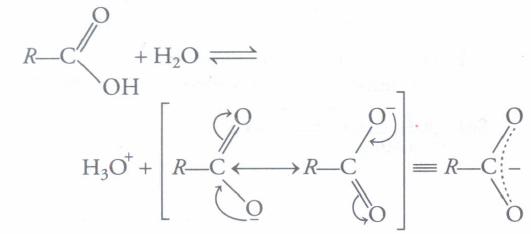
Resonance stabilisation of carboxylate anion is more than that of undissociated carboxylic acid. Therefore, greater stability of carboxylate ion is responsible for the acidic character of carboxylic acids. Carboxylic acids are more acidic than alcohols because carboxylate anions are more stable than alkoxide ions, so carboxylic acids have strong tendency to release a proton.
Arrange benzoic acid, 3, 4-dinitrobenzoic acid, 4-methoxybenzoic acid in increasing order of acidic strength.
35.
Molar conductivity of a solution is the conductance of solution containing one mole of electrolyte, kept between two electrodes having unit length between them and large cross sectional area so as to contain the electrolyte. In other words, molar conductivity is the conductance of the electrolytic solution kept between the electrodes of a conductivity cell at unit distance but having area of cross section large enough to accommodate sufficient volume of solution that contains one mole of the electrolyte. It is denoted by Λm.
Write the mathematical expression for molar conductivity.
36.
Read the passage given below and answer the following questions:
Carboxylic acids having an a-hydrogen atom when treated with chlorine or bromine in the presence of small amount of red phosphorus gives a-halo carboxylic acids. The reaction is known as Hell- Volhard-Zelinsky reaction.
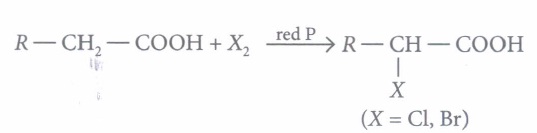
When sodium salt of carboxylic acid is heated with soda lime it loses carbon dioxide and gives hydrocarbon with less number of C-atoms.

In these questions (i - iv), a statement of assertion followed by a statement of reason is given. Choose the correct answer out of the following choices.
(a) Assertion and reason both are correct statements and reason is correct explanation for assertion.
(b) Assertion and reason both are correct statements but reason is not correct explanation for assertion.
(c) Assertion is correct statement but reason is wrong statement.
(d) Assertion is wrong statement but reason is correct statement.
(i) Assertion: (CH3)3CCOOH does not give H.V.Z reaction.
Reason: (CH3)3CCOOH does not have \(\alpha\)-hydrogen atom.
(ii) Assertion: H.V.Z. reaction involves the treatment of carboxylic acids having \(\alpha\)-hydrogens with Cl2 or Br2 in presence of small amount of redphosphorus.
Reason : Phosphorus reacts with halogens to form phosphorus trihalides.
(iii) Assertion: C6H5COCH2COOH undergoes decarboxylation easily than C6H5COCOOH.
Reason : C6H5COCH2COOH is a 13-ketoacid.
(iv) Assertion: On heating 3-methylbutanoic acid with soda lime, isobutane is obtained.
Reason: Soda lime is a mixture of NaOH + CaO in the ratio 3 : 1.
1.
(i) Cannizzaro reaction Aldehydes (not having alpha hydrogen atoms) undergo self oxidation-reduction (disproportionation) reaction. One molecule is oxidized to carboxylic acid and another molecule is reduced to alcohol. Concentrated alkali is the reagent.
(iii) Cross aldol condensation between different carbonyl compounds (aldehydes and ketones). If both reactants contain alpha hydrogen atoms, four different products can be obtained.
2.
Let \( a=100, a-x=100-30=70, t=40 \mathrm{~min} \)
\(k=\frac{2.303}{t} \log \frac{a}{(a-x)}=\frac{2.303}{40 \mathrm{~min}} \log \frac{100}{70}\)
\(=\frac{2.303}{40} \log \frac{10}{7}=\frac{2.303}{40} \log 1.428=\frac{2.303}{40} \times 0.1545\)
\(k=8.91 \times 10^{-3} \min ^{-1} \)
\(t_{1 / 2}=\frac{0.693}{\mathrm{k}}=\frac{0.693}{8.91 \times 10^{-3} \min ^{-1}}=77.78 \mathrm{~min} \)
\(t_{1 / 2}=77.78 \mathrm{~min}\)
3.
(i) When glucose is treated with HI, it forms n-hexane, suggesting that all the six carbon atoms are linked in a straight line.
.png)
(ii) On heating glucose with bromine water, it gets oxidised to six carbon carboxylic acid, gluconic acid.
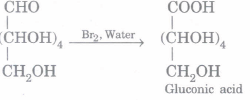
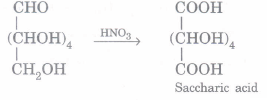
(iii) Glucose on treatment with nitric acid gives a dicarboxylic acid, saccharic acid.
4.
This is because the electrolyte KOH is not consumed in the reaction.
5.
It is used in preparation of dyes.
6.
7.
\(\Delta_{\mathrm{r}} G^{\ominus}=-n F \mathrm{E}_{\text {(cell) }}^{\ominus}\)
n in the above equation is 2, F = 96487 C mol –1 and \(\mathrm{E}_{\text {(cell })}^{\ominus}\) = 1.1 V
Therefore, \(\Delta_{\mathrm{r}} G^{\ominus}\) = – 2 × 1.1V × 96487 C mol –1
= – 21227 J mol–1
= – 212.27 kJ mol–1
8.
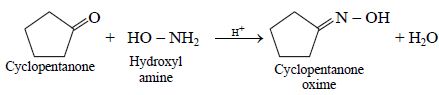
(i) Cyclopentanone reacts with hydroxyl amine to form oxime.
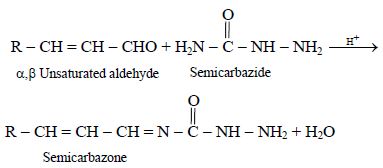
(ii) \(\text { a } \beta\)unsaturated aldehyde reacts with semicarbazide (H2NCONHNH2) to form semicarbazone.

(iii) Cyclohexanone reacts with 2,4-dinitro phenyl hydrazine to form 2,4-dinitro phenyl hydrazone.
(iv) Acetophenone reacts with ethyl amine to form an imine
9.
T1 = 298 K, T2 = 308 k.
R = 8.314 J mol-1 K-1
Activation energy
k2=2k1
\(log\frac{k_2}{k_1}=\frac{E_a}{2.303R}[\frac{1}{T_1}-\frac{1}{T_2}]\)
\(\Rightarrow\ \ log2=\frac{E_a}{19.15 \ J\ mol^{-1}}[\frac{1}{298}-\frac{1}{308}]\)
\(E_a=\frac{0.3010\times19.15\times 298\times 308}{10}J\ mol^{-1}\)
\(E_a=52905 \ J\ mol^{-1}\ or \ 52.905\ kJ\ mol^{-1}\)
10.
0.6094 V, Zn + Pb2+ \(\longrightarrow\) Zn2+ + Pb; Zn|Zn2+ (0.1 M) || Pb2+ (0.02 M) Pb
11.
In benzoic acid, carboxyl group is meta-directing because it is electron withdrawing, therefore, there is +ve charge on 0- and p-positions, therefore, electrophilic substitution takes places at m-position due to greater electron density, e.g

12.
(i) Carrot and Cod liver oil.
(ii) Nucleotides are monomers of nucleic acids. They consist of heterocyclic base, pentose sugar and phosphoric acid residue.
13.
(c)
anomers of glucose
14.
(b)
15.
(c)
1.5
16.
(a)
Cellulose
17.
(b)
p-amino azobenzene
18.
(b)
Gattermann reaction
19.
(c)
NaBr + H2O + Na2CO3
20.
(c)
2.76 X 10⁶
21.
(b)
Thiol
22.
(d)
an aldehyde and an ester
23.
(c)
glucose and galactose
24.
(a)
4-methoxy-2-nitrobenzaldehyde
25.
(b)
E3 > E2 > E1
26.
(d)
106
27.
(b)
Rate of a reaction increases with decrease in activation energy
28.
(b)
\(2{ H }_{ 2 }O(l)\longrightarrow { O }_{ 2 }(g)+4{ H }^{ + }(aq)+4{ e }^{ - };{ E }_{ cell }^{ \circleddash }=1.23V\)
29.
(b) (i) Add I2 and NaOH. Pentan-2-one will give yellow ppt. due to iodoform, whereas pentan-3-one will not.
(ii) Add I2 and NaOH. Ethanal will give yellow ppt. of iodoform, whereas propanal will not.
30.
\(\mathrm{Sn}(\mathrm{s}) \mid \mathrm{Sn}^{2+}(0.004 \mathrm{M}) \| \mathrm{H}^{+}(0.020 \mathrm{M}) \mid \mathrm{H}_{2}(g)(1 \text { bar }) \mid \operatorname{Pt}(s)\)
Cell reaction is
\(\mathrm{Sn}+2 \mathrm{H}^{+}(0.020 \mathrm{M}) \rightarrow \mathrm{Sn}^{2+}(0.004 \mathrm{M})+\mathrm{H}_{2}(1 \mathrm{bar})\)
\(E_{\mathrm{cell}}^{\circ}=E_{\mathrm{H}^{+}}^{\circ} \cdot \frac{1}{2} \mathrm{H}_{2}-E_{\mathrm{Sn}}^{2+} / \mathrm{Sn} \)
\(=0-(-0.14 \mathrm{~V})=0+0.14 \mathrm{~V}=0.14 \mathrm{~V}\)
for calculation of emf apply Nernst equation;
\(E_{\text {cell }} =E_{\text {cell }}^{\circ}-\frac{0.0591}{n} \log \frac{\left[\mathrm{Sn}^{2+}\right] \times p_{\mathrm{H}_{2}}}{\left[\mathrm{H}^{+}\right]^{2}} \)
\(=0.14-\frac{0.0591}{2} \log \frac{[0.004] \times 1}{[0.020]^{2}} \)
\(=0.14-\frac{0.0591}{2} \log \frac{0.004}{0.0004} \\ =0.14-\frac{0.0591}{2} \log 10 \\ =0.14-\frac{0.0591}{2}=0.110 \mathrm{~V}\)
(b) (i) From standard oxidising potential it is clear that oxygen gas should be liberated at anode, but its rate of production is very low. In order to increase that we increase the voltage of external battery Because of which chloride ions get oxidised easily and Cl2 gas is liberated at anode.
(ii) Conductivity of solution is conductance of ions present in unit volume of solution. On dilution number of CH3COOH ions per unit volume decreases. Hence conductivity decreases.
31.
(ii) Alcohols have higher boiling point as compared to that of amines, because oxygen being more electronegative atom, forms strong hydrogen bond as compared to that of nitrogen. In tertiary amine, there is no hydrogen bond formation due to the absence of H-atoms and hence, has the lowest boiling point. Therefore, increasing order of boiling point (CH3)3N < C2H5NH2 < C2H5OH .
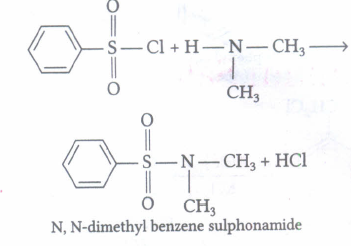
(iii) (CH3)3NH and (CH3)3N are secondary and tertiary arnines respectively. These are distinguished by Hinsberg's reagent which gives sulphonamide with secondary amines and no reaction carried out with tertiary arnines. (CH3)3NH reacts with benzene sulphonyl chloride as follows:
32.
\(\begin{equation} \mathrm{C}_{12} \mathrm{H}_{12} \mathrm{O}_{11}+\mathrm{H}_{2} \mathrm{O} \stackrel{\mathrm{H}^{+}}{\longrightarrow} \mathrm{C}_{6} \mathrm{H}_{12} \mathrm{O}_{6}+\mathrm{C}_{6} \mathrm{H}_{12} \mathrm{O}_{6}\\ Sucrose\quad\quad\quad\quad\quad Glucose \quad\quad Fructose \end{equation}\)
33.
In aqueous solution, basic nature depends on + I-effect, H-bonding and steric effect. The combined effectshows that (CH3)2 NH is more basic than (CH3)3N as H-bonding is more in case of (CH3)2 NH than in (CH3)3N which predominates over the stability due to + I effect of three - CH3 groups.
34.
4-methoxybenzoicacid < benzoic acid < 3, 4-dinitro benzoic acid.
35.
The mathematical expression for molar conductivity is given as,
\(\Lambda_{\mathrm{m}}=\frac{K \times 1000}{M}\\ where, \Lambda_{\mathrm{m}}= Molar \ conductivity \ of \ solution\)
K = Conductivity of solution
M = Molarity of the solution
36.
(i) (a)
(ii) (c): Phosphorus converts a little .of the acid into acid chloride which is more reactive than the parent carboxylic acid. Thus, it is the acid chloride, not the acid itself, that undergoes chlorination at the \(\alpha\)-carbon.
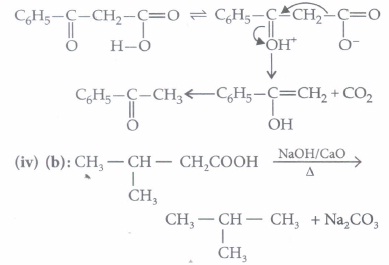
(iii) (a): \(\beta\)-ketoacids are unstable acids. They readily undergo decarboxylation through a cyclic transition state.
(i) (b): All aliphatic aldehydes give red ppt. with
Fehling's solution, but ketones do not reduce Fehling's
solution.
(ii) (e): Aliphatic aldehydes reduce Fehling's solution,
but aromatic aldehydes do not.

12th Standard CBSE Syllabus & Materials
12th Standard CBSE
CBSE 12th Computer Science Python Revision Tour I - New Previous year Question Papers Study Material - QB365 Set A
NEW12th Standard CBSE
CBSE 12th Business Studies Planning Important Questions And Answers Study Material - QB365 Set A
NEW12th Standard CBSE
CBSE 12th Business Studies Business Environment Important Questions And Answers Study Material - QB365 Set A
NEW12th Standard CBSE
CBSE 12th Business Studies Principles of Management Important Questions And Answers Study Material - QB365 Set A



NCERT Books

Syllabus

Exam Pattern

Sample Question Papers

Previous year Question Papers

Important Notes

MCQ Practice test

NCERT Exemplers

Case study Questions

Image Based Questions

Passage based Questions

HOT Questions

Value Based Questions

Model Questions Papers
NCERT ( Book Back ) Questions

Assertion and Reason
Important Questions And Answers

CBSE 12th Standard CBSE Subjects
CBSE Standards








