
 100% FREE ACCESS
12th Standard CBSE Syllabus & Materials
12th Standard CBSE
CBSE 12th Economics Government Budget and the Economy Previous year Question Papers Study Material - QB365 Set A
NEW12th Standard CBSE
CBSE 12th Computer Science Interface Python with MySQL - New Previous year Question Papers Study Material - QB365 Set A
NEW12th Standard CBSE
CBSE 12th Computer Science Database Concept - New Previous year Question Papers Study Material - QB365 Set A
NEW12th Standard CBSE
CBSE 12th Computer Science Data Communication - New Previous year Question Papers Study Material - QB365 Set A
NEW12th Standard CBSE
CBSE 12th Computer Science Data Structures - New Previous year Question Papers Study Material - QB365 Set A
NEW12th Standard CBSE
CBSE 12th Computer Science Functions - New Previous year Question Papers Study Material - QB365 Set A

Published on: 02/11/2025
Download CBSE Class 12th Standard CBSE Chemistry question papers, sample papers, important questions, and previous year solved papers in PDF format. Get free study materials, NCERT solutions, and exam preparation resources for Class 12th Standard CBSE Chemistry
Questions + Answers key
Take MCQ Chemistry Test
1.
Name the compound that will give,butanone on oxidation with alk.KMnO4 solution.
2.
Draw the molecular structure of the compound 4-methylpent-3-en-2-one.
3.
What is Tollen's reagent? Write one usefulness of this reagent.
4.
Give reasons for the following
(i) Carboxylic carbon is less electropilic than carbonyl carbon of aldehydes and ketones.
(ii) Propanal is more reactive than propanone towards addition of HCN.
5.
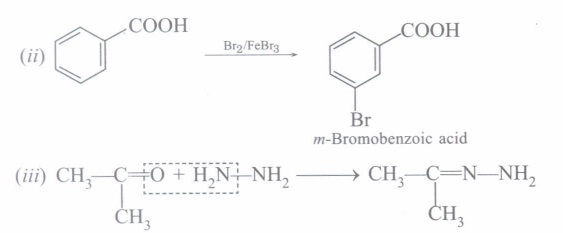
Predict the products of the following reactions:
\(\text { (i) } \mathrm{C}_{6} \mathrm{H}_{5}-\mathrm{CH}_{3} \frac{(\text { a }) \mathrm{KMnO}_{4} / \mathrm{KOH}}{(\text { b }) \mathrm{H}^{+}} \text {? }\)
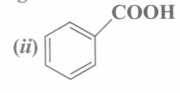
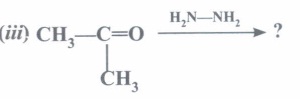
6.
An organic compound with molecular formula C9H10O forms 2,4-DNP derivative, reduces Tollen's reagent and undergoes Cannizzaro's reaction.
On vigorous oxidation it gives 1,2-benzene dicarboxylic acid. Identify the compound.
7.
Convert:
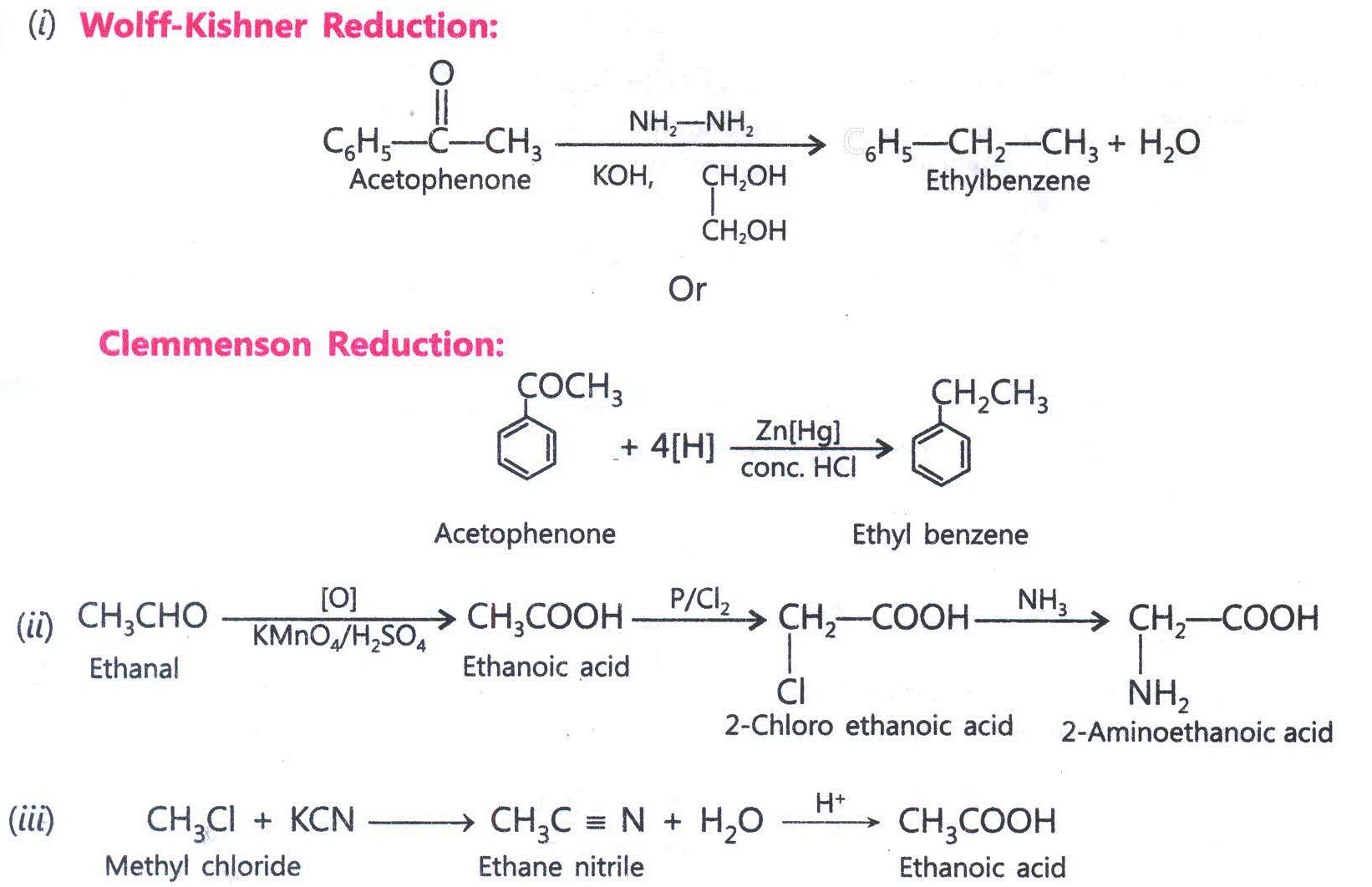
(i) Acetophenone to ethylbenzene
(ii) Ethanal to 2-aminoethanoic acid
(iii) Methyl chloride to ethanoic acid.
8.
Of the following which is the product formed when cyclohexanone undergoes aldol condensation followed by heating?
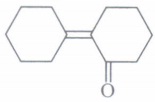
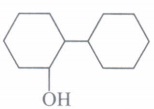
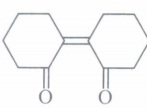
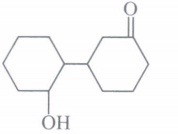
9.
Treatment of compound 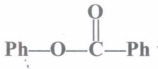 with NaOH solution yields
Phenol
Sodium phenoxide
Sodium benzoate
Benzophenone
10.
Select the reagent for the given conversion.
\(\mathrm{CH}_{3}\left(\mathrm{CH}_{2}\right)_{8} \mathrm{CH}_{2} \mathrm{OH} \longrightarrow \mathrm{CH}_{3}\left(\mathrm{CH}_{2}\right)_{8} \mathrm{COOH}\)
KMnO4 in acidic,neutral, alkaline media
K2Cr2O7 in acidic media
CrO3 in acidic media
All of the above
11.
The distinguishing test between methanoic acid and ethanoic acid is
Tollens' test
sodium bicarbonate test
Litmus test
esterification test
12.
CH3COOH \(\xrightarrow {H_3O^{+}}\) B + H2O In the above reaction, 'A' and 'B' respectively are
CH3COOC2H5, C2H5OH
CH3CHO, C2H5OH
C2H5OH, CH3CHO
C2H5OH, CH3COOC2H5
13.
The decreasin order of acidity amoung the following compounds, ethanol (1), 2, 2, 2-trifluorethanol (II), trifluoroacetic acid (III) and acetic acid (IV) is
III > II > IV > I
IV > III > II > I
I > II > III > IV
III > IV > II > I
14.
C6H514COOH on heating with Na2CO3 realeases
CO2
14CO2
CO
none of these
15.
The acid D obtained through the following sequence of reactions is: C2H5Br \(\xrightarrow{Alc.KOH}\) A \(\xrightarrow [ { CCI }_{ 4 } ]{ { Br }_{ 2 } } B\xrightarrow [ (excess) ]{ KCN } C\xrightarrow { { H }_{ 3 }{ O }^{ + } } D\)
succinic acid
malonic acid
maleic acid
oxalic acid
16.
In the Cannizaro reaction given below,
2 Ph __ CHO \(\xrightarrow{OH^{-}}\) Ph __ CH2OH + PhCO-2, the slowest step is
the attack of - OH at the carbonyl group
the transfer of hydride ion to the carbonyl group
the transfer of hydride ion to the carbonyl group
the abstraction of a proton from the carboxylic acid
the deprotonation of Ph __ CH2OH
17.
Identify the correct order of boiling points of the following compounds :
CH3CH2CH2CH2OH (1), CH3CH2CH2CHO (2), CH3CH2CH2COOH (3)
1 > 2 > 3
3 > 1 > 2
1 > 3 > 2
3 > 2 > 1
18.
An organic compound (A) having molecular formula, C2H4O reduces Tollens' reagent. Two moles of (A) react with AI(OC2H5)3 to yield C4H8O2 (B) which reacts with NH3 to give C2H6O (C) and C2H5NO (D). Identify A,B,C and D.
19.
Me3CCH2COOH is more acidic than Me3SiCH2COOH
20.
Read the passage given below and answer the following questions:
Aldehydes and ketones are reduced to primary and secondary alcohols respectively by NaBH4 or LiAIH4 as well as catalytic hydrogenation. The carbonyl group of aldehydes and ketones is reduced to  group on treatment with Zn-Hg and cone, HCI (Clemmensen reduction) or with hydrazine followed by NaOH or KOH in highly boiling solvent such, as ethylene glycol (Wolff- Kishner reduction).
Aldehydes differ from ketones in their oxidation reactions. Aldehydes are easily oxidised to carboxylic acids on treatment with HNO3, KMnO4, K2Cr2O7 etc. Even mild oxidising agents mainly Tollens' reagent and Fehling's solution also oxidise aldehydes. Ketones are generally oxidised under vigorous conditions i.e., strong oxidising agents and at elevated temperatures, to give mixture of carboxylic acids having lesser number of C-atoms than the parent ketone.
The following questions are multiple choice questions. Choose the most appropriate answer:
(i) Which of the following cannot be made by reduction of ketone or aldehyde with NaBH4 in methanol?
| (a) 1-Butanol | (b) 2-Butanol |
| (c) 2-Methyl-I-propanol | (d) 2-Methyl-2-propanol |
(ii) The carbonyl compound producing an optically active product by reaction with LiAlH4 is
| (a) propanone | (b) butanone | (c) 3-pentanone | (d) benzophenone |
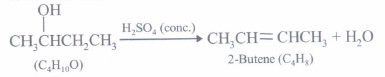
(iii) A substance C4H10O(X) yields on oxidation a compound C4H8O which gives an oxime and a positive iodoform test. The substance X on treatment with cone. H2S04 gives C4Hs. The structure of the compound (X) is
| (a) CH3CH2CH2CH2OH | (b) CH3CH(OH)CH2CH3 |
| (c) (CH3)3COH | (d) CH3CH2-O-CH2CH3 |
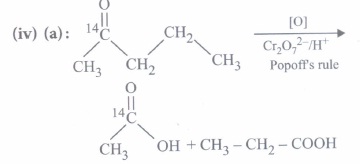
(iv) In the oxidation 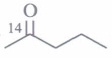 of by acidified K2Cr2O7, the products are

21.
Read the passage given below and answer the following questions :
When an aldehyde with no a-hydrogen reacts with concentrated aqueous NaOH, half the aldehyde is converted to carboxylic acid salt and other half is converted to an alcohol. In other words, half of the reactant is oxidized
and other half is reduced. This reaction is known as Cannizzaro reaction
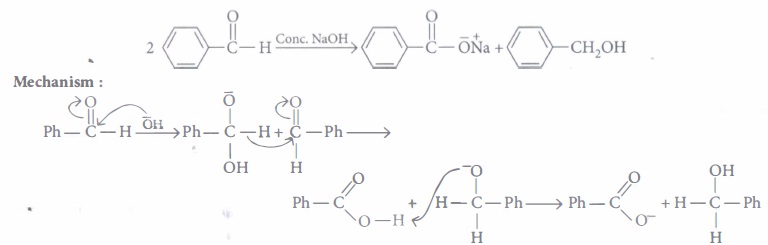
The following questions are multiple choice questions. Choose the most appropriate answer :
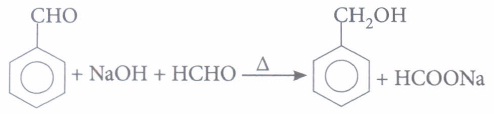
(i) A mixture of benzaldehyde and formaldehyde on heating with aqueous NaOH solution gives
| (a) benzyl alcohol and sodium formate | (b) sodium benzoate and methyl alcohol |
| (c) sodium benzoate and sodium formate | (d) benzyl alcohol and methyl alcohol. |
(ii) Which of the following compounds will undergo Cannizzaro reaction?
| (a) CH3CHO | (b) CH3COCH3 |
| (c) C6H5CHO | (d) C6H5CH2CHO |
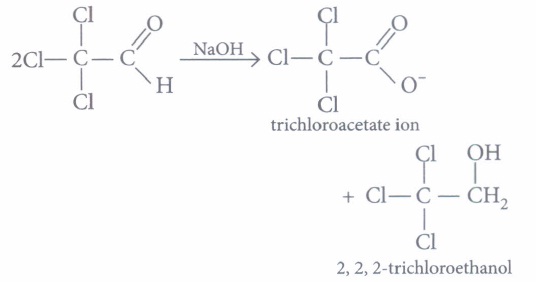
(iii) Trichloroacetaldehyde is subjected to Cannizzaro's reaction by using NaOH. The mixture of the products contains sodium trichloroacetate ion and another compound. The other compounds is
| (a) 2, 2, 2-trichloroethanol | (b) trichloromethanol |
| (c) 2, 2, 2-trichloropropanol | (d) chloroform |
(iv) Which of the following reaction will not result in the formation of carbon-carbon bonds?
| (a) Cannizzaro reaction | (b) Wurtz reaction |
| (c) Reimer- Tiemann reaction | (d) Friedel-Crafts acylation |
22.
Assertion: Even though there are two NH2 groups in semicarbazide, only one reacts with carbonyl compounds
Reason: Semicarbazide has two NH2 groups out of which one is in resonance with the carbonyl group.
Codes:
(a) If both assertion and reason are true and the reason is the correct explanation of the assertion.
(b) If both assertion and reason are true but the reason is not the correct explanation of the assertion.
(c) If the assertion is true but the reason is false.
(d) If the assertion is false but the reason is true.
(e) If the assertion and reason both are false
23.
Assertion: The \(\alpha\)-hydrogen atom in carbonyl compounds is less acidic.
Reason: The anion formed after the loss of \(\alpha\)-hydrogen atom is resonance stabilised.
Codes:
(a) Assertion and reason both are correct and reason is correct explanation of assertion.
(b) Assertion and reason both are wrong statements.
(c) Assertion is correct but reason is wrong statement.
(d) Assertion is wrong but reason is correct statement.
(e) Assertion and reason both are correct statements but reason is not correct explanation of assertion.
24.
Assertion: Carboxylic acids have higher boiling points than alkanes.
Reason: Carboxylic acids a;e resonance hybrids.
Codes:
(a) Assertion and reason both are correct statements and reason is correct explanation for assertion.
(b) Assertion and reason both are correct statements but reason is not correct explanation for assertion.
(c) Assertion is correct statement but reason is wrong statement.
(d) Assertion is wrong statement but reason is correct statement.
25.
Assertion: Hydrogen bonding in carboxylic acids is stronger than alcohols.
Reason: Highly branched carboxylic acids are more acidic than unbranched acids.
Codes:
(a) Assertion and reason both are correct statements and reason is correct explanation for assertion.
(b) Assertion and reason both are correct statements but reason is not correct explanation for assertion.
(c) Assertion is correct statement but reason is wrong statement.
(d) Assertion is wrong statement but reason is correct statement.
1.
Butan-2-ol.
2.

3.
It is ammoniacal silver nitrate (agNO3 + NH4OH) solution. It is used as mild oxidising agent to test the presence of aldehyde group.
4.
(i) This is because the lone pairs on oxygen atom attached to hydrogen atom in the -COOH group are involved in resonance.
(ii) This is because of the presence of alkyl groups on both of the carbonyl carbon, propanone is strically more hindered than propanol, making it less reactive to nucleophilic attack.
5.
\(\text { (i) } \mathrm{C}_{6} \mathrm{H}_{5}-\mathrm{CH}_{3} \frac{(\mathrm{a}) \mathrm{KMnO}_{4} / \mathrm{KOH}}{\text { (b) } \mathrm{H}^{+}} \mathrm{C}_{6} \mathrm{H}_{5}-\mathrm{COOH}\)
6.
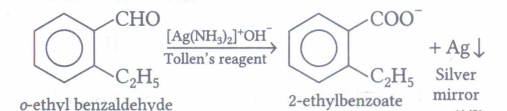
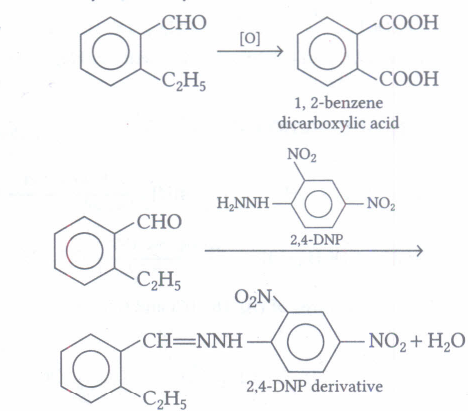
(i) As the given compound with molecular formula C9H10O, forms a 2,4-DNP derivative and reduces Tollen's reagent, thus it must be an aldehyde.
(ii) As it undergoes Cannizzaro reaction, hence -CHO group is directly attached to the benzene ring.
(iii) On vigorous oxidation, it gives 1,2-benzenedicarboxylic acid. Therefore, it must be an ortho-substituted benzaldehyde and the only o-substituted aromatic aldehyde which have C9H10O molecular formula is o-ethyl benzaldehyde.
Reactions involved
7.
8.
(a)
9.
(a)
Phenol
10.
(d)
All of the above
11.
(a)
Tollens' test
12.
(d)
C2H5OH, CH3COOC2H5
13.
(d)
III > IV > II > I
14.
(a)
CO2
15.
(a)
succinic acid
16.
(b)
the transfer of hydride ion to the carbonyl group
17.
(b)
3 > 1 > 2
18.
(i) Since compound (A) with M.F. C2H4O reduces Tollens' reagent, it must be an aldehyde, i.e., acetaldehyde (CH3HO).
\(\underset{Acetaldehyde}{CH_3CHO}+\underset{Tollens\ reagent}{2[Ag(NH_3)_2]^+}+3OH^-\longrightarrow CH_3COO^-+2Ag\downarrow+4NH_3+2H_2O\)
(ii) In presence of Al(OC2H5)3 aldehydes undergo Tischenko reaction to give esters. Thus, when two moles of acetaldehyde (CH3CHO) react in presence of AI(OC2H5)3 ethyl acetate (B) with M.F. C4H8O2 is produced
\(\underset{Acetaldehyde(A)\\(Two\ moles)}{CH_3CHO+OHCCH_3}\xrightarrow[(Tischenko reaction)]{Al(OC_2H_5)_3}\underset{Ethyl\ acetate\\ M/F.\ C_4H_8O_2}{CH_3COOCH_2CH_3}\)
(iii) The structure of ethyl acetate (B) is confirmed by the observation that on treatment with NH3, it gives one molecule of an alcohol, i.e., ethyl alcohol, CH3CH2OH (C) and one molecule of an amide, i.e., acetamide, CH3CONH2(D)
\(\underset{Ethyl\ acetate(B)}{CH_3COOCH_2CH_3}\xrightarrow{NH_3}\underset{Ethyl alcohol (C)\\ M.F. C_2H_6O}{CH_3CH_2OH}+\underset{Acetamide (D)\\ M.F. C_2H_5NO}{CH_3CONH_2}\)
19.
Si (E.N. = 8) is more electropositive than C (E.N. = 2.5), therefore, Me3Si (trimethylsilyl group) has greater +l-effect than that of Me3C (r-butyl group). As a result, Me3Si intesifies the -ve charge on the carboxylate ion relative to r-butyl group and hence Me3CCH2COOH is a stronger acid that Me3SiCH2COOH.
20.
(i) (d): 2-Methyl-2-propanol is 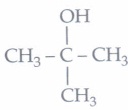 It cannot be obtained by reduction of an aldehyde or ketone with NaBH4·
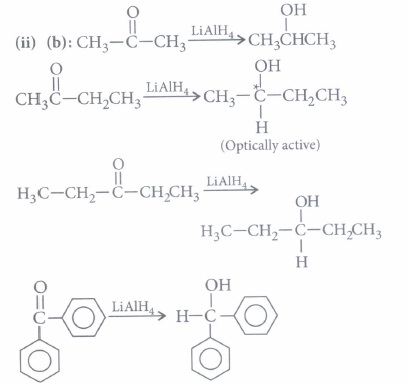
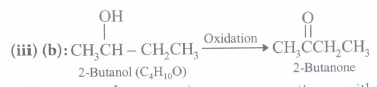
2-Butanone forms oxime on reaction with hydroxylamine (NH2OH) and also gives positive iodoform test.
21.
(i) (a): It is an example of cross Cannizzaro reaction where aromatic aldehyde gets reduced to alcohol and aliphatic aldehyde gets oxidised to its sodium salt (both aldehydes must not contain any \(\alpha\)-hydrogen).
(ii) (c)
(iii) (a): The Cannizzaro product of given reaction yields 2, 2, 2-trichloroethanol.
(iv) (a): C-C bond is not formed in Cannizzaro reaction while other reactions result in the formation of C-C bond.
22.
(a) If both assertion and reason are true and the reason is the correct explanation of the assertion.
23.
(d) Assertion is wrong but reason is correct statement.
24.
(b): Boiling points of carboxylic acids are higher due to th.eir tendency to associate and form dimers to a greater extent by hydrogen bonding.
25.
(c): Highly branched carboxylic acids are less acidic than unbranched acids. The +I effect of alkyl groups in branched acid increases the magnitude of negative charge. Thus, -COOH group is shielded from solvent molecules and cannot be stabilized by solvation as effectively as in unbranched carboxylic acids.

12th Standard CBSE Syllabus & Materials
12th Standard CBSE
CBSE 12th Computer Science Python Revision Tour I - New Previous year Question Papers Study Material - QB365 Set A
NEW12th Standard CBSE
CBSE 12th Business Studies Planning Important Questions And Answers Study Material - QB365 Set A
NEW12th Standard CBSE
CBSE 12th Business Studies Business Environment Important Questions And Answers Study Material - QB365 Set A
NEW12th Standard CBSE
CBSE 12th Business Studies Principles of Management Important Questions And Answers Study Material - QB365 Set A



NCERT Books

Syllabus

Exam Pattern

Sample Question Papers

Previous year Question Papers

Important Notes

MCQ Practice test

NCERT Exemplers

Case study Questions

Image Based Questions

Passage based Questions

HOT Questions

Value Based Questions

Model Questions Papers
NCERT ( Book Back ) Questions

Assertion and Reason
Important Questions And Answers

CBSE 12th Standard CBSE Subjects
CBSE Standards








