
12th Standard CBSE Syllabus & Materials
12th Standard CBSE
CBSE 12th Economics Government Budget and the Economy Previous year Question Papers Study Material - QB365 Set A
NEW12th Standard CBSE
CBSE 12th Computer Science Interface Python with MySQL - New Previous year Question Papers Study Material - QB365 Set A
NEW12th Standard CBSE
CBSE 12th Computer Science Database Concept - New Previous year Question Papers Study Material - QB365 Set A
NEW12th Standard CBSE
CBSE 12th Computer Science Data Communication - New Previous year Question Papers Study Material - QB365 Set A
NEW12th Standard CBSE
CBSE 12th Computer Science Data Structures - New Previous year Question Papers Study Material - QB365 Set A
NEW12th Standard CBSE
CBSE 12th Computer Science Functions - New Previous year Question Papers Study Material - QB365 Set A

Published on: 20/08/2026
Download CBSE Class 12th Standard CBSE Chemistry question papers, sample papers, important questions, and previous year solved papers in PDF format. Get free study materials, NCERT solutions, and exam preparation resources for Class 12th Standard CBSE Chemistry
Questions + Answers key
Take MCQ Chemistry Test
1.
Carbohydrates are polyhydroxy aldehydes or ketones and are also called saccharides, Glucose is an example of monosaccharides. GIucose (C6H12O6) is an aldohexose and its open chain structure was assigned on the basis of many reactions as evidences like presence of carbonyl group, presence of straight chain, presence of five -OH groups etc.
Glucose is correctly named as D-(+)-glucose. Glucose is found to exist in two different crystalline forms which are named as \(\alpha\) and \(\beta\). Despite having the aldehyde group, glucose does not give 2, 4-DNP test.
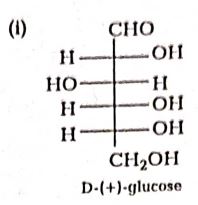
(i) What is the correct structure of D-(+)-glucose?
(ii) Glucose on oxidation with HNO3 gives a dicarboxylic acid called saccharic acid. What does this result indicate?
(iii) The pentaacetate of glucose does not react with H2N-OH What does this result indicate?
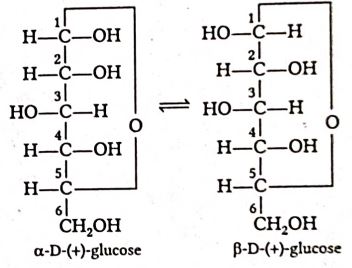
(iv) What is the difference between \(\alpha\)-D-glucose and \(\beta\)-D-glucose?
Or
Give the possible explanation for the following:
Glucose doesn't give 2,4-DNP test.
2.
Biomolecules are complex molecules which build up living organisms and required for their growth, maintenance and ability to reproduce. Carbohydrates are polyhydroxy aldehydes and ketones which are major sources of energy. Monosachharides are simple sugars which cannot be hydrolysed. Oligosachharide, on hydrolysis give 2 to 10 molecules of monosachharides. Polysachharides like starch and cellulose on hydrolysis give large number of molecules of glucose \(\alpha\)-glucose and \(\beta\)-glucose (Anomers). Proteins are complex nitrogeneous polymers of amino acids connected through peptide bonds. The sequence in which amino acids are linked is called Primary structure. Secondary structures are of 2 types \(\alpha\)-helix in globular proteins and \(\beta\)-pleated structure in fibrous proteins involving H-bonds. Tertiary structure has H-bonds, disulphide linkage, ionic bonding and van der Waals' forces. Insulin is hormone for metabolism of glucose, has quarternary structure. Denaturation of protein destroys secondary and tertiary structure, loss of biological activity but primary structure remaining the same.
Enzymes are highly specific, work at specific pH, moderate temperature and catalyse biochemical reactions. Hormones perform specific functions and secreated by endocrine glands. Vitamins are essential for healthy body. A, D, E, K are fat soluble vitamins. Vitamin C and B1, B2, B6 are water soluble. B12 is neither water, nor fat soluble. Nucleic acids are polymer of nucleotides. RNA consist of m-RNA, t-RNA, r-RNA. RNA has Adenine, Cytosine, Uracil and Guanine. It helps in protein synthesis. It cannot replicate. DNA contains deoxyribose, A, C, G and Thymine. It transfers genetic characteristics. DNA has double helix structure and undergoes replication.
(a) Name a disaccharide which on hydrolysis give glucose and galactose.
(b) What type of protein is albumin?
(c) Name one non-reducing sugar.
(d) Which one is complementary base of cytosine in one strand of DNA to that in other strand of DNA?
(e) Which linkage by which nucleotide are joined together between 5' and 3' atoms of pentose sugar?
(f) Which vitamin helps in coagulation of blood?
(g) Which enzyme can dissolve blood clots to prevent heart attack?
3.
Read the passage given below and answer the following questions:
Glucose is known as dextrose because it occurs in nature as the optically active dextrorotatory isomer. It is essential constituent of human blood. The blood normally contains 65 to 110 mg of glucose per 100 mL (hence named Blood sugar). The level may be much higher in diabetic persons. The urine of diabetic persons also contain considerable amount of glucose. In combined form, it occurs in cane sugar and polysaccharides such as starch and cellulose.
Glucose has an aldehyde group (-CHO), one primary alcoholic group (-CH2OH) and four secondary alcoholic groups (-CHOH) in their structure. Due to the presence five hydroxyl groups (-OH), glucose acetylation. Glucose also undergoes oxidation with mild oxidising agents like bromine water as well as with strong oxidising agents like nitric acid. Since glucose is readily oxidised, it acts as a strong reducing agent and reduces Tollen's reagent and Fehling solution. Glucose exists in two crystalline forms: \(\alpha \) -D-glucose and \(\beta \) -Dglucose undergoes If either of the two forms is dissolved in water and allowed to stand, the specific rotation of the solution changes gradually, until a constant value is obtained. This change is called mutarotation.
In these questions (i-iv), a statement of assertion followed by a statement of reason is given. Choose the correct answer out of the following choices.
(a) Assertion and reason both are correct statements and reason is correct explanation for assertion.
(b) Assertion and reason both are correct statements but reason is not correct explanation for assertion.
(c) Assertion is correct statement but reason is wrong statement.
(d) Assertion is wrong statement but reason is correct statement.
(i) Assertion: A diabetic person carries a packet of glucose with him always.
Reason: Glucose increases the blood sugar level almost instantaneously.
(ii) Assertion: On oxidation with nitric acid, glucose as well as gluconic acid both yield saccharic acid.
Reason: The pentaacetate of glucose does not react with hydroxylamine indicating the absence of free -CHO group.
(iii) Assertion: Glucose reacts with acetyl chloride to form pentaacetyl glucose.
Reason: The formation of pentaacetyl derivative confirms the presence of five -OH groups in glucose.
(iv) Assertion: A certain compound gives negative test with ninhydrin and positive test with Benedict's solution, the compound is an amino acid.
Reason: Glucose is a monosaccharide.
4.
Read the passage given below and answer the following questions:
Carbohydrates are polyhydroxy aldehydes and ketones and those compounds which on hydrolysis give such compounds are also carbohydrates. The carbohydrates which are not hydrolysed are called monosaccharides. Monosaccharides with aldehydic group are called aldose and those which free ketonic groups are called ketose. Carbohydrates are optically active. Number of optical isomers = 2n
Where n = number of asymmetric carbons. Carbohydrates are mainly synthesised by plants during photosynthesis.
The monosaccharides give the characteristic reactions of alcohols and carbonyl group (aldehydes and ketones). It has been found that these monosaccharides exist in the form of cyclic structures. In cyclization, the -OH groups (generally C5 or C4 in aldohexoses and C5 or C6 in ketohexoses) combine with the aldehyde or keto group. As a result, cyclic structures of five or six membered rings containing one oxygen atom are formed, e.g., glucose forms a ring structure. Glucose contains one aldehyde group, one 1o alcoholic group and four 2o alcoholic groups in its open chain structure.
The following questions are multiple choice questions. Choose the most appropriate answer:
(i) First member of ketos sugar is
| (a) ketotriose | (b) ketotetrose | (c) ketopentose | (d) ketohexose |
(ii) In CH2OHCHOHCHOHCHOHCHOHCHO, the number of optical isomers will be
| (a) 16 | (b) 8 | (c) 32 | (d) 4 |
(iii) Some statements are given below:
1. Glucose is aldohexose.
2. Naturally occurring glucose is dextrorotatory.
3. Glucose contains three, chiral centres.
4. Glucose contains one 1o alcoholic group and four 2o alcoholic groups.
Among the above, correct statements are
| (a) 1 and 2 only | (b) 3 and 4 only |
| (c) 1,2 and 4 only | (d) 1,2,3 and 4 |
(iv) Which of the following reactions of glucose can be explained only by its cyclic structure?
| (a) Glucose forms cyanohydrin with HCN |
| (b) Glucose reacts with hydroxylamine to form an oxime |
| (c) Pentaacetate of glucose does not react with hydroxylamine |
| (d) Glucose is oxidised by nitric acid to gluconic acid . |
5.
Read the passage given below and answer the following questions:
Pentose and hexose undergo intramolecular hemiacetal or hemiketal formation due to combination of the -OH group with the carbonyl group. The actual structure is either of five or six membered ring containing an oxygen atom. In the free state all pentoses and hexoses exist in pyranose form (resembling pyran). However, in the combined state some of them exist as five membered cyclic structures, called furanose (resembling furan).
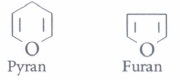
The cyclic structure of glucose is represented by Haworth structure:
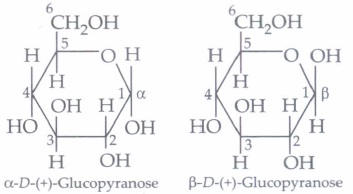
\(\alpha \) and \(\beta\) -D-glucose have different configuration at anomeric (C-l) carbon atom, hence are called anomers and the C-l carbon atom is called anomeric carbon (glycosidic carbon).
The six membered cyclic structure of glucose is called pyranose structure.
The following questions are multiple choice questions. Choose the most appropriate answer:
(i) \(\alpha\) -D(+)-glucose and \(\beta\) -D( +)glucose are
| (a) enantiomers | (b) conformers | (c) epimers | (d) anomers |
(ii) The following carbohydrate is
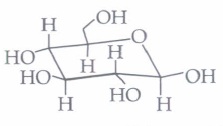
| (a) a ketohexose | (b) an aldohexose |
| (c) an \(\alpha \)-furanose | (d) an \(\alpha \)-pyranose |
(iii) In the following structure,
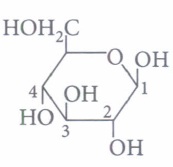
anomeric carbon is
| (a) C-l | (b) C-2 | (c) C-3 | (d) C-4 |
(iv) The term anomers of glucose refers to
| (a) isomers of glucose that differ in configurations at carbons one and four (C-l and C-4) |
| (b) a mixture of (D)-glucose and (L)-glucose |
| (c) enantiomers of glucose |
| (d) isomers of glucose that differ in configuration at carbon one (C-l). |
1.
(ii) Glucose on oxidation with HNO3 gives saccharic acid. This indicates the presence of a one primary alcoholic (-OH) group in glucose.
(iii) The pentaacetate of glucose does not react with hydroxylamine which shows the absence of free aldehydic (-CHO) group.
(iv) In \(\alpha\)-D-glucose, the -OH group at C1 is towards right, whereas in \(\beta\)-D-glucose, the -OH group at C1 is towards left. Such a pair of stereoisomers which differ in the configuration only at C1 are called anomers.
Or
Actually, glucose exists in the cyclic hemiacetal form (hence the aldehyde group is not free) with only a small amount (<0.05%) of the open chain form.
Since, the concentration of the open chain form is low and its reaction with 2,4-DNP is reversible, therefore, formation of 2,4-DNP derivative cannot disturb the equilibrium to regenerate more open chain form from the cyclic hemiacetal form and hence, does not give this test.
2.
(a) Lactose.
(b) Globular protein.
(c) Sucrose
(d) Guanine
(e) Phosphodiester linkage
(f) Vitamin K.
(g) Streptokinase
3.
(i) (a)
(ii) (b): 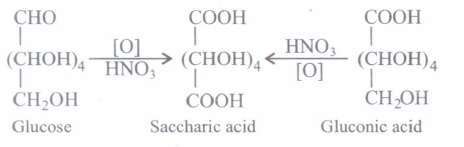
Strong oxidising agents like nitric acid oxidises both the terminal -CHO and -CH2OH groups of glucose to give the dibasic acid, saccharic acid.
(iii) (b)
(iv) (d): If a certain compound gives negative test with ninhydrin and positive test with Benedict's solution then the compound should be a monosaccharide.
4.
(i) (a)
(ii) (a)
(iii) (c) : Glucose contains four chiral centres.
(iv) (c) : Pentacetate of glucose does not react with hydroxylamine showing absence of free -CHO group. This cannot be explained by open structure of glucose.
5.
(i) (d): \(\alpha \)-D-(+)-glucose and \(\beta \) -D-(+)-glucose differ in configuration at C1 (U., anomeric or glycosidic carbon) and hence are called anomers.
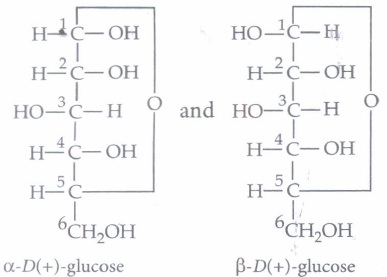
(ii) (b): This structure is an example of pyranose and aldohexose. Here, the carbohydrate's structure is of the \(\beta \) -pyranose form.
(iii) (a) : C-1 is the anomeric carbon.
(iv) (d): Anomers are cyclic monosaccharides or glycosides that are epimers, differing from each other in the configuration at C-1, if they are aldoses or in the configuration at C- 2 if they are ketoses.

12th Standard CBSE Syllabus & Materials
12th Standard CBSE
CBSE 12th Computer Science Python Revision Tour I - New Previous year Question Papers Study Material - QB365 Set A
NEW12th Standard CBSE
CBSE 12th Business Studies Planning Important Questions And Answers Study Material - QB365 Set A
NEW12th Standard CBSE
CBSE 12th Business Studies Business Environment Important Questions And Answers Study Material - QB365 Set A
NEW12th Standard CBSE
CBSE 12th Business Studies Principles of Management Important Questions And Answers Study Material - QB365 Set A



NCERT Books

Syllabus

Exam Pattern

Sample Question Papers

Previous year Question Papers

Important Notes

MCQ Practice test

NCERT Exemplers

Case study Questions

Image Based Questions

Passage based Questions

HOT Questions

Value Based Questions

Model Questions Papers
NCERT ( Book Back ) Questions

Assertion and Reason
Important Questions And Answers

CBSE 12th Standard CBSE Subjects
CBSE Standards








