
 100% FREE ACCESS
12th Standard CBSE Syllabus & Materials
12th Standard CBSE
CBSE 12th Economics Government Budget and the Economy Previous year Question Papers Study Material - QB365 Set A
NEW12th Standard CBSE
CBSE 12th Computer Science Interface Python with MySQL - New Previous year Question Papers Study Material - QB365 Set A
NEW12th Standard CBSE
CBSE 12th Computer Science Database Concept - New Previous year Question Papers Study Material - QB365 Set A
NEW12th Standard CBSE
CBSE 12th Computer Science Data Communication - New Previous year Question Papers Study Material - QB365 Set A
NEW12th Standard CBSE
CBSE 12th Computer Science Data Structures - New Previous year Question Papers Study Material - QB365 Set A
NEW12th Standard CBSE
CBSE 12th Computer Science Functions - New Previous year Question Papers Study Material - QB365 Set A

Published on: 02/11/2025
Download CBSE Class 12th Standard CBSE Chemistry question papers, sample papers, important questions, and previous year solved papers in PDF format. Get free study materials, NCERT solutions, and exam preparation resources for Class 12th Standard CBSE Chemistry
Questions + Answers key
Take MCQ Chemistry Test
1.
Describe a method for the identification of primary, secondary and tertiary amines. Also write chemical equations of the reactions involved.
2.
(i) Give the structures of different isomeric amines corresponding to the molecular formula, C4H11N.
(ii) Write the IUPAC names of all the isomers.
(iii) What type of isomerism is exhibited by different pairs of amines?
3.
Write one chemical equation for each, to illustrate the following reactions:
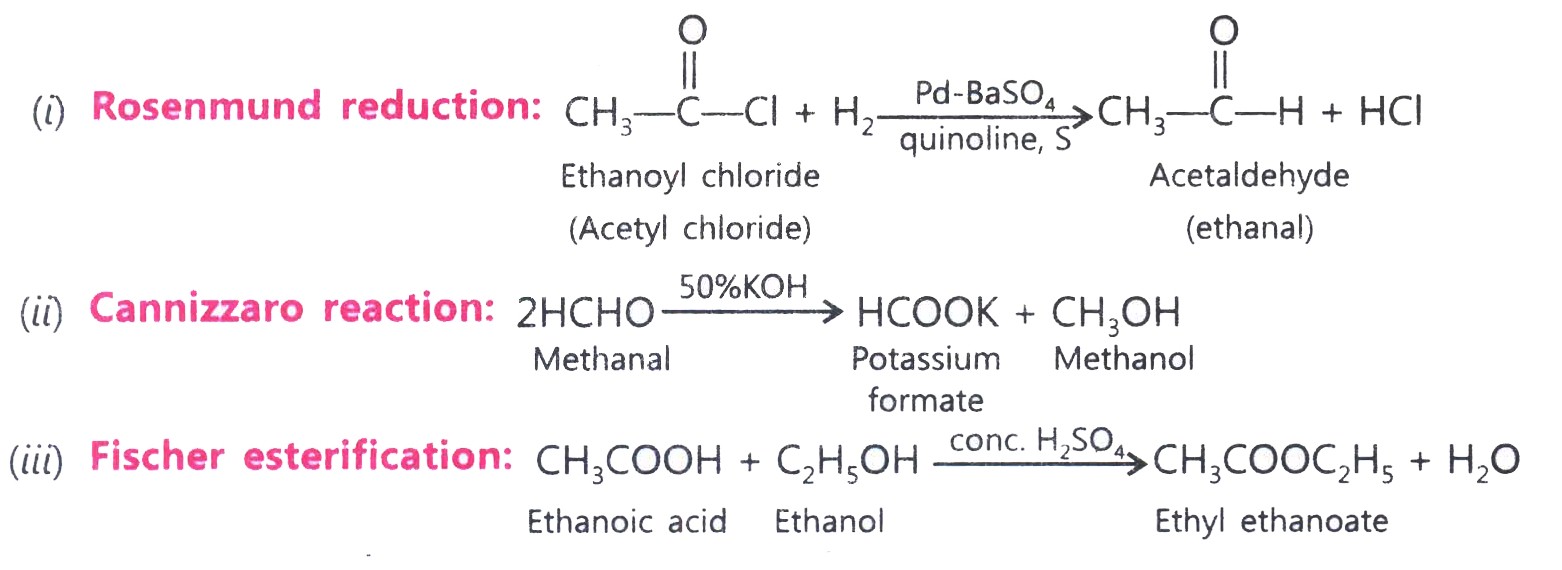
(i) Rosenmund reduction
(ii) Cannizzaro reaction
(iii) Fischer esterification
4.
How are the following conversions carried out?
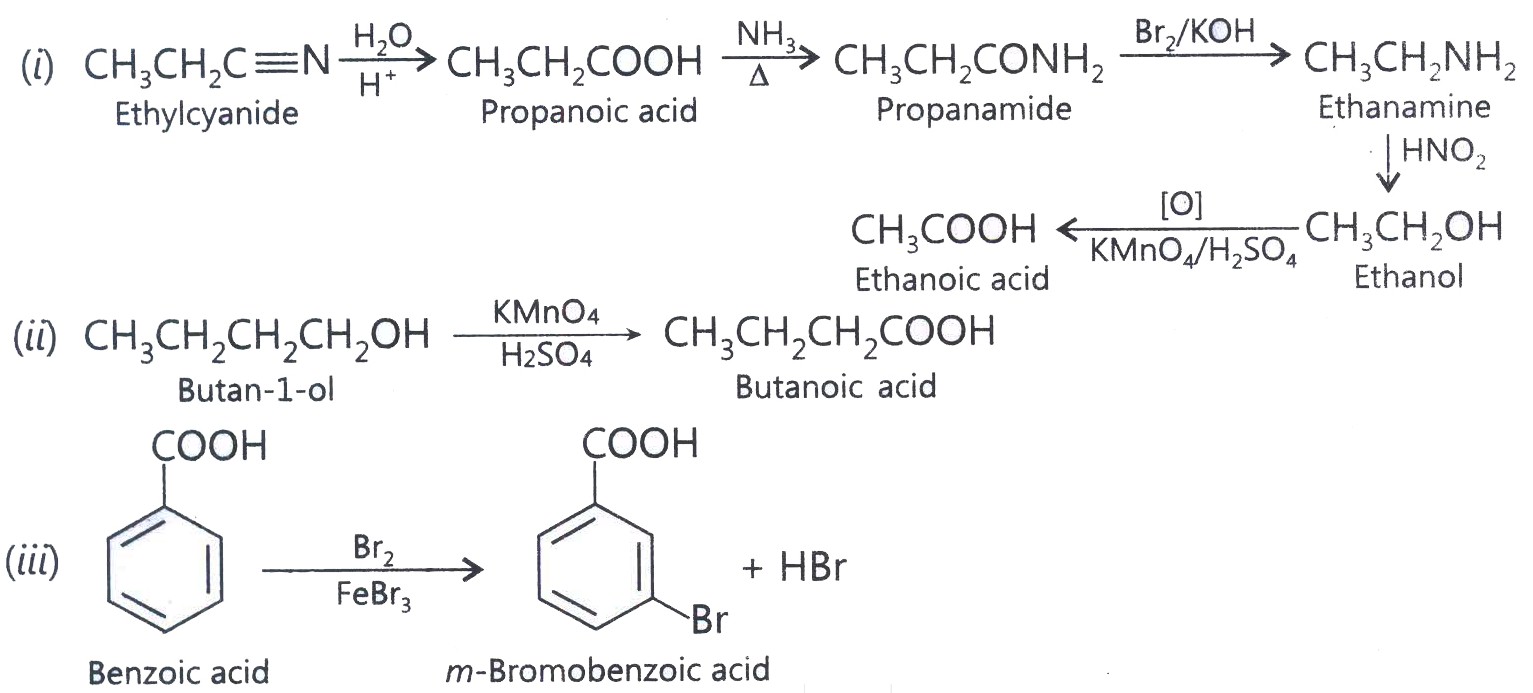
(i) Ethylcyanide to ethanoic acid
(ii) Butan-1-ol to butanoic acid
(iii) Benzoic acid to m-bromobenzoic acid.
5.
For a decomposition reaction the values of rate constant, k at two different temperatures are given below:
k1 = 2.15 \(\times\) 10-8 L mol-1 s-1 at 650 K
k2 = 2.39 \(\times\) 10-7 L mol-1 s-1 at 700 K
Calculate the value of activation energy for this reaction. (R = 8.314 J K-1 mol-1)
6.
In general it is observed that the rate of chemical reaction doubles with every 10o rise in temperature. If the generalization holds good for the reaction in the temperature range 295 K to 305 K, what would be the value of activation energy for the this reaction?
(R = 8.314 J mol-1 K-1)
7.
For a first order reaction, show that time required for 99% completion is twice the time required for the completion of 90% of reaction
8.
Write the reaction involved in carbylamine test.
9.
Arrange the following:
(i) In increasing order of their basic strength:
C6H5NH2, CH3CH2NH2, CH3NHCH3
(ii) In increasing order of solubility in water:
CH3NH2 , (CH3)2N, (CH3)2NH
10.
Describe the following.
(i) Cannizzaro reaction
(ii) Cross aldol condensation
11.
Name the reagents you will use to bring about the following conversions.
a. Ethane nitrile to ethanal
b. But-2-ene to ethanal
12.
A first order reactions has rate constant k = 5.5 \(\times\) 10-14 s-1. Find the half life of the reaction.
13.
The IUPAC name of the compound
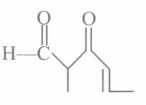
2-Fonnyl hex-2-en-3-one
5-methyl-4-oxo hex-2-en-5al
3-keto-2-methyl hex-5en-al
3-keto-2-methyl hex-4-en-1-al
14.
The product formed by the reaction of an aldehyde with a primary amine is
Carboxylic acid
Aromatic acid
Schiff's base
Ketone
15.
Reduction of aldehydes and ketones into hydrocarbons using zinc amalgam and conc. HCI is called:
Cope reduction
Dow reduction
Wolff Kishner reduction
Clemensen reduction
16.
In the first order reaction the concentration of reactant decreases from 0.6 M to 0.3 M in 30 minutes. The time taken for the concentration to change from 0.1 M to 0.025 M:
60 min
30 min
15 min
50 min
17.
The correct IUPAC name for CH2=CHCH2NHCH3 is
Allylmethylamine
2-amino-4-pentene
4-aminopent-1-ene
N-methylprop-2-en-1-amine
18.
Which of the following can reduce Fehling's solution ?
Formic acid
Formaldehyde
Acetic acid
Acetaldehyde
19.
Benzophenone (C6H5COC6H5) will react with
NaHSO3
CH3OH
HCN
NH2OH
20.
Which of the following will not undergo diazotisation?
m-Toluidine
Aniline
p-Aminophenol
Benzylamine
21.
Ethylamine on heating with CS2 in presence of HgCl2 forms
\({ C }_{ 2 }{ H }_{ 5 }NCS\)
\(\left( { C }_{ 2 }{ H }_{ 5 } \right) _{ 2 }S\)
\(\left( { C }_{ 2 }{ H }_{ 5 } \right) _{ 2 }CS\)
\({ C }_{ 2 }{ H }_{ 5 }\left( CS \right) _{ 2 }\)
22.
When a primary amine reacts with chloroform and ethanolic KOH, then the product formed is
isocyanide
aldehyde
cyanide
alcohol
23.
C6H5CONHCH3 can be converted into C6H5CH2NHCH3 by
NaBH4
H2-Pd/C
LIAIH4
Zn-Hg/HCI
24.
Which of the following reactions will not give a primary amine?
\({ CH }_{ 3 }CON{ H }_{ 2 }\overset { { Br }_{ 2 }/KOH }{ \longrightarrow } \)
\({ CH }_{ 3 }CN\overset { { LiAiH }_{ 4 } }{ \longrightarrow } \)
\({ CH }_{ 3 }NC\overset { { LiAiH }_{ 4 } }{ \longrightarrow } \)
\({ CH }_{ 3 }{ CONH }_{ 2 }\overset { { LiAiH }_{ 4 } }{ \longrightarrow } \)
25.
For the elementary reaction M \(\longrightarrow\) N, the rate of disappearance of M increses by a factor of 8 upon doubling the concentration of M. The order of reaction with respect to M is
4
3
2
1
26.
Under the same reaction conditions, initial concentration of 1.386 mol dm-3 of a substance becomes half in 40 seconds and 20 seconds through first order and zero kinetices respectively. Ratio (k1/k0) of the rate constants for first order (k1) and zero order (k0) of the reactions is
0.5 mol-1 dm3
1.0 mol-1 dm-3
1.5 mol-1 dm-3
2.0 mol-1 dm3
27.
During decomposition of an activated complex
energy is always realeased
energy is always absorbed
energy is not change
reaction may be formed
28.
The rate of the reaction 2 NO + CI2 \(\rightarrow\) 2NOCI is given by the rate equation : rate = k [NO]2 [CI2]. The value of the rate constant can be increased by
increasing the temperature
increasing the concentration of NO
increasing the concentration of CI2
doing all of these
29.
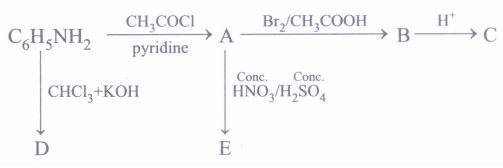
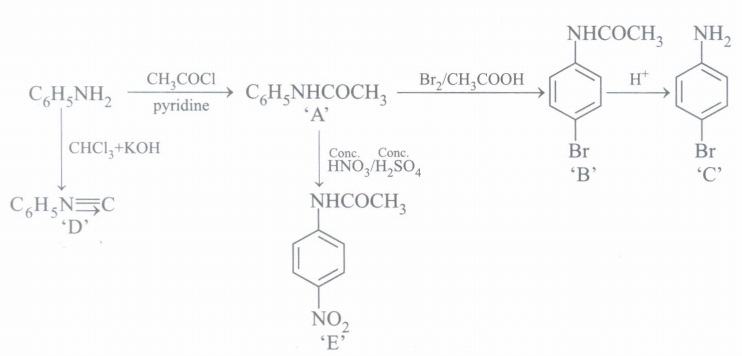
Identify A to E in the following sequence of reaction
30.
Write the reactions involved in the following:
(i) Hofmann bromamide degradation reaction
(ii) Diazotisation
(iii) Gabriel phthalimide synthesis
31.
An aromatic compound 'A' of molecular formula C7H7ON undergoes a series of reactions as shown below. Write the structures of A, B, C, D and E in the following reactions.
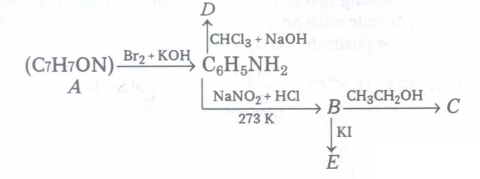
32.
(i) Convert
(a) Benzoic acid to benzaldehyde
(b) Propanone to propane
33.
An alkene 'A' (Molecular formula C5H10 )on ozonolysis gives a mixture of two compounds 'B' and 'C'. Compound 'B' gives positive Fehling's test and also forms iodoform on treatment with I and NaOH. Compound 'C' does not give Fehling's test but forms iodoform. Identify the compounds A, B and C. Write the reaction for ozonolysis and formatiuon of iodoform from B and C.
34.
What is Arrhenius equation to describe the effect of temperature on rate of a reaction? How can it be used to calculate the activation energy of a reaction?
35.
Read the passage given below and answer the following questions:
When the mixture contains the three amine salts (1°, 2° and 3°) along with quaternary salt, it is distilled with KOH solution. The three amines distill, leaving the quaternary salt unchanged in the solution. Then the mixture of amines is separated by fractional distillation, Hinsbergs method and Hoffmann's method.
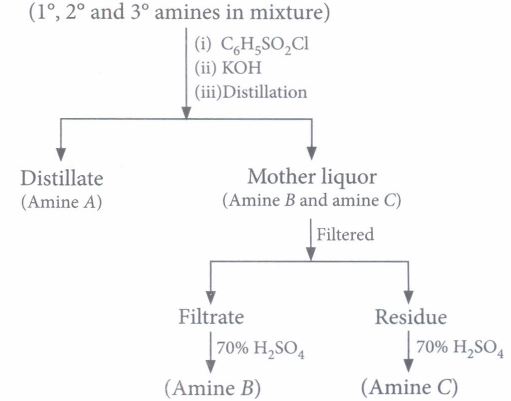
The following questions are multiple choice questions. Choose the most appropriate answer:
(i) Hinsberg reagent is
| (a) aliphatic sulphonyl chloride | (b) phthalamide |
| (c) aromatic sulphonyl chloride | (d) anhydrous ZnCl2 + conc. HCl. |
(ii) Primary amine with Hinsberg's reagent forms
| (a) N-alkyl benzene sulphonamide soluble in KOH solution |
| (b) N-alkyl benzene sulphonamide insoluble in KOH solution |
| (c) N, N-dialkyl benzene sulphonamide soluble in KOH solution |
| (d) N, N-dialkyl benzene sulphonamide insoluble in KOH solution. |
(iii) To separate amines in a mixture Hoffmann's method is used. The Hoffmann's reagent is
| (a) benzenesulphonyl chloride | (b) diethyloxalate |
| (c) benzeneisocyanide | (d) p-toulenesulphonic acid. |
(iv) 3o amines with Hinsberg's reagent give
| (a) no reaction | (b) product which is same as that of 10 amine |
| (c) product which is same as that of 2° amine | (d) products which is a quaternary salt. |
36.
Read the passage given below and answer the following questions :
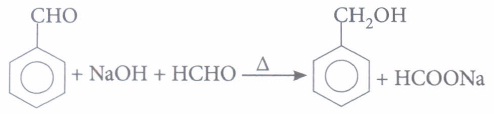
When an aldehyde with no a-hydrogen reacts with concentrated aqueous NaOH, half the aldehyde is converted to carboxylic acid salt and other half is converted to an alcohol. In other words, half of the reactant is oxidized
and other half is reduced. This reaction is known as Cannizzaro reaction
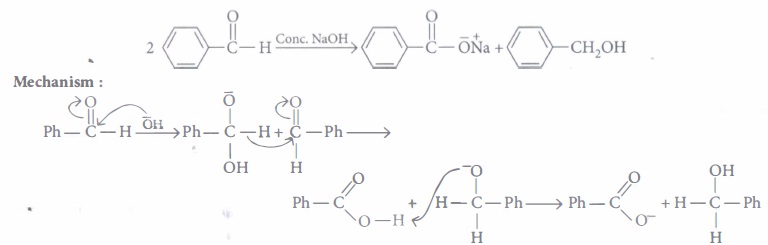
The following questions are multiple choice questions. Choose the most appropriate answer :
(i) A mixture of benzaldehyde and formaldehyde on heating with aqueous NaOH solution gives
| (a) benzyl alcohol and sodium formate | (b) sodium benzoate and methyl alcohol |
| (c) sodium benzoate and sodium formate | (d) benzyl alcohol and methyl alcohol. |
(ii) Which of the following compounds will undergo Cannizzaro reaction?
| (a) CH3CHO | (b) CH3COCH3 |
| (c) C6H5CHO | (d) C6H5CH2CHO |
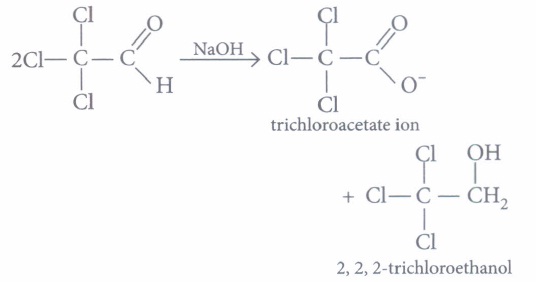
(iii) Trichloroacetaldehyde is subjected to Cannizzaro's reaction by using NaOH. The mixture of the products contains sodium trichloroacetate ion and another compound. The other compounds is
| (a) 2, 2, 2-trichloroethanol | (b) trichloromethanol |
| (c) 2, 2, 2-trichloropropanol | (d) chloroform |
(iv) Which of the following reaction will not result in the formation of carbon-carbon bonds?
| (a) Cannizzaro reaction | (b) Wurtz reaction |
| (c) Reimer- Tiemann reaction | (d) Friedel-Crafts acylation |
1.
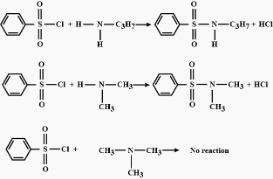
Hinsberg's test is used for the identification of primary, secondary, and tertiary amines.
Hinsberg's reagent is benzenesulphonyl chloride (C6H5SO2Cl).
It reacts differently with primary, secondary, and tertiary amines.
(i) Hinsberg's reagent reacts with primary amines to form N− alkylbenzenesulphonyl amide which is acidic in nature and soluble in alkali.
Note: N− alkylbenzenesulphonyl amide contains a strong electron-withdrawing sulphonyl group. Due to this, the H− atom attached to nitrogen can be removed easily. Hence, it is acidic.
(ii) Hinsberg's reagent reacts with secondary amines to form a sulphonamide which is insoluble in alkali.
Note: As there is no hydrogen atom attached to the N atom in the sulphonamide, it is not acidic and insoluble in alkali.
(iii) Hinsberg's reagent does not react with tertiary amines.
2.
(i) and (ii)
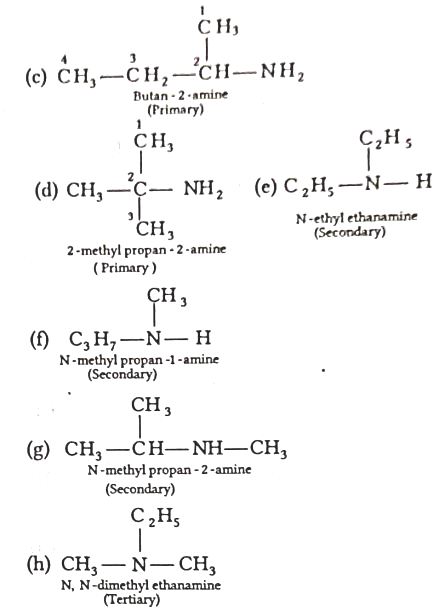
Eight isomers of C4H11N are
(a) \(\stackrel{4}{\mathrm{C}} \mathrm{H}_3-\stackrel{3}{\mathrm{C}} \mathrm{H}_2-\stackrel{2}{\mathrm{C}} \mathrm{H}_2-\stackrel{1}{\mathrm{C}} \mathrm{H}_2-\mathrm{NH}_2\)
Butan -1 -amine
(Primary)
(b) CH3
|
\(\stackrel{3}{CH}_3-{ }^2 \mathrm{CH}-\stackrel{1}{C} \mathrm{H}_2-\mathrm{NH}_2\)
2-methyl propan -1-amine
(Primary)
(iii) Isomerism exhibited by different amines are:
(a) Chain isomers, i.e. have different carbon chains, (a) and (b), (c) and (d) (as discussed in part (i) and (ii)]
(b) Position isomers, i.e. functional group occupy different positions, (a) and (c), (b) and (d).
(c) Metamers, i.e. different alkyl groups are attached to the same functional group, (e) and (f), (e) and (g).
(d) Functional isomers, i.e. they have different functional groups. All the three categories (1°, 2° and 3°) of amines are the functional isomers of each other.
3.
4.
5.
\(\log { \frac { { k }_{ 2 } }{ { k }_{ 1 } } } =\frac { { E }_{ a } }{ 2.303R } \left( \frac { 1 }{ { T }_{ 1 } } -\frac { 1 }{ { T }_{ 2 } } \right)\)
\(\log { \frac { 2.39\times { 10 }^{ -7 } }{ 2.15\times { 10 }^{ -8 } } } =\frac { { E }_{ a } }{ 2.303\times 8.314 } \left( \frac { 1 }{ 650 } -\frac { 1 }{ 700 } \right)\)
\({ E }_{ a }=\frac { 19.147\times 650\times 700\times \left( \log { 23.9 } -\log { 2.15 } \right) }{ 50 } \)
\(=\frac { 19.147\times 650\times 700\times \left( 1.3783-0.3324 \right) }{ 50 } \)
\(=\frac { 19.147\times 650\times 700\times 1.0459 }{ 50\times 1000 } \)
\({ E }_{ a }=\frac { 19.147\times 13\times 7\times 1.0459 }{ 10 }\)
\(=182.23\ kJ/mol\ \)
6.
\({ T }_{ 1 }=295K, \ { T }_{ 2 }=305K, \ { k }_{ 2 }=2{ k }_{ 1 } \ (given)\)
\(\log { \frac { { k }_{ 2 } }{ { k }_{ 1 } } } =\frac { { E }_{ a } }{ 2.303R } \left( \frac { { T }_{ 2 }-{ T }_{ 1 } }{ { T }_{ 1 }{ T }_{ 2 } } \right) \)
\(\log { 2 } = \ \frac { { E }_{ a } }{ 2.303\times 8.314 } \left( \frac { 305-295 }{ 305\times 295 } \right) \)
\({ E }_{ a } \ = \ \frac { 19.147\times 305\times 295\times 0.3010 }{ 10 } \)
\( { E }_{ a } \ = \ 51854.8 \ J \ { mol }^{ -1 }\)
\(=51.85 \ KJ \ { mol }^{ -1 }\)
7.
For first order reaction, \(t=\frac { 2.303 }{ k } \log { \frac { a }{ a-x } } \)
99% completion means that x = 99% of a = 0.99 a
\({ t }_{ 99 }\%\)\(=\frac { 2.303 }{ k } \log { \frac { a }{ a-0.99a } } =\frac { 2.303 }{ k } \log { { 10 }^{ 2 } } =2\times \frac { 2.303 }{ k } \)
90% completion means that x = 90% of a = 0.90 a
\(\therefore \quad { t }_{ 90 }\%\)\(=\frac { 2.303 }{ k } \log { \frac { a }{ a-0.99a } } =\frac { 2.303 }{ k } \log { { 10 } } =2\times \frac { 2.303 }{ k } \)
\(\therefore \quad \frac { { t }_{ 99 } }{ { t }_{ 90 } } ={ \left( \frac { 2\times 2.303 }{ k } \right) }/{ \left( \frac { 2.303 }{ k } \right) }=2\quad \)\({ t }_{ 99 }\%\)\(=2\times { t }_{ 90 }\%\)
8.
In this reaction, the analyte is heated with alcoholic potassium hydroxide and chloroform. If a primary amine is present, the isocyanide (carbylamine) is formed, as indicated by a foul odour. The carbylamine test does not give a positive reaction with secondary and tertiary amines.
9.
(i) C6H5NH2 < CH3CH2NH2 < CH3NHCH3
(ii) (CH3 )3N < (CH3)2NH < CH3NH2
10.
(i) Cannizzaro reaction Aldehydes (not having alpha hydrogen atoms) undergo self oxidation-reduction (disproportionation) reaction. One molecule is oxidized to carboxylic acid and another molecule is reduced to alcohol. Concentrated alkali is the reagent.
(iii) Cross aldol condensation between different carbonyl compounds (aldehydes and ketones). If both reactants contain alpha hydrogen atoms, four different products can be obtained.
11.
a. Tertiary butyl ketone does not give precipitate with sodium bisulphate whereas acetone does.
b. Dialkyl cadmium is considered superior to grignard reagent for the preparation of a ketone from an acid chloride.
12.
\({ t }_{ { 1 }/{ 2 } }=\frac { 0.693 }{ k } \)
\(=\frac { 0.693 }{ 5.5\times { 10 }^{ -14 }{ s }^{ -1 } }\)
\(=1.26\times { 10 }^{ 13 }s\)
13.
(d)
3-keto-2-methyl hex-4-en-1-al
14.
(c)
Schiff's base
15.
(d)
Clemensen reduction
16.
(a)
60 min
17.
\(\overset { 3 }{ C } { H }_{ 2 }=\overset { 2 }{ C } H\overset { 1 }{ C } { H }_{ 2 }NHCH_{ 3 }\quad N-Methylprop-2-en-1\quad amine\)
18.
(d)
Acetaldehyde
19.
(d)
NH2OH
20.
Only \({ 1 }^{ \circ }\) aromic amines undergo diazotisation. Benzylamine is a \({ 1 }^{ \circ }\) aliphatic amine and hence does not undergo diazotisation.
21.
(a)
\({ C }_{ 2 }{ H }_{ 5 }NCS\)
22.
Carbylamine reaction yields isocyanides.
23.
(c)
LIAIH4
24.
(c)
\({ CH }_{ 3 }NC\overset { { LiAiH }_{ 4 } }{ \longrightarrow } \)
25.
(b)
3
26.
(a)
0.5 mol-1 dm3
27.
Activated complex has higher energy. When it decomposes. energy is always realeased and it may give products or reactants back.
28.
(a) : The rate of constant of a reaction depends only on temperature and does not depend upon concentrations of the reactants.
29.
30.
(a) (i) Hofmann Bromamide Degradation Reaction This reaction is used for preparing amine contaning one carbon less than the starting amide. This method was developed for the preparation of primary amines by reacting an amide with Br2/ Cl2 in NaOH/KOH.
In this reaction, migration of an alkyl or aryl group takes place from carbonyl carbon of the amide to the N-atom.
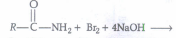
\(\begin{equation} R-\mathrm{NH}_{2}+\mathrm{Na}_{2} \mathrm{CO}_{3}+2 \mathrm{NaBr}+2 \mathrm{H}_{2} \mathrm{O} \end{equation}\)
\(\begin{equation} \text { e.g. } \mathrm{CH}_{3} \mathrm{CH}_{2} \mathrm{CONH}_{2}+\mathrm{Br}_{2}+4 \mathrm{NaOH}\\ \text { Amide } \end{equation}\)⟶\(\begin{equation} \begin{aligned} &3 \mathrm{CH}_{3} \mathrm{CH}_{2} \mathrm{NH}_{2}+\mathrm{Na}_{2} \mathrm{CO}_{3}+2 \mathrm{NaBr}+2 \mathrm{H}_{2} \mathrm{O}\\ &\text { Amine } \end{aligned} \end{equation}\)
(ii) Diazotisation The conversion of primary aromatic amines into their diazonium salts is called diazotisation. Benzene diazonium chloride is prepared by the reaction of aniline with nitrous acid (which is produced by the reaction of NaNO2 and HCI) at 273-278K or 0-5oC as shown below:
\(\begin{array}{r} \mathrm{C}_{6} \mathrm{H}_{5} \mathrm{NH}_{2}+\mathrm{NaNO}_{2}+2 \mathrm{HCl} \stackrel{273-278 \mathrm{~K}}{\longrightarrow} \mathrm{C}_{6} \mathrm{H}_{5} \mathrm{~N^+}_{2}{\mathrm{Cl^-}}+ \mathrm{NaCl}+2 \mathrm{H}_{2} \mathrm{O} \end{array}\)
Due to its unstability, the diazonium salt is not generally stored and is used immediately after its preparation.
(iii) Gabriel Phthalimide Synthesis When a phthalimide is treated with ethanolic KOH, it forms potassium salt of phthalimide which on heating with alkyl halide followed by alkaline hydrolysis forms corresponding primary amines as shown below.
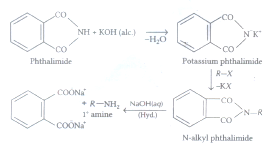
Primary amines are produce through this method without the traces of secondary or tertiary amines. So, this method is preferred for the synthesis of primary amines.
31.
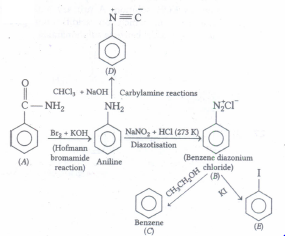
32.

33.
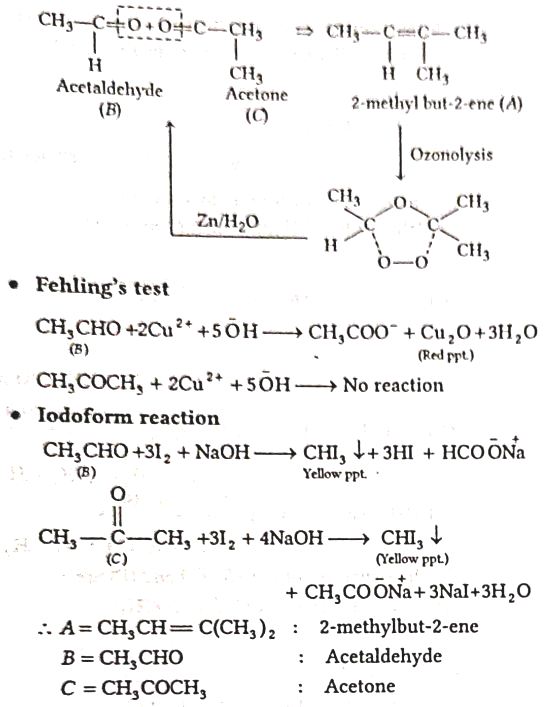
According to the given information compound A (mol formula CH5H10) is an alkene.
A on ozonolysis gives two carbonyl compound. (i.e. have  group) B and C.
B gives Fehling's test, so it is an aldehyde.
B also gives Tollen's test, so it has 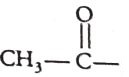 group. That means, B is acetaldehyde.
C does not give Fehling test, so it is a ketone. Also, it gives positive iodoform test so it contain group. That means, B is acetaldehyde.
C does not give Fehling test, so it is a ketone. Also, it gives positive iodoform test so it contain group.
Now, structure of alkene A can be obtained by writing the products of ozonolysis side by side with their  groups facing each other. On removing the oxygen atoms and joining the remaining fragments by a double bond, the structure of alkene 'A' can be obtained which is 2-methylbut-2-ene.
34.
Arrhenius equation. To deduce a quantitative relationship between rate constant and temperature, Arrhenius gave the following equation:
\(k=A{ e }^{ { { -E }_{ a } }/{ RT } }\quad \quad ..(i)\)
where A is a constant of proportionality, Ea is the activation energy which represents the minimum energy that the reacting molecules must possess before undergoing a reaction, T is the absolute temperature and R is the gas constant. This equation is called Arrhenius equation.
Taking logarithm, eq. (i) may be written as
\(ln\ \ \ k=ln\ A-\frac { { E }_{ a } }{ R } \times \frac { 1 }{ T } \quad \)
Converting to logarithm to the base 10 (InX = 2.303 log X), we get
\(2.303\log { k } =2.303\log { A } -\frac { { E }_{ a } }{ RT } \quad \quad ...(ii)\)
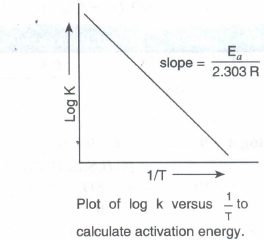
When log k is plotted against \(\frac { 1 }{ T } \) , we get a straight line as shown in diagram.
The intercept of this line is equal to log A and slope is equal to \(-\frac { { E }_{ a } }{ 2.303R } \quad \)
Therefore,
\(Slope=-\frac { { E }_{ a } }{ 2.303R } \)
Knowing the value of slope and gas constant R, activation energy can be calculated as
\({ E }_{ a }=-2.303R\times Slope\)
Alternatively, \({ E }_{ a }\) and A can be calculated by determining the values of rate constant at two different temperatures. Le,t \({ k }_{ 1 }\) and \({ k }_{ 2 }\) are the rate constants for the reaction at two different temperatures \({ T }_{ 1 }\) and \(T_{ 2 }\) respectively. Then,
\(\log { { k }_{ 1 } } =\log { A- } \frac { { E }_{ a } }{ 2.303\quad R{ T }_{ 1 } } \)
\(and\ \ \log { { k }_{ 2 } } =\log { A- } \frac { { E }_{ a } }{ 2.303\quad R{ T }_{ 1 } } \)
Subtracting eq. (iv) from eq. (iii), we get
\(\log { { k }_{ 2 } } -\log { { k }_{ 1 } } =\frac { { E }_{ a } }{ 2.303R } \left[ \frac { 1 }{ { T }_{ 1 } } -\frac { 1 }{ T_{ 2 } } \right] \)
 \(or\ log=\frac { { E }_{ a } }{ 2.303R } \left[ \frac { 1 }{ { T }_{ 1 } } -\frac { 1 }{ T_{ 2 } } \right] \)
By substituting the values of \({ k }_{ 1 }\) and\({ k }_{ 2 }\) and temperatures \({ T }_{ 1 }\) and \(T_{ 2 }\), \({ E }_{ a }\)can be calculated.
35.
(i) (c)
(ii) (a): A primary amine forms N-alkylbenzene sulphonamidewhich because ofthe presence of an acidic hydrogen on the N-atom dissolves in aqueous KOH.
(iii) (b)
(iv) (a): Tertiary amine does not contain a replaceable hydrogen on the nitrogen atom. So, 3o amine does not react with Hinsberg's reagent.
36.
(i) (a): It is an example of cross Cannizzaro reaction where aromatic aldehyde gets reduced to alcohol and aliphatic aldehyde gets oxidised to its sodium salt (both aldehydes must not contain any \(\alpha\)-hydrogen).
(ii) (c)
(iii) (a): The Cannizzaro product of given reaction yields 2, 2, 2-trichloroethanol.
(iv) (a): C-C bond is not formed in Cannizzaro reaction while other reactions result in the formation of C-C bond.

12th Standard CBSE Syllabus & Materials
12th Standard CBSE
CBSE 12th Computer Science Python Revision Tour I - New Previous year Question Papers Study Material - QB365 Set A
NEW12th Standard CBSE
CBSE 12th Business Studies Planning Important Questions And Answers Study Material - QB365 Set A
NEW12th Standard CBSE
CBSE 12th Business Studies Business Environment Important Questions And Answers Study Material - QB365 Set A
NEW12th Standard CBSE
CBSE 12th Business Studies Principles of Management Important Questions And Answers Study Material - QB365 Set A



NCERT Books

Syllabus

Exam Pattern

Sample Question Papers

Previous year Question Papers

Important Notes

MCQ Practice test

NCERT Exemplers

Case study Questions

Image Based Questions

Passage based Questions

HOT Questions

Value Based Questions

Model Questions Papers
NCERT ( Book Back ) Questions

Assertion and Reason
Important Questions And Answers

CBSE 12th Standard CBSE Subjects
CBSE Standards








