
 100% FREE ACCESS
12th Standard CBSE Syllabus & Materials
12th Standard CBSE
CBSE 12th Economics Government Budget and the Economy Previous year Question Papers Study Material - QB365 Set A
NEW12th Standard CBSE
CBSE 12th Computer Science Interface Python with MySQL - New Previous year Question Papers Study Material - QB365 Set A
NEW12th Standard CBSE
CBSE 12th Computer Science Database Concept - New Previous year Question Papers Study Material - QB365 Set A
NEW12th Standard CBSE
CBSE 12th Computer Science Data Communication - New Previous year Question Papers Study Material - QB365 Set A
NEW12th Standard CBSE
CBSE 12th Computer Science Data Structures - New Previous year Question Papers Study Material - QB365 Set A
NEW12th Standard CBSE
CBSE 12th Computer Science Functions - New Previous year Question Papers Study Material - QB365 Set A

Published on: 02/11/2025
Download CBSE Class 12th Standard CBSE Chemistry question papers, sample papers, important questions, and previous year solved papers in PDF format. Get free study materials, NCERT solutions, and exam preparation resources for Class 12th Standard CBSE Chemistry
Questions + Answers key
Take MCQ Chemistry Test
1.
Read the passage given below and answer the following questions:
Amines are basic in nature. The basic strength of amines can be expressed by their dissociation constant, Kb or pKb.
\(\mathrm{RNH}_{2}+\mathrm{H}_{2} \mathrm{O} \rightleftharpoons \mathrm{RNH}_{3}^{+}+\mathrm{OH}^{-}\)
\(K_{b}=\frac{\left[R \mathrm{NH}_{3}^{+}\right]\left[\mathrm{OH}^{-}\right]}{\left[R \mathrm{NH}_{2}\right]} \text { and } \mathrm{p} K_{b}=-\log K_{b}\)
Greater the Kb value or smaller the pKb value, more is the basic strength of amine. Aryl amines such as aniline are less basic than allphatic amines due to the involvement of lone pair of electrons on N-atom with the resonance in benzene. In derivatives of aniline, the electron releasing groups increase the basic strength while electron withdrawing groups decrease the basic strength. The base weakening effect of electron withdrawing group and base strengthening effect of electron releasing group is more marked at p-position than at m-position. o-Substituted aniline is less basic than aniline due to ortho effect and is probable due to combination of electronic and steric effect.
The following questions are multiple choice questions.Choose the most appropriate answer :
(i) Which of the following has lowest pKb value?
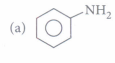 |
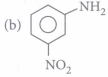 |
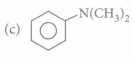 |
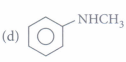 |
(ii) The strongest base among the following is
| (a) C6H5NH2 | (b) p-NO2 - C6H4CH2NH2 |
| (c) m-NO2 - C6H4NH2 | (d) C6H5NH2 |
(iii) Maximum pKb value of
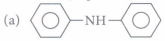 |
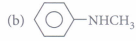 |
| (c) (CH3CH2)2NH | (d) (CH3)2NH |
(iv) Which of the following statements is not correct?
| (a) Methylamine is more basic than NH3 | (b) Amines form hydrogen bonds. |
| (c) Ethylamine has higher boiling point than propane. | (d) Dimethylamine is less basic than methylamine. |
2.
Read the passage given below and answer the following questions:
Amines are alkyl or aryl derivatives of ammonia formed by replacement of one or more hydrogen atoms. Alkyl derivatives are called aliphatic amines and aryl derivatives are known as aromatic amines. The presence of aromatic amines can be identified by performing dye test. Aniline is the simplest example of aromatic amine. It undergoes electrophilic substitution reactions in which - NH2 group strongly activates the aromatic ring through delocalisation oflone pair of electrons of N-atom. Aniline undergoes electrophilic substitution reactions. Ortho and para positions to the -NH2 group become centres of high electrons density. Thus, -NH2 group is ortho and para-directing and powerful activating group. The following questions are multiple choice questions.
Choose the most appropriate answer:
(i) Cyclohexylamine and aniline can be distinguished by
| (a) Hinsberg test | (b) carbylamine test | (c) Lassaigne test | (d) azo dye test |
(ii) Which of the following compounds gives-dye test?
| (a) Aniline | (b) Methyl amine | (c) Diphenyl amine | (d) Ethyl amine |
(iii) Oxidation of aniline with manganese dioxide and sulphuric acid produces
| (a) phenylhydroxylamine | (b) nitrobenzene | (c) p-benzoquinone | (d) phenol. |
(iv) Aniline when treated with conc, HNO3 and H2SO4 gives
| (a) phenylhydroxylamine | (b) m-nitroaniline | (c) p-benzoquinone | (d) nitrobenzene. |
3.
Read the passage given below and answer the following questions:
The amines are basic in nature due to the presence of a lone pair of electron on N-atom of the -NH2 group, which it can donate to electron deficient compounds. Aliphatic amines are stronger bases than NH3 because of the +1 effect of the alkyl groups. Greater the number of alkyl groups attached to N-atom, higher is the electron density on it and more will be the basicity. Thus, the order of basic nature of amines is expected to be 3° > 2° > 1°, however the observed order is 2° > 1° > 3°. This is explained on the basis of crowding on N-atom of the amine by alkyl groups which hinders the approach and bonding by a proton, consequently, the electron pair which is present on N is unavailable for donation and hence 3° amines are the weakest bases. Aromatic amines are weaker bases than ammonia and aliphatic amines. Electron -donating groups such as -CH3 , -OCH3 , etc. increase the basicity while electron-withdrawing substitutes such as -NO2 , -CN, halogens, etc. decrease the basicity of amines. The effect of these substituents is more at p than at m-positions.
The following questions are multiple choice questions. Choose the most appropriate answer :
(i) Which one of the following is the strongest base in aqueous solution?
| (a) Methyl amine | (b) Trimethyl amine | (c) Aniline | (d) Dimethyl amine |
(ii) Which order of basicity is correct?
| (a) Aniline> m-toluidine > o-toluidine | (b) Aniline> o-toluidine > m-toluidine | (c) o-toluidine> aniline> m-toluidine | (d) o-toluidine < aniline < m-toluidine |
(iii) What ts the decreasing order of basicity of primary, secondary and tertiary ethylamines and NH3?
| (a) NH3 > C2H5NH2 > (C2H5)2NH > (C2H5)3N | (b) (C2H5)3N> (C2H5)2NH > C2H5NH2 > NH3 |
| (c) (C2H5)2NH >C2H5NH2 > (C2H5)3N > NH3 | (d) (C2H5)2NH> (C2H5)3N > C2H5NH2 > NH3 |
(iv) Choose the correct statement.
| (a) Methylamine is slightly acidic. | (b) Methylamine is less basic than ammonia. | (c) Methylamine is a stronger base than ammonia. | (d) Methylamine forms salts with alkalie |
4.
Read the passage given below and answer the following questions:
A mixture of two aromatic compounds (A) and (B) was separated by dissolving in chloroform followed by extraction with aqueous KOH solution. The organic layer containing compound (A), when heated with alcoholic solution of KOH produce C7H5N (C) associated with unpleasant odour.
The following questions are multiple choice questions. Choose the most appropriate answer:
The reaction of (A) with alcoholic solution of KOH to produce (C) of unpleasant odour is called
| (a) Sandmeyer reaction | (b) Carbylamine reaction |
| (c) Ullmann reaction | (d) Reimer-Tiemann reaction |
(ii) The alkaline aqueous layer (B) when heated with chloroform and then acidified give a mixture of isomeric compounds of molecular formula C7H6O2. (B) is
| (a) C6H5CHO | (b) C6H5COOH | (c) C6H5CH3 | (d) C6H5OH |
(iii) In the chemical reaction, \(\mathrm{CH}_{3} \mathrm{CH}_{2} \mathrm{NH}_{2}+\mathrm{CHCl}_{3}+3 \mathrm{KOH} \longrightarrow(A)+(B)+3 \mathrm{H}_{2} \mathrm{O},\) the compounds (A) and (B) are respectively
| (a) C2H5NC and KCI | (b) C2H5CN and KCI |
| (c) CH3CH2CONH2 and KCI | (d) C2H5NC and K2CO3 |
(iv) Direct nitration of an aromatic compound (A) is not feasible because
| (a) the reaction cannot be stopped at the mononitration stage |
| (b) a mixture of o, m and p-nitroaniline is always obtained |
| (c) nitric acid oxidises most of the aromatic compound to give oxidation products along with only a small amount of nitrated products |
|
(d) all of the above |
5.
Read the passage given below and answer the following questions:
When the mixture contains the three amine salts (1°, 2° and 3°) along with quaternary salt, it is distilled with KOH solution. The three amines distill, leaving the quaternary salt unchanged in the solution. Then the mixture of amines is separated by fractional distillation, Hinsbergs method and Hoffmann's method.
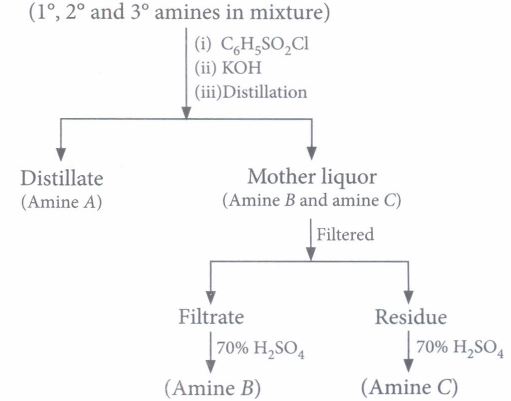
The following questions are multiple choice questions. Choose the most appropriate answer:
(i) Hinsberg reagent is
| (a) aliphatic sulphonyl chloride | (b) phthalamide |
| (c) aromatic sulphonyl chloride | (d) anhydrous ZnCl2 + conc. HCl. |
(ii) Primary amine with Hinsberg's reagent forms
| (a) N-alkyl benzene sulphonamide soluble in KOH solution |
| (b) N-alkyl benzene sulphonamide insoluble in KOH solution |
| (c) N, N-dialkyl benzene sulphonamide soluble in KOH solution |
| (d) N, N-dialkyl benzene sulphonamide insoluble in KOH solution. |
(iii) To separate amines in a mixture Hoffmann's method is used. The Hoffmann's reagent is
| (a) benzenesulphonyl chloride | (b) diethyloxalate |
| (c) benzeneisocyanide | (d) p-toulenesulphonic acid. |
(iv) 3o amines with Hinsberg's reagent give
| (a) no reaction | (b) product which is same as that of 10 amine |
| (c) product which is same as that of 2° amine | (d) products which is a quaternary salt. |
6.
Read the passage given below and answer the following questions:
Aldehydes and ketones having acetyl group 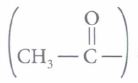 are oxidised by sodium hypohalate (NaOX) or halogen and alkali (X2 + OH-) to corresponding sodium salt having one carbon atoms less than the carbonyl compound and give a haloform.

Sodium hypoiodite (NaOI) when treated with compounds containing CH3CO - group gives yellow precipitate of iodoform. Haloform reaction does not affect a carbon-carbon double bond present in the compound.
The following questions are multiple choice questions. Choose the most appropriate answer:
| (a) Isopropyl alcohol | (b) Propionaldehyde |
| (c) Ethylphenyl ketone | (d) Benzyl alcohol |
(ii) Which of the following compounds is not formed in iodoform reaction of acetone?
| (a) CH3COCH2I | (b) ICH2COCH2I |
| (c) CH3COCHI2 | (d) CH3COCI3 |
(iii) For the given set of reactions
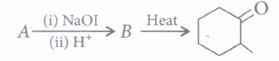
starting compound A corresponds to

(iv) An organic compound 'A' has the molecular formula C3H6O. It undergoes iodoform test. When saturated with HCI it gives 'B' of molecular formula C9H14O. 'A' and 'B' respectively are
| (a) propanal and mesityl oxide | (b) propanone and mesityl oxide |
| (c) propanone and 2,6-dimethyl-2,5-hepta-dien-4-one | (d) propanone and propionaldehyde |
7.
Read the passage given below and answer the following questions :
Carboxylic acids dissociate in water to give carboxylate ion and hydronium ion.
RCOOH + H2O \(\longrightarrow\) RCOO- + H3O+
The acidity of carboxyl group is due to the presence of positive charge on oxygen which liberates proton. The carboxylate ion formed is resonance stabilised.

Carboxylic acids are stronger acids than phenols. Electron withdrawing groups (EWG) increase the acidity of carboxylic acids by stabilising the conjugate base through delocalisation of negative charge by inductive and/ or resonance effects. Electron donating group (EDG) decrease the acidity by destabilising the conjugate base.
The following questions are multiple choice questions. Choose the most appropriate answer :
(i) Which of the following reactions is showing the acidic property of carboxylic acid?

(ii) Which one of the following is the correct order of acidic strength?
| (a) CF3COOH > CHCl2COOH > HCOOH > C6H5CH2COOH > CH3COOH |
| (b) CH3COOH > HCOOH > CF3COOH > CHCl2COOH > C6H5CH2COOH |
| (c) HCOOH > C6H5CH2COOH > CF3COOH > CHCl2COOH > CH3COOH |
| (d) CF3COOH > CH3COOH > HCOOH > CHCl2COOH > C6H5CH2COOH |
(iii) Which of the following acids has the smallest dissociation constant?
| (a) CH3CHFCOOH | (b) FCH2CH2COOH |
| (c) BrCH2CH2COOH | (d) CH3CHBrCOOH |
(iv) The correct order of acidity for the following compounds is
| (a) I > II > III > IV | (b) III > I > II > IV |
| (c) III> IV > II> I | (d) I > III > IV > II |
8.
Read the passage given below and answer the following questions
A tertiary alcohol H upon acid catalysed dehydration gives a product I. Ozonolysis of I leads to compounds J and K. Compound J upon reaction with KOH gives benzyl alcohol and a compound L, whereas K on reaction with KOH gives only M.
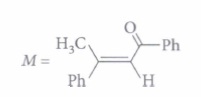
The following questions are multiple choice questions. Choose the most appropriate answer :
(i) Compound H is formed by the reaction of
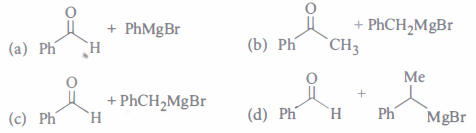
(ii) The structures of compound J, Kand L, respectively, are
| (a) PhCOCH3 , PhCH2COCH3 and PhCH2COO-K+ | (b) PhCHO, PhCH2CHO and PhCOO-K+ |
| (c) PhCOCH3, PhCH2CHO and CH3 COO-K+ | (d) PhCHO, PhCOCH3 and PhCOO-K+ |
(iii) When (J) is treated with acetic anhydride, in the presence of corresponding salt of an acid, the product obtained is
| (a) cinnamic acid | (b) crotonic acid | (c) maleic acid | (d) benzylic acida |
(iv) Which of the following statements is correct for compound (K)?
| (a) It reacts with alkaline KMnO4 followed by acidic hydrolysis and forms benzoic acid. |
| (b) It reacts with iodine and NaOH to form triiodomethane. |
| (c) It is prepared by the reaction of benzene with benzoyl chloride in presence of anhydrous aluminium chloride |
| (d) It reacts with freshly prepared ammoniacal silver nitrate solution |
9.
Read the passage given below and answer the following questions :
When an aldehyde with no a-hydrogen reacts with concentrated aqueous NaOH, half the aldehyde is converted to carboxylic acid salt and other half is converted to an alcohol. In other words, half of the reactant is oxidized
and other half is reduced. This reaction is known as Cannizzaro reaction
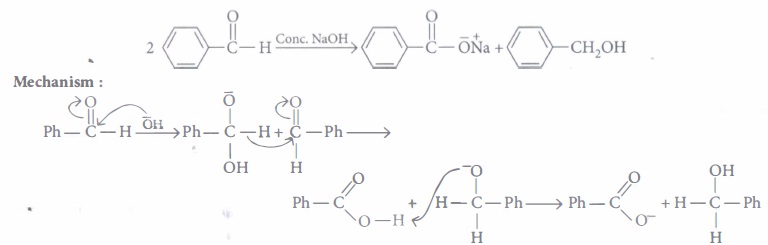
The following questions are multiple choice questions. Choose the most appropriate answer :
(i) A mixture of benzaldehyde and formaldehyde on heating with aqueous NaOH solution gives
| (a) benzyl alcohol and sodium formate | (b) sodium benzoate and methyl alcohol |
| (c) sodium benzoate and sodium formate | (d) benzyl alcohol and methyl alcohol. |
(ii) Which of the following compounds will undergo Cannizzaro reaction?
| (a) CH3CHO | (b) CH3COCH3 |
| (c) C6H5CHO | (d) C6H5CH2CHO |
(iii) Trichloroacetaldehyde is subjected to Cannizzaro's reaction by using NaOH. The mixture of the products contains sodium trichloroacetate ion and another compound. The other compounds is
| (a) 2, 2, 2-trichloroethanol | (b) trichloromethanol |
| (c) 2, 2, 2-trichloropropanol | (d) chloroform |
(iv) Which of the following reaction will not result in the formation of carbon-carbon bonds?
| (a) Cannizzaro reaction | (b) Wurtz reaction |
| (c) Reimer- Tiemann reaction | (d) Friedel-Crafts acylation |
10.
Read the passage given below and answer the following questions:
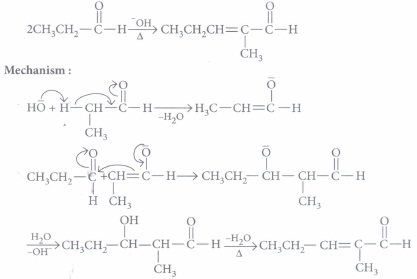
The addition reaction of enol or enolate to the carbonyl functional group of aldehyde or ketone is known as aldol addition. The \(\beta\)-hydroxyaldehyde or \(\beta\)-hydroxyketone so obtained undergo dehydration in second step to produce a conjugated enone. The first part of reaction is an addition reaction and the second part is an elimination reaction. Carbonyl compound having \(\alpha\)-hydrogen undergoes aldol condensation reaction.
The following questions are multiple choice questions. Choose the most appropriate answer:
(i) Condensation reaction is the reverse of which of the following reaction?
| (a) Lock and key hypothesis | (b) Oxidation |
| (c) Hydrolysis | (d) Glycogen formation |
(ii) Which of the following compounds would be the main product of an aldol condensation of acetaldehyde and acetone?
| (a) CH3CH=CHCHO | (b) CH3CH=CHCOCH3 |
| (c) (CH3)2C=CHCHO | (d) (CH3)2C=CHCOCH3 |
(ii) Which combination of carbonyl compounds gives phenyl vinyl ketone by an aldol condensation?
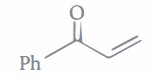
| (a) Acetophenone and Formaldehyde | (b) Acetophenone and acetaldehyde |
| (c) Benzaldehyde and acetaldehyde | (d) Benzaldehyde and acetone |
(iv) Which of the following will undergo aldol condensation?
| (a) HCHO | (b) CH3CH2OH |
| (c) C6H5CHO | (d) CH3CH2CHO |
11.
Read the passage given below and answer the following questions :
In a reaction, the rates of disappearance of different reactants or rates of formation of different products may not be equal but rate of reaction at any instant of time has the same value expressed in terms of any reactant or product. Further, the rate of reaction may not depend upon the stoichiometric coefficients of the balanced chemical equation. The exact powers of molar concentrations of reactants on which rate depends are found experimentally and expressed in terms of 'order of reaction'. Each reaction has a characteristic rate constant depends upon temperature. The units of the rate constant depend upon the order of reaction.
The following questions are multiple choice questions. Choose the most appropriate answer :
(i) The rate constant of a reaction is found to be 3 x 10⁻³ mol-2 L 2 sec-1.The order of the reaction is
| (a) 0.5 | (b) 2 | (c) 3 | (d) 1 |
(ii) In the reaction \(A+3 B \rightarrow 2 C\) ,the rate of formation of C is
| (a) the same as rate of consumption of A | (b) the same as the rate of consumption of B |
| (c) twice the rate of consumption of A | (d) 3/2 times the rate of consumption of B. |
(iii) Rate of a reaction can be expressed by following rate expression, Rate = k[A]2 [B], if concentration of A is increased by 3 times and concentration of B is increased by 2 times, how many times rate of reaction increases?
| (a) 9 times | (b) 27 times | (c) 18 times | (d) 8 times |
(iv) The rate of a certain reaction is given by,rate = k[H+]n . The rate increases 100 times when the pH changes from 3 to 1. The order (n) of the reaction is
| (a) 2 | (b) 0 | (c) 1 | (d) 1.5 |
12.
Read the passage given below and answer the following questions :
Number of molecules which must collide simultaneously to give product is called molecularity. It is equal to sum of coefficients of reactants present in stoichiometric chemical equation. For reaction, \(m_{1} A+m_{2} B \rightarrow \text { Product }\)
Molecularity = [m1 + m2 ]
In complex reaction each step has its own molecularity which is equal to the sum of coefficients of reactants present in a particular step. Molecularity is a theoretical property. Its value is any whole number. Number of concentration terms on which rate of reaction depends is called order of reaction or sum of powers of concentration terms present in the rate equation is called order of reaction.
If rate equation of reaction is : Rate = \(k \cdot C_{A}^{m_{1}} \cdot C_{B}^{m_{2}}\)
Then order of reaction = m1 + m2
In simple reaction, order and molecularity are same. In complex reaction, order of slowest step is the order of over all reaction. This step is known as rate determining step. Order is an experimental property. Its value may be zero, fractional or negative.
The following questions are multiple choice questions. Choose the most appropriate answer:
(i) Higher order (> 3) reactions are rare due to
| (a) shifting of equilibrium towards reactants due to elastic collisions |
| (b) loss of active species on collision |
| (c) low probability of simultaneous collision of all the reacting species |
| (d) increase in entropy and activation energy as more molecules are involved |
(ii) The molecularity of the reaction:
\(6 \mathrm{FeSO}_{4}+3 \mathrm{H}_{2} \mathrm{SO}_{4}+\mathrm{KClO}_{3} \rightarrow \mathrm{KCl}+3 \mathrm{Fe}_{2}\left(\mathrm{SO}_{4}\right)_{3}+3 \mathrm{H}_{2} \mathrm{O} \text { is }\)
| (a) 6 | (b) 3 | (c) 10 | (d) 7 |
(iii) Which of the following statements is false in the following?
| (a) Order of a reaction may be even zero |
| (b) Molecularity of a reaction is always a whole number. |
| (c) Molecularity and order always have same values for a reaction. |
| (d) Order of a reaction depends upon the mechanism of the reaction. |
(iv) The rate of the reaction \(A+B+C \rightarrow \text { products }\) , is given by \(r=-\frac{d[A]}{d t}=k[A]^{1 / 2}[B]^{1 / 3}[C]^{1 / 4}\) ,The order of the reaction is
| (a) \(\frac{1}{3}\) | (b) \(\frac{1}{4}\) | (c) \(\frac{1}{2}\) | (d) \(\frac{13}{12}\) |
13.
Read the passage given below and answer the following questions:
A reaction is said to be of the first order if the rate of the reaction depends upon one concentration term only. For a first order reaction of the type A \(\rightarrow\) Products, the rate of the reaction is given as : rate = k[A]. The differential rate law is given as \(\frac{d A}{d t}=-k[A]\) .The integrated rate law : In \(\frac{[A]}{[A]_{0}}=-k t\) where [A] is the concentration of reactant left at time t and [A]o is the initial concentration of the reactant, k is the rate constant.
The following questions are multiple choice questions. Choose the most appropriate answer :
(i) The unit of rate constant for a first order reaction is
| (a) s-1 | (b) mol L-1 s-1 | (c) L mol-1 s-1 | (d) L2 mol-2 s-1 |
(ii) Half-life period of a first order reaction is 10 min. Starting with initial concentration 12 M, the rate after 20 min is
| (a) 0.693 x 3 M min-1 | (b) 0.0693 x 4 M min-1 | (c) 0.0693 M min-1 | (d) 0.0693 x 3 M min-1 |
(iii) For a first order reaction, (A) \(\rightarrow\) products, the concentration of A changes from 0.1 M to 0.025 M in 40 minutes. The rate of reaction when the concentration of A is 0.01 M, is
| (a) 3.47 x 10⁻⁴ M/min | (b) 3.47 x 10⁻⁵ M/min | (c) 1.73 x 10⁻⁴ M/min | (d) 1.73 x 10⁻⁵ M/min |
(iv) The half-life period of a 1st order reaction is 60 minutes. What percentage will be left over after 240 minutes?
| (a) 6.25% | (b) 4.25% | (c) 5% | (d) 6% |
14.
Read the passage given below and answer the following questions:
For the reaction: \(2 \mathrm{NO}_{(g)}+\mathrm{Cl}_{2(g)} \rightarrow 2 \mathrm{NOCl}_{(g)}\), the following data were collected. All the measurements were taken at 263 K.
| Experiment No. |
Initial [NO] (M) | Initial [Cl2] (M) | Initial rate of disapp. of Cl2 (M/min) |
| 1. | 0.15 | 0.15 | 0.60 |
| 2.` | 0.15 | 0.30 | 1.20 |
| 3. | 0.30` | 0.15 | 2.40 |
| 4 | 0.25 | 0.25 | ? |
The following questions are multiple choice questions. Choose the most appropriate answer:
(i) The molecularity of the reaction is
| (a) 1 | (b) 2 | (c) 3 | (d) 4 |
(ii) The expression for rate law is
| (a) r = k[NO][Cl2] | (b) r = k[NO]2[Cl2 ] | (c) ) r = k[NO][Cl2]2 | (d) r = k[NO]2[Cl2]2 |
(iii) The overall order of the reaction is
| (a) 2 | (b) 0 | (c) 1 | (d) 3 |
(iv) The value of rate constant is
| (a) 150.32 M-2 min-1 | (b) 200.08 M-1 min-1 | (c) 177.77 M-2 min-1 | (d) 155.75 M-1 min-1 |
15.
Read the passage given below and answer the following questions :
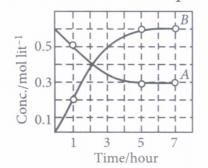
The progress of the reaction, \(A \rightleftharpoons n B\) with time is represented in the following figure.
The following questions are multiple choice questions. Choose the most appropriate answer:
(i) What is the value of n?
| (a) 1 | (b) 2 | (c) 3 | (d) 4 |
(ii) Find the-value of the equilibrium constant
| (a) 0.6 M | (b) 1.2M | (c) 0.3M | (d) 2.4M |
(iii) The initial rate of conversion of A will be
| (a) 0.1 mol L-1 hr-1 | (b) 0.2 mol L-1 hr-1 | (c) 0.4 mol L-1 hr-1 | (d) 0.8 mol L-1 hr-1 |
(iv) For the reaction, if \(\frac{d[B]}{d t}=2 \times 10^{-4}\) , value of \(-\frac{d[A]}{d t}\) will be
| (a) 2 x 10- 4 | (b) 10-4 | (c) 4 x 10- 4 | (d) 0.5 x 10- 4 |
1.
(i) (c)
(ii) (d)
(iii) (a)
(iv) (d): Dimethylamine is more basic than methyl amine.
2.
(i) (d)
(ii) (a): Aromatic primary amines give dye test.
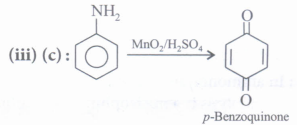
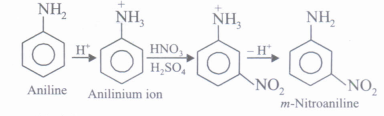
(iv) (b): In acidic medium aniline gets protonated to anilinium ion which is meta-directing.
3.
(i) (d): The increasing order of basicity of the given compounds is (CH3)2NH > CH3NH2 > (CH3)3N > C6H5NH2 .Due to the +1effect of alkyl groups, the electron density on nitrogen increases and thus, the availability of the lone pair of electrons to proton increases and hence, the basicity of amines also increases. So, aliphatic amines are more basic than aniline. In case of tertiary amine (CH3)3N, the covering of alkyl groups over nitrogen atom from all sides makes the approach and bonding by a proton relatively difficult, hence the basicity decreases. Electrop withdrawing groups decrea e electron density on nitrogen atom and thereby decreasing basicity.
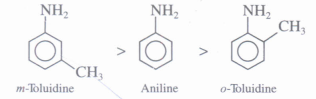
(ii) (d): In general, electron donating (+ R) group which when present on benzene ring (-NH2 , -OR, -R, etc.) at the para position increases the basicity of aniline.
Ortho substituted anilines are weaker bases than aniline due to ortho effect.
(iii) (d): In case of ethylamines, the combined effect of inductive effect, steric effect'and solvation effect gives the order of basic strength as
(C2H5)3N> (C2H5)2NH > C2H5NH2 > NH3
(2°) (3°) (1°)
(iv) (c) : Methyl amine is stronger base than ammonia due to electron releasing inductive effect of methyl group.
4.
(i) (b) : Carbylamine reaction
C6H5NH2 + CHCl3 + 3KOH (alc.) ➝ C6H52NC + 3KCI + 3H2O
Aniline Phenyl isocyanide (C)
(A)
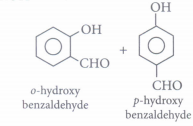
(ii) (d): Alkaline layer on treating with CHCl3 followed by acidification gives two is?mers having formula (C7H6O2). This is Reimer-Tiemann reaction and thus (B) is C6H5OH.
\(
\mathrm{C}_{6} \mathrm{H}_{5} \mathrm{OH}+\mathrm{CHCl}_{3}+\mathrm{KOH} \stackrel{\mathrm{H}^{+}}{\longrightarrow}\\
\text { Phenol }(B)
\) 
(iii) (a): CH3CH2NH2 + CHCl3 + 3KOH ➝ C2H5NC + 3KCl + 3H2O
This is called carbylamine reaction.
(iv) (c): Direct nitration of aniline is not a feasible process because nitric acid oxidises most of aniline to give oxidation products along with only a small amount of nitrated products.
5.
(i) (c)
(ii) (a): A primary amine forms N-alkylbenzene sulphonamidewhich because ofthe presence of an acidic hydrogen on the N-atom dissolves in aqueous KOH.
(iii) (b)
(iv) (a): Tertiary amine does not contain a replaceable hydrogen on the nitrogen atom. So, 3o amine does not react with Hinsberg's reagent.
6.
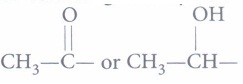
(i) (a): Iodoform test is given by the organic compounds having
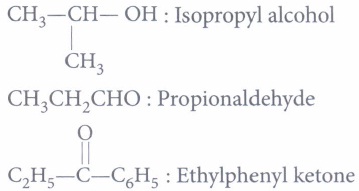
C6H5 - CH2-OH : Benzyl alcohol
Therefore, isopropyl alcohol will give positive iodoform test.
(ii) (b): Iodoform reaction of acetone occurs in following steps
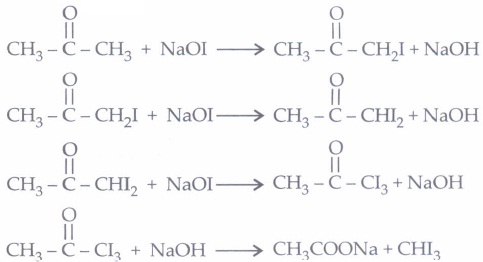
(iii) (c): Given reagents indicate the presence of -COCH3 group in the starting compound A. Further, since the -COOH group introduced in B due to iodoform reaction is absent in the final product, B should be a p-keto acid. Hence, A should have structure given in option (c).
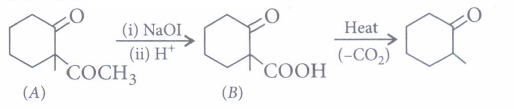
(iv) (c): Since compound A(C3H6O) undergoes iodoform test, it must be CH3COCH3 (propanone). Further, the compound 'B' obtained from 'A' has three times more the number of carbon atoms as in 'A' (propanone), 'B' must be phorone, i.e., 2,6-dimethyl-2, 5-heptadien -4-one.
\(\left(\mathrm{CH}_{3}\right)_{2} \mathrm{C}=\mathrm{O}+\mathrm{H}_{3} \mathrm{CCOCH}_{3}+\mathrm{O}=\mathrm{C}\left(\mathrm{CH}_{3}\right)_{2}\) \(\stackrel{\mathrm{HCl}}{\rightarrow}\left(\mathrm{CH}_{3}\right)_{2} \mathrm{C}=\mathrm{CHCOCH}=\mathrm{C}\left(\mathrm{CH}_{3}\right)_{2}\)
A, propanone(3 molecules) 2,6-dimethyl- 2,5-heptadien-4-one
7.
(i) (d): All the reactions are showing the acidic properties of carboxylic acid. Carboxylic acid forms the sodium salts with all i.e., alkali metals, NaOH and Na2CO3 etc. and removes the acidic proton from the carboxylic acid.
(ii) (a): In general, greater the +I effect of the group attached to the carboxyl group, lesser will be the acidic strength and greater the -I effect ofthe group, greater will be acidic strength. As number of halogen atoms and electronegativity of halogen atom increases, acidic strength increases. Thus, correct order of acidic strength is
CF3COOH> CHCl2COOH > HCOOH > C6H5CH2COOH > CH3COOH
(iii) (c) : Stronger -I group attached closer to - COOH makes the acid stronger, i.e., acid has the larger dissociation constant. - Br shows poor (-I) effect and also far away from -COOH group i.e., option (c) has smallest dissociation constant.
(iv) (a): Due to ortho-effect, (I) and (II) are stronger acids than (III) and (IV). Due to two ortho-hydroxyl groups in (I), it is stronger acid than (II). (III) is a stronger acid than (IV) because at m-position, -OH group cannot exert its +R effect but can only exert its -I effect while at p-position, -OH group exerts its strong +R effect. Thus, the correct order of acidity is : I > II > III > IV.
8.
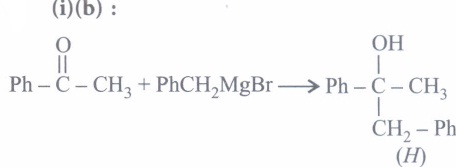
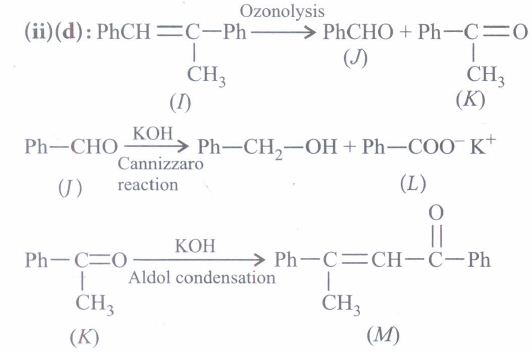
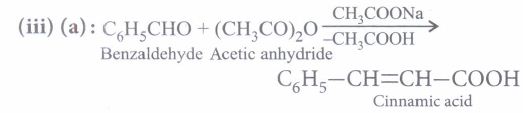
(iv) (b)
9.
(i) (a): It is an example of cross Cannizzaro reaction where aromatic aldehyde gets reduced to alcohol and aliphatic aldehyde gets oxidised to its sodium salt (both aldehydes must not contain any \(\alpha\)-hydrogen).
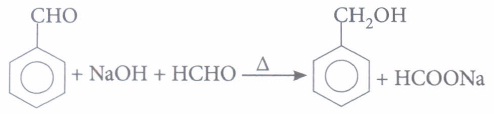
(ii) (c)
(iii) (a): The Cannizzaro product of given reaction yields 2, 2, 2-trichloroethanol.
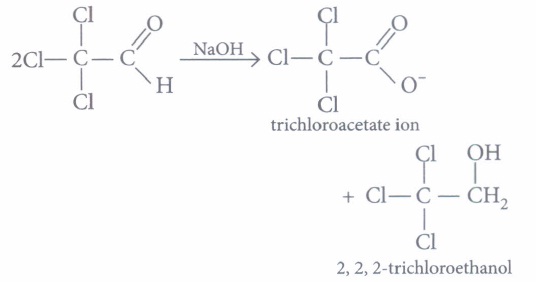
(iv) (a): C-C bond is not formed in Cannizzaro reaction while other reactions result in the formation of C-C bond.
10.
(i) (c) : Condensation reaction is the reverse of hydrolysis, which splits a chemical entity into two parts through the action of the polar water molecule
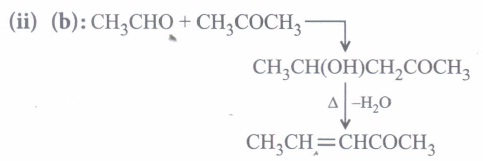
(iii) (a)
(iv) (d)
11.
(i) (c) : Unit of k for nth order = (mol L-1 )1-n sec-1.
Here,k = 3 x 10⁻³ mol-2 L2 sec-1 ...(i)
Unit of \(k=m o l^{-2} L^{2} \sec ^{-1} \Rightarrow\left(m o l L^{-1}\right)^{-2} \sec ^{-1}\) ...(ii)
Comparing (i) and (ii) we get, \(1-n=-2 \Rightarrow n=3\)
(ii) (c) : \(\text { Rate }=-\frac{d[A]}{d t}=-\frac{1}{3} \frac{d[B]}{d t}=\frac{1}{2} \frac{d[C]}{d t}\)
(iii) (c) : Given R1 = k[A]2 [B]
According to question R2 = k[3A]2 [2B]
= k x 9 [A]2 x 2 [B] = 18 x k [A]2 [B] = 18 R1
(iv) (c) : Rate (r) = k[H+]n
When pH = 3 ; [H+] = 10-3 and when pH = 1 ; [H+] = 10-1.
\(\therefore \quad \frac{r_{1}}{r_{2}}=\frac{k\left(10^{-3}\right)^{n}}{k\left(10^{-1}\right)^{n}} \Rightarrow \frac{1}{100}=\left(\frac{10^{-3}}{10^{-1}}\right)^{n}\left(\because r_{2}=100 r_{1}\right)\)
\(\Rightarrow \quad\left(10^{-2}\right)^{1}=\left(10^{-2}\right)^{n} \Rightarrow n=1\)
12.
(i) (c) : The reactions of higher order are very rare because of the less chances of the molecules to come together simultaneously and collide.
(ii) (c) : The total number of reactant molecules participating in a chemical reaction is known as its rnolecularity, hence the molecularity = 6 + 3 + 1 = 10.
(iii) (c) : Molecularity mayor may not be equal to the order of a reaction.
(iv) (d) : Order of reaction \(=\frac{1}{2}+\frac{1}{3}+\frac{1}{4}=\frac{6+4+3}{12}=\frac{13}{12}\)
13.
(i) (a) : Unit of rate constant for a reaction of nth order = (conc.)1-n time-1
For a first order reaction, n = 1
Unit of rate constant = (mol L-1)1 - 1 s-1= s-1
(ii) (d) : \(\underset{\text { Initial conc. }}{12 \mathrm{M} \stackrel{t_{1 / 2}}{\longrightarrow}} 6 \mathrm{M} \stackrel{t_{1 / 2}}{\longrightarrow} 3 \mathrm{M}\)
t1/2 = 10 min
\(k=\frac{0.693}{10}=0.0693 \mathrm{~min}^{-1}\)
As t1/2 is 10 min, after 20 minutes the concentration will be 3 M.
Hence, Rate = 0.0693 x 3 M min-1
(iii) (a) : For the first order reaction,
\(k=\frac{2.303}{t} \log \frac{a}{a-x}\)
a = 0.1 M, a - x = 0.025 M, t = 40 min
\(k=\frac{2.303}{40} \log \frac{0.1}{0.025}=\frac{2.303}{40} \log 4=0.0347 \mathrm{~min}^{-1}\)
\([A] \rightarrow \text { product }\)
Thus, rate = k[A]
rate = 0.0347 x 0.01 M min-1= 3.47 x 10⁻⁴ M min-1
(iv) (a) : \(t_{1 / 2}=\frac{0.693}{k} \Rightarrow \frac{0.693}{t_{1 / 2}}=k \Rightarrow \frac{0.693}{60}=k\)
k = 0.01155 min-1
\(k=\frac{2.303}{t} \log \left(\frac{a}{a-x}\right)\)
Let the initial amount (a) be 100
\(0.01155 \mathrm{~min}^{-1}=\frac{2.303}{240 \mathrm{~min}} \log \left(\frac{100}{a-x}\right)\)
1.204 = log100 - log(a-x)
1.204 = 2 - log(a-x)
log (a - x) = 2 - 1.204 = 0.796
(a - x) = 6.25%
14.
(i) (c) : \(2 \mathrm{NO}_{(g)}+\mathrm{Cl}_{2(g)} \rightarrow 2 \mathrm{NOCl}_{(g)}\)
Molecularity = 3
(ii) (b) : Let rate of this reaction, r = k[NO]m[CI2 ]n then \(\frac{r_{1}}{r_{2}}=\frac{0.60}{1.20}=\frac{k(0.15)^{m}(0.15)^{n}}{k(0.15)^{m}(0.30)^{n}}\)
or \(\frac{1}{2}=\left(\frac{1}{2}\right)^{n} \Rightarrow n=1\)
Again from \(\frac{r_{2}}{r_{3}}=\frac{1.20}{2.40}=\frac{k(0.15)^{m}(0.30)^{n}}{k(0.30)^{m}(0.15)^{n}}\)
or \(\frac{1}{2}=\left(\frac{1}{2}\right)^{m} \cdot \frac{2}{1} \text { or } \frac{1}{4}=\left(\frac{1}{2}\right)^{m} \Rightarrow m=2\)
Hence, expression for rate law is
r = k[NO] 2[Cl2 ]1
(iii) (d) : As the order W.r.t. NO is 2 and order W.r.t. Cl2 is 1, hence the overall order is 3.
(iv) (c) : Substituting the values of experiment 1 in rate law expression
0.60 M min-1 = k(0.15 M)2 (0.15 M)1
or \(k=\frac{0.60 \mathrm{Mmin}^{-1}}{0.0225 \times 0.15 \mathrm{M}^{3}}=177.77 \mathrm{M}^{-2} \mathrm{~min}^{-1}\)
15.
(i) (b) : According to the figure, in the given time of 4 hours (1 to 5) concentration of A falls from 0.5 to 0.3 M, while in the same time concentration of B increases from 0.2 to 0.6 M.
Decrease in concentration of A in 4 hours
= 0.5 - 0.3 = 0.2 M
Increase in concentration of B in 4 hours
= 0.6 - 0.2 = 0.4 M
Thus, increase in concentration of B in a given time is twice the decrease in concentration of A. Thus, n = 2
(ii) (b) : \(K=\frac{[B]^{2}}{[A]}=\frac{(0.6)^{2}}{0.3}=1.2 \mathrm{M}\)
(iii) (a) : From t = 0 to t = 1 hr,
For A, dx = 0.6 - 0.5 = 0.1 mol L-1
\(\therefore\) Initial rate of conversion of \(A=\frac{d x}{d t}\)
\(=\frac{0.1 \mathrm{~mol} \mathrm{~L}^{-1}}{1 \mathrm{hr}}=0.1 \mathrm{~mol} \mathrm{~L}^{-1} \mathrm{hr}^{-1}\)
(iv) (b) : \(A \rightleftharpoons 2 B\)
\(-\frac{d[A]}{d t}=+\frac{1}{2} \frac{d[B]}{d t}=\frac{1}{2} \times 2 \times 10^{-4}=10^{-4}\)

12th Standard CBSE Syllabus & Materials
12th Standard CBSE
CBSE 12th Computer Science Python Revision Tour I - New Previous year Question Papers Study Material - QB365 Set A
NEW12th Standard CBSE
CBSE 12th Business Studies Planning Important Questions And Answers Study Material - QB365 Set A
NEW12th Standard CBSE
CBSE 12th Business Studies Business Environment Important Questions And Answers Study Material - QB365 Set A
NEW12th Standard CBSE
CBSE 12th Business Studies Principles of Management Important Questions And Answers Study Material - QB365 Set A



NCERT Books

Syllabus

Exam Pattern

Sample Question Papers

Previous year Question Papers

Important Notes

MCQ Practice test

NCERT Exemplers

Case study Questions

Image Based Questions

Passage based Questions

HOT Questions

Value Based Questions

Model Questions Papers
NCERT ( Book Back ) Questions

Assertion and Reason
Important Questions And Answers

CBSE 12th Standard CBSE Subjects
CBSE Standards








