
 100% FREE ACCESS
12th Standard CBSE Syllabus & Materials
12th Standard CBSE
CBSE 12th Economics Government Budget and the Economy Previous year Question Papers Study Material - QB365 Set A
NEW12th Standard CBSE
CBSE 12th Computer Science Interface Python with MySQL - New Previous year Question Papers Study Material - QB365 Set A
NEW12th Standard CBSE
CBSE 12th Computer Science Database Concept - New Previous year Question Papers Study Material - QB365 Set A
NEW12th Standard CBSE
CBSE 12th Computer Science Data Communication - New Previous year Question Papers Study Material - QB365 Set A
NEW12th Standard CBSE
CBSE 12th Computer Science Data Structures - New Previous year Question Papers Study Material - QB365 Set A
NEW12th Standard CBSE
CBSE 12th Computer Science Functions - New Previous year Question Papers Study Material - QB365 Set A

Published on: 02/11/2025
Download CBSE Class 12th Standard CBSE Chemistry question papers, sample papers, important questions, and previous year solved papers in PDF format. Get free study materials, NCERT solutions, and exam preparation resources for Class 12th Standard CBSE Chemistry
Questions + Answers key
Take MCQ Chemistry Test
1.
How will you distinguish between C6H5CH2NH2 and C6H5NH2? Write the chemical equations for the reactions involved.
2.
Hoe is aniline obtained from benzoic acid?
3.
Why is an alkylamine more basic than ammonia?
4.
A reaction is of first order in reactant A and of second order in reactant B. How is the rate of this reaction affected when
(i) the concentration of B alone is increased to three times
(ii) the concentrations of A as well as B are doubled?
5.
Why does the rate of a reaction not remain constant throughout the reaction process?
6.
A first order reaction has a specific reaction of 10-3 sec-1 . How much time will it take for 10g of the reaction to 2.5g? Given log2 = 0.301, log4 = 0.6021, log6 = 0.778.
7.
Explain why the amino group in aniline acts as a powerful activator and ortho and para director towards electrophilic substitution reaction.
8.
A compound 'A' of molecular formula C3H7O2N on reactin with Fe and conc.HCI gives a compound 'B' of molecular formula C3H9N. Compound 'B' on treatement with NaNO2 and HCI gives another compound 'C' of molecular formula C3H8O. The compound 'C' gives effervescence with Na. On oxidation with CrO3, the cmpound 'C' gives a saturated aldehyde containing three carbon atoms. Deduce the structures of A, B and C and write the equations for the reaction involved.
9.
(i) Stating the necessary reaction condition write chemical reaction equations to obtain the following:
Chlorobenzene from aniline
(ii) Identify A and B in the following:
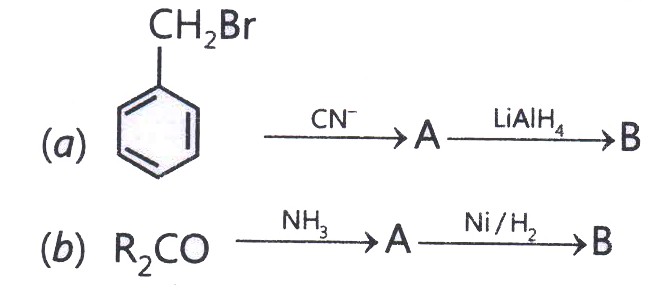
10.
A first order reaction takes 100 minutes for completion of 60% of the reaction. Find the time when 90% of the reaction will be completed.
11.
(a) Illustrate the following reactions giving suitable example in each case:
(i) Ammonolysis
(ii) Coupling reaction
(iii) Acetylation of amines
(b) Describe Hinsberg method for the identification of primary, secondary and tertiary amines. Also write the chemical equations of the reactions involved.
12.
(i) Write the rate law for a first order reaction. Justify the statement that half life for a first order reaction is independent of the initial concentration of the reactant.
(ii) For a first order reaction, show that the time required for 99% completion of a first order reaction is twice the time required for the completion of 90%.
13.
What is Arrhenius equation to describe the effect of temperature on rate of a reaction? How can it be used to calculate the activation energy of a reaction?
14.
(i) tert-Butylamine cannot be prepared by the action of NH3 on tert-butyl bromide. Explain why?
(ii) Suggest a convenient method for the preparation of tert-butylamine.
15.
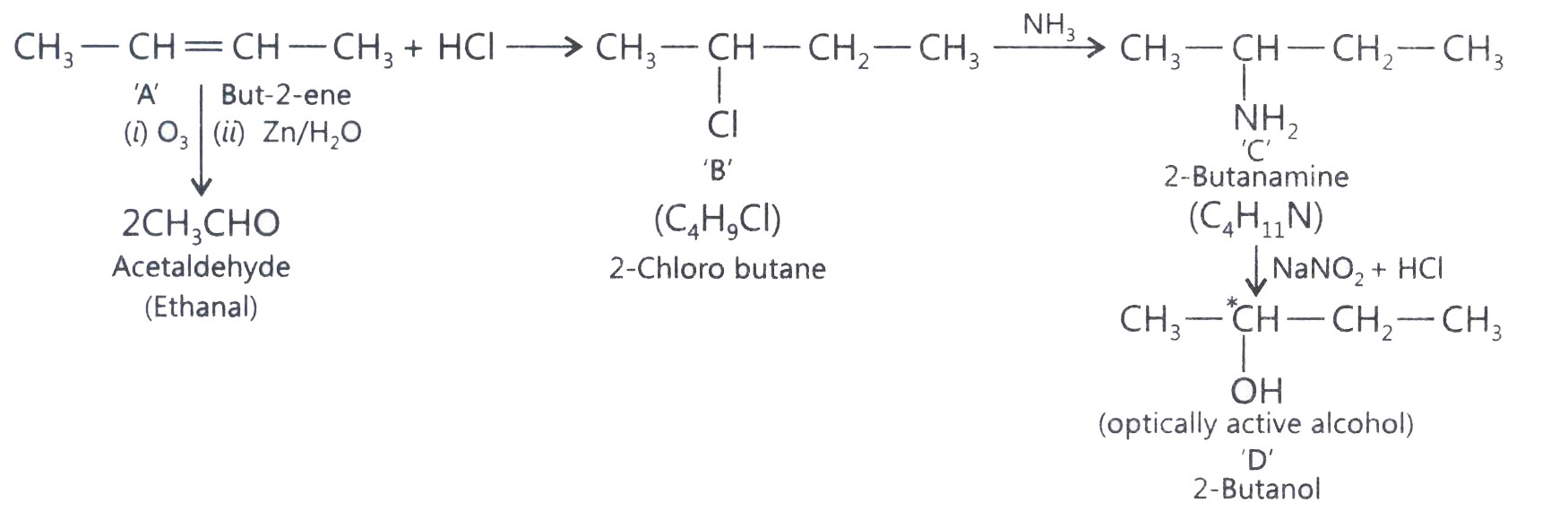
A hydrocarbon 'A' (C4H8) on reaction with HCI gives a compound 'B' , (C4H11N). On reacting with NaNO2 and HCI followed by treatment with water, compound 'C'. Ozonolysis of 'A' gives 2 moles of acetaldehyde. Identify compounds 'A' to 'D' . Explain the reactions involved.
16.
(a) Define the following:
(i) Order of a reaction
(ii) Elementary step in a reaction
(b) A first order reaction has a rate constant value of 0.00510 min-1. If we begin with 0.10 M concentration of the reactant, how much of the reactant will remain after 3.0 hours?
17.
When a primary amine reacts with chloroform and ethanolic KOH, then the product formed is
isocyanide
aldehyde
cyanide
alcohol
18.
C6H5CONHCH3 can be converted into C6H5CH2NHCH3 by
NaBH4
H2-Pd/C
LIAIH4
Zn-Hg/HCI
19.
A chemical reaction was carried out at 300 K and 280 K the rate constants were found to be K1 and K2 respectively. Then
K2 = 4K1
K2 = 2K1
K2 = 0.25 K
K2 = 0.5 K1
20.
The unit of rate constant for a zero order reaction is
mol L-1 s-1
L mol-1 s-1
L2mol-1 s-1
s-1
21.
The rate of a gaseous reaction is given by the expression k [A][B]. If the volume of the reaction vessel is suddenly reduced to 1/4 th of the initial volume, the reaction rate relating to original rate will be
1/10
1/8
8
16
1.
Add CHCI3 and alc. KOH,C6H5 - NH2 gives foul smell of isocyanide whereas C6H5 - NH - CH3 does not.
2.

3.
It is because alkyl groups are electron releasing in alkyl amines, they will increase electron density on 'N', therefore, they are more basic than NH3.
4.
\((i) \ Rate \ =k{ \left[ A \right] }^{ 1 }{ \left[ B \right] }^{ 2 }\)
\(Rate \ =k{ \left[ A \right] }{ \left[ 3B \right] }^{ 2 }\)
\(Rate \ =9k{ \left[ A \right] }{ \left[ B \right] }^{ 2 }\)
If concentration of 'B' alone increases three times, the rate will increase nine times.
(ii) If concentration of 'A' as well as 'B' is doubled, rate \(=k{ \left[ 2A \right] }^{ 1 }{ \left[ 2B \right] }^{ 2 }\), the rate will increase eight times.
So rate \(=k{ \left[ 2A \right] }^{ 1 }{ \left[ 2B \right] }^{ 2 }\).
5.
It is because concentration of reactants goes on decreasing with time.
6.
1386.6 s.
7.
-NH2 group has lone pair of electrons, therefore, it increases electron density at o and p-positions and that is why electrophilic substitution takes place at o- and p-positions.
8.
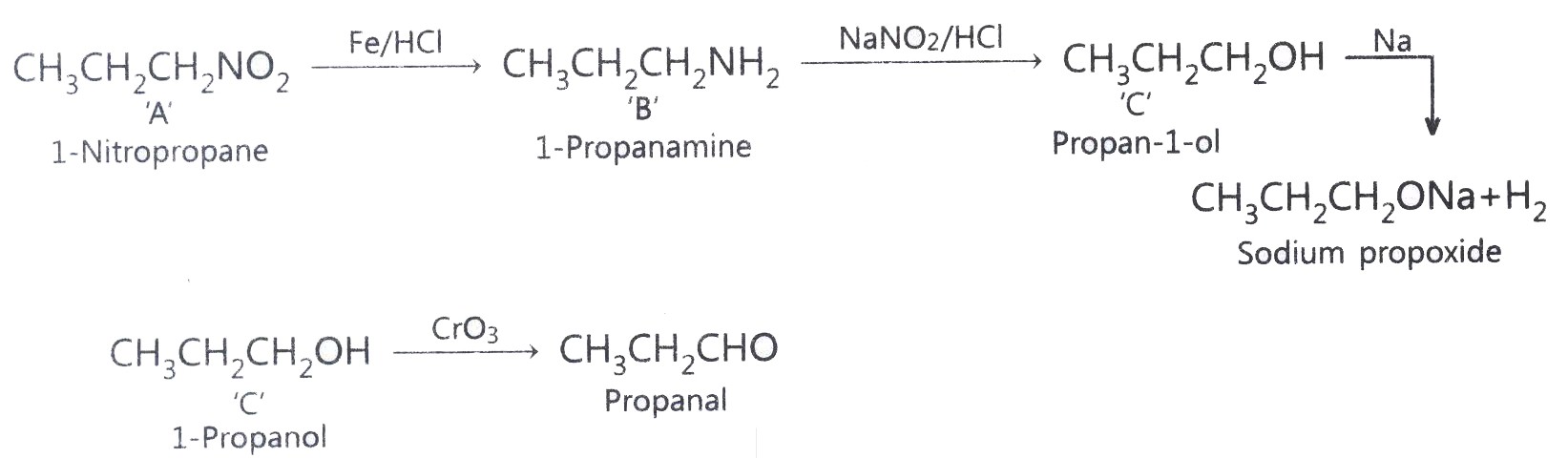
9.
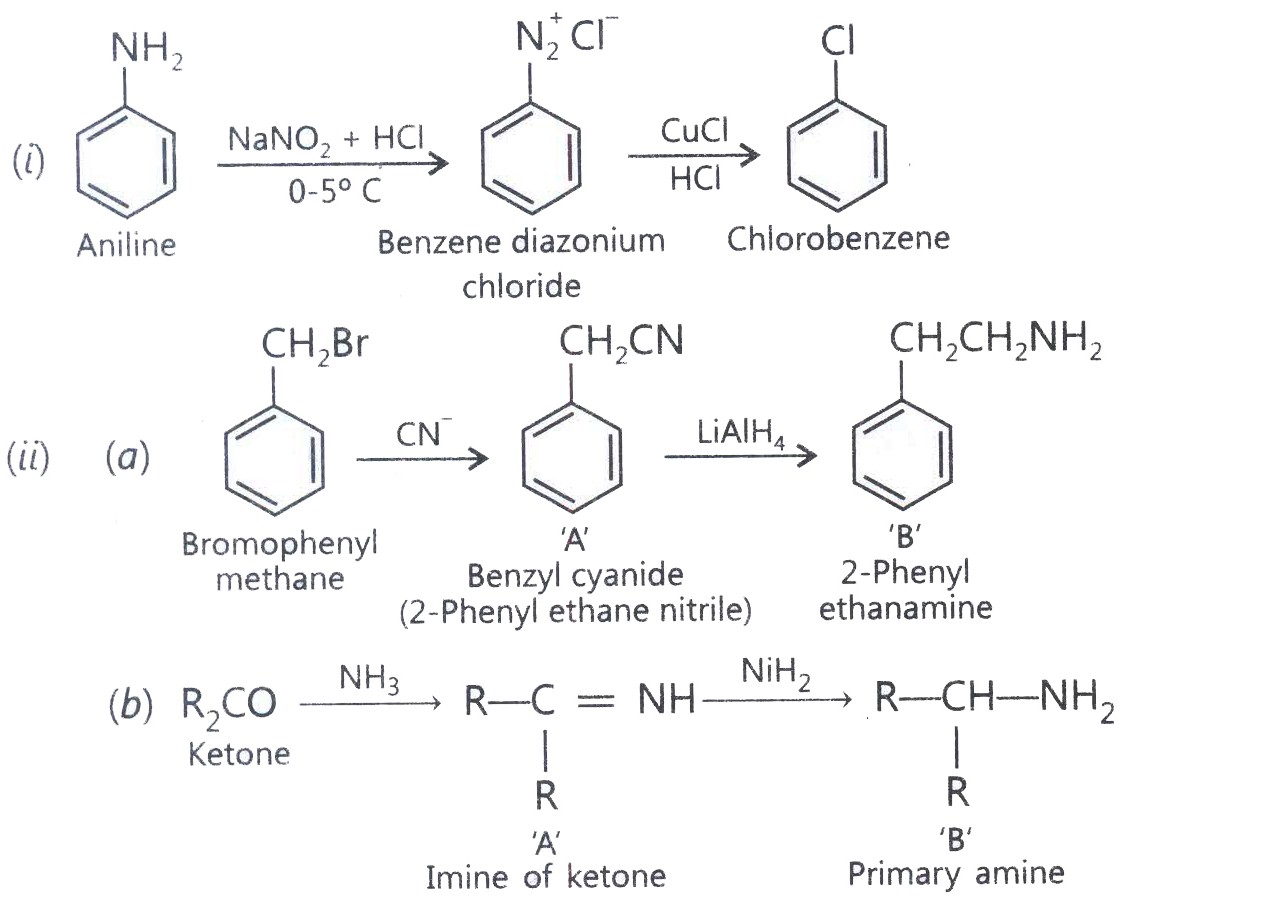
10.
\(k={2.303\over t}log{[R]_0\over [R]}\)
\(={2.303\over 100}log{[R]_0\over {40\over 100}[R]_0}\)
[60% is complete, 40% is left]
\(k={2.303\over 100}(log5-log2)\)
\(k={2.303\over 100}(0.6990-0.3010)\)
\(k={2.303\over 100}\times0.3980\ min^{-1}\)
\(t_{90./.}={2.303\over k}log{[R]_0\over [R]}\)
[90% is complete, 10% is left]
\(t_{90./.}={2.303\over k}log{[R]_0\over {10\over 100}[R]_0}\)
\(={2.303\times100\over 2.303\times0.3980}log10\)
\(={100\over 0.3980}=251.26min\)
11.
(a) (i) Ammonolysis:
\(\mathrm{C}_{2} \mathrm{H}_{5} \mathrm{Cl}+\mathrm{NH}_{3} \longrightarrow \mathrm{C}_{2} \mathrm{H}_{5} \mathrm{NH}_{2}+\mathrm{HCl}\)
Chloroethane Ethanemine
(ii) Coupling reaction:

(iii) Acetylation of amines:
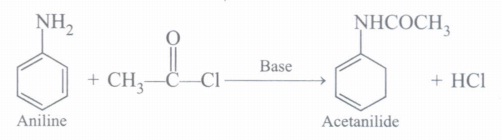
(b) Primary amines reacts with Hinsberg reagent (C6H5 SO2Cl) to form a compound soluble in KOH or NaOH.

Secondary amines react with C6H5 SO2CI to form compound insoluble in KOH.
\(\mathrm{C}_{6} \mathrm{H}_{5} \mathrm{SO}_{2} \mathrm{Cl}+\mathrm{R}_{2} \mathrm{NH} \longrightarrow \mathrm{C}_{6} \mathrm{H}_{5} \mathrm{SO}_{2} \mathrm{NR}_{2} \stackrel{\mathrm{KOH}}{\longrightarrow} \text { Insoluble. }\)
Tertiary amines do not react with C6H5 SO2Cl.
12.
For a first order reaction
\(k=\frac{2.303}{t}\log\frac{[R_0]}{[R]},\) where \([R]_0\) = initial concentration, [R] = conc. after time t
When half of the reaction is completed, [R] = [R]0/2. Representing, the time taken for half of the reaction to be completed, by t1/2' equation becomes:
\(k=\frac{2.303}{t_{1/2}}\log\frac{[R]_0}{[R]_0/2} \)
\(\Rightarrow\ \ \ \ t_{1/2}=\frac{2.303}{k}\log2\)
\(\Rightarrow\ \ \ \ t_{1/2}=\frac{2.303}{k}\times 0.3010\)
\(\Rightarrow\ \ \ \ t_{1/2}=\frac{0.693}{k}\)
The above equation shows that half life first order reaction is independent of the initial concentration of the reactant.
(ii) For a first order reaction
\(\Rightarrow\ t=\frac{2.303}{k}\log\frac{a}{a-x}\)
\(\Rightarrow\ \ \ \ t_{99\cdot /\cdot }=\frac{2.303}{k}\log\frac{100}{1}\)
\( =\frac{2.303}{k}\log 100\)
\( =\frac{2.303\times 2}{k}=\frac{4.606}{k}\)
and \(\Rightarrow\ \ t_{90\cdot /\cdot }=\frac{2.303}{k}\log\frac{100}{10}\)
\(=\frac{2.303}{k}\log{10}=\frac{2.303}{k}\)
\(\frac{t_{99\cdot /\cdot }}{t_{90\cdot /\cdot } }=2\)
\(t_{99\cdot /\cdot }=2\times t_{90\cdot /\cdot }\)
13.
Arrhenius equation. To deduce a quantitative relationship between rate constant and temperature, Arrhenius gave the following equation:
\(k=A{ e }^{ { { -E }_{ a } }/{ RT } }\quad \quad ..(i)\)
where A is a constant of proportionality, Ea is the activation energy which represents the minimum energy that the reacting molecules must possess before undergoing a reaction, T is the absolute temperature and R is the gas constant. This equation is called Arrhenius equation.
Taking logarithm, eq. (i) may be written as
\(ln\ \ \ k=ln\ A-\frac { { E }_{ a } }{ R } \times \frac { 1 }{ T } \quad \)
Converting to logarithm to the base 10 (InX = 2.303 log X), we get
\(2.303\log { k } =2.303\log { A } -\frac { { E }_{ a } }{ RT } \quad \quad ...(ii)\)
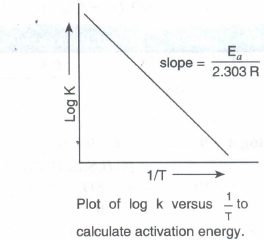
When log k is plotted against \(\frac { 1 }{ T } \) , we get a straight line as shown in diagram.
The intercept of this line is equal to log A and slope is equal to \(-\frac { { E }_{ a } }{ 2.303R } \quad \)
Therefore,
\(Slope=-\frac { { E }_{ a } }{ 2.303R } \)
Knowing the value of slope and gas constant R, activation energy can be calculated as
\({ E }_{ a }=-2.303R\times Slope\)
Alternatively, \({ E }_{ a }\) and A can be calculated by determining the values of rate constant at two different temperatures. Le,t \({ k }_{ 1 }\) and \({ k }_{ 2 }\) are the rate constants for the reaction at two different temperatures \({ T }_{ 1 }\) and \(T_{ 2 }\) respectively. Then,
\(\log { { k }_{ 1 } } =\log { A- } \frac { { E }_{ a } }{ 2.303\quad R{ T }_{ 1 } } \)
\(and\ \ \log { { k }_{ 2 } } =\log { A- } \frac { { E }_{ a } }{ 2.303\quad R{ T }_{ 1 } } \)
Subtracting eq. (iv) from eq. (iii), we get
\(\log { { k }_{ 2 } } -\log { { k }_{ 1 } } =\frac { { E }_{ a } }{ 2.303R } \left[ \frac { 1 }{ { T }_{ 1 } } -\frac { 1 }{ T_{ 2 } } \right] \)
 \(or\ log=\frac { { E }_{ a } }{ 2.303R } \left[ \frac { 1 }{ { T }_{ 1 } } -\frac { 1 }{ T_{ 2 } } \right] \)
By substituting the values of \({ k }_{ 1 }\) and\({ k }_{ 2 }\) and temperatures \({ T }_{ 1 }\) and \(T_{ 2 }\), \({ E }_{ a }\)can be calculated.
14.
(i) tert-Butyl bromide being a 3° alkyl halide on treatment with a base (i.e. NH3) prefers to undergo elimination rather than substitution. Therefore, the product is isobutylene rather than tert-butylamine.

1° amines containing tert-alkyl groups can be prepared by action of suitable Grignard reagents on O-methylhydroxylarnine. For example,
.png)
15.
16.
(a) (i) It is sum of powers to which cone. terms are raised in rate law or rate equation.
(ii) Each step of complex reaction (which takes place in more than one step) is called elementary, step in a reaction.
\((b) \ k=0.00510 \ { min }^{ -1 }\)
\(t=\frac { 2.303 }{ k } \log { \frac { { \left[ R \right] }_{ 0 } }{ \left[ R \right] } }\)
\(3\times 60\times 60=\frac { 2.303 }{ 0.00510 } \log { \frac { 0.1 }{ \left[ R \right] } }\)
\(\log { \frac { 0.1 }{ \left[ R \right] } } =\frac { 10800\times 0.00510 }{ 2.303 } \)
\(=23.94\)
\(\frac { 0.1 }{ \left[ R \right] } =Antilog \ 23.94\)
\(\frac { 0.1 }{ \left[ R \right] } =8.71\times { 10 }^{ 23 }\)
\(\left[ R \right] =\frac { 0.1 }{ 8.71\times { 10 }^{ 23 } }\)
\(\left[ R \right] =0.1148\times { 10 }^{ -24 }\)
\(\left[ R \right] =1.148\times { 10 }^{ -25 }M\)
17.
Carbylamine reaction yields isocyanides.
18.
(c)
LIAIH4
19.
(c) : For every 10oC rise in temperature, rate constant is doubled, Hence, for 20oC rise in temperature, rate constant will become 4 times, i.e., K1 = 4 K2 or K2 = 0.25 K1
20.
(a) Rate = \(\frac {dx}{dt} = k[A_o]^{o} = k \) or \(k = \frac {dx}{dt} = \frac {conc}{Time} =\frac {mol L^{-1}}{s}\)mol L-1 s-1.
21.
(d) : Rate = k ab. When volume is reduced to 1/4 th, Concentrations will become = 4 times
New rate = k (4 a) (4 b) = 16 k ab = 16 times.

12th Standard CBSE Syllabus & Materials
12th Standard CBSE
CBSE 12th Computer Science Python Revision Tour I - New Previous year Question Papers Study Material - QB365 Set A
NEW12th Standard CBSE
CBSE 12th Business Studies Planning Important Questions And Answers Study Material - QB365 Set A
NEW12th Standard CBSE
CBSE 12th Business Studies Business Environment Important Questions And Answers Study Material - QB365 Set A
NEW12th Standard CBSE
CBSE 12th Business Studies Principles of Management Important Questions And Answers Study Material - QB365 Set A



NCERT Books

Syllabus

Exam Pattern

Sample Question Papers

Previous year Question Papers

Important Notes

MCQ Practice test

NCERT Exemplers

Case study Questions

Image Based Questions

Passage based Questions

HOT Questions

Value Based Questions

Model Questions Papers
NCERT ( Book Back ) Questions

Assertion and Reason
Important Questions And Answers

CBSE 12th Standard CBSE Subjects
CBSE Standards








