
 100% FREE ACCESS
12th Standard CBSE Syllabus & Materials
12th Standard CBSE
CBSE 12th Economics Government Budget and the Economy Previous year Question Papers Study Material - QB365 Set A
NEW12th Standard CBSE
CBSE 12th Computer Science Interface Python with MySQL - New Previous year Question Papers Study Material - QB365 Set A
NEW12th Standard CBSE
CBSE 12th Computer Science Database Concept - New Previous year Question Papers Study Material - QB365 Set A
NEW12th Standard CBSE
CBSE 12th Computer Science Data Communication - New Previous year Question Papers Study Material - QB365 Set A
NEW12th Standard CBSE
CBSE 12th Computer Science Data Structures - New Previous year Question Papers Study Material - QB365 Set A
NEW12th Standard CBSE
CBSE 12th Computer Science Functions - New Previous year Question Papers Study Material - QB365 Set A

Published on: 02/11/2025
Download CBSE Class 12th Standard CBSE Chemistry question papers, sample papers, important questions, and previous year solved papers in PDF format. Get free study materials, NCERT solutions, and exam preparation resources for Class 12th Standard CBSE Chemistry
Questions + Answers key
Take MCQ Chemistry Test
1.
Give reasons:
(i) Electrophilic substitution in aromatic amines takes place more readily than benzene.
(ii) CH3CONH2 is a weaker base than CH3CH2.NH2.
2.
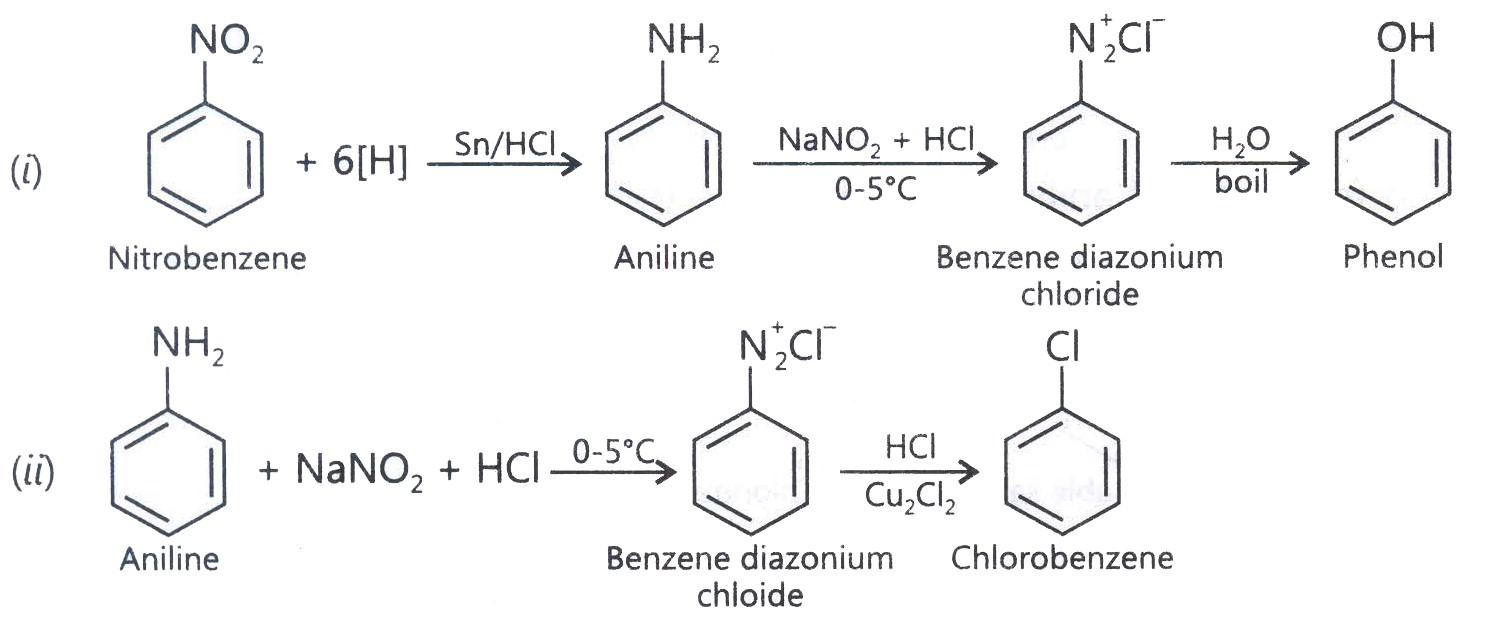
How will you bring about the following conversions?
(i) Nitrobenzene to Phenol.
(ii) Aniline to Chlorobenzene.
3.
How will you distinguish 1o and 2o hydroxyl groups present in glucose? Explain with reactions.
4.
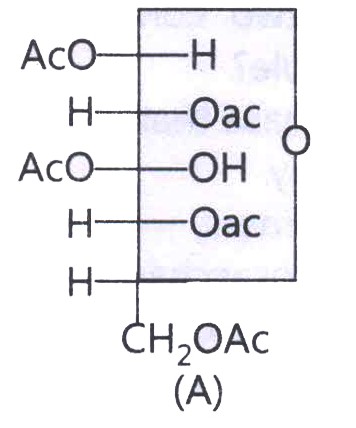
Why does compound(A) given below not form an oxime?
5.
CoSO4Cl. 5NH3 exists in ywo isomeric forms 'A' and 'B' . Isomer 'A' reacts with AgNO3 to give white precipitate, but does not react with BaCl2. Isomer 'B' gives white precipitate with BaCl2 but does not react with AgNO3. Answer the following questions.
(i) Identify 'A' and 'B' and write their structural formulae.
(ii) Name the type of isomerism involved.
(iii) Give the IUPAC name of 'A' and 'B'.
6.
What is the relationship between observaed colour of the complex and the wavelength of light absorbed by the complex?
7.
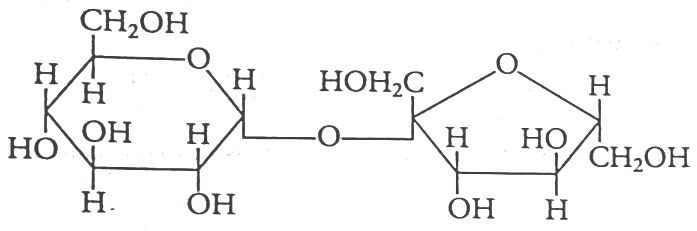
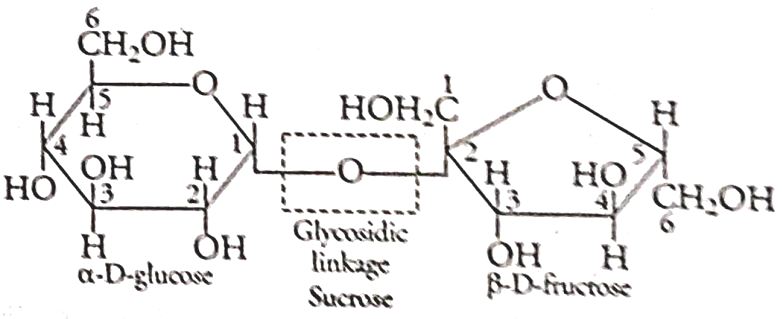
Label the glucose and fructose units in the following disaccharide and identify anomeric carbons atoms in these units. Is the sugar reducing in nature? Explain.
8.
Write chemical equations involved when aniline is treated with the following reagents:
(i) Br2(aq)
(ii) CHCI3 + KOH
(iii) HCI
9.
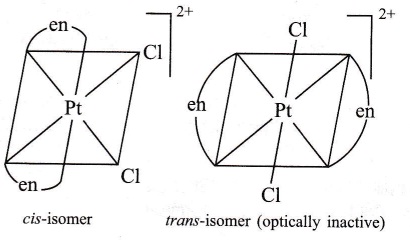
(i) Draw the geometrical isomers of complex [Pt(en)2Cl2]2+. Which of them is optically inactive?
(ii) On the basis of crystal field theory write the electronic configuration for d4 ion, if \(\triangle\)0 > p.
(iii) Write the hybridization type and magnetic behaviour of the complex [Fe(H2O)6]2+.
10.
Explain the shape and magnetic behaviour of [Fe(CN)6]4-.
11.
Write the structures and names of all the stereo isomers of the following compounds
(i) [Co(en)2] Cl2]+
(ii) [Pt (NH3)2CI2]
(iii) [Fe(NH3)4CI2]CI
12.
Give the structures of A, B and C in the following reaction:
(a) \({ C }_{ 6 }{ H }_{ 5 }{ NO }_{ 2 }\overset { Fe/HCI }{ \longrightarrow } A\overset { { HNO }_{ 2 };273K }{ \longrightarrow } B\overset { { C }_{ 6 }{ H }_{ 5 }{ OH } }{ \longrightarrow } C\)
(b) \({ C }_{ 6 }{ H }_{ 5 }{ N }_{ 2 }CI\overset { CuCN }{ \longrightarrow } A\overset { { H }_{ 2 }O/{ H }^{ + } }{ \longrightarrow } B\overset { { NH }_{ 3 };\triangle }{ \longrightarrow } C\)
13.
(i) Write the structural difference between starch and cellulose.
(ii) What type of linkage is present in Nucleic acids?
(iii) Give one example each for fibrous protein and globular protein.
14.
Answer the following queries about proteins:
(i) How are proteins related to amino acids?
(ii) How are oligopeptides different from polypeptides?
(iii) When is a protein said to be denaturated?
15.
The correct name of the given reaction is
\(\mathrm{Ar}-\mathrm{N}_2^{+} \mathrm{X}^{-} \xrightarrow[\text { Cu powder }]{\mathrm{HBr}} \mathrm{Ar}-\mathrm{Br}+\mathrm{N}_2\)
Hofmann bromamide degradation reaction
Gabriel phthalimide synthesis
Carbylamine reaction
Gattermann reaction
16.
\(^{\prime} \mathrm{A}^{\prime}\stackrel{\text { Reduction }}{\longrightarrow}{ }^{\prime} \mathrm{B}^{\prime} \stackrel{\mathrm{HNO}_{2}}{\longrightarrow} \mathrm{CH}_{3} \mathrm{CH}_{2} \mathrm{OH}\)
The compound' A' is
propane nitrile
ethane nitrile
nitro methane
methyl isocyanate
17.
Correct increasing order of wavelength of absorption in visible region for cornplex of Co3+ is
\( {\left[\mathrm{Co}\left(\mathrm{H}_{2} \mathrm{O}\right)_{6}\right]^{3+},\left[\mathrm{Co}(\mathrm{en})_{3}\right]^{3+},\left[\mathrm{Co}\left(\mathrm{NH}_{3}\right)_{6}\right]^{3+}} \)
\({\left[\mathrm{Co}\left(\mathrm{H}_{2} \mathrm{O}\right)_{6}\right]^{3+},\left[\mathrm{Co}\left(\mathrm{NH}_{3}\right)_{6}\right]^{3+},\left[\mathrm{Co}(\mathrm{en})_{3}\right]^{3+}} \)
\({\left[\mathrm{Co}\left(\mathrm{NH}_{3}\right)_{6}\right]^{3+},\left[\mathrm{Co}(\mathrm{en})_{3}\right]^{3+},\left[\mathrm{Co}\left(\mathrm{H}_{2} \mathrm{O}\right)_{6}\right]^{3+}} \)
\({\left[\mathrm{Co}(\mathrm{en})_{3}\right]^{3+},\left[\mathrm{Co}\left(\mathrm{NH}_{6}\right)_{6}\right]^{3+},\left[\mathrm{Co}\left(\mathrm{H}_{2} \mathrm{O}\right)_{6}\right]^{3+}} \)
18.
Which of the following vitamin is responsible for beri-beri disease?
A
B1
K
D
19.
Which of the following amine will form stable diazonium salt at 273-278K?
C2H5NH2
C6H5NH2
C6H5CH2NH2
C6H5N(CH3)2
20.
Which of the following is not a fat soluble vitamin?
Vitamin B complex
Vitamin D
Vitamin E
Vitamin A
21.
Method by which aniline cannot be prepared is
degradation of benzamide with bromine in alkaline solution
reduction of nitrobenzene with H2/Pd in ethanol
potassium salt of phthalimide treated with chlorobenzene followed by hydrolysis with aqueous NaOH solution.
hydrolysis of phenylisocyanide with acidic solution
22.
Hydrolysis of sucrose is called
inversion
esterification
hydration
saponificatio
23.
Dinucleotide is obtained by joining two nucleotides together by phosphodiester linkage. Between which carbon atoms of pentose sugars of nucleotides are these linkages present ?
5' and 3'
1' and 5'
5' and 5'
3' and 3'
24.
Optical isomerism is exhibited by (ox = oxalateanion, en = ethylene diamine)
cis-[CrCl2(ox)2]3-
[Co(en)3]3+
trans-[CrCl2(ox)2]3-
[Co(ox)(en)2]+
25.
The non-existent metal carbonyl among the following is
Cr(CO)6
Mn(CO)5
Ni(CO)4
Fe(CO)5
26.
Which of the following is an outer orbital complex?
[Fe(CN)6]4-
[FeF6]3-
[Co(NH3)6]3+
[Co(CN)6]2+
27.
(a) Write the structures of the main products of the following reactions:
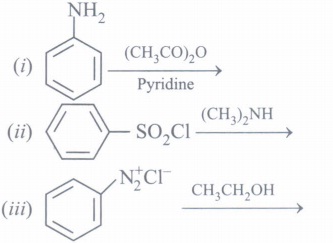
(b) Give a simple chemical test to distinguish between Aniline and N,N-dimethylaniline.
(c) Arrange the following in the increasing order of their pKb values:
C6H5NH2 , C2H5NH2 , C6H5NHCH3
28.
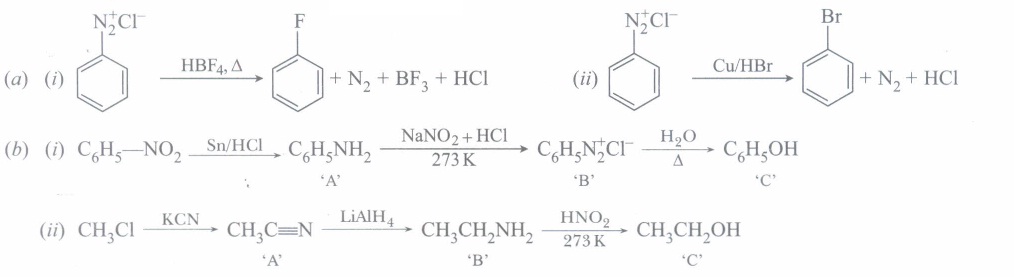
(a) Write the structures of main products when benzene diazonium chloride \(\left(\mathrm{C}_{6} \mathrm{H}_{5} \mathrm{~N}_{2}^{+} \mathrm{Cl}^{-}\right)\)reacts with the following reagents:
(i) HBF4/\(\triangle\)
(ii) Cu/HBr
(b) Write the structures of A, Band C in the following reactions:
\(\text {(i) } \mathrm{C}_{6} \mathrm{H}_{5} \mathrm{NO}_{2} \stackrel{\mathrm{Sn} / \mathrm{HCl}}{\longrightarrow} \mathrm{A} \frac{\mathrm{NaNO}_{2}+\mathrm{HCl}}{273 \mathrm{~K}} \longrightarrow \mathrm{B} \frac{\mathrm{H}_{2} \mathrm{O}}{\Delta} \mathrm{C}\)
\(\text {(ii) } \mathrm{CH}_{3} \mathrm{Cl} \stackrel{\mathrm{KCN}}{\longrightarrow} \mathrm{A} \stackrel{\mathrm{LiAlH}_{4}}{\longrightarrow} \mathrm{B} \frac{\mathrm{HNO}_{2}}{273 \mathrm{~K}} \mathrm{C}\)
29.
(i) Define:
(a) Metal carbonyls
(b) Chelate
(ii) (a) Give one chemical test as an evidence to show that [Co(NH3)5CI]SO4 and [Co(NH3)5(SO4)] Cl are ionisation isomers.
(b) [NiCl4]2- is paramagnetic while [Ni(CO4] is diamagnetic though both are tetrahedral. Why? (Atomic no. of Ni = 28)
(c) Write the electronic configuration of Fe(III) on the basis of crystal field theory when it forms an octahedral complex in the presence of (i) strong field ligand, and (ii) weak field ligand. (Atomic no. of Fe = 26)
30.
Account for the following:
(i) pKb of aniline is more than that of methylamine.
(ii) Ethylamine is soluble in water whereas aniline is not.
(iii) Methylamine in water reacts with ferric chloride to precipitate hydrated ferric oxide.
(iv) Although amino group is o– and p– directing in aromatic electrophilic substitution reactions, aniline on nitration gives a substantial amount of m-nitroaniline.
(v) Aniline does not undergo Friedel-Crafts reaction.
(vi) Diazonium salts of aromatic amines are more stable than those of aliphatic amines.
(vii) Gabriel phthalimide synthesis is preferred for synthesising primary amines.
31.
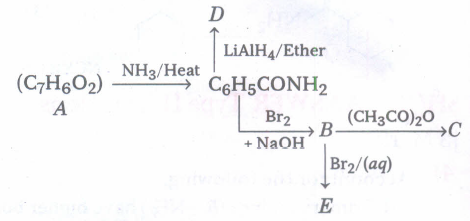
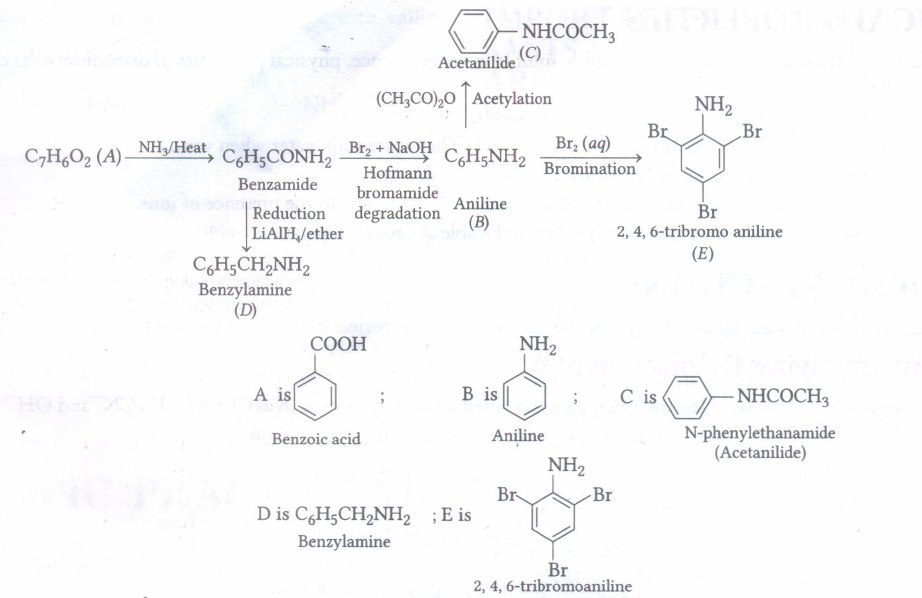
An aromatic compound 'A' of molecular formula C7H6O2 undergoes a series of reactions as shown below. Write the structures of A, B, C,D and E in the following reactions.
32.
Co-ordination compounds have an important role in the field of medicines. Out of these, the compound cis-platin is quite effective against cancer. It inhibits the growth of tumors leading to cancer.
(i) What is the chemical formula and name of the complex?
(ii) How does it behave as an anti cancer agent?
(iii) Why is trans-isomer not effective?
(iv) What is the value associated with the use of cis platin?
33.
34.
In the following questions. an Assertion (A) is followed by a corresponding Reason (R) Use the following keys to choose the appropriate answer.
Assertion (A) Fresh tomatoes are better source of vitamin C than those which have been stored for sometime.
Reason (R) On prolonged exposure to air, vitamin C is destroyed due to aerial oxidation.
Codes:
(a) Both (A) and (R) are correct, (R) is the correct explanation of (A).
(b) Both (A) and (R) are correct, (R) is not the correct explanation of (A).
(c) (A) is correct; (R) is incorrect.
(d) (A) is incorrect; (R) is correct.
35.
In the following questions. an Assertion (A) is followed by a corresponding Reason (R) Use the following keys to choose the appropriate answer.
Assertion (A) Aromatic primary amines cannot be prepared by Gabriel phthalimide synthesis.
Reason (R) Aryl halides do notundergo electrophilic substitution with anion formed by phthalimide.
Codes:
(a) Both (A) and (R) are correct, (R) is the correct explanation of (A).
(b) Both (A) and (R) are correct, (R) is not the correct explanation of (A).
(c) (A) is correct; (R) is incorrect.
(d) (A) is incorrect; (R) is correct.
36.
In the following questions. an Assertion (A) is followed by a corresponding Reason (R) Use the following keys to choose the appropriate answer.
Assertion (A) Oxidation number of Cr in \(\begin{equation} \left[\mathrm{Cr}\left(\mathrm{NH}_{3}\right)_{3}\left(\mathrm{H}_{2} \mathrm{O}\right)_{3}\right] \mathrm{Cl}_{3} \end{equation}\) is same as the charge of the complex ion, +3.
Reason (R) All the ligands are neutral molecules in this compound.
Codes:
(a) Both (A) and (R) are correct, (R) is the correct explanation of (A).
(b) Both (A) and (R) are correct, (R) is not the correct explanation of (A).
(c) (A) is correct; (R) is incorrect.
(d) (A) is incorrect; (R) is correct.
37.
Amines are usually formed from nitro compounds, halides, amides, imides, etc. They exhibit hydrogen bonding which influences their physical properties. In alkyl amines, a combination of electron releasing,steric and hydrogen bonding factors influence the stability of the substituted ammonium cations in protic polar solvents and thus affect the basic nature of amines.
In aromatic amines, electron releasing and withdrawing groups, respectively increase and decrease their basic character. Influence of the number of hydrogen atoms at nitrogen atom on the type of reactions and nature of products is responsible foridentification and distinction between primary, secondary and tertiary amines.
Presence of amino group in aromatic ring enhances reactivity of the aromatic amines. Aryl diazonium salts provide advantageous methods for producing aryl halides, cyanides, phenols and arencs by reductive removal of the diazo group.
Answer the following questions
(i) Arrange the following in the increasing order of their pKb values in aqueous solutions:
\(\mathrm{C}_2 \mathrm{H}_5 \mathrm{NH}_2,\left(\mathrm{C}_2 \mathrm{H}_5\right)_2 \mathrm{NH},\left(\mathrm{C}_2 \mathrm{H}_5\right)_3 \mathrm{~N}\)
(ii) Aniline on nitration gives a substantial amount of m-nitroaniline though amino group is o/p directing. Why?
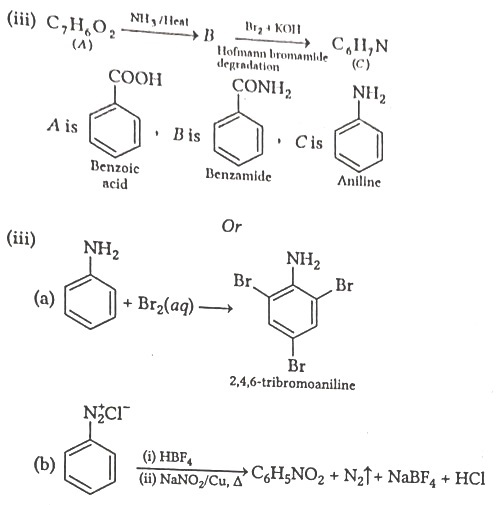
(iii) An aromatic compound 'A' of molecular formula C7H6O2 on treatment with aqueous ammonia and heating forms compound 'B'. Compound 'B' on heating with Br2 and aqueous KOH gives a compound 'C' of molecular formula C6H7N. Write the structures of A, B and C.
Or
(iii) Complete the following reactions giving main products:
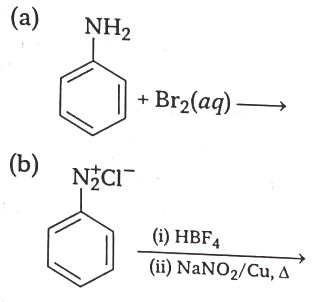
38.
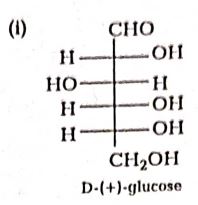
Carbohydrates are polyhydroxy aldehydes or ketones and are also called saccharides, Glucose is an example of monosaccharides. GIucose (C6H12O6) is an aldohexose and its open chain structure was assigned on the basis of many reactions as evidences like presence of carbonyl group, presence of straight chain, presence of five -OH groups etc.
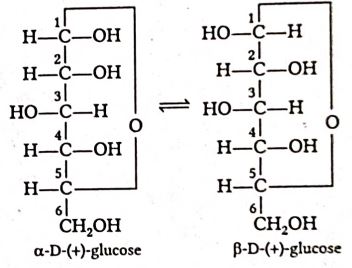
Glucose is correctly named as D-(+)-glucose. Glucose is found to exist in two different crystalline forms which are named as \(\alpha\) and \(\beta\). Despite having the aldehyde group, glucose does not give 2, 4-DNP test.
(i) What is the correct structure of D-(+)-glucose?
(ii) Glucose on oxidation with HNO3 gives a dicarboxylic acid called saccharic acid. What does this result indicate?
(iii) The pentaacetate of glucose does not react with H2N-OH What does this result indicate?
(iv) What is the difference between \(\alpha\)-D-glucose and \(\beta\)-D-glucose?
Or
Give the possible explanation for the following:
Glucose doesn't give 2,4-DNP test.
1.
(i) 一NH2 group of aromatic amines strongly activates the aromatic ring through delocalization of the lone pair of electrons of the N-atom over the aromatic ring. Due to the strong activating effect of the 一NH2 group, aromatic amines undergo electrophilic substitution reactions readily than. benzene.
(ii) Due to resonance, the lone pair of electrons on the nitrogen atom in CH3CONH2 is delocalized over the keto group.
As a result, electron density on the N-atom in CH3CONH2 decreases. On the other hand, in C2H5NH2 , due to + I effect of the ethyl group, the electron density on the N-atom increases consequently, CH3CONH2 is a weaker base than CH3CH2NH2.
2.
3.
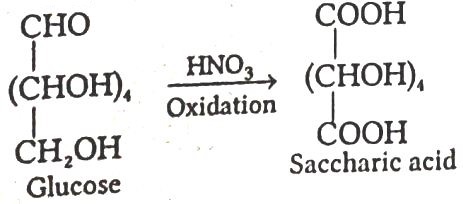
Glucose consists of 5 - OH groups. Among these, the - OH group present on the terminal carbon atom (i.e. C-6 atom) is called 1° hydroxyl group while all the four remaining -OH groups present on C-2, C-3, C-4 and C-5 atoms are called 2° hydroxyl groups. 1° hydroxyl groups are easily oxidised to carboxylic acid group, while 2° hydroxyl groups undergo oxidation only under drastic conditions.
e.g. On oxidation with nitric acid, glucose gives a dicarboxylic acid, saccharic acid (also called glycaric acid) having the same number of carbon atoms as glucose. This indicates that glucose contains one primary (1°) alcoholic or hydroxyl group.
4.
It is because it does not have free aldehyde group, therefore it does not orm oxime.
5.
\((i)\ \left[ Co{ \left( { NH }_{ 3 } \right) }_{ 5 }{ SO }_{ 4 } \right] Cl+{ AgNO }_{ 3 }(aq)\longrightarrow AgCl(s)+\left[ Co{ \left( { NH }_{ 3 } \right) }{ SO }_{ 4 } \right] { NO }_{ 3 }\\ \quad \quad \quad \quad \quad \quad \quad \quad \quad 'A'\quad \ \quad \quad \quad \quad \quad \quad \quad \quad \quad \quad white\ ppt\)
\( \left[ Co{ \left( { NH }_{ 3 } \right) }_{ 5 }Cl \right] { SO }_{ 4 }+{ BaCl }_{ 2 }\longrightarrow { BaSO }_{ 4 }(s)+\left[ Co{ \left( { NH }_{ 3 } \right) }_{ 5 }Cl \right] { Cl }_{ 2 }\\ \quad \quad \quad \quad \quad \quad \quad \quad \quad 'B'\quad \quad \quad \quad \quad \quad \quad \quad \quad \quad \quad \quad \quad \quad \quad white\ ppt\)
(ii) Ionisation isomerism
(iii) 'N' is pentaamrnine chloridocobalt(III) sulphate.
'B' is pentaammine sulphatocobalt(III) chloride.
6.
When white light falls on the complex, some part of it is absorbed, Higher \({ \triangle }_{ o }\) (crystal field splitting energy) lower will be the wavelength absorbed by the complex. The colour of the complex is the colour from the wavelength left over (complementry colour).
7.
C-1 of glucose unit and C-2 of fructose unit are anomeric carbon atoms in the given disaccharide. The disaccharide is non-reducing sugar because -OH groups attached to anomeric carbon atoms are involved in the formation of glycosidic bond.
8.
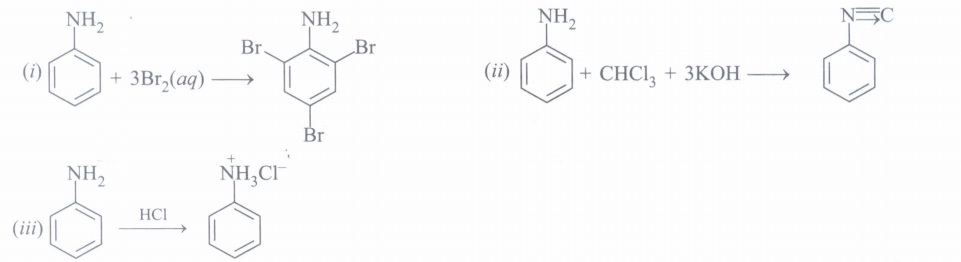
9.
(i)
(ii) \(\triangle\)o > P
\(\therefore \quad \mathrm{t}_{2 g}^{4} \mathrm{e}_{g}^{0}\)
(iii) Ni(28): [Ar]4s2 3d8
Ni2+: [Ar] 4so 3d8
CN- is a strong field ligand, will cause pairing of electrons in [Ni(CN)4]2-.
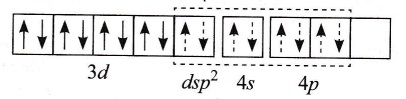
It has dsp2 hybridization and diamagnetic in nature.
10.
Hybridization : d2 sp3
Shape : Octahedral Magnetic
character : Diamagnetic.
11.
(i) [Co(en)3] Cl3
IUPAC name:
Tris - (ethane - l,2- diamine) cobalt (III) chloride.
s.png)
(ii) Pt(NH3)2CI2
(ill) [Fe(NH3)4CI2]Cl
IUPACname
Tetraamminedichloridoiron (II) chloride
Isomers Geometrical isomers (cis and trans)
s.png)
12.
(i) \(A-{ C }_{ 6 }{ H }_{ 5 }{ NH }_{ 2 },\quad B-{ C }_{ 6 }{ H }_{ 5 }{ N }_{ 2 }^{ + }C{ I }^{ - },C-{ C }_{ 6 }{ H }_{ 5 }{ -N }_{ 2 }-{ C }_{ 6 }{ H }_{ 4 }OH\)
(ii) \(A-{ C }_{ 6 }{ H }_{ 5 }CN,\quad B-{ C }_{ 6 }{ H }_{ 5 }NCOOH,\quad C-{ C }_{ 6 }{ H }_{ 5 }{ CONH }_{ 2 }\)
13.
(i) In starch, the glucose monomers are in alpha configuration while in cellulose the glucose monomers are in beta configuration. Starch is a polymer consisting of amylose and amylopectin while cellulose is a long chain composed only of
β-D-glucose units.
(ii) Phosphodiester linkage between the 5' and 3'atoms is present in nucleic acids.
(iii) Example of fibrous protein-Collagen, keratin, myosin.
Example of globular protein-Insulin, haemoglobin, egg albumin.
14.
(i) Proteins are biopolymers of amino acids which condense together forming peptide bonds.
(ii) Oligopeptides on hydrolysis give 3 to 12 \(\alpha \)-amino acids, where as polypeptides give large number of \(\alpha \)-amino acids on hydrolysis.
(iiI) When tertiary structure of protein is ruptured by,protein pH or on heating, protein is said to be denatured.It lose its biological activity.
15.
(d)
Gattermann reaction
16.
(b)
ethane nitrile
17.
(d)
\({\left[\mathrm{Co}(\mathrm{en})_{3}\right]^{3+},\left[\mathrm{Co}\left(\mathrm{NH}_{6}\right)_{6}\right]^{3+},\left[\mathrm{Co}\left(\mathrm{H}_{2} \mathrm{O}\right)_{6}\right]^{3+}} \)
18.
(b)
B1
19.
(b)
C6H5NH2
20.
(a)
Vitamin B complex
21.
Aniline cannot be prepared by Gabriel phthalimide method because chlorobenzene (i.e.,aryl halide) does not undergo nucleophilic substitution reaction with potassium phthalimide in aqueous NaOH solution.
22.
(a)
inversion
23.
(a)
5' and 3'
24.
(a)
cis-[CrCl2(ox)2]3-
25.
(b)
Mn(CO)5
26.
(b)
[FeF6]3-
27.
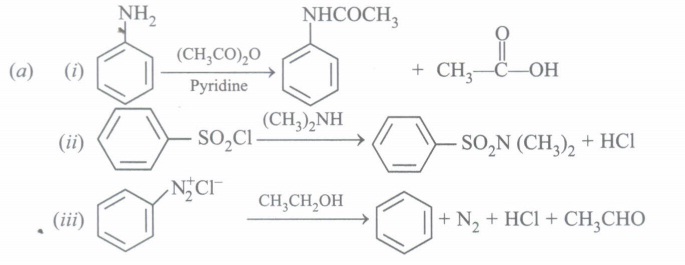
(b) Carbylamine test: Add CHCl3 and KOH to each of them, aniline will give offensive smelling compound whereas N, N-Dimethyl aniline will not react
(c) C2H5NH2 < C6H5NHCH3 < C6H5NH2 is increasing order of their pKb due to decreasing order of basic character.
28.
29.
(i) (a) Metal carbonyls: Metal carbonyls are the compounds in which carbon monoxide (CO) acts as the ligand. The metal-carbon bond in metal carbonyls possesses both \(\sigma\) and \(\pi\) characters, e.g. N(CO)4[nickeltetracarbonyl]. Its IUPAC name is tetra carbonyl nickel(0).
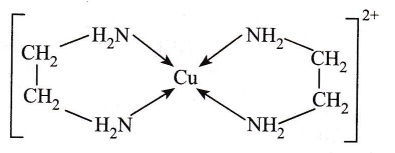
(b) Chelate: An inorganic metal complex in which there is a close ring of atoms caused by attachment of a ligand to a metal atom at two points. An example is the complex ion formed between ethylene diamine and cupric ion,[Cu(NH2CH2CH2NH2)2]2+.
(ii) (a) Add BaCl2 solution. [Co(NH3)]5Cl]SO4 will give white ppt. of BaSO4.
\(\left[\mathrm{Co}\left(\mathrm{NH}_{3}\right)_{5} \mathrm{Cl}\right] \mathrm{SO}_{4}+\mathrm{BaCl}_{2}(a q) \)\( \longrightarrow\left[\mathrm{Co}\left(\mathrm{NH}_{3}\right)_{5} \mathrm{Cl}\right] \mathrm{Cl}_{2}+\mathrm{BaSO}_{4} \downarrow \)
\(\text { (White ppt.) }\)
Add AgNO3(aq) solution [Co(NH3)5SO4] Cl will give white ppt. of AgCl.
\( {\left[\mathrm{Co}\left(\mathrm{NH}_{3}\right)_{5} \mathrm{SO}_{4}\right] \mathrm{Cl}+\mathrm{AgNO}_{3}(a q)} \) \(\longrightarrow \mathrm{AgCl}+\left[\mathrm{Co}\left(\mathrm{NH}_{3}\right)_{5} \mathrm{SO}_{4}\right] \mathrm{NO}_{3} \)
\(\text { (White ppt) }\)
(c) Fe3+ (4s03d5) In strong field \( \Delta_{0}>P t_{2 g}^{5} e g^{0} \)
In weak field \(\Delta_{0}
30.
(i) pKb of aniline is more than that of methylamine.
In aniline, the lone pair of electrons on N atom is in resonance with benzene ring. Hence, it cannot be easily donated to an acid. This decreases its basicity. In methyl amine, the +I effect of methyl group increases the electron density on N atom so that the lone pair of electrons on N atom can be easily donated to an acid. Hence, methylamine is more basic than aniline. Higher is the basicity, lower is the pKb and vice versa.
(ii) Ethylamine is soluble in water whereas aniline is not. With increase in the molecular weight, the solubility decreases. Aniline has higher molecular weight than ethylamine.
(iii) Methylamine in water reacts with ferric chloride to precipitate hydrated ferric oxide. Due to the +I effect of −CH3 group, methylamine is more basic than water. Therefore, in water, methylamine produces OH− ions by accepting H+ ions from water. OH− ions react with ferric chloride to precipitate hydrated ferric oxide.
(iv) The nitration of aniline is carried out using conc. HNO3 and H2SO4. However, in the presence of conc. H2SO4, aniline forms aniline hydrogen sulphate in which the anilinium ion, C6H5NH3+ is meta directing because the positive charge on the nitrogen attracts electrons from the benzene ring.
(v) Aniline does not undergo Friedel craft's reactions because the reagent AlCl3 (the Lewis acid which is used as a catalyst in friedel crafts reaction), being electron deficient acts as a Lewis base. and attacks on the lone pair of nitrogen present in aniline to form an insoluble complex which precipitates out and the reaction does not proceed.
(vi) In aromatic diazonium salts, due to resonance, there is dispersal of positive charge on benzene ring.
But in aliphatic diazonium salts, resonance is not possible, so aliphatic diazonium salts are less stable than aromatic diazonium salt.
(vii) The reaction between alkyl halide (R- X) and ammonia gives mixture, of 1, 2, and 3 amines with tetra alkyl ammonium halide. The mixture is not separable. To get pure 1 amine, Gabriel phthalimide synthesis is preferred.
31.
32.
(i)The chemical formula of the compound is shown. Its name is cis-diammine dichlorido platinum (II).
(ii) It behaves as an anti cancer agent by taking part in the chelate formation or chelation.
(iii) In the trans isomer the similar groups are on opposite sides and chelate formation does not take place.
(iv) Cis-platin saves many valueable lives by forming co-ordinate complex. So it is life saving.
33.
34.
(a) Both (A) and (R) are correct and (R) is correct explanation of (A).
35.
(c) Aromatic primary amines cannot be prepared by the Gabriel phthalimide synthesis because aryl halides do not undergo nucleophilic substitution reaction with the anion formed by phthalimide. Thus, (A) is correct but (R) is incorrect
36.
(a) Oxidation number of Cr in \(\begin{equation} \left[\mathrm{Cr}\left(\mathrm{NH}_{3}\right)_{3}\left(\mathrm{H}_{2} \mathrm{O}\right)_{3}\right] \mathrm{Cl}_{3} \end{equation}\) is same as the charge ofthe complex ion, i.e. +3 because all the ligands are neutral molecules in this compound. Both (A) and (R) are correct and (R) is correct explanation of (A).
37.
(i) \(\begin{aligned}
\left(\mathrm{C}_2 \mathrm{H}_5\right)_2 \mathrm{NH}>\left(\mathrm{C}_2 \mathrm{H}_5\right)_3 \mathrm{~N}>\mathrm{C}_2 \mathrm{H}_5 \mathrm{NH}_2
\end{aligned}\)
38.
(ii) Glucose on oxidation with HNO3 gives saccharic acid. This indicates the presence of a one primary alcoholic (-OH) group in glucose.
(iii) The pentaacetate of glucose does not react with hydroxylamine which shows the absence of free aldehydic (-CHO) group.
(iv) In \(\alpha\)-D-glucose, the -OH group at C1 is towards right, whereas in \(\beta\)-D-glucose, the -OH group at C1 is towards left. Such a pair of stereoisomers which differ in the configuration only at C1 are called anomers.
Or
Actually, glucose exists in the cyclic hemiacetal form (hence the aldehyde group is not free) with only a small amount (<0.05%) of the open chain form.
Since, the concentration of the open chain form is low and its reaction with 2,4-DNP is reversible, therefore, formation of 2,4-DNP derivative cannot disturb the equilibrium to regenerate more open chain form from the cyclic hemiacetal form and hence, does not give this test.

12th Standard CBSE Syllabus & Materials
12th Standard CBSE
CBSE 12th Computer Science Python Revision Tour I - New Previous year Question Papers Study Material - QB365 Set A
NEW12th Standard CBSE
CBSE 12th Business Studies Planning Important Questions And Answers Study Material - QB365 Set A
NEW12th Standard CBSE
CBSE 12th Business Studies Business Environment Important Questions And Answers Study Material - QB365 Set A
NEW12th Standard CBSE
CBSE 12th Business Studies Principles of Management Important Questions And Answers Study Material - QB365 Set A



NCERT Books

Syllabus

Exam Pattern

Sample Question Papers

Previous year Question Papers

Important Notes

MCQ Practice test

NCERT Exemplers

Case study Questions

Image Based Questions

Passage based Questions

HOT Questions

Value Based Questions

Model Questions Papers
NCERT ( Book Back ) Questions

Assertion and Reason
Important Questions And Answers

CBSE 12th Standard CBSE Subjects
CBSE Standards








