
 100% FREE ACCESS
12th Standard CBSE Syllabus & Materials
12th Standard CBSE
CBSE 12th Economics Government Budget and the Economy Previous year Question Papers Study Material - QB365 Set A
NEW12th Standard CBSE
CBSE 12th Computer Science Interface Python with MySQL - New Previous year Question Papers Study Material - QB365 Set A
NEW12th Standard CBSE
CBSE 12th Computer Science Database Concept - New Previous year Question Papers Study Material - QB365 Set A
NEW12th Standard CBSE
CBSE 12th Computer Science Data Communication - New Previous year Question Papers Study Material - QB365 Set A
NEW12th Standard CBSE
CBSE 12th Computer Science Data Structures - New Previous year Question Papers Study Material - QB365 Set A
NEW12th Standard CBSE
CBSE 12th Computer Science Functions - New Previous year Question Papers Study Material - QB365 Set A

Published on: 02/11/2025
Download CBSE Class 12th Standard CBSE Chemistry question papers, sample papers, important questions, and previous year solved papers in PDF format. Get free study materials, NCERT solutions, and exam preparation resources for Class 12th Standard CBSE Chemistry
Questions + Answers key
Take MCQ Chemistry Test
1.
Explain the violet colour of the complex [Ti(H2O)6]3+ on the basis of crystal field theory.
2.
Write IUPAC names for:
(i) [Cr(NH3)6]3+
(ii) [Ni(NH3)6] Cl2
3.
Write all the geometrical isomers of [Pt(NH3)(Br)(Cl)(py)] and how many of these will exhibit optical isomers?
4.
Which of the two is more stable K4[Fe(CN)6] or K3[Fe(CN)6]?
5.
(i) On the basis of crystal field theory, write the electronic configuration for d5 ion with a strong field ligand for which ∆0 > Ρ.
(ii) [NiCO)4] has tetrahedral geometry, while [Ni(CN)4]2- has square planer yet both exhibit dimagnetism. Explain.
[Atomic number Ni = 28]
6.
(a) How is a double salt different from a complex?
(b) Write IUPAC names of the following:
(i)K3[Fe(C204)3]
(ii) [Pt(NH3)6] Cl4
(c) Draw the structure of cis-isomer of [Co(NH3)4Cl2]+
7.
Specify the oxidation numbers of the metals in the following coordination entities:
(i) [Co(H2O) (CN) (en)2]2+
(ii) [PtCl4]2-
(iii) [Cr(NH3)3Cl3]
(iv) [CoBr2(en)2]+
(v) K3[Fe(CN)6]
8.
Write the formulae for the following coordination compounds:
(a) Tetraamminediaquacobalt (III) chloride
(b) Potassium tetracyanonickelate(II)
(c) Tris(ethane-1,2-diamine) chromium (III) chloride
(d) Amminebromidochloridonirito-N-platinate (II)
(e) Dichloridobis (ethane-1, 2-diamine) platinum (IV) nitrate.
(f) Iron (III) hexacyanoferrate (II)
9.
Structure of [Ni(CO)4] is
tetrahedral
square planar
octahedral
None of these
10.
Which of the following are \(\pi\) - bonded organometallic compounds?
Zeise's salt
Furacene
Dibenzene chromium
Grignard reagent
11.
The spin only magnetic moment value (in Bohr magneton units) of Cr(CO)6 is
0
2.84
4.90
5.92
12.
Which one of the following complex ions has geometrical isomers?
[Co(en)3]3+
Ni(NH3)5Br]+
[Co(NH3)2(en)2]3+
[Cr(NH3)4(en)3+
13.
Which of the following has largest number of isomers?
[Ru(NH3)4Cl2]+
[Co(en)2Cl2]+
[Ir(PR3)2H(CO)]2+
[Co(NH3)5Cl]2+
14.
The formula, dichlorobis (urea) copper (II) is
[Cu{O = C(NH2)}2]Cl2
[CuCl2{O = C(NH2)2}]
[Cu{O = C(NH2)2}Cl]Cl
[CuCl2{O = C(NH2)2}2]
15.
Which of the following is an outer orbital complex?
[Fe(CN)6]4-
[FeF6]3-
[Co(NH3)6]3+
[Co(CN)6]2+
16.
The hybridisation of Fe in K4[Fe(CN)6] is
dsp2
sp3
d2sp3
sp3d2
17.
An example of ambidentate ligand is
Ammine
Aquo
Oxalato
Thiacyanato
18.
Indicate the types of isomerism exhibited by the following complexes and draw the structures for these isomers:
(i) K[Cr(H2O)2(C2O4)2
(ii) [Co(en)3]Cl3
(iii) [Co(NH3)5(NO2)](NO3)2
(iv) [Pt(NH3)(H2O)Cl2]
19.
Using crystal field theory, draw energy level diagram, write electronic configuration of the central metal atom/ion and determine the magnetic moment value in the following :
(i) \([CoF_6]^{3-}, [Co(H_2O)_6]^{2+},[Co(CN)_6]^{3-}\)
(ii) \([FeF_6]^{3-}, \ [Fe(H_2O)_6]^{2+}, [Fe(CN)_6]^{4-}\).
20.
In the following question a statement of assertion followed by a statement of reasons is given. Choose the correct answer out of the following choices.
Assertion: [Cr(H2O)6]Cl2 and [Fe(H2O)6]Cl2 are reducing in nature.
Reasons: Unpaired electrons are present in their d-orbitals.
Codes:
(a) Assertion and reason both are true, reason is correct explanation of assertion.
(b) Assertion and reason both are true but reason is not the correct explanation of assertion.
(c) Assertion is true, reason is false.
(d) Assertion is false, reason is true.
21.
In the following questions. an Assertion (A) is followed by a corresponding Reason (R) Use the following keys to choose the appropriate answer.
Assertion (A) The ligands of nitro and nitrito are called ambidentate ligands .
Reason (R) These ligands give linkage isomers.
Codes:
(a) Both (A) and (R) are correct, (R) is the correct explanation of (A).
(b) Both (A) and (R) are correct, (R) is not the correct explanation of (A).
(c) (A) is correct; (R) is incorrect.
(d) (A) is incorrect; (R) is correct.
22.
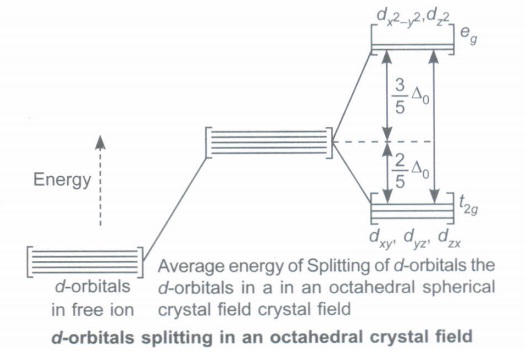
Observe the diagram of splitting of d-orbitals in octahedral field and answer the questions based on the diagrams and related studied concepts.
(a) What is crystal field splitting anergy?
(b) Why dx2-y2 ,dz2 have higher energy than dxy, dyz, dzx orbitals in octahedral crystal field?
(c) What is relationship between (CFSE) \(\triangle\)0 and strength of ligand?
(d) What is electronic configuration of d5 ion if \(\triangle\)0 < P?
(e) What is spectrochemical series?
1.
In ground state, Ti has 23 electrons with electronic configuration 3d34s2.
The oxidation state of Ti in the given compound is +3.
Hence it will now have the configuration 3d2. Since it has 2 unpaired electrons and has the ability to
undergo d-d transition, the given complex gives violet colour.
2.
(i) hexaamminechromium (III) ion
(ii) hexaamminenickel (II) chloride
3.
This is a complex of the type MABCD. It will have three geometrical isomers as represented below:
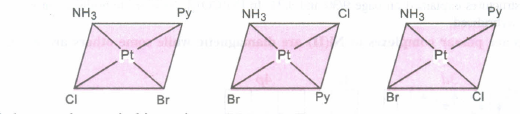
It does not show optical isomerism
4.
K3[Fe(CN)6] is more stable than K4[Fe(CN)6].
5.
(i) On the basis of crystal field theory, for a d5 ion, if ∆0 > Ρ then the complex is a high spin complex formed by the association of weak ligands with the metal ion. As a result, the fourth electron enters one of the eg orbital, thereby exhibiting the electronic configuration
\(t_{2 g}^3 e_g^1\)
(ii) Ni(CO)4 = Ni + 4COThus Ni(CO)4 is diamagnetic. thus according to VBT sp3 hybridization have tetrahedral geometry. In [Ni(CN)4]2-, there is Ni2+ ion for which the electronic configuration in the valence shell is 3d8 4s0. In presence of strong field CN- ions, all the electrons are paired up.
6.
| Double Salt | Complex Compound |
| They dissociate into simple ions completely when dissolved in water. e.g., KCl.MgCI2.6H20 |
They do not dissociate into simple ions when disolved in water. [Co(NH3)6]CI3 |
(b) (1) Potassium trioxalato ferrate (Ill) Yz
(ii) Hexammine platinum (IV) chloride.
cis - isomer of [Co(NH3)4CI2]+
7.
(i) x + (0) + (-1) + (0) = + 2 or x = + 3
(ii) x - 4 = -2 or x = + 2
(iii) x + 0 + 3(-1) = 0 or x = + 3
(iv) x + 2(-1) + 0 = + 1 or x = + 3
(v) [Fe(CN)6]3-, x + 6(-1) = - 3 or x = + 3
8.
(a) [Co(NH3)4(H2O)2]Cl3
(b) K2[Ni(CN)4]
(c) [Cr(en)3]Cl3
(d) [Pt(Br)(Cl)(NO2)(NH3)]
(e) [PtCl2(en)2](NO3)2
(f) Fe4[Fe(CN)6]3-
9.
(a)
tetrahedral
10.
(a)
Zeise's salt
11.
(a)
0
12.
(c)
[Co(NH3)2(en)2]3+
13.
(b)
[Co(en)2Cl2]+
14.
(b)
[CuCl2{O = C(NH2)2}]
15.
(b)
[FeF6]3-
16.
(c)
d2sp3
17.
(d)
Thiacyanato
18.
(i) Both geometrical (cis-, trans-) isomers for K[Cr(H2O)2(C2O4)2 can exist. Also, optical isomers for cis-isomer exist.
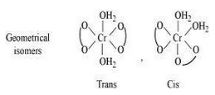
(ii) Trans-isomer is optically inactive. On the other hand, cis-isomer is optically active.
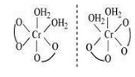
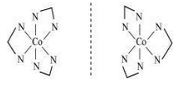
Two optical isomers for [Co(en)3]Cl3 exits
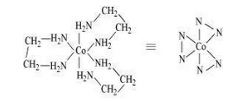
(iii) Two optical isomers are possible for this structure
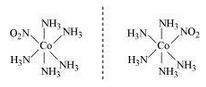
(iv) A pair of optical isomers:
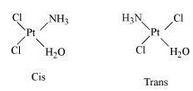
It can also show linkage isomerism.
[Co(NH3)5(NO2)](NO3)2 and [Co(NH3)5(ONO)](NO3)2
It can also show ionization isomerism.
[Co(NH3)5(NO2)](NO3)2 = [CO(NH3)5(NO3)](NO3)(NO2)
19.
(i) \([CoF_6]^{3-}\)
\( [Co(H_2O)_6]^{2+}\)
\([Co(CN)_6]^{3-}\)
(ii) \([FeF_6]^{3-}\)
\(\ [Fe(H_2O)_6]^{2+}\)
\([Fe(CN)_6]^{4-}\)
It is diamagnetic due to the absence of unpaired electrons.
20.
(b) Assertion and reason both are true but reason is not the correct explanation of assertion.
21.
(a) When a monodentate ligand has two possible donor atoms and attached in two ways to the central metal atom then that ligand is called ambidentate ligand. e.g. nitro (NO2) and nitrito (ONO). These show linkage isomerism. Both (A) and (R) are correct and (R) is the correct explanation of (A).
22.
(a) The energy difference between the two sets of d-orbitals is called crystal field splitting energy denoted by \(\triangle\)0 .
(b) The orbitals dx2y2, dz2 lying in the direction of ligands, will experience greater repulsion and their energies will be raised relative to their positions in symmetrical field as compared to orbitals dxy, dyz, dzx lying in between the axis (at angle of 45°), lying away from the approach of ligand.
(c) Greater the (CFSE) \(\triangle\)0 more will be strength of ligand.
(d) \(t_{2 g}^{3} e g^{2}\)
(e) The series in which ligands are arranged in increasing order of magnitude of crystal field splitting energy (\(\triangle\)0 ) is called spectrochemical series.

12th Standard CBSE Syllabus & Materials
12th Standard CBSE
CBSE 12th Computer Science Python Revision Tour I - New Previous year Question Papers Study Material - QB365 Set A
NEW12th Standard CBSE
CBSE 12th Business Studies Planning Important Questions And Answers Study Material - QB365 Set A
NEW12th Standard CBSE
CBSE 12th Business Studies Business Environment Important Questions And Answers Study Material - QB365 Set A
NEW12th Standard CBSE
CBSE 12th Business Studies Principles of Management Important Questions And Answers Study Material - QB365 Set A



NCERT Books

Syllabus

Exam Pattern

Sample Question Papers

Previous year Question Papers

Important Notes

MCQ Practice test

NCERT Exemplers

Case study Questions

Image Based Questions

Passage based Questions

HOT Questions

Value Based Questions

Model Questions Papers
NCERT ( Book Back ) Questions

Assertion and Reason
Important Questions And Answers

CBSE 12th Standard CBSE Subjects
CBSE Standards








