
 100% FREE ACCESS
12th Standard CBSE Syllabus & Materials
12th Standard CBSE
CBSE 12th Economics Government Budget and the Economy Previous year Question Papers Study Material - QB365 Set A
NEW12th Standard CBSE
CBSE 12th Computer Science Interface Python with MySQL - New Previous year Question Papers Study Material - QB365 Set A
NEW12th Standard CBSE
CBSE 12th Computer Science Database Concept - New Previous year Question Papers Study Material - QB365 Set A
NEW12th Standard CBSE
CBSE 12th Computer Science Data Communication - New Previous year Question Papers Study Material - QB365 Set A
NEW12th Standard CBSE
CBSE 12th Computer Science Data Structures - New Previous year Question Papers Study Material - QB365 Set A
NEW12th Standard CBSE
CBSE 12th Computer Science Functions - New Previous year Question Papers Study Material - QB365 Set A

Published on: 02/11/2025
Download CBSE Class 12th Standard CBSE Chemistry question papers, sample papers, important questions, and previous year solved papers in PDF format. Get free study materials, NCERT solutions, and exam preparation resources for Class 12th Standard CBSE Chemistry
Questions + Answers key
Take MCQ Chemistry Test
1.
Explain what is meant by the following:
(i) Peptide linkage
(ii) Pyronose structure of glucose
2.
Identify the compounds A, B, C and D in the following sequence of reaction:
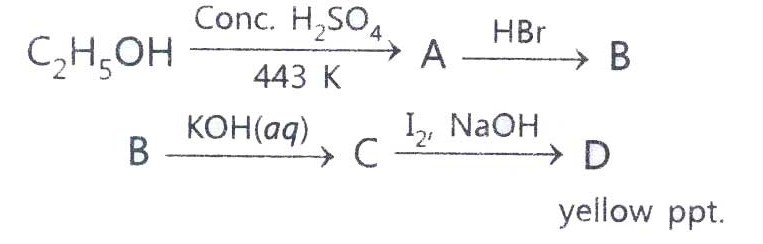
3.
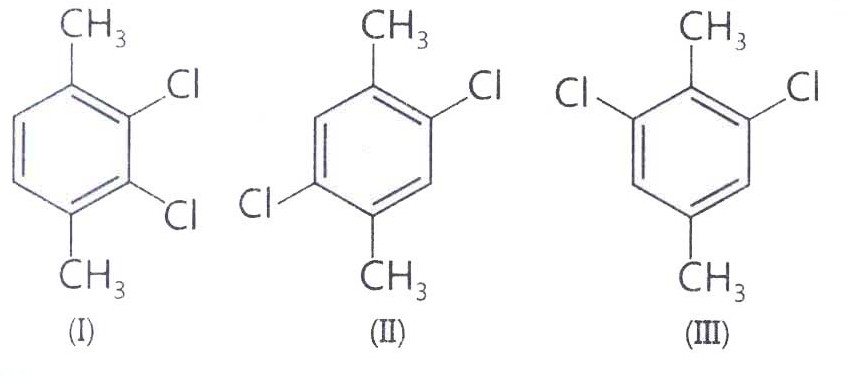
Which of the following compounds will have the highest melting point and why?
4.
Name the metal present in
(i) Chlorophyll
(ii) Haemoglobin
(iii) Vitamin B12
(iv) cis-platin.
5.
Why is CO a stromger lig and than CI-?
6.
(i) Which one of the following is a disaccharide: Starch, Maltose, Fructose, Glucose?
(ii) What is the difference between fibrous protein and globular protein?
(iii) Write the name of vitamin whose deficiency causes bone deformities in children.
7.
Classify the following compounds as primary, secondary and tertiary halides.
(i) 1-Bromobut-2-ene
(ii) 4-Bromopent-2-ene
(iii) 2-Bromo-2-methylpropane
8.
Indentify A, B, C, D, E, R and R1 in the following:
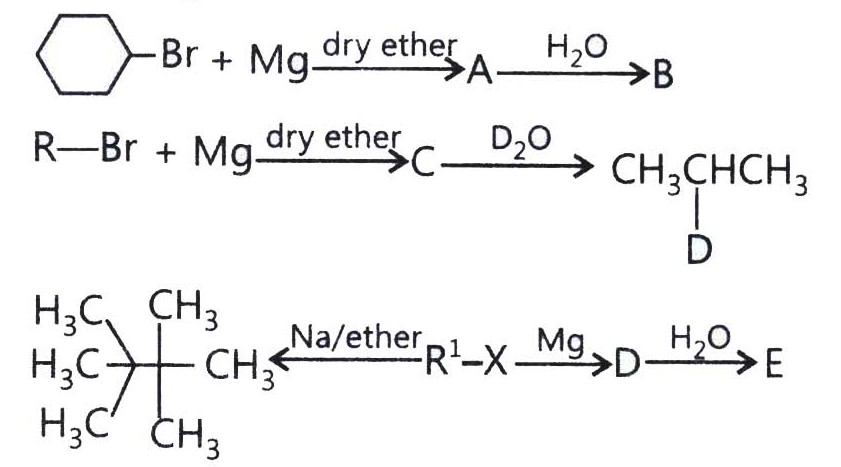
9.
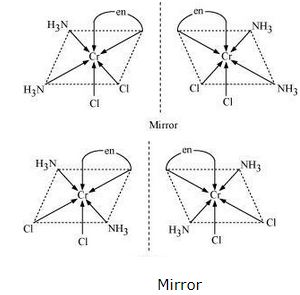
Draw the structures of optical isomers of:
(a) [Cr(C2O4)3]3-
(b) [PtCl2(en)2]2+
(c) [Cr(NH3)2Cl2(en)]+
10.
For the complex [Fe(en)2Cl2]Cl, identify the following:
(i) Oxidation number of iron.
(ii) Hybrid orbitals and shape of the complex.
(iii) Magnetic behavior of the complex.
(iv) Number of its geometrical isomers.
(v) Whether there may be optical isomer also.
(vi) Name of the complex.
11.
The deficiency of vitamin C causes
scurvy
rickets
pyorrhea
pernicious anaemia
12.
The number of tripeptides formed by three different amino acids are
Three
Four
Five
Six
13.
Glycogen is
a structural polysaccharide
structurally similar to amylopenctin but extensively branched
a polymer of \(\beta-D-\)glucose unis
structurally very much similar to amylopectin
14.
The compound,
C7H8 \(\xrightarrow { 3{ CI }_{ 2 }/\triangle } A\xrightarrow { Br_{ 2 }/Fe } B\xrightarrow { Zn/HCI } C\)
The compound C is
o-Bromotoluene
m-Bromotoluene
p-Bromotoluene
3-Bromo-2,4,6-trichlorotoluene
15.
Best reagent for nuclear iodination of aromatic compounds is
KI/CH3COCH3
I2/CH3CN
KI/CH3COOH
I2/HNO3
16.
Which one of the following forms propanenitrile as the major product?
Ethyl bromide ||+ alcoholic KCN
Propyl bromide+alcoholic KCN
Propyl bromide +alcoholic AgCN
Ethyl bromide+alcoholic AgCN
17.
The oxidation state of nickel in [Ni(CO)4] is
4
0
2
3
18.
Zelse's salt is
[Fe(C5H5)2]
[Pb(C2H5)4]
K[PtCl3(C2H4)]
[Ni(CO)4]
19.
\({ Ag }^{ + }+{ NH }_{ 3 }\rightleftharpoons \left[ Ag\left( { NH }_{ 3 } \right) \right] ^{ + }\) ; K1= 6.8 x 10⁻³
\(\left[ Ag\left( { NH }_{ 3 } \right) \right] ^{ + }+{ NH }_{ 3 }\rightleftharpoons \left[ Ag\left( { NH }_{ 3 } \right) _{ 2 } \right] ^{ + }\)
then the formation constant of [Ag(NH3)2]+ is
\(1.08\times { 10 }^{ -7 }\)
\(1.08\times { 10 }^{ -5 }\)
\(1.08\times { 10 }^{ -9 }\)
none of these
20.
IUPAC name of [Pt(NH3)3Br(NO2)Cl]Cl is
Triamminechloridobromidonitroplatinum (IV) chloride
Triamminebromidonitrochloridoplatinum (IV) chloride
Triamminebromidochloridonitroplatinum (IV) chloride
Triamminenitrochloridobromidoplatinum (IV) chloride
21.
(i) Define:
(a) Metal carbonyls
(b) Chelate
(ii) (a) Give one chemical test as an evidence to show that [Co(NH3)5CI]SO4 and [Co(NH3)5(SO4)] Cl are ionisation isomers.
(b) [NiCl4]2- is paramagnetic while [Ni(CO4] is diamagnetic though both are tetrahedral. Why? (Atomic no. of Ni = 28)
(c) Write the electronic configuration of Fe(III) on the basis of crystal field theory when it forms an octahedral complex in the presence of (i) strong field ligand, and (ii) weak field ligand. (Atomic no. of Fe = 26)
22.
Vitamins represents a group of organic compounds which are needed in small amounts for the healthy growth and maintenance of our body. These are not synthesised by the body and are supplied by the diet. The deficiency of vitamins can be supplemented with medicines.
(i) Which vitamins are water soluble ?
(ii) What are the chemical name of vitamin C and vitamin D ?
(iii) What is the source of vitmain K ?
(iv) How is vitamin K useful ?
23.
What happens when
(i) n-butyl chloride is treated with alcoholic KOH.
(ii) bromobenzene is treated with Mg in the presence o dry ether.
(iii) Chlorobenzene is subjected to hydrolysis.
(iv) methyl bromide is treated with sodium in presence of dry ether.
(v) methyl chloride is treated with KCN?
24.
Assertion: Carbon-halogen bond in aryl halide has partial double bond character.
Reason: Aryl halides undergo nucleophilic substitution easily.
Codes:
A) Assertion and reason both are correct statements and reason is correct explanation for assertion.
B) Assertion and reason both are correct statements but reason is not correct explanation for assertion.
C) Assertion is correct statement but reason is wrong statement.
D) Assertion is wrong statement but reason is correct statement.
25.
Assertion: Aryl halide gives a mixture of o-and p-products.
Reason: Aryl halides undergo electrophilic substitutions more readily than benzene.
Codes:
A) Assertion and reason both are correct statements and reason is correct explanation for assertion.
B) Assertion and reason both are correct statements but reason is not correct explanation for assertion.
C) Assertion is correct statement but reason is wrong statement.
D) Assertion is wrong statement but reason is correct statement.
26.
Assertion: Alpha (\(\alpha \))-amino acids exist as internal salt in solution as they have amino and carboxylic acid groups in near vicinity.
Reason: H+ ion given by carboxylic group (-COOH) is captured by amino group (-NH2) having lone pair of electrons.
Codes:
(a) Assertion and reason both are correct statements and reason is correct explanation for assertion.
(b) Assertion and reason both are correct statements but reason is not correct explanation for assertion.
(c) Assertion is correct statement but reason is wrong statement.
(d) Assertion is wrong statement but reason is correct statement.
27.
Assertion: DNA has a double helix structure.
Reason: The two strands in a DNA molecule are exactly similar.
Codes:
(a) Assertion and reason both are correct statements and reason is correct explanation for assertion.
(b) Assertion and reason both are correct statements but reason is not correct explanation for assertion.
(c) Assertion is correct statement but reason is wrong statement.
(d) Assertion is wrong statement but reason is correct statement.
28.
Assertion: [Fe(CN)6]3- has d2sp3 type hyhridisation.
Reason: [Fe(CN)6]3- ion shows magnetic moment corresponding to two unpaired electrons.
Codes:
(a) Assertion and reason both are correct statements and reason is correct explanation for assertion.
(b) Assertion and reason both are correct statements but reason is not correct explanation for assertion.
(c) Assertion is correct statement but reason is wrong statement.
(d) Assertion is wrong statement but reason is correct statement.
29.
In the following questions. an Assertion (A) is followed by a corresponding Reason (R) Use the following keys to choose the appropriate answer.
Assertion (A) In the presence of enzyme, substrate molecule can be attacked by the reagent effectively.
Reason (R) Active sites of enzymes hold the substrate molecule in a suitable position.
Codes:
(a) Both (A) and (R) are correct, (R) is the correct explanation of (A).
(b) Both (A) and (R) are correct, (R) is not the correct explanation of (A).
(c) (A) is correct; (R) is incorrect.
(d) (A) is incorrect; (R) is correct.
30.
In the following questions. an Assertion (A) is followed by a corresponding Reason (R) Use the following keys to choose the appropriate answer.
Assertion (A) The coagulation of egg white occur on boiling.
Reason (R) Denaturation of protein is occur when its native form is subjected to physical change or chemical change.
Codes:
(a) Both (A) and (R) are correct, (R) is the correct explanation of (A).
(b) Both (A) and (R) are correct, (R) is not the correct explanation of (A).
(c) (A) is correct; (R) is incorrect.
(d) (A) is incorrect; (R) is correct.
31.
In the following questions. an Assertion (A) is followed by a corresponding Reason (R) Use the following keys to choose the appropriate answer.
Assertion (A) The total number of isomers shown by \(\begin{equation} \left[\mathrm{Co}(\mathrm{en})_{2} \mathrm{Cl}_{2}\right]^{+} \end{equation}\) complex ion-is three.
Reason (R) \(\begin{equation} \left[\mathrm{Co}(\mathrm{en})_{2} \mathrm{Cl}_{2}\right]^{+} \end{equation}\) complex ion has an octahedral geometry.
Codes:
(a) Both (A) and (R) are correct, (R) is the correct explanation of (A).
(b) Both (A) and (R) are correct, (R) is not the correct explanation of (A).
(c) (A) is correct; (R) is incorrect.
(d) (A) is incorrect; (R) is correct.
32.
Complex compounds play an important role in our daily life. Werner's theory of complex compounds says every metal atom or ion has primary valency (oxidation state) which is satisfied by -vely charged ions, ionisable where secondary valency (coordination number) is non-ionisable, satisfied by Iigands (+ve, -ve, neutral) but having lone pair. Primary valency is non-directional, secondary valency is directional. Complex compounds are name according to IUPAC system. Valence bond theory helps in determining shapes of complexes based on hybridisation, magnetic properties, outer or inner orbital complex. Complex show ionisation, linkage, solvate and coordination isomerism also called structural isomerism. Some of them also show stereoisomerism i.e. geometrical and optical isomerism. Ambidentate ligand are essential to show linkage isomerism. Polydentate Iigands form more stable complexes then unidentate Iigands. There are called ehelating agents. EDTA is used to treat lead poisoning, cis-platin as anticancer agents. Vitamin B12 is complex of cobalt. Haemoglobin, oxygen carrier is complex of Fe2+ and chlorophyll essential for photosynthesis is complex of Mg2+.
(a) What is the oxidation state of Ni in [Ni(CO)4]?
(b) One mole of CrCI3 . 6H2O reacts with excess of AgO3 to yield 2 mole of AgCI. Write formula of complex. Write IUPAC name also.
(c) Out Cis - [Pt(en)2 CI2 ]2+ and trans (Ptren), CI2 )2+ which one shows optical isomerism?
(d) Name the hexadentate ligand used for treatment of lead poisoning.
(e) What is hybridisation of [CoF6]3- [Co = 27] Give its shape and magnetic properties.
(f) Out [Fe(CO)5], [Fe(C2 O4 )3]3-, [Fe(H2O6)3+, [Fe(CN)6]3-, which is most stable?
(g) What type of isomerism is shown by [Cr(H2O)6] CI3 and [Cr(H2O)5 CI] CI2 . H2O?
33.
Read the passage given below and answer the following questions:
Carbohydrates can exist in either of two conformations, as determined by the orientation of the hydroxyl group about the asymmetric carbon farthest from the carbonyl.
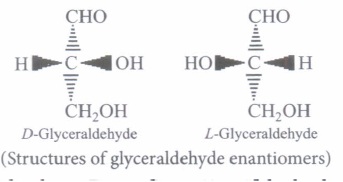
By convention, a monosaccharide is said to have D-configuration if the hydroxyl group attached to the asymmetric carbon atom adjacent to the - CH2OH group is on the right hand side irrespective of the positions of the other hydroxyl groups. On the other hand, the molecule is assigned L-configuration if the - OH group attached to the carbon adjacent to the - CH2OH group is on the left hand side.
The following questions are multiple choice questions. Choose the most appropriate answer:
(i) D-Glyceraldehyde and L-Glyc~raldehyde are
| (a) epimers | (b) enantiomers |
| (c) anomers | (d) conformational diasteriomers |
(ii) Which of the following monosaccharides, is the majority found in the human body?
| (a) D-type | (b) L-type | (c) Both of these | (d) None of these |
(iii) Monosaccharides contain
| (a) always six carbon atoms | (b) always five carbon atoms |
| (c) always four carbon atoms | (d) may contain 3 to 7 carbon atoms |
(iv) The correct corresponding order of names of four aldoses with configuration given below
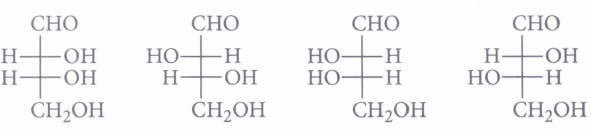
respectively, is
| (a) L-erythrose, L-threose, L-erythrose, D-threose |
| (b) D-threose, D-erythrose, L-tl?repse, L-erythrose |
| (c) L-erythrose, L-threose, D-erythrose, D-threose |
| (d) D-erythrose, D-threose, L-erythrose, L-threose. |
34.
Read the passage given below and answer the following questions:
Nucleophilic substitution reactions are of two types; substitution nucleophilic bimolecular (SN2) and substitution nucleophilic unimolecular (SN1) depending on molecules taking part in determining the rate of reaction. Reactivity of alkyl halide towards SN1 and SN2 reactions depends on various factors such as steric hindrance, stability of intermediate or transition state and polarity of solvent. SN2 reaction mechanism is favoured mostly by primary alkyl halide then secondary and then tertiary. This order is reversed in case of SN1 reactions.
The following questions are multiple choice questions. Choose the most appropriate answer:
(i) Which of the following is most reactive towards nucleophilic substitution reaction?
| (a) \(\mathrm{C}_{6} \mathrm{H}_{5} \mathrm{Cl}\) | (b) \(\mathrm{CH}_{2}=\mathrm{CHCl}\) | (c) \(\mathrm{ClCH}_{2} \mathrm{CH}=\mathrm{CH}_{2}\) | (d) \(\mathrm{CH}_{3} \mathrm{CH}=\mathrm{CHCl}\) |
(ii) Isopropyl chloride undergoes hydrolysis by
| (a) SN1mechanism | (b) SN2mechanism | (c) SN1 and SN2mechanism | (d) neither SN1 and SN2mechanism |
(iii) The most reactive nucleophile among the following is
| (a) CH3O- | (b) C6H5O- | (c) (CH3)2CHO- | (d) (CH3)3CO- |
(iv) Tertiary alkyl halides are practically inert to substitution by SN2mechanism because of
| (a) insolubility | (b) instability | (c) inductive effect | (d) stearic hindrance. |
1.
(i) Peptide linkage: The amide linkage between two a-amino acids formed with the loss of a water molecule is called a peptide linkage.
(ii) The six membered cyclic structure of glucose is called pyranose structure (α - or β -), in analogy with heterocylic compound pyran glucose
2.

3.
Compound (II) is most symmetrical because it has both the -CH2 groups and Cl atoms para- to each other. Therefore, it fits in the crystal lattice better than the other two isomers and hence it has the highest melting point.
4.
(i) Mg
(ii) Fe
(iii) Co
(iv) Pt
5.
It is because CO can form σ (sigma) as well as π -bond, therefore, it is stronger ligand than CI-.
6.
(i) Maltose is disaccharide.
(ii)
| Fibrous protein | Globular protein |
|---|---|
| It consist linear thread like molecules which tend to lie side by side to form fibres. Example: Keratin, collagen |
It consist compact form of molecules which are folded together. Example: enzymes, hormones. |
(iii) The deficiency of vitamin D causes bone deformities in children.
7.
\((i)\ { { C }H }_{ 3 }CH=CH-\overset { { 1 }^{ \circ } }{ { C } } { H }_{ 2 }Br\ \ (ii){ { C }H }_{ 3 }-\overset { { 2 }^{ \circ } }{ { C } } { H }Br-CH=CH-{ { C }H }_{ 3 }\ \ (iii){ { C }H }_{ 3 }\overset { { 3 }^{ \circ } }{ - } \overset { \underset { | }{ { CH }_{ 3 } } }{ \underset { \overset { | }{ { CI } } }{ C } } -Br\ \)
1-Bromobut-2-enc 4-Bromopent-2-ene 2-Bromo-2-methylpropane
(1o Alkyl halide) (2o Alkyl halide) (3o Alkyl halide)
8.
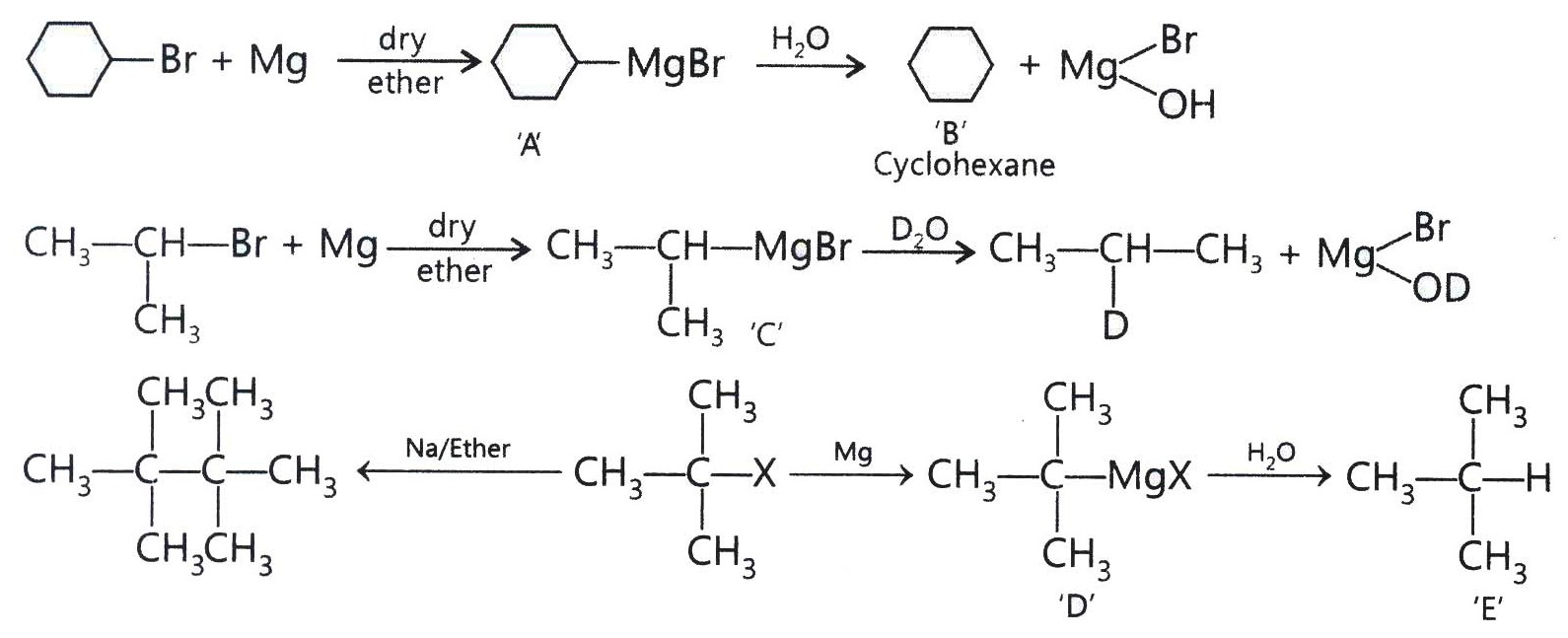
9.
(a) [Cr(C2O4)3]3-
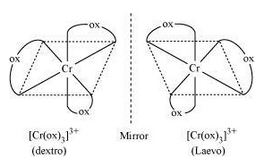
(b) [PtCl2(en)2]2+
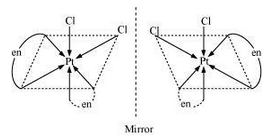
(c) [Cr(NH3)2Cl2(en)]+
10.
(i) +3 (III)
(ii) dsp, octahedral
(iii) paramagnetic
(iv) Two geometrical isomers
(v) Yes, there may be optical isomer also due to presence of polydentate ligand.
(vi) Dichlorido bis-(ethane 1, 2-diamine) Iron (III)
11.
(a)
scurvy
12.
(d)
Six
13.
(b)
structurally similar to amylopenctin but extensively branched
14.
(b)
m-Bromotoluene
15.
(d)
I2/HNO3
16.
(a)
Ethyl bromide ||+ alcoholic KCN
17.
(b)
0
18.
(c)
K[PtCl3(C2H4)]
19.
(b)
\(1.08\times { 10 }^{ -5 }\)
20.
(a)
Triamminechloridobromidonitroplatinum (IV) chloride
21.
(i) (a) Metal carbonyls: Metal carbonyls are the compounds in which carbon monoxide (CO) acts as the ligand. The metal-carbon bond in metal carbonyls possesses both \(\sigma\) and \(\pi\) characters, e.g. N(CO)4[nickeltetracarbonyl]. Its IUPAC name is tetra carbonyl nickel(0).
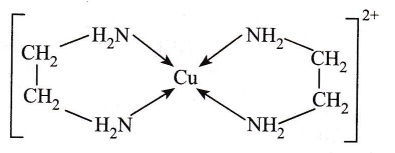
(b) Chelate: An inorganic metal complex in which there is a close ring of atoms caused by attachment of a ligand to a metal atom at two points. An example is the complex ion formed between ethylene diamine and cupric ion,[Cu(NH2CH2CH2NH2)2]2+.
(ii) (a) Add BaCl2 solution. [Co(NH3)]5Cl]SO4 will give white ppt. of BaSO4.
\(\left[\mathrm{Co}\left(\mathrm{NH}_{3}\right)_{5} \mathrm{Cl}\right] \mathrm{SO}_{4}+\mathrm{BaCl}_{2}(a q) \)\( \longrightarrow\left[\mathrm{Co}\left(\mathrm{NH}_{3}\right)_{5} \mathrm{Cl}\right] \mathrm{Cl}_{2}+\mathrm{BaSO}_{4} \downarrow \)
\(\text { (White ppt.) }\)
Add AgNO3(aq) solution [Co(NH3)5SO4] Cl will give white ppt. of AgCl.
\( {\left[\mathrm{Co}\left(\mathrm{NH}_{3}\right)_{5} \mathrm{SO}_{4}\right] \mathrm{Cl}+\mathrm{AgNO}_{3}(a q)} \) \(\longrightarrow \mathrm{AgCl}+\left[\mathrm{Co}\left(\mathrm{NH}_{3}\right)_{5} \mathrm{SO}_{4}\right] \mathrm{NO}_{3} \)
\(\text { (White ppt) }\)
(c) Fe3+ (4s03d5) In strong field \( \Delta_{0}>P t_{2 g}^{5} e g^{0} \)
In weak field \(\Delta_{0}
22.
(i) Vitamin B-complex and vitamin C are water soluble vitamins.
(ii) Vitamin C is chemically ascorbic acid while vitamin D is ergocalciferol.
(iii) Green leafy vegetables like spinach, cabbage, carrot etc.
(iv) It is essentially needed for body. The deficiency of vitamin K leads to blood clotting and even harmorrhage
23.
\(\underset { n-Butylchloride }{ { CH }_{ 3 }{ CH }_{ 2 }{ CH }_{ 2 }{ CH }_{ 2 }CI } +KOH(alc.)\overset { \triangle }{ \longrightarrow } \underset { But-l-ene }{ { CH }_{ 3 }{ CH }_{ 2 }CH={ CH }_{ 2 }+KCI+{ H }_{ 2 }O } \)
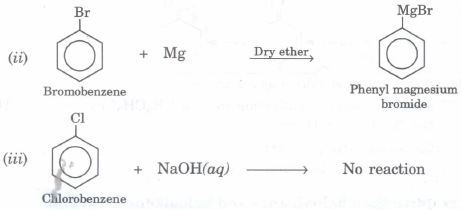
\((iv)\quad { 2CH }_{ 3 }Br+2Na\overset { Dry\quad ether }{ \underset { \quad Wurt\\ reaction }{ \longrightarrow } } \underset { Ethane }{ { CH }_{ 3 }{ CH }_{ 3 } } +2NaBr\)
\(\\ (vi)\quad \underset { Methyl\\ chloride }{ { CH }_{ 3 }CI } +KCN\longrightarrow \underset { Methyl\\ chloride }{ { CH }_{ 3 }CN } +KCI\)
24.
C) Assertion is correct statement but reason is wrong statement.
Explanation:
Aryl halides undergo nucleophilic substitution with difficulty.
25.
C) Assertion is correct statement but reason is wrong statement.
Explanation:
Halogens are somewhat deactivating but o, p-directing. As a result, aryl halides undergo the usual electrophilic substitution reactions less readily than benzene.
26.
\(\text { (a): } \mathrm{NH}_{2}-\mathrm{CH}_{2}-\mathrm{COOH}\) is a typical \(\alpha \) -amino acid.
In solution it exists as, internal salt or zwitter ion,
\(\left(\mathrm{NH}_{3}-\mathrm{CH}_{2}-\mathrm{COO}^{-}\right)\)
because the proton (H+) of - COOH group is captured by - NH2 group as NH2 has a lone pair of electrons on N atom.
27.
(c): The two strands in a DNA molecule are not exactly similar but are complimentary.
28.
(C): [Fe(CN)6]3- ion shows magnetic moment corresponding to one unpaired electron.
29.
(a) In the presence of an enzyme, substrate molecule can be attacked by the reagent effectively because activesites of enzymes hold the substrate moleculein a suitable position. Thus, both (A) and (R) are correct explanation of (A).
30.
(a) When a protein in its native form is subjected to physical change like change in temperature or chemical change like change in pH, the hydrogen bonds are disturbed.
Due to this, globules unfold and helix get uncoiled and protein loses its biological activity. This is called denaturation of protein. The coagulation of egg white on boiling is the common example of denaturation. Thus, both (A)and (R)are correct explanation of (A).
31.
(b) \(\begin{equation} \left[\mathrm{Co}(\mathrm{en})_{2} \mathrm{Cl}_{2}\right]^{+} \end{equation}\)exist in cis and trans isomers out of which cis isomer will be optically active (cis-d-isomer) and (cis-l-isomer). Both (A) and (R) are correct but (R) is not the correct explanation of (A).
32.
(a) Zero
(b) [Cr(H2O)5Cl]CI2 . H2O, pentaaqua chlorido chromium (III) chloride.
(c) Cis - [Pt(en)2 Cl2]2+ shows optical isomerism.
(d) EDTA4- (ethylene diamine tetra acetate)
(e) Sp3 d2, octahedral, paramagnetic. It is outer orbital complex.
(f) [Fe(CO)5] is most stable because CO is strongest ligand.
(g) Solvate isomerism.
33.
(i) (b)
(ii) (a)
(iii) (d)
(iv) (d): 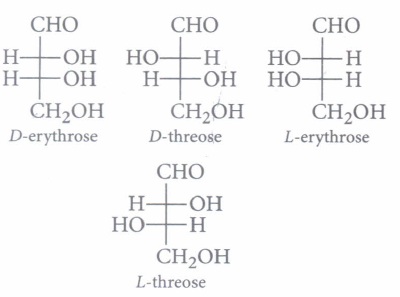
34.
(i) (c) : Allylic chlorides are most reactive.
(ii) (c): 20 - alkyl halides undergo hydrolysis by SN1 or SN2 mechanism.
(iii) (a): Smaller the size of the nucleophile (i.e., CH3O-), more reactive it is.
(iv) (d): Stearic hindrance due to bulky alkyl groups prevents the attack of the nucleophile in SN2 mechanism.

12th Standard CBSE Syllabus & Materials
12th Standard CBSE
CBSE 12th Computer Science Python Revision Tour I - New Previous year Question Papers Study Material - QB365 Set A
NEW12th Standard CBSE
CBSE 12th Business Studies Planning Important Questions And Answers Study Material - QB365 Set A
NEW12th Standard CBSE
CBSE 12th Business Studies Business Environment Important Questions And Answers Study Material - QB365 Set A
NEW12th Standard CBSE
CBSE 12th Business Studies Principles of Management Important Questions And Answers Study Material - QB365 Set A



NCERT Books

Syllabus

Exam Pattern

Sample Question Papers

Previous year Question Papers

Important Notes

MCQ Practice test

NCERT Exemplers

Case study Questions

Image Based Questions

Passage based Questions

HOT Questions

Value Based Questions

Model Questions Papers
NCERT ( Book Back ) Questions

Assertion and Reason
Important Questions And Answers

CBSE 12th Standard CBSE Subjects
CBSE Standards








