
12th Standard CBSE Syllabus & Materials
12th Standard CBSE
CBSE 12th Economics Government Budget and the Economy Previous year Question Papers Study Material - QB365 Set A
NEW12th Standard CBSE
CBSE 12th Computer Science Interface Python with MySQL - New Previous year Question Papers Study Material - QB365 Set A
NEW12th Standard CBSE
CBSE 12th Computer Science Database Concept - New Previous year Question Papers Study Material - QB365 Set A
NEW12th Standard CBSE
CBSE 12th Computer Science Data Communication - New Previous year Question Papers Study Material - QB365 Set A
NEW12th Standard CBSE
CBSE 12th Computer Science Data Structures - New Previous year Question Papers Study Material - QB365 Set A
NEW12th Standard CBSE
CBSE 12th Computer Science Functions - New Previous year Question Papers Study Material - QB365 Set A

Published on: 20/08/2026
Download CBSE Class 12th Standard CBSE Chemistry question papers, sample papers, important questions, and previous year solved papers in PDF format. Get free study materials, NCERT solutions, and exam preparation resources for Class 12th Standard CBSE Chemistry
Questions + Answers key
Take MCQ Chemistry Test
1.
Why is the \(E^{\ominus}\) values for Mn3+/Mn2+ couple much more positive than for Cr3+/Cr2+ or Fe3+/Fe2+ ? Explain?
2.
Represent the cell in which the following reaction takes place:
Mg(s) + 2Ag+ (0.0001 M) \(\longrightarrow\) Mg2+ (0.130 M ) +2 Ag(s)
Calculate its E(cell) if \(E_{\text {(cell) }}^{\ominus}\)= 3.17 V.
3.
A solution of urea in water has a boiling point of 100.128°C. Calculate the freezing point of the same solution. Molal constants for water Kf and Kb are 1.86°C and 0.512°C respectively.
4.
The treatment of alkyl chlorides with aqueous KOH lead to the formation of alcohols but in presence of alcoholic KOH alkenes are major products. Explain.
5.
Name the metal present in
(i) Chlorophyll
(ii) Haemoglobin
(iii) Vitamin B12
(iv) cis-platin.
6.
Define threshold energy of a reaction.
7.
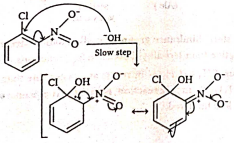
With the help of resonating structures explain the effect of presence of nitro group at ortho position in chlorobenzene.
8.
(a) What are the different oxidation states exhibited by the lanthanoids?
(b) Write two characteristics of the transition elements.
(c) Which of the 3d-block elements may not be regarded as the transition elements and why?
9.
Write structures of different dihalogen derivatives of propane.
10.
[Cr(NH3)6]3+ is paramagnetic while [Ni(CN)4]2- is diamagnetic. Explain Why?
11.
Which of the two \(Na^{ + }\) or \(Ag^{ + }\) is stronger Lewis acid and why?
12.
When a certain electrolytic cell was filled with 0.1 M KCl, it has resistance of 85 ohms at 25 oC. When the same cell was filled with an aqueous solution of 0.052 M unknown electrolyte, the resistance was 96 ohms. Calculate the molar conductance of the electrolyte at this concentration. [Specific conductance of 0.1 M KCl = \(1.29\times { 10 }^{ -2 }{ ohm }^{ -1 }{ cm }^{ -1 }\)]
13.
Boiling point of water at 750 mm Hg is 99.63 oC. How much sucrose is to be added to 500 g of water such that it boils at 100oC?
14.
For a first order reaction, show that time required for 99% completion is twice the time required for the completion of 90% of reaction
15.
Identify A, B, C, D, E, R and R' in the following:
(i)

(ii)

(iii)

16.
Define conductivity and molar conductivity for the solution of an electrolyte. Discuss their variation with concentration.
17.
Using crystal field theory, draw energy level diagram, write electronic configuration of the central metal atom/ion and determine the magnetic moment value in the following :
(i) \([CoF_6]^{3-}, [Co(H_2O)_6]^{2+},[Co(CN)_6]^{3-}\)
(ii) \([FeF_6]^{3-}, \ [Fe(H_2O)_6]^{2+}, [Fe(CN)_6]^{4-}\).
18.
The time required for 10% completion of a first order reaction at 298 K is equal to that required for its 25% completion at 318 K. If the pre-exponential factor for the reaction is 3.56 \(\times 10 ^{9} s^{-1}\), calculate its rate constant at 318 K and also the energy of activation.
19.
Vapour pressure of chloroform (CHCI3) and dichloromethane (CH2CI2) at 298 K are 200 mm Hg and 415 mm Hg respectively.
(i) Calculate the vapour pressure of the solution prepared by mixing 25.5 g of CHCl3 and 40 g of CH2Cl2 at 298 K and
(ii) mole fractions of each component in vapour phase.
20.
The non-stoichiometric reaction:
2A + B \(\rightarrow\) C+D
| Initial conc A | Initial conc of B | Initial rate (Mol L-1 ) |
| 0.1 M | 0.1 M | 1.2 x 10- 3 |
| 0.1 M | 0.2M | 1.2 x 10- 3 |
| 0.2 M | 0.1 M | 2.4 x 10- 3 |
The rate law for formation of c is
\(\frac{\mathrm{dc}}{\mathrm{dt}}=k[\mathrm{~A}]\)
\(\frac{\mathrm{dc}}{\mathrm{dt}}=k[\mathrm{~A}][\mathrm{B}]\)
\(\frac{\mathrm{dc}}{\mathrm{dt}}=k[\mathrm{~A}]^{2}[\mathrm{~B}]^{1}\)
\(\frac{\mathrm{dc}}{\mathrm{dt}}=k[\mathrm{~A}][\mathrm{B}]^{2}\)
21.
Which of the following compounds will give racemic mixture on nucleophilic substitution by OH- ion?
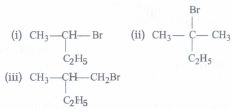
(i)
(i), (ii) and (iii)
(ii) and (iii)
(i) and (iii)
22.
The unit of the rate constant of nth order is
mol1-n Ln-1s-1
mol n-1 Ln-1s-1
moln-1 Ln-1s
mol n L1-ns-1
23.
The reaction of aqueous KMnO4 with H2O2 in acidic conditions gives
Mn4+ and O2
Mn2+ and O2
Mn2+ and O3
Mn4+ and MnO2
24.
Which of the following actinoids show oxidation states upto +7 ?
Am
Pu
U
Np
25.
Due to the presence of ambidentate ligands co-ordination compounds show isomerism. Palladium complexes of the type \([Pd(C_6H_5)_2(SCN)_2]\) and \([Pd(C_6H_5)_2(NCS)_2]\) are
linkage isomers
coordination isomers
ionisation isomers
geometrical isomers
26.
Which of the following are false ?
Saline water slows down rusting
In Daniell cell, if concentrations of the solutions are doubled, the emf of the cell is also doubled.
EMF of a cell is an intensive quantity whereas free energy change, \(\Delta G\) is extensive.
Galvanized iron sheets remain protected from rusting even if a crack is developed
27.
A lead storage battery has been used for one month (30 days) at the rate of one hour per day by drawing a constant current of 2 amperes. H2SO4 consumed by the battery is
1.12 mole
2.24 mole
3.36 mole
4.48 mole
28.
Which of the following is not an example of Wurtz-Fitting reaction?
C6H5CH2Cl+CH3Cl \(\overset { Na/ether }{ \longrightarrow } \)
C6H5CH2Cl+C6H5Cl \(\overset { Na/ether }{ \longrightarrow } \)
C6H5Cl+CH3Cl \(\overset { Na/ether }{ \longrightarrow } \)
None of the above
29.
IUPAC name of sodium cobaltinitrite is
Sodium cobaltinotrite
Sodium hexanitritocobaltate(III)
Sodium hexanitrocobalt(III)
Sodium hexanitritocobaltate(II)
30.
Which of the following 0.1 M aqueous solution is likely to have tha highest boilling point ?
\({ Na }_{ 2 }{ SO }_{ 4 }\)
KCI
Glucose
Urea
31.
5ml of 1 N HCI, 20ml of N/2 H2SO4 and 30ml of N/3 HNO3 are mixed together and the volume made to one litre. The normality of the resulting solution is
N/5
N/10
N/20
N/40
32.
Assertion: Sodium ions are discharged in preference to hydrogen ions at a mercury cathode.
Reason: The nature of the cathode can effect the order of discharge of ions.
Codes:
A) If both assertion and reason are true and the reason is the correct explanation of the assertion.
B) If both assertion and reason are true but reason is not the correct explanation of the assertion.
C) If assertion is true but reason is false.
D) If the assertion and reason both are false.
E) If assertion is false but reason is true.
33.
Assertion (A) : Alkyl halides are insoluble in water.
Reason (R) : Alkyl halides have halogen attached to sp³ hybridised carbon.
(a) Both (A) and (R) are correct, (R) is the correct explanation of (A).
(b) Both (A) and (R) are correct, (R) is not the correct explanation of (A).
(c) (A) is correct but (R) is incorrect.
(d) (A) is incorrect but (R) is correct
34.
Assertion: Amalgam is a homogeneous solution.
Reason: Amalgam is a solution in which mercury is solute and zinc is solvent.
(a) Assertion and reason both are correct statements and reason is correct explanation for assertion.
(b) Assertion and reason both are correct statements but reason is not correct explanation for assertion .
(c) Assertion is correct statement but reason is wrong statement.
(d) Assertion is wrong statement but reason is correct statement.
35.
Assertion: Zeises salt is a ㅠ-bonded organometallic compound.
Reason: The oxidation number of platinum in Zeises salt is +2.
Codes:
(a) Assertion and reason both are correct statements and reason is correct explanation for assertion.
(b) Assertion and reason both are correct statements but reason is not correct explanation for assertion.
(c) Assertion is correct statement but reason is wrong statement.
(d) Assertion is wrong statement but reason is correct statement.
36.
Transition metals form complex compounds which playa very important role in our daily life. Complexes are also formed by other groups elements e.g. Chlorophyll is coordination compound of Mg. Organometallic compounds like Grignard reagent is most useful in organic chemistry. Complexes are used in medicines, analytical chemistry, qualitative analysis, electroplating, biological processes. Stability of complexes depends upon charge on central metal ion, strength of ligand. Counter ions outside the coordination entity are ionisable but inside the coordination sphere are not ionisable.
(a) Name a complex used as anticancer agent?
(b) What is coordination number of Co in [Co(en)3]3+ and why?
(c) Name a complex used in Gold plating
(d) Name a complex used for determining hardness of water. What is its denticity?
(e) How is undecomposed AgBr removed from photographic film? Write the reaction involved.
37.
Electrochemistry plays a very important part in our daily life. Primary cells like dry cell is used in torches, wall clock, mercury cell is used in hearing aids, watches. Secondary cells Ni-Cd cell is used in cordless phones, lithium battery is used in mobiles, lead storage battery is used in vehicle and inverter. Fuel cells like H2 -O2 cell was used in apollo space programme. A 38% solution of sulphuric and is used in lead storage battery. Its density is 1.30 g mL -1. The battery holds 3.5 L of the acid. During the discharge of the battery, the density of H2 SO4 falls to 1.14 g mL -1 (20% solution by mass) (Molar mass of H2 SO4 is 98 g mol -1).
(a) Write the chemical reaction taking place at anode when lead storage battery is in use.
(b) How much electricity in Faraday is required to carry out the reduction of one mole of PbO2 ?
(c) What is molarity of sulphuric acid before discharge?
(d) What is mass of sulphuric acid in solution after discharge?
(e) Write the products of electrolysis when dilute sulphuric acid is electrolysed using platinum electrodes.
1.
Much larger third ionisation energy of Mn (where the required change is d5 to d4) is mainly responsible for this. This also explains why the +3 state of Mn is of little importance.
2.
The cell can be written as Mg | Mg2+(0.130M) | Ag+(0.0001M) | Ag
\(E_{(\text {cell })}=E_{\text {(cell) }}^{\ominus}-\frac{\mathrm{RT}}{2 \mathrm{~F}} \ln \frac{\left[\mathrm{Mg}^{2+}\right]}{\left[\mathrm{Ag}^{+}\right]^{2}}\)
\(=3.17 \mathrm{~V}-\frac{0.059 \mathrm{~V}}{2} \log \frac{0.130}{(0.0001)^{2}}\)
= 3.17 V – 0.21V = 2.96 V.
3.
- 0.465°C
4.
In an aqueous solution, KOH almost completely ionises to give OH– ions. OH– ions is a strong nucleophile, which leads the alkyl chloride to undergo a substitution reaction to form alcohol.
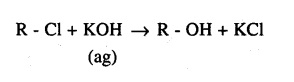
On the other hand, an alcoholic soln of KOH contains alkoxide (RO–) ion, which is a strong base. Thus, it can abstract a hydrogen from the β – carbon of the alkyl chloride and form an alkene by eliminating a molecule of HCl.
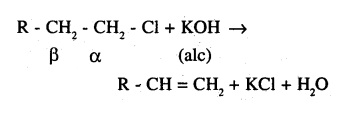
OH– ion is a much weaker base than RO– ion. Also, OH– ion is highly solvated in an aqueous solution and as a result the basic character of OH’ ion decreases. Therefore, it cannot abstract a hydrogen from β - carbon.
5.
(i) Mg
(ii) Fe
(iii) Co
(iv) Pt
6.
Threshold energy is the minimum energy which must be possessed by reacting molecules in order to undergo effective collision which leads to formation of product molecule.
7.
Nitro group at ortho-position in chlorobenzene withdraws the electron density from the benzene ring and thus facilitates the attack of nucleophile on haloarene. -NO, at ortho-position
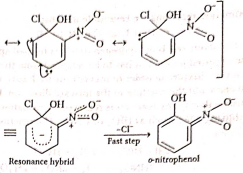
8.
(a) Lanthanoids, mostly show +3 oxidation state but some of them show +2 and +4 oxidation states also due to the stability of electronic configuration (4f0, 4f 7 and 4f14 ).
(b) (i) They show variable oxidation states.
(ii) They form coloured ions.
(c) Zn may not be regarded as transition metal because neither Zn nor Zn2+ have incompletely filled d-orbital.
9.
The structures of different dihalogen derivatives of propane are :
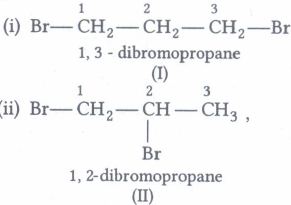
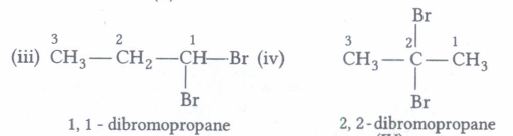
10.
[Cr(NH3)6]3+ is paramagnetic due to presence of 3 unpaired electrons. Cr (Z = 24) has electronic configuration [Ar]3d 54s 1 .
Cr3+ has electronic configuration [Ar]3d 3 .
It undergoes d 2 sp 3 hybridisation to form six hybrid orbitals which are occupied by electron pairs donated by six ammonia ligands.[Ni(CN)4]2- is diamagnetic as all electrons are paired. Ni (Z = 28) has electronic configuration [Ar]3d 8 4s 2. Ni 2+ has electronic configuration [Ar]3d 8. It undergoes dsp 2 hybridisation to form 4 hybrid orbitals which are occupied by electron pairs donated by four cyanide ligands.
11.
Ag+ ion is stronger Lewis acid than Na+. Ag+ has 18-electron shell configuration (known as pseudo inert gas configuration) and causes greater polarization than Na+, an ion with 8-electron shell configuration. This is due to the fact that in the case of 18-electrons shell ion there are 10 d-electrons in addition to 88-and p-electrons. The d-electrons do not shield the nuclear charge effectively and therefore, they have increased the effective nuclear charge. Hence they cause greater polarization and therefore, Ag+ is a stronger Lewis acid than Na+ ion.
12.
\(K=1.29\times { 10 }^{ -2 }{ ohm }^{ -1 }{ cm }^{ -1 }\)
\(K=\frac { 1 }{ R } \times \frac { 1 }{ a } \Rightarrow \frac { 1 }{ a } =K\times R=1.29\times { 10 }^{ -2 }\times 85=109.65\times { 10 }^{ -2 }=1.0965{ cm }^{ -1 }\)
\({ \wedge }_{ m }=\frac { 1000K }{ M } =\frac { 1000 }{ M } \times \frac { 1 }{ R } \times \frac { 1 }{ a } \)
\({ \wedge }_{ m }=\frac { 1000\times 1\times 1.0965 }{ 0.052\times 96 } =\frac { 1096.50 }{ 4.992 } =219.65 \ S \ { cm }^{ 2 }{ mol }^{ -1 }\)
13.
Elevation in boiling point required \((\triangle { T }_{ b })=100-99.{ 63 }^{ \circ }=0.{ 37 }^{ \circ }\)
Mass of solvent (water), \({ w }_{ 1 }=500\quad g\)
Molar mass of solvent, \({ M }_{ 1 }=18 \ g \ { mol }^{ -1 }\)
Molar mass of solute,\({ C }_{ 12 }{ H }_{ 22 }{ O }_{ 11 }=342 \ g{ \ mol }^{ -1 }\)
Applying the formula, \({ M }_{ 2 }=\frac { 1000\triangle { T }_{ b }{ w }_{ 2 } }{ { w }_{ 1 }\times \triangle { T }_{ b } } \)
or \({ w }_{ 2 }=\frac { { M }_{ 2 }\times { w }_{ 1 }\triangle { T }_{ b } }{ 1000\times { K }_{ b } } =\frac { 342 \ g{ \ mol }^{ -1 }\times 500 \ g\times 0.37 \ K }{ 1000 \ g{ \ kg }^{ -1 }\times 0.52 \ K \ kg \ { \ mol }^{ -1 } } =121.7 \ g\)
14.
For first order reaction, \(t=\frac { 2.303 }{ k } \log { \frac { a }{ a-x } } \)
99% completion means that x = 99% of a = 0.99 a
\({ t }_{ 99 }\%\)\(=\frac { 2.303 }{ k } \log { \frac { a }{ a-0.99a } } =\frac { 2.303 }{ k } \log { { 10 }^{ 2 } } =2\times \frac { 2.303 }{ k } \)
90% completion means that x = 90% of a = 0.90 a
\(\therefore \quad { t }_{ 90 }\%\)\(=\frac { 2.303 }{ k } \log { \frac { a }{ a-0.99a } } =\frac { 2.303 }{ k } \log { { 10 } } =2\times \frac { 2.303 }{ k } \)
\(\therefore \quad \frac { { t }_{ 99 } }{ { t }_{ 90 } } ={ \left( \frac { 2\times 2.303 }{ k } \right) }/{ \left( \frac { 2.303 }{ k } \right) }=2\quad \)\({ t }_{ 99 }\%\)\(=2\times { t }_{ 90 }\%\)
15.
(i) Haloalkanes react with Mg in dry ether to form Grignard reagents (RMgX), which react with water to form hydrocarbons.

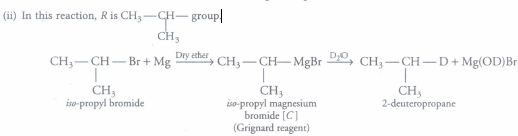
(iii) Haloalkanes react with Na in dry ether to give hydrocarbons containing double number of C-atoms.

16.
Conductivity The inverse of resistivity is called conductivity. It is denoted by K (kappa). It is also known as specific conductance. k = 1/p SI unit of conductivity is Sm-1 or ohm-1 m-1
Molar conductivity It is defined as the conductance of the solution which contains one mole of the electrolyte such that entire solution is in between the two electrodes kept one centimeter apart, and large enough to contain all the electrolytes.
Molar conductivity, \(\Lambda _{ m }=\frac { K }{ C } \)
Variation of conductivity and molar conductivity with concentration.
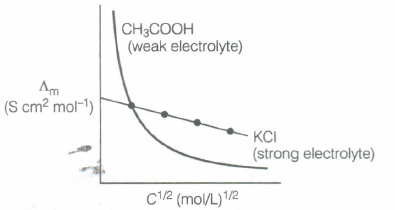
Conductivity and molar conductivity change with change in concentration of electrolyte ..Conductivity always decreases with decrease in concentration for both weak as well as strong electrolytes.
But molar conductivity increases with decrease in concentration. For strong electrolytes, \(\Lambda _{ m }\) increases slowly with dilution but for weak electrolyte, \(\Lambda _{ m}\) increases steeply on dilution, especially near lower concentrations.
17.
(i) \([CoF_6]^{3-}\)
\( [Co(H_2O)_6]^{2+}\)
\([Co(CN)_6]^{3-}\)
(ii) \([FeF_6]^{3-}\)
\(\ [Fe(H_2O)_6]^{2+}\)
\([Fe(CN)_6]^{4-}\)
It is diamagnetic due to the absence of unpaired electrons.
18.
\(t_1={2.303\over k_1}log{a\over 0.10a}=t_1={2.303\over k_2}log{a\over a-0.25a}\)
As t1 = t2 \({2.303\over k_1}log{a\over 0.90a}={2.303\over k_2}log{a\over 0.7a};\ {k_2\over k_1}={log(100/75)\over log(100/90)}=2.73\)
But \(log{k_2\over k_1}={E_a\over 2.303R}\left(T_2-T_1\over T_1T_2\right)\)
Putting k2/k1) = 2.73, R = 8.314 J K-1 mol-1, T1 = 298 K, T2 = 308 K, we get Ea = 76.6 kJ mol-1
Further, k - Ae-Ea / RT or log k = log A -\({E_a\over 2.303RT}\)
Putting A = 3.56 x 10⁹s-1, R = 8.314 x 10⁻³ kJ K-1 mol-1, Ea = 76.6 kJ mol-1, T = 318 K, we get
k = 9.3 x 10⁻⁴ S-1.
19.
(i) Molar mass of CH2Cl2 = 12 × 1 + 1 × 2 + 35.5 × 2 = 85 g mol–1
Molar mass of CHCl3 = 12 × 1 + 1 × 1 + 35.5 × 3 = 119.5 g mol–1
\(\text {Moles of } \mathrm{CH}_{2} \mathrm{Cl}_{2} \quad=\frac{40 \mathrm{~g}}{85 \mathrm{~g} \mathrm{~mol}^{-1}}=0.47 \mathrm{~mol}\)
\(\text {Moles of } \mathrm{CHCl}_{3} \quad=\frac{25.5 \mathrm{~g}}{119.5 \mathrm{~g} \mathrm{~mol}^{-1}}=0.213 \mathrm{~mol}\)
\(x_{\mathrm{CH}_{2} \mathrm{Cl}_{2}}=\frac{0.47 \mathrm{~mol}}{0.683 \mathrm{~mol}}=0.688\)
xCHCl3 = 1.00 – 0.688 = 0.312
\(p_{\text {total }}=p_{1}^{0}+\left(p_{2}^{0}-p_{1}^{0}\right) x_{2}=200+(415-200) \times 0.688\)
= 200 + 147.9 = 347.9 mm Hg
(ii) y1 = p1/ptotal, we can calculate the mole fraction of the components in gas phase (y1).
\(p_{\mathrm{CH}_{2} \mathrm{Cl}_{2}}=0.688 \times 415 \mathrm{~mm} \mathrm{Hg}=285.5 \mathrm{~mm} \mathrm{Hg}\)
\(p_{\mathrm{CHCl}_{3}}=0.312 \times 200 \mathrm{~mm} \mathrm{Hg}=62.4 \mathrm{~mm} \mathrm{Hg}\)
\(y_{\mathrm{CH}_{2} \mathrm{Cl}_{2}}=285.5 \mathrm{~mm} \mathrm{Hg} / 347.9 \mathrm{~mm} \mathrm{Hg}=0.82\)
\(y_{\mathrm{CHCl}_{3}}=62.4 \mathrm{~mm} \mathrm{Hg} / 347.9 \mathrm{~mm} \mathrm{Hg}=0.18\)
20.
(a)
\(\frac{\mathrm{dc}}{\mathrm{dt}}=k[\mathrm{~A}]\)
21.
(a)
(i)
22.
(a)
mol1-n Ln-1s-1
23.
(b)
Mn2+ and O2
24.
(d)
Np
25.
(a)
linkage isomers
26.
(a)
Saline water slows down rusting
27.
(b)
2.24 mole
28.
(a)
C6H5CH2Cl+CH3Cl \(\overset { Na/ether }{ \longrightarrow } \)
29.
(b)
Sodium hexanitritocobaltate(III)
30.
(a)
\({ Na }_{ 2 }{ SO }_{ 4 }\)
31.
\({ N }_{ 1 }{ V }_{ 1 }+{ N }_{ 2 }{ V }_{ 2 }+{ N }_{ 3 }{ V }_{ 3 }={ N }_{ 4 }{ V }_{ 4 }={ N }_{ 4 }({ V }_{ 1 }+{ V }_{ 2 }+{ V }_{ 3 })\)
32.
E) If assertion is false but reason is true.
Explanation:
The nature of the cathode can affect the order of discharge of ions.
33.
(a) Both (A) and (R) are correct, (R) is the correct explanation of (A).
Here, both (A) and (R) are true but (R) is not the correct explanation of (A).
Alkyl halides are insoluble in water because they are unable to form hydrogen bonds with water or break pre-existing hydrogen bonds.
34.
(b): In amalgam, solute and solvent are uniformly distributed.
35.
(b): In these complexes, the metal and ligand form a bond that involves the rt-electrons of the ligand and so it is a ㅠ -bonded organometallic compound.
36.
(a) Cis-platin
(b) Coordination number of Co is 6 because 'en' (ethane 1, 2-diammine) is bidentate ligand.
(c) \(\left[\mathrm{An}(\mathrm{CN})_{2}\right]^{\ominus}\) Dicyanido aurate(1)
(d) EDTA, it is hexadentate ligand.
(e) It is done by reacting with sodium thio sulphate
AgBr + 2Na2S2O3 \(\rightarrow\) Na3[Ag(SP3)2] + NaBr
Sodium dithio sulphato argentate (I)
37.
(a) \(\mathrm{Pb}+\mathrm{SO}_{4}^{2-} \longrightarrow \mathrm{PbSO}_{4}+2 \mathrm{e}^{-}\) (At anode)
(b) \(\mathrm{PbO}_{2}+4 \mathrm{H}^{+}+2 \mathrm{e}^{-}+\mathrm{SO}_{4}^{2-} \longrightarrow \mathrm{PbSO}_{4}+2 \mathrm{H}_{2} \mathrm{O}\)
2 Faraday is required.
(c) \(\mathrm{M}=\frac{\text { percentage by mass } \times d \times 10}{\text { Molar mass }}\)
\(=\frac{38 \times 1.30 \times 10}{98}=\frac{494}{98}=5.041 \mathrm{M}\)
(d) Mass of solution after discharge = 3500 mL x 1.14 g mL-1 = 3990 g
Mass of H2 SO4 present in solution (20%) = \(\frac{20}{100} \times 3990 \mathrm{~g}=798 \mathrm{~g}\)
(e) \(\mathrm{H}_{2} \mathrm{SO}_{4}(\mathrm{dil}) \longrightarrow 2 \mathrm{H}^{+}+\mathrm{SO}_{4}^{2-}\)
H2O \(\rightarrow\) H+ + OH-
At cathode: 2H+ + 2e- \(\rightarrow\) H2(g)
At anode: \(2 \mathrm{H}_{2} \mathrm{O} \longrightarrow 4 \mathrm{H}^{+}+4 \mathrm{e}^{-}+\mathrm{O}_{2}(g)\)
H2 gas is liberated at cathode and O2 gas is formed at anode.

12th Standard CBSE Syllabus & Materials
12th Standard CBSE
CBSE 12th Computer Science Python Revision Tour I - New Previous year Question Papers Study Material - QB365 Set A
NEW12th Standard CBSE
CBSE 12th Business Studies Planning Important Questions And Answers Study Material - QB365 Set A
NEW12th Standard CBSE
CBSE 12th Business Studies Business Environment Important Questions And Answers Study Material - QB365 Set A
NEW12th Standard CBSE
CBSE 12th Business Studies Principles of Management Important Questions And Answers Study Material - QB365 Set A



NCERT Books

Syllabus

Exam Pattern

Sample Question Papers

Previous year Question Papers

Important Notes

MCQ Practice test

NCERT Exemplers

Case study Questions

Image Based Questions

Passage based Questions

HOT Questions

Value Based Questions

Model Questions Papers
NCERT ( Book Back ) Questions

Assertion and Reason
Important Questions And Answers

CBSE 12th Standard CBSE Subjects
CBSE Standards








