
 100% FREE ACCESS
12th Standard CBSE Syllabus & Materials
12th Standard CBSE
CBSE 12th Economics Government Budget and the Economy Previous year Question Papers Study Material - QB365 Set A
NEW12th Standard CBSE
CBSE 12th Computer Science Interface Python with MySQL - New Previous year Question Papers Study Material - QB365 Set A
NEW12th Standard CBSE
CBSE 12th Computer Science Database Concept - New Previous year Question Papers Study Material - QB365 Set A
NEW12th Standard CBSE
CBSE 12th Computer Science Data Communication - New Previous year Question Papers Study Material - QB365 Set A
NEW12th Standard CBSE
CBSE 12th Computer Science Data Structures - New Previous year Question Papers Study Material - QB365 Set A
NEW12th Standard CBSE
CBSE 12th Computer Science Functions - New Previous year Question Papers Study Material - QB365 Set A

Published on: 02/11/2025
Download CBSE Class 12th Standard CBSE Chemistry question papers, sample papers, important questions, and previous year solved papers in PDF format. Get free study materials, NCERT solutions, and exam preparation resources for Class 12th Standard CBSE Chemistry
Questions + Answers key
Take MCQ Chemistry Test
1.
In the button cells widely used in watches and other devices the following reaction takes place:
Zn(s) + Ag2O(s) + H2O(l) \(\rightarrow\) Zn2+(aq) + 2Ag(s) + 2OH–(aq)
Determine \(\Delta_{r} G^{\ominus} \text { and } E^{\ominus}\) for the reaction.
2.
The half-life for decay of radioactive 14C is 5730 years. An archaeological artefact containing wood had only 80% of 14 C activity as found in a living tree. Calculate the age of the artefact
3.
100 g of liquid A (molar mass 140 g mol -1) was dissolved in 1000 g of liquid B (molar mass 180 g mol-1). The vapour pressure of pure liquid B was found to be 500 torr. Calculate the vapour pressure of pure liquid A and its vapour pressure in the solution if the total vapour pressure of the solution is 475 torr.
4.
The decomposition of dimethyl ether leads to the formation of CH4, H2 and CO and the reaction rate is given by Rate = k[PCH3OCH3] 3/2 . If the pressure is measured in bar and time in minutes then what are the units of the rate and rate constants ?
5.
For the reaction R \(\longrightarrow\) P, the concentration of a reactant changes from 0.03M to 0.02M in 25 minutes. Calculate the average rate of reaction using units of time both in minutes and seconds.
6.
Why cannot vitamin C be stored in our body?
7.
The conductivity of 0.001028 mol L-1 acetic acid is \(4.95\times { 10 }^{ -5 }S{ cm }^{ -1 }\) Calculate its dissociation constant if \({ \Lambda }_{ m }^{ o }\) for acetic os 390.5 S cm2 mol-1.
8.
19.5 g of CH2FCOOH is dissolved in 500 g of water. The depression in the freezing point of water observed is 1.0oC. Calculate the van't Hoff factor and dissociation constant of fluoro acetic acid.
9.
The following experimental rate data were obtained for a reaction carried out at 25C
A(g)+ B(g) → C(g)+ D(g)
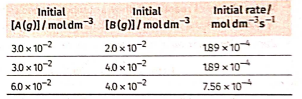
What are the orders with respect to A(g) and B(g)?
| Order with respect to A(g) | Order with respect to B(g) |
| Zero | Second |
| Order with respect to A(g) | Order with respect to B(g) |
| First | Zero |
| Order with respect to A(g) | Order with respect to B(g) |
| Second | Zero |
| Order with respect to A(g) | Order with respect to B(g) |
| Second | First |
10.
On the basis of following Eo values, the strongest oxidising agent is
[Fe(CN)4)4- \(\longrightarrow\) [Fe(CN)6]3- + e- Eo = - 0.35 V
Fe2+ \(\longrightarrow\) Fe3+ + e- Eo = - 0.77 V
Fe2+
Fe3+
[Fe(CN)6]3-
[Fe(CN)6]4-
11.
Which of the following expression is correct for 'Ka' in terms of A0 and A, where 'C' is molarity.
\(\mathbf{K}_{a}=\frac{\mathbf{C} \Lambda_{m}^{\circ}}{\Lambda_{m}\left(\Lambda_{m}^{\circ}-\Lambda\right)}\)
\(\mathbf{K}_{a}=\frac{\mathbf{C} \Lambda_{m}^{2}}{\Lambda_{m}^{0}\left(\Lambda_{m}^{0}-\Lambda_{m}\right)}\)
\(\mathbf{K}_{a}=\frac{\mathbf{C} \Lambda_{m}^{2}}{\Lambda_{m}^{\circ}}\)
\(\mathbf{K}_{a}=\frac{\mathbf{C} \Lambda_{m}^{2}}{\left(\Lambda_{m}^{0}-\Lambda_{m}\right)}\)
12.
Kb (molal elevation constant) is inversely proportional to
boiling point of solvent
\(\Delta_{\text {vap }}\)H of solvent
Molar mas of solvent
all of these
13.
If conc. of reactant' A' is increased 10 times and rate of reaction becomes 100 times. What is order with respect to 'A'?
1
2
3
4
14.
In the given reaction,
2Cu+(aq) \(\rightleftharpoons\) Cu2+(aq) + Cu(s)
EOCu+/Cu = 0.6 V and EoCu2+/Cu = 0.41 V
Find out the equilibrium constant.
2.76 x 10²
2.76 X 10⁴
2.76 X 10⁶
2.76 x 10⁸
15.
DNA and RNA contain four bases each. which of the following bases is not present in RNA ?
Adenine
Uracil
Thymine
Cytosine
16.
Nucleic acids are the polymers of ......... .
Nucleosides
Nucleotides
Bases
Sugars
17.
Glycogen is a branched chain polymer of \(\alpha\)-D-glucose units nin which chain is formed by C1 - C4 glycosidic linkage whereas branching occures by the formation of C1-C6 glycosidic linkage. Structure of clycogen is similar to ......... .
Amylose
Amylopectin
Cellulose
Glucose
18.
Which of the following relationships are not correct ?
pH of solution in hydrogen electrode
\({ =\frac { Electrode \ potential }{ 0.0591 } }at \ 298 \ K\)
\({ E }_{ cell }=\frac { 0.0591 }{ n } log{ K }_{ c }\)
Cell constant = Conductivity/Conductance
\({ \Delta G }^{ 0 }=nF{ E }_{ cell }^{ 0 }\)
19.
In the study of inversion of surcose in presence of readings at times r0 , r1 and \({ r }_{ \infty }\) represent the polarimetric readings at times 0, t and \( \infty \) respectively, then at the 50% inversion, which of the following relationship will hold good ?
\({ r }_{t }={ r }_{0 }+{ r }_{ \infty }\)
\({ r }_{t }\frac {1}{2}({ r }_{0 }+{ r }_{ \infty })\)
\({ r }_{t }={ r }_{0 }-{ r }_{ \infty }\)
\({ r }_{t }\frac {1}{2}({ r }_{0 }-{ r }_{ \infty })\)
20.
t1/4 can be taken as the time taken for the concentration of a reactant to drop to \(\frac {3}{4}\) of its initial value. If the rate constant for a first order reaction is K, then t1/4 can be written as
0.10/K
0.29/K
0.69/K
0.75/K
21.
The colligative properties of a solution are
\(\alpha \ molality\)
\(\alpha \ \frac { 1 }{ molecular \ mass \ of \ the \ solute } \)
proportional to each other
independent of the nature of the solute, i.e., electrolyte or non - electrolyte
22.
At a certain Hill station, water boils at 96oC. The amount of NaCI that should be added to one litre of water so that it boils at 100oC will be (Kb for H2O = 0.52 K/m)
[Co(NH3)6]CI3
[Co(NH3)5CI]CI2
[Co(NH3)4CI2]CI
None of these
23.
A first order reaction has a half-life period of 34.65 seconds. Its rate constant is
2 \(\times 10\) -2 sec-1
4 \(\times 10\) -4 sec-1
20 sec-1
2 \(\times 10\) -4 sec-1
24.
The standard emf of a galvanic cell involving 3 moles of electrons in a redox reaction is 0.59 V. The equilibrium constant for the reaction of the cell is
1025
1020
1015
1030
25.
The values of van't Hoff factors for KCI, NaCI and K2SO4, respectively, are ................. .
2,2 and 2
2,2 and 3
1,1, and 2
1,1 and 1
26.
In which mode of expression, the concentration of solution remains independent of temperature ?
Molarity
Normality
Formality
Molality
27.
The standard electrode potential for Daniell cell is 1.1V. Calculate the standard Gibbs energy for the reaction:
Zn(s) + Cu2+(aq) → Zn2+(aq) + Cu(s)
28.
Amongst the following compounds, identify which are insoluble, partially soluble and highly soluble in water?
(i) Phenol
(ii) Toluene
(iii) Formic acid
(iv) Ethylene glycol
(v) Chloroform
(vi) Pentanol
29.
Define the following as related to proteins.
(i) Peptide linkage
(ii) Primary structure
(iii) Denaturation.
30.
The rate of the chemical reaction doubles for an Increase of 10 K from 298 K. Calculate Ea.
31.
Calculate \(\Lambda_{m}^{0}\) for CaCl2 and MgSO4 from the data given in Table
| Ion | \(\lambda^0\)/(S cm2mol–1) | Ion | \(\lambda^0\)/(S cm2mol–1) |
| H+ | 349.6 | OH– | 199.1 |
| Na+ | 50.1 | Cl– | 76.3 |
| K+ | 73.5 | Br– | 78.1 |
| Ca2+ | 119.0 | CH3COO | -40.9 |
| Mg2+ | 106.0 | \(\mathrm{SO}_{4}^{2-}\) | 160.0 |
32.
33.
34.
Read the passage given below and answer the following questions:
Carbohydrates are polyhydroxy aldehydes and ketones and those compounds which on hydrolysis give such compounds are also carbohydrates. The carbohydrates which are not hydrolysed are called monosaccharides. Monosaccharides with aldehydic group are called aldose and those which free ketonic groups are called ketose. Carbohydrates are optically active. Number of optical isomers = 2n
Where n = number of asymmetric carbons. Carbohydrates are mainly synthesised by plants during photosynthesis.
The monosaccharides give the characteristic reactions of alcohols and carbonyl group (aldehydes and ketones). It has been found that these monosaccharides exist in the form of cyclic structures. In cyclization, the -OH groups (generally C5 or C4 in aldohexoses and C5 or C6 in ketohexoses) combine with the aldehyde or keto group. As a result, cyclic structures of five or six membered rings containing one oxygen atom are formed, e.g., glucose forms a ring structure. Glucose contains one aldehyde group, one 1o alcoholic group and four 2o alcoholic groups in its open chain structure.
The following questions are multiple choice questions. Choose the most appropriate answer:
(i) First member of ketos sugar is
| (a) ketotriose | (b) ketotetrose | (c) ketopentose | (d) ketohexose |
(ii) In CH2OHCHOHCHOHCHOHCHOHCHO, the number of optical isomers will be
| (a) 16 | (b) 8 | (c) 32 | (d) 4 |
(iii) Some statements are given below:
1. Glucose is aldohexose.
2. Naturally occurring glucose is dextrorotatory.
3. Glucose contains three, chiral centres.
4. Glucose contains one 1o alcoholic group and four 2o alcoholic groups.
Among the above, correct statements are
| (a) 1 and 2 only | (b) 3 and 4 only |
| (c) 1,2 and 4 only | (d) 1,2,3 and 4 |
(iv) Which of the following reactions of glucose can be explained only by its cyclic structure?
| (a) Glucose forms cyanohydrin with HCN |
| (b) Glucose reacts with hydroxylamine to form an oxime |
| (c) Pentaacetate of glucose does not react with hydroxylamine |
| (d) Glucose is oxidised by nitric acid to gluconic acid . |
1.
\( \mathrm{Zn}_{(s)} \longrightarrow \mathrm{Zn}^{2+}+2 \mathrm{e}^{-} ; E^{\ominus}=0.76 \mathrm{~V}\)
\(\mathrm{Ag}_{2} \mathrm{O}_{(s)}+\mathrm{H}_{2} \mathrm{O}_{(t)}+2 \mathrm{e}^{-} \longrightarrow 2 \mathrm{Ag}_{(s)}+2 \mathrm{OH}^{-} ; E^{\ominus}=0.344 \mathrm{~V} \)
__________________________________________________
\(\mathrm{Zn}_{(s)}+\mathrm{Ag}_{2} \mathrm{O}_{(s)}+\mathrm{H}_{2} \mathrm{O}_{(n)} \longrightarrow \mathrm{Zn}^{2+}+2 \mathrm{Ag}_{(s)}+2 \mathrm{OH}^{-} ; E^{\ominus}=1.104 \mathrm{~V}\)
Eø = 1.104 V
We know that,
ΔrGø = -nFEø
= - 2 x 96487 x 1.04
= - 213043.296 J
= - 213.04 kJ
2.
\({ t }_{ { 1 }/{ 2 } }=5730 \ years\)
\({ t }_{ { 1 }/{ 2 } }=\frac { 0.693 }{ k } \)
\(k=\frac { 0.693 }{ 5730 } { years }^{ -1 }\)
\(k=\frac { 2.303 }{ t } \log { \frac { { \left[ N \right] }_{ 0 } }{ \left[ N \right] } }\)
\(t=\frac { 2.303 }{ k } \log { \frac { 100 }{ 80 } }\)
\(=\frac { 2.303 }{ 0.693 } \times 5730\left[ \log { 5 } -\log { 4 } \right] \)
\(=\frac { 5730 }{ 0.3010 } \times \left[ 0.6990-0.6021 \right] \)
\(=\frac { 5730 }{ 0.3010 } \times 0.0969=\frac { 55.237 }{ 0.3010 } \)
\(=1844.64 \ years\approx 1845 \ years\)
3.
\(\text { No. of moles of solute, } n_{2}=\frac{100}{140}=\frac{5}{7} \text { mole }\)
\(\text { No. of moles of solvent, } n_{1}=\frac{1000}{180}=\frac{50}{9} \text { mole }\)
Mole fraction of solute
\(x_{2}=\frac{n_{2}}{n_{1}+n_{2}}=\frac{5 / 7}{5 / 7+50 / 9}=0.114\)
\(\text {Mole fraction of solvent, } x_{1}=\left(1-x_{2}\right)=(1-0 \cdot 114)\)
= 0.886
According to Raoult's law
\( P_{A}=x_{A} P_{A}^{0}=0.114 \times P_{A}^{0} \)
\(P_{B}=x_{B} P_{B}^{\circ}=0.886 \times 500=443 \text { torr } \)
\(P_{\text {Total }}=P_{A}+P_{B}\)
\(475=0.114 P_{A}^{\circ}+443\)
\( P_{A}^{\circ}=\frac{475-443}{0 \cdot 114}=280 \cdot 7 \text { torr } \)
\(\therefore P_{A}=0 \cdot 114 \times 280 \cdot 7=32 \text { torr. }\)
4.
\(Rate=\frac { bar }{ min } =bar \ { min }^{ -1 }\)
\(Rate=k{ \left( { P }_{ { CH }_{ 3 }O{ CH }_{ 3 } } \right) }^{ { 3 }/{ 2 } }\)
\(bar \ { min }^{ -1 }=k{ \left( bar \right) }^{ { 3 }/{ 2 } }\)
\(\\ k=\frac { bar \ { min }^{ -1 } }{ { \left( bar \right) }^{ { 3 }/{ 2 } } } ={ bar }^{ -{ 1 }/{ 2 } }{ min }^{ -1 }\)
5.
\(Rate=-\frac { \Delta \left[ R \right] }{ \Delta t } \)
\(=-\frac { \left[ 0.02M-0.03M \right] }{ 25 } \)
\(=\frac { 0.01 }{ 25 } mol\quad { L }^{ -1 }\quad { min }^{ -1 }\)
\(Rate=0.4\times { 10 }^{ -3 }mol\quad { L }^{ -1 }\quad { min }^{ -1 }\)
\(=4\times { 10 }^{ -4 }mol\quad { L }^{ -1 }\quad { min }^{ -1 }\)
\(=\frac { 4\times { 10 }^{ -4 }mol\quad { L }^{ -1 } }{ 60\quad s } \)
\(=0.066\times { 10 }^{ -4 }\)
\(=6.6\times { 10 }^{ -6 }mol\quad { L }^{ -1 }\quad { s }^{ -1 }\)
6.
Vitamin C cannot be stored in our body because it is soluble in water therefore gets excreted in urine.
7.
\({ \wedge }_{ m }=\frac { 1000K }{ C } =\frac { 1000{ cm }^{ 3 }\times 4.95\times { 10 }^{ -5 }S{ cm }^{ -1 } }{ 0.001028mol } =48.15S{ cm }^{ 2 }{ mol }^{ -1 }\)
\(\\ \alpha =\frac { { \wedge }_{ m } }{ { { \wedge }^{ ° } }_{ m } } =\frac { 48.15S{ cm }^{ 2 }{ mol }^{ -1 } }{ 390.5S{ cm }^{ 2 }{ mol }^{ -1 } } =0.1233\)
\({ K }_{ \alpha }=\frac { { C\alpha }^{ 2 } }{ 1-\alpha } =\frac { 0.001028 }{ 1-0.1233 }\) = 1.78 × 10⁻⁵ mol L–1
8.
Van't Hoff factor (i) = \(\frac { ({ M }_{ 2 })_{ cal } }{ ({ M }_{ 2 })_{ obs } } =\frac { 78 }{ 72.54 } =1.0753.\)
Taking volume of the solution as 500mL,
\({ K }_{ \alpha }=\frac { { C\alpha }^{ 2 } }{ 1-\alpha } =\frac { (0.5){ (0.0753) }^{ 2 } }{ 1-0.0753 } =3.07\times { 10 }^{ -3 }\) .
9.
(c)
| Order with respect to A(g) | Order with respect to B(g) |
| Second | Zero |
10.
(b)
Fe3+
11.
(b)
\(\mathbf{K}_{a}=\frac{\mathbf{C} \Lambda_{m}^{2}}{\Lambda_{m}^{0}\left(\Lambda_{m}^{0}-\Lambda_{m}\right)}\)
12.
(b)
\(\Delta_{\text {vap }}\)H of solvent
13.
(b)
2
14.
(c)
2.76 X 10⁶
15.
(c)
Thymine
16.
(b)
Nucleotides
17.
(b)
Amylopectin
18.
(a)
pH of solution in hydrogen electrode
\({ =\frac { Electrode \ potential }{ 0.0591 } }at \ 298 \ K\)
19.
(b)
\({ r }_{t }\frac {1}{2}({ r }_{0 }+{ r }_{ \infty })\)
20.
(b)
0.29/K
21.
(a)
\(\alpha \ molality\)
22.
(a)
[Co(NH3)6]CI3
23.
(a) : \(k = \frac {0.693}{t/2}= \frac {0.693}{34.65}s^{-1} = 2 \times 10^{-2}\)s-1
24.
(d)
1030
25.
(b)
2,2 and 3
26.
(d)
Molality
27.
\(\Delta_{\mathrm{r}} G^{\ominus}=-n F \mathrm{E}_{\text {(cell) }}^{\ominus}\)
n in the above equation is 2, F = 96487 C mol –1 and \(\mathrm{E}_{\text {(cell })}^{\ominus}\) = 1.1 V
Therefore, \(\Delta_{\mathrm{r}} G^{\ominus}\) = – 2 × 1.1V × 96487 C mol –1
= – 21227 J mol–1
= – 212.27 kJ mol–1
28.
(i) Phenol Partially soluble (Reason: Phenol has polar - OH group and non-polar - C6H5 group).
(ii) Toluene Insoluble (Reason: Toluene is non-polar, water is polar.)
(iii) Formic acid Highly soluble (Reason: Hydrogen bonding)
(iv) Ethylene glycol Highly soluble (Reason: Hydrogen bonding).
(v) Chloroform Insoluble (Reason: H-bonds are forme although polarity is present).
(vi) Pentanol Partially soluble (Reason: - OH group is polar but long hydrocarbon part is non-polar).
29.
(i) Peptide linkage. Peptide bond is formed by the condensation of two or more same or different n-amino acids. The condensation occurs between amino acids with the elimination of water. In this case, the carboxyl group of one amino acid and amino group of another amino acid get condensed with the elimination of water molecule.
The resulting \(\quad O\\ \quad \parallel \\ -C-NH-\) linkage is called peptide linkage. The formation of a dipeptide and the peptide
.png)
(ii) Primary structure. The primary structure of proteins gives the sequence in which the amino acids are linked in one or more polypeptide chains of proteins. This is shown below:
.png)
(iii) Denaturation. A process that changes the physical and biological properties of proteins without affecting the chemical composition of a protein is called denaturation. The denaturation is caused by certain physical or chemical treatments such as changes in pH, temperature, presence of some salts or certain chemical agents.
30.
\(\log { \frac { { k }_{ 2 } }{ { k }_{ 1 } } } =\frac { { E }_{ a } }{ 2.303R } \left( \frac { { T }_{ 2 }-{ T }_{ 1 } }{ { T }_{ 1 }{ T }_{ 2 } } \right)\)
\(\frac { { k }_{ 2 } }{ { k }_{ 1 } } =2,\quad { T }_{ 1 }=298K,\quad { T }_{ 2 }=308K,\quad R=8.314\quad J{ K }^{ -1 }{ mol }^{ -1 }\)
\(\log { 2 } =\frac { { E }_{ a } }{ 2.303\times 8.314 } \times \left[ \frac { 308-298 }{ 308\times 298 } \right] \)
\(0.3010=\frac { { E }_{ a } }{ 2.303\times 8.314 } \times \frac { 10 }{ 298\times 308 } \)
\(\therefore \ { E }_{ a }=\frac { 0.3010\times 2.303\times 8.314\times 298\times 308 }{ 10 } \)
\(52.898 \ kJ\)
31.
We know from Kohlrausch law that
\(A_{m\left(\mathrm{CaCl}_{2}\right)}^{\mathrm{o}}=\lambda_{\mathrm{Ca}^{2+}}^{0}+2 \lambda_{\mathrm{Cl}^{-}}^{0}=119.0 \mathrm{~S} \mathrm{~cm}^{2} \mathrm{~mol}^{-1}+2(76.3) \mathrm{S} \mathrm{cm}^{2} \mathrm{~mol}^{-1}\)
= (119.0 + 152.6) S cm2 mol–1
= 271.6 S cm2 mol–1
\(A_{n\left(\mathrm{MgSO}_{4}\right)}^{\mathrm{o}}=\lambda_{\mathrm{Mg}^{2+}}^{0}+\lambda_{\mathrm{so}_{4}^{2}}^{0}=106.0 \mathrm{~S} \mathrm{~cm}^{2} \mathrm{~mol}^{-1}+160.0 \mathrm{~S} \mathrm{~cm}^{2} \mathrm{~mol}^{-1}\)
= 266 S cm2 mol–1
32.
33.
34.
(i) (a)
(ii) (a)
(iii) (c) : Glucose contains four chiral centres.
(iv) (c) : Pentacetate of glucose does not react with hydroxylamine showing absence of free -CHO group. This cannot be explained by open structure of glucose.

12th Standard CBSE Syllabus & Materials
12th Standard CBSE
CBSE 12th Computer Science Python Revision Tour I - New Previous year Question Papers Study Material - QB365 Set A
NEW12th Standard CBSE
CBSE 12th Business Studies Planning Important Questions And Answers Study Material - QB365 Set A
NEW12th Standard CBSE
CBSE 12th Business Studies Business Environment Important Questions And Answers Study Material - QB365 Set A
NEW12th Standard CBSE
CBSE 12th Business Studies Principles of Management Important Questions And Answers Study Material - QB365 Set A



NCERT Books

Syllabus

Exam Pattern

Sample Question Papers

Previous year Question Papers

Important Notes

MCQ Practice test

NCERT Exemplers

Case study Questions

Image Based Questions

Passage based Questions

HOT Questions

Value Based Questions

Model Questions Papers
NCERT ( Book Back ) Questions

Assertion and Reason
Important Questions And Answers

CBSE 12th Standard CBSE Subjects
CBSE Standards








