
 100% FREE ACCESS
12th Standard CBSE Syllabus & Materials
12th Standard CBSE
CBSE 12th Economics Government Budget and the Economy Previous year Question Papers Study Material - QB365 Set A
NEW12th Standard CBSE
CBSE 12th Computer Science Interface Python with MySQL - New Previous year Question Papers Study Material - QB365 Set A
NEW12th Standard CBSE
CBSE 12th Computer Science Database Concept - New Previous year Question Papers Study Material - QB365 Set A
NEW12th Standard CBSE
CBSE 12th Computer Science Data Communication - New Previous year Question Papers Study Material - QB365 Set A
NEW12th Standard CBSE
CBSE 12th Computer Science Data Structures - New Previous year Question Papers Study Material - QB365 Set A
NEW12th Standard CBSE
CBSE 12th Computer Science Functions - New Previous year Question Papers Study Material - QB365 Set A

Published on: 02/11/2025
Download CBSE Class 12th Standard CBSE Chemistry question papers, sample papers, important questions, and previous year solved papers in PDF format. Get free study materials, NCERT solutions, and exam preparation resources for Class 12th Standard CBSE Chemistry
Questions + Answers key
Take MCQ Chemistry Test
1.
The resistance of a conductivity cell containing 0.001M KCl solution at 298 K is 1500 \(\Omega\). What is the cell constant if conductivity of 0.001M KCl solution at 298 K is 0.146 x 10⁻³ S cm-1 ?
2.
Define limiting molar conductivity. Why conductivity of an electrolyte solution decreases with decrease in concentration ?
3.
Why in a concentrated solution, a strong electrolyte shows deviations from Debye-Huckel-Onsager equation ?
4.
The conductivity of 0.20 M KCl at 298 K is 0.025 S cm-1. Calculate its molar conductivity.
5.
(i) Write two advantages of H2 \(\rightarrow\)O2 fuel cell over ordinary cell.
(ii) Equilibrium constant (KC) for the given cell reaction is 10. Calculate E0cell.
\(A(s)+B^{ 2+ }(aq)\rightleftharpoons A^{ 2+ }(aq)+B(s)\)
6.
Predict whether the following reaction (s) is (are) feasible or not
(i) \(Fe+{ Zn }^{ 2+ }\longrightarrow { Fe }^{ 2+ }+Zn,{ E }_{ Zn }^{ o }=-0.76V,{ E }^{ o }_{ Fe }=-0.44V\)
(ii) \(Zn+{ 2Ag }^{ + }\longrightarrow { Zn }^{ 2+ }+2Ag,{ E }_{ Zn }^{ o }=-0.76V,{ E }^{ o }_{ Ag }=-0.80V\)
7.
Calculate \({ \Lambda }_{ m }^{ o }\) for CaCl2 and MgSO4 from the data given below:
\({ \lambda }^{ o }({ Ca }^{ 2+ })=119.0 \ S \ { cm }^{ 2 }{ mol }^{ -1 }\)
\({ \lambda }^{ o }(Cl^{ - })=76.3 \ S \ { cm }^{ 2 }{ mol }^{ -1 }\)
\({ \lambda }^{ o }({ Mg }^{ 2+ })=106 \ S \ { cm }^{ 2 }{ mol }^{ -1 }\)
\({ \lambda }^{ o }({ SO }_{ 4 }^{ 2- })=160.0 \ S \ { cm }^{ 2 }{ mol }^{ -1 }\)
8.
(i) On the basis of Eo values, identify which amongst the following is the strongest oxidising agent
\(\mathrm{Cl}_2(\mathrm{~g})+2 e^{-} \longrightarrow 2 \mathrm{Cl}^{-} ; \mathrm{E}^{o}=+1.36 \mathrm{~V} \)
\(\mathrm{MnO}_4^{-}+8 \mathrm{H}^{+}+5 \mathrm{e}^{-} \longrightarrow \mathrm{Mn}^{2+}+4 \mathrm{H}_2 \mathrm{O}_i \mathrm{E}^{\mathrm{o}}=1.5 \mathrm{IV} \)
\(\mathrm{Cr}_2 \mathrm{O}_7^{2-}+14 \mathrm{H}^{+}+6 \mathrm{c}^{-} \longrightarrow 2 \mathrm{Cr}^{\prime \prime}+7 \mathrm{H}_2 \mathrm{O}_4 \mathrm{E}^{\circ}=+1.33 \mathrm{~V}
\)
(ii) The following figure, represents variation of (∧m) vs √C for an electrolyte. Here A is the molar conductivity and C is the concentration of the electrolyte.
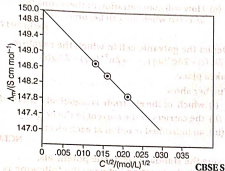
(a) Define molar conductivity.
(b) Identify the nature of electrolyte on the basis of the above plot. Justify your answer.
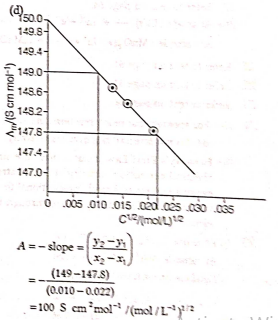
(c) Determine the value of Am for the electrolyte.
(d) Show how to calculate the value of A
9.
(a) Define the following terms:
(i) Limiting molar conductivity
(ii) Fuel cell
(b) Resistance of a conductivity cell filled with 0.1 mol L-1 KCI solution is \(\mathbf{1 0 0} \Omega\). If the resistance of the same cell when filled with 0.02 mol L-1 KCI solution is \(\mathbf{520} \Omega\), calculate the conductivity and molar conductivity of 0.02 mol L-1 KCI solution. The conductivity of 0.1 mol L-1 KCI solution is 1.29 x \(10^{-2} \Omega^{-1}\) cm-1.
10.
(a)When a bright silver object is placed in the solution of gold chloride, it acquires a golden tinge but nothing happens when it is placed in a solution of copper chloride. Explain this behaviour of silver.
[Given: Ecu2+/cu = + 0.34; EoAg+ /Ag = + 0.80 V,
EAu2+/Au = + 1.40 V]
(b)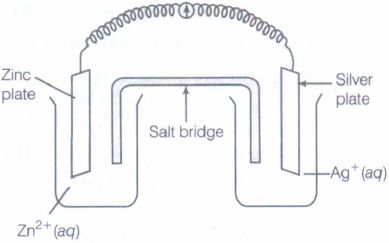
Consider the figure given above and answer the following questions:
(i) What is the direction of flow of electrons?
(ii) Which one is anode and which one is cathode?
(iii) What will happen if the salt bridge is removed?
(iv) How will concentration of Zn2+ and Ag + ions be affected when the cell functions?
(v) How will concentration of these ions be affected when the cell becomes dead?
11.

 Where, λ+ and λ– are the ionic conductivities of positive and negative ions, respectively and v+ and v– are their stoichiometric coefficients in the salt molecular formula.
12.
Observe the graph shown in figure between Am (molar conductivity) Vs \(\sqrt{\mathrm{C}}\) (Molar concentration) and answer the questions based on graph.
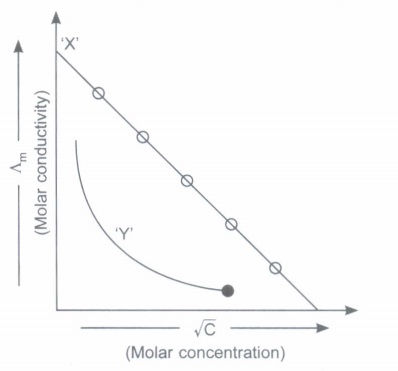
(a) The curve 'V' is for KCI or CH3 COOH?
(b) What is intercept on \(\Lambda\)m axis for 'X' equal to?
(c) Give mathematical equation representing straight line.
(d) What is slope equal to?
(e) What happens to molar conductivity on dilution in case of weak electrolyte and why?
1.
Cell constant = Conductivity/Conductance = Conductivity x Resistance
= (0.146 x 10⁻³) S cm-1 x 1500 \(\Omega\)
= 0.219 cm-1
2.
The molar conductivity of a solution at infinite dilution, i.e., when concentration approaches zero is called limiting molar conductivity. With decrease in concentration, i.e., with dilution, number of ions per cm3 decreases due to large increase in volume of the solution. As conductivity is the conductance per cm3 of the solution, hence it decreases.
3.
In concentrated solution of a strong electrolyte, the interionic forces of attraction are large.
4.
\({ \Lambda }_{ m }=\frac { 1000\times k }{ M } =\frac { 1000\times 0.025\times { 10 }^{ -2 } }{ 0.20 } =125 \ S{ cm }^{ 2 }{ mol }^{ -1 }\)
5.
i) Advantages of fuel cells
(a) Because of the continuous supply of fuels, these cells never become dead. These cells are usually operated at a temperature of 70-140°C and gives a potential of about 0.9V.
(b) Fuel cells do not cause any pollution unlike thermal plant which burns fossil fuels like coal gas, oil, etc.
(ii) The reaction
\(A(s)+B^{ 2+ }(aq)\rightleftharpoons A^{ 2+ }(aq)+B(s)\)
By using Nernst equation
\(E_{ cell }=E^{ 0 }_{ cell }-\frac { 0.059 }{ n } log\left[ \frac { A^{ 2+ } }{ B^{ 2+ } } \right] \)
At equilibrium Ecell = 0
Ecell = \(\frac { 0.059 }{ n } \) log kc
Kc = 10 and n = 2
\(E^{ 0 }_{ cell }-\frac { 0.059 }{ n } \) log10
\(E^{ 0 }_{ cell }-\frac { 0.059 }{ n } =0.0295\)
6.
(i) No (ii) yes
7.
\({ { \wedge }^{ ° } }_{ m }\left( { CaCl }_{ 2 } \right) ={ \lambda }^{ ° }\left( { Ca }^{ 2+ } \right) +2{ \lambda }^{ ° }\left( { Cl }^{ - } \right) \)
\(=119.0S{ cm }^{ 2 }{ mol }^{ -1 }+2\times 76.3S{ cm }^{ 2 }{ mol }^{ -1 }=271.6S{ cm }^{ 2 }{ mol }^{ -1 }\)
\({ { \wedge }^{ ° } }_{ m }\left( { MgSO }_{ 4 } \right) ={ \lambda }^{ ° }\left( { Mg }^{ 2+ } \right) +2{ \lambda }^{ ° }\left( { { SO }_{ 4 } }^{ 2- } \right) \)
\(=106 \ S{ \ cm }^{ 2 }{ \ mol }^{ -1 }+160 \ S{ \ cm }^{ 2 }{ \ mol }^{ -1 }=266 \ S{ \ cm }^{ 2 }{ \ mol }^{ -1 }\)
8.
(i) \(\mathrm{MnO}_4^{-}\)is the strongest oxidising agent. Oxidising power of metals decrease with an increase in their $E^{\prime}$ values.
ii) (a) Molar conducivity of a solution is the conductance of that volume of solution containing one mole of electrolyte, kept between two electrodes having unit length between them and large cross-sectional areas so as to contain the electrolyte.
(b) The nature the electrolyte on the basis of plot is strong electrolyte. For strong electrolyte, \(\Lambda_{\text {m }}^{\circ}\) increases slowly with dilution.
(c) Using Debye-Huckel Onsager equation,
\(\Lambda_m=A_m^2-A \sqrt{C}\)
\(\Lambda^{\circ}\) value from graph is \(150 \mathrm{~S} \mathrm{~cm}^2 \mathrm{~mol}^{-1}\).
9.
(a) (i) Limiting molar conductivity \(\left(\Lambda_{m}^{\circ}\right)\) : It is defined as the maximum molar conductance of an electrolyte when solution is infinitely dilute, i.e. concentration approaches zero when electrolyte solution is kept in cell, unit distance apart having large area of cross-section to hold enough electrolyte.
(ii) Fuel cell is a cell in which chemical energy of a fuel is converted into electrical energy.
(b) R = 100 ohms, M = 0.1 mol L-1 of KCI
\(\kappa=\frac{1}{R} \times \frac{l}{A}\)
\(\Rightarrow 1.29 \times 10^{-2} \mathrm{ohm}^{-1} \mathrm{~cm}^{-1}=\frac{1}{100 \mathrm{ohm}} \times \frac{l}{A}\)
\(\Rightarrow \ \frac{l}{A}=1.29 \mathrm{~cm}^{-1}\)
Again, \(\kappa=\frac{1}{R} \times \frac{l}{A}=\frac{1}{520} \times 1.29\)
= \(\frac{1.29}{5.20} \times 10^{-2}\)
= 2.48 x 10- 3 ohm-1 cm-1
Now, M = 0.02 mol L-1
\(\Lambda_{m}=\frac{1000 \kappa}{\mathrm{M}}=\frac{1000 \times 2.48 \times 10^{-3}}{0.02}\)
= 124 S cm2 mol-1
10.
(a) Eo value of silver (EoAg+ /Ag = +0.80V) is lower than Ag lAg that of gold, hence silver displaces gold
( EoAu3+ /Au= + 1.40V), which gets deposited on the silver Object
Eo value of copper (E°cu2+/cu = +0.34) is lower than that of silver, hence silver cannot displace copper from its solution.
(b) (i) Electrons flow from Zn to Ag plate.
(ii) Zn acts as anode and Ag acts as cathode
(iii) Cell will stop functioning
(iv) Concentration of Zn2+ions will increase and that of Ag+ ions will decrease.
(v) No change
11.
12.
(a) It is for CH3COOH.
(b) It is equal \(\Lambda\)° (limiting molar conductivity).
(c) \(\Lambda_{\mathrm{m}}=\Lambda_{\mathrm{m}}^{\circ}-\mathrm{A} \sqrt{\mathrm{C}}\)
(d) Slope = -A
(e) \(\Lambda\)m for weak electrolyte increases sharply on dilution because both number of ions as well as mobility of ions increases.

12th Standard CBSE Syllabus & Materials
12th Standard CBSE
CBSE 12th Computer Science Python Revision Tour I - New Previous year Question Papers Study Material - QB365 Set A
NEW12th Standard CBSE
CBSE 12th Business Studies Planning Important Questions And Answers Study Material - QB365 Set A
NEW12th Standard CBSE
CBSE 12th Business Studies Business Environment Important Questions And Answers Study Material - QB365 Set A
NEW12th Standard CBSE
CBSE 12th Business Studies Principles of Management Important Questions And Answers Study Material - QB365 Set A



NCERT Books

Syllabus

Exam Pattern

Sample Question Papers

Previous year Question Papers

Important Notes

MCQ Practice test

NCERT Exemplers

Case study Questions

Image Based Questions

Passage based Questions

HOT Questions

Value Based Questions

Model Questions Papers
NCERT ( Book Back ) Questions

Assertion and Reason
Important Questions And Answers

CBSE 12th Standard CBSE Subjects
CBSE Standards








