
 100% FREE ACCESS
12th Standard CBSE Syllabus & Materials
12th Standard CBSE
CBSE 12th Economics Government Budget and the Economy Previous year Question Papers Study Material - QB365 Set A
NEW12th Standard CBSE
CBSE 12th Computer Science Interface Python with MySQL - New Previous year Question Papers Study Material - QB365 Set A
NEW12th Standard CBSE
CBSE 12th Computer Science Database Concept - New Previous year Question Papers Study Material - QB365 Set A
NEW12th Standard CBSE
CBSE 12th Computer Science Data Communication - New Previous year Question Papers Study Material - QB365 Set A
NEW12th Standard CBSE
CBSE 12th Computer Science Data Structures - New Previous year Question Papers Study Material - QB365 Set A
NEW12th Standard CBSE
CBSE 12th Computer Science Functions - New Previous year Question Papers Study Material - QB365 Set A

Published on: 02/11/2025
Download CBSE Class 12th Standard CBSE Chemistry question papers, sample papers, important questions, and previous year solved papers in PDF format. Get free study materials, NCERT solutions, and exam preparation resources for Class 12th Standard CBSE Chemistry
Questions + Answers key
Take MCQ Chemistry Test
1.
What is lanthanoid contraction? What are the consequences of lanthanoid contraction?
2.
Calculate the emf of the cell in which the following reaction takes place :
\(Ni(s)+2{ Ag }^{ + }(0.002M)\longrightarrow { Ni }^{ 2+ }(0.160M)+2Ag(s)\)
Given that \(\mathrm{E}_{\text {(cell) }}^{\ominus}\) = 1.05 V
3.
Represent the cell in which the following reaction takes place:
Mg(s) + 2Ag+ (0.0001 M) \(\longrightarrow\) Mg2+ (0.130 M ) +2 Ag(s)
Calculate its E(cell) if \(E_{\text {(cell) }}^{\ominus}\)= 3.17 V.
4.
\(\Lambda_{m}^{0}\) for NaCl, HCl and NaAc are 126.4, 425.9, and 91.0 S cm2 mol–1 respectively. Calculate \(\Lambda^{0}\) for HAc.
5.
Give the IUPAC names of the following compounds:
(i) Ph CH2CH2COOH
(ii) (CH3)2C=CHCOOH
(iii)
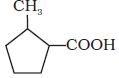
(iv)
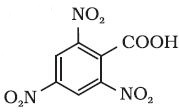
6.
Silver atom has completely filled d orbitals (4d10) in its ground state. How can you say that it is a trasition element?
7.
Why are Cr2+ reducing and Mn3+ oxidising when both have d4 configuration?
8.
Depict the galvanic cell in which the reaction
\(Zn(s)+2{ Ag }^{ + }(aq)\longrightarrow { Zn }^{ 2+ }(aq)+2Ag(s)\) takes place. Further, show
(i) Which of the electrodes is negatively charged ?
(ii) The carriers of the current in the cell.
(iii) Individual reaction at each electrode.
9.
How would you determine the standard electrode potential of the system Mg2+ | Mg?
10.
Give plausible explanation for each of the following:
(i) Cyclohexanone forms cyanohydrin in good yield but 2,2,6- trimethylcyclohexanone does not.
(ii) There are two -NH2 groups in semicarbazide. However, only one is involved in the formation of semicarbazones.
(iii) During the preparation of esters from a carboxylic acid and an alochiol in the presence of an acid catalyst, the water or the ester should be removed as soon as it is formed.
11.
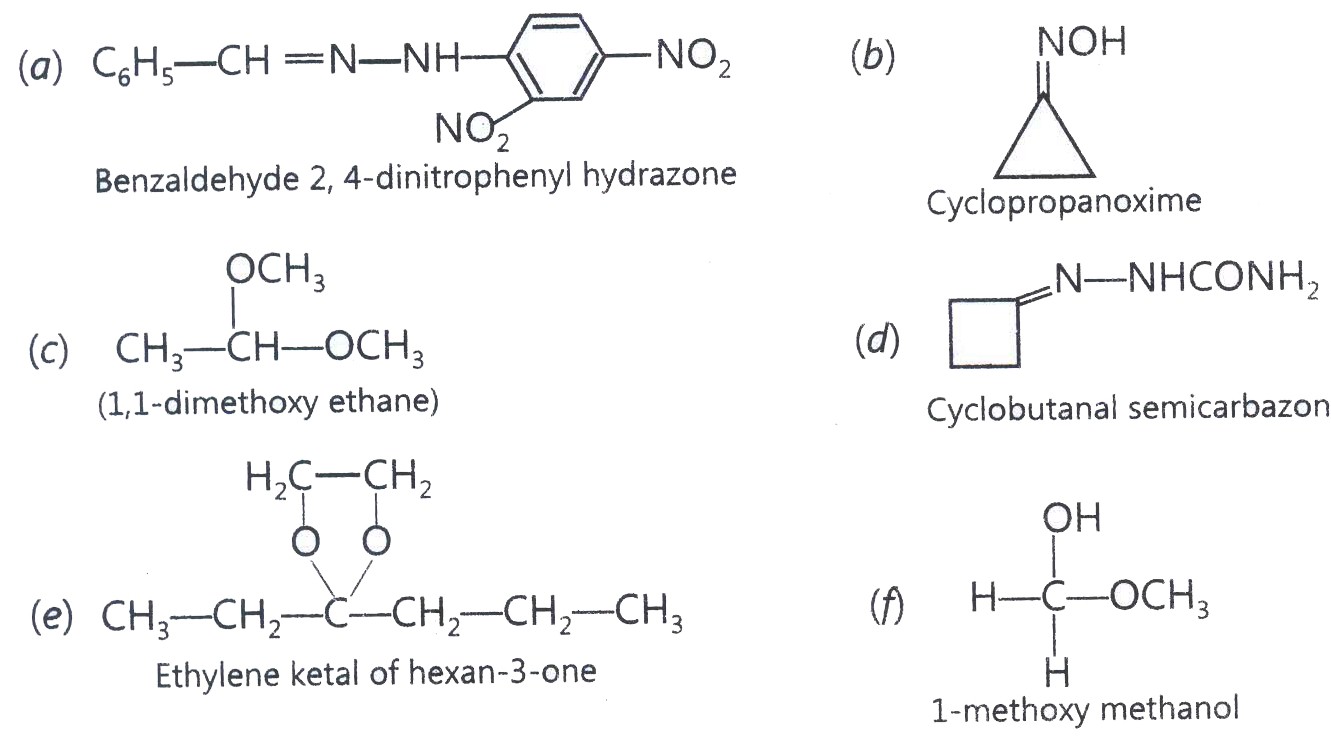
Draw structures of the following derivatives.
(a) The 2,4-dinitrophenylhydrazone of benzaldehyde
(b) Cyclopropanone oxime
(c) Acetaldehydedimethylacetal
(d) The semicarbazone of cyclobutanone
(e) The ethylene ketal of hexan-3-one
(f) The methyl hemiacetal of formaldehyde
12.
Indicate the steps in the preparation of :
(a) K2Cr2O7 from chromite ore.
(b) KMnO4 from pyrolusite ore.
13.
How would you account for the following?
(a) Of the d4 species, Cr2+ is strongly reducing while manganese (III) is strongly oxidising.
(b) Cobalt (II) is stable in aqueous solution but in the presence of complexing reagents, it is easily oxidised.
(c) The d1 configuration is very unstable in ions.
14.
What are the characteristics of the transition elements and why are they called transition elements ? Which of the d-block elements may not be regarded as the transition elements?
15.
An organic compound contains 69.77% carbon, 11.63% hydrogen and rest oxygen. The molecular mass of the compound is 86. It does not reduce Tollens’ reagent but forms an addition compound with sodium hydrogen sulphite and give positive iodoform test.
On vigorous oxidation it gives ethanoic and propanoic acid. Write the possible structure of the compound.
16.
Describe the following:
(i) Acetylation
(ii) Cannizzaro reaction
(iii) Cross aldol condensation
(iv) Decarboxylation
17.
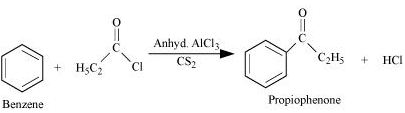
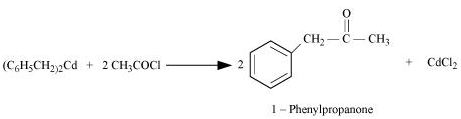
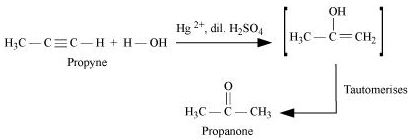
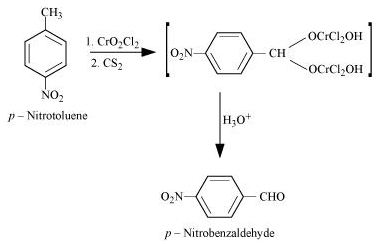
Write the structures of products of the following reactions;
(i)
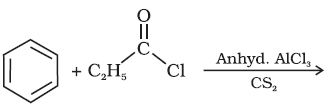
(ii) \(\begin{equation} \left(\mathrm{C}_{6} \mathrm{H}_{5} \mathrm{CH}_{2}\right)_{2} \mathrm{Cd}+2 \mathrm{CH}_{3} \mathrm{COCl} \rightarrow \end{equation}\)
(iii)

(iv)
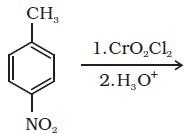
18.
Define conductivity and molar conductivity for the solution of an electrolyte. Discuss their variation with concentration.
19.
Compare the general characteristics of the first series of the transition metals with those of the second and third columns. Give special emphasis on the following points:
(i) electronic configurations,
(ii) oxidation states,
(iii) ionisation enthalpies and
(iv) atomic sizes.
1.
The steady decrease in the size of lanthanide ions with the increase in atomic number is called lanthanide contraction.
Consequences:
There is not regular trend in ionization potential in the group due to lanthanide contraction.
Similarity of 2nd and 3rd transition group
2.
Applying Nernst equation to the given cell reaction
\({ E }_{ cell }={ { E }^{ ° } }_{ cell }-\frac { 0.0591 }{ n } log\frac { \left[ { Ni }^{ 2+ } \right] }{ { \left[ { Ag }^{ + } \right] }^{ 2 } } =1.05V-\frac { 0.0591 }{ n } log\frac { 0.160 }{ { \left( 0.002 \right) }^{ 2 } } =1.05-\frac { 0.0591 }{ n } log\left( 4\times { 10 }^{ 4 } \right) \)
\(=1.05-\frac { 0.0591 }{ n } (4.6021)=1.05-0.14V\)
E(cell) = 0.91 V
3.
The cell can be written as Mg | Mg2+(0.130M) | Ag+(0.0001M) | Ag
\(E_{(\text {cell })}=E_{\text {(cell) }}^{\ominus}-\frac{\mathrm{RT}}{2 \mathrm{~F}} \ln \frac{\left[\mathrm{Mg}^{2+}\right]}{\left[\mathrm{Ag}^{+}\right]^{2}}\)
\(=3.17 \mathrm{~V}-\frac{0.059 \mathrm{~V}}{2} \log \frac{0.130}{(0.0001)^{2}}\)
= 3.17 V – 0.21V = 2.96 V.
4.
\(A_{\mathrm{m}(\mathrm{HAc})}^{\mathrm{o}}=\lambda_{\mathrm{H}^{+}}^{0}+\lambda_{\mathrm{Ac}^{-}}^{0}=\lambda_{\mathrm{H}^{+}}^{0}+\lambda_{\mathrm{Cl}^{-}}^{0}+\lambda_{\mathrm{Ac}^{-}}^{0}+\lambda_{\mathrm{Na}^{+}}^{0}-\lambda_{\mathrm{Cl}^{-}}^{0}-\lambda_{\mathrm{Na}^{+}}^{\mathrm{o}}\)
\(=\Lambda_{m(\mathrm{HCl}}^{0}+A_{m(\mathrm{NaAc})}^{0}-\Lambda_{m(\mathrm{NaCl}}^{\mathrm{o}}\)
= (425.9 + 91.0 – 126.4 ) S cm2 mol –1
= 390.5 S cm2 mol–1.
5.
i) PhCH2CH2COOH
3-Phenylpropanoic acid
ii) (CH3)2C = CHCOOH
3-Methylbut-2-enoic acid
iii) 2-Methylcyclopentane carboxylic acid
iv) 2,4,6-Trinitrobenzoic acid
6.
Silver in its + 1 oxidation state, exhibits 4d10 5so configuration. But in some compounds, it also shows +2 oxidation state, so the configuration becomes 4d10 5so. Here, d-orbital is not completely fllled, Therefore, silver is a transition element.
7.
Cr2+ is reducing as its configuration changes from d4 to d3, the latter having a half-filled t2g level. On the other hand, the change from Mn3+ to Mn2+ results in the half-filled (d5) configuration which has extra stability.
8.
The cell will be represented as:
Zn (s) I Zn2+(aq) II Ag2+ (aq) I Ag (s)
(i) Anode, i.e., zinc electrode will be negatively charged.
(ii) The current will flow from silver to copper in the external circuit.
(iii) At Anode: Zn (s)⇾ Zn2+(aq) + 2 e-
At Cathode: Ag+ (aq) + e ⇾ Ag
9.
We will set up a cell consisting of Mg IMgSO4 (1M) as one electrode (by dipping a magnesium wire in 1M MgSO4solution) and standard hydrogen electrode Pt, H2(1 atm H+I (1 M) as the second electrode and measure the EMF of the cell and also note the direction of deflection in the voltmeter. The direction of deflection shows that electrons flow from magnesium electrode to hydrogen electrode, i.e., oxidation takes place on magnesium electrode and reduction on hydrogen electrode. Hence, the cell may be represented as:
\(Mg|{ Mg }^{ 2+ }\left( 1M \right) ||{ H }^{ + }\left( 1M \right) |{ H }_{ 2 },(1 \ atm),Pt\)
\({ { E }^{ ° } }_{ cell }={ { E }^{ ° } }_{ { H }^{ + },1/2{ H }_{ 2 } }-{ { E }^{ ° } }_{ { Mg }^{ 2+ },Mg }\)
\(Put \ { { \ E }^{ ° } }_{ { H }^{ + },1/2{ H }_{ 2 } }=0\)
Hence, E ° Mg2+, Mg = - E° cell
10.
(i) In 2,2,6-trimethylcyclohexanone, three methyl groups are present at alpha position with respect to carbonyl group. Hence, the attack of cyanide nucleophile is sterically hindered. In cyclohexanone, there is little steric hinderance. Hence, cyclohexanone forms cyanohydrin in good yield but 2,2,6-trimethylcyclohexanone does not.
(ii) In senicarbazide, out of two −NH2 groups, one is involved in resonance with amide carbonyl. The lone pair of electron on N is delocalized through resonance and cannot be donated to a suitable electrophile. Hence, this −NH2 group cannot act as a nucleophile. Hence, out of two −NH2 groups in semicarbazide, only one is involved in the formation of semicarbazones.
(iii) During the preparation of esters from a carboxylic acid and an alcohol in the presence of an acid catalyst, the water or the ester should be removed as soon as it is formed. This ensures that the equilibrium will shift in the forward direction and more and more of ester will be formed. Note: The formation of an ester by condensation of carboxylic acid and alcohol is a reversible reaction.
11.
12.
(a)\(4FeCr_2O_4 + 8Na_2CO_3 + 7O_2 \longrightarrow 8Na_2CrO_4 + 2Fe_2O_3 + 8CO_2\)
\(2Na_2CrO_4 + 2H+ \longrightarrow Na_2Cr_2O_7 + 2Na^+ + H_2O\)
\(Na_2Cr_2O_7 + 2KCI \longrightarrow K_2Cr_2O_7 + 2NaCI\)
(b)\(2MnO_2 + 4KOH + O_2 \xrightarrow{\Delta} 2K_2MnO_4 + 2H_2\)
\(\underset{Magnate\ ion}{MnO_4^{2-}}\xrightarrow{electrolysis}\underset{Permagnate\ ion}{MnO_4^-}+e^-\)
13.
(a) E values for Cr3+/Cr2+is negative (- 0.41 V) and for Mn3+/Mn2+is positive (+1.57V).Thus, Cr2+ can undergo oxidation and, therefore, is reducing agent. On the other hand, Mn(III) can undergo reduction, and therefore, acts as an oxidizing agent.
(b) In the presence of complexing agents, cobalt gets oxidized from,+2 to +3 state because Co (III) is more stable than Co (II).
(c) After the loss of ns electrons, a d1 electron can easily be lost to give a stable configuration. Therefore, the elements having d1 configuration are either reducing or undergo disproportionation.
14.
Characteristics:
(i) They show variable oxidation states.
(ii) They form coloured ions
They are called transition elements because they are less electropositive elements because they are less electropositive than p-block elements. Zn, Cd, Hg are not regarded as transition elements.
15.
% of carbon = 69.77 %
% of hydrogen = 11.63 %
% of oxygen = {100 - (69.77 + 11.63)}%
= 18.6 %
Thus, the ratio of the number of carbon, hydrogen, and oxygen atoms in the organic compound can be given as:
\(\mathrm{C}: \mathrm{H}: \mathrm{O}=\frac{69.77}{12}: \frac{11.63}{1}: \frac{18.6}{16}\)
= 5.81:11.63:1.16
= 5:10:1
Therefore, the empirical formula of the compound is C5H10O. Now, the empirical formula mass of the compound can be given as:
5 × 12 + 10 ×1 + 1 × 16
= 86
Molecular mass of the compound = 86
Therefore, the molecular formula of the compound is given by C5H10O.
Since the given compound does not reduce Tollen's reagent, it is not an aldehyde. Again, the compound forms sodium hydrogen sulphate addition products and gives a positive iodoform test. Since the compound is not an aldehyde, it must be a methyl ketone.
The given compound also gives a mixture of ethanoic acid and propanoic acid.
Hence, the given compound is Pentan-2-one.
16.
(i) Acetylation
Acetyl group is introduced in an organic compound. Reagent is acetyl chloride or acetic anhydride.
Bases such as pyridine and dimethylaniline are used to neutralize acid (HCl or acetic acid).
(ii) Cannizzaro reaction
Aldehydes (not having alpha hydrogen atoms) undergo self oxidation-reduction (disproportionation) reaction. One molecule is oxidized to carboxylic acid and other molecule is reduced to alcohol. Concentrated alkali is the reagent.
(iii) Cross aldol condensation
Aldol condensation between different carbonyl compounds (aldehdyes and ketones). If both reactants contain alpha hydrogen atom, four different products can be obtained.
(iv) Decarboxylation
Loss of CO2 from carboxylic acids to form hydrocarbons. For this, sodium salts of carboxylic acids are heated with soda lime.
17.
(i)
(ii)
(iii)
(iv)
18.
Conductivity The inverse of resistivity is called conductivity. It is denoted by K (kappa). It is also known as specific conductance. k = 1/p SI unit of conductivity is Sm-1 or ohm-1 m-1
Molar conductivity It is defined as the conductance of the solution which contains one mole of the electrolyte such that entire solution is in between the two electrodes kept one centimeter apart, and large enough to contain all the electrolytes.
Molar conductivity, \(\Lambda _{ m }=\frac { K }{ C } \)
Variation of conductivity and molar conductivity with concentration.
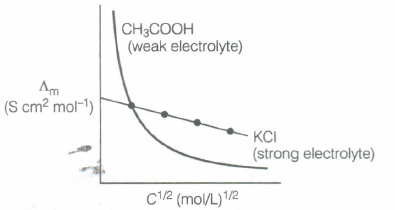
Conductivity and molar conductivity change with change in concentration of electrolyte ..Conductivity always decreases with decrease in concentration for both weak as well as strong electrolytes.
But molar conductivity increases with decrease in concentration. For strong electrolytes, \(\Lambda _{ m }\) increases slowly with dilution but for weak electrolyte, \(\Lambda _{ m}\) increases steeply on dilution, especially near lower concentrations.
19.
(i) Electronic configurations: In 1st transition series, 3d orbitals are progressively filled, whereas, in 2nd transition series, 4d orbitals are progressively filled and in 3rd transition series, 5d-orbitals are progressively filled.
(ii) Oxidation states: Elements show variable oxidation states in both the. series. The highest oxidation state is equal to a total number of electrons in '5' as well as 'd' orbitals. The number of oxidation states shown is less in 5d transition series than 4d series. In 3d series +2, +3 oxidation states are common and they form stable complexes in these oxidation states. In other series, SO4 and PtF6 are formed which are quite stable in higher oxidation state.
(iii) ionization enthalpies: The ionization enthalpy of 5d series is higher than 3d and 4d series due to lanthanide contraction, the effective nuclear charge is more.
(iv) Atomic sizes: The atomic sizes of 4d and 5d series do not differ appreciably due to lanthanoid contraction. The atomic radii of second and third series are larger than 3d series.

12th Standard CBSE Syllabus & Materials
12th Standard CBSE
CBSE 12th Computer Science Python Revision Tour I - New Previous year Question Papers Study Material - QB365 Set A
NEW12th Standard CBSE
CBSE 12th Business Studies Planning Important Questions And Answers Study Material - QB365 Set A
NEW12th Standard CBSE
CBSE 12th Business Studies Business Environment Important Questions And Answers Study Material - QB365 Set A
NEW12th Standard CBSE
CBSE 12th Business Studies Principles of Management Important Questions And Answers Study Material - QB365 Set A



NCERT Books

Syllabus

Exam Pattern

Sample Question Papers

Previous year Question Papers

Important Notes

MCQ Practice test

NCERT Exemplers

Case study Questions

Image Based Questions

Passage based Questions

HOT Questions

Value Based Questions

Model Questions Papers
NCERT ( Book Back ) Questions

Assertion and Reason
Important Questions And Answers

CBSE 12th Standard CBSE Subjects
CBSE Standards








