
 100% FREE ACCESS
12th Standard CBSE Syllabus & Materials
12th Standard CBSE
CBSE 12th Economics Government Budget and the Economy Previous year Question Papers Study Material - QB365 Set A
NEW12th Standard CBSE
CBSE 12th Computer Science Interface Python with MySQL - New Previous year Question Papers Study Material - QB365 Set A
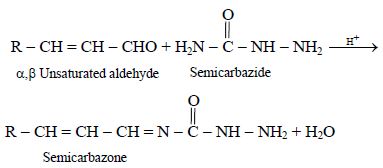
NEW12th Standard CBSE
CBSE 12th Computer Science Database Concept - New Previous year Question Papers Study Material - QB365 Set A
NEW12th Standard CBSE
CBSE 12th Computer Science Data Communication - New Previous year Question Papers Study Material - QB365 Set A
NEW12th Standard CBSE
CBSE 12th Computer Science Data Structures - New Previous year Question Papers Study Material - QB365 Set A
NEW12th Standard CBSE
CBSE 12th Computer Science Functions - New Previous year Question Papers Study Material - QB365 Set A

Published on: 02/11/2025
Download CBSE Class 12th Standard CBSE Chemistry question papers, sample papers, important questions, and previous year solved papers in PDF format. Get free study materials, NCERT solutions, and exam preparation resources for Class 12th Standard CBSE Chemistry
Questions + Answers key
Take MCQ Chemistry Test
1.
How is t-butyl alcohol obtained from acetone?
2.
Explain why is OH group in phenols more strongly held as compound to OH group in alcohols.
3.
How will you distinguish between the following pairs by chemical reactions?
(i) CH3OH and C2H5OH
(ii) Phenol and methanol
(iii) 1-Propanol and 2-methyl-2-propanol
(iv) Ethanol and 1-Propanol?
4.
Explain why the following pairs of compound do not show optical activity.
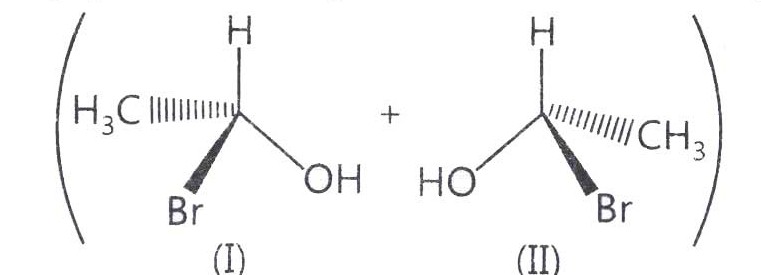
a 1 : 1 mixture of I and II.
5.
Which will react faster in SN2 displacement, 1-bromopentane or 2-bromopentane, and why?
6.
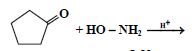
Predict the products of the following reactions:
(i)
(ii)
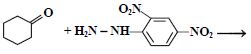
(iii)

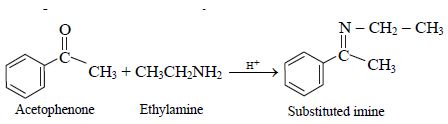
(iv)
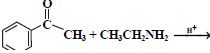
Elimination of H2O from carbonyl and amine group and formation of C= N bond.
7.
(i) How can diethyl ether be prepared from the following?
(a) Ethyl iodide (b) Ethyl alcohol
Write the chemical equation in each case.
(ii) Howis ethyl alcohol obtained from molasses?
8.
An alkyl halide X, of formula \({ C }_{ 6 }{ H }_{ 13 }Cl\) on treatment with potassium tertiary butoxide, gives the isomeric alkenes Y and Z \(\left( { C }_{ 6 }{ H }_{ 12 } \right) \). Both alkenes on hydrogenation give 2, 3-dimethylbutane. Predict the structures of X, Y and Z.
9.
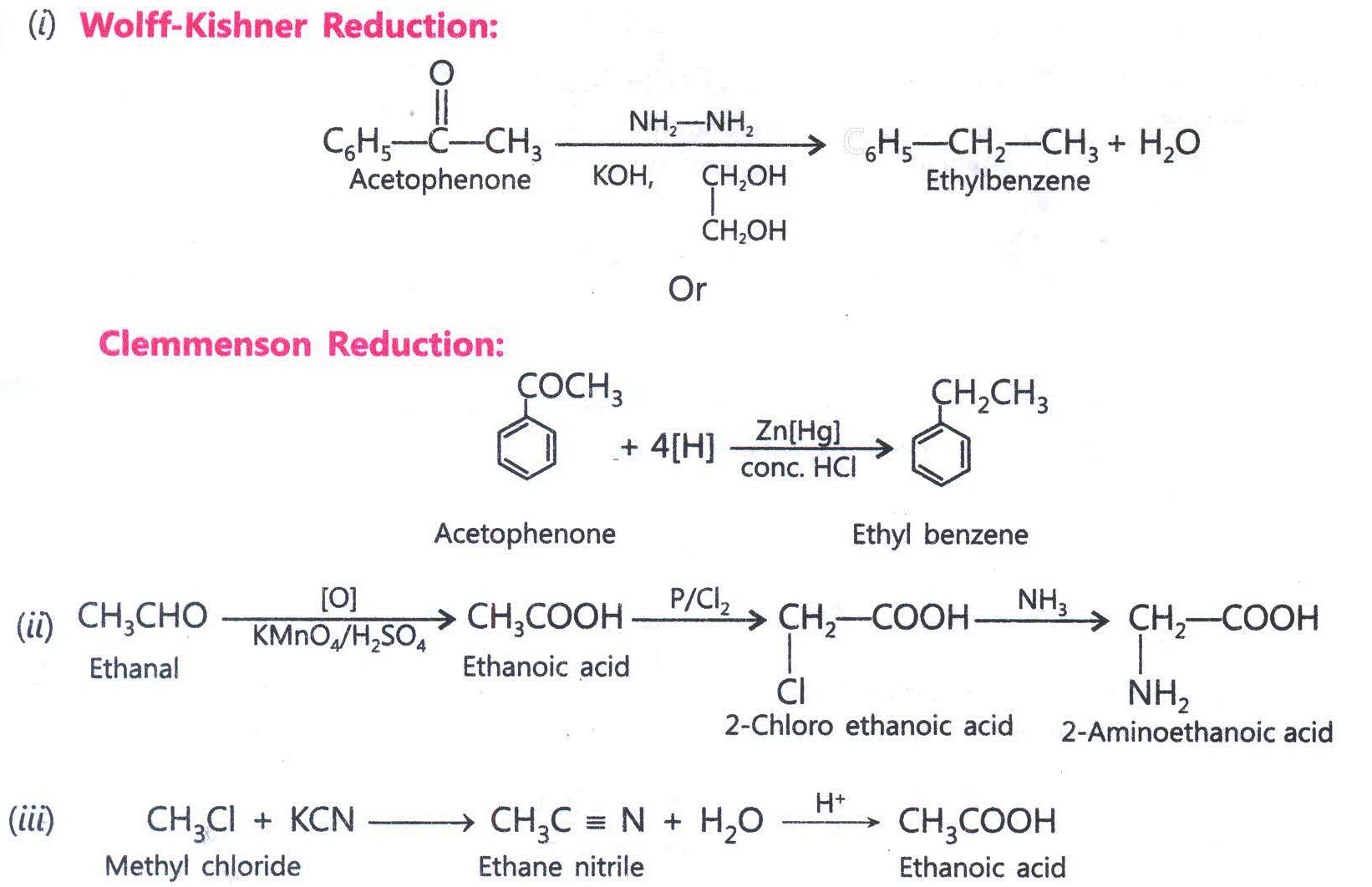
Convert:
(i) Acetophenone to ethylbenzene
(ii) Ethanal to 2-aminoethanoic acid
(iii) Methyl chloride to ethanoic acid.
10.
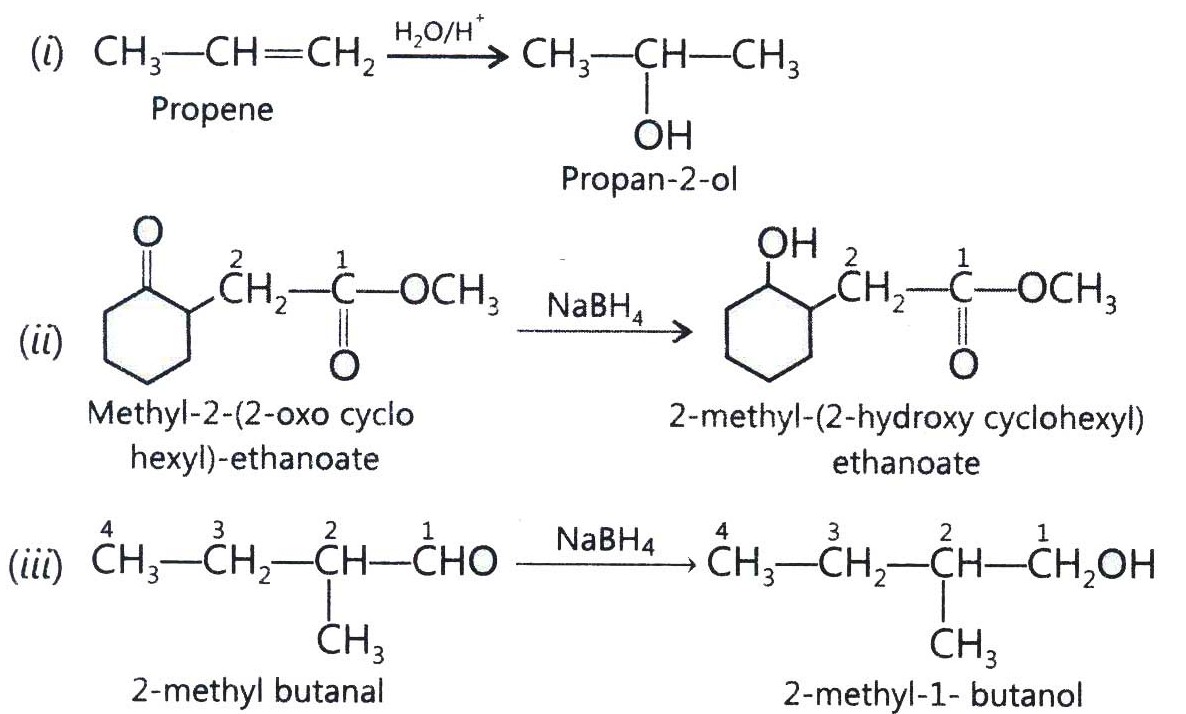
Write structures of the products of the following reactions:
(i)

(ii)
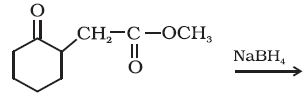
(iii)
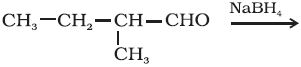
11.
An organic compound (A) with molecular formula C6H6O gives a characteristic colour with aqueous FeCl3 solution. When (A) is treated with CO2 and NaOH at 410K under pressure, it gives compound (B) which upon acidification gives compound (C). Compound (C) reacts with acetyl chloride to give (D) which is a popular pain killer, Deduce the structures of (A), (B), (C) and (D) and explain all the reactions involved.
12.
(a) Write chemical equations to illustrate the following name bearing reactions:
(i) Cannizzaro's reaction
(ii) Hell-Volhard-Zelinsky reaction
(b) Give chemical tests to distinguish between the following pairs of compounds
(i) Propanal and Propanone
(ii) Acetophenone and Benzophenone
(iii) Phenol and Benzoic acid
13.
Which of the following reagents converts C6H5COCHO to C6H5CHOHCOOH ?
Aq. NaOH
Acidic Na2SO3
Na2CrO4/H2SO4
NaNO2/HCI
14.
Decreasing order reactivity in Williamson's ether synthesis of the following is:
I.Me3CCH2Br
II.CH3CH2CH2Br
III.CH2=CHCH2Cl
IV.CH3CH2CH2Cl.
III > II > IV > I
I > II > IV III
IIC > III > IV > I
I > III > II > IV
15.
Phenol, when it first reacts with concentrated sulphuric acid and then with concentrated nitric acid, gives
nitrobenzene
2,4,6-trinitrobenzene
o-nitrophenol
p-nitrophenol
16.
Which of the following reactions is an example of nucleophilic substitution reaction ?
2 RX + Na \(\longrightarrow\) R __ R + 2 NaX
RX + H2 \(\longrightarrow\) RH + HX
RX + Mg \(\longrightarrow\) RMgX
RX + KOH \(\longrightarrow\) ROH + KX
17.
Which of the following are arranged in the decreasing order of dipole moment?
CH3Cl, CH3Br, CH3F
CH3Cl, CH3F, CH3Br
CH3Br, CH3Cl, CH3F
CH3Br, CH3F, CH3Cl
18.
Formic acid does not undergo HVZ reaction because it does not have ___________
19.
Pentan-2-one can be distinguished from pentan-3-one by __________ test.
20.
Esters on treatment with excess of Grignard reagents followed by acid hydrolysis gives -----------
21.
Assertion : SN2 reaction of an optically active aryl halide with an aqueous solution of KOH always gives an alcohol with opposite sign of rotation.
Reason : SN2 reactions always proceed with inversion of configuration.
Codes:
(a) If both Assertion and Reason are correct and the Reason is a correct explanation of the Assertion.
(b) If both Assertion and Reason are correct but Reason is not a correct explanation of the Assertion.
(c) If the Assertion is correct but Reason is incorrect.
(d) If both the Assertion and Reason are incorrect.
22.
In the following questions. an Assertion (A) is followed by a corresponding Reason (R) Use the following keys to choose the appropriate answer.
Assertion (A) neo pentyl chloride is formed when neo pentyl alcohol reacts with HCl.
Reason (R) neo pentyl alcohol is a primary alcohol.
Codes:
(a) Both (A) and (R) are correct, (R) is the correct explanation of (A).
(b) Both (A) and (R) are correct, (R) is not the correct explanation of (A).
(c) (A) is correct; (R) is incorrect.
(d) (A) is incorrect; (R) is correct.
1.

2.
The OH group in phenol is more strongly held because of double bond character between C and O due to resonance.
3.
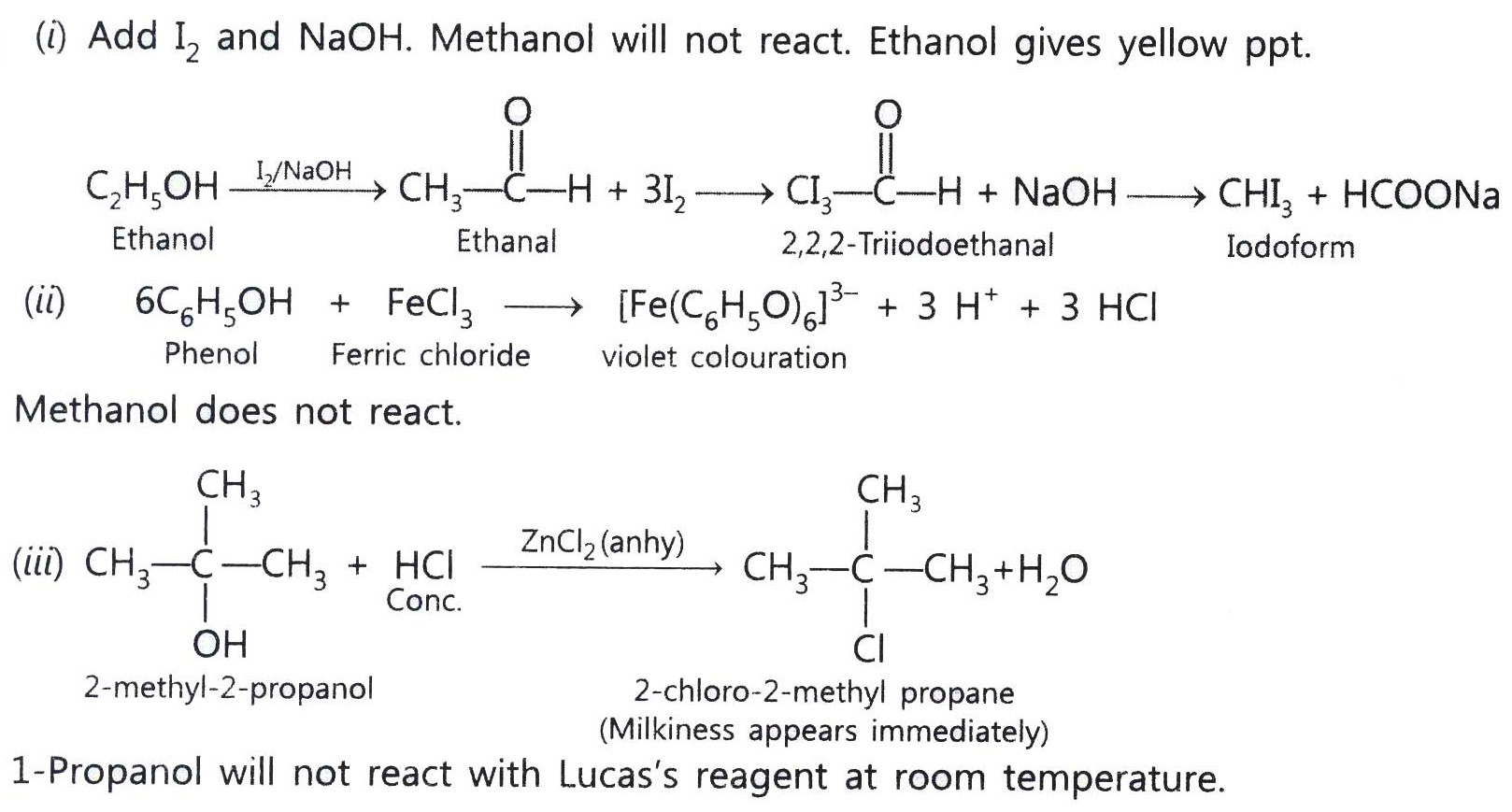

1-Propanol will not react with I2/NaOH to give iodoform.
4.
It is racemic mixture which contains equal amounts of dexto and laborotatory substances. If half of the total number of molecules rotates the plane-polarised light towards left, remaining half of the molecules rotates towards right such that net optical rotation is zero.
5.
1-Bromopentane will react faster in SN2 because it is 1o (primary) halide and has less stearic hidrance.
6.
(i) Cyclopentanone reacts with hydroxyl amine to form oxime.
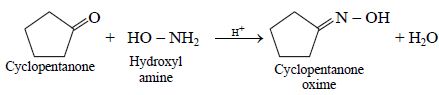
(ii) \(\text { a } \beta\)unsaturated aldehyde reacts with semicarbazide (H2NCONHNH2) to form semicarbazone.

(iii) Cyclohexanone reacts with 2,4-dinitro phenyl hydrazine to form 2,4-dinitro phenyl hydrazone.
(iv) Acetophenone reacts with ethyl amine to form an imine
7.
\(\begin{equation} \mathrm{CH}_{3} \mathrm{CH}_{2} \mathrm{l}+\mathrm{CH}_{3} \mathrm{CH}_{2} \mathrm{OH} \longrightarrow \mathrm{CH}_{3} \mathrm{CH}_{2} \mathrm{OCH}_{2} \mathrm{CH}_{3}+\mathrm{HI} \end{equation}\)
8.
It is given that
\(\underset { (X) }{ { C }_{ 6 }{ C }_{ 3 }CI } \overset { { ({ C }H_{ 3 }) }_{ 3 }COK }{ \longrightarrow } \ { \underset { (Y)\ and\ (Z) }{ Twoisomeric\\ alkenes\ of\ \\ formula\ { C }_{ 6 }{ H }_{ 12 }\ } }\overset { { H }_{ 2 } }{ \longrightarrow } \underset { 2,3-Dimethylbutance }{ { C }H_{ 3 }-\overset { \underset { | }{ { C }H_{ 3 } } }{ CH } -\overset { \underset { | }{ { C }H_{ 3 } } }{ CH } -{ C }H_{ 3 } } \)
The two alkenes forming 2, 3-dimethyl butane are:
\(\underset { (Y) }{ { C }H_{ 3 }-\overset { \underset { | }{ { C }H_{ 3 } } }{ C } =\overset { \underset { | }{ { C }H_{ 3 } } }{ C } -{ C }H_{ 3 } } \quad and\quad \underset { (Z) }{ { C }H_{ 2 }=\overset { \underset { | }{ { C }H_{ 3 } } }{ C } -\overset { \underset { | }{ { C }H_{ 3 } } }{ CH } -{ C }H_{ 3 } } \)
9.
10.
11.
(i) Since compound (A) with M.F. C6H6O gives characteristic colour with FeCI3, therefore, (A) must be phenol.
(ii) Since compound (A), i.e., phenol reacts with CO2 and NaOR under pressure (i.e., Kolbe's reaction) to give compound (B) which on acidification gives compound (C), therefore, (B) must be sodium salicylate and (C) must be salicylic acid.
(iii) Since (C) reacts with acetyl chloride to form a popular pain killer (D), therefore, (D) must be aspirin.
12.
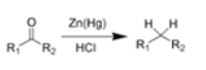
(a) (i) Clemmensen Reduction
The carbonyl group of aldehydes and ketones is reduced to the CH2 group on treatment with zinc amalgam and concentrated hydrochloric acid. This is known as Clemmensen reduction.
(ii) Hell-Volhard-Zelinsky (HVZ )reaction.
Carboxylic acids having a  hydrogen are halogenated at the
  position on treatment with chlorine or bromine in the presence of small amount of red phosphorus to give
  halocarboxylic acids. The reaction is known as Hell-Volhard-Zelinsky reaction.
.JPG)
(b) (i) Propanal (CH3CH2CHO) can be distinguished from propanone (CH3COCH3) by iodoform test.
Being a methyl ketone, propanone on treatment with I2/NaOHundergoes iodoform reaction to give a yellow ppt. of iodoform.
(ii) (ii) Benzaldehyde (C6H5CHO) and acetophenone (C6H5COCH3) can be distinguished by iodoform test.
(iii) Acetophenone, being a methyl ketone on treatment with I2 /NaOH undergoes iodoform reaction to give a yellow ppt. of iodoform. On the other hand, benzaldehyde does not give this test.
13.
(a)
Aq. NaOH
14.
(c)
IIC > III > IV > I
15.
(c)
o-nitrophenol
16.
(d)
RX + KOH \(\longrightarrow\) ROH + KX
17.
(b)
CH3Cl, CH3F, CH3Br
18.
()
\(\alpha\)-hydrogen
19.
()
Iodoform
20.
()
sec- or tert-alcohols
21.
(d) If both the Assertion and Reason are incorrect.
Explanation:
Assertion is false, because aryl halides do not undergo nucleophilic substitution under ordinary conditions. This is due to resonance, because of which the carbon– chlorine bond acquires partial double bond character, hence it becomes shorter and stronger and thus cannot be replaced by nucleophiles. However Reason is true.
22.
(d) 2- chloro -2 methylbutane (not neo pentyl chloride) is formed when neo pentyl alcohol reacts with HCI. The initially formed primary carbocation undergoes rearrangement to form more stable tertiary carbocation. The reaction is given as follows
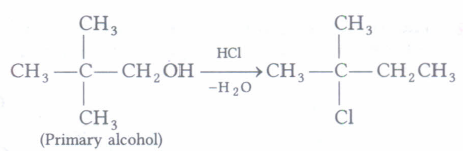
Therefore, (A) is incorrect but (R) is correct statement.

12th Standard CBSE Syllabus & Materials
12th Standard CBSE
CBSE 12th Computer Science Python Revision Tour I - New Previous year Question Papers Study Material - QB365 Set A
NEW12th Standard CBSE
CBSE 12th Business Studies Planning Important Questions And Answers Study Material - QB365 Set A
NEW12th Standard CBSE
CBSE 12th Business Studies Business Environment Important Questions And Answers Study Material - QB365 Set A
NEW12th Standard CBSE
CBSE 12th Business Studies Principles of Management Important Questions And Answers Study Material - QB365 Set A



NCERT Books

Syllabus

Exam Pattern

Sample Question Papers

Previous year Question Papers

Important Notes

MCQ Practice test

NCERT Exemplers

Case study Questions

Image Based Questions

Passage based Questions

HOT Questions

Value Based Questions

Model Questions Papers
NCERT ( Book Back ) Questions

Assertion and Reason
Important Questions And Answers

CBSE 12th Standard CBSE Subjects
CBSE Standards








