
 100% FREE ACCESS
12th Standard CBSE Syllabus & Materials
12th Standard CBSE
CBSE 12th Economics Government Budget and the Economy Previous year Question Papers Study Material - QB365 Set A
NEW12th Standard CBSE
CBSE 12th Computer Science Interface Python with MySQL - New Previous year Question Papers Study Material - QB365 Set A
NEW12th Standard CBSE
CBSE 12th Computer Science Database Concept - New Previous year Question Papers Study Material - QB365 Set A
NEW12th Standard CBSE
CBSE 12th Computer Science Data Communication - New Previous year Question Papers Study Material - QB365 Set A
NEW12th Standard CBSE
CBSE 12th Computer Science Data Structures - New Previous year Question Papers Study Material - QB365 Set A
NEW12th Standard CBSE
CBSE 12th Computer Science Functions - New Previous year Question Papers Study Material - QB365 Set A

Published on: 02/11/2025
Download CBSE Class 12th Standard CBSE Chemistry question papers, sample papers, important questions, and previous year solved papers in PDF format. Get free study materials, NCERT solutions, and exam preparation resources for Class 12th Standard CBSE Chemistry
Questions + Answers key
Take MCQ Chemistry Test
1.
The C-O-C bond angle in the ether molecule is
111°
90°
120°
180°
2.
Whlch of the following reagents will not convert ethyl alcohol into ethyl chloride?
PCl5
NaCl
SOCl2
HCl / ZnCl2
3.
Which of the following is the correct increasing order for the rate of reaction of the given compounds towards nucleophilic substitution?
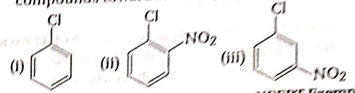
(i) < (ii) < (iii)
(iii) < (ii) < (i)
(i) < (iii) < (ii)
(iii) < (i) < (ii)
4.
Which of the following compounds will react with sodium hydroxide solution in water?
C6H5OH
C6H5CH2OH
(CH3 )3 COH
C2H5OH
5.
Salicylic acid on reaction with CH3 OH in presence of Cone. H2SO4 gives
Methyl salicylate (Iodex)
Benzoic acid
Methyl benzoate
Phenol
6.
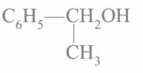
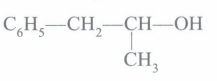
Which of the following are benzylic alcohols?
C6H5 -CH2 -CH2OH
C6H5-CH2OH
7.
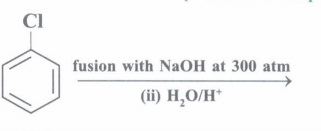
Which of the following reactions will yield phenol?
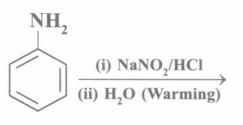
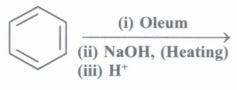
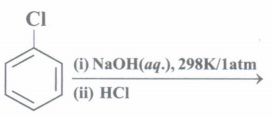
8.
Monochlorination of toluene in sunlight followed by hydrolysis with aq. NaOH yields ___________
o-Cresol
m-Cresol
2, 4-Dihydroxytoluene
benzyl alcohol
9.
\(\left(\mathrm{CH}_{3}\right)_{3} \mathrm{CONa}+\mathrm{CH}_{3} \mathrm{CH}_{2} \mathrm{Cl} \stackrel{-\mathrm{NaCl}}{\longrightarrow}\left(\mathrm{CH}_{3}\right)_{3} \mathrm{COC}_{2} \mathrm{H}_{5}\) is called
Etard reaction
Gattermann Koch reaction
Williamson synthesis
Esterification
10.
THe electrophile involved in Riemer-Tiemann reaction of phenol with CHCI3 in presence of NaOH is
:CCl 2
\(\stackrel{\ominus}{C} C_{3}\)
\(\stackrel{\oplus}{\mathrm{CHO}} \)
\(\stackrel{\oplus}{\mathrm{C}} \mathrm{HCl}_{2}\)
11.
\(\text { Phenol } \stackrel{\mathrm{Zn} \text { , dust }}{\longrightarrow} \cdot \mathrm{X}^{\prime} \frac{\mathrm{CH}_{3} \mathrm{Cl}}{\text { Anhy. } \mathrm{AICl}_{3}} \cdot \mathrm{Y}, \frac{\text { Alkaline }}{\mathrm{KMnO}_{4}} \text { ' } \mathrm{Z} \text { ' }\)
The product 'Z' is
Benzaldehyde
Benzoic acid
Benzene
Toluene
12.
The heating of phenyl methyl ether with HI produces
Iodobenzene
Phenol
Benzene
Ethyl chloride
13.
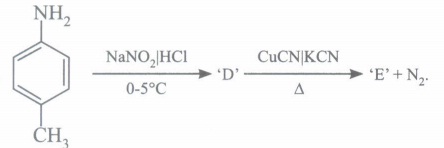
The product 'E' is
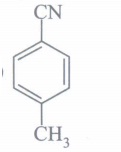
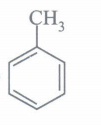
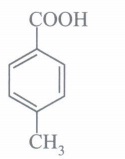
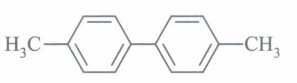
14.
Which of the following structures is enantiomeric with the molecule (A) given below:
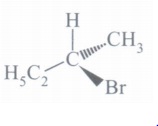
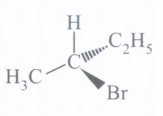
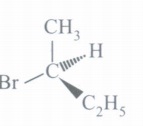
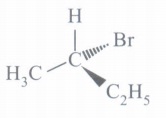
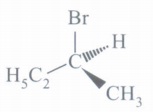
15.
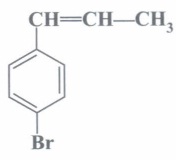
The reaction of \(\mathrm{C}_{6} \mathrm{H}_{5}-\mathrm{CH}=\mathrm{CH}-\mathrm{CH}_{3}\) with HBr produces
C6H5CH2CH2CH2Br
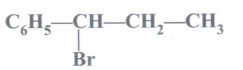
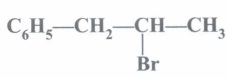
16.
The reagent(s) used for the reduction of aldehydes and ketone into alcohols is/are
fmely divided metals such as Pt/Pd/Ni
sodium borohydride
lithium aluminium hydride
All of the above
17.
IUPAC name of the compound
 is ___________.
1-methoxy-1-methylethane
2-methoxy-2-methylethane
2-methoxypropane
isoptopylmethyl ether
18.
IUPAC name of m- cresol is___________.
3-methylphenol
3-chlorophenol
3-methoxyphenol
benzene-1,3-diol
19.
Choose the incorrect statement among the following:
In polyhalogen compounds, more than one halogen atom is present
Dichloromethane is used as paint remover
Chloroform is used as an anaesthetic in surgery
Chloroform is also used as paint remover
20.
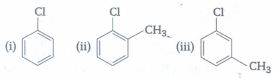
(i) < (ii) < (iii)
(i) < (iii) < (ii)
(iii) < (ii) < (i)
(ii) < (iii) < (i)
21.
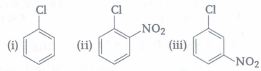
(i) < (ii) < (iii)
(iii) < (ii) < (i)
(i) < (iii) < (ii)
(iii) < (i) < (ii)
22.
Which of the carbon atoms present in the molecule given below are asymmetric?
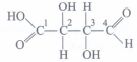
1, 2, 3, 4
2, 3
1,4
1, 2, 3
23.
Which of the following is halogen exchange reaction?
RX + NaI ⟶ RI + NaX
\(C=C+HX\to \underset{\overset{|}{H}}{C-}\underset{\overset{|}{H}}{C}\)
\(R-\mathrm{OH}+\mathrm{HX} \stackrel{\mathrm{ZnCl}_{2}}{\longrightarrow} R-X+\mathrm{H}_{2} \mathrm{O}\)

24.
Carbon-halogen bond is polarised because
halogen atom is less electronegative
halogen atom is more electronegative than carbon atom
carbon bears negative charge while halogen bears positive charge
None of the above
25.
The position of Br in the compound CH3CH= CHC(Br)(CH3)2 can be classified as ___________.
allyl
aryl
vinyl
secondary
26.
Which of the following compounds will give a yellow precipitate with iodine and alkali?
Acetophenone
Methyl acetate
Acetamide
2-Hydroxypropane
27.
tert-Butyl ether on heating with HI gives a mixture of
tert-butyl alcohol and methyl iodide
tert-butyl iodide and methanol
isobutylene and methyl iodide
isobutylene and methanol
28.
Which one of the following phenols has the highest pKa value?
o-Nitrophenol
Phenol
m-Nitrophenol
Picric acid
p-Cresol
29.
The conversion of m-nitrophenol resorcinol involves respectively
hydrolysis, diazotization and reduction
diazotisation, reduction and hydrolysis
hydrolysis, reduction and diazotization
reduction, diazotization and hydrolysis
30.
Cyclohexene is best prepared from cyclohexanol by which of the following reagents:
Conc.H3PO4
Conc.HCl/ZnCl2
Conc.HCl
Conc.HBr
31.
In the reaction, CH3COOH \(\overset{LiAlH_4}\longrightarrow\) A \(\overset{PCl_4}\longrightarrow\) B \(\overset{Alc.KOH}\longrightarrow\)C, the product C is
acetyl chloride
acetaldeyde
acetylene
ethylene
32.
Propene on hydroboration-oxidation produces
CH3CH2CH2OH
CH3CHOHCH3
CH3CHOHCH2OH
CH3CH2CHO
33.
Consider the following reaction, ethanol \(\overset{PCl_5}\longrightarrow\) X \(\overset{alc.KOH}\longrightarrow\) Y \(\overset{H_2SO_4}{\underset {(ii)H_2O,room temperature}{\longrightarrow}}\) Z The product Z is:
CH3CH2 - O - CH2CH3
CH3CH2 - O-SO3H
CH3CH2OH
CH2 = CH2
34.
The reagents used in the preparation DDT from chlorobenzene are
Chloral (CCI3CHO)
Conc.II2SO4
CH3COCCI3
CH2CICOCH2CI
35.
The reagents which cannot be used to distinguish benzyl chloride from chlorobenzene are
Br2/CCI4
Shaking with an aqueous solution of AgNO3
Boiling with aqueous KOH solution followed by acidification with dil.dil. NHO3 and addition of AgNO3 solution.
Fusion with sodium metal followed by acidification with dil.HNO3 and addition of AgNO3 solution.
36.
Which of the following easily undergo nucleophilic substitution by SN1 mechanism in butanol ?
C6H5CH2Br
BrCH2CH = CH2
(CH3)3CBr
(CH3)3CCH2Br
37.
How many stereoisomers does this molecule have ? CH3CH = CHCH2CHB2CHBrCH3
8
2
4
6
38.
How many chiral compounds are possible on monochlorination of 2-methylbutane ?
2
4
6
8
39.
Chlorobenzene is formed by reaction of chlorine with benzene in the presence of AlCl3. Which of the following species attacks the benzene ring in this reaction?
Cl-
Cl+
AlCl3
[AlCl4]-
40.
Which reagent will you use for the following reaction?
CH3CH2CH2CH3 \(\longrightarrow\) CH3CH2CH2CH2Cl+CH3CH2CHClCH3
Cl2/UV light
NaCl+H2SO4
Cl2 gas in dark
Cl2 gas in the presence of iron in dark
41.
Arrange the following : CH3CH2CH2CI (I), CH3CH2CHCICH3 (II), (CH3)2CHCH2CI (III) and(CH3)3C__CI (IV) in order of decreasing tensency towards SN2 reactions
I > III > II > IV
III > IV > II > I
II > I > III > IV
IV > III > II > I
42.
The synthesis of alkyl flurides is best acomplished by
Finekelstein reaction
Swarts reaction
free radical fluourination
Sandmeyer's reaction
43.
An ether is more volatile than alcohol having the same molecular formula. This is due to
intermolecular hydrogen bonding in alcohols
dipolar character of ethers
alcohols having resonance structures
intermolecular hydrigen bonding in ethers.
44.
Products obtained when HI reacts with isopropyl methyl ether at 373 K are
isopropyl iodide and methyl alcihol
isopropyl alcohol and methyl iodide
isopropyl iodide and water
methyl iodide and water
45.
The relative ease of dehydration of alcohols follows the following order :
tertiary>secondary>primary
primary>secondary>tertiary
secondary>tertiary>primary
tertiary>primary>secondary
46.
Among the following the strongest nucleophile is
C2H5SH
CH3COO-
CH3NH2
NCCH2-
47.
The reactivity order of halides for dehydrohalogenation is
R-F > R-Cl > R-Br > R-I
R-I > R-Br > R-Cl > R-F
R-I > R-Cl > R-Br > R-F
R- > R-I > R-Br > R-Cl
48.
Which of the following are arranged in the decreasing order of dipole moment?
CH3Cl, CH3Br, CH3F
CH3Cl, CH3F, CH3Br
CH3Br, CH3Cl, CH3F
CH3Br, CH3F, CH3Cl
49.
When Chlorine is passed through propene at 400oC, which of the following is formed?
PVC
Allyl chloride
Vinyl chloride
1,2-Dichloroethane
50.
Addition of HBr gives same product in the presence or absence of peroxide when alkene is
1-butene
2-methylpropene
propene
2-butene
1.
(a)
111°
2.
(b)
NaCl
3.
(c)
(i) < (iii) < (ii)
4.
(a)
C6H5OH
5.
(a)
Methyl salicylate (Iodex)
6.
(b)
C6H5-CH2OH
7.
(a)
8.
(d)
benzyl alcohol
9.
(c)
Williamson synthesis
10.
(a)
:CCl 2
11.
(b)
Benzoic acid
12.
(b)
Phenol
13.
(a)
14.
(a)
15.
(c)
16.
(d)
All of the above
17.
(c)
2-methoxypropane
18.
(a)
3-methylphenol
19.
(d)
Chloroform is also used as paint remover
20.
(d)
(ii) < (iii) < (i)
21.
(c)
(i) < (iii) < (ii)
22.
(b)
2, 3
23.
(a)
RX + NaI ⟶ RI + NaX
24.
(b)
halogen atom is more electronegative than carbon atom
25.
(a)
allyl
26.
(d)
2-Hydroxypropane
27.
(b)
tert-butyl iodide and methanol
28.
(e)
p-Cresol
29.
(d)
reduction, diazotization and hydrolysis
30.
(a)
Conc.H3PO4
31.
(d)
ethylene
32.
(a)
CH3CH2CH2OH
33.
(c)
CH3CH2OH
34.
(a)
Chloral (CCI3CHO)
35.
(d)
Fusion with sodium metal followed by acidification with dil.HNO3 and addition of AgNO3 solution.
36.
(a)
C6H5CH2Br
37.
(c)
4
38.
(a)
2
39.
(b)
Cl+
40.
(a)
Cl2/UV light
41.
(a)
I > III > II > IV
42.
(b)
Swarts reaction
43.
(a)
intermolecular hydrogen bonding in alcohols
44.
(b)
isopropyl alcohol and methyl iodide
45.
(a)
tertiary>secondary>primary
46.
(a)
C2H5SH
47.
(b)
R-I > R-Br > R-Cl > R-F
48.
(b)
CH3Cl, CH3F, CH3Br
49.
(b)
Allyl chloride
50.
(d)
2-butene

12th Standard CBSE Syllabus & Materials
12th Standard CBSE
CBSE 12th Computer Science Python Revision Tour I - New Previous year Question Papers Study Material - QB365 Set A
NEW12th Standard CBSE
CBSE 12th Business Studies Planning Important Questions And Answers Study Material - QB365 Set A
NEW12th Standard CBSE
CBSE 12th Business Studies Business Environment Important Questions And Answers Study Material - QB365 Set A
NEW12th Standard CBSE
CBSE 12th Business Studies Principles of Management Important Questions And Answers Study Material - QB365 Set A



NCERT Books

Syllabus

Exam Pattern

Sample Question Papers

Previous year Question Papers

Important Notes

MCQ Practice test

NCERT Exemplers

Case study Questions

Image Based Questions

Passage based Questions

HOT Questions

Value Based Questions

Model Questions Papers
NCERT ( Book Back ) Questions

Assertion and Reason
Important Questions And Answers

CBSE 12th Standard CBSE Subjects
CBSE Standards








