
 100% FREE ACCESS
12th Standard CBSE Syllabus & Materials
12th Standard CBSE
CBSE 12th Economics Government Budget and the Economy Previous year Question Papers Study Material - QB365 Set A
NEW12th Standard CBSE
CBSE 12th Computer Science Interface Python with MySQL - New Previous year Question Papers Study Material - QB365 Set A
NEW12th Standard CBSE
CBSE 12th Computer Science Database Concept - New Previous year Question Papers Study Material - QB365 Set A
NEW12th Standard CBSE
CBSE 12th Computer Science Data Communication - New Previous year Question Papers Study Material - QB365 Set A
NEW12th Standard CBSE
CBSE 12th Computer Science Data Structures - New Previous year Question Papers Study Material - QB365 Set A
NEW12th Standard CBSE
CBSE 12th Computer Science Functions - New Previous year Question Papers Study Material - QB365 Set A

Published on: 02/11/2025
Download CBSE Class 12th Standard CBSE Chemistry question papers, sample papers, important questions, and previous year solved papers in PDF format. Get free study materials, NCERT solutions, and exam preparation resources for Class 12th Standard CBSE Chemistry
Questions + Answers key
Take MCQ Chemistry Test
1.
Why is \(\mathrm{CH}_{2}=\mathrm{CH}-\mathrm{CH}_{2}-\mathrm{Cl} \) more easily hydrolysed than CH3 -CH2 -CH2 -Cl?
2.
Arrange the following compounds in increasing order of their boiling points.
CH3CHO, CH3CH2OH, CH3OCH3, CH3CH2CH3
3.
How would you convert ethanol to ethene?
4.
Write the structure of the following compound: 3-(4-chlorophenyl)-2-methylpropane.
5.
State Henry’s law and mention some important applications.
6.
Define osmotic pressure.
7.
Write the structures of products of the following reactions;
(i)
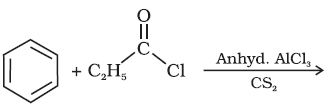
(ii) \(\begin{equation} \left(\mathrm{C}_{6} \mathrm{H}_{5} \mathrm{CH}_{2}\right)_{2} \mathrm{Cd}+2 \mathrm{CH}_{3} \mathrm{COCl} \rightarrow \end{equation}\)
(iii)

(iv)
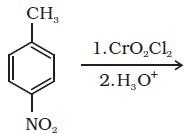
8.
How is 1-propoxy propane synthesised from propan-1-ol ? Write the mechanism of this reaction.
9.
What happens when
(i) n-butyl chloride is treated with alcoholic KOH.
(ii) bromobenzene is treated with Mg in the presence o dry ether.
(iii) Chlorobenzene is subjected to hydrolysis.
(iv) methyl bromide is treated with sodium in presence of dry ether.
(v) methyl chloride is treated with KCN?
10.
Define the following terms: (i) Mole fraction (ii) Molality (iii) Molarity (iv) Mass percentage.
11.
Draw the structure of major monohalo products in each of the following reactions:
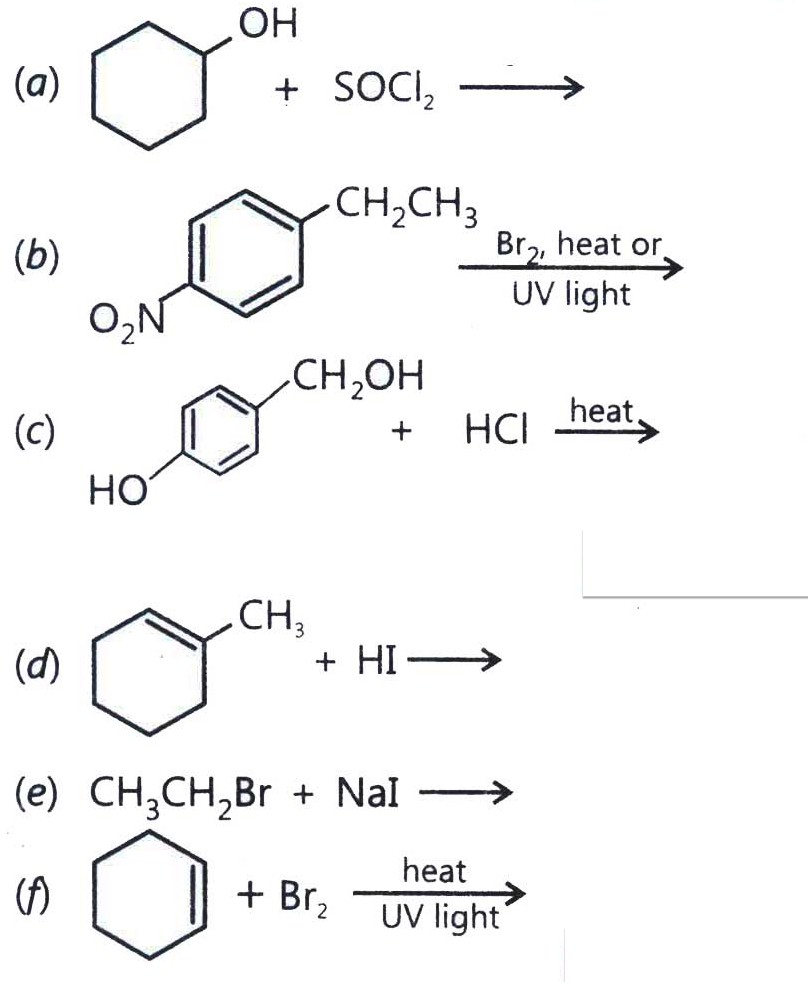
12.
Explain how rusting of iron is envisaged as setting up of an electrochemical cell.
13.
The standard electrode potential for Daniell cell is 1.1V. Calculate the standard Gibbs energy for the reaction:
Zn(s) + Cu2+(aq) → Zn2+(aq) + Cu(s)
14.
In the following pairs of halogen compounds, which compound undergoes faster SN1 reaction?
(i)
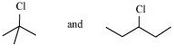
(ii)

15.
What is meant by positive and negative deviations from Raoult's law and how is the sign of \(\triangle_{mix}\)H related to positive and negative deviations from Raoult's law?
16.
Write the mechanism of hydration of ethene to yield ethanol.
17.
Rekha observed that her mother placed shrinked or dried vegetables in water before cutting these for cooking. After sometime, these vegetables looked fresh.
Answer the following questions:
(i) Why did Rekha's mother place the shrinked or dried vegetables in water?
(ii) What is the name of the process used and define it.
(iii) Would the temperature increase accelerate the process or not?
18.
Write structural formulas and names of four possible aldol condensation products from propanal and butanal. In each case, indicate which aldehdye acts as nucleophile and which as electrophile.
19.
Account the following:
(i) The boiling point of ethanol is higher than that of methanol.
(ii) Phenol is a stronger acid than an alcohol.
(iii) The boiling points of ethers are lower than isomeric alcohols.
20.
The true statement about mercury cell is
it is used in high current devices
here Zn - Hg acts as cathode and a paste of C+ HgO as anode.
the cell potential remains constant due to non-involvement of such a ion, concentration of which can change during its whole life.
All of the above
21.
C3H5O did not give a silver mirror with Tollens' reagent, but give an oxmic with hydroxmine. reagent, but gave an oxmie with hydroxylamine. It can give possitive
iodoform test
Fehling's test
Schiff's test
Carbylamine test
22.
Propene on hydroboration-oxidation produces
CH3CH2CH2OH
CH3CHOHCH3
CH3CHOHCH2OH
CH3CH2CHO
23.
Which of the following cannot reduce 'Tollens' reagent ?
HCOOH
HCHO
CH3CHO
CH3COCH3
24.
Which of the following organic compounds answers both iodoform test and Fehling's test?
Ethanal
Propanone
Ethanol
Methanol
25.
Which one is most reactive towards SN1 reaction ?
C6H5CH2Br
C6H5CH(C6H5)Br
C6H5CH(CH3)Br
C6H5C(CH3)(C6H5)Br
26.
Arrange the given set of compounds in order of increasing boiling points
I. 1-chloropropane
II. Isopropyl chloride
III. 1-chloropropane
II < III < I
I < II < III
II < I < III
III < I < II
27.
Phenol reacts with bromine in CS2 to give
o-bromophenol
m-bromophenol
o-and p-bromophenol
2, 4, 6-tribromophenol
28.
Which of the following will produce only one product on reduction with LiAIH4?
CH3OCOCH2CH3
CH3CH2OCOCH2CH3
CH3CH2OCOCH3
CH3CH2OCOCH2CH2CH3
29.
The reaction of hydrogen bromide with propene in absence of peroxide is an example of a/an
free radical addition
nucleophilic addition
electrophilic substitution
electrophilic addition
30.
Which of the statements about solutions of electrolytes is not correct ?
Conductivity of solution depends upon size of ions
Conductivity depends upon viscosity of solution
Conductivity does not depend upon solvation of ions present in solution
Conductivity of solution increases with temperature.
31.
Which one of the following statement is always true about the spontaneous cell reaction in a galvanic cell?
\({ E_{ cell } }^{ ° }>0,{ \Delta G }^{ ° }>0,Q>{ K }_{ c }\)
\({ E_{ cell } }^{ ° }<0,{ \Delta G }^{ ° }<0,Q<{ K }_{ c }\)
\({ E_{ cell } }^{ ° }>0,{ \Delta G }^{ ° }<0,Q<{ K }_{ c }\)
\({ E_{ cell } }^{ ° }>0,{ \Delta G }^{ ° }<0,Q>{ K }_{ c }\)
32.
Which has the highest oxidizing power ?
I2
Br2
F2
Cl2
33.
An aqueous solution of methanol in water has vapour pressure
equal to that of water
equal to that of methanol
more than that of water
less than that of water
34.
A solution with lower osmotic pressure is called ........... with respect to a more concentrated solution which is called ............... .
35.
Metallic conductance involves movement of electrons where as electrolytic conductance involves movement of ions. Specific conductance increases with increase in concentration where as Am (molar conductivity) decreases with increase in concentration. Electrochemical cell converts chemical energy of redox reaction into electricity. Mercury cell, Dry cells are primary cells where as Ni-Cd cell, lead storage battery are secondary cells. Electroehemical series is arrangement of elements in increasing order of their reduction potential. Electrolytic cell converts electrical energy into chemical energy which is used in electrolysis. Amount of products formed are decided with the help of Faraday's laws of Electrolysis. Kohlrausch law helps to determine limiting molar conductivity of weak electrolyte, their degree of ionisation (\(\alpha\)) and their dissociation constants. Corrosion is electrochemical phenomenon. Metal undergoing corrosion acts as anode, loses electrons to form ions which combine with substances present in atmosphere to form surface compounds. More reactive metals are coated over less reactive metals to prevent corrosions. H2 -O2 fuel cell was used in apollo space programme.
(a) Out of 0.5 M, 0.01 M, 0.1 M and 1.0 M which solution of KCl will have highest value of specific conductance? Why?
(b) Write the product of electrolysis of aq. NaCI on cathode. Why?
(c) When does electrochemical cell behaves like electrolytic cell?
(d) For an electrochemical cell Mg(s) + 2Ag+(aq) \(\rightarrow\) 2Ag(s) + Mg2+. Give the cell representation and write Nernst equation.
(e) Which will have higher conductance, silver wire at 30° or at 60°C?
(f) Calculate maximum work obtained from the cell Ni(s) + 2Ag+(aq) \(\rightarrow\) Ni2+(aq) + 2Ag(s) Eocell = 1.05V.
(g) Which cell is used in hearing aids and watches?
36.
Read the passage given below and answer the following questions:
An organic compound (A) having molecular formula C6H6O gives a characteristic colour with aqueous FeCl3 solution. (A) on treatment with CO2 and NaOH at 400 K under pressure gives (B), which on acidification gives a compound (C). The compound (C) reacts with acetyl chloride to give (D) which is a popular pain killer.
The following questions are multiple choice questions. Choose the most appropriate answer:
(i) Compound (A) is
| (a) 2-hexanol | (b) dimethyl ether | (c) phenol | (d) 2-methyl pentanol. |
(ii) Number of carbon atoms in compound (D) is
| (a) 7 | (b) 6 | (c) 8 | (d) 9 |
(iii) The conversion of compound (A) to (C) is known as
| (a) Reimer- Tiemann reaction | (b) Kolbe's reaction | (c) Schimdt reaction | (d) Swarts reaction |
(iv) Compound (A) on heating with compound (C) in presence of POCl3 gives a compound (D) which is used
| (a) in perfumery as a flavouring agent | (b) as an antipyretic | (c) as an analgesic | (d) as an intestinal antiseptic. |
37.
Read the passage given below and answer the following questions:
Nucleophilic substitution reactions are of two types; substitution nucleophilic bimolecular (SN2) and substitution nucleophilic unimolecular (SN1) depending on molecules taking part in determining the rate of reaction. Reactivity of alkyl halide towards SN1 and SN2 reactions depends on various factors such as steric hindrance, stability of intermediate or transition state and polarity of solvent. SN2 reaction mechanism is favoured mostly by primary alkyl halide then secondary and then tertiary. This order is reversed in case of SN1 reactions.
The following questions are multiple choice questions. Choose the most appropriate answer:
(i) Which of the following is most reactive towards nucleophilic substitution reaction?
| (a) \(\mathrm{C}_{6} \mathrm{H}_{5} \mathrm{Cl}\) | (b) \(\mathrm{CH}_{2}=\mathrm{CHCl}\) | (c) \(\mathrm{ClCH}_{2} \mathrm{CH}=\mathrm{CH}_{2}\) | (d) \(\mathrm{CH}_{3} \mathrm{CH}=\mathrm{CHCl}\) |
(ii) Isopropyl chloride undergoes hydrolysis by
| (a) SN1mechanism | (b) SN2mechanism | (c) SN1 and SN2mechanism | (d) neither SN1 and SN2mechanism |
(iii) The most reactive nucleophile among the following is
| (a) CH3O- | (b) C6H5O- | (c) (CH3)2CHO- | (d) (CH3)3CO- |
(iv) Tertiary alkyl halides are practically inert to substitution by SN2mechanism because of
| (a) insolubility | (b) instability | (c) inductive effect | (d) stearic hindrance. |
38.
Read the passage given below and answer the following questions:
An ideal solution may be defined as the solution which obeys Raoult's law exactly over the entire range of concentration. The solutions for which vapour pressure is either higher or lower than that predicted by Raoult's law are called non-ideal solutions.
Non-ideal solutions can show either positive or negative deviations from Raoult's law depending on whether the A-B interactions in solution are stronger or weaker than A - A and B - B interactions.
The following questions are multiple choice questions. Choose the most appropriate answer:
(i) Which of the following solutions is/are ideal solution(s)?
(i) Bromoethane and iodoethane (ii) Acetone and chloroform
(iii) Benzene and acetone (iv)n-heptane and n-hexane
| (a) only 1 | (b) I and II | (c) II and III | (d) I and IV |
(ii) Which of the following is not true for positive deviations?
| (a) The A-B interactions in solution are weaker than the A -A and B -B interactions. |
| (b) \(P_{A}<P_{A}^{\circ} x_{A} \text { and } P_{B}<P_{B}^{\circ} x_{B}\) |
| (c) Carbon tetrachloride and chloroform mixture is an example of positive deviations. |
| (d) All of these |
(iii) For water and nitric acid mixture which of the given graph is correct?
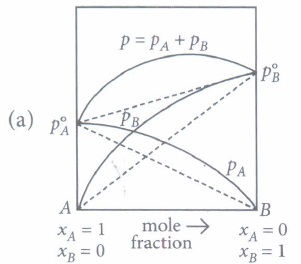 |
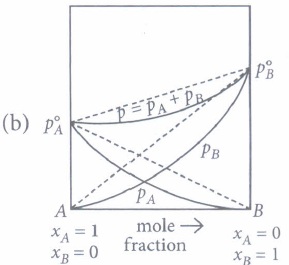 |
| (C) Both of these | (d) None of these |
(iv) Water- HCl mixture
I. shows positive deviations II. forms minimum boiling azeotrope
III. shows negative deviations IV. forms maximum boiling azeotrope
| (a) I and II | (b) II and III |
| (c) I and IV | (d) III and IV |
39.

1.
It is because \(\mathrm{CH}_2=\mathrm{CH} \mathrm{C} \stackrel{\oplus}{\mathrm{H}}{ }_2 \longleftrightarrow \mathrm{CH}_2-\mathrm{CH}=\mathrm{CH}_2\) allyl carbocation is stabilized by resonance more than \(\mathrm{CH}_3-\mathrm{CH}_2 \stackrel{\oplus}{\mathrm{CH}_2}\) by inductive effect.
2.
\(\mathrm{CH}_3 \mathrm{CH}_2 \mathrm{CH}_3<\mathrm{CH}_3 \mathrm{OCH}_3<\mathrm{CH}_3 \mathrm{CHO}<\mathrm{CH}_3 \mathrm{CH}_2 \mathrm{OH}\) Stronger the attractive forces, higher is the boiling point. Hydrocarbons are non-polar having weakest attractive forces, ethers are polar and aldehydes have strong dipolar interaction. Alcohols have maximum intermolecular forces due to the presence of H-bonding.
3.

4.
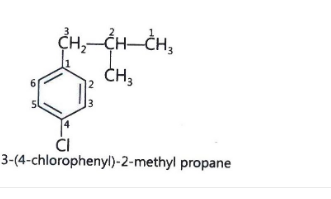
5.
Henry's Law: It states that the partial vapour pressure of gas in vapour phase(g) is directly proportional to the mole fraction of the gas in the solution.
Applications of Henry's Law:
(i) To minimise the painful effects accompanying the decompression of deep sea divers, oxygen diluted with less soluble helium gas is used as breathing gas.
(ii) To increase the solubility of CO2 in soft, drinks and soda water, the bottle is sealed under high pressure.
6.
It is the extra pressure which must be applied on solution side so as to prevent the flow of solvent molecules from solution through semi-permeable
7.
(i)
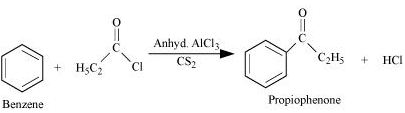
(ii)
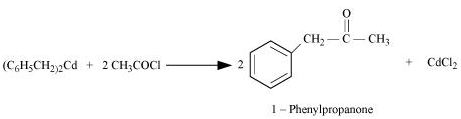
(iii)
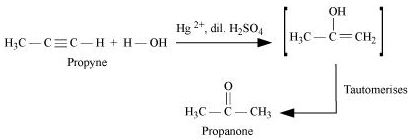
(iv)
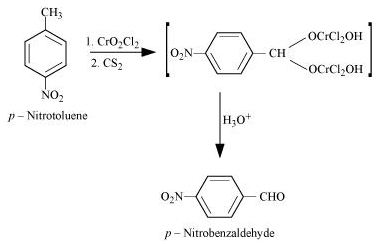
8.
Two methods can be employed for this preparation
(i) Via Williamson's synthesis
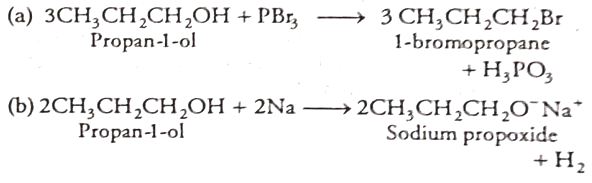
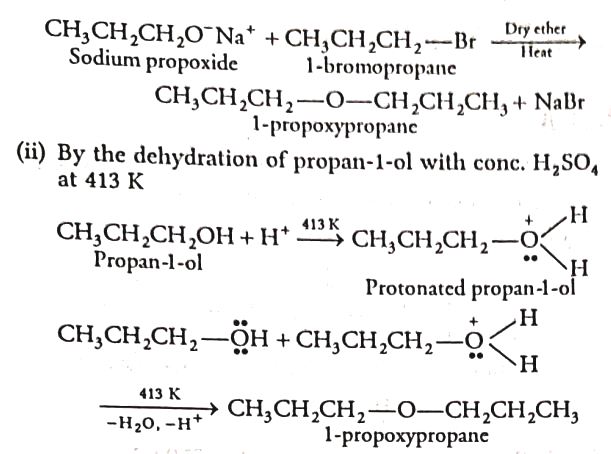
9.
\(\underset { n-Butylchloride }{ { CH }_{ 3 }{ CH }_{ 2 }{ CH }_{ 2 }{ CH }_{ 2 }CI } +KOH(alc.)\overset { \triangle }{ \longrightarrow } \underset { But-l-ene }{ { CH }_{ 3 }{ CH }_{ 2 }CH={ CH }_{ 2 }+KCI+{ H }_{ 2 }O } \)
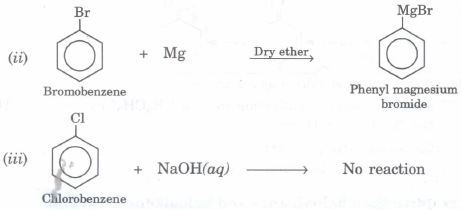
\((iv)\quad { 2CH }_{ 3 }Br+2Na\overset { Dry\quad ether }{ \underset { \quad Wurt\\ reaction }{ \longrightarrow } } \underset { Ethane }{ { CH }_{ 3 }{ CH }_{ 3 } } +2NaBr\)
\(\\ (vi)\quad \underset { Methyl\\ chloride }{ { CH }_{ 3 }CI } +KCN\longrightarrow \underset { Methyl\\ chloride }{ { CH }_{ 3 }CN } +KCI\)
10.
(i) Mole fraction: It is the ratio of the number of moles of one component to the total number of moles of all the components present in the solution. For example, if a binary solution has nA moles of one component and nB moles of second component, then mole fraction of component A(xA) and B(xB) is:
\({ x }_{ A }=\frac { { n }_{ A } }{ { n }_{ A }+{ n }_{ B } } \) and \({ x }_{ B }=\frac { { n }_{ B } }{ { n }_{ A }+{ n }_{ B } } \) and xA + xB = 1
(ii) Molality: It is the number of moles of solute dissolved per 1000 g (or 1 kg) of solvent. If n2 moles of solute are dissolved in w1 g of solvent, then
Molality = \(\frac { { n }_{ 2 } }{ { w }_{ 1 } } \times 1000\)
(iii) Molarity: It is the number of moles of solute dissolved per liter of the solution. If n2 moles of solute are dissolved in V mL of the solution, then
Molarity = \(\frac { { n }_{ 2 }\times 1000 }{ V } \)
(iv) Mass percentage: It is the amount of solute (in grams) per 100 g of the solution. If w2 g of solute are dissolved in w1 g of solvent, then
Mass percentage of solute = \(\frac { { w }_{ 2 } }{ { w }_{ 1 }+{ w }_{ 2 } } \times 100\)
11.
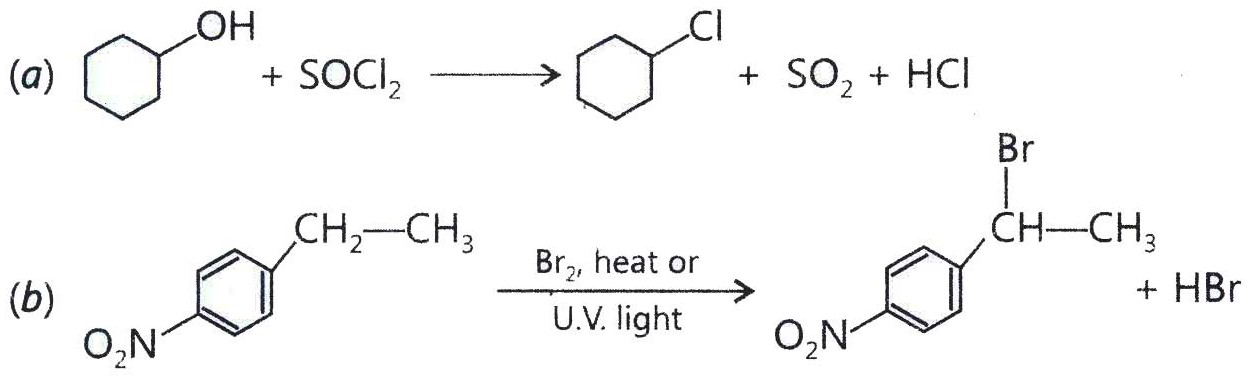
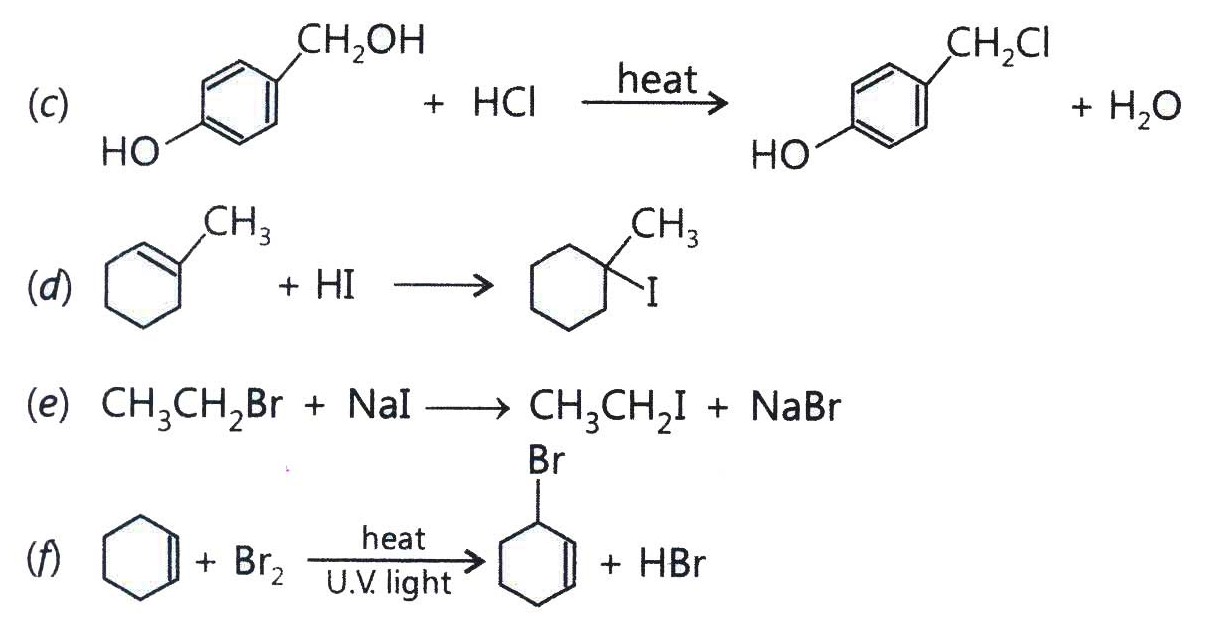
12.
In process of rusting, water molecules present at the layer of iron react with oxides and get dissociated and give H+ ions
H2O + CO2 → H2CO3
H2CO3↔ 2H+ + CO32–
In present of H+ ions iron convert in Fe2+ so this part is act as anode
Reaction at anode:
Fe(s) → Fe2+(aq) + 2e–
Electron released at anodic spot move through the metals and go to another spot on the metal and reduce oxygen this spot act as cathode
Reaction at Cathode:
O2(g) + 4H+(aq) + 4e+( aq) → 2H2O(l)
The overall reaction
2Fe(s) + O2(g) + 4H+(aq) → 2H2O(l) + Fe2+(aq)
Hence, rusting of iron act as electrochemical cell.
13.
\(\Delta_{\mathrm{r}} G^{\ominus}=-n F \mathrm{E}_{\text {(cell) }}^{\ominus}\)
n in the above equation is 2, F = 96487 C mol –1 and \(\mathrm{E}_{\text {(cell })}^{\ominus}\) = 1.1 V
Therefore, \(\Delta_{\mathrm{r}} G^{\ominus}\) = – 2 × 1.1V × 96487 C mol –1
= – 21227 J mol–1
= – 212.27 kJ mol–1
14.
(i)
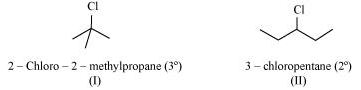
SN1 reaction proceeds via the formation of carbocation. The alkyl halide (I) is 3° while (II) is 2°. Therefore, (I) forms 3° carbocation while (II) forms 2° carbocation. Greater the stability of the carbocation, faster is the rate of SN1 reaction. Since 3° carbocation is more stable than 2° carbocation. (I), i.e. 2-chloro-2-methylpropane, undergoes faster SN1 reaction than (II) i.e., 3 chloropentane.
(ii)
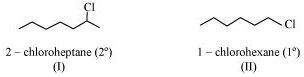
The alkyl halide (I) is 2° while (II) is 1°. 2° carbocation is more stable than 1° carbocation. Therefore, (I), 2-chloroheptane, undergoes faster SN1 reaction than (II), 1-chlorohexane.
15.
Positive deviation from Raoult's law occurs when the total vapour pressure of the solution is more than corresponding vapour pressure in case of ideal solution.
\(P={P}_{{A}}+{P}_{{B}}>{P}_{{A}}^{\circ} {X}_{{A}}+{P}_{{B}}^{\circ} {X}_{{B}}\)
Negative deviation from Raoult's law occurs when the total vapour pressure of the solution is less than corresponding vapour pressure in case of the ideal solution.
\({P}={P}_{{A}}+{P}_{{B}}<{P}_{{A}}^{\circ} {X}_{{A}}+{P}_{{B}}^{\circ} {X}_{{B}}\)
For positive deviation from Raoult's law, Δ mix ,H has a positive sign.
For negative deviation from Raoult's law, Δ mix .H has a negative sign.
16.
Direct addition of H2O to ethene in presence of an acid does not occur. Indirectly, ethene is first passed through cone. H2SO4, when ethyl hydrogen sulphate is formed.

Ethyl hydrogen sulphate when boiled with water undergoes hydrolysis to form ethanol.

17.
(i) The cell walls of the vegetables have semi-permeable membrane. When the vegetables have dried, the concentration of water inside becomes low. When the dried or shrinked vegetables are placed in water, water enters into the cells due to osmosis. Hence, they swell and return to the original form.
(ii) The process is osmosis. It is defined as the flow of the solvent molecules from the solvent to the solution or from less concentrated solution to a more concentrated solution through a semi-permeable membrane.
(iii) The process will be accelerated with increase of temperature because osmosis becomes faster with increase of temperature.
18.
.png)
19.
(i) It is due to higher molecular weight, more surface area more vav deer waals, forces of Attraction in C2H2Oh.
(ii) Phenol is the strongest acid than alcohol because phenoxide ion is more stable due to resonance than ethoxide ion.
(iii) It is because ethers are not associated with inter molecular H- bonding, whereas ethanol.
20.
(d)
All of the above
21.
(a)
iodoform test
22.
(a)
CH3CH2CH2OH
23.
(d)
CH3COCH3
24.
(a)
Ethanal
25.
(d)
C6H5C(CH3)(C6H5)Br
26.
(c)
II < I < III
27.
(c)
o-and p-bromophenol
28.
(c), esters having the same number of carbon atoms in the alkyl and acyl group, i.e., CH3CH2 and COCH3 group in CH3CH2OCOCH3.
29.
(d)
electrophilic addition
30.
(c)
Conductivity does not depend upon solvation of ions present in solution
31.
(c)
\({ E_{ cell } }^{ ° }>0,{ \Delta G }^{ ° }<0,Q<{ K }_{ c }\)
32.
(c)
F2
33.
Methanol being more volatile than water, the solution of methanol in water will have more vapour pressure than water (a case of positive deviation).
34.
()
hypotonic, hypertonic
35.
(a) 1,0 M KCI solution because it will have more number of ions per unit volume of solution.
(b) \(2 \mathrm{H}^{+}+2 e^{-} \rightarrow \mathrm{H}_{2}(g)\)
\(\left[\because \mathrm{E}_{\mathrm{H}^{+} / \mathrm{H}_{2}}^{\circ}=0\right.\) , is higher than \(\left.\mathrm{E}_{\mathrm{Na}^{+} / \mathrm{Na}}^{\circ}=-2.71 \mathrm{~V}\right]\)
(c) When Eextemal > Eo cell
(d) Mg(s) I Mg2+ (aq) II Ag+ (aq) I Ag(s)
\(\mathrm{E}_{\mathrm{cell}}=\mathrm{E}_{\text {cell }}^{\circ}-\frac{0.0591}{2} \log \frac{\left[\mathrm{Mg}^{2+}\right]}{\left[\mathrm{Ag}^{+}\right]^{2}}\)
(e) Silver wire at 30°C. Metallic conductance decreases with increase in temperature.
(f) \(\triangle\)Go = - nPF = - 2 x l.05 V x 96500 C = - 202.65 kJ
Wmax= - \(\triangle\)Go = - (-202.65 kJ) = + 202.65 kJ
(g) Mercury cell
36.
(i) (c):
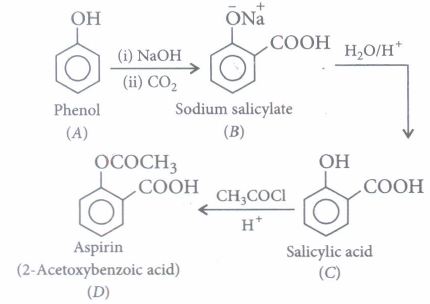
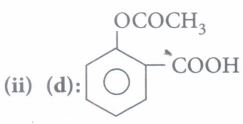
It has 9 C-atoms.
(iii) (b): Sodium phenoxide when heated with CO2 at 400 K under a pressure of 4-7 atm followed by acidification gives 2-hydroxybenzoic acid (salicylic acid) as the main product along with a small amount of 4-hydroxybenzoic acid. This reaction is called Kolbe's reaction.
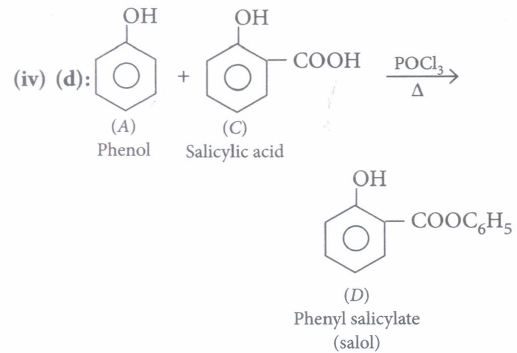
Salol is used as an intestinal antiseptic.
37.
(i) (c) : Allylic chlorides are most reactive.
(ii) (c): 20 - alkyl halides undergo hydrolysis by SN1 or SN2 mechanism.
(iii) (a): Smaller the size of the nucleophile (i.e., CH3O-), more reactive it is.
(iv) (d): Stearic hindrance due to bulky alkyl groups prevents the attack of the nucleophile in SN2 mechanism.
38.
(i) (d) : II represents negative deviations and III represents positive deviations.
(ii) (b): For positive deviations \(p_{A}>p_{A}^{\circ} x_{A} \text { and } p_{B}>p_{B}^{\circ} x_{B}\)
(iii) (b): Water and nitric acid mixture shows negative deviations from Raoult's law, hence \(p_{A}<p_{A}^{\circ} x_{A} \text { and } p_{B}<p_{B}^{\circ} x_{B}\)
(iv) (d): Water-HCl mixture shows negative deviations from Raoult's law and solutions showing negative deviations from ideal behaviour form maximum boiling azeotrope.
39.
(a)

12th Standard CBSE Syllabus & Materials
12th Standard CBSE
CBSE 12th Computer Science Python Revision Tour I - New Previous year Question Papers Study Material - QB365 Set A
NEW12th Standard CBSE
CBSE 12th Business Studies Planning Important Questions And Answers Study Material - QB365 Set A
NEW12th Standard CBSE
CBSE 12th Business Studies Business Environment Important Questions And Answers Study Material - QB365 Set A
NEW12th Standard CBSE
CBSE 12th Business Studies Principles of Management Important Questions And Answers Study Material - QB365 Set A



NCERT Books

Syllabus

Exam Pattern

Sample Question Papers

Previous year Question Papers

Important Notes

MCQ Practice test

NCERT Exemplers

Case study Questions

Image Based Questions

Passage based Questions

HOT Questions

Value Based Questions

Model Questions Papers
NCERT ( Book Back ) Questions

Assertion and Reason
Important Questions And Answers

CBSE 12th Standard CBSE Subjects
CBSE Standards








