
 100% FREE ACCESS
12th Standard CBSE Syllabus & Materials
12th Standard CBSE
CBSE 12th Economics Government Budget and the Economy Previous year Question Papers Study Material - QB365 Set A
NEW12th Standard CBSE
CBSE 12th Computer Science Interface Python with MySQL - New Previous year Question Papers Study Material - QB365 Set A
NEW12th Standard CBSE
CBSE 12th Computer Science Database Concept - New Previous year Question Papers Study Material - QB365 Set A
NEW12th Standard CBSE
CBSE 12th Computer Science Data Communication - New Previous year Question Papers Study Material - QB365 Set A
NEW12th Standard CBSE
CBSE 12th Computer Science Data Structures - New Previous year Question Papers Study Material - QB365 Set A
NEW12th Standard CBSE
CBSE 12th Computer Science Functions - New Previous year Question Papers Study Material - QB365 Set A

Published on: 02/11/2025
Download CBSE Class 12th Standard CBSE Chemistry question papers, sample papers, important questions, and previous year solved papers in PDF format. Get free study materials, NCERT solutions, and exam preparation resources for Class 12th Standard CBSE Chemistry
Questions + Answers key
Take MCQ Chemistry Test
1.
Give an example of vic-dihalide.
2.
Identify the hydrocarbon (C5H10) that does not react with chlorine in dark but gives a single mono chloro compound C5H9CI in bright sunlight (or) Which isomer of C5H10 gives a single monochloro compound, C5H9CI in bright sunlight?
3.
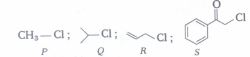
P, Q, R and S undergoes SN2 reaction with KI in acetone. What is the order of the rate of reaction?
4.
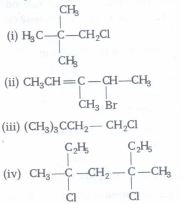
Give the IUPACnames of the following compounds.
5.
Write the reaction for the formation of each of the following.
(i) Dichloromethane
(ii) Phosgene
6.
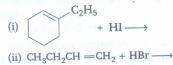
Complete the following reactions.
7.
Why is iodination of benzene difficult?
8.
What is the IUPAC name of DDT? Why is its use banned in many countries?
9.
An alcohol having molecular formula, C4H10O is optically active. What is its structure?
10.
Write a chemical reaction in which iodide ion displaces diazonium group from diazonium salt.
11.
Arrange the following compounds in the order of increasing boiling points. Chloromethane, chloroform, iodomethane, bromomethane.
12.
How can the following conversion be carried out?
Aniline to bromobenzene.
13.
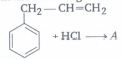
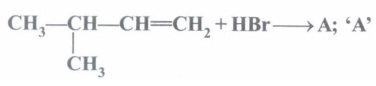
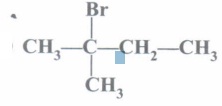
What is A in the following reaction?
14.
Write the structure of the following compound, 2-chloro-3-methylpentane
15.
Write the IUPAC name of the following compound
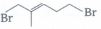
16.
Among the following, which nomenclature is not according to the IUPAC system?
1-bromoprop-Z-ene, 2-methyl-3 phenylpentane and 5-oxohexanoic acid
17.
Among the following, which is not an allylic halide? 3-bromo-2-methylpropene, 4-bromobut-1-ene and 3-bromo-2-methylbut-l-ene.
18.
(i) Give the reaction for the formation of phosgene gas.
(ii) What happens when phosgene gas reacts with ethanol? (Give chemical reaction only).
19.
Chloroform is stored in closed dark coloured bottles completely filled, so that air is kept out. Explain.
20.
Name the non-volatile, non-toxic compound, which is formed when 1% ethanol is added to the bottles of chloroform to convert phosgene gas to that compound.
21.
Which polyhalogen compound is used in the production of freon refrigerant R -22?
22.
Write one use for each of the following.
(i) DDT (ii) Iodoform
23.
Write the mechanism of the following reaction:
\(n B u B r+K C N \longrightarrow ^{E t O H-H_{2} O} n B u C N\)
24.
Out of chlorobenzene and benzyl chloride, which one gets easily hydrolysed by aqueous NaOH and why?
25.
Write the structure of the major organic products in each of the following reactions:
\((i) \mathrm{CH}_{3} \mathrm{CH}_{2} \mathrm{CH}_{2} \mathrm{Cl}+\mathrm{NaI} \frac{\text { Acetone }}{\mathrm{Heat}}{\longrightarrow}\)
\(\\ (ii) \mathrm{CH}_{3} \mathrm{CH}_{2} \mathrm{CH}_{2} \mathrm{OH}+\mathrm{SOCl}_{2} \stackrel{\text { Pyridine }}{\longrightarrow}\)
\(\\ (iii) \mathrm{CH}_{3} \mathrm{CH}_{2} \mathrm{CH}=\mathrm{CH}_{2}+\mathrm{HBr} \stackrel{\text { Peroxide }}{\longrightarrow}\)
(iv) \(C{H}_{3}CH=\underset{\overset{|}{C{H}_{3}}}{C(C{H}_{3})+HBr}\)
26.
Why aryl halides cannot be prepared by the reaction of phenol with HCI in the presence of ZnCI2?
27.
Give one example of alkene where addition of HBr gives same product in the presence or absence of peroxide.
28.
Write the IUPAC name of the following compounds.
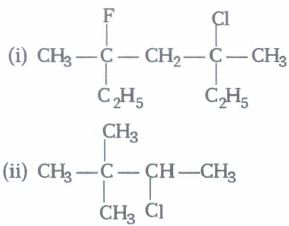
29.
Write the structures of the following organic halogen compounds.
(i)1-bromo-4-sec-butyl-2-methylbenzene
(ii) 1,4-dibromobut-2-ene
30.
Draw the structure of the following compounds.
(i) 2,2-dimethyl-1-bromobutane
(ii) 2,2,4,4-tetramethylhexane
31.
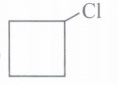
Write the IUPAC name of the compound shown alongside and mention the hybridisation of each carbon-halogen bond.
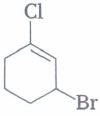
32.
Write the structure of 3-bromo-2-methylprop-1-ene.
33.
Write the IUPAC name of the following compound.
\(C{H}_{\mathit{3}}\mathit{-}\underset{\overset{\mathit{|}}{Cl}}{CH}-C{H}_{2}-CH=C{H}_{2}\)
34.
Discuss the mechanism of SN1 reaction of haloalkanes.
35.
Write the chemical equations when,
(i) methyl chloride is treated with AgN02.
(ii) bromo benzene is treated with CH3CI in the presence of anhydrous AICl3
36.
Write chemical equations when
(i) ethyl chloride is treated with aqueous KOH
(ii) chlorobenzene is treated with CH3COCl in the presence of anhydrous AIC13
37.
How methyl bromide be preferentially converted to methyl isocyanide?
38.
Which compound in the following pair undergoes faster towards SN1 reaction?
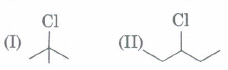
39.
What happens when ethyl chloride is treated with aqueous KOH
40.
What happens when CH3-Br is treated with KCN?
41.
Which would undergo S N2 reaction faster in the following pair and why?
\(CH_{ 3 }-CH_{ 3 }-Br-CH_{ 3 }-CH_{ 2 }-1\)
42.
Draw the structures of the following organic halogen compounds
(i) p-bromochlorobenzene
(ii)1-chloro-4-ethylcyclohexane
43.
Write the IUPAC name of
\(CICH_{ 2 }C\equiv CCH_{ 2 }Br\)
44.
Draw the structure of the following compound: 4-bromo-3-methylpent-2-ene.
45.
Draw the structure of the compound, l-chloro-4- ethylcyclohexane.
46.
Draw the structure of the compound, 4-tert-butyl-3-iodoheptane.
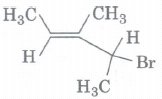
47.
Give the IUPAC name of the following compound:
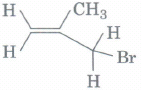
48.
Write the IUPAC name of the following compound
49.
Draw the structure of the following compound: 3-(4-chlorophenyl)-2-methyl propane
50.
Draw the structure of the following organic compound: 2-chloro-3-methylpentane.
51.
Draw the structure of the following compound: 1-bromo-4-sec-butyl- 2- methylbenzene
52.
Draw the structure of 2-(2-chlorophenyl)-1-iodooctane
53.
Draw the structure of 2-(2-bromophenyl) butane.
54.
Draw the structure of 1,4-dibromobut-2-ene
55.
Write the IUPAC name of the following compound:
\(CH_{ 3 }-\underset { \underset { Br }{ | } }{ CH } -CH_{ 2 }-\underset { \underset { CI }{ | } }{ CH } -CH_{ 3 }\)
56.
Write the IUPAC name of
\(CH_{ 3 }-\overset { \overset { CH_{ 3 } }{ | } }{ \underset { \underset { CH_{ 3 } }{ | } }{ C } } -\underset { \underset { CI }{ | } }{ CH } -CH_{ 3 }\)
57.
Write the IUPAC name of
\(CH_{ 3 }CH=CH-\overset { \overset { CH_{ 3 } }{ | } }{ \underset { \underset { Br }{ | } }{ C } } -CH_{ 3 }\)
58.
Write the IUPAC name of
\(CH_{ 3 }-\underset { \underset { CI }{ | } }{ CH } -CH_{ 2 }-C=CH_{ 2 }\)
59.
Write the IUPAC name of
(CH3)2CH· CH (Cl) CH3
60.
Draw the structure of 2-bromopentane.
61.
Write the structure of 3-Bromo-2-methylprop-l-ene
62.
Write the structure of I-bromo-4-chlorobut-2-ene.
63.
Out of .png) and
and .png) which is an example of allylic halide?
which is an example of allylic halide?
64.
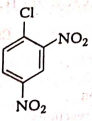
Write the structure of 2, 4-dinitrochlorobenzene.
65.
what happens when chlorobenzene is subjected to hydrolysis?
66.
Vinyl halide are inert towards both SN1 and SN2 reaction. Give reason.
67.
Bring out the following conversions.
(ii) Chlorobenzene to 2-chloroacetophenone
(iii) Chloroethane to butane
68.
Haloalkanes undergo nucleophilic substitution whereas haloarenes undergo electrophilic substitution. Explain.
69.
Give chemical tests to distinguish between the following pairs of compounds :
(i) Benzyl chloride and chlorobenzene
(ii) Chloroform and carbon tetrachloride
70.
What happpens when :
(i) CH3 -CI is treated with aqueous KOH?
(ii) CH3 -CI is treated with KCN?
(iii) CH3 -Br is treated with Mg in the presence of dry ether ?
71.
(i) Which alkyl halide from the following pair is chiral and undergoes faster \({ S }_{ N }^{ 2 }\) reaction?


(ii) Out of \({ S }_{ N }^{ 1 }\) and \({ S }_{ N }^{ 2 }\), which reaction occurs with
(a) Inversion of configuration
(b) Racemisation
72.
In the following pair of halogen compounds, which will react faster by \({ S }_{ N }^{ 1 }\) mechanism?
73.
How may methyl bromide be preferentially converted to methyl isocyanide?
74.
Which would undergo \({ S }_{ N }^{ 1 }\) reactions faster in the following pair :
CH3-CH2-CH2-Br and \({ CH }_{ 3 }-\underset { \overset { | }{ Br } }{ CH } -{ CH }_{ 3 }\)
75.
Amongst the isomeric alkanes of molecular formula C5H12 , identify the one that on photochemical chlorination yields a single monochloride.
76.
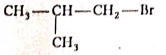
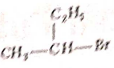
Out of \(CH_{ 3 }-\underset { \overset { | }{ { CH }_{ 3 } } }{ CH } -{ CH }_{ 2 }-CI\) and \({ CH }_{ 3 }-{ CH }_{ 2 }-\underset { \overset { | }{ { CH }_{ 3 } } }{ CH } -CI\) which one is more reactive towards SN1 reaction and why?
77.
Write the IUPAC name of the following :
78.
Give reasons:
(i) \(C-Cl\) bond length in chlorobenzene is shorter than \(C-Cl\) bond length in \({ CH }_{ 3 }-Cl\)
(ii) The dipole moment of chlorobenzene is lower than that of cyclohexyl chloride.
(iii) \({ S }_{ N }1\) reactions are accompanied by racemization in optically active alkyl halides.
79.
Explain as to why haloarenes are much less reactive than haloalkanes towards nucleophilic substitution reactions.
80.
Convert the following in not more than two steps:
(a) Propene to propyne
(b) Ethanol to but-1-yne
81.
Explain the following:
(i) Although haloalkanes are polar in character yet they are insoluble in water.
(ii) Chloroform is a chlorine compound, but it fails to react with \(\ AgN{ O }_{ 3 }\) solution.
82.
Write the structure of the major organic product in each of the following:
\((a)\ { \left( { CH }_{ 3 } \right) }_{ 3 }CBr+{ H }_{ 2 }O\ \overset { Heat }{ \longrightarrow } \)
\(\\ (ii) \mathrm{CH}_{3} \mathrm{CH}(\mathrm{Br}) \mathrm{CH}_{2} \mathrm{CH}_{3}+\mathrm{NaOH} \stackrel{\text { Water }}{\longrightarrow}\)
\(\\ (c)\ { CH }_{ 3 }{ CH }_{ 2 }Br+KCN\ \overset { aq.ethanol }{ \longrightarrow } \)
\(\begin{equation} \text { (iv) } \mathrm{C}_{6} \mathrm{H}_{5} \mathrm{ONa}+\mathrm{C}_{2} \mathrm{H}_{5} \mathrm{Cl} \longrightarrow \end{equation}\)
83.
What happens when \({ CH }_{ 3 }-Br\) is treated with KCN?
84.
The p-isomer of dichlorobenzene has higher melting point than o- and m-isomer.Why?
85.
Haloarenes are insoluble in water but are soluble in benzene. Explain.
86.
RCl is hydrolysed to ROH slowly but the reaction is rapid if catalytic amount of KI is added to the reaction mixture. Explain.
87.
Give one chemical test to distinguish between \({ C }_{ 2 }{ H }_{ 5 }Br\) and \({ C }_{ 2 }{ H }_{ 5 }Cl\) .
88.
Cyanide ion acts as an ambident nucleophile. From which end it acts as a stronger nucleophile in aqueous medium? Give reason for your answer.
89.
Predict the major product formed when HCl is added to isobutylene. Explain the mechanism involved.
90.
tert-Butyl bromide reacts with aq.NaOH by SN1 mechanism while n-butyl bromide reacts by SN2 mechanism. Why?
91.
How will you obtain monobromobenzene from aniline?
92.
Elimination reactions (especially \(\beta\)-elimination) are as common as the nucleophilic substitution reaction in case of alkyl halides. Specify the reagents used in both cases.
93.
Give at least one test which can distinguish between C2H5Br and C2H5CI.
94.
Explain the following :
(i) In nucleophilic aromatic substitution reactions,flurides are more reactive than chlorides while in aliphatic nucleophilic substitution reactions reverse is true.
(ii) Chlorobenzene forms Grignard reagent in THF but not in ether.
95.
Primary alkyl halide C4H9Br (A) reacted with alcholicKOH to give compound (B). Compound (B) is reacted will NBr to give (C) which is an isomer of (A). When (A) is reacted with Na metal , if gives a compound (D), C8H18 which is different from the compound formed when n-butyl bromide is reacted with sodium. Give the structural formula of (A) and write the equations for all the reactions.
96.
Wurtz reaction fails in case of tert-alkyl halides. Explain.
97.
Write all the streoisomers possible for the compound with M.F.C4H10O2. Which of these are are optically active and which are not? Give reasons.
98.
Optically active 2-iodobutane on treatment with Nal in acetone gives a product which of these are optical activity. Explain
99.
Difference between
(i) retention and inversion
(ii) enatiomers and diasteromers
100.
Which is a better nucleophile, a bromide ion or an iodide ion ?
101.
What happens when chlorine is passed through boilingtoluene in the presence of sunlight ?
102.
Which of the following has highest dipole moment ?
(i) CH2CI2
(ii) CHCI3
(iii) CCI4
103.
How will you prepare bromobenzene from aniline ?
104.
A hydrocarbon of molecular mass 72 g mol-1 gives a single monochloro derivate and two dichloro derivatives on photochlorination.Give the structure of the hydrocarbon.mono-and dichloroderivatives
105.
Write down the product formed when HBr adds to 3-methyl-1-butene.
106.
How will you bring about the conversion : methyl bromide to methyl iodide ?
107.
Name two alkenes that will yield 1-chloro-1methylcyclohexane by its reaction with HCI. Write the reactions involved.
108.
Why it is necessary to avoid even traces of moisture during the use of a Grignard reagent?
109.
Allyl chloride is hydrolysed more readily than n-propyl chloride. Why?
110.
What are the IUPAC names of the insecticide DDT and benzene hexachloride? Why is their use banned in india and other countries?
111.
Why can aryl halides not be prepared by reaction of phenol with HCl in the presence of ZnCl2?
112.
Write a test to detect the presence of double bond in a molecule.
113.
How do polar solvents help in the first step in SN1 mechanism?
114.
Write down the structure and IUPAC name for neopentyl bromide.
115.
Identify the products A and B formed in the following reaction:
CH3-CH2-CH=CH-CH3+HCl \(\longrightarrow\) A+B
116.
Write the structures and names of the compounds formed when compound 'A' with molecular formula, C7H8 is treated with Cl2 in the presence of FeCl3
117.
Name the alkene which will yield 1-Chloro-1-methylcyclohexane by its reaction with HCl. Write the reaction involved.
118.
Identify the products A and B formed in the following reaction:CH3-CH2-CH = CH-CH3+HCl \(\longrightarrow\) A+B
119.
Compound 'A' with molecular formula C4H9Br is treated with aq.KOH solution. The rate of this reaction depends upon the concentration of the compound 'A' only. When another optically active isomer 'B' of this compound was treated with aq.KOH solution, the rate of reaction was found to be dependent on concentration of compound and KOH both.
(i) Write down the structural formula o both compounds 'A' and 'B'
(ii) Out of these compounds which one will be converted to the product with inverted configuration.
120.
Discuss the role of Lewis acid in the preparation of aryl bromides and chlorides in the dark.
121.
Why iodoform has appreciable antiseptic property?
122.
Which of the compounds will react faster in SN1 reaction with the -OH ion?
CH3-CH2-Cl or C6H5-CH2-Cl
123.
Out of o-and p-dibromobenzene which one has higher melting point and why?
124.
p-Dichlorobenzene has higher m.p. than those of o- and m-isomers. Discuss.
125.
Out of C6H5CH2Cl and C6H5CHClC6H5 which is more easily hydrolysed by aqueous KOH?
126.
Explain the following reaction : n-BuBr+KCN \(\xrightarrow [ ]{EtOH-H_2O}\)n-BuCN
127.
Predict all the alkenes that would be formed by dehydrohalogenation of the following halides with sodium ethoxide in ethanol and identify the major alkene.
(i) 1-Bromo-1-methylcyclohexane
(ii) 2-chloro-2-methylbutane
(iii) 3-Bromo-2, 2,3-trimethylpentane.
128.
Write the equations for the preparation of 1-iodobutane from
(1) 1-butanol
(2) 1-Chlorobutane
(3) but-1-ene
129.
Write the isomers of the compound having formula C4H9Br.
130.
Name the following halides according to IUPAC system and classify them as alkyl, allyl, benzyl(primary, secondary,tertiary), vinyl or aryl halides.
(i) CH3CH=CHC(Br)(CH3)2
(ii) p-ClC6H4CH2CH(CH3)2
(iii) m-ClCH2C6H4CH2C(CH3)3
(iv) o-Br-C6H4CH(CH3)CH2CH3
131.
Name the following halides according to IUPAC system and classify them as alkyl, allyl, benzyl(primary, secondary,tertiary), vinyl or aryl halides.
(i) (CH3)2CHCH(Cl)CH3
(ii) CH3CH2CH(CH3)CH(C2H5)Cl
(iii) CH3CH2C(CH3)2CH2l
(iv) (CH3)3CCH2CH(Br)C6H5
132.
Haloalkanes react with KCN to form alkyl cyanides as main product while AgCN forms isocyanides as the chief product. Explain
133.
Identify all the possible monochloro structural isomers that would be expected to form on free radical chlorination of (CH3)2CHCH2CH3
134.
p-Chloronitrobenzene undergoes nucleophilic substitution faster than chlorobenzene. Explain giving the resonating structures as well.
135.
Out of Various possible isomers of C7H7Cl containing a benzene ring. suggest the structure with the weakest C-Cl bond.
136.
(\(\pm\))-2-Butanol is optically inactive. Give reasons.
137.
Difference between retention and inversion.
138.
Distinguish between enantiomers and diastereomers.
139.
What are enantiomers? Draw the structure o the possible enantiomers of 3-methylpent-1-ene.
140.
What is meant by chirality of a compound. Give one example.
141.
Identify and indicate the presence of centre of chirality, if any, in the following molecules? How many stereoisomers are possible for each.
(i) 2-Aminobutane
(ii) 3-Bromopent-1-ene
(iii) 1,2-Dichloropropene
(iv) 3-Methyl-1-pentene
142.
Difference between chiral and achiral molecules.
143.
An alkyl chloride (X)reacts with magnesium metal in presence of dry ether followed by treatment of ethanol gives propane. Write the structure of the alkyl halide (X).
144.
An alkyl halide (A), on reaction with magnesium in dry ether followed by treatment with ethonal gave 2-methylbutane. Write all the possible structures of A.
145.
Arrange the following halides in order of increasing SN2 reactivity:
CH3Cl, CH3Br, CH3CH2Cl, (CH3)2CHCl
146.
What will the major organic product of the following reaction?
\({ C }_{ 2 }{ H }_{ 5 }{ C }_{ 2 }{ H }_{ 5 }\overset { (i)Br_{ 2 },hv }{ \underset { (ii)NaCN }{ \longrightarrow } } \)
147.
CHF3 is less acidic than CHCl3. Explain
148.
Complete the following reaction.
\({ CH }_{ 3 }-CH={ CH }_{ 2 }\overset { HBr }{ \underset { peroxide }{ \longrightarrow } } X\overset { Nal }{ \underset { Acetone }{ \longrightarrow } } Y\)
149.
Iodoform has antiseptic properties. Give one reason to support it.
150.
What effect should be following resonance of vinyl chloride have on its dipole moment?
151.
(i) CH3CH2I \(\overset { NaCN }{ \longrightarrow } \ ?\ \overset { OH^{ - },\ partial\ hydrolysis }{ \longrightarrow } \)?
(ii) CH3CH2Br
152.
The boiling points of alkyl halides are higher than those of corresponding alkenes because of ..........
153.
Racemic mixture is optically inactive. Give reason.
154.
What is known as a racemic mixture? Give one example.
155.
What do prefixes (+),(-) and \((\pm )\) before an organic compound mean ?
156.
What is the condition to be satisfied for a compound to be chiral?
157.
What is plane polarized light ?
158.
Arrange the following in order of their increasing reactivity in nucleophilic substitution reactions
CH3F, CH3I, CH3Br, CH3CI.
159.
Which is a better nucleophile, a bromide ion or an idodide ion ?
160.
Organic halogon compounds used in industry as solvents are chlorides rather than bromides and iodides. Explain
161.
Which alkyl halide has the highest density and why ?
162.
Out of ethyl bromide and ethyl chloride which has higher boiling point and why ?
163.
Arrange the following in order of increasing boiling point :
(i) CH3CH2CH2CH2Br
(ii) (CH3)3CBr
(iii) (CH3)2CHCH2Br.
164.
How will you obtain 1-bropropane from propane ?
165.
Explain why thionyl chloride method is preferred for preparing alkyl chlorides from alcols?
166.
Suggest a possible reason for the following observations:
(i) The order of reactivity of haloalkanes is RI > RCI > RBr.
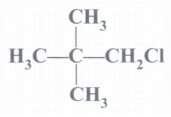
(ii) Neopentyl chloride (CH3)3CCH2CI does not follow SN2 mechanism.
(iii) Ethers have low boiling points.
167.
Discuss the nature of C-X bond in the haloarenes.
168.
tert-Butylbromides reacts with aq. NaOH by SN1 mechanism while n-butylbromide reacts by SN2 mechanism. Why?
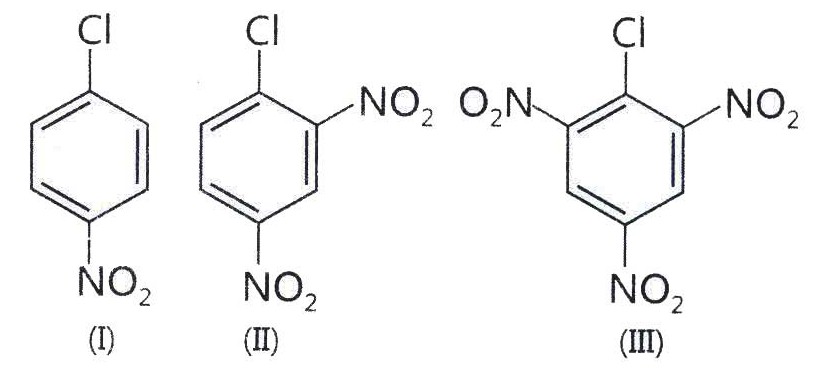
169.
Aryl halides are extremely less reactive towards nucleophilic substitution. Predict and explain the order of reactivity of the following compounds towards nucleophilic substitution:
170.
What are the IUPAC names of the insecticide DDT and banned in India and other countries?
171.
Diphenyls are potential threat to the environment. How are these produced from aryl halides?
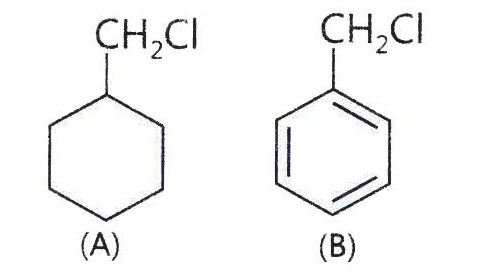
172.
Which of the following compounds would undergo SN1 reaction faster and why?
173.
Which of the following haloalkanes reacts with aqueous KOH most easily? Explain giving reason.
(i) 1-Bromobutane
(ii) 2-Bromobutane
(iii) 2-Bromo-2-methylpropane
(iv) 2-Chlorobutane
174.
Draw other resonance structures
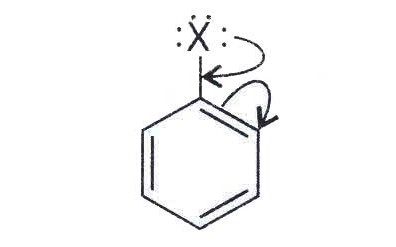
related to the following structure and find out whether the functional group present in the molecule is ortho, para directing or meta directing.
175.
Which of the products will be major product in the reaction given below? Explain.
\(CH_3CH=CH_2+HI \to \underset{'A'}{CH_3CH_2CH_2I} + \underset{'B'}{CH_3CHICH_3}\)
176.
Which of the following compounds(a) and (b) will not react with a mixture of NaBr and H2SO4. Explain why?

177.
Discuss the role of Lewis acids in the preparation of aryl bromides and chlorides in the dark.
178.
Haloarenes are less reactive than haloalkanes and haloalkenes. Explain.
179.
Aryl chlorides and bromides can be easily prepared by electrophilic substitution of arenes with chlorine and bromine respectively in the presence of Lewis acid catalysts. But why does preparation of aryl iodides requires presence of an oxidising agent?
180.
The treatment of alkyl chlorides with aqueous KOH lead to the formation of alcohols but in presence of alcoholic KOH alkenes are major products. Explain.
181.
Give the uses of Freon-12, DDT.
182.
Write the structure of the following organic halogen compounds:
(a) 2-Bromobutane
(b) 4-tert-Butyl-3-iodoheptane
(c) 1-Bromo-4-sec-buty1-2-methyl benzene
(d) 1, 4-Dibromobut-2-ene.
183.
Write the structure of the following organic halogen compounds:
(a) 2-Chloro-3-methylpentane
(b) p-Bromochlorobenzene
(c) 1- Chlore-4-ethylcyclohexane
(d) 2-(2-Chlorophenyl)-1-iodooctane
184.
Draw the structures of optically active unsaturated compound having molecular formula C5H9Br, that after addition of H2 becomes either optically inactive or shows optical activity.
185.
How will you bring about the following conversions?
(a) Bromoethane to cis-hex-3-ene
(b) Benzyl alcohol to phenylethanenitrile
(c) Cyclopentene to cyclopenta-1, 3-diene
(d) Aniline to phenyl isocyanide.
186.
Arrange the following compounds according to reactivity towards nucleophilic substitution reaction with reagents mentioned:
(i) 4-nitrochlorobenzene; 2, 4-dinitrochloro-benzene and 2, 4, 6-trinitrochlobenzene with CH3ONa
(ii) Chlorobenzene, 4-chloro-1-methyl-benzene, 4-nitrochlorobenzene and 2, 4, 6-trinitro-chlorobenzene with caustic alkali.
187.
Convert:
(i) Benzene to p-nitrochlorobenzene
(ii) Benzene to aniline
(iii) Benzene to m-nitrochlorobenzene
(iv) Benzene to diphenyl
(v) Benzene to p-chlorotoluene
(vi) Chlorobenzene to DDT
(vii) Chlorobenzene to phenyl cyanide
(viii) Benzene diazonium chloride to aniline.
188.
Why are haloarenes more stable than haloalkanes and undergo electrophilic substitution reaction at ortho and para positions?
189.
Write the structural formulae of the organic compounds 'A', 'B', 'C' and 'D' in the following sequence of reaction
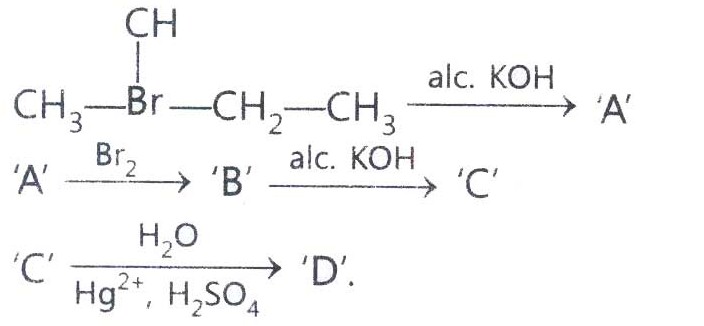
190.
Identify the compounds A, B, C and D in the following sequence of reaction:
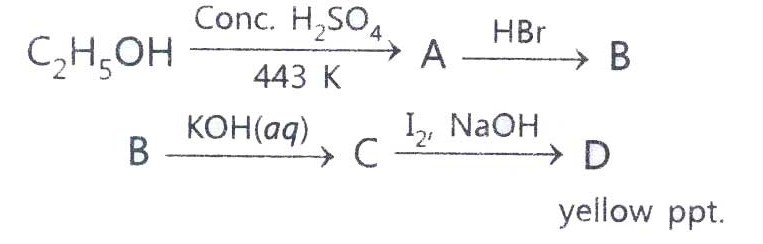
191.
In the following pairs of halogen compounds, which compound undergoes faster SN1 reaction?

192.
(i) Why is it that haloalkanes are more reactive than haloarenes towards nucleophiles?
193.
Complete the following reaction equations:
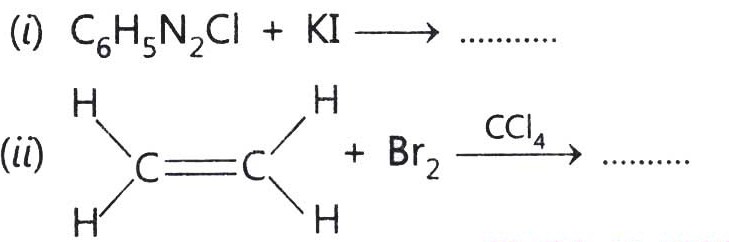
194.
Which compound in each of the following pairs will react faste in SN2 reaction with OH-?
(a) CH3Br or CH3I
(b) (CH3)3CCl or CH3Cl
195.
Which one in the following pairs undergoes SN1 substitution reaction faster and why?
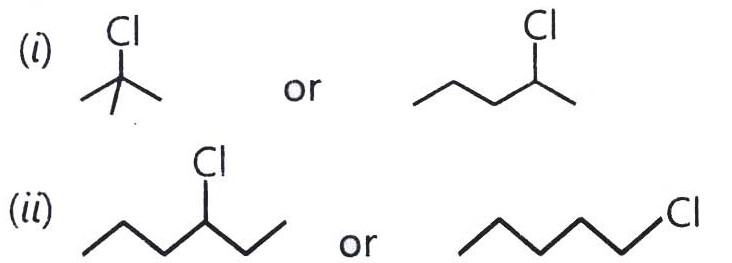
196.
Which one in the following pairs of substances undergoes SN2 substitution reaction faster and why
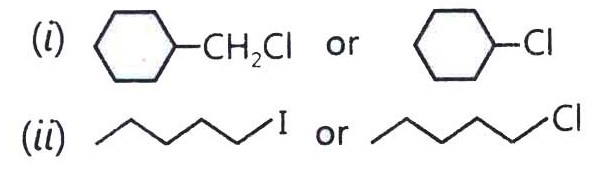
197.
Suggest a possible mechanism for the following reaction:
\(n-BuBr + KCN \xrightarrow{EtOH_2,\ H_2O} n-BuCN\)
198.
What are ambident nucleophiles? Explain with an example.
199.
Answer the following questions:
(i) What is meant by chirality of a compound? Give an example.
(ii) Which one of the following compounds is more easily hydrolyzed by KOH and why?
\(CH_3CHClCH_2CH_3\) or \(CH_3CH_2CH_2Cl\)
200.
Write down the structure and IUPAC name for neo-pentylbromide.
201.
Which of the following compounds will have the highest melting point and why?
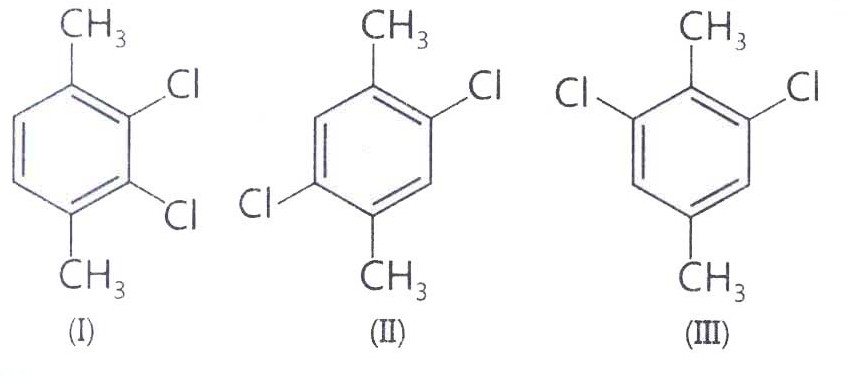
202.
Explain why the following pairs of compound do not show optical activity.
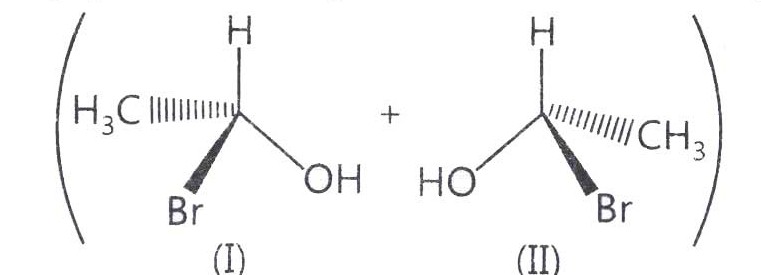
a 1 : 1 mixture of I and II.
203.
P-Dichlorobenzene has higher m.pt. and solubility than those of o- and m-isomers. Discuss.
204.
A hydrocarbon \(C_5H_{12}\) gives only one mono-chlorinated product. Identify the hydrocarbon.
205.
Write a chemical reaction in which iodideion displaces diazonium group from a diazonium salt.
206.
Complete the following chemical equation:
\(H_3CCH_CH=CH_2+HBr \xrightarrow {peroxide} .......\)
\(\)
207.
Write the structure of the compound:
1-chloro-4-ethylcyclohexane.
208.
Write the IUPAC name of the following compound:
209.
Write the structure of the compound: 4-tert. Butyl-3-iodoheptane.
210.
A solution of KOH hydrolyses CH3 CHCICH2CH3 and CH3CH2CH2CH2Cl. Which one of these is more easily hydrolysed?
211.
Write the structure of the following compound: 3-(4-chlorophenyl)-2-methylpropane.
212.
Write the structure of the following compound: 1, 4-dibromobut-2-ene.
213.
Write structure of the compound:
2-chorle-3-methylpentane.
214.
Write the structure of the following compound:
1-bromo-4-sec-butyl-2methylbenzene.
215.
Which will react faster in SN2 displacement, 1-bromopentane or 2-bromopentane, and why?
216.
Write the IUPAC name of the following compound: \(CH_2 = CHCH_2 Br\)
217.
Write the IUPAC name of the following compound: \((CH_3)_3CCH_2Br\)
218.
Give the IUPAC name of the following compound
\(CH_{2} = C - CH_2Br\\ \ \ \ \ \ \ \ \ \ \ \ \ \ \ |\\ \ \ \ \ \ \ \ \ \ \ \ \ \ CH_3\) or

219.
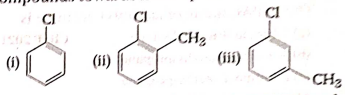
Which of the following is the correct increasing order for the rate of reaction of the given compounds towards nucleophilic substitution?
(i) < (ii) < (iii)
(i) < (iii) < (ii)
(iii) < (ii) < (i)
(ii) < (iii) < (i)
220.
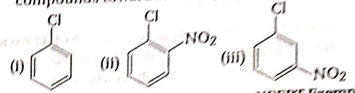
Which of the following is the correct increasing order for the rate of reaction of the given compounds towards nucleophilic substitution?
(i) < (ii) < (iii)
(iii) < (ii) < (i)
(i) < (iii) < (ii)
(iii) < (i) < (ii)
221.
Which of the following compounds undergoes racemisation on hydrolysis with aqueous KOH?
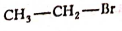
CH2 - Br
222.
Which reagent is required for one step conversion of benzene diazonium chloride to bromobenzene?
PBr3
HBr
Cu2Br2
Br2
223.
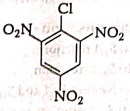
Which of the following is most reactive towards nucleophilic substitution reaction?


224.
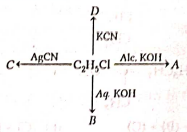
Identify A, B, C and D




225.
The reaction of toluene with Cl2 in presence of FeCl, gives "X", while the reaction of toluene with , in presence of light gives 'Y'. Thus, 'X' and 'Y' are
X = benzyl chloride Y = o and p-chlorotoluene
X = m-chlorotoluene Y = p-chlorotoluene
X = o and p-chlorotoluene Y = trichloromethylbenzene
X = benzyl chloride, Y = m-chlorotoluene
226.
Reaction of 1-phenyl-2-chloropropane with alcoholic KOH gives mainly
1-phenylpropene
3-phenylpropene
1-phenylpropan-3-ol
1-phenylpropan-2-ol
227.
Complete the following analogy. Same molecular formula but different structures: A:: Non-superimposable mirror Images: B
A: Isomers; B : Enantiomer
A: Enantiomers; B: Racemic mixture
A: Stereoisomers; B: Retention
A: Isomers; B: Stereoisomers
228.
Racemisation occurs in
SN1 reaction
SN2 reaction
Neither SN1 and SN2 reaction
SN2 reaction as well as SN1 reactions
229.
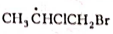
Which of the following molecules has a chiral centre correctly labelled with as asterisk (*)?



230.
Which reagents are required for one step conversion of chlorobenzene to toluene?
CH3Cl/AlCl3
CH3Cl Na, Dry ether
CH3Cl/Fe, Dark
NaNO₂/HCI/0-5°C
231.
Which of the following isomer has the highest melting point?
1,2-dichlorobenzene
1,3-dichlorobenzene
1, 4-dichlorobenzene
All isomers have same melting points
232.
Alkenes decolourise bromine water in presence of CCl4 due to formation of
allyl bromide
vinyl bromide
bromoform
vicinal dibromide
233.
The IUPAC name of iso-butyl bromide is ______.
1-bromo-3-methylbutane
3-bromo-2-methylpropane
2-bromo-2-methylpropane
1-bromo-2-methylpropane
234.
In which of the following molecules, C atom marked with asterisk is chiral?
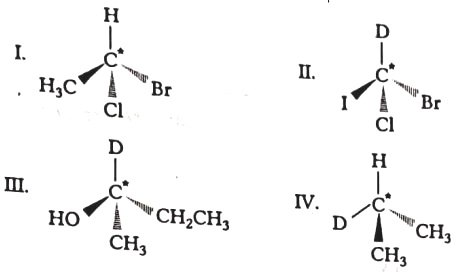
I, II, III
I, II, III, IV
II, III, IV
I, III, IV
235.
Out of the following alkenes, the one which will produce tertiary butyl alcohol on acid catalysed hydration is
CH3CH2CH = CH2
CH3CH = CH2
CH3 - CH = CH - CH3
(CH3)2C = CH2
236.
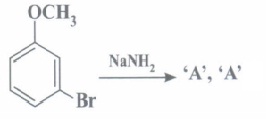
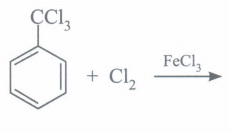 'A', 'A' is
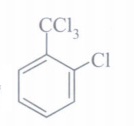
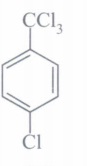
Both (a) and (b)
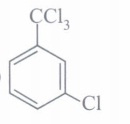
237.
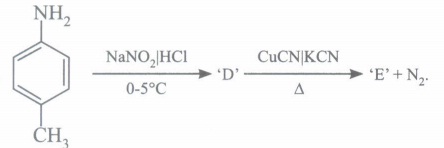
The product 'E' is
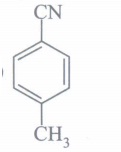
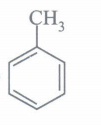
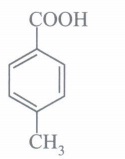
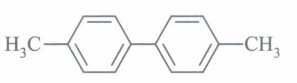
238.
Toluene reacts with Br2 in presence of sunlight to give
o-Bromo toluene
p-bromo toluene
Benzyl bromide
All of these
239.
3-methyl pent-2-ene on reaction with HBr in presence of peroxide forms an addition product. The number of possible stereoisomers for the product are
6
0
2
4
240.
Which of the following structures is enantiomeric with the molecule (A) given below:
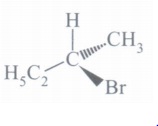
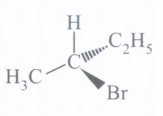
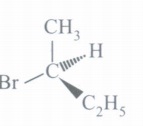
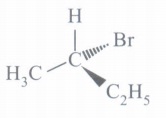
241.
The order of reactivity of alcohols with halogen acids follows
1° > 2° > 3°
2° > 1° > 3°
3° > 1° > 2°
3° > 2° > 1°
242.
 'Y', Y is
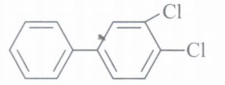
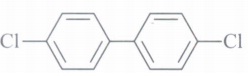
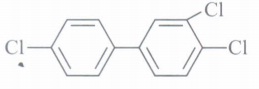
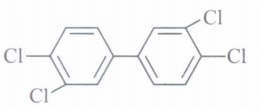
243.
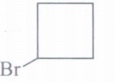
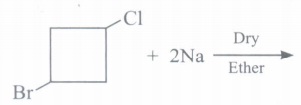 'X', X is


244.
Which of the following statements are correct about the kinetics of this reaction?
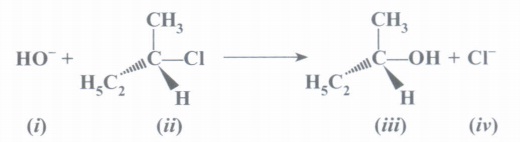
The rate of reaction depends on the concentration of only (ii).
The rate of reaction depends on concentration of both (i) and (ii).
Molecularity of reaction is one
Molecularity of reaction is two.
245.
Which of the following statements are correct about the mechanism of this reaction?
A carbocation will be formed as an intermediate in the reaction.
OH- will attach the substrate (ii) from one side and CI- will leave it simultaneously from other side.
An unstable intermediate will be formed in which OH- and Cl- will be attached by weak bonds.
(d) Reaction proceeds through SN1 mechanism
246.
Which of the following statements are correct about the reaction intermediate?
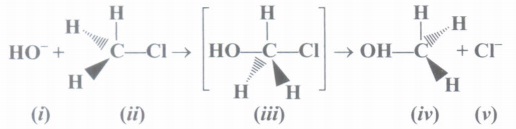
Intermediate (iii) is unstable because in this carbon is attached to 5 atoms
Intermediate (iii) is unstable because carbon atom is Sp2 hybridised.
Intermediate (iii) is stable because carbon atom is Sp2 hybridised.
Intermediate (iii) is less stable than the reactant (ii).
247.
Which of the following statements are correct about this reaction?
The given reaction follows SN2 mechanism
(ii) and (iv) have opposite configuration.
(ii) and (iv) have same configuration.
The given reaction follows SN1 mechanism.
248.
Which of the statements are correct about above reaction?
(i) and (v) both are nucleophiles.
In (iii) carbon atom is Sp3 hybridised.
In (iii) carbon atom is Sp2 hybridised.
(i) and (v) both are electrophiles.
249.
The increasing order of reactivity towards SN1 mechanism is
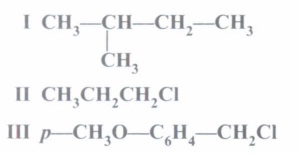
III < II < I
II< I< III
I < III < II
II< III < I
250.
The synthesis of alkyl fluoride is best accomplished by
Finkelstein reaction
Swartz reaction
Free radical flilorination
Sandmeyers reaction
251.
A dihalogen derivative 'X' of a hydrocarbon with three carbon atoms react with ale. KOH and produces hydrocarbon which forms red ppt. with ammonical Cu2Cl2. 'X' gives an aldehyde on reaction with aq. KOH. The compound 'X' is
1,3-Dichloropropane
1, 2-Dichloropropane
2, 2-Dichloropropane
1, 1-Dichloropropane
252.
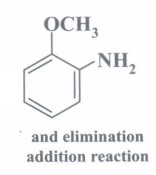
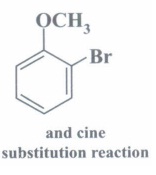
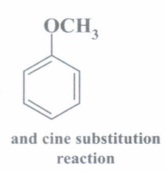
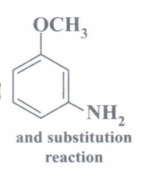
253.
\(\mathrm{CH}_{3} \mathrm{CH}_{2} \mathrm{CH}_{2} \mathrm{Br}+\mathrm{NaCN} \rightarrow \mathrm{CH}_{3} \mathrm{CH}_{2} \mathrm{CH}_{2} \mathrm{CN}+\mathrm{NaBr}\) will be fastest in
ethanol
methanol
N, N dimethyl formamide
Water
254.
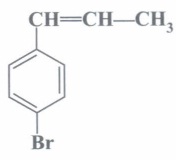
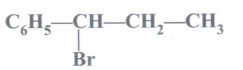
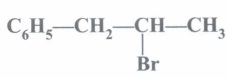
The reaction of \(\mathrm{C}_{6} \mathrm{H}_{5}-\mathrm{CH}=\mathrm{CH}-\mathrm{CH}_{3}\) with HBr produces
C6H5CH2CH2CH2Br
255.
Which of the following compound will undergo racemisation when reacts with aq. KOH?
(i) and (ii)
(ii) and (iv)
(iii) and (iv)
(iv)
256.
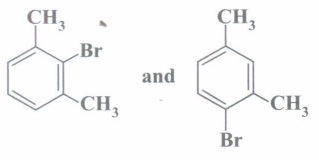
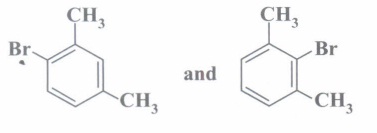
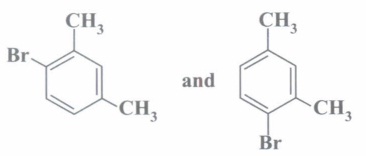
m-Xylene reacts with Br2 in presence of FeBr3 , what are products formed
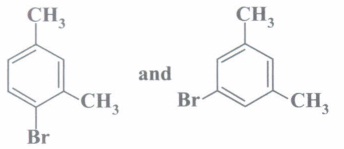
257.
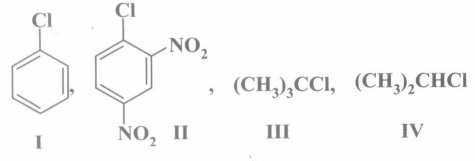
The correct order of increasing the reactivity of C-X bond towards nucleophile in following compounds
IV < III < I< II
III < II< I < IV
I< II< IV < III
II< III < I< IV
258.
Which of the following is most reactive towards SN1 reaction?
C6H5C(CH3)C6H5Br
C6H5CH2Br
C6H5CH(C6HS)Br
C6H5CH(CH3)Br
259.
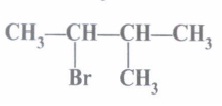
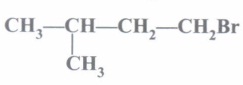
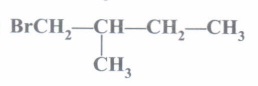
260.
The increasing order of nucleophilicity would be
Cl- < Br- < I-
I - < CI- < Br-
Br- < CI- < F-
I- < Br- < CI-
261.
Which of the following undergoes nucleophilic substitution exclusively by SN1 mechanism?
Benzyl chloride
Ethyl chloride
Chlorobenzene
Isopropyl chloride
262.
Aryl halide are extremely less reactive towards nucleophilic substitution reaction due to
resonance effect
unstability of phenyl cation
repulsion between ㅠ-cloud of benzene ring and incoming nucleophile.
All of the above
263.
Which of the following molecules is achiral?
2-chlorobutane
2,2-dichlorobutane
Bromochloroiodomethane
2-bromobutane
264.
Which of the following would undergo SN2 reaction faster?


265.
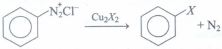
Which of the following do/does not match the equation?
X = Cl
X = Br
X = I
Both (a) and (b)
266.
The IUPAC name of
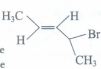
2-bromopent-4-ene
2-bromopent-3-ene
4-bromopent-2-ene
4-bromopent-l-ene
267.
IUPAC name of DDT is
1,1-bis (4-chlorophenyl)-2,2,2-tricWoroethane
1,2-bis (4-cWorophenyl)-1,1,1-trichloroethane
2,2-bis (4-chlorophenyl)-1, 1,1-trichloroethane
2,I-bis (4--chlorophenyl)-1,1,tricchloroethane
268.
Freons, hydrofluorocarbons and fluorocarbons are stable in the stratosphere which are used in
aerosol propellants
air conditioning equipments
refrigeration
All of the above
269.
When freon is manufactured by tetrachloromethane, the reaction involved in this process is called
Sandmeyer reaction
Swarts reaction
Finkelstein reaction
All of these
270.
Which of the following effects is/are caused by exposure to CCI4?
Liver cancer in human
Damage to nerve cells
Coma, unconsciousness
All of the above
271.
Choose the incorrect statement among the following:
In polyhalogen compounds, more than one halogen atom is present
Dichloromethane is used as paint remover
Chloroform is used as an anaesthetic in surgery
Chloroform is also used as paint remover
272.
Which one does not give iodoform test?
Ethanol
Benzophenone
Ethanal
Acetophenone
273.
With which mixture carbylamine test is performed in the presence of alc. KOH?
Chloroform and silver powder
Tri halogenated methane and one primary amine
One alkyl halide and one 10 amine
One alkyl cyanide and one 10 amine
274.
Chloroform is slowly oxidised by air in the presence of light to form.
phosgene
formic acid
formyl chloride
methyl chloride
275.
What of the following is formed? When chloroform reacts with concentrated nitric acid?
CHCl3NO2
C(NO2)CI3
CCl3CNO2
CHCl2NO2
276.
Chloroform can be obtained from
methanol
methanal
propanol-1
propan-2-ol
277.
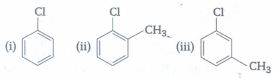
(i) < (ii) < (iii)
(i) < (iii) < (ii)
(iii) < (ii) < (i)
(ii) < (iii) < (i)
278.
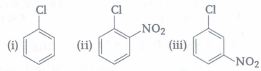
(i) < (ii) < (iii)
(iii) < (ii) < (i)
(i) < (iii) < (ii)
(iii) < (i) < (ii)
279.
Which of the carbon atoms present in the molecule given below are asymmetric?
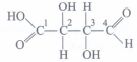
1, 2, 3, 4
2, 3
1,4
1, 2, 3
280.
In which of the following molecules carbon atom marked with asterisk (*) is asymmetric?
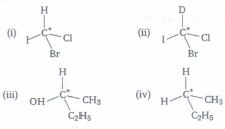
(i), (ii), (iii) and (iv)
(i), (ii) and (iii)
(ii), (iii) and (iv)
(i), (iii) and (iv)
281.
Which of the following compounds will give racemic mixture on nucleophilic substitution by OH- ion?
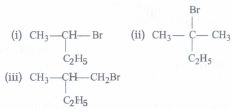
(i)
(i), (ii) and (iii)
(ii) and (iii)
(i) and (iii)
282.
Arrange the following compounds in the increasing order of their densities.
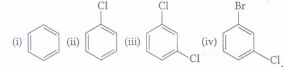
(i) < (ii) < (iii) < (iv)
(i) < (iii) < (iv) < (ii)
(iv) < (iii) < (ii) < (i)
(ii) < (iv) < (iii) < (i)
283.
Arrange the following compounds in increasing order of their boiling points.
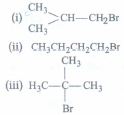
(ii) < (i) < (iii)
(i) < (ii) < (iii)
(iii) < (i) < (ii)
(iii) < (ii) < (i)
284.
Identify the compound Y in the following reaction.
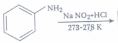
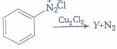


285.
The reaction of toluene with chlorine in the presence of iron and in the absence of light yields ___________.


Mixture of (b) and (c)
286.
Which of the following is halogen exchange reaction?
RX + NaI ⟶ RI + NaX
\(C=C+HX\to \underset{\overset{|}{H}}{C-}\underset{\overset{|}{H}}{C}\)
\(R-\mathrm{OH}+\mathrm{HX} \stackrel{\mathrm{ZnCl}_{2}}{\longrightarrow} R-X+\mathrm{H}_{2} \mathrm{O}\)

287.
Select the by-product formed in the reaction,
ROH+ PCl5 ⇢ RCI + A
Here A is
POCI3 + HCI
H3PO3 + No other by-product
H3PO3 + HCI
POCI3 +No other by-product
288.
What is 'A' in the following reaction?
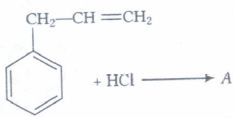
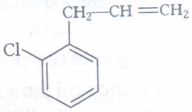
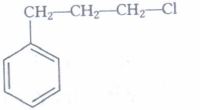
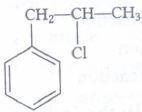
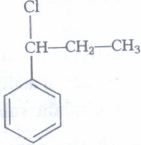
289.
The order of reactivity of following alcohols with halogen acids is____________
(a) CH3-CH2-CH2-OH
(b)\(C{H}_{\mathit{3}}C{H}_{\mathit{2}}\mathit{-}\underset{\overset{\mathit{|}}{C{H}_{3}}}{CH}\mathit{-}OH\)
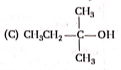
(A) > (B) > (C)
(C) > (B) > (A)
(B) > (A) > (C)
(A) > (C) > (B)
290.
Which of the following alcohols will yield the corresponding alkyl chloride on reaction with concentrated HCI at room temperature?
CH3CH2- CH2- OH
\(C{H}_{\mathit{3}}C{H}_{\mathit{2}}\mathit{-}\underset{\overset{\mathit{|}}{C{H}_{3}}}{CH}\mathit{-}OH\)
\(C{H}_{\mathit{3}}C{H}_{\mathit{2}}\mathit{-}\underset{\overset{\mathit{|}}{C{H}_{3}}}{CH}\mathit{-}C{H}_{\mathit{2}}OH\)
\(C{H}_{\mathit{3}}C{H}_{\mathit{2}}\mathit{-}\underset{\overset{\mathit{|}}{C{H}_{3}}}{\overset{\underset{\mathit{|}}{C{H}_{\mathit{3}}}}{C}}\mathit{-}OH\)
291.
Carbon-halogen bond is polarised because
halogen atom is less electronegative
halogen atom is more electronegative than carbon atom
carbon bears negative charge while halogen bears positive charge
None of the above
292.
Possible number of isomers of C3H6C12 compound are
2
4
6
8
293.
The common and IUPAC names of the
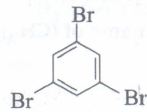
compound respectively are
sym-tribromobenzene and 1, 2, 5 tribromobenzene
sym-tribromobenzene and 1, 3, 5-tribromobenzene
0, m, p-tribromobenzene and 1, 3, 5-tribromobenzene
None of the above
294.
What should be the correct IUPAC name for diethylbromomethane?
1 -bromo-1, 1-diethylmethane
3-bromopentane
1-bromo-1-ethylpropane
1-bromopentane
295.
Which is the correct IUPAC name for
\(C{H}_{\mathit{3}}\mathit{-}\underset{\overset{\mathit{|}}{{C}_{\mathit{2}}{H}_{5}}}{CH}-C{H}_{2}-Br\)
1-bromo-2-ethylpropane
1-bromo-2-ethyl-2-methylethane
1-bromo-2-methylbutane
2-methyl-1-bromobutane
296.
Ethylidene chloride is a / an ____________
vic-dihalide
gem-dihalide
allylic halide
vinylic halide
297.
The position of Br in the compound CH3CH= CHC(Br)(CH3)2 can be classified as ___________.
allyl
aryl
vinyl
secondary
298.
The reagents used in the preparation DDT from chlorobenzene are
Chloral (CCI3CHO)
Conc.II2SO4
CH3COCCI3
CH2CICOCH2CI
299.
The reagents which cannot be used to distinguish benzyl chloride from chlorobenzene are
Br2/CCI4
Shaking with an aqueous solution of AgNO3
Boiling with aqueous KOH solution followed by acidification with dil.dil. NHO3 and addition of AgNO3 solution.
Fusion with sodium metal followed by acidification with dil.HNO3 and addition of AgNO3 solution.
300.
Which of the following compound/s on halo-generation give a racemic mixture of products ?
(CH3)4C
CH3CH2CH2CH3
CH3CH2CH3
CH3CH3
301.
Which of the following easily undergo nucleophilic substitution by SN1 mechanism in butanol ?
C6H5CH2Br
BrCH2CH = CH2
(CH3)3CBr
(CH3)3CCH2Br
302.
Which of the following methods cannot be used to prepare allyl fluride ?
CICH2CH = CH2 \(\xrightarrow { NaF,acetone } \)
CH3CH = CH2 + F2 \(\xrightarrow { hv } \)
HOCH2CH = CH2 \(\xrightarrow { HF } \)
CICH2CH = CH2+AgF \(\longrightarrow \)
303.
Which of the following reactions is most suitable for the preparation of n-propylbenzene ?
Fridel-Crafts alkylation
Wurtz reaction
Wurtz-Fitting reaction
Grignard reaction
304.
Bottles containing C6H5I and C6H5CH2I lost their original labels. They were labelled as A and B for testing. A and B were separately taken in test tubes and boiled with NaOH solution. The end solution in each tube was made acidic with dilute HNO3 and some AgNO3 solution was added. Substance B gave a yellow precipitate. Which one of the following statements is true for this experiment?
Addition of HNO3 was unnecessary
A was C6H5I
A was C6H5CH2I
B was C6H5I
305.
How many stereoisomers does this molecule have ? CH3CH = CHCH2CHB2CHBrCH3
8
2
4
6
306.
Out of the following the alkene that exhibits optical isomerism is
3-methyl-1-pentene
2-methyl-2-pentene
3-methyl-2-pentene
4-methyl-1-pentene
307.
How many chiral compounds are possible on monochlorination of 2-methylbutane ?
2
4
6
8
308.
Cycloalkane formed when 1,4-dibromopentane is heated with sodium is
methylcyclobutane
cyclopentane
cyclobutane
methylcyclopentane
309.
An alkyl bromide (X) reacts with sodium in ether to form 4,5-diethyloctane, the compound (X) is
CH3(CH2)3Br
CH3(CH2)5Br
CH3(CH2)3CH(Br)CH3
CH3__(CH2)2__CH(Br)__CH2CH3
310.
The products expected to be formed is the Wurtz reaction of a mixture of neopenty bromide and isobutyl bromide are
(i) 2,2,4-trimathylpentane
(ii) 2,2,5,5-tertramethylhexane
(iii) 2,2,4,4-tetramethylhexane
(iv) 2,5-dimethylthexane
(v) 2,2,5-trimethylhexane
(ii), (iii) and (v)
(ii), (iv) and (v)
(ii), (iv) and (v)
(ii), (iii) and (v)
(i), (ii) and (iv)
311.
(CH3)3CMgBr on reaction with D2O produces
(CH3)3CD
(CH3)3COD
(CD3)3CD
(CD3)3OD
312.
In the following reaction,
C6H5CH2Br \(\xrightarrow [ (ii){ H }_{ 3 }{ O }^{ + } ]{ (i)Mg,ether } \)
the product 'X' is
C6H5CH2OCH2C6H5
C6H5CH2OH
C6H5CH3
C6H5CH2CH2C6H5
313.
An alkyl bromide produces a single alkene when it reacts with sodium ethoxide and ethanol. THis alkene on hydrogenation produces 2-methylbutane. What is the identity of the alkyl halide ?
1-Bromo-2,2-dimethylpropane
1-Bromobutane
1-Bromo-2-methylbutane
2-Bromo-2-methylbutane
2-Bromopentane
314.
The major product obtained on treatment of CH3CH2CH(F)CH3 with CH3O-/CH3OH is
CH3CH2CH(OCH3)CH3
CH3CH = CHCH3
CH3CH2CH = CH2
CH3CH2CH2CH2OCH3
315.
The case of dehydrohalogenation of alkyl halides with alcholic KOH is
3o < 2o < 1o
3o > 2o > 1o
3o < 2o > 1o
3o > 2o < 1o
316.
Alkyl fluorides are synthesised by heating an alkyl chloride/bromide in presence of ............. or ..............
CaF2
CoF2
Hg2F2
NaF
317.
Alkyl halides are prepared from alcohols by treating with
HCl+ZnCl2
Red P+Br2
H2SO4+KI
All the above
318.
Which of the following compounds can be classified as aryl halides?
p-ClC6H4CH2CH(CH3)2
p-CH3CHCl(C6H4)CH2CH3
o-BrH2C-C6H4CH(CH3)CH2CH3
C6H5-Cl
319.
Which of the following are secondary bromides?
(CH3)2CHBr
(CH3)3CCH2Br
CH3CH(Br)CH2CH3
(CH3)2CBrCH2CH3
320.
Which of the following compounds are gem-dihalides?
Ethylidene chloride
Ethylene dichloride
Methylene chloride
Bezyl chloride
321.
Ethylene chloride and ethylidene chloride are isomers. Identify the correct statements.
Both the compounds form same product on treatment with alcoholic KOH
Both the compounds form same product on treatment with alcoholic KOH
Both the compounds form same product on reduction
Both the compounds are optically active
322.
Haloalkanes contain halogen atom (s) attached to the sp3 hybridised carbon atom of an alkyl group. Identify haloalkane from the following compounds.
2-Bromopentane
Vinyl chloride (Chloroethene)
2-Chloroacetophenone
Trichloromethane
323.
Which is the correct increasing order of boiling points of the following compounds?
1-Bromoethane, 1-Bromopropane,
Bromobenzene <1-Bromobutane < 1-Bromopropane < 1-Bromoethane
Bromobenzene <1-Bromobutane < 1-Bromopropane < 1-Bromobutane
1-Bromopropane < 1-Bromobutane < 1-Bromoethane < Bromobenzene
1-Bromoethane < 1-Bromopropane <1-Bromobutane < Bromobenzene
324.
Which is the correct increasing order of boiling points of the following compounds?
1-Iodobutane, 1-Bromobutane,
1-Chlorobutane, Butane
Butane < 1-Chlorobutane < 1-Bromobutane < 1-IOdobutane
1-Iodobutane < 1-Bromobutane < 1-Chlorobuane < Butane
Butane < 1-Iodobutane < 1-Bromobutane < 1-Chlorobutane
Butane < 1-Chlorobutane < 1-Iodobutane < 1-Bromobutane
325.
Reaction of C6H5CH2Br with aqueous sodium hydroxide follows...........
SN1 mechanism
SN2 mechanism
Any of the above two depending upon the temperature of reaction
Saytzef rule
326.
Molecules whose mirror image is non-super-imposable over them are known as chiral. Which of the following molecules is chiral in nature?
2-Bromobutane
1-Bromobutane
2-Bromopropane
2-Bromopropan-2-ol
327.
Which of the following alkyl halides will undergo SN1 reaction most readily?
(CH3)3C-F
(CH3)3C-Cl
(CH3)3C-Br
(CH3)3C-I
328.
A primary alkyl halide would prefer to undergo ...........
SN1 reaction
SN2 reaction
\(\alpha\)-elimination
Racemisation
329.
Ethylidene chloride is a/an ............
vic-dihalide
gem-dihalide
allylic halide
vinylic halide
330.
Chlorobenzene is formed by reaction of chlorine with benzene in the presence of AlCl3. Which of the following species attacks the benzene ring in this reaction?
Cl-
Cl+
AlCl3
[AlCl4]-
331.
Which of the following is an example of vic-dihalide?
Dichloromethane
1,2 Dichloroethane
Ethylidene chloride
Allyl chloride
332.
Which reagent will you use for the following reaction?
CH3CH2CH2CH3 \(\longrightarrow\) CH3CH2CH2CH2Cl+CH3CH2CHClCH3
Cl2/UV light
NaCl+H2SO4
Cl2 gas in dark
Cl2 gas in the presence of iron in dark
333.
Toluene reacts with a halogen in the presence of iron (III) chloride giving ortho and para halo compounds. The reaction is
Electrophilic elimination reaction
Electrophilic substitution reaction
Free radical addition reaction
Nucleophilic substitution reaction
334.
In SN1 reaction on chiral centres, there is
inversion more than retention reading to partial racemization.
100% retension
100% conversion
100% racemization
335.
The hydrolysis of optically active 2-brombutane with aqueous NaOH results in the retention reading to partial racemization
(-) butan-2-ol
(\(\pm \))-butan-2-ol
(+)-butan-2-ol
(\(\pm \))-butan-1-ol
336.
An incorrect statement with respect to SN1 and SN2 mechanisms for alkyl halides is
a strong nucleophile in an aprotic solvent increases the eare of SN2 reaction
competting reaction for an SN2 reaction is rearrangement
SN1 reactions can be catalysed by some lewis acids
a weak nucleophile and a protic solvent increases the rate or favours SN1 reaction
337.
In SN2 reactions, the correct order of reactivity for the following compounds :
CH3CI, CH3CH2CI, (CH3)2 CHCI and (CH3)3 CCi is
(CH3)2CHCI > CH3CH2CI > CH3CI > (CH3)3CCI
CH3CI > (CH3)2CHCI > CH3CI > (CH3CH2CI > (CH3)3CCI
CH3CI > CH3CH2CI > (CH3)2CHCI > (CH3)3CCI
CH3CH2CI > CH3CI > (CH3)2CHCI > (CH3)3CCI
338.
Arrange the following : CH3CH2CH2CI (I), CH3CH2CHCICH3 (II), (CH3)2CHCH2CI (III) and(CH3)3C__CI (IV) in order of decreasing tensency towards SN2 reactions
I > III > II > IV
III > IV > II > I
II > I > III > IV
IV > III > II > I
339.
The organic chloro compound, which shows complete sterochemical inversion during a SN2 reaction, is
CH3CI
(C2H5)2CHCI
(CH3)3CCI
(CH3)2CHCI
340.
The order of rate of hydrolysis of alkyl halides 1o, 2o, 3o and CH3 X by the SN2 pathway is
1o > 2o > 3o > CH3X
CH3X > 3o > 2o > 1o
CH3X > 1o > 2o > 2o
3o > 2o > 1o > CH3X
341.
Which one is most reactive towards SN1 reaction ?
C6H5CH2Br
C6H5CH(C6H5)Br
C6H5CH(CH3)Br
C6H5C(CH3)(C6H5)Br
342.
For the following : (a) I- (b) CI- (c) Br- the increasing order of nucleophilicity would be
Br- < CI- < I-
I- < Br- < CI-
CI- < Br- < I-
I- < CI- < Br-
343.
The most reactive nucleophile amoung the following is
CH3O-
C6H5O-
(CH3)2CHO-
(CH3)3CO-
344.
CH3 __ Br + Nu- \(\longrightarrow\) CH3 __ Nu + Br- The increasing order of the rate of the above reaction with nucleophiles (Nu-) A to D is [Nu- = (A) PhO-, (B) AcO- , (C) HO-, (D) CH3O-]
D > C > A > B
D > C > B > A
A > B > C > D
B > D > C > A
345.
Which of the following reactions is an example of nucleophilic substitution reaction ?
2 RX + Na \(\longrightarrow\) R __ R + 2 NaX
RX + H2 \(\longrightarrow\) RH + HX
RX + Mg \(\longrightarrow\) RMgX
RX + KOH \(\longrightarrow\) ROH + KX
346.
Amoung the following, the molecule with the highest dipole moment is
CH3CI
CH2CI2
CHCI3
CCI4
347.
The arrangements of following compounds :
(i) bromomethane
(ii) bromoform
(iii) chloromethane
(iv) dibromomethane
in the increasing order of their voiling point is
(iv) < (iii) < (i) < (ii)
(i) < (ii) < (iii) < (iv)
(iii) < (i) < (iv) < (ii)
(ii) < (iii) < (i) < (iv)
348.
Arrange the given set of compounds in order of increasing boiling points
I. 1-chloropropane
II. Isopropyl chloride
III. 1-chloropropane
II < III < I
I < II < III
II < I < III
III < I < II
349.
The compound,
C7H8 \(\xrightarrow { 3{ CI }_{ 2 }/\triangle } A\xrightarrow { Br_{ 2 }/Fe } B\xrightarrow { Zn/HCI } C\)
The compound C is
o-Bromotoluene
m-Bromotoluene
p-Bromotoluene
3-Bromo-2,4,6-trichlorotoluene
350.
The reaction of tolune with CI2 in presence of light FeCI3 gives X and reaction in presence of light gives Y. Thus, X and Y are
X = benzyl chloride, Y = m-chlororoluene
X = benzyl chloride, Y = o-chlororoluene
X = m-chlororoluene, Y = p-chlororoluene
X = o- and p-chlororoluene, Y = trichloromethylbenzene
351.
Which of the following sequence of reactions (reagents) can be used for conversion of C6H5CH2CH3 into C6H5CH = CH2 ?
SOCI2 ; H2O
SO2CI2 ; alc. KOH
CI2/hv ; H2O
SOCI2 ; alc. KOH
352.
Best reagent for nuclear iodination of aromatic compounds is
KI/CH3COCH3
I2/CH3CN
KI/CH3COOH
I2/HNO3
353.
Which of the following is the correct method of preparation of methyl fluoride ?
CH4 + HF \(\longrightarrow\)
CH3OH + HF \(\longrightarrow\)
CH4 + F2 \(\longrightarrow\)
CH3Br + AgF \(\longrightarrow\)
CH3NH2 + HF \(\longrightarrow\)
354.
The synthesis of alkyl flurides is best acomplished by
Finekelstein reaction
Swarts reaction
free radical fluourination
Sandmeyer's reaction
355.
The intermidiate during the addition of HCI to propane in presence of peroxide is
CH3\(\overset { \bullet }{ C } \)HCH2 CI
CH3\(\overset {+ }{ C } \)CH3
CH3CH2\(\overset { \bullet }{ C } \)H2
CH3CH2\(\overset {+ }{ C } \)H2
356.
In the addition of HBr to propene in the absence of peroxides, the first step involves the addition of
H+
Br-
\({ H }^{ \bullet }\)
\({ Br }^{ \bullet }\)
357.
In the presence of peroxide, hydrogen chloride and hydrogen iodide do not give anti-Markovinikov's addition to alkenes because
both are highly ionic
one is oxidising and the other is reducing
one of the steps are exothermic in both the cases
all the steps are exothermic in both the reactions.
358.
Which of the following reaction(s) can be used for the preparation of alkyl halides ?
(I) CH3CH2OH + HCI
(II) CH3CH2OH + HCI
(III) (CH3)COH + HCI
(IV) (CH3)2CHOH + HCI
(I) and (II) only
(IV) only
(III) and (IV) only
(I) ,(III) and (IV) only
359.
In one step ethyne can be obtained from
ethonol
ethanal
Chloroform
ethyl bromide
360.
Which of the following is not an example of Wurtz-Fitting reaction?
C6H5CH2Cl+CH3Cl \(\overset { Na/ether }{ \longrightarrow } \)
C6H5CH2Cl+C6H5Cl \(\overset { Na/ether }{ \longrightarrow } \)
C6H5Cl+CH3Cl \(\overset { Na/ether }{ \longrightarrow } \)
None of the above
361.
Chlorobenzene on treatment with sodium in dry ether gives diphenyl. The name of the reaction is
Fitting reaction
Wurtz-Fitting reaction
Sandmeyer reaction
Gatterman reaction
Wurtz reaction
362.
Which of the following is not chiral?
2-Hydroxypropanoic acid
2-Butanol
2,3-Dibromobutane
3-Bromopentane
363.
Which of the following events does not occur during SN2 reaction mechanism?
Back side attack of nucleophile
Formation of carbonium ion
One step continuous process
100% inversion of configuration
364.
The correct increasing order of reactivity of halides for SN2 reaction is
CH3CH2X < (CH3)2CHX < CH2 = CHCH2X < PhCH2X
(CH3)2CHX < CH3CH2X < CH2 =CHCH2X < PhCH2X
PhCH2X < (CH3)2CHX < CH3CH2X <CH2 = CHCH2X
CH2 = CHCH2X < PhCH2X < (CH3)2CHX < CH3CH2X
365.
Which of the following is most reactive towards nucleophilic substitution reaction?
CH2=CH-Cl
C6H5Cl
CH3CH=CHCl
ClCH2-CH=CH2
366.
Which one of the following forms propanenitrile as the major product?
Ethyl bromide ||+ alcoholic KCN
Propyl bromide+alcoholic KCN
Propyl bromide +alcoholic AgCN
Ethyl bromide+alcoholic AgCN
367.
Among the following the strongest nucleophile is
C2H5SH
CH3COO-
CH3NH2
NCCH2-
368.
The reactivity order of halides for dehydrohalogenation is
R-F > R-Cl > R-Br > R-I
R-I > R-Br > R-Cl > R-F
R-I > R-Cl > R-Br > R-F
R- > R-I > R-Br > R-Cl
369.
Which of the following are arranged in the decreasing order of dipole moment?
CH3Cl, CH3Br, CH3F
CH3Cl, CH3F, CH3Br
CH3Br, CH3Cl, CH3F
CH3Br, CH3F, CH3Cl
370.
Which of the following possesses highest melting point?
Chlorobenzene
o-Dichlorobenzene
m-Dichlorobenzene
p-Dichlorobenzene
371.
Which of the following compounds has the highest boiling point?
CH3CH2CH2Cl
CH3CH2CH2CH2Cl
CH3CH(CH3)CH2Cl
(CH3)3CCl
372.
When Chlorine is passed through propene at 400oC, which of the following is formed?
PVC
Allyl chloride
Vinyl chloride
1,2-Dichloroethane
373.
Fluorobenzene (C6H5F) can be synthesised in the laboratory
by heating phenol with HF and KF
From aniline by diazotisation followed by heating the diazonium salt with HBF4
by direct fluorination of benzene with F2 gas
by reacting bromobenzene with NaF solution
374.
Which of the following halogen-exchange reaction will occur?
R-I+NaCl
R-F+KCl
R-Cl+NaI
CH3 -F+AgBr
375.
A compound is formed by substitution of two chlorine for two hydrogens in propane. The number of possible isomeric compound is
4
3
5
2
376.
The addition of HBr is easiest with
CH2=CHCl
ClCH=CHCl
CH3-CH=CH2
(CH3)2C=CH2
377.
Addition of HBr gives same product in the presence or absence of peroxide when alkene is
1-butene
2-methylpropene
propene
2-butene
378.
When hydrochloric acid gas is treated with propene in presence of benzoyl peroxide, it gives
2-Chloropropane
Allyl chloride
No reaction
n-Propyl chloride
379.
The reaction of hydrogen bromide with propene in absence of peroxide is an example of a/an
free radical addition
nucleophilic addition
electrophilic substitution
electrophilic addition
380.
When a nucleophile (i.e. electron rich species) stronger than the halide ion, reacts with halo alkane having a partial positive charge on the carbon atom bonded to halogen, a substitution reaction takes place and the halogen atom called leaving group departs as halide ion. Since, the substitution reaction is initiated by a nucleophile, hence it is called nucleophilic substitution reaction. The nucleophilic substitution reactions proceed by the following two different mechanisms:
I. Bimolecular Nucleophilic Substitution (SN2)
When two molecules take part in determining the rate of the reaction, it is called bimolecular nucleophilic substitution (SN2). Here, the rate depends upon the concentration of both the reactants.
II. Unimolecular Nucleophilic Substitution (SN1)
When only one molecule is involved in determining the rate of the reaction, it is called unimolecular nucleophilic substitution. Such type of reactions are generally carried out in polar protic solvents such as water, alcohol, acetic acid, etc., because they stabilise the carbo cation by solvation.
Out of SN1 and SN2, which reaction occurs with inversion of configuration?
381.
Assertion: Carbon-halogen bond in aryl halide has partial double bond character.
Reason: Aryl halides undergo nucleophilic substitution easily.
Codes:
A) Assertion and reason both are correct statements and reason is correct explanation for assertion.
B) Assertion and reason both are correct statements but reason is not correct explanation for assertion.
C) Assertion is correct statement but reason is wrong statement.
D) Assertion is wrong statement but reason is correct statement.
382.
Assertion: Aryl halide gives a mixture of o-and p-products.
Reason: Aryl halides undergo electrophilic substitutions more readily than benzene.
Codes:
A) Assertion and reason both are correct statements and reason is correct explanation for assertion.
B) Assertion and reason both are correct statements but reason is not correct explanation for assertion.
C) Assertion is correct statement but reason is wrong statement.
D) Assertion is wrong statement but reason is correct statement.
383.
384.
Assertion: Haloalkanes show H-bonding.
Reason: Haloalkanes are insoluble in water.
Codes:
A) Assertion and reason both are correct statements and reason is correct explanation for assertion.
B) Assertion and reason both are correct statements but reason is not correct explanation for assertion.
C) Assertion is correct statement but reason is wrong statement.
D) Assertion is wrong statement but reason is correct statement.
385.
386.
387.
Assertion: Electron withdrawing groups in aryl halides decrease the reactivity towards nucleophilic substitution.
Reason: 2, 4-Dinitrochlorobenzene is more reactive than chlorobenzene.
Codes:
A) Assertion and reason both are correct statements and reason is correct explanation for assertion.
B) Assertion and reason both are correct statements but reason is not correct explanation for assertion.
C) Assertion is correct statement but reason is wrong statement.
D) Assertion is wrong statement but reason is correct statement.
388.
389.
Assertion: Boiling point of RCI is greater than RF.
Reason: R-CI is more stable than R-F.
Codes:
A) Assertion and reason both are correct statements and reason is correct explanation for assertion.
B) Assertion and reason both are correct statements but reason is not correct explanation for assertion.
C) Assertion is correct statement but reason is wrong statement.
D) Assertion is wrong statement but reason is correct statement.
390.
391.
392.
Assertion: Vinylic halides are highly reactive towards nucleophilic substitution reactions.
Reason: Reactivity is due to the polarity of carbon-halogen bond.
Codes:
A) Assertion and reason both are correct statements and reason is correct explanation for assertion.
B) Assertion and reason both are correct statements but reason is not correct explanation for assertion.
C) Assertion is correct statement but reason is wrong statement.
D) Assertion is wrong statement but reason is correct statement.
393.
Assertion: Tertiary haloalkanes are more reactive than primary haloalkanes towards elimination reactions.
Reason: The +I effect of the alkyl groups weakens the C - X bond.
Codes:
A) Assertion and reason both are correct statements and reason is correct explanation for assertion.
B) Assertion and reason both are correct statements but reason is not correct explanation for assertion.
C) Assertion is correct statement but reason is wrong statement.
D) Assertion is wrong statement but reason is correct statement.
394.
Assertion: Boiling point of alkyl halides increases with increase in molecular weight.
Reason: Boiling point of alkyl halides is in the order RI > RBr > RCI >RF
Codes:
A) Assertion and reason both are correct statements and reason is correct explanation for assertion.
B) Assertion and reason both are correct statements but reason is not correct explanation for assertion.
C) Assertion is correct statement but reason is wrong statement.
D) Assertion is wrong statement but reason is correct statement.
395.
Assertion: p-Dichlorobenzene is less soluble in organic solvents than the corresponding o-isomer.
Reason: o-Dichlorobenzene is polar while p-dichlorobenzene is not.
Codes:
A) Assertion and reason both are correct statements and reason is correct explanation for assertion.
B) Assertion and reason both are correct statements but reason is not correct explanation for assertion.
C) Assertion is correct statement but reason is wrong statement.
D) Assertion is wrong statement but reason is correct statement.
396.
Assertion : CCl4 is not a fire extinguisher.
Reason : CCl4 is insoluble in water.
Codes:
(a) If both Assertion and Reason are correct and the Reason is a correct explanation of the Assertion.
(b) If both Assertion and Reason are correct but Reason is not a correct explanation of the Assertion.
(c) If the Assertion is correct but Reason is incorrect.
(d) If both the Assertion and Reason are incorrect.
397.
Assertion : CHCl3 is stored in dark bottles.
Reason : CHCl3 is oxidised in dark.
Codes:
(a) If both Assertion and Reason are correct and the Reason is a correct explanation of the Assertion.
(b) If both Assertion and Reason are correct but Reason is not a correct explanation of the Assertion.
(c) If the Assertion is correct but Reason is incorrect.
(d) If both the Assertion and Reason are incorrect.
398.
Assertion : Exposure of ultraviolet rays to human causes the skin cancer, disorder and disrupt the immune system.
Reason : Carbon tetrachloride is released into air it rises to atmosphere and deplets the ozone layer.
Codes:
(a) If both Assertion and Reason are correct and the Reason is a correct explanation of the Assertion.
(b) If both Assertion and Reason are correct but Reason is not a correct explanation of the Assertion.
(c) If the Assertion is correct but Reason is incorrect.
(d) If both the Assertion and Reason are incorrect.
399.
Assertion : Alkylbenzene is not prepared by Friedel-Crafts alkylation of benzene.
Reason : Alkyl halides are less reactive than acyl halides.
Codes:
(a) If both Assertion and Reason are correct and the Reason is a correct explanation of the Assertion.
(b) If both Assertion and Reason are correct but Reason is not a correct explanation of the Assertion.
(c) If the Assertion is correct but Reason is incorrect.
(d) If both the Assertion and Reason are incorrect.
400.
Assertion : SN2 reaction of an optically active aryl halide with an aqueous solution of KOH always gives an alcohol with opposite sign of rotation.
Reason : SN2 reactions always proceed with inversion of configuration.
Codes:
(a) If both Assertion and Reason are correct and the Reason is a correct explanation of the Assertion.
(b) If both Assertion and Reason are correct but Reason is not a correct explanation of the Assertion.
(c) If the Assertion is correct but Reason is incorrect.
(d) If both the Assertion and Reason are incorrect.
401.
Assertion (A) : Nucleophilic substitution of iodoethane is easier than chloroethane.
Reason (R) : Bond enthalpy of C-1 bond is less than that of C-Cl bond
(a) Both (A) and (R) are correct, (R) is the correct explanation of (A).
(b) Both (A) and (R) are correct, (R) is not the correct explanation of (A).
(c) (A) is correct but (R) is incorrect.
(d) (A) is incorrect but (R) is correct
402.
Assertion (A) : Alkyl halides are insoluble in water.
Reason (R) : Alkyl halides have halogen attached to sp³ hybridised carbon.
(a) Both (A) and (R) are correct, (R) is the correct explanation of (A).
(b) Both (A) and (R) are correct, (R) is not the correct explanation of (A).
(c) (A) is correct but (R) is incorrect.
(d) (A) is incorrect but (R) is correct
403.
Assertion (A) : The boiling points of alkyl halides decrease in the order RI > RBr > RCI > RF.
Reason (R) : The boiling point of alkyl chlorides, bromides and iodides are considerably higher than that of the hydrocarbon of comparable molecular mass.
(a) Both (A) and (R) are correct, (R) is the correct explanation of (A).
(b) Both (A) and (R) are correct, (R) is not the correct explanation of (A).
(c) (A) is correct but (R) is incorrect.
(d) (A) is incorrect but (R) is correct
404.
In the following questions a statement of assertion followed by a statement of reason is given. Choose the correct answer out of the following choices.
Assertion: Hydrolysis of (-)-2-bromooctane proceeds with inversion of configuration.
Reason: This reaction proceeds through the formation of a carbocation.
Codes:
(a) Assertion and reason both are correct and reason is correct explanation of assertion.
(b) Assertion and reason both are wrong statements.
(c) Assertion is correct but reason is wrong statement.
(d) Assertion is wrong but reason is correct statement.
(e) Assertion and reason both are correct statements but reason is no! correct explanation of assertion.
405.
In the following questions a statement of assertion followed by a statement of reason is given. Choose the correct answer out of the following choices.
Assertion: It is difficult to replace chlorine by -OH in chlorobenzene in comparison to that in chloroethane.
Reason: Chlorine-carbon (C-Cl) bond in chlorobenzene has a partial double bond character due to resonance.
Codes:
(a) Assertion and reason both are correct and reason is correct explanation of assertion.
(b) Assertion and reason both are wrong statements.
(c) Assertion is correct but reason is wrong statement.
(d) Assertion is wrong but reason is correct statement.
(e) Assertion and reason both are correct statements but reason is no! correct explanation of assertion.
406.
In the following questions a statement of assertion followed by a statement of reason is given. Choose the correct answer out of the following choices.
Assertion: Aryl iodides can be prepared by reaction of arenes with iodine in the presence of an oxidising agent.
Reason: Oxidising agent oxidises I2 into HI.
Codes:
(a) Assertion and reason both are correct and reason is correct explanation of assertion.
(b) Assertion and reason both are wrong statements.
(c) Assertion is correct but reason is wrong statement.
(d) Assertion is wrong but reason is correct statement.
(e) Assertion and reason both are correct statements but reason is not correct explanation of assertion.
407.
In the following questions a statement of assertion followed by a statement of reason is given. Choose the correct answer out of the following choices.
Assertion: In monohaloarenes, further electrophilic substitution occurs at ortho and para positions.
Reason: Halogen atom is a ring deactivator.
Codes:
(a) Assertion and reason both are correct and reason is correct explanation of assertion.
(b) Assertion and reason both are wrong statements.
(c) Assertion is correct but reason is wrong statement.
(d) Assertion is wrong but reason is correct statement.
(e) Assertion and reason both are correct statements but reason is not correct explanation of assertion.
408.
In the following questions a statement of assertion followed by a statement of reason is given. Choose the correct answer out of the following choices.
Assertion: Presence of a nitro group at ortho or para position increases the reactivity of haloarenes towards nucleophilic substitution.
Reason: Nitro group, being an electron withdrawing group decreases the electron density over the benzene ring.
Codes:
(a) Assertion and reason both are correct and reason is correct explanation of assertion.
(b) Assertion and reason both are wrong statements.
(c) Assertion is correct but reason is wrong statement.
(d) Assertion is wrong but reason is correct statement.
(e) Assertion and reason both are correct statements but reason is not correct explanation of assertion.
409.
In the following questions a statement of assertion followed by a statement of reason is given. Choose the correct answer out of the following choices.
Assertion: tert-Butyl bromide undergoes Wurtz reaction to give 2, 2, 3, 3-tetramethylbutane.
Reason: In Wurtz reaction, alkyl halides react with sodium in dry ether to give hydrocarbon containing double the number of carbon atoms present in the halide.
Codes:
(a) Assertion and reason both are correct and reason is correct explanation of assertion.
(b) Assertion and reason both are wrong statements.
(c) Assertion is correct but reason is wrong statement.
(d) Assertion is wrong but reason is correct statement.
(e) Assertion and reason both are correct statements but reason is not correct explanation of assertion.
410.
In the following questions a statement of assertion followed by a statement of reason is given. Choose the correct answer out of the following choices.
Assertion: KCN reacts with methyl chloride to give methyl isocyanide.
Reason: CN- is an ambident nucleophile.
Codes:
(a) Assertion and reason both are correct and reason is correct explanation of assertion.
(b) Assertion and reason both are wrong statements.
(c) Assertion is correct but reason is wrong statement.
(d) Assertion is wrong but reason is correct statement.
(e) Assertion and reason both are correct statements but reason is not correct explanation of assertion.
411.
Assertion: Isopropyl chloride is less reactive than CH3Br in SN2 reactions.
Reason: SN2reactions are always accompanied by inversion of configuration.
Codes:
(a) Assertion and reason both are correct statements and reason is correct explanation for assertion.
(b) Assertion and reason both are correct statements but reason is not correct explanation for assertion.
(c) Assertion is correct statement but reason is wrong statement.
(d) Assertion is wrong statement but reason is correct statement.
412.
Assertion: 2-Chloro-3-methylbutane on treatment with alcoholic potash gives 2-methylbut-2-ene as major product.
Reason: The reaction occurs according to Saytzeff rule.
Codes:
(a) Assertion and reason both are correct statements and reason is correct explanation for assertion.
(b) Assertion and reason both are correct statements but reason is not correct explanation for assertion.
(c) Assertion is correct statement but reason is wrong statement.
(d) Assertion is wrong statement but reason is correct statement.
413.
Assertion: Tertiary halo alkanes are more reactive than primary halo alkanes towards elimination reactions.
Reason: The +I- effect of the alkyl groups weakens the C - X bond.
Codes:
(a) Assertion and reason both are correct statements and reason is correct explanation for assertion.
(b) Assertion and reason both are correct statements but reason is not correct explanation for assertion.
(c) Assertion is correct statement but reason is wrong statement.
(d) Assertion is wrong statement but reason is correct statement.
414.
Assertion: SN1mechanism is facilitated by polar protic solvents like water, alcohol, etc.
Reason: C6H5CH(C6H5) Br is less reactive thanC6H5CH(CH3)Br in SN1 reactions.
Codes:
(a) Assertion and reason both are correct statements and reason is correct explanation for assertion.
(b) Assertion and reason both are correct statements but reason is not correct explanation for assertion.
(c) Assertion is correct statement but reason is wrong statement.
(d) Assertion is wrong statement but reason is correct statement.
415.
Assertion : Nucleophilic substitution reaction on an optically active alkyl halide gives a mixture of enantiomers.
Reason: The reaction occurs by SN2 mechanism.
Codes:
(a) Assertion and reason both are correct statements and reason is correct explanation for assertion.
(b) Assertion and reason both are correct statements but reason is not correct explanation for assertion.
(c) Assertion is correct statement but reason is wrong statement.
(d) Assertion is wrong statement but reason is correct statement.
416.
Assertion: p- Dichlorobenzene has higher melting point than o-dichlorobenzene.
Reason: Stronger the van der Waals forces of attraction, higher is the melting point.
Codes:
(a) Assertion and reason both are correct statements and reason is correct explanation for assertion.
(b) Assertion and reason both are correct statements but reason is not correct explanation for assertion.
(c) Assertion is correct statement but reason is wrong statement.
(d) Assertion is wrong statement but reason is correct statement.
417.
Assertion: Carbon -halogen bond in aryl halide has partial double bond character.
Reason: Aryl halides undergo nucleophilic substitution easily.
Codes:
(a) Assertion and reason both are correct statements and reason is correct explanation for assertion.
(b) Assertion and reason both are correct statements but reason is not correct explanation for assertion.
(c) Assertion is correct statement but reason is wrong statement.
(d) Assertion is wrong statement but reason is correct statement.
418.
Assertion: n-Butyl bromide has higher boiling point than isobutyl bromide.
Reason: The branching of the chain makes the molecule more compact and therefore decreases the surface area.
Codes:
(a) Assertion and reason both are correct statements and reason is correct explanation for assertion.
(b) Assertion and reason both are correct statements but reason is not correct explanation for assertion.
(c) Assertion is correct statement but reason is wrong statement.
(d) Assertion is wrong statement but reason is correct statement.
419.
In the following questions. an Assertion (A) is followed by a corresponding Reason (R) Use the following keys to choose the appropriate answer.
Assertion (A) Phosphorus chlorides (In and penta) are preferred over thionyl chloride for the preparation of alkyl chlorides from alcohols.
Reason (R) Thionyl chloride give pure alkyl halides.
Codes:
(a) Both (A) and (R) are correct, (R) is the correct explanation of (A).
(b) Both (A) and (R) are correct, (R) is not the correct explanation of (A).
(c) (A) is correct; (R) is incorrect.
(d) (A) is incorrect; (R) is correct.
420.
In the following questions. an Assertion (A) is followed by a corresponding Reason (R) Use the following keys to choose the appropriate answer.
Assertion (A) SN1 mechanism is ruled out in case of haloarene.
Reason (R) Phenyl cation is formed as a result of self ionisation which is not stabilised by resonance.
Codes:
(a) Both (A) and (R) are correct, (R) is the correct explanation of (A).
(b) Both (A) and (R) are correct, (R) is not the correct explanation of (A).
(c) (A) is correct; (R) is incorrect.
(d) (A) is incorrect; (R) is correct.
421.
In the following questions. an Assertion (A) is followed by a corresponding Reason (R) Use the following keys to choose the appropriate answer.
Assertion (A) neo pentyl chloride is formed when neo pentyl alcohol reacts with HCl.
Reason (R) neo pentyl alcohol is a primary alcohol.
Codes:
(a) Both (A) and (R) are correct, (R) is the correct explanation of (A).
(b) Both (A) and (R) are correct, (R) is not the correct explanation of (A).
(c) (A) is correct; (R) is incorrect.
(d) (A) is incorrect; (R) is correct.
422.
In the following questions. an Assertion (A) is followed by a corresponding Reason (R) Use the following keys to choose the appropriate answer.
Assertion (A) Nitration of chlorobenzene leads to the formation of ortho and para nitrochloro benzene.
Reason (R) -NO2 group is a o,p-directing group.
Codes:
(a) Both (A) and (R) are correct, (R) is the correct explanation of (A).
(b) Both (A) and (R) are correct, (R) is not the correct explanation of (A).
(c) (A) is correct; (R) is incorrect.
(d) (A) is incorrect; (R) is correct.
423.
In the following questions. an Assertion (A) is followed by a corresponding Reason (R) Use the following keys to choose the appropriate answer.
Assertion (A) Bond cleavage inhaloarene is difficult than halo alkane.
Reason (R) Phenyl carbocation is more stable.
Codes:
(a) Both (A) and (R) are correct, (R) is the correct explanation of (A).
(b) Both (A) and (R) are correct, (R) is not the correct explanation of (A).
(c) (A) is correct; (R) is incorrect.
(d) (A) is incorrect; (R) is correct.
424.
In the following questions. an Assertion (A) is followed by a corresponding Reason (R) Use the following keys to choose the appropriate answer.
Assertion (A) It is necessary to avoid traces of moisture from Grignard reagent.
Reason (R) Grignard reagent reacts with water and forms hydrocarbon.
Codes:
(a) Both (A) and (R) are correct, (R) is the correct explanation of (A).
(b) Both (A) and (R) are correct, (R) is not the correct explanation of (A).
(c) (A) is correct; (R) is incorrect.
(d) (A) is incorrect; (R) is correct.
425.
In the following questions. an Assertion (A) is followed by a corresponding Reason (R) Use the following keys to choose the appropriate answer.
Assertion (A) SN1 reaction is accompanied by racemisation.
Reason (R) Carbocation is formed in this reaction and attack of nucleophile can be from either side of the leaving group.
Codes:
(a) Both (A) and (R) are correct, (R) is the correct explanation of (A).
(b) Both (A) and (R) are correct, (R) is not the correct explanation of (A).
(c) (A) is correct; (R) is incorrect.
(d) (A) is incorrect; (R) is correct.
426.
In the following questions. an Assertion (A) is followed by a corresponding Reason (R) Use the following keys to choose the appropriate answer.
Assertion (A) Boiling points of chlorides, bromides and iodides are considered to be higher than hydrocarbons.
Reason (R) Due to greater polarity and higher molecular mass, the intermolecular forces of attraction are weaker in halogen derivative as compared to hydrocarbon.
Codes:
(a) Both (A) and (R) are correct, (R) is the correct explanation of (A).
(b) Both (A) and (R) are correct, (R) is not the correct explanation of (A).
(c) (A) is correct, (R) is incorrect.
(d) (A) is incorrect, (R) is correct.
1.
1, 2-dichloroethane.
2.
A hydrocarbon with the molecular formula, C5H10 belongs to the group with a general molecular formula CnH2n. Therefore, it may either be an alkene or a cycloalkane. Since hydrocarbon does not react with chlorine in the dark, it cannot be an alkene. Thus, it should be a cycloalkane. Further, the hydrocarbon gives a single monochloro compound, C5H9Cl by reacting with chlorine in bright sunlight. Since a single monochloro compound is formed, the hydrocarbon must contain H−atoms that are all equivalent. Also, as all H−atoms of a cycloalkane are equivalent, the hydrocarbon must be a cycloalkane.
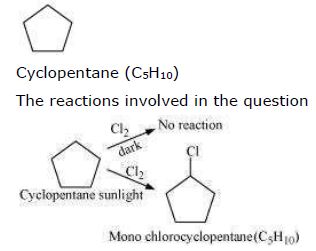
3.
S>P>R>Q
Relative reactivity for SN2 reaction in the given structurest is
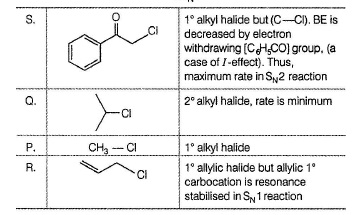
4.
(i) 1-chloro-2,2-dimethylpropane
(ii) 4-bromo-3-methylpent-2-ene
(iii) 1-chloro- 3, 3-dimethylbutane
(iv) 3, 5-dichloro-3, 5-dimethylheptane
5.
\((i)\mathrm{CH}_{4}+2 \mathrm{Cl}_{2} \stackrel{\text { hv}}{\longrightarrow} \mathrm{CH}_{2} \mathrm{Cl}_{2}+2 \mathrm{HCl}\)
\(\\ (ii) 2 \mathrm{CHCl}_{3}+\mathrm{O}_{2} \stackrel{\mathrm{hv}}{\longrightarrow} 2 \mathrm{COCl}_{2}+2 \mathrm{HCl}\)
6.
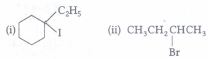
7.
Iodination of benzene is difficult bcoz they require presence of oxidizing agents such as HNO3, HIO4 to oxidize HI. Aryl chlorides( halogens bonded with sp3 hybridised) and bromides can be easily prepared by electrophilic substitution with cl,br at dark ordinary temperature in presence of Lewis acid as catalyst to generate electrophile but in case of iodine the reactions are reversible.
8.
The IUPAC name of DDT is 2, 2-bis-(4-chlorophenyl)-1, 1, f-trichloroethane. It is non-biodegradable and extremely stable compound which act as a water pollutant and kills aquatic animals thus in balancing the water ecosystem.
9.

10.
Replacement of the diazonium group by iodine is done simply by shaking the diazonium salt with potassium iodide.

11.
Chloroform > Iodomethane > Bromomethane > Chlorornethane
12.

Aniline Bromobenzene
13.

14.

15.
1, 5- dibromo-2-methylpent-2-ene
16.
1-bromoprop-2-ene
17.
4-bromobut-1-ene
18.
\((i) 2 \mathrm{CHCl}_{3}+\mathrm{O}_{2} \frac{\text { Air or }}{\text { Light }} 2 \mathrm{COCl}_{2}+2 \mathrm{HCl}\)
\(\\ (ii) \mathrm{COCl}_{2}+2 \mathrm{C}_{2} \mathrm{H}_{5} \mathrm{OH} \longrightarrow\left(\mathrm{C}_{2} \mathrm{H}_{5}\right)_{2} \mathrm{CO}_{3}+2 \mathrm{HCl}\)
Phosgene Ethanol Diethyl carbonate
19.
In the presence of light, chloroform is oxidised by air to form an extremely poisonous gas, phosgene (carbonyl chloride). It is therefore, stored in dark coloured completely filled bottles, so that air is kept out.

20.
Diethyl carbonate
21.
Chloroform(CHCI3)
22.
(i) As an antiseptic
(ii) Powerful insecticide
23.
KCN gives CN- ion as a nucleophile in aqueous medium. Resonating forms of KCN are
\(\stackrel{+}{\mathrm{K}}[* \overline{\mathrm{C}} \equiv \mathrm{N}:] \longleftrightarrow[\mathbf{t} \mathrm{C}=\ddot{\mathrm{N}} \overline{\mathbf{3}}]{\mathrm{K}}^{+}\)
Thus, cyanide ion is an ambident nucleophile. Therefore, it can attack the C-atom of C-Br bond in n-BuBr either through C-atom or through N-atom. Thus, two possible products are cyanides and isocyanides, respectively. But C-C bond is more stable than C-N bond, so attack occurs through C-atom and hence, cyanide is predominantly formed.
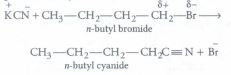
24.
C-CI bond in chlorobenzene is stronger than C-CI bond in benzyl chloride. Therefore hydrolys is of benzyl chloride is easy. It is due to the fact that in chlorobenzene the lone pairs of electrons on halogen atom are delocalised as shown below:

25.

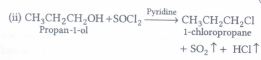
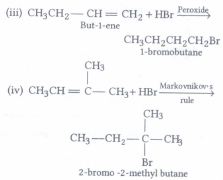
26.
Due to resonance in phenol, C-O bond of phenol has some partial double bond character, which strengthens the bond. So, it is difficult to break this C-O bond of phenol while the C-O bond of alcohol is purely single bond and comparatively weaker bond. So, alkyl halides can be prepared by the reaction of alcohols with HCI in the presence of ZnCl2 while aryl halides cannot be prepared by the reaction of phenol with HCI in the presence of ZnCI2.
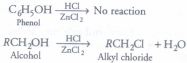
27.
Symmetrical alkenes (CH2 = CH2) gives only one addition product.

28.
(i) 3-chloro-5-tluoro-3,5-dimethylheptalle
(ii) 2-chloro-3,3-dimethylbutane (halogen is preferred over alkyl group while naming).
29.
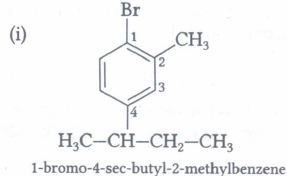
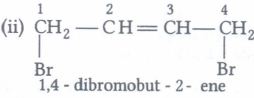
30.
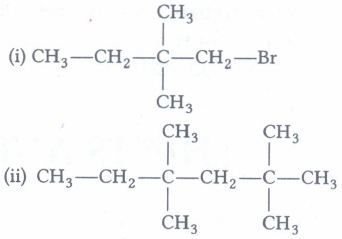
31.
IUPAC Name: 3-bromo-1-chlorocyclohex-1-ene
Hybridisation C-Cl (Sp2), C-Br (sp3)
32.
The structure of3-bromo-2-methylprop-1-ene is
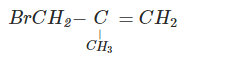
33.
4-chloropent-1-ene
34.
SN1 reactions are generally carried out in polar protic solvents (like water, alcohol, acetic acid, etc). The reaction between tert-butyl bromide.and hydroxide ion yields ter/-butyl alcohol and follows the first order kinetics.
\(\left( CH_{ 3 } \right) _{ 3 }CBr+OH^{ - }\rightarrow \left( CH_{ 3 } \right) _{ 3 }COH+Br^{ - }\)
The steps involved are
(i) Formation of carbocation intermediate
\(\left( CH_{ 3 } \right) _{ 3 }C-Br\underrightarrow { Slow } \underset { (Carbocation) }{ (CH_{ 3 })_{ 3 }C^{ + } } +Br^{ - }\)
(ii) Attack of nucleophile on carbocation formed leading to formation of substituted product.
\(\left( CH_{ 3 } \right) _{ 3 }C^{ + }+\underset { (Nucleophile) }{ OH^{ - } } \underrightarrow { Fast } \left( CH_{ 3 } \right) _{ 3 }COH\)
35.
\(\underset { Methyl\\ Chloride }{ CH_{ 3 }CI } +AgNO_{ 2 }+AgCI\)
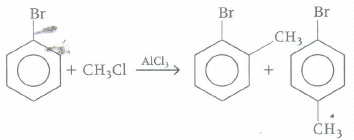
36.
\(CH_{ 3 }Br+\underset { Ethylchloride }{ CH } -CI+KOH(aq)\rightarrow \underset { Ethanol }{ CH_{ 3 } } CH_{ 2 }OH+KCI\)
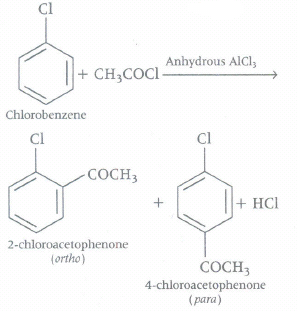
37.
It can be done by treating the methyl bromide with alcoholic silver cyanide
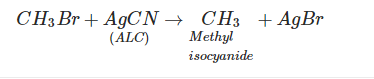
38.
The reactivity towards SN1 reaction depends upon the stability of the intermediate carbocation which an alkyl halide gives on ionisation Thus,
.png)
As 3° carbocations are more stable than
20 carbocations, therefore .png) will react faster than
will react faster than .png) in SN1 reaction
in SN1 reaction
39.
Ethyl chloride undergoes hydrolysis to form ethyl alcohol (through SN2 nucleophilic substitution).

40.
When CH3--Br is treated with KCN, methyl cyanide is obtained.

It is a nucleophilic substitution reaction. Nucleophile CN- substitutes Br-
41.
As 1- ion is a better leaving group than Br" ion, therefore iodides are more reactive than bromides. Therefore, CH3-CH2--I is more reactive than CH3-CH2-Br towards SN2reaction and hence, CH3-CH2-1 would undergo SN2reaction faster than CH3-CH2-Br.
42.
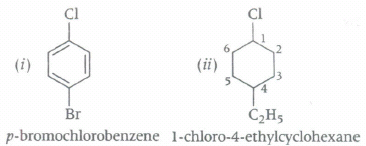
43.

44.

45.
Cyclic arrangement of 6C-atoms; CI at C-1 and C2H5 at C-4

46.

47.

48.

49.

50.

51.

52.

53.

54.
C-chain of 4 atoms, -Br at C1 and C4, double bond between C2 and C3

55.

56.

57.
4-bromo-4-methylpent-2-ene
58.

(As double bond is given preference over halogen)
59.

60.

61.
The structure of 3-bromo-2-methyl prop- 1 ene is

62.
The structure of l-bromo-4-chlorobut_2_ene is

63.
In allylic halides, the halogen is bonded to the sp3-hybridised carbon atom next to a carbon-carbon double bond. Thus

is a aIIylic halide.
64.
The structure of 2,4-dinitrochlorobenzene is

65.
Phenol is formed.
66.
In SN1 reaction, the bond is to cleave to form a carbocation intermediate. In SN2 reaction, the bond has to again cleave to accommodate the attacking nucleophile. This means that vinyl halides are reluctant to respond to both types of reactions.
67.
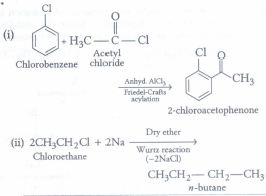
68.
In haloalkanes, the halogen atom is attached to carbon atom. As the halogen atom is more electronegative than carbon, the bond between carbon and halogen is polar in character.
\(C^{ \delta + }-{ X }^{ \delta - }\)
Due to presence of partial positive charge on carbon atom, the nucleophiles can attack on electron deficient carbon thereby resulting in the displacement of weaker nucleophile, thus typical reactions of alkyl halides are nucleophilic substitution reactions:
R : X + : Z-\(\rightarrow\)R : Z + X-
Nucleophile Halide ion
Whereas in haloarenes, as the halogen atom attached to benzene ring, releases electron towards benzene ring ( +m effect) thereby the ortho and para positions become site of attack for electrophiles more than nucleophiles.
69.
(i) On adding sodium hydroxide and silver nitrate to both the compounds, benzyl chloride forms white precipitate but chlorobenzene does not form white precipitate.
C6H5CH2CI + NaOH\(\rightarrow\)C6H5CH2OH +NaCI
NaCI + AgNO3\(\rightarrow\)AgCI(s) + NaNO3
(white ppt.)
(ii) On heating chloroform and carbon tetrachloride with aniline and ethanolic potassium hydroxide separately chloroform forms pungent smelling isocyanide but carbon tetrachloride does not form this compound.
C6H5NH2 + CHCI3 + 3KOH \(\overset { \Delta }{ \rightarrow } \)C6H5NC + 3KCI + 3H2O
Phenyl isocyanide
70.
(i) CH3 - CI + KOH\(\rightarrow\)CH3OH + KCI
(aq) Methanol
(ii) CH3 - CI + KCM \(\rightarrow\) CH3 CN + KCI
Methyl cyanide
(iii) CH3 Br + Mg \(\overset { Dry\ ether }{ \longrightarrow } \)CH3MgBr
Methyl magnesium bromide
71.
is chiral.
undergoes faster towards SN2 reaction as it is a primary halide.
(a) SN2 reaction occurs with inversion of configuration.
(b) SN1 reaction proceeds with racernisation.
72.
The 3° alkyl halides are most reactive, because the intermediate carbonation formed in their case is most stable in S1N mechanism. The most stable intermediate is formed at faster rate.
73.
\( \mathrm{CH}_3 \mathrm{Br}+\text { alc. } \mathrm{AgCN} \longrightarrow \mathrm{CH}_3 \mathrm{NC}+\mathrm{AgBr} \)
74.
\({ CH }_{ 3 }-\underset { \overset { | }{ Br } }{ CH } -{ CH }_{ 3 }\)will react faster due to 2°halide, will give stable carbocation.
75.
Neopentane or 2, 2-Dimethylpropane
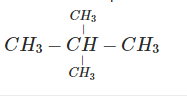
76.
\({ CH }_{ 3 }-{ CH }_{ 2 }-\underset { \overset { | }{ { CH }_{ 3 } } }{ CH } -CI\) will undergo SN1 reaction faster because it is a secondary alkyl halide and forms a secondary carbocation that can stabilise more than primary carbocation.
77.
3-bromo-2 - methyl prop-1-ene
78.
(i) In chlorobenzene, there is a delocalisation of electrons due to resonance.
It is considered to be resonance hybrid of the following structures:
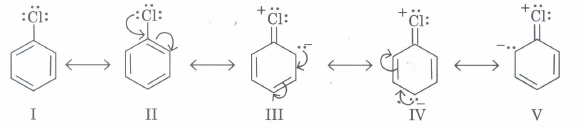
The contribution of structure III, N and V imparts a partial double bond character to C-CI bond. This is confirmed by X-ray analysis which shows that C-CI bond length in chlorobenzene is 1.69 whereas C-CI bond length in ethyl chloride is \(1.82\overset { \circ }{ A } \). There is no resonance in CH3CI and hence no partial double bond character.
(ii) In chlorobenzene, the C of C-CI bond is sp2-hybridised while the C of C - CI bond in cyclohexyl chloride is sp3-hybridised.
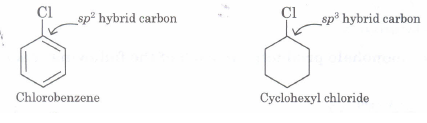
Therefore, the sp2-hybridised C of chlorobenzene has more s-character and hence more electronegative than the sp3-hybrid C of cyclohexyl chloride. As a result, the Sp2 hybrid of C-CI bond in chlorobenzene has less tendency to release electrons to CI than the sp3 hybrid carbon of cyclohexyl chloride. As a result, the C-CI bond in chlorobenzene is less polar than in cyclohexyl chloride.
(iii) The SN1 reactions proceed through the formation of carbocations. In case of optically active alkyl halides the product formed is a racemic mixture. This is because the intermediate carbocation is planar species, therefore, the attack of the nucleophile, OH- ion can take place from both the faces (front and rear) with equal ease. As a result, 50 : 50 mixture 0 the two enantiomers (laevo and dextro) is formed. Thus, the product formed is a racemic mixture (±)which is optically inactive.
For example, hydrolysis of optically active 2-bromobutane results in the formation of racemic mixture (±)-butan-2-oL.
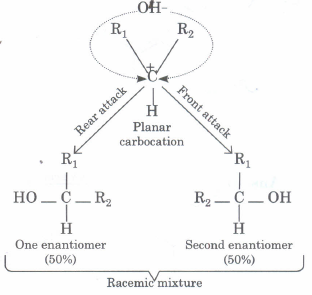
79.
Haloarenes are much less reactive than haloalkanes towards nucleophilic substitution reactions because of the following reasons:
1. Resonance effect: In haloarenes, there is delocalisation of electrons due to resonance. For example, chlorobenzene is considered to be a resonance hybrid of the following structures:
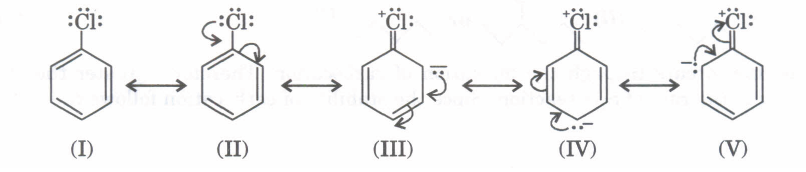
It is evident tht, the contribution of structures III, IV and V imparts a partial double bond character to the carbon-chlorine bond. This is confirmed by X-ray analysis which shows that the C - CI bond length in chlorobenzene is 1.69A while the C-CI bond length in ethyl chloride molecule is 1.82A. The shortening of bond length imparts stability to aryl halides and the bond cleavage becomes rather difficult. The aryl halides are therefore, less reactive than alkyl halides.
2. Different hybridisation states of carbon atom: In haloalkanes the carbon atom of the C - X bond is sp3 hybridised while in haloarene halides, the carbon atom is sp2 hybridised. The Sp2 hybridised carbon atom with a greater s-character is more electronegative. It can hold the electron pair of the bond more tightly than the Sp3 hybridised carbon atom in alkyl halides. Therefore, it has less tendency to release electrons to the halogen. As a result, the bond cleavage in aryl halides is some what more difficult than in alkyl halides.
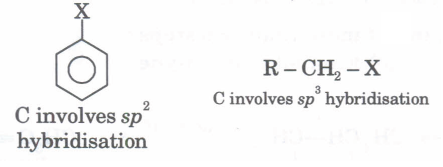
Thus, haloarenes are less reactive towards the substitution reactions than haloalkanes.
80.
(a) \({ CH }_{ 3 }\underset { Propene }{ CH } ={ CH }_{ 2 }\overset { { Br }_{ 2 } }{ \longrightarrow } { CH }_{ 3 }\underset { \overset { | }{ Br } }{ CH } -\underset { \overset { | }{ Br } }{ { CH }_{ 2 } } \overset { 2\quad alc.KOH }{ \longrightarrow } \underset { Propyne }{ { CH }_{ 3 } } C\equiv CH\)
(b) \({ CH }_{ 3 }\underset { Ethanol }{ { CH }_{ 2 }OH } \quad \overset { { SOCI }_{ 2 } }{ \longrightarrow } \quad { CH }_{ 3 }{ CH }_{ 2 }CI\quad \overset { HC\equiv CN{ a }^{ + } }{ \longrightarrow } { CH }_{ 3 }\underset { But-1-yne }{ { CH }_{ 2 } } C\equiv CH\)
81.
(i) Although haloalkanes are polar compounds, yet these are practically insoluble in water. This is because these are not able to form hydrogen bonds with water. However, these are soluble in organic solvents like alcohol, benzene, ether, etc.
(ii) Chloroform is a chlorine compound but it is covalent in nature. Therefore, it does not ionize in water to give \({ Cl }^{ - }\)ions. Hence it does not react with \(AgN{ O }_{ 3 }\) solution.
82.
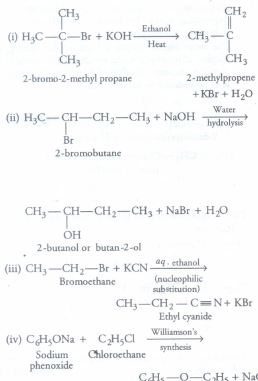
83.
Ethane nitrile is formed.
\(
\mathrm{CH}_3 \mathrm{Br}+\mathrm{KCN} \longrightarrow \mathrm{CH}_3 \mathrm{C} \equiv \mathrm{N}+\mathrm{KBr}
\)
84.
The melting point of para isomer is quite higher than that of ortho or meta isomers.This is due to the fact that it has symmetrical structure and therefore, its molecules can easily pack closely in crystal lattice. As a result, intermolecular forces of attraction are stronger and therefore, greater energy is required to break its lattice and it melts at higher temperature.
85.
Haloarenes are insoluble in water because these cannot form hydrogen bonds with water molecules. However, these are soluble in benzene in accordance with the general principle of solubility, i.e., like dissolves like. Haloarenes are organic compounds having a large hydrocarbon part (benzene ring) and are soluble in hydrocarbon solvents like benzene.
86.
I− is a powerful nucleophile which reacts rapidly with RCl to form RI.
KI ⟶ K++ I−
RCl + I−⟶ RI + Cl−
Iodide is a better leaving group than chloride and therefore, RI is hydrolysed rapidly to form ROH.
RI + OH−⟶ ROH + I−
The I− formed in the above reaction recycles and this explains the catalytic effect.
87.
Treat both of them separately with aqueous KOH followed by AgNO3. The compound which gives a white ppt. with AgNO3 is C2H5Cl and the one which gives light yellow ppt. is C2H5Br.
\(
C_2 H_5 \mathrm{Cl}+\mathrm{KOH}(\mathrm{aq}) \longrightarrow \mathrm{C}_2 \mathrm{H}_5 \mathrm{OH}+\mathrm{KCl} \stackrel{\mathrm{AgNO}_3}{\longrightarrow} \text { White ppt. of } \mathrm{AgCl} \\
\mathrm{C}_2 \mathrm{H}_5 \mathrm{Br}+\mathrm{KOH}(\mathrm{aq}) \longrightarrow \mathrm{C}_2 \mathrm{H}_5 \mathrm{OH}+\mathrm{KBr} \stackrel{\mathrm{AgNO}_3}{\longrightarrow} \text { yellow ppt. of } \mathrm{AgBr}
\)
88.
It acts as a stronger nucleophile from carbon end because it will lead to the formation of C-C bond which is more stable than C-N bond.
89.
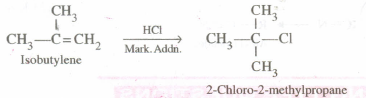
Mechanism. This reaction is an example of electrophilic addition reaction and occurs in two steps: Step I. In the first step, a proton adds to form two possible carbocations (I and II). Since carbocation (I) is 3°, therefore, it is much more stable than carbocation (II) which is 1°,
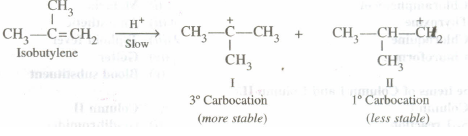
Step II. In the second step, the Cl- ion readily attacks the 3° carboation (I) forming 2-chloro-2-methylpropane as the major product.
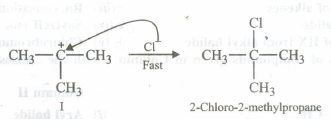
90.
tert-Butyl bromide readily loses Be ion to form stable tert-butyl carbocation. Therefore, it undergoes reaction by SNI mechanism which occurs in two steps. In the first step, tert-butyl carbocation is formed. This step is slow and hence is the rate determining step of the reaction. In the second step, the tert-butyl carbocation is readily attacked by OH- ion to form tert-butyl alcohol.
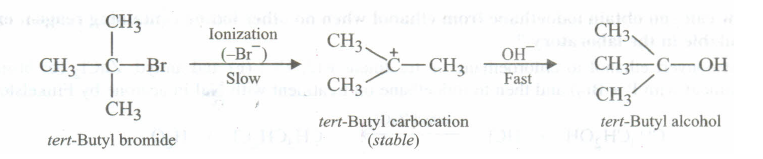
On the other hand, n-butyl bromide does not undergo ionization to produce n-butyl carbocation because it is not stable. Therefore, it prefers to undergo reaction by SN2 mechanism which occurs in one step through a transition state involving nucleophilic attack of the OH- ion. from the back side with simultaneous expulsion of Br- ion from the front side.

91.

92.
Both elimination reactions (particularly \(\beta\) - elimination reactions) and nucleophilic substitution reactions occur simultaneously. However, by a proper choice of reagents and reaction conditions, we can make one reaction to predominate over the other. Usually strong and bulkier bases and high temperature favour elimination reactions whereas weaker and smaller bases and lower temperature favour substitution reactions.
For example, ethyl bromide on heating with alcoholic KOH (which contains the stronger base \({ C }_{ 2 }{ H }_{ 5 }{ O }^{ - }\) ion) at bout 473-523 K undergoes elimination to give ethene while with aqueous KOH at about )73 K it gives ethanol.
\(\underset { Ethanol }{ { C }H_{ 3 }{ CH }_{ 2 }OH } \overset { KOH(aq) }{ \underset { \ \ \ 373\ K\\ (Subsititution) }{ \longleftarrow } } \underset { Ethyl\quad bromide }{ { C }H_{ 3 }{ CH }_{ 2 }Br } \quad \overset { KOH(alc }{ \underset { \ 473-523\quad K\\ (Elimination) }{ \longrightarrow } } \underset { Ethene }{ { C }H_{ 2 }={ C }H_{ 2 } } \)
For further details refer to 'Supplement your knowledge for competitions.
93.
Make the Lassaigne's extract of C2H5Br and C2H5CI separately. Acidify them with dil. HNO3 and add AgNO3 solution. C2H5Br gives pale yellow ppt. of AgBr partially soluble in ammonia while C2H5CI gives white ppt. of AgCl soluble in ammonia.
94.
(i) The greater reactivity of fluorides as compared to chlorides in nucleophilic aromatic substitution is due to the strong -I-effect of the F atom which favours the initial nucleophilic attack on the aromatic ring. However, in nucleophilic aliphatic substitution, the greater reactivity of chlorides as compared to fluorides is due to greater leaving ability of Cl- ion over F- ion.
(ii) Due to + R-effect of CI, the C-Cl bond has some double bond character and hence little more difficult to break. In other words, energy of activation for cleavage of C-Cl bond is little higher which cannot be supplied by the low boiling point (b.p. 308 K) of ether but can be easily supplied by the little higher b.p. (340 K) of THF.
95.
\({ CH }_{ 3 }-\overset { \underset { | }{ { CH }_{ 3 } } }{ CH } -{ CH }_{ 2 }Br+KOH(a/c)\longrightarrow { CH }_{ 3 }-\overset { \underset { | }{ { CH }_{ 3 } } }{ CH } ={ CH }_{ 2 }\overset { HBr }{ \longrightarrow } { CH }_{ 3 }-\overset { \underset { | }{ { CH }_{ 3 } } }{ \underset { \overset { | }{ Br } }{ C } } -{ CH }_{ 3 }\)
'A' 'B' 'C'
'C' is the isomer of 'A'.
\(2{ CH }_{ 3 }-\overset { \underset { | }{ { CH }_{ 3 } } }{ CH } -{ CH }_{ 2 }Br+2Na\overset { Dry }{ \underset { ether }{ \longrightarrow } } { CH }_{ 3 }-\overset { \underset { | }{ { CH }_{ 3 } } }{ CH } -{ CH }_{ 2 }-{ CH }_{ 2 }-\overset { \underset { | }{ { CH }_{ 3 } } }{ CH } -{ CH }_{ 3 }+2NaBr\)
\(\\ 2{ CH }_{ 3 }{ CH }_{ 2 }{ CH }_{ 2 }{ CH }_{ 2 }Br+2Na\overset { Dry }{ \underset { ether }{ \longrightarrow } } { CH }_{ 3 }-{ CH }_{ 2 }-\overset { 'D'(C_{ 8 }{ H }_{ 18 }) }{ \underset { n-Octane(C_{ 8 }{ H }_{ 18 }) }{ { CH }_{ 2 }-{ CH }_{ 2 }-{ CH }_{ 2 } } } -{ CH }_{ 2 }-{ CH }_{ 2 }-{ CH }_{ 3 }\)
'D' and n-octane are different.
96.
tert-Alkyl halides prefer to undergo dehydrohalogenation in presence of a strong base such as Na metal instead of undergoing Wurtz reaction as explained below:
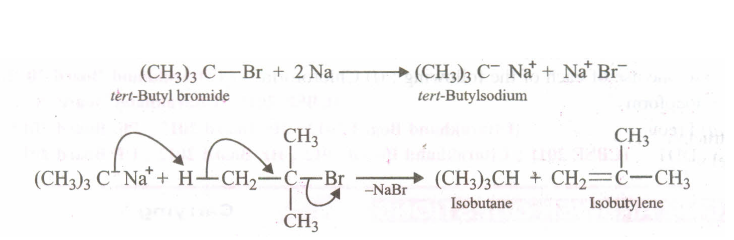
Thus, only 1o and 2° alkyl halides undergo Wurtz reaction while 3° alkyl halides prefer to undergo dehydrohalogenation to form alkenes.
97.
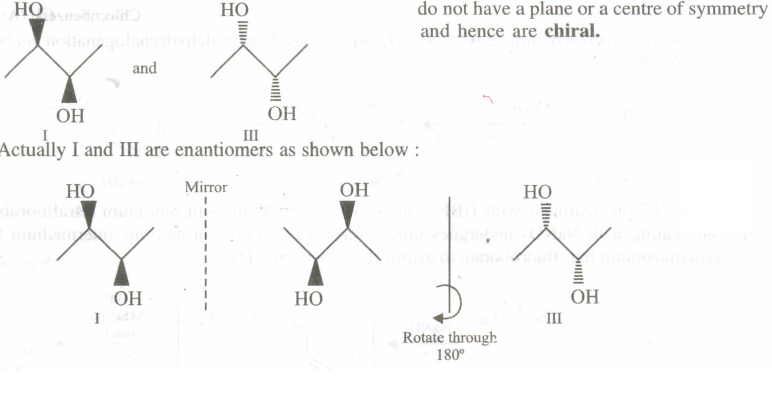
Structure (II) has a centre of symmetry and hence is achiral. It also has a plane of symmetry as shown below. Therefore, structure (II) represents a meso-compound.
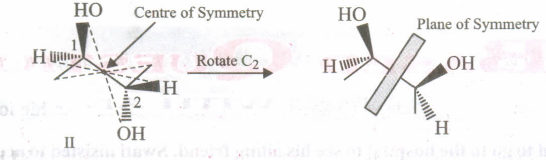
Finally, structures (I and (II) and (II and III) are not mirror images and hence are diastereomers .
98.
Optically active 2-iodobutane on treatment with Nal in acetone undergoes racemization and hence the product does not show optical activity as explained below:
When optically active 2-iodobutane (I) is treated with 1- ion, it undergoes Walden inversion (SN2 reaction) to give 2 iodobutane (II) which is the enantiomer of (1). Now 2- iodobutane (II) undergoes Walden inversion to give enantiomer (I). As a result of repetition of these two Walden inversions, ultimately a 50 : 50 mixture of the two enantiomers is obtained. In other words, optically active 2- iodobutane undergoes reacemization.
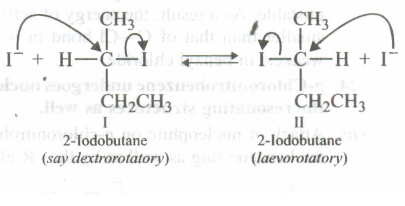
99.
(i) If the relative configuration of the atoms/groups around a chiral centre in an optically active molecule remains the same before and after the reaction, the reaction is said to proceed with retention of configuration. On the other hand, if the relative configuration of the atoms/groups around a chiral centre in the product is opposite to that in the reactant, the reaction is said to proceed with inversion of configuration. For example,
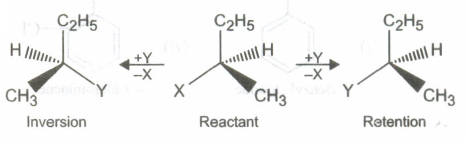
Stereoisomers which are non-superimposable mirror images of each other are called enantiomers while stereoisomers which are not mirror images of each other are called diastereomers. For example, tartaric acid exists in three stereoisomeric forms I, II and III
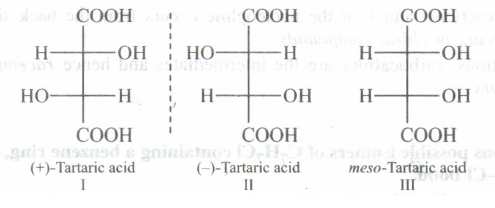
100.
Because of bigger size and lower electronegativity, iodide ion can donate a pair of electrons more easily than bromide ion and hence iodide ion is a better nucleophile than bromide ion
101.
Free radical substitution occurs at the methyl group giving first benzyl chloride, then benzyl dichloride and finally benzotrichloride.
\(\underset { Tolune }{ { C }_{ 6 }{ H }_{ 5 }{ CH }_{ 3 } } +{ Cl }_{ 2 }\overset { 383K,\ hv }{ \underset { -HCI }{ \longrightarrow } } \underset { Benzyl\ chloride }{ { C }_{ 6 }{ H }_{ 5 }{ CH }_{ 2 } } CI\ \overset { 383,hv }{ \underset { -HCI }{ \longrightarrow } } \ \underset { Benzyl\ dichloride }{ { C }_{ 6 }{ H }_{ 5 }{ CHCl }_{ 2 } } \ \overset { 383,hv }{ \underset { -HCI }{ \longrightarrow } } \ \underset { Benzylchloride }{ { C }_{ 6 }{ H }_{ 5 }{ CCl }_{ 3 } } \)
102.
The three dimensional structures of the three compounds along with the direction of dipole moment in each of their bonds are given below:

CCl4 being symmetrical has zero dipole moment. In CHCI3 , the resultant of two C-C1 dipoles is opposed by the resultant of C-H and C-CI bonds. Since the latter resultant is expected to be smaller than the former, therefore, CHCI3 has a finite dipole (1·03 D) moment. In CH2CI2, the resultant of two C-Cl dipole moments is reinforced by resultant of two C-H dipoles, therefore, CH 2CI2 (1·62 D) has a dipole moment higher than that of CHCI3. Thus, CH2CI2 has the highest dipole moment.
103.
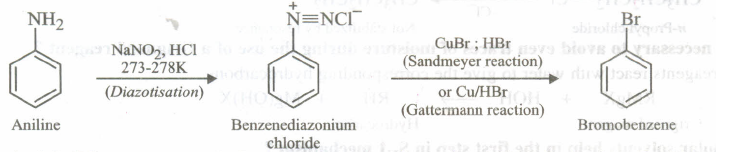
104.
The hydrocarbon having molecular mass of 72 g mol-1 must be C 5H12. Since on photochlorination, it gives a single monochloro derivative, therefore, all the twelve hydrogens in this hydrocarbon are equivalent. Thus, the hydrocarbon must be neopentane or 2, 2-dimethylpropane. It forms only one monochloro derivative and two dichloro derivatives as shown below:
\({ CH }_{ 3 }-\overset { \underset { | }{ { CH }_{ 3 } } }{ \underset { \overset { | }{ \underset { 2.2-Dimethylpropane\\ (Allthe12H'sare\\ equivalent) }{ { CH }_{ 3 } } } }{ C } } -{ CH }_{ 3 }\ { CH }_{ 3 }-\overset { \underset { | }{ { CH }_{ 3 } } }{ \underset { \overset { | }{ \underset { \ l-Chloro-2.2-\\ \ dimethylpropane\\ (Monochloroderivative) }{ { CH }_{ 3 } } } }{ C } } -{ CH }_{ 3 }CI\ \ { CH }_{ 3 }-\overset { \underset { | }{ { CH }_{ 3 } } }{ \underset { \overset { | }{ \underset { 1.3-Dichloro-\\ 2.2-dimethylpropane\\ (Dichloroderivative) }{ { CH }_{ 3 } } } }{ C } } -{ CH }_{ 3 }CI\ \ { CH }_{ 3 }-\overset { \underset { | }{ { CH }_{ 3 } } }{ \underset { \overset { | }{ \underset { L'l-Dichloro-\\ 2, 2-dimethylpropane\\ tDichloro derivative) }{ { CH }_{ 3 } } } }{ C } } -{ CH }_{ 3 }{ CI }_{ 2 }\)
105.
(i) Addition of H+ to 3-methyl-1-butene first gives 2° carbocation (I) which being less stable rearranges to the more stable 3° carbocation (II). Nucleophilic attack by Be ion on this carbocation gives 2- bromo-2-methylbutane as the major product,
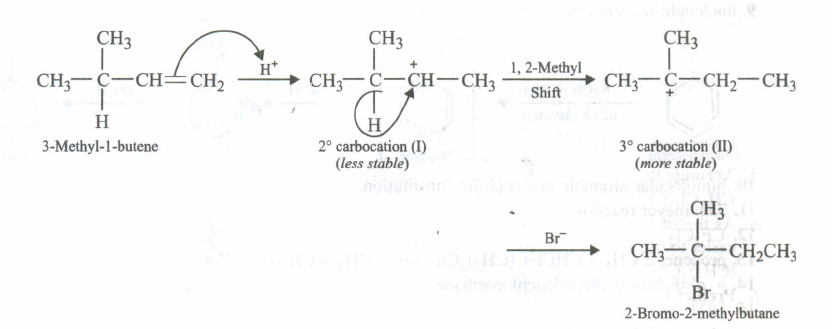
(ii) Electrophilic addition reaction occurs. In the first step, H+ adds to that carbon atom of the double bond which carries the CH3 group since it produces carbocation (I) which is stabilized by +R-effect of the Ph group and +l-effect of the CH2CH3 group. Subsequent nucleophilic attack by Br- on carbocation (I) gives l-bromo-l-phenylpropane (II) as the final product.
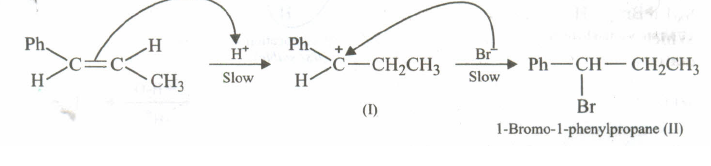
(iii) In presence of peroxides, addition of HBr to alkenes occurs anti to Markovnikov's rule. Thus,

106.
\({ CH }_{ 3 }-Br+NaI\overset { Dry\ acetone }{ \underset { (Filkenstein\ reaction) }{ \longrightarrow } } \ \underset { Methyl\ iodile }{ { CH }_{ 3 }-I } \)
107.
Two alkenes are possible. These are :
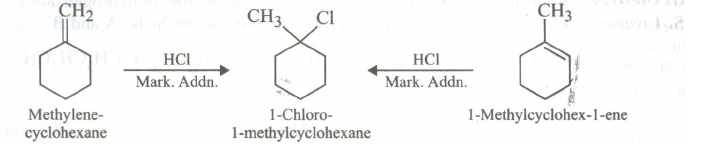
108.
Grignard reagents react with water to give the corresponding hydrocarbons.
\(\underset { Grignard\ reagent }{ RMgX } \ +\ HOH\longrightarrow \underset { Hydrocarbon }{ RH } \ +\ Mg(OH)X\)
109.
In S N1 reactions, carbocations are the intermediates. Obviously more stable the carbocation, more reactive is the alkyl halide. Since allyl chloride upon ionization gives allyl cation which is stabilized by resonance but the carbocation obtained from n-propyl chloride is not, therefore, allyl chloride It undergoes hydrolysis much faster than n-propyl chloride.
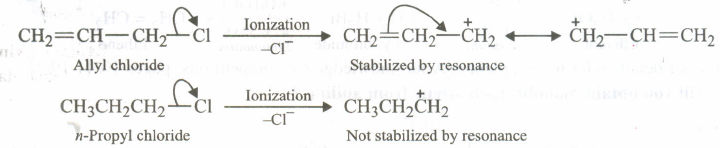
110.
The IUPAC name of DDT is 2, 2-bis (4-chlorophenyl)-I, I, l-trichloroethane and that of benzene hexachloride is 1, 2, 3, 4, 5, 6-hexachlorocyclohexane. Their use in India and other countries has been banned because they are not biodegradable. As a result, these insecticides enter the food chain of animals and get deposited in their fatty tissues over a period of time and affect their reproductive systems.
111.
It is due to double bond character  in phenol due to resonace, hence, breaking of this bond is difficult to replace it by CI.
112.
Add bromine water. If it decolourises, then the presence of double bond in a compound is confirmed.
113.
The first step in \({ S }_{ N }1\) SN1reactions involves the formation of carbocations. Polar solvents stabilize the carbocations thus formed by solvation and hence favour the \({ S }_{ N }1\) mechanism.
114.
\({ CH }_{ 3 }-\overset { \underset { | }{ { CH }_{ 3 } } }{ \underset { \overset { | }{ { CH }_{ 3 } } }{ C } } -{ CH }_{ 2 }Br\\ \)
1-Bromo-2,2-dimethyl propane (Neopentyl bromide)
115.
In the given reaction, addition occurs and following two products (A and B) are possible.
\({ CH }_{ 3 }-{ CH }_{ 2 }=CH=CH-{ CH }_{ 3 }+HCI\longrightarrow { CH }_{ 3 }-{ CH }_{ 2 }-\underset { \overset { | }{ Cl } }{ CH } -{ CH }_{ 2 }-{ CH }_{ 3 }+{ CH }_{ 3 }-{ CH }_{ 2 }-{ CH }_{ 2 }-\underset { \overset { | }{ Cl } }{ CH } -{ CH }_{ 3 }\\ \quad \quad \quad \quad \quad \quad \quad \quad \quad \quad \quad \quad \quad \quad \quad \quad \quad \quad \quad \quad \quad \quad \quad \quad 'A'\quad \quad \quad \quad \quad \quad \quad \quad \quad \quad \quad \quad \quad \quad \quad \quad \quad 'B'\quad \quad \quad \quad \quad \quad \)
2-chloropentane 3-chloropentane
116.
Compound with MF C7H8 is toluene. Since CH3 group is O, p-directing, therefore, chlorination of toluene with Cl2 in presence of FeCl3 gives a mixture of o-chlorotoluene and p-chlorotoluene, in which the p-isomer predominates.
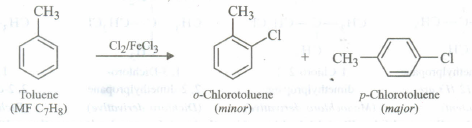
117.
Two alkenes are possible These are :
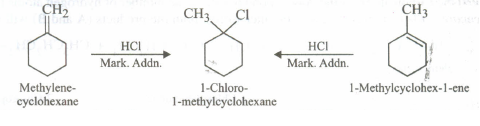
118.
\({ CH }_{ 3 }-{ CH }_{ 2 }=CH=CH-{ CH }_{ 3 }+HCI\longrightarrow { CH }_{ 3 }-{ CH }_{ 2 }-\underset { \overset { | }{ Cl } }{ CH } -{ CH }_{ 2 }-{ CH }_{ 3 }+{ CH }_{ 3 }-{ CH }_{ 2 }-{ CH }_{ 2 }-\underset { \overset { | }{ Cl } }{ CH } -{ CH }_{ 3 }\\ \quad \quad \quad \quad \quad \quad \quad \quad \quad \quad \quad \quad \quad \quad \quad \quad \quad \quad \quad \quad \quad \quad \quad \quad 'A'\quad \quad \quad \quad \quad \quad \quad \quad \quad \quad \quad \quad \quad \quad \quad \quad \quad 'B'\quad \quad \quad \quad \quad \quad \)
119.
(i) Since the rate of reaction depends upon the concentration of 'A' only, therefore, 'A' -should be 3o halide which will follow SN1 mechanism.
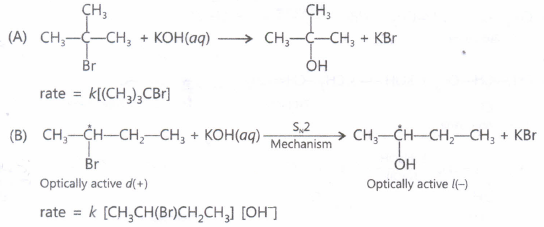
120.
The role of Lewis acids in the preparation of aryl chlorides and bromides is to generate the electrophiles, i.e., CI+and Br+ from the corresponding halogens
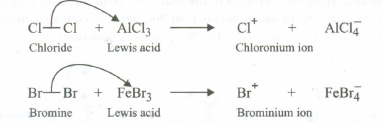
These electrophiles then react with arenes to form the corresponding aryl halides by electrophilic substitution mechanism.
121.
The antiseptic property of iodoform is due to liberation of 12 when it comes in contact with skin and not due to iodoform itself.
\(\underset { Iodo\ form }{ { CHI }_{ 3 } } \overset { contact\ with\ skinow }{ \longrightarrow } \underset { Iodine }{ { I }_{ 2 } } (has\ antiseptic\ property)\)
122.
SN1 reactions occur through carbocation intermediates. C6H5 -CH2CI readily undergoes ionization to give C6HsCH+2 which is stabilized by resonance.
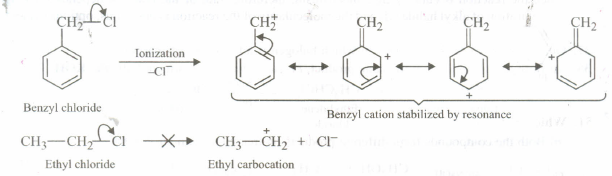
In constant, CH3CH2CI does not undergo ionization to give CH3CH 2+.As a result, C6H5CH2CI reacts
123.
p-dibromobenzene has higher melting point because it is symmetrical and fits into crystal lattice more readily.
124.
The p-isomer being more symmetrical fits closely in the crystal lattice and thus has stronger intermolecular forces of attraction than those of o- and m-isomers. Since during melting or dissolution, the crystal lattice breaks, therefore, a larger amount of energy is needed to melt or dissolve the p-isomer than the corresponding o- and m- isomers. In other words, the melting point of the p-isomer is higher and its solubility lower than the corresponding o- and m- isomers.
125.
\({ C }_{ 6 }{ H }_{ 5 }-\overset { \underset { | }{ Cl } }{ CH } -{ C }_{ 6 }{ H }_{ 5 }\) will get hydrolysed easily because carbocation formed will be stabilized by resonance effect of two phenyl groups, whereas in \({ C }_{ 6 }{ H }_{ 5 }{ CH }_{ 2 }Cl\), he carbocation is stabilized by resonance effect of one phenyl group.
126.
KCN has nucleophile CN- ion which is ambident nucleophile because of the following two contributing structures:
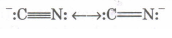
Therefore, it can attack the carbon atom of C-Br bond in n-BuBr either through C or N. Since C-C bond is stronger than C-N bond, therefore, the attack occurs through C to form n-butyl cyanide as given below:

127.
(i) In l-bromo-l-methylcyclohexane, the \(\beta \)-hydrogens on either side of the Br atom are equivalent, therefore, only 1- alkene is formed.
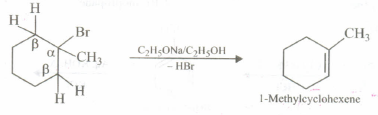
ii) 2-Boro-2-methylbutane has two different sets of equivalent \(\beta \)-hydrogens and hence, in principle, can give two alkenes (I and II). But according to SaytzetT rule, more highly substituted alkene (II), being mor~ stable, is the major product.

(iii) 3-Bromo-2, 2, 3-trimethylpentane has two different sets of \(\beta \)-hydrogens and hence, in principle, can give two alkenes (I and II). But according to SaytzetT rule, more highly substituted alkene (II), being more stable, is the major product.
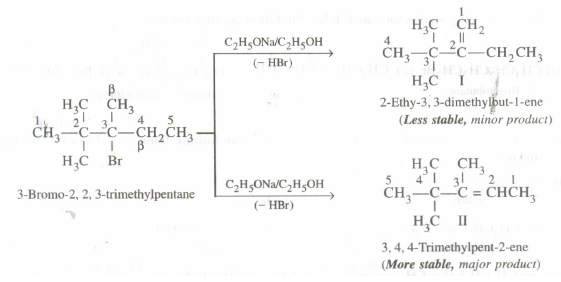
128.
(i)

(ii)

(iii)

129.
(i)
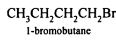
(ii)
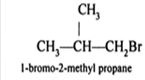
(iii)
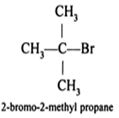
(iv)
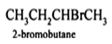
130.
(i) 4-Bromo-4-methylpent-2-ene 3° and Allylic halide
(ii) 1-Chloro-4-(2-methylpropyl) benzene Aryl halide
(iii) 1-Chloromethyl-3-(2,2-dimethylpropyl) Benzene Benzylic halide (1°)
(iv) 1-Bromo-2-(1-methylpropyl)benzene Aryl halide
131.
(i) 2-Chloro- 3-methylbutane 2° (secondry) halide
(ii) 3-Chloro-4-methylhexane 2° (secondry) halide
(iii) 1-Iodo-2, 2-dimethylbutane 1° (Primary) halide
(iv) 1-Bromo-3, 3-dimethyl-1-phenylbutane Benzylic halide (2°)
132.
This is nucleophilic substitution reaction. KCN is an ionic compound, it breaks into K+ and CN- in aqueous solution. It attacks 'C' of alkyl halide through carbon since C-C bond is more stable than C-N bond due to lack of polarity. However, AgCN is covalent compound, therefore, bond can form only throu9'h 'N' which has lone pair to donate for forming coordinate bond in isocyanide.
133.
In the given molecule, there are four different types of hydrogen atoms. Replacement of these hydrogen atoms will give the following four monochloro derivatives.
(i) (CH3)2CHCH2CH2Cl
(ii) (CH3)2CHCH(Cl)CH3
(iii) (CH3)2C(Cl)CH2CH3
(iv) CH3CH(CH2Cl)CH2CH3
134.
Attack of nucleophile on p-chloronitrobenzene gives carbanion (I) which is stabilized by x-electrons of the benzene ring as well as by the -R-effect and the -I-effect of the - NO2 group as shown below:
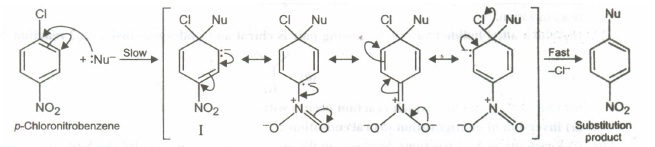
on the other hand attackp of the nucleophile on chlorobenzene gives carbanion (II) which is stablized only by the electrons of the beneze ring as shown below

Due to greater stability of the carbanion (I)over carbanion (Il), p-cWoronitrobenzene undergoes nucleophilic substitution faster than chlorobenzene.
135.
Four isomers are possible; their structures are:
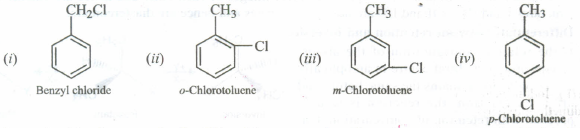
Just as in chlorobenzene, the C-Cl bond in O-, m- and p-chlorotol~enes, has some double bond character due to resonance. In contrast, in benzyl chloride, the C-Cl bond is a pure single bond. Hence, out of the four isomers, the C-Cl bond is the weakest in benzyl chloride. Alternatively, the cleavage of C-Cl bond in benzyl chloride gives benzyl cation which is stabilized by resonance.

On the other hand, cleavage of C-Cl bond in O-, m- or p-chlorotoluenes gives tolyl cation which is highly unstable. As a result, the energy of activation for the cleavage of C-l bond in benzyl chloride is much smaller than that of C-CI bond in O-, m- or p-chlorotoluenes. Consequently, the C-l bond is the weakest in benzyl chloride.
136.
(±)-2-Butanol contains equal amounts of the two enantiomers, i.e., (+)-2-butanol and (-)-2~butanol. Since (+)-2-butanol rotates the plane of polarized toward right, (-)-2-butanol rotates the plane of polarized towards left but to the same extent. The overall rotation is zero and hence (±)-2-butanol is optically inactive.
137.
If the relative configuration of the atoms/ groups around a chiral centre in an optically active molecule remains the same before and after the reaction, the reaction is said to proceed with retention of configuration. On the other hand, if the relative configuration of the atoms/groups around a chiral centre in the product is opposite to that in the reactant, the reaction is said to proceed with inversion of configuration. For example,
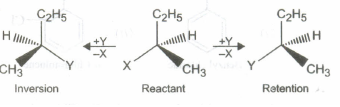
138.
Stereoisomers which are non-superimposable mirror images of each other are called enantiomers while stereoisomers which are not mirror images of each other are called diastereomers. For example, tartaric acid exists in three stereoisomeric forms I, II and III
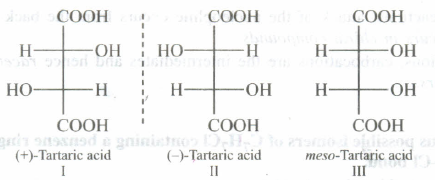
Structures 1 and II are non-superimposable mirror images of each other and hence are enantiomers. But structures 1and III (or II and III) are not mirror images and hence are diastereomers.
139.
Stereoisomers which are non-superirnposable mirror images of each other are called enantiomers. The enantiomers of 3-methylpent -1-ene are:
140.
A compound is said to be chiral if it exists in two stereoisomeric forms which are non-superimposable mirror images of each other. This property of non-superposability is called chirality and the two compounds which are nonsuperimposable mirror images of each other are called enantiomers.
For example, butan-2-ol is a chiral compound because it exists in two stereoisomers which are non-superimposable mirror images of each other.
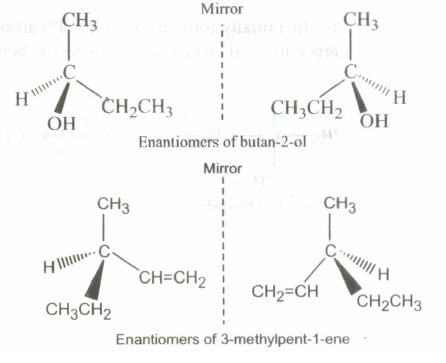
141.
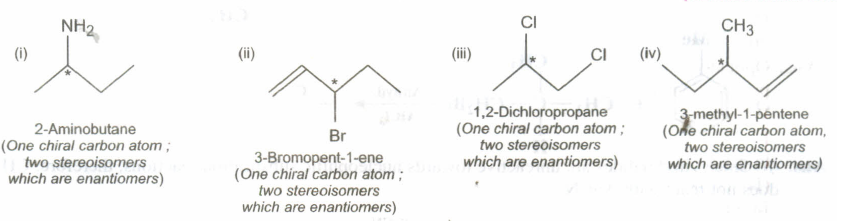
142.
A chiral molecule is one that is not superimposable on its mirror image. These molecules contain one asymmetric or chiral carbon atom. For example, butan-2-oI,
An achiral molecule, on the other hand, is one which is superimposable on its mirror image. For example, propan-2-ol.
143.
The alkyl halide (X) on treatment with Mg metal in dry ether gives a Grignard reagent which on treatment with ethanol gives propane. Therefore, the Grignard reagent may be either n-propylmagnesium halide or isopropylmagnesium halide and the corresponding alkyl halide (X) may be ether n-propyl halide or isopropyl halide.\(\)
\(\underset { n-Propyhalide(X) }{ { CH }_{ 3 }{ CH }_{ 2 }{ CH }_{ 2 }-X } \ \ \ \ or\ \underset { Isopropyl\ halide(X) }{ ({ { CH }_{ 3 }) }_{ 2 }CH-X } \overset { Mg/dry\ ether }{ \longrightarrow }\)
\( \\ \underset { n-Propyhalide(X) }{ { CH }_{ 3 }{ CH }_{ 2 }{ CH }_{ 2 }-MgX } \ or\ \ \underset { Isopropyl\ mag.\ halide }{ ({ { CH }_{ 3 }) }_{ 2 }CH-MgX } \ \overset { { CH }_{ 3 }{ CH }_{ 2 }OH }{ \longrightarrow } { CH }_{ 3 }{ CH }_{ 2 }OMgX\)
144.
The structures of all the possible alkyl halides that can be obtained by monohalogenation of 2-methylbutane are:
\(\underset { 1-Bromo-3-methylbutane }{ { C }H_{ 3 }-\overset { 3 }{ \underset { \overset { | }{ { C }H_{ 3 } } }{ C } } -{ C }H_{ 2 }\overset { 1 }{ C } { H }_{ 2 }Br } \quad \quad \quad \quad \underset { 2-Bromo-3-methylbutane }{ { C }H_{ 3 }-\overset { 3 }{ \underset { \overset { | }{ { C }H_{ 3 } } }{ C } } -\overset { 2 }{ \underset { \overset { | }{ Br } }{ CH } } -{ C }H_{ 3 } } \quad \quad \quad \quad \)

The Grignard reagents of all these four alkyl halides will give 2-methylbutane on treatment with ethanol.
145.
As the size of the alkyl group increases, S N2 reactivity decreases. Further, C-Br bond being weaker is easier to break than C-Cl bond. Therefore, the overaU increasing S N2 reactivity follows the order:
\(({ { C }H_{ 3 }) }_{ 2 }CHl<{ C }H_{ 3 }{ C }H_{ 2 }Cl<{ C }H_{ 3 }Cl<{ C }H_{ 3 }Br.\)
146.
When ethylbenzene is treated with Br2 in presence of light, the bromine free radical formed during the reaction, abstracts the IX (but not ) hydrogen from the ethyl group to form a resonance stabilized benzylic radical (I) which then reacts with Br2 to form I-bromo-I-phenylethane (II). This on treatment with NaCN undergoes nucleophilic substitution to form 2-phenylpropanenitrile (III).

147.
Due to stronger -I-effect of F than CI, CHF3 should be more acidic than CHCI3. But actually reverse is true. This is due to the reason that: CCI3- left after the removal of a proton from CHCI3 is stabilized by resonance due to the presence of d-orbitals on CI but: CF3- left after the removal of a proton from CHF3 is not stabilized by resonance due to the absence of d-orbitals on F.
148.
\({ CH }_{ 3 }-\underset { Propene }{ CH } ={ CH }_{ 2 }\overset { HBr.peroxide }{ \underset { (anti-Mark\ addition) }{ \longrightarrow } } \underset { 1-Bromopropane(X) }{ { CH }_{ 3 }{ CH }_{ 2 }{ CH }_{ 2 }-Br } \overset { HBr.peroxide }{ \underset { (Finkestein\ reaction) }{ \longrightarrow } } \underset { I-Iodopropane(Y) }{ { CH }_{ 3 }{ CH }_{ 2 }{ CH }_{ 2 }-I } \)
149.
The antiseptic propertics of iodoform is due to I2 which is liberated when iodoform comes in constact with skin.

150.
This resonance effect decreases the dipole moment of vinyl chloride to ethyl chloride.
151.
(i) CH3CH2CN, CH3CH2CONH2
(ii) CH3CH2CN, CH3CH2CH2NH2
152.
dipole-dipole interactions
153.
A 50 : 50 mixture of two enantiomers of any optically active compound is called a racemic mixture. It is always optically inactive since rotation caused by the molecules of one enantiomer. For example, an equimolar mixture of (+)-2 bromobutane and (-) -2- bromobutane is called a racemic mixture.
154.
A 50 : 50 mixture of two enantiomers of any optically active compound is called a racemic mixture. It is always optically inactive since rotation caused by the molecules of one enantiomer. For example, an equimolar mixture of (+)-2 bromobutane and (-) -2- bromobutane is called a racemic mixture.
155.
Prefixes (+),(-) and (±)(±) imply dextrorotatory,laevorotatory and racemic modification respectively.
156.
Its mirror image should be non-superimposable.
157.
A beam of light which was vibrations in only one plane is called plane polarised light.
158.
Reactivity increases as the carbon-halogen bond dissociation energy decreases, i.e., CH3F < CH3CI < CH3Br < CH3I.
159.
Because of bigger size and lower electronegativity, iodide ion can donate a pair of electrons more easily than bromide ion and hence iodide ion is a better nucleophile than bromide ion.
160.
Organic alkyl chlorides are widely used as solvents in industry because chlorides are not only more stable but are also more volatile than bromides and iodides.
161.
CH3I ; because of its lowest carbon content and haviest halogen i.e. I.
162.
Due to bigger size of Br over CI, the van der Waals forces of attraction are stronger in ethyl bromide then in ethyl chloride. Therefore, ethyl bromine has higher boilimh point than ethyl chloride.
163.
The b.p increases as the branching decreases (or the surface area increases), i.e., (CH3)3CBr < (CH3) CHCH2Br < CH3CH2CH2CH2Br.
164.
With HBr in presence of perxides \(\left(\mathrm{CH}_3 \mathrm{CH}=\mathrm{CH}_2 \stackrel{\text { HBr.peroxides }}{\longrightarrow} \mathrm{CH}_3 \mathrm{CH}_2 \mathrm{CH}_2 \mathrm{Br}\right)\)
165.
Because the products of the reaction. i.e., SO2 and HCI being gases escape into the atmosphere leaving behind alkyl chorides in almost pure state.
166.
(i) It is because of lower bond dissociation energy in the case of \({ R }^{ \_ \_ \_ }{ I }\) than \({ R }^{ \_ \_ \_ }{ Cl }\). \({ R }^{ \_ \_ \_ }{ Cl }\) is more polar than \({ R }^{ \_ \_ \_ }{ Br }\) , therefore, more reactive.
(ii) It is because it forms stable carbocation, therefore , follows SN 1 mechanism.

(iii) Ethers are not associated with H-bonding and have weak van der Waal's forces of attraction, hence they have low boiling point.
167.
In haloarenes, there is double bond character between C----X Bond due to resonance, therefore, it is less reactive and difficult to break.
168.
It is because tert-butyl carbocation is more stable than n-butyl carbocation, therefore, tertiary butyl chloride follows SN1 mechanism; whereas n-butyl bromide is primary halide, undergoes SN2 mechanism.
169.
The order of reactivity III > II > I
170.
The IUPAC name of DDT is 2,2-bis(4-chlorophenyl)-1,1,1-trichloroethane. The IUPAC name of bezenehexachloride is 1,2,3,4,5,6-hexachlorocyclohexane. Their use is banned in India and other countries because DDT is not metabolised very rapidly or solubilized effectively by animals.
171.
In an environment, diphenyl is formed during the incomplete combustion of mineral oil and coal. It is present in the exhaust gases of vehicles and in exhaust air from residential and industrial heating devices. Acute exposure to high levels of biphenyl has been observed to cause eye and skin irritation and toxic effect on the liver, kidneys and central/peripheral nervous system. Kidneys of animals are also affected due to the ingestion of biphenyls.
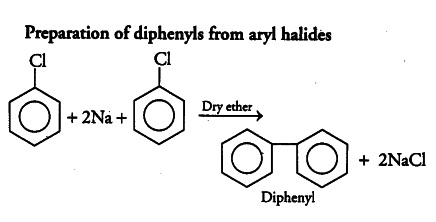
Aryl halides, when treated with sodium in the presence of dry ether gives diphenyl. This reaction is called Fitting reaction.
172.
(B) Undergoes SN1 reaction faster than (A) because in case of (B), the carbocation formed after the loss of Cl – is stabilised by resonance, whereas, no such stabilisation is possible in the carbocation obtained from (A).
173.
(iii) 2-Bromo-2 methylpropane will react with aq KOH most easily because it will form 3o carbocation which is most stable.
174.
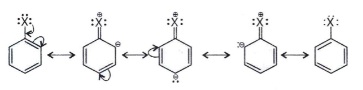
The functional group is ortho and para directing because electron density is maximum at ortho and partho para-positions.
175.
‘B’ is major product of the reaction.
176.
(b) will not react due to presence of double bond character in C---- O bond due to resonance.
177.
It helps in generation of electrophile.
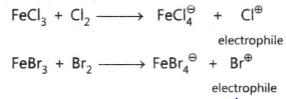
178.
In haloarenes the bond between the halogen and the benzene ring is not a single It has a partial double bond character due to resonance. Thus the attack of the nucleophile becomes more difficult in a haloarene than a haloakane.
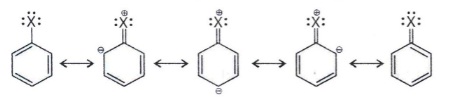
179.
It is because iodination is reversible as HI formed is good reducing agent which needs to be removed with the help of oxidising agent.
180.
In an aqueous solution, KOH almost completely ionises to give OH– ions. OH– ions is a strong nucleophile, which leads the alkyl chloride to undergo a substitution reaction to form alcohol.
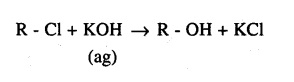
On the other hand, an alcoholic soln of KOH contains alkoxide (RO–) ion, which is a strong base. Thus, it can abstract a hydrogen from the β – carbon of the alkyl chloride and form an alkene by eliminating a molecule of HCl.
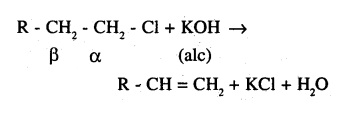
OH– ion is a much weaker base than RO– ion. Also, OH– ion is highly solvated in an aqueous solution and as a result the basic character of OH’ ion decreases. Therefore, it cannot abstract a hydrogen from β - carbon.
181.
(i) Freon-12 is used as refrigerant in fridge and air-conditioners.
(ii) DDT is used as insecticide.
182.
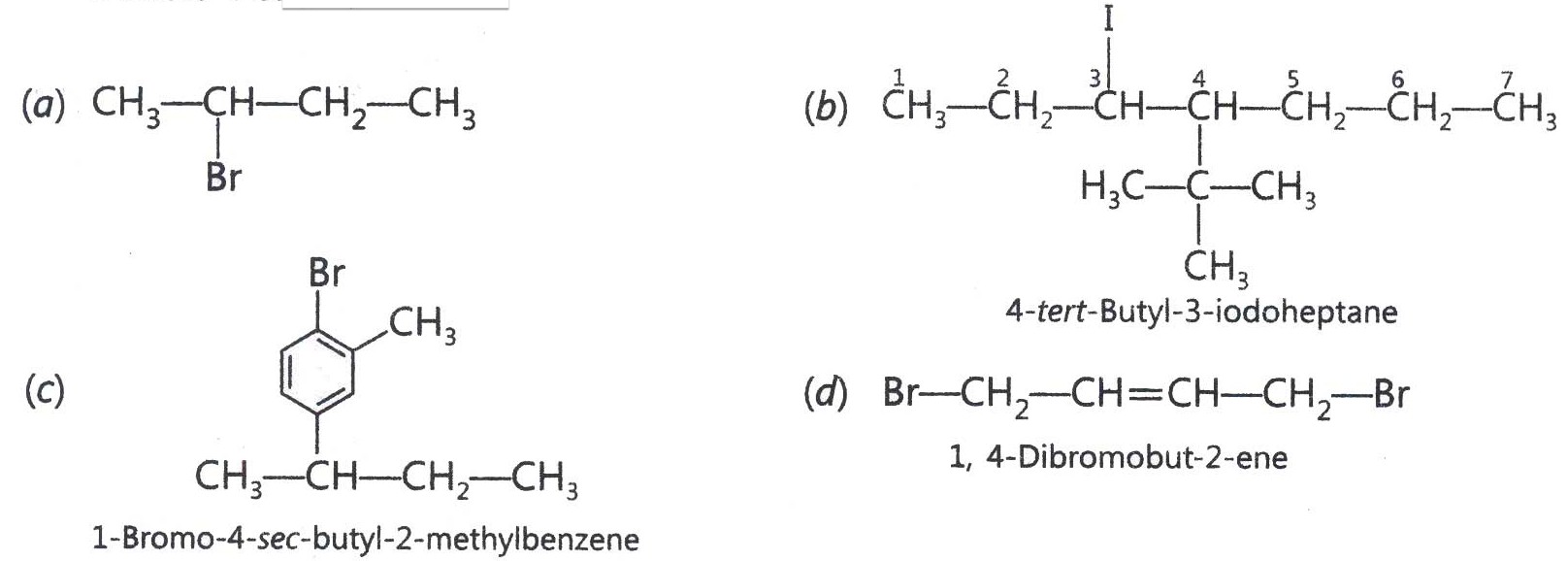
183.
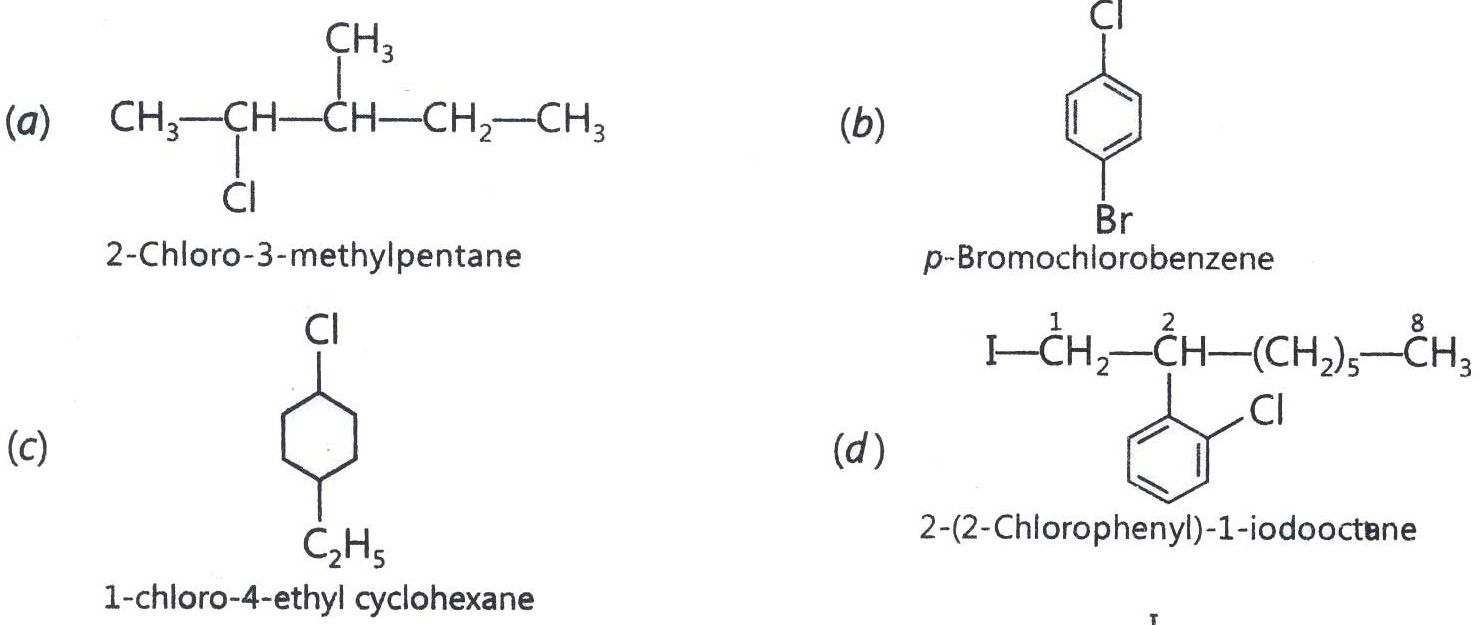
184.

185.
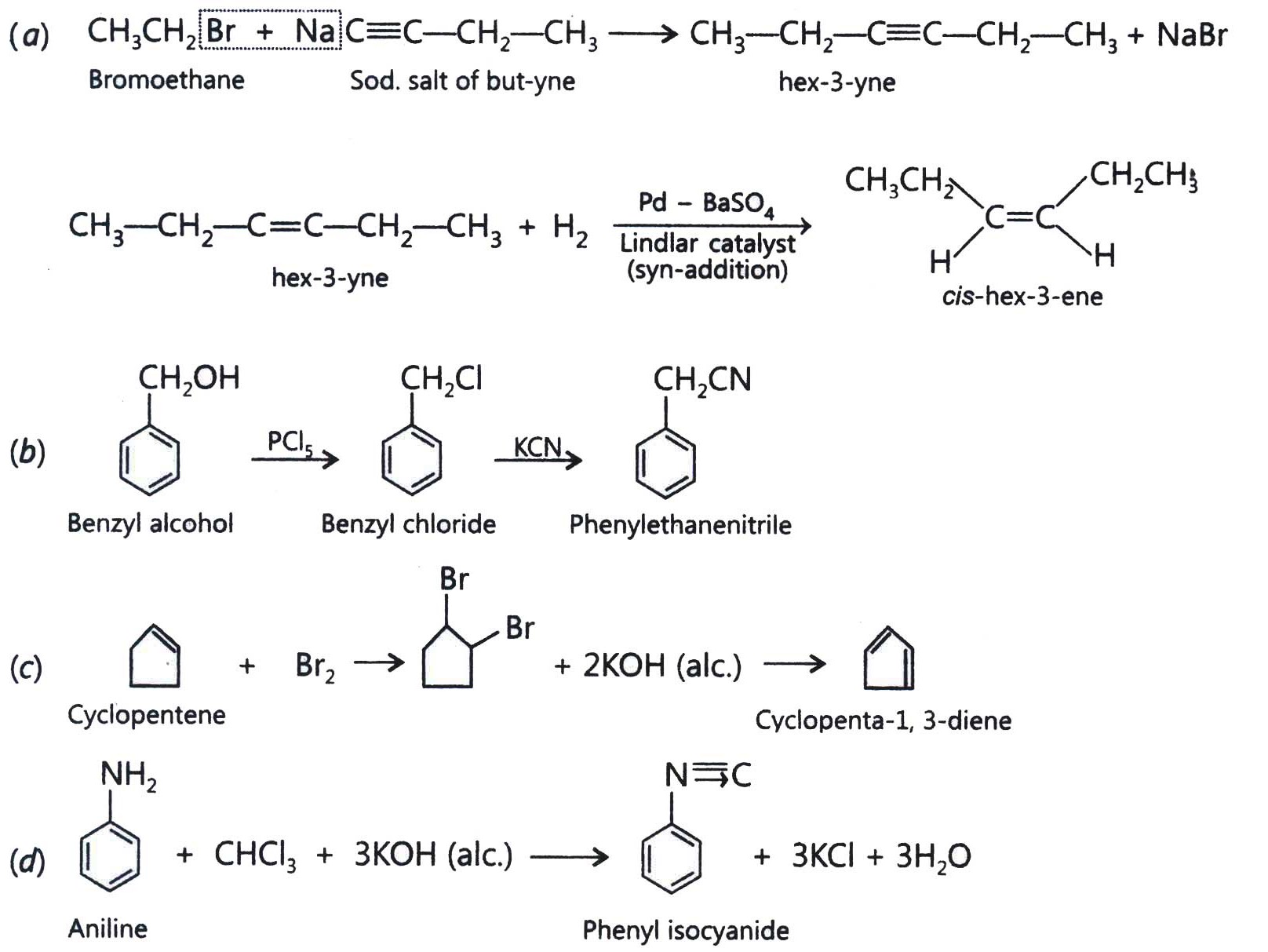
186.
(i) 2,4,6, trinitrochlorobenzene > 2,4 dinitrochlorobemzene > 4- nitrochlorobenzene
(ii) 2, 4, 6-trinitro-chlorobenzene >4-nitrochlorobenzene > Chlorobenzene > 4-chloro-1-methyl-benzene >
187.
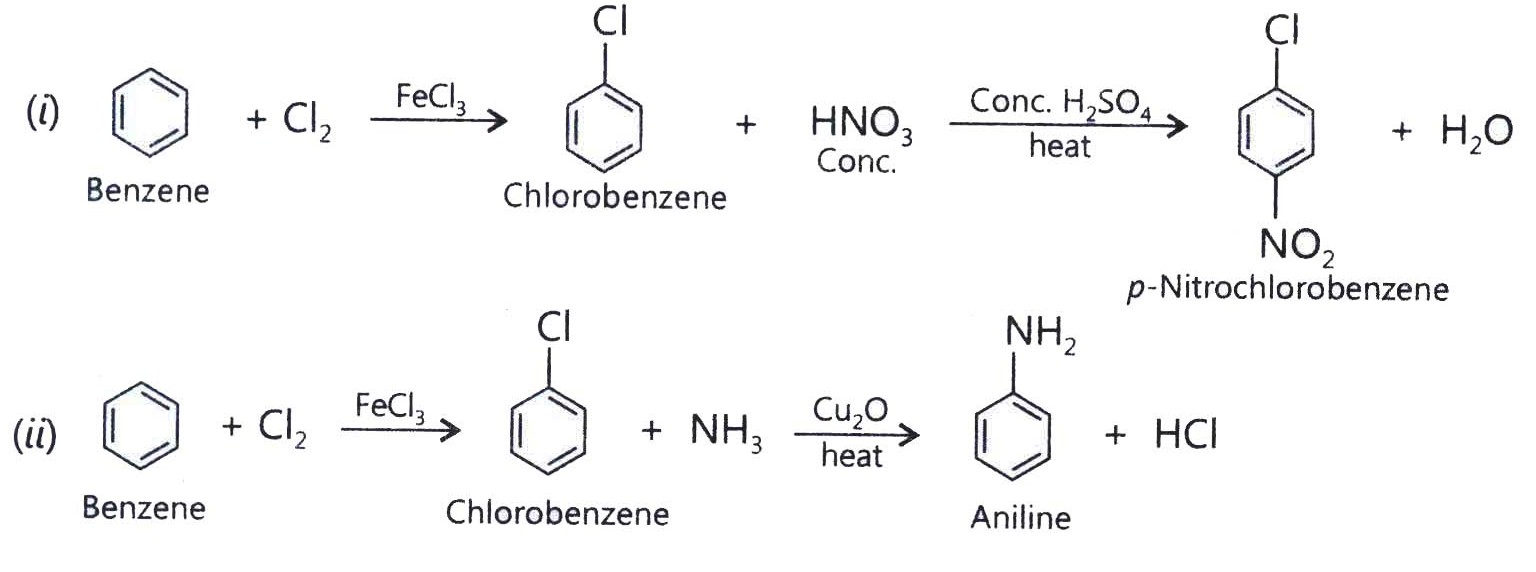
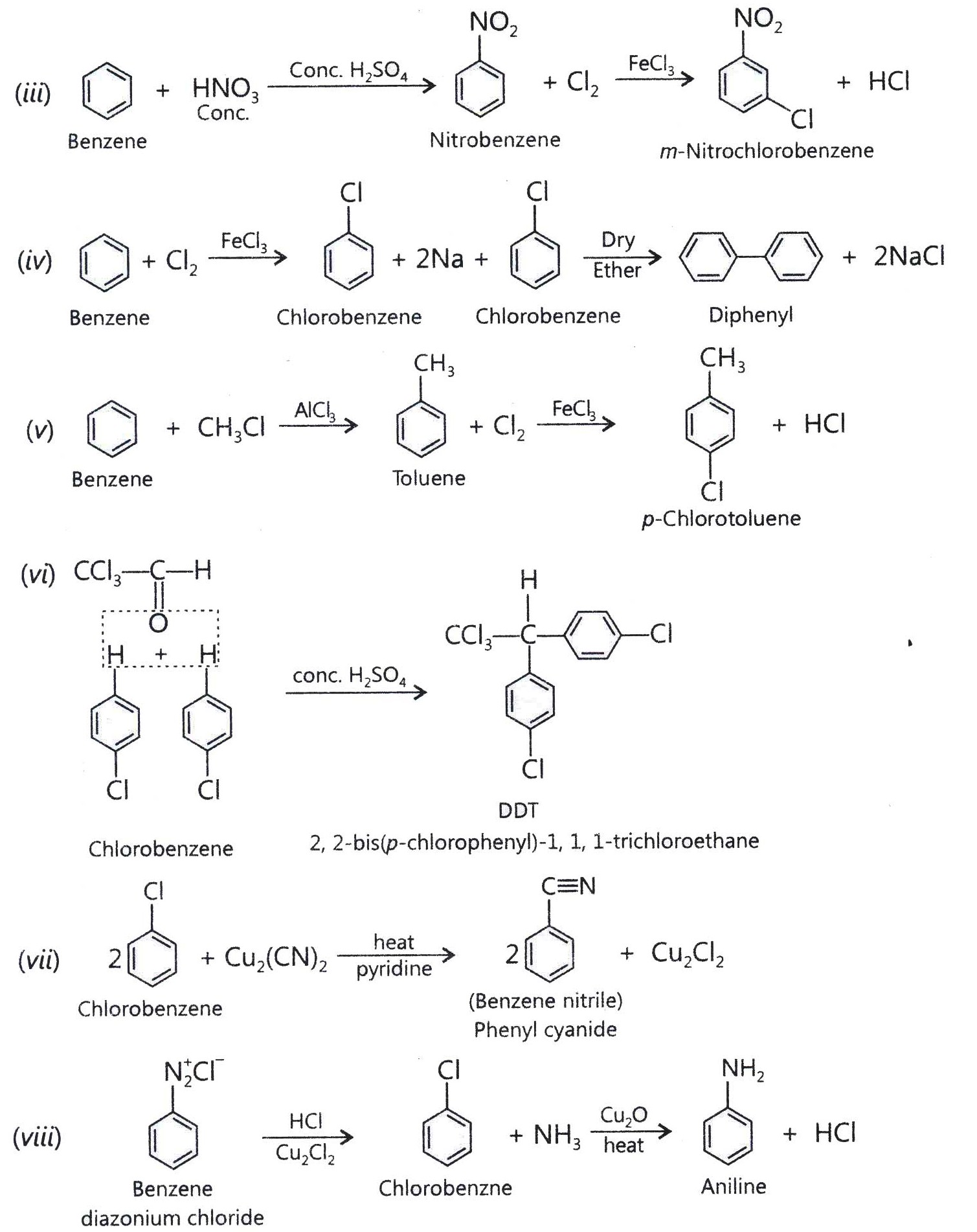
188.
Haloarenes are resonance stabilized. Due to resonance, C-X bond in haloarenes acquire a double bond character which makes them more stable than haloalkanes.
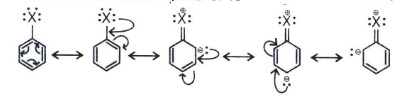
189.
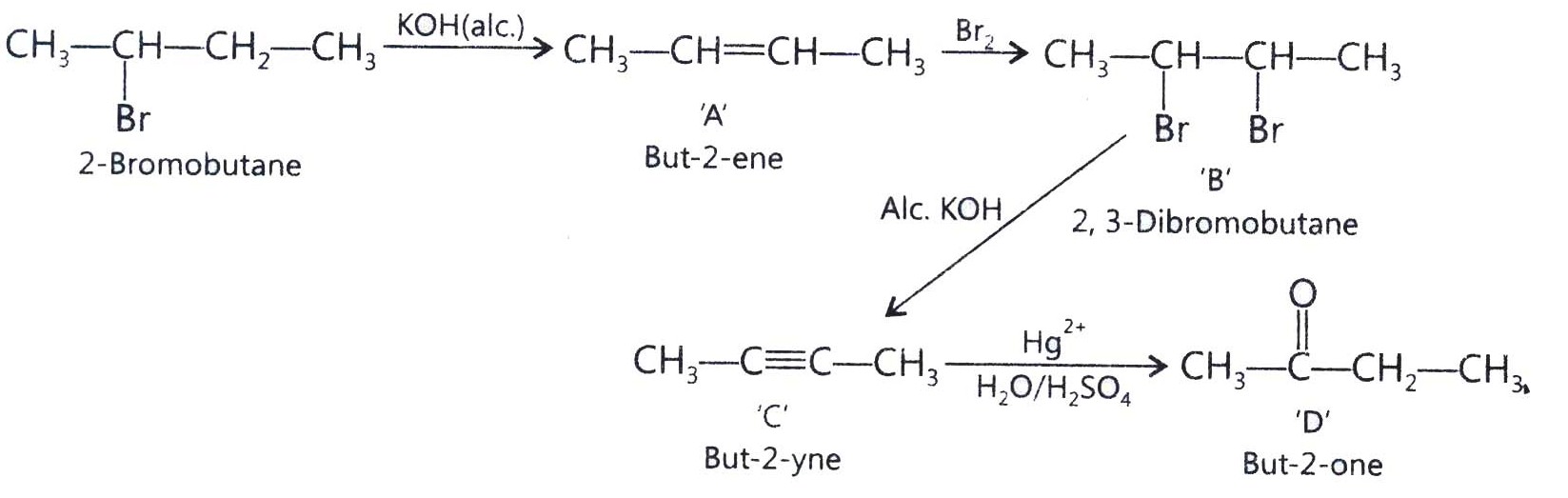
190.

191.
(i)
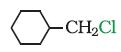
It is primary halide and therefore undergoes SN2 reaction faster.
(ii)

As iodine is a better leaving group because of its large size, it will be released at a faster rate in the presence of incoming nucleophile.
192.
(i) As C-X bond in aryl halide acquires a partial double bond character due to resonance while the C-X bond in alkyl halide is a pure single bond. Hence, Bond Strength of Haloarenes is more than that of Haloalkanes. So, Haloarenes are less reactive than Haloalkanes towards nucleophilic substitution.
193.
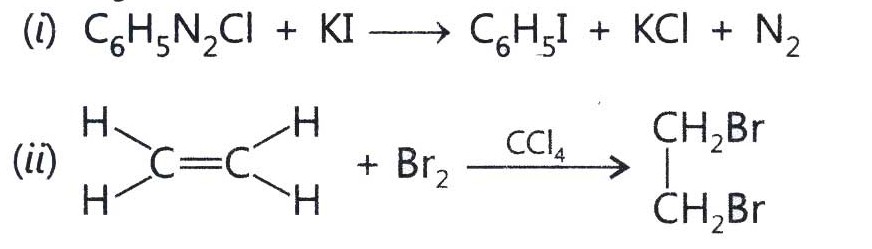
194.
In the SN2 mechanism, the reactivity of halides for same halides group increase down the group. Because increase in size increase, the halide becomes a better leaving group. Therefore, CH3I will react faster than CH3Br in SN2 reactions with OH-.
195.
(i)
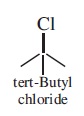
3° halide reacts faster than 2° halide because of the greater stability of tertiary carbocation.
(ii)
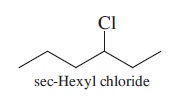
(ii) 2° halide reacts faster than 1° halide because of the greater stability of secondary carbocation than primary.
196.
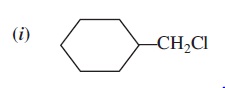
It is primary halide therefore undergoes SN2 reaction faster.
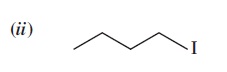
As iodine is a better leaving group because of its large size, it will be released at a faster rate in the presence of incoming nucleophile.
197.
The reaction is an SN2 reaction. In this reaction, CN- acts as the nucleophile and attacks the carbon atom to which Br is attacked. CN- is an ambident nucleophile and can attack through both C and N. In this case, it attacks through the C-atom.
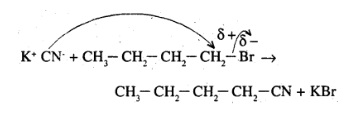
198.
Ambident Nucleophile- An anionic nucleophile, which has two nucleophilic centers, or two negative sites is known as an ambident nucleophile. This negative charge is delocalized due to resonance.
Example – Cyanide and Thiocyanate are examples of ambident nucleophiles.
-C≡N ↔ :C=N-
S=C=N- ↔ -S - C≡ N
199.
(i) Chirality: It is a geometrical property of a rigid object ( or molecules ) by which it gets such spatial arrangement of points or atoms that, the molecule becomes non-super imposable of its mirror image.
The chiral molecule of the object does not have any element of symmetry like, a mirror image, centre of inversion (i) etc.
3-bromopent-1-ene is represented as
(ii) Due to +I effect of alkyl groups the 2° carbonium ion CH3—CH+ —CH2—CH3 derived from sec. butyl chloride is more stable than the 1° carbonium ion CH3—CH2—C H2+ derived from n-propyl chloride. Therefore sec. butyl chloride gets hydrolyzed more easily than n-propyl chloride under SN1 conditions.
This is because; iodine is a better leaving group due to its large size. So, it will be released at a faster rate in the presence of an incoming nucleophile
200.
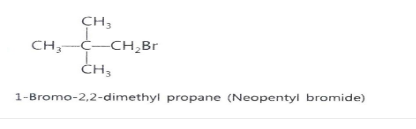
201.
Compound (II) is most symmetrical because it has both the -CH2 groups and Cl atoms para- to each other. Therefore, it fits in the crystal lattice better than the other two isomers and hence it has the highest melting point.
202.
It is racemic mixture which contains equal amounts of dexto and laborotatory substances. If half of the total number of molecules rotates the plane-polarised light towards left, remaining half of the molecules rotates towards right such that net optical rotation is zero.
203.
p-Dichlorobenzene is symmetrical, therefore, first into crystal lattice more readily and has higher melting point as compared to o- and m- isomers. Its solubility is higher because it is symmetrical and has more force of attraction with the solvent.
204.
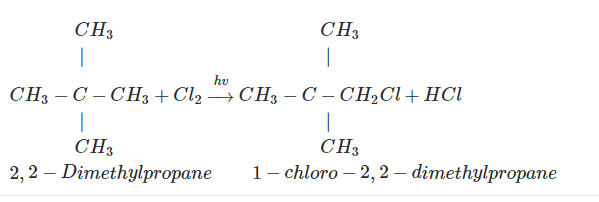
205.
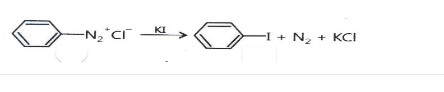
206.

207.
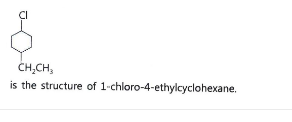
208.
1-Chloro-2, 2-dimethylpropane.
209.
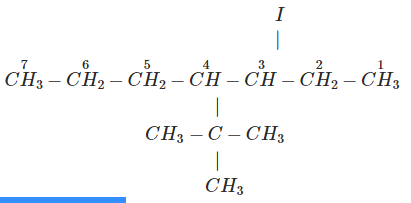
(4-tert-butyl-3-idoheptane)
210.
CH3−CH(Cl)CH2CH3 will be more easily hydrolysed because it will form secondary carbocation which is more stable than primary carbocation.
211.
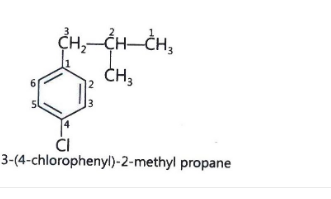
212.

213.
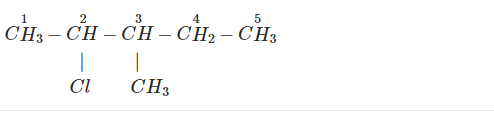
214.
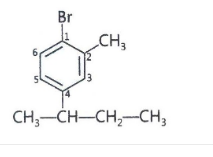
215.
1-Bromopentane will react faster in SN2 because it is 1o (primary) halide and has less stearic hidrance.
216.
3 - Bromopropene.
217.
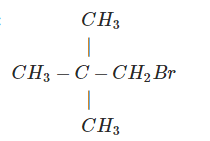
1-Bromo-2, 2-dimethylpropane
218.
3-Bromo-2-methylpropene.
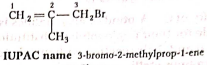
219.
(d)
(ii) < (iii) < (i)
220.
(c)
(i) < (iii) < (ii)
221.
(d)
222.
(c)
Cu2Br2
223.
(d)
224.
(a)
225.
(c)
X = o and p-chlorotoluene Y = trichloromethylbenzene
226.
(a)
1-phenylpropene
227.
(a)
A: Isomers; B : Enantiomer
228.
(a)
SN1 reaction
229.
(b)
230.
(b)
CH3Cl Na, Dry ether
231.
(c)
1, 4-dichlorobenzene
232.
(d)
vicinal dibromide
233.
(d)
1-bromo-2-methylpropane
234.
(a)
I, II, III
235.
(d)
(CH3)2C = CH2
236.
(d)
237.
(a)
238.
(c)
Benzyl bromide
239.
(d)
4
240.
(a)
241.
(d)
3° > 2° > 1°
242.
(b)
243.
(d)
244.
(a)
The rate of reaction depends on the concentration of only (ii).
245.
(a)
A carbocation will be formed as an intermediate in the reaction.
246.
(a)
Intermediate (iii) is unstable because in this carbon is attached to 5 atoms
247.
(a)
The given reaction follows SN2 mechanism
248.
(a)
(i) and (v) both are nucleophiles.
249.
(b)
II< I< III
250.
(b)
Swartz reaction
251.
(d)
1, 1-Dichloropropane
252.
(d)
253.
(c)
N, N dimethyl formamide
254.
(c)
255.
(d)
(iv)
256.
(c)
257.
(c)
I< II< IV < III
258.
(a)
C6H5C(CH3)C6H5Br
259.
(a)
260.
(a)
Cl- < Br- < I-
261.
(a)
Benzyl chloride
262.
(b)
unstability of phenyl cation
263.
(b)
2,2-dichlorobutane
264.
(d)
265.
(c)
X = I
266.
(c)
4-bromopent-2-ene
267.
(c)
2,2-bis (4-chlorophenyl)-1, 1,1-trichloroethane
268.
(d)
All of the above
269.
(d)
All of these
270.
(d)
All of the above
271.
(d)
Chloroform is also used as paint remover
272.
(b)
Benzophenone
273.
(b)
Tri halogenated methane and one primary amine
274.
(a)
phosgene
275.
(b)
C(NO2)CI3
276.
(d)
propan-2-ol
277.
(d)
(ii) < (iii) < (i)
278.
(c)
(i) < (iii) < (ii)
279.
(b)
2, 3
280.
(b)
(i), (ii) and (iii)
281.
(a)
(i)
282.
(a)
(i) < (ii) < (iii) < (iv)
283.
(b)
(i) < (ii) < (iii)
284.
(a)
285.
(d)
Mixture of (b) and (c)
286.
(a)
RX + NaI ⟶ RI + NaX
287.
(a)
POCI3 + HCI
288.
(c)
289.
(b)
(C) > (B) > (A)
290.
(d)
\(C{H}_{\mathit{3}}C{H}_{\mathit{2}}\mathit{-}\underset{\overset{\mathit{|}}{C{H}_{3}}}{\overset{\underset{\mathit{|}}{C{H}_{\mathit{3}}}}{C}}\mathit{-}OH\)
291.
(b)
halogen atom is more electronegative than carbon atom
292.
(b)
4
293.
(b)
sym-tribromobenzene and 1, 3, 5-tribromobenzene
294.
(b)
3-bromopentane
295.
(b)
1-bromo-2-ethyl-2-methylethane
296.
(b)
gem-dihalide
297.
(a)
allyl
298.
(a)
Chloral (CCI3CHO)
299.
(d)
Fusion with sodium metal followed by acidification with dil.HNO3 and addition of AgNO3 solution.
300.
(b)
CH3CH2CH2CH3
301.
(a)
C6H5CH2Br
302.
(a)
CICH2CH = CH2 \(\xrightarrow { NaF,acetone } \)
303.
(c)
Wurtz-Fitting reaction
304.
(b)
A was C6H5I
305.
(c)
4
306.
(c)
3-methyl-2-pentene
307.
(a)
2
308.
(a)
methylcyclobutane
309.
(d)
CH3__(CH2)2__CH(Br)__CH2CH3
310.
(b)
(ii), (iv) and (v)
311.
(a)
(CH3)3CD
312.
(a)
C6H5CH2OCH2C6H5
313.
(c)
1-Bromo-2-methylbutane
314.
(c)
CH3CH2CH = CH2
315.
(b)
3o > 2o > 1o
316.
(b)
CoF2
317.
(a)
HCl+ZnCl2
318.
(a)
p-ClC6H4CH2CH(CH3)2
319.
(a)
(CH3)2CHBr
320.
(a)
Ethylidene chloride
321.
(a)
Both the compounds form same product on treatment with alcoholic KOH
322.
(a)
2-Bromopentane
323.
(d)
1-Bromoethane < 1-Bromopropane <1-Bromobutane < Bromobenzene
324.
(a)
Butane < 1-Chlorobutane < 1-Bromobutane < 1-IOdobutane
325.
(a)
SN1 mechanism
326.
(a)
2-Bromobutane
327.
(d)
(CH3)3C-I
328.
(b)
SN2 reaction
329.
(b)
gem-dihalide
330.
(b)
Cl+
331.
(b)
1,2 Dichloroethane
332.
(a)
Cl2/UV light
333.
(b)
Electrophilic substitution reaction
334.
(a)
inversion more than retention reading to partial racemization.
335.
(b)
(\(\pm \))-butan-2-ol
336.
(b)
competting reaction for an SN2 reaction is rearrangement
337.
(c)
CH3CI > CH3CH2CI > (CH3)2CHCI > (CH3)3CCI
338.
(a)
I > III > II > IV
339.
(a)
CH3CI
340.
(c)
CH3X > 1o > 2o > 2o
341.
(d)
C6H5C(CH3)(C6H5)Br
342.
(c)
CI- < Br- < I-
343.
(a)
CH3O-
344.
(a)
D > C > A > B
345.
(d)
RX + KOH \(\longrightarrow\) ROH + KX
346.
(a)
CH3CI
347.
(c)
(iii) < (i) < (iv) < (ii)
348.
(c)
II < I < III
349.
(b)
m-Bromotoluene
350.
(d)
X = o- and p-chlororoluene, Y = trichloromethylbenzene
351.
(b)
SO2CI2 ; alc. KOH
352.
(d)
I2/HNO3
353.
(d)
CH3Br + AgF \(\longrightarrow\)
354.
(b)
Swarts reaction
355.
(a)
CH3\(\overset { \bullet }{ C } \)HCH2 CI
356.
(a)
H+
357.
(c)
one of the steps are exothermic in both the cases
358.
(d)
(I) ,(III) and (IV) only
359.
(c)
Chloroform
360.
(a)
C6H5CH2Cl+CH3Cl \(\overset { Na/ether }{ \longrightarrow } \)
361.
(a)
Fitting reaction
362.
(d)
3-Bromopentane
363.
(b)
Formation of carbonium ion
364.
(d)
CH2 = CHCH2X < PhCH2X < (CH3)2CHX < CH3CH2X
365.
(d)
ClCH2-CH=CH2
366.
(a)
Ethyl bromide ||+ alcoholic KCN
367.
(a)
C2H5SH
368.
(b)
R-I > R-Br > R-Cl > R-F
369.
(b)
CH3Cl, CH3F, CH3Br
370.
(d)
p-Dichlorobenzene
371.
(b)
CH3CH2CH2CH2Cl
372.
(b)
Allyl chloride
373.
(a)
by heating phenol with HF and KF
374.
(c)
R-Cl+NaI
375.
(c)
5
376.
(d)
(CH3)2C=CH2
377.
(d)
2-butene
378.
(a)
2-Chloropropane
379.
(d)
electrophilic addition
380.
SN2.
381.
C) Assertion is correct statement but reason is wrong statement.
Explanation:
Aryl halides undergo nucleophilic substitution with difficulty.
382.
C) Assertion is correct statement but reason is wrong statement.
Explanation:
Halogens are somewhat deactivating but o, p-directing. As a result, aryl halides undergo the usual electrophilic substitution reactions less readily than benzene.
383.
384.
D) Assertion is wrong statement but reason is correct statement.
Explanation:
Even though haloalkanes are polar molecules, still they are insoluble in water. This is due to the fact that haloalkanes can neither form hydrogen bonds with water nor they can break the hydrogen bonds already existing between water molecules.
385.
386.
387.
D) Assertion is wrong statement but reason is correct statement.
Explanation:
Halobenzenes become reactive to nucleophilic substitution reactions when electron withdrawing group (nitro, cyano) are present at ortholpara position. This is evident from the milder conditions required for hydrolysis in 2,4-dinitrochlorobenzene than chlorobenzene.
388.
389.
C) Assertion is correct statement but reason is wrong statement.
Explanation:
For the same alkyl group, the boiling points are in the order Rl>RBr >RCl>RF. This is because with the increase in the size of halogen, the magnitude of van der Waals' force increases and boiling point increases. Bond strength decreases as the size of the halogen increases. CH3F>CH3Cl>CH3Br>CH3l and stability decreases as the strength of C-X bond decreases.
390.
391.
392.
D) Assertion is wrong statement but reason is correct statement.
Explanation:
Vinylic halides are very less reactive towards nucleophilic substitution reactions because of resonance effect. Resonance gives rise to partial double bond character to the carbon-halogen bond making it stronger and therefore more difficult to cleave than a Csp3 - X bond. It also reduces the polarity of the carbon-halogen bond thereby making heterolysis difficult.
393.
B) Assertion and reason both are correct statements but reason is not correct explanation for assertion.
Explanation:
Due to steric hindrance, tertiary haloakanes do not prefer to undergo substitution but instead undergo elimination.
394.
B) Assertion and reason both are correct statements but reason is not correct explanation for assertion.
Explanation:
Greater the molecular mass, stronger the van der Waals' forces of attraction and hence higher is the melting point/boiling point.
395.
B) Assertion and reason both are correct statements but reason is not correct explanation for assertion.
Explanation:
p-Dichlorobenzene being more symmetrical than o-isomer fits closely in the crystal lattice and hence greater amount of energy is needed to break the crystal lattice. Thus, p-isomer is less soluble than o-isomer.
396.
(d) If both the Assertion and Reason are incorrect.
Explanation:
CCl4 is used as a fire extinguisher. The dense, non combustible vapours cover the burning substance and prevents the availability of oxygen around burning material.
397.
(c) If the Assertion is correct but Reason is incorrect.
Explanation:
CHCl3 is stored in dark bottles to prevent oxidation of CHCl3 in presence of sunlight.
398.
(b) If both Assertion and Reason are correct but Reason is not a correct explanation of the Assertion.
Explanation:
Carbon tetrachloride rises to atmosphere and deplete the ozone layer. This depletion of ozone layer increases exposure of UV rays to human being which lead to increase of skin cancer, eye diseases and disorder with disruption of the immune system.
399.
(c) If the Assertion is correct but Reason is incorrect.
Explanation:
Alkyl halides give polyalkylation products.
400.
(d) If both the Assertion and Reason are incorrect.
Explanation:
Assertion is false, because aryl halides do not undergo nucleophilic substitution under ordinary conditions. This is due to resonance, because of which the carbon– chlorine bond acquires partial double bond character, hence it becomes shorter and stronger and thus cannot be replaced by nucleophiles. However Reason is true.
401.
(a) Both (A) and (R) are correct, (R) is the correct explanation of (A).
Nucleophilic substitution of iodoethane is easier than chloroethane because bond energy or enthalpy of C-I bond is less than that of C-Cl bond. Thus, both (A) and (R) are correct and (R) is the correct explanation of (A).
402.
(a) Both (A) and (R) are correct, (R) is the correct explanation of (A).
Here, both (A) and (R) are true but (R) is not the correct explanation of (A).
Alkyl halides are insoluble in water because they are unable to form hydrogen bonds with water or break pre-existing hydrogen bonds.
403.
(b) Both (A) and (R) are correct, (R) is not the correct explanation of (A).
For the same alkyl group, the boiling point of alkyl halides decreases in the order RI > RBr > RCI > RF, because with increase in size and mass of halogen atom, the magnitude of van der Waals forces increases.
404.
(c) Assertion is correct but reason is wrong statement.
405.
(a) Assertion and reason both are correct and reason is correct explanation of assertion.
406.
(c) Assertion is correct but reason is wrong statement
407.
(e) Assertion and reason both are correct statements but reason is not correct explanation of assertion.
408.
(a) Assertion and reason both are correct and reason is correct explanation of assertion.
409.
(a) Assertion and reason both are correct and reason is correct explanation of assertion.

410.
(d) Assertion is wrong but reason is correct statement. AgCN reacts with CH3Cl to give isocyanide, KCN gives cyanide. CN- is ambident nucleophile,
411.
(b): As the size of the alkyl groups increases, the SN2 reactivity decreases, further C-Cl bond is stronger and more difficult to cleave than C- Br bond. So CH3Br is more reactive than (CH3)2CHCl.
412.
(a): 2-Chloro-3-methylbutane on treatment with alcoholic potash gives 2-methylbut-2-ene as main product.
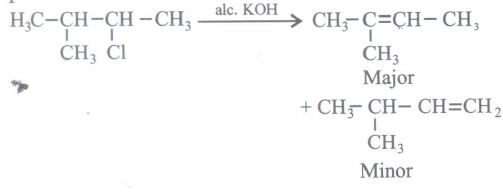
Elimination occurs according to Saytzeff rule, "the major product is one which involves elimination of H from less hydrogenated carbon''.
413.
(a): Due to steric hindrance, tertiary haloakanes do not prefer to undergo substitution but instead undergo elimination.
414.
(c): Carbocation intermediate obtained from C6H5CH(C6H5) Br is more stable than that obtained from C6H5CH(CH3)Br because it is stabilized by two phenyl groups due to resonance. Therefore, the former bromide is reactive than the latter in SN1 reactions.
415.
(c): In case of optically active alkyl halides, SN1 reactions are accompanied by racemisation. The carbocation formed is sp2 hybridised and planar. The attack of the nucleophile may be accomplished from either side resulting in a mixture of products with opposite configuration i.e., racemic mixture.
416.
(b): Among dichlorobenzenes, the p-isomer being symmetrical, packs closely in the crystal lattice and hence has much higher melting point than o- and m- isomers.
417.
(c): Aryl halides undergo nucleophilic substitution with difficulty.
418.
(a): Branching of chain makes molecule more compact and therefore, decreases the surface area. Due to decreases in surface area, the magnitude of van der Waals' force of attraction decreases and consequently, the boiling points of branched chain are less than those of straight chain compounds.
419.
(b) (A) is not correct but (R) is correct. In fact, the use of thionylchloride is preferred over phosphorus chlorides for preparing haloalkanes from alcohols because the other products of the reaction (i.e.) HCI(g) and SO2(g) being gases escape out leaving behind pure haloalkane.
420.
(a) In case of haloarenes, the phenyl cation formed as a result of self ionisation will not be stabilised by resonance and therefore SN1 mechanism is ruled out. Thus, both (A) and (R) are correct and (R) is correct explanation of (A).
421.
(d) 2- chloro -2 methylbutane (not neo pentyl chloride) is formed when neo pentyl alcohol reacts with HCI. The initially formed primary carbocation undergoes rearrangement to form more stable tertiary carbocation. The reaction is given as follows
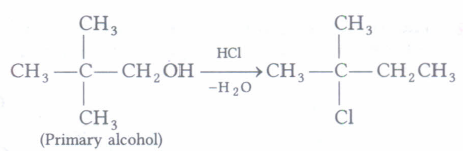
Therefore, (A) is incorrect but (R) is correct statement.
422.
(c) (A) is correct but (R) is incorrect. Presence of - Cl in chlorobenzene activates the ring at ortho and, para-positions and therefore, nitration of chlorobenzene leads to the formation of o- and p-chloro nitro chlorobenzene. NO2 group is a meta-directing group.
423.
(c) (A) is correct but (R) is incorrect. Bond cleavage in haloarene is difficult than haloalkane due to partial double bond character in C-Cl bond because of resonance, so it is less reactive towards nucleophilic substitution reaction. Phenyl carbo cation is very unstable.
424.
(a) It is necessary to avoid traces of moisture from Grignard reagent, because it reacts with water to give hydrocarbon.
\(\begin{equation} R M g X+H_{2} \mathrm{O} \longrightarrow R H+M g(O H) X \end{equation}\)
Both (A) and (R) are correct and (R) is correct explanation of (A).
425.
(a) In case of optically active alkyl halides, SN1 reactions are accompanied by racemisation. The carbocation formed in the slow step being sp2 -hybridised is planar (achiral). The attack of the nucleophile may be from either side resulting mixture of products. One product has same configuration, while other has opposite configuration. Thus, both (A) and (R) are correct and (R) is the correct explanation of (A).
426.
(c) (A) is correct but (R) is incorrect. Due to greater polarity as well as higher molecular mass as compared to the parent hydrocarbon, the intermolecular forces of attraction (dipole-dipole and van der Waals) are stronger in the halogen derivatives that is why the boiling points of chlorides, bromides and iodides are considerably higher than those of the hydrocarbons of comparable molecular mass.

12th Standard CBSE Syllabus & Materials
12th Standard CBSE
CBSE 12th Computer Science Python Revision Tour I - New Previous year Question Papers Study Material - QB365 Set A
NEW12th Standard CBSE
CBSE 12th Business Studies Planning Important Questions And Answers Study Material - QB365 Set A
NEW12th Standard CBSE
CBSE 12th Business Studies Business Environment Important Questions And Answers Study Material - QB365 Set A
NEW12th Standard CBSE
CBSE 12th Business Studies Principles of Management Important Questions And Answers Study Material - QB365 Set A



NCERT Books

Syllabus

Exam Pattern

Sample Question Papers

Previous year Question Papers

Important Notes

MCQ Practice test

NCERT Exemplers

Case study Questions

Image Based Questions

Passage based Questions

HOT Questions

Value Based Questions

Model Questions Papers
NCERT ( Book Back ) Questions

Assertion and Reason
Important Questions And Answers

CBSE 12th Standard CBSE Subjects
CBSE Standards








