
 100% FREE ACCESS
12th Standard CBSE Syllabus & Materials
12th Standard CBSE
CBSE 12th Economics Government Budget and the Economy Previous year Question Papers Study Material - QB365 Set A
NEW12th Standard CBSE
CBSE 12th Computer Science Interface Python with MySQL - New Previous year Question Papers Study Material - QB365 Set A
NEW12th Standard CBSE
CBSE 12th Computer Science Database Concept - New Previous year Question Papers Study Material - QB365 Set A
NEW12th Standard CBSE
CBSE 12th Computer Science Data Communication - New Previous year Question Papers Study Material - QB365 Set A
NEW12th Standard CBSE
CBSE 12th Computer Science Data Structures - New Previous year Question Papers Study Material - QB365 Set A
NEW12th Standard CBSE
CBSE 12th Computer Science Functions - New Previous year Question Papers Study Material - QB365 Set A

Published on: 02/11/2025
Download CBSE Class 12th Standard CBSE Chemistry question papers, sample papers, important questions, and previous year solved papers in PDF format. Get free study materials, NCERT solutions, and exam preparation resources for Class 12th Standard CBSE Chemistry
Questions + Answers key
Take MCQ Chemistry Test
1.
What are anomers ? Give two points of difference between two anomer of glucose.
2.
What products would be formed when a nucleotide form DNA containing thymine is hydrolysed ?
3.
What is the sum of mole fractions of all the components in a three component system ?
4.
Arrange the following solutions in the increasing order of their osmotic pressure
(a) 34.2 g/lit sucrose
(b) 60 g/lit urea (NH2 CONH2)
(c) 90 g/lit glucose
(d) 58.5 g/lit sodium chloride
Give reason in support of your answer
5.
Calculate the osmotic pressure in pascals exerted by a solution prepared by dissolving 1.0 g of polymer of molar mass 185,000 in 450 ml of water at 37oC.
6.
Henry's law constant for CO2 in water is 1.67 \(\times\)108 Pa at 298 K. Calculate the quality of CO2 in 500 ml of soda water when packed under 2.5 atm CO2 pressure at 298 K.
7.
Define the term solution. How many types of solutions are formed? Write briefly about each type with an example.
8.
How do you explain the absence of aldehyde group in the pentaacetate of D-glucose ?
9.
(a) What is meant by:
(i) Colligativge properties,
(ii) Molality of a solution?
(b) What concentration of nitrogen should be present in a glass of water at room temperature? Assume a temperature of 25oC, a total pressure of 1 atmosphere and mole fraction of nitrogen in air of 0.78. [KH for nitrogen = 8.42 \(\times\) 107 M/mm Hg]
10.
0.6 mL of acetic acid (CH3COOH), having density 1.06 g mL–1, is dissolved in 1 litre of water. The depression in freezing point observed for this strength of acid was 0.0205°C. Calculate the van’t Hoff factor and the dissociation constant of acid.
11.
The vapour pressure of water at \(25^{ ° }C\) IS 23.755 torr and the vapour pressure of a solution containing 5 g of solute X in 100 g of water is 23.402 torr. Calculate the molar mass of X.
12.
200 cm3 of an aqueous solution of a protein contains 1.26 g of the protein. The osmotic pressure of such a solution at 300 K is found to be 2.57 x 10⁻³ bar. Calculate the molar mass of the protein.
13.
Write the important structural and functional differences between DNA and RNA
14.
Define the following as related to proteins.
(i) Peptide linkage
(ii) Primary structure
(iii) Denaturation.
15.
Calculate the mass of urea (NH2CONH2) required in making 2.5 kg of 0.25 molal aqueous solution.
16.
Answer the following questions briefly:
(i) What are any two good sources of Vitamin A?
(ii) What are nucleotides?
17.
Which of the following statement is correct?
Fibrous proteins are generally soluble in water.
Albumin is an example of fibrous proteins.
In fibrous proteins, the structure is stabilised by hydrogen bonds and disulphide bonds.
pH does not affect the primary structure of protein.
18.
Which one of the following is not correct for an ideal solution?
It must obey Raoult's law
\(\triangle\)H = 0
\(\triangle\)V = 0
\(\triangle\)H = \(\triangle\)V \(\neq\)0
19.
Molality of an aqueous solution of urea is 4.44 mol/kg. In solution mole fraction of urea is
0.074
0.00133
0.008
0.0044
20.
Cheilosis and digestive disorders are due to the deficiency of
ascorbic acid
pyridoxine
thiamine
riboflavin
21.
Biuret test is not given by
urea
proteins
carbohydrates
polypepides
22.
Fructose reduces Tollens' reagent due to
asymmetric carbons
primary alcoholic group
secondary alcoholic group
enolisation of fructose followed by conversion to aldehyde by base
23.
Which of the following B group vitamins can be stored in our body ?
Vitamin B1
Vitamin B2
Vitamin B6
Vitamin B12
24.
Benzoic acid undergoes dimerisation in benzene solution. The van't Hoff factor (i) is related to the degree of association 'x' of the acid as
i = (1 - x)
i = (1 + x)
i = (1 - x/2)
1 = (1 + x/2)
25.
An aqueous solution of urea is found to boil at 100.52oC. Give Kb for water is 0.52 K kg mol-1 , the mole fraction of urea in the solution is
1
0.5
0.018
0.25
26.
Concentrated aqueous sulphuric acid is 98% H2SO4 by mass and has a density of 1.80 g mL-1. Volume of the acid required to make one litre of 0.1 M H2SO4 solution is
5.55 mL
11.10 mL
16.65 mL
22.20 mL
27.
28.
Carbohydrates are polyhydroxy aldehydes or ketones and are also called saccharides, Glucose is an example of monosaccharides. GIucose (C6H12O6) is an aldohexose and its open chain structure was assigned on the basis of many reactions as evidences like presence of carbonyl group, presence of straight chain, presence of five -OH groups etc.
Glucose is correctly named as D-(+)-glucose. Glucose is found to exist in two different crystalline forms which are named as \(\alpha\) and \(\beta\). Despite having the aldehyde group, glucose does not give 2, 4-DNP test.
(i) What is the correct structure of D-(+)-glucose?
(ii) Glucose on oxidation with HNO3 gives a dicarboxylic acid called saccharic acid. What does this result indicate?
(iii) The pentaacetate of glucose does not react with H2N-OH What does this result indicate?
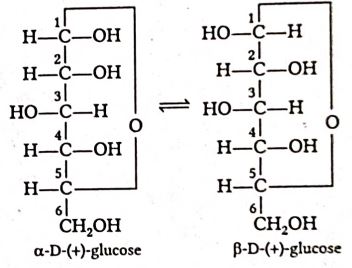
(iv) What is the difference between \(\alpha\)-D-glucose and \(\beta\)-D-glucose?
Or
Give the possible explanation for the following:
Glucose doesn't give 2,4-DNP test.
1.
The pair of optical Isomers which differ in the orientation of H and OH gp only at C1 Carbon atom are called anomers. Difference between two anomers of glucose :
| α-D (+) glucose | β-D (+) glucose |
| (1) The specific rotation is + 111°. | (1) The specific rotation is + 19.2°. |
| (2) The – OH gp at C1 is below the plane. | (2) The – OH gp at C-1 is above the plane |
2.
Besides thymine, the two other products are : 2-deoxy-Dribose and phosphoric acid.
3.
x1 + x2 + x3 = 1
4.
Sucrose < Glucose < Urea < NaCl
5.
\(\pi =CRT=\frac { n }{ V } RT\)
Here, number of moles of solute dissolved (n) \(=\frac { 1.0 \ g }{ 185,000 \ g \ { mol }^{ -1 } } =\frac { 1 }{ 185,000 } mol\)
\(V=450 \ mL=0.450 \ L,T={ 37 }^{ \circ }C=37+273=310 \ K\)
\( R=8.314 \ kPa \ L \ { K }^{ -1 }{ mol }^{ -1 }=8.314\times { 10 }^{ 3 }Pa \ L \ { K }^{ -1 }{ mol }^{ -1 }\)
Substituting these values, we get
\(\pi =\frac { 1 }{ 185,000 } mol \times\frac { 1 }{ 0.45 \ L }x \times8.314 \times { 10 }^{ 3 }Pa \ L \ { K }^{ -1 }{ mol }^{ -1 } \times 310 \ K=30.96 \ Pa.\)
6.
Here, \({ K }_{ H }=4.27\times { 10 }^{ 5 }mm,\ p=760 \ mm\)
Applying Henry's law, \(p={ K }_{ H }x, we \ have \ x=\frac { p }{ { K }_{ H } } =\frac { 760 \ mm }{ 4.27 \times{ 10 }^{ 5 }mm } =1.78 \times{ 10 }^{ -3 }\)
i.e., mole fraction of methane in benzene = 1.78 x 10⁻³
7.
A solution is a homogeneous mixture of two or more substances whose composition can be varied. On the basis of physical state of the component of solution, there are the following nine types of solutions:
(i) Gases Solutions
| Solute | Solvent | Type of solution | Examples |
| Gas | Gas | Solid in gas | Mixture of nitrogen and oxygen gases, air |
| Liquid | Gas | Liquid in gas | Chloroform mixed with nitrogen gas, |
| Solid | Gas | Gas in gas | Camphor in nit.rogen gas |
(ii) Liquid Solutions
| Solute | Solvent | Type of solution | Examples |
| Gas | Liquid | Gas in liquid | Oxygen dissolved in water, CO2 dissolved in water |
| Liquid | Liquid | Liquid in liquid | Ethanol dissolved in water |
| Solid | Liquid | Solid in liquid | Sucrose or salt in water |
(ii) Solid Solutions
| Solute | Solvent | Type of solution | Examples |
| Gas | Solid | Gas in solid | solidtion of hydrogen in palladium (phenomenon of adsorption of gases over metals) |
| Liquid | Solid | Liquid in solid | Mercury with sodium (amalgams) |
| Solid | Solid | Solid in solid | Copper dissolved in gold (alloys) |
8.
The cyclic hemiacetal form of glucose contains an OH group at C-I which gets hydrolysed in aqueous solution to produce the open chain aldehydic form which then reacts with \({ NH }_{ 2 }OH\) to form the
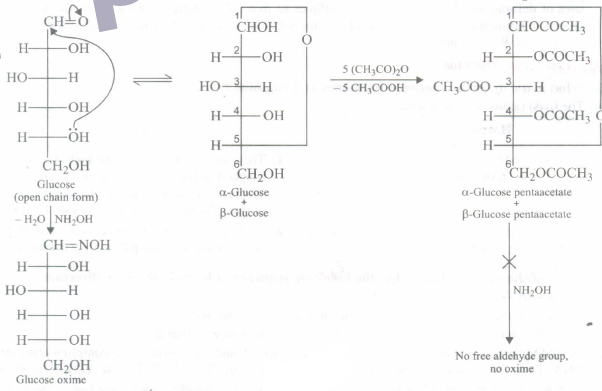
corresponding oxime. Thus, glucose contains an aldehydic group. In contrast, when glucose is reacted with acetic anhydride, the OH group at C-l, along with the four other OH groups at C-2, C-3, C-4 and C-6 form a pentaacetate. Since the pentaacetate of glucose does not contain a free OH group at C-l, it cannot get hydrolysed in aqueous solution to produce the open chain aldehydic form and hence glucose pentaacetate does not react with \({ NH }_{ 2 }OH\) to form glucose oxime.
This proves that glucose pentaacetate does not contain the aldehyde group
9.
(a)(i) Colligative properties: Those properties of solutions which depend upon the number of particles of solute and solvent but not on the nature of solute are called colligative properties.
(ii) Molality of a solution: It is defined as the number of moles of solute per 1000 g or 1 kg of solvent \(m={n_B\over W_A}\times 1000\ \ or\ \ m={W_B\over M_B\times W_A}\times 1000\)
where 'nB' is the number of moles of solute, WA is the weight of solvent in grams, WB is the amount of solute and 'MB' is molecular weight of solute.
(b) PN = 0.78 atm = 0.78 x 760 mm Hg
= 592.8 mm Hg
KH = 8.42 x 10⁻⁷ M/mm Hg
XN2 =?
XN2 = KH X PN2
[Since KH is given in M/mm Hg, therefore, this formula is being used]
=> xN = 8.42 x 10⁻⁷ M/mm Hg x 592.8mm Hg
=> XN2 = 4991.376 x 10-7 M
= 4.99 x 10⁻⁴ M
Also, \(x_{N_2}={n_{N_2}\over n_{N_2}+n_{H_20}}\)
\(={n_{N_2}\over n_{H_2O}}={n_{N_2}\over {1000\over 18}}\)
\(n_{N_2}={1000\over 18}\times 4.99 \times 10^{-4}\)
= 0.0277 M = 2.77 x 10⁻² M
10.
\(\text { Number of moles of acetic acid } =\frac{0.6 \mathrm{~mL} \times 1.06 \mathrm{~g} \mathrm{~mL}^{-1}}{60 \mathrm{~g} \mathrm{~mol}^{-1}} \\\)
\(=0.0106 \mathrm{~mol}=n\)
\(\text { Molality }=\frac{0.0106 \mathrm{~mol}}{1000 \mathrm{~mL} \times 1 \mathrm{~g} \mathrm{~mL}^{-1}}=0.0106 \mathrm{~mol} \mathrm{~kg}^{-1}\)
\(\triangle\)Tf = 1.86 K kg mol–1 x 0.0106 mol kg–1 = 0.0197 K
\(\text { van't Hoff Factor }(i)=\frac{\text { Observed freezing point }}{\text { Calculated freezing point }}=\frac{0.0205 \mathrm{~K}}{0.0197 \mathrm{~K}}=1.041\)
Acetic acid is a weak electrolyte and will dissociate into two ions: acetate and hydrogen ions per molecule of acetic acid. If x is the degree of dissociation of acetic acid, then we would have n (1 – x) moles of undissociated acetic acid, nx moles of CH3COO– and nx moles of H+ ions,
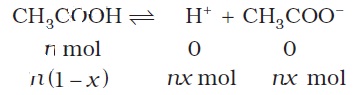
Thus total moles of particles are: n(1 – x + x + x) = n(1 + x)
\(i=\frac{n(1+x)}{n}=1+x=1.041\)
Thus degree of dissociation of acetic acid = x = 1.041– 1.000 = 0.041
Then [CH3COOH] = n(1 – x) = 0.0106 (1 – 0.041),
[CH3COO–] = nx = 0.0106 x 0.041, [H+] = nx = 0.0106 x 0.041.
\(\mathrm{K}_{\mathrm{a}}=\frac{\left[\mathrm{CH}_{3} \mathrm{COO}^{-}\right]\left[\mathrm{H}^{+}\right]}{\left[\mathrm{CH}_{3} \mathrm{COOH}\right]}=\frac{0.0106 \times 0.041 \times 0.0106 \times 0.041}{0.0106(1.00-0.041)}\)
= 1.86 × 10⁻⁵
11.
Mass of solute, \({ \omega }_{ B }=5g\)
Mass of water, \({ \omega }_{ A }=100g\)
Molecular mass of water, \({ M }_{ A }=18\)
Vapour pressure of water, \({ p }_{ A }^{ 0 }=23.755\quad torr\)
Vapour pressure of solution, \({ p }_{ A }=23.402\quad torr\)
Lowering in vapour pressure = \({ p }_{ A }^{ 0 }-{ p }_{ A }=23.755 -23.402=0.353\)
\(Now,\frac { { p }_{ A }^{ 0 }-{ p }_{ A } }{ { p }_{ A }^{ 0 } } =\frac { { \omega }_{ B }{ M }_{ A } }{ { \omega }_{ A }{ M }_{ B } }\)
\( \frac { 0.353 }{ 23.755 } =\frac { 5\times 18 }{ 100\times { M }_{ B } }\)
\( \\ or \ { M }_{ B }=\frac { 5\times 18 }{ 100\times 0.353 } \times 23.755=60.56\)
12.
The various quantities known to us are as follows: P = 2.57 × 10⁻³ bar,
V = 200 cm3 = 0.200 litre
T = 300 K
R = 0.083 L bar mol-1 K-1
Substituting these values in equation (2.42) we get
\(M_2=\frac{1.26 \mathrm{~g} \times 0.083 \mathrm{~L} \mathrm{bar} \mathrm{K}^{-1} \mathrm{~mol}^{-1} \times 300 \mathrm{~K}}{2.57 \times 10^{-3} \mathrm{bar} \times 0.200 \mathrm{~L}}=61,022 \mathrm{~g} \mathrm{~mol}^{-1}\)
13.
| S.No | DNA | RNA |
| 1 | The sugar present in DNA is 2-deoxy-D-(-)-ribose. | The sugar present in ~A is D-(-)-ribose. |
| 2 | DNA contains cytosine and thymine as pyrimidine bases. | RNA contains cytosine and uracil as pyrimidine bases. |
| 3 | DNA has double stranded u-helix structure. | RNA has single stranded \(\alpha \)-helix structure. |
| 4 | DNA molecules are very large; their molecular mass may vary from \(6\times { 10 }^{ 6 }-16-{ 10 }^{ 6 }u\) ,i.e., from six to sixteen million. | RNA molecules are much smaller with molecular mass ranging from 20,000 to 40,000 u. |
| 1. DNA has unique property of replication. | 1. RNA usually does not replicate. |
| 2. DNA controls the transmission of hereditary effects. | 2. RNA controls the synthesis of prote |
14.
(i) Peptide linkage. Peptide bond is formed by the condensation of two or more same or different n-amino acids. The condensation occurs between amino acids with the elimination of water. In this case, the carboxyl group of one amino acid and amino group of another amino acid get condensed with the elimination of water molecule.
The resulting \(\quad O\\ \quad \parallel \\ -C-NH-\) linkage is called peptide linkage. The formation of a dipeptide and the peptide
.png)
(ii) Primary structure. The primary structure of proteins gives the sequence in which the amino acids are linked in one or more polypeptide chains of proteins. This is shown below:
.png)
(iii) Denaturation. A process that changes the physical and biological properties of proteins without affecting the chemical composition of a protein is called denaturation. The denaturation is caused by certain physical or chemical treatments such as changes in pH, temperature, presence of some salts or certain chemical agents.
15.
0.25 Molal aqueous solution to urea means that
moles of urea = 0.25 mole
mass of solvent (NH2CONH2) = 60 g mol-1
\(\therefore\) 0.25 mole of urea = 0.25 x 60 = 15g
Mass of solution = 1000+15 = 1015g = 1.015 kg
1.015 kg of urea solution contains 15g of urea
\(\therefore\)2.5 kg of solution contains urea = 15/1.015 x 2.5 = 37 g
16.
(i) Carrot and Cod liver oil.
(ii) Nucleotides are monomers of nucleic acids. They consist of heterocyclic base, pentose sugar and phosphoric acid residue.
17.
(d)
pH does not affect the primary structure of protein.
18.
(d)
\(\triangle\)H = \(\triangle\)V \(\neq\)0
19.
(a)
0.074
20.
(d)
riboflavin
21.
(c)
carbohydrates
22.
(d)
enolisation of fructose followed by conversion to aldehyde by base
23.
(d)
Vitamin B12
24.
(c)
i = (1 - x/2)
25.
(c)
0.018
26.
(a)
5.55 mL
27.
28.
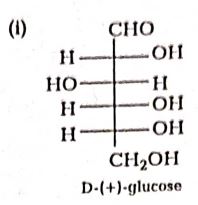
(ii) Glucose on oxidation with HNO3 gives saccharic acid. This indicates the presence of a one primary alcoholic (-OH) group in glucose.
(iii) The pentaacetate of glucose does not react with hydroxylamine which shows the absence of free aldehydic (-CHO) group.
(iv) In \(\alpha\)-D-glucose, the -OH group at C1 is towards right, whereas in \(\beta\)-D-glucose, the -OH group at C1 is towards left. Such a pair of stereoisomers which differ in the configuration only at C1 are called anomers.
Or
Actually, glucose exists in the cyclic hemiacetal form (hence the aldehyde group is not free) with only a small amount (<0.05%) of the open chain form.
Since, the concentration of the open chain form is low and its reaction with 2,4-DNP is reversible, therefore, formation of 2,4-DNP derivative cannot disturb the equilibrium to regenerate more open chain form from the cyclic hemiacetal form and hence, does not give this test.

12th Standard CBSE Syllabus & Materials
12th Standard CBSE
CBSE 12th Computer Science Python Revision Tour I - New Previous year Question Papers Study Material - QB365 Set A
NEW12th Standard CBSE
CBSE 12th Business Studies Planning Important Questions And Answers Study Material - QB365 Set A
NEW12th Standard CBSE
CBSE 12th Business Studies Business Environment Important Questions And Answers Study Material - QB365 Set A
NEW12th Standard CBSE
CBSE 12th Business Studies Principles of Management Important Questions And Answers Study Material - QB365 Set A



NCERT Books

Syllabus

Exam Pattern

Sample Question Papers

Previous year Question Papers

Important Notes

MCQ Practice test

NCERT Exemplers

Case study Questions

Image Based Questions

Passage based Questions

HOT Questions

Value Based Questions

Model Questions Papers
NCERT ( Book Back ) Questions

Assertion and Reason
Important Questions And Answers

CBSE 12th Standard CBSE Subjects
CBSE Standards








