
 100% FREE ACCESS
12th Standard CBSE Syllabus & Materials
12th Standard CBSE
CBSE 12th Economics Government Budget and the Economy Previous year Question Papers Study Material - QB365 Set A
NEW12th Standard CBSE
CBSE 12th Computer Science Interface Python with MySQL - New Previous year Question Papers Study Material - QB365 Set A
NEW12th Standard CBSE
CBSE 12th Computer Science Database Concept - New Previous year Question Papers Study Material - QB365 Set A
NEW12th Standard CBSE
CBSE 12th Computer Science Data Communication - New Previous year Question Papers Study Material - QB365 Set A
NEW12th Standard CBSE
CBSE 12th Computer Science Data Structures - New Previous year Question Papers Study Material - QB365 Set A
NEW12th Standard CBSE
CBSE 12th Computer Science Functions - New Previous year Question Papers Study Material - QB365 Set A

Published on: 02/11/2025
Download CBSE Class 12th Standard CBSE Chemistry question papers, sample papers, important questions, and previous year solved papers in PDF format. Get free study materials, NCERT solutions, and exam preparation resources for Class 12th Standard CBSE Chemistry
Questions + Answers key
Take MCQ Chemistry Test
1.
The standard electrode potential for Daniell cell is 1.1V. Calculate the standard Gibbs energy for the reaction:
Zn(s) + Cu2+(aq) → Zn2+(aq) + Cu(s)
2.
Calculate the ‘spin only’ magnetic moment of M2+(aq) ion (Z = 27).
3.
Write structural formulas and names of four possible aldol condensation products from propanal and butanal. In each case, indicate which aldehdye acts as nucleophile and which as electrophile.
4.
Depict the galvanic cell in which the reaction
\(Zn(s)+2{ Ag }^{ + }(aq)\longrightarrow { Zn }^{ 2+ }(aq)+2Ag(s)\) takes place. Further, show
(i) Which of the electrodes is negatively charged ?
(ii) The carriers of the current in the cell.
(iii) Individual reaction at each electrode.
5.
Describe a method for the identification of primary, secondary and tertiary amines. Also write chemical equations of the reactions involved.
6.
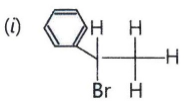
Write the products of the following reactions:
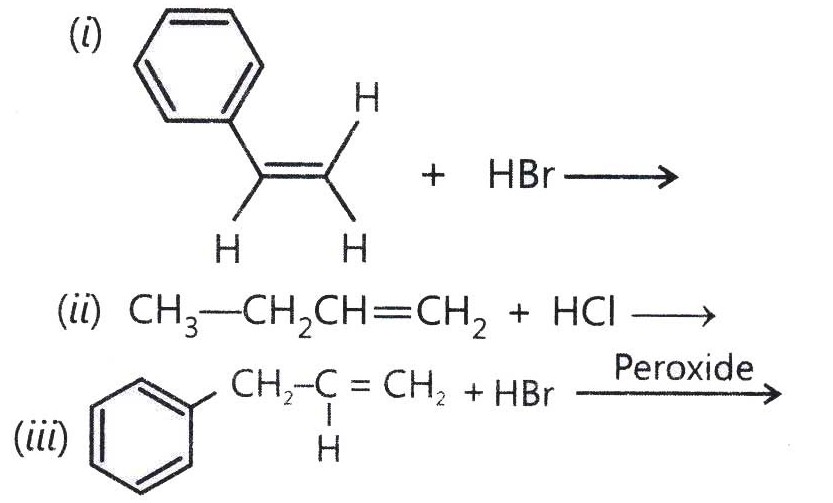
7.
Give the IUPAC names of the following compounds:
(i) CH3CH(Cl)CH(Br)CH3
(ii) CHF2CBrClF
(iii) ClCH2C \(\equiv \) CCH2Br
(iv) (CCl3)3CCl
(v) CH3C(p-ClC6H4)2CH(Br)CH3
(vi) (CH3)3CCH= C(Cl)C6H4I-p
8.
If N2 gas is bubbled through water at 293 K, how many millimoles of N2 gas would dissolve in 1 liter of water? Assume that N2 exerts a partial pressure of 0.987 bar. Given Henry's law constant for N2 at 293 K is 76.48 kbar.
9.
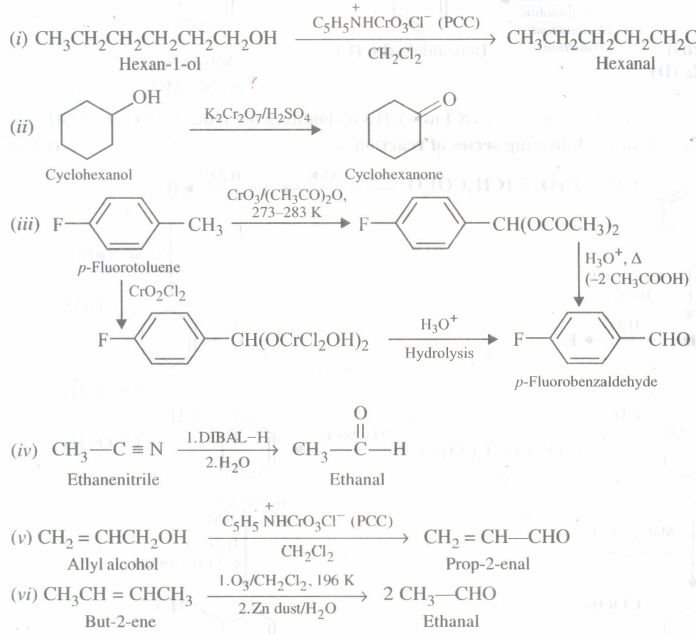
Give names of the reagents to bring about the following transformations
(i) Hexan-1-ol to hexanal,
(ii) Cyclohexanol to cyclohexanone
(iii) p-Fluorotoluene to p-fluorobenzaldehyde,
(iv) Ethanenitrile to ethanal.
(v) Allyl alcohol to propenal, and
(vi) But-2-ene to ethanal.
10.
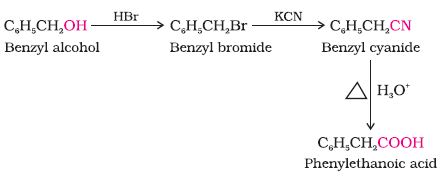
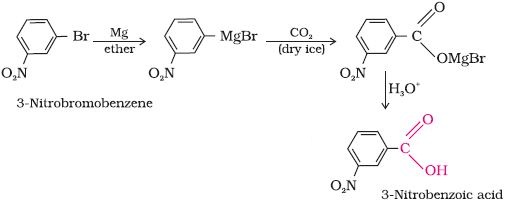
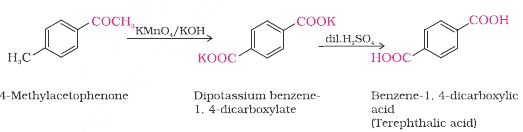
Write chemical reactions to affect the following transformations:
(a) Butan-1-ol to butanoic acid
(b) Benzyl alcohol to phenylethanoic acid
(c) 3-Nitrobromobenzene to 3-nitrobenzoic acid
(d) 4-Methylacetophenone to benzene-1, 4-di-carboxylic acid
(e) Cyclohexene to hexane-1,6-dioic acid
(f) Butanal to butanoic acid.
11.
Explain giving reason:
(a) The enthalpies of atomisation of the transition metals are high.
(b) Transition metals and many of their compounds show paramagnetic behaviour.
(c) The transition metals generally form coloured compounds.
(d) transition metals and their many compounds act as good catalyst.
12.
The half-life for decay of radioactive 14C is 5730 years. An archaeological artefact containing wood had only 80% of 14 C activity as found in a living tree. Calculate the age of the artefact
13.
Write the reactions involved in the following reactions:
(i) Clemmensen reduction
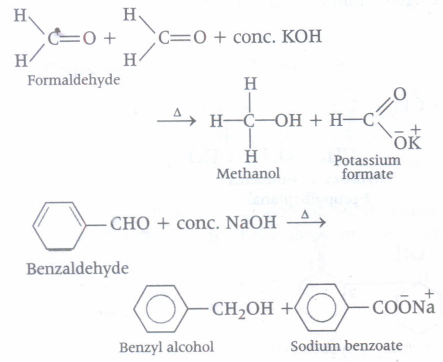
(ii) Cannizzaro reaction
14.
Write the IUPAC names of the following:
(i) \({ \left[ CO{ \left( { ONO } \right) ( }{ { { NH }_{ 3 }) }_{ 5 } } \right] }{ Cl }_{ 2 }\)
(ii) \({ K }_{ 3 }\left[ Cr{ \left( CN \right) }_{ 6 } \right] \)
\(\)
15.
For a reaction A \(\longrightarrow \) B, the rate of reaction becomes twenty seven times when the concentration of A is increased three ttimes. what is the order of the reaction?
16.
Why is benzenediazonium chloride not stored and is used immediately after its preparation?
17.
Define transition temperature in solubility of a solid in a liquid.
18.
Why is the vapour pressure of a liquid constant at constant temperature ?
19.
The reaction of toluene with Cl2 in presence of FeCl, gives "X", while the reaction of toluene with , in presence of light gives 'Y'. Thus, 'X' and 'Y' are
X = benzyl chloride Y = o and p-chlorotoluene
X = m-chlorotoluene Y = p-chlorotoluene
X = o and p-chlorotoluene Y = trichloromethylbenzene
X = benzyl chloride, Y = m-chlorotoluene
20.
Salicylic acid on heating with acetic anhydride in basic medium gives
Aspirin
Methyl salicylate
Phenyl salicylate
Acetyl salicylate
21.
The deficiency of vitamin C causes
scurvy
rickets
pyorrhea
pernicious anaemia
22.
Which of the following compounds will dissolved in an alkali solution after it undergoes reaction with Hinsberg's reagent?
CH3NH2
(CH3)3N
(C2H5)2NH
C6H5NHC6H5
23.
The correct order of acid strength of the following substituted phenol in water at 280C is
p-nitrophenol < p-fluorophenol < p-chlorophenol
p-chlorophenol < p-fluorophenol < p-nitrophenol
p-fluorophenoll < p-chlorophenol < p-nitrophenol
p-fluorophenoll < p-nitrophenol < p-chlorophenol
24.
Chlorination of toluene in presence of light and heat followed by treatment with aqueous NaOH gives :
o-Cresol
p-Cresol
2, 4 - Dihydroxytoluene
Benzoic acid
25.
Which of the following events does not occur during SN2 reaction mechanism?
Back side attack of nucleophile
Formation of carbonium ion
One step continuous process
100% inversion of configuration
26.
Which one of the following complexes will have four isomers?
[Co(en) (NH3)2Cl2]Cl
[Co(PPh3)2(NH3)2Cl2]Cl
[Co(en)3]Cl3
[Co(en)2Cl2]Br
27.
The reactivity order of halides for dehydrohalogenation is
R-F > R-Cl > R-Br > R-I
R-I > R-Br > R-Cl > R-F
R-I > R-Cl > R-Br > R-F
R- > R-I > R-Br > R-Cl
28.
A current is passed through two cells connected in series. The first cell contains X (NO3)3 (aq) and the second cell contains Y (NO3)2 (aq). The relative atomic masses of X and Y are in the ratio 1 : 2. What is the ratio of the liberated mass of X to that of Y ?
3 : 2
1 : 2
1 : 3
3 : 1
2 : 1
29.
A 0.004 M solution of Na2SO4 is isotonic with a 0.010 M solution of glucose at the temperature. The apparent degree of dissociation of Na2SO4 is
25%
50%
75%
85%
30.
Which of the following statements is correct ?
The rate of a reaction decreases with passage of time as the concentration od reactants decreases
The rate of a reaction is name at any time during the reation
The rate of a reaction is independent of temperature change
The rate of a reaction decreases with increase in concentration of reactant(s)
31.
Assertion : Cysteine can cross link peptide chains.
Reason : Ammo acids are classified as essential and non-essential amino acids.
Codes:
A) Assertion and reason both are correct statements and reason is correct explanation for assertion.
B) Assertion and reason both are correct statements but reason is not correct explanation for assertion.
C) Assertion is correct statement but reason is wrong statement.
D) Assertion is wrong statement but reason is correct statement.
32.
33.
Assertion: Reduction potential of Mn (+3 to +2) is more positive than Fe (+3 to +2).
Reason: Ionisation potential of Mn is more than that of Fe.
Codes:
(a) Assertion and reason both are correct statements and reason is correct explanation for assertion.
(b) Assertion and reason both are correct statements but reason is not correct explanation for assertion.
(c) Assertion is correct statement but reason is wrong statement.
(d) Assertion is wrong statement but reason is correct statement.
34.
In the following questions.an Assertion (A) is followed by a corresponding Reason (R) Use the following keys to choose the appropriate answer.
Assertion (A) Mercury cells give a constant voltage throughout its life.
Reason (R) Electrolyte KOH is not involved in the reaction.
Codes:
(a) Both (A) and (R) are correct, (R) is the correct explanation of (A).
(b) Both (A) and (R) are correct, (R) is not the correct explanation of (A).
(c) (A) is correct; (R) is incorrect.
(d) (A) is incorrect; (R) is correct.
35.
Read the passage given below and answer the following questions:
Ligands are atoms or ions which can donate electrons to the central atoms. Ligands can be monodentate, bidentate or polydentate as well. Few ligands can coordinate with the central atom through more than one site, these are called ambidentate ligands. When a di- or polydentate ligand uses its two or more donor atoms to bind a single metal ion, it is said to be a chelating ligand.
In these questions (i-iv), a statement of assertion followed by a statement of reason is given. Choose the correct answer out of the following choices.
(a) Assertion and reason both are correct statements and reason is correct explanation for assertion.
(b) Assertion and reason both are correct statements but reason is not correct explanation for assertion.
(c) Assertion is correct statement but reason is wrong statement.
(d) Assertion is wrong statement but reason is correct statement.
(i) Assertion: Glycinate ion is an example of mono dentate ligand.
Reason: Glycinate contains Nand O as donor atoms
(ii) Assertion: Oxalate ion is a bidentate ligand.
Reason: Oxalate ion has two donor atoms
(iii) Assertion: A chelating ligand must possess two or more lone pairs at such a distance that it may form suitable strain free 5 and 6 membered rings with the metal ion.
Reason: H2N- NH2 is a chelating ligand.
(iv) Assertion: In Zeise's salt coordination number of Pt is five.
Reason: Ethene is a monodentate ligand.
36.
Read the passage given below and answer the following questions:
The concentration of potassium ions inside a biological cell is at least twenty times higher than the outside. The resulting potential difference across the cell is important in several processes such as transmission of nerve impulses and maintaining the ion balance. A simple model for such a concentration cell involving a metal M is M(s) | M+(aq.; 0.05 molar) || M+(aq; 1 molar) |M(s).
The following questions are multiple choice questions. Choose the most appropriate answer:
(i) For the above cell,
| (a) \(E_{\text {cell }}<0 ; \Delta G>0\) | (b) \(E_{\text {cell }}>0 ; \Delta G<0\) | (c) \(E_{\text {cell }}<0 ; \Delta G^{\circ}>0\) | (d) \(E_{\text {cell }}>0 ; \Delta G^{\circ}<0\) |
(ii) The value of equilibrium constant for a feasible cell reaction is
| (a) < 1 | (b) = 1 | (c) > 1 | (d) zero |
(iii) What is the emf ofthe cell when the cell reaction attains equilibrium?
| (a) 1 | (b) 0 | (c) > 1 | (d) < 1 |
(iv) The potential of an electrode change with change in
| (a) concentration of ions in solution | (b) position of electrodes |
| (c) voltage of the cell | (d) all of these |
1.
\(\Delta_{\mathrm{r}} G^{\ominus}=-n F \mathrm{E}_{\text {(cell) }}^{\ominus}\)
n in the above equation is 2, F = 96487 C mol –1 and \(\mathrm{E}_{\text {(cell })}^{\ominus}\) = 1.1 V
Therefore, \(\Delta_{\mathrm{r}} G^{\ominus}\) = – 2 × 1.1V × 96487 C mol –1
= – 21227 J mol–1
= – 212.27 kJ mol–1
2.
Z = 27
\(\Rightarrow[\mathrm{Ar}] 3 \mathrm{~d}^{7} 4 \mathrm{~s}^{2}\)
\(\therefore \mathrm{M}^{2+}=[\mathrm{Ar}] 3 \mathrm{~d}^{7}\)
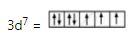
i.e., 3 unpaired electrons
\(\therefore n=3\)
\(\Rightarrow \sqrt{n(n+2)}=\mu\)
\(\Rightarrow \sqrt{3(3+2)}=\mu\)
\(\Rightarrow \sqrt{15}=\mu\)
\(\mu \approx 4 \mathrm{BM}\)
3.
.png)
4.
The cell will be represented as:
Zn (s) I Zn2+(aq) II Ag2+ (aq) I Ag (s)
(i) Anode, i.e., zinc electrode will be negatively charged.
(ii) The current will flow from silver to copper in the external circuit.
(iii) At Anode: Zn (s)⇾ Zn2+(aq) + 2 e-
At Cathode: Ag+ (aq) + e ⇾ Ag
5.
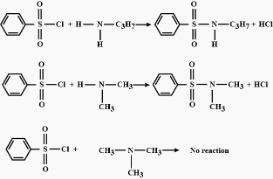
Hinsberg's test is used for the identification of primary, secondary, and tertiary amines.
Hinsberg's reagent is benzenesulphonyl chloride (C6H5SO2Cl).
It reacts differently with primary, secondary, and tertiary amines.
(i) Hinsberg's reagent reacts with primary amines to form N− alkylbenzenesulphonyl amide which is acidic in nature and soluble in alkali.
Note: N− alkylbenzenesulphonyl amide contains a strong electron-withdrawing sulphonyl group. Due to this, the H− atom attached to nitrogen can be removed easily. Hence, it is acidic.
(ii) Hinsberg's reagent reacts with secondary amines to form a sulphonamide which is insoluble in alkali.
Note: As there is no hydrogen atom attached to the N atom in the sulphonamide, it is not acidic and insoluble in alkali.
(iii) Hinsberg's reagent does not react with tertiary amines.
6.


7.
The IUPAC names of various compounds are given below in order:
(i) 2-Bromo-3-chlorobutane
(ii) 1-Bromo-1-chloro-1,22-trifluoroethane
(iii) 1-Bromo-4-chlorobut-2-yne
(iv) 2-(Trichloromethyl)-1,1,1,2,3,3,3-heptachloropropane
(v) 2-Bromo-3,3-bis (4-chlororphenyl) butane
(vi) 1-Chloro-1-(4-iodophenyl)-3,3-dimethylbut-1-ene
8.
The solubility of gas is related to the mole fraction in aqueous solution. The mole fraction of the gas in the solution is calculated by applying Henry’s law. Thus:
\(x(\text { Nitrogen })=\frac{p \text { (nitrogen) }}{K_{\mathrm{H}}}=\frac{0.987 \mathrm{bar}}{76,480 \mathrm{bar}}=1.29 \times 10^{-5}\)
As 1 litre of water contains 55.5 mol of it, therefore if n represents number of moles of N2 in solution,
\(x(\text { Nitrogen })=\frac{n \text { mol }}{n \text { mol }+55.5 \text { mol }}=\frac{n}{55.5}=1.29 \times 10^{-5}\)
(n in denominator is neglected as it is < < 55.5)
Thus n = 1.29 × 10⁻⁵ \(\times\) 55.5 mol = 7.16\(\times\) 10–4 mol
\(=\frac{7.16 \times 10^{-4} \mathrm{~mol} \times 1000 \mathrm{ \ mmol}}{1 \mathrm{~mol}}=0.716 \mathrm{ \ mmol}\)
9.
10.
(i)

(ii)
(iii)
(iv)
(v)
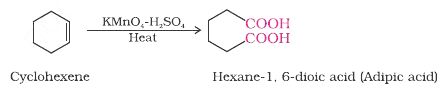
(vi)

11.
(a) The high enthalpies of atomization are due to a large number of unpaired electrons in their atoms. Therefore, they have stronger interatomic interactions and hence, stronger bonding between atoms. Thus, they have high enthalpies of atomization.
(b) Most of the compounds of transition elements contain unpaired electrons in their (n-1) d-subshells. Therefore, they are paramagnetic in nature and are attracted by the magnetic field. The magnetic character is expressed in terms of magnetic moment. The larger the number of unpaired electrons in a substance, the greater is the paramagnetic character and larger is the magnetic moment. The magnetic moment is expressed in Bohr magneton abbreviated as B.M. For example, Ti2+ has 2 unpaired electrons and has less magnetic moment than Mn2+which has 3 unpaired electrons. Mn2+has 5 unpaired electrons and has maximum magnetic moment among the divalent transition metal ions because d-subshell can have a maximum of 5 unpaired electrons.
(c) Most of the transition metal ions are colored both in the solid state and in aqueous solutions.The color of these ions is attributed to the presence of incomplete (n - 1) d subshell. The electrons in these metal ions can be easily promoted from one energy level to another in the same d-subshell. The amount of energy required to excite the electrons to higher energy states within the same d-subshell corresponds to the energy of certain colors of visible light. Therefore, when white light falls on a transition metal compound, some of its energy corresponding to a certain color, is absorbed causing promotion of d-electrons. This is known as d-d transitions. The remaining colors of white light are transmitted and the compound appears colored. For example, hydrated cupric compounds absorb radiations corresponding to red light and the transmitted color is greenish blue (which is complementary color to red color). Thus, cupric compounds have greenish-blue color
(d) Some transition metals and their compounds act too good catalysts for various reactions. This is due to their ability to show multiple oxidation states. The common examples are Fe, Co, Ni, V, Cr, Mn, Pt, etc.The transition metals form reaction intermediates with the substrate by using empty d-orbitals. These intermediates give reaction paths of lower activation energy and therefore, increase the rate of reaction.
12.
\({ t }_{ { 1 }/{ 2 } }=5730 \ years\)
\({ t }_{ { 1 }/{ 2 } }=\frac { 0.693 }{ k } \)
\(k=\frac { 0.693 }{ 5730 } { years }^{ -1 }\)
\(k=\frac { 2.303 }{ t } \log { \frac { { \left[ N \right] }_{ 0 } }{ \left[ N \right] } }\)
\(t=\frac { 2.303 }{ k } \log { \frac { 100 }{ 80 } }\)
\(=\frac { 2.303 }{ 0.693 } \times 5730\left[ \log { 5 } -\log { 4 } \right] \)
\(=\frac { 5730 }{ 0.3010 } \times \left[ 0.6990-0.6021 \right] \)
\(=\frac { 5730 }{ 0.3010 } \times 0.0969=\frac { 55.237 }{ 0.3010 } \)
\(=1844.64 \ years\approx 1845 \ years\)
13.
(i) Clemmensen reduction It involves reduction of carbonyl group of an aldehyde or ketone to methylene group to form a hydrocarbon. Clemmensen reduction is carried out in presence of Zn amalgam and conc. HCl.
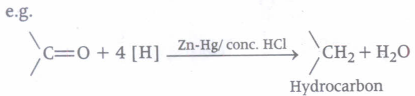
It is widely used for the reduction of aldehydes and ketones which are sensitive to alkalies.
(ii) Cannizzaro reaction Aldehydes which do not have ∝-H atoms undergo Cannizzaro reaction on treatment with cone. alkali. In this reaction, one molecule of aldehyde is reduced to alcohol while another molecule is oxidised to salt of carboxylic acid.
14.
(i) Pentaamminenitrito-O-cobalt(III) chloride
(ii) Potassium hexacyanochromate(III)
15.
3
16.
Benzenediazonium chloride is unstable. Therefore, it cannot be stored. Instead it is used immediately after its preparation.
17.
The temperature at which the trend of solubility changes (e.g., first increases and then decreases) is called the transition temperature.
18.
This is because it reaches a state of equilibrium where rate of evaporation = rate of condensation.
19.
(c)
X = o and p-chlorotoluene Y = trichloromethylbenzene
20.
(a)
Aspirin
21.
(a)
scurvy
22.
Amines form benzenesulphonamides which are soluble in alkali, i.e., option (a) is correct.
23.
(c)
p-fluorophenoll < p-chlorophenol < p-nitrophenol
24.
(d)
Benzoic acid
25.
(b)
Formation of carbonium ion
26.
(d)
[Co(en)2Cl2]Br
27.
(b)
R-I > R-Br > R-Cl > R-F
28.
(c)
1 : 3
29.
(c)
75%
30.
(a)
The rate of a reaction decreases with passage of time as the concentration od reactants decreases
31.
B) Assertion and reason both are correct statements but reason is not correct explanation for assertion.
Explanation:
Cysteine can cross link peptide chains through disulphide bridge. Cross linking by disulphide bridge can occur either between the distant, properly oriented parts of the same polypeptide chain (as in oxytocin or vasopressin) or between different polypeptide chains.
32.
33.
(c): Mn2+ = [Ar]3d5, Mn3+ = [Ar]3d4
Fe2+= [Ar]3d6, Fe3+= [Ar]3d5
Thus, Mn2+ has more stable configuration than Mn3+ while Fe3+has more stable configuration than Fe2+. Hence, reduction potential for Mn3+/Mn2+ couple is more positive than Fe3+/ Fe2+. As we move across the period, ionisation potential increases, thus, ionisation potential of Fe is more than that of Mn.
34.
(c) Mercury cell gives the constant voltage throughout its life because the overall reaction does not involve any ion in the solution, concentration of which changes during its whole life.Thus, (A) is correct but (R) is incorrect.
35.
(i) (d): Glycinate ion is an example of bidentate ligand. It contains Nand O as donor atoms.
(ii) (a)
(iii) (c) : H2N - NH2 does not act as chelating ligand.
The coordination by hydrazine leads to a three member highly unstable strained ring and thus it does not act as chelating agent.
(iv) (d): In Zeises salt, coordination no. of Pt is 4. Ethylene is a mono dentate ligand.
36.
(i) (b) : \(\begin{array}{l} M \longrightarrow M^{+}+e^{-} \\ (1 \cdot M)(0.05 M) \end{array}\)
For concentration cell, \(E_{\text {cell }}=-\frac{0.059}{1} \log \frac{0.05}{1}\)
\(E_{\text {cell }}=-\frac{0.059}{1} \log \left(5 \times 10^{-2}\right)\)
\(E_{\text {cell }}=-\frac{0.059}{1}[(-2)+\log 5]-0.059(-2+0.698)\)
= -0.059(-1.302) = 0.0768
\(\Delta G=-n F E_{\text {cell }}\)
If Ecell is positive, \(\Delta G\) is negative.
(ii) (c) : \(K=\operatorname{antilog}\left(\frac{n E^{\circ}}{0.0591}\right)\)
For feasible cell, Eo is positive, hence from the above equation K > 1 for a feasible cell reaction.
(iii) (b)
(iv) (a)

12th Standard CBSE Syllabus & Materials
12th Standard CBSE
CBSE 12th Computer Science Python Revision Tour I - New Previous year Question Papers Study Material - QB365 Set A
NEW12th Standard CBSE
CBSE 12th Business Studies Planning Important Questions And Answers Study Material - QB365 Set A
NEW12th Standard CBSE
CBSE 12th Business Studies Business Environment Important Questions And Answers Study Material - QB365 Set A
NEW12th Standard CBSE
CBSE 12th Business Studies Principles of Management Important Questions And Answers Study Material - QB365 Set A



NCERT Books

Syllabus

Exam Pattern

Sample Question Papers

Previous year Question Papers

Important Notes

MCQ Practice test

NCERT Exemplers

Case study Questions

Image Based Questions

Passage based Questions

HOT Questions

Value Based Questions

Model Questions Papers
NCERT ( Book Back ) Questions

Assertion and Reason
Important Questions And Answers

CBSE 12th Standard CBSE Subjects
CBSE Standards








