
 100% FREE ACCESS
12th Standard CBSE Syllabus & Materials
12th Standard CBSE
CBSE 12th Economics Government Budget and the Economy Previous year Question Papers Study Material - QB365 Set A
NEW12th Standard CBSE
CBSE 12th Computer Science Interface Python with MySQL - New Previous year Question Papers Study Material - QB365 Set A
NEW12th Standard CBSE
CBSE 12th Computer Science Database Concept - New Previous year Question Papers Study Material - QB365 Set A
NEW12th Standard CBSE
CBSE 12th Computer Science Data Communication - New Previous year Question Papers Study Material - QB365 Set A
NEW12th Standard CBSE
CBSE 12th Computer Science Data Structures - New Previous year Question Papers Study Material - QB365 Set A
NEW12th Standard CBSE
CBSE 12th Computer Science Functions - New Previous year Question Papers Study Material - QB365 Set A

Published on: 07/03/2026
Download CBSE Class 12th Standard CBSE Chemistry question papers, sample papers, important questions, and previous year solved papers in PDF format. Get free study materials, NCERT solutions, and exam preparation resources for Class 12th Standard CBSE Chemistry
Questions + Answers key
Take MCQ Chemistry Test
1.
Calculate the molarity of a solution containing 5 g of NaOH in 450 mL solution.
2.
(i) Gas (A) is more soluble in water than Gas (B) at the same temperature. Which one of the two gases will have the higher value of KH (Henry's constant) and why?
(ii) In non-ideal solution, what type of deviation shows the formation of maximum boiling azeotropes ?
3.
(i) Write the colligative property which is used to find the molecular mass of macromolecules.
(ii) In non-ideal solution, what type of deviation shows the formation of minimum boiling azeotropes?
4.
Define an ideal solution and write one of its characteristics.
5.
State the following:
(i) Raoult's law in its general from in reference to solutions.
(ii) Henry's law about partial pressure of a gas in a mixture.
6.
How does sprinkling of salt help in clearing the show covered roads in hilly areas ? Explain the phenomenon involved in the process.
7.
Calculate the molarity of each of the following solutions :
(a) 30g of Co (NO3)2. 6H2O in 4.3 L of solution
(b) 30 mL of 0.5 M H2SO4 dilute to 500 mL.
8.
Calculate molality of 2.5 g of ethanoic acid (CH3COOH) in 75 g of benzene.
9.
Given below is the sketch of a plant carrying out a process.
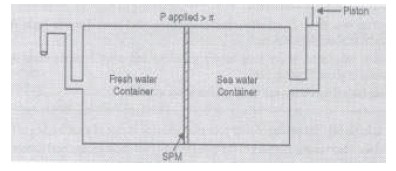
(i) Name the process occurring in the above plant.
(ii) To which container does the net flow of solvent take place ?
(iii) Name one SPM which can be used in this plant.
(iv) Give one practical use of the plant.
10.
Why is liquid ammonia bottle first cooled in ice before opening it ?
11.
Why is the vapour pressure of a liquid constant at constant temperature ?
12.
What is the effect of temperature on molarity of a solution ?
13.
Why do gases always tend to be less soluble in liquids as the temperature is raised?
14.
State Henry’s law and mention some important applications.
15.
State Raoult's law for a solution conatining volatile components. How does Roult's law become a special case of Henry's law?
16.
(a) Define the following terms:
(i) Ideal solution
(ii) Azeotrope
(iii) Osmotic pressure
(b) A solution of glucose (C6H12O6) in water is labelled as 10% by weight. What would be the molality of the solution?
(Molar mass of glugose = 180 g mol-1)
17.
(i) Define molality in terms of elevation in boiling point.
(ii) Derive the relation between elevation in boiling point and the molecular mass of a non-volatile solute.
18.
Give reasons for the following:
(a) Measurement of osmotic pressure method is preferred for the determination of molar masses of macro molecules such as proteins and polymers.
(b) Aquatic animals are more comfortable in cold 1 water than in warm water.
(c) Elevation of boiling point of 1M KCI solution is nearly double than that of 1M sugar solution.
19.
Amongst the following compounds, identify which are insoluble, partially soluble and highly soluble in water?
(i) Phenol
(ii) Toluene
(iii) Formic acid
(iv) Ethylene glycol
(v) Chloroform
(vi) Pentanol
20.
Based on solute-solvent interactions, arrange the following in the increasing order of solubility in n-octane and explain. Cyclohexane, KCI, CH3OH, CH3CN.
21.
The depression in freezing point of water observed for the same molar concentrations of acetic acid, trichloroacetic acid and trifluoroacetic acid increases in the order as stated above. Explain briefly.
1.
\(\text { Moles of } \mathrm{NaOH}=\frac{5 \mathrm{~g}}{40 \mathrm{~g} \mathrm{~mol}^{-1}}=0.125 \mathrm{~mol}\)
Volume of the solution in litres = 450 mL / 1000 mL L-1
\(\text { Molarity }=\frac{0.125 \mathrm{~mol} \times 1000 \mathrm{~mL} \mathrm{~L}^{-1}}{450 \mathrm{~mL}}=0.278 \mathrm{M}\)
= 0.278 mol L-1
= 0.278 mol dm-3
2.
(i) Gas B will have the higher value of KH (Henry's constant) as lower is the solubility of the gas in the liquid higher is the value of KH.
(ii) In non-ideal solution, negative deviation shows the formation of maximum boiling azeotropes.
3.
(i) Osmotic pressure
(ii) Minimum boiling azeotropes show positive deviation from Raoult's law.
4.
An ideal solution may be defined as the solution which obeys Raoult's law exactly over the entire range of temperature and pressure. For ideal solution
(i) Heat of mixing zero
(ii) Volume change of mixing is zero.
5.
(i) For a solution of volatile liquids, at a given temperature the partial vapour pressure of each component in solution is equal to the product of vapour pressure of the pure component and its mole fraction.
(ii) Henry's law states that the mass of a gas dissolved per unit volume of the solvent at a constant temperature is directly proportional to the pressure of the gas in equilibrium with the solution.
6.
When salt is spread over snow covered roads, depression in freezing point of water takes place. At the ambient temperature, snoe starts melting and it helps in clearing the roads.
7.
(a) Molarity of solution = \(\frac { No.\ of \ moles \ of \ solute }{ Volume \ of \ solution \ in \ L } =\frac {0.0966 \ mole }{ 4.3 \ L }= 0.022 \ M\)
(b) Molarity of solution = \(\frac { No.\ of \ moles \ of \ solute }{ Volume \ of \ solution \ in \ L } =\frac { 0.015 \ mole }{ 0.500 \ L } = \ 0.03 \ M\)
8.
Molar mass of C2H4O2: 12 × 2 + 1 × 4 + 16 × 2 = 60 g mol-1
\(\text {Moles of } \mathrm{C}_{2} \mathrm{H}_{4} \mathrm{O}_{2}=\frac{2.5 \mathrm{~g}}{60 \mathrm{~g} \mathrm{~mol}^{-1}}=0.0417 \mathrm{~mol}\)
\(\text {Mass of benzene in } \mathrm{kg}=75 \mathrm{~g} / 1000 \mathrm{~g} \mathrm{~kg}^{-1}=75 \times 10^{-3} \mathrm{~kg}\)
\(\text {Molality of } \mathrm{C}_{2} \mathrm{H}_{4} \mathrm{O}_{2}=\frac{\text { Moles of } \mathrm{C}_{2} \mathrm{H}_{4} \mathrm{O}_{2}}{\text { kg of benzene }}=\frac{0.0417 \mathrm{~mol} \times 1000 \mathrm{~g} \mathrm{~kg}^{-1}}{75 \mathrm{~g}}\)
= 0.556 mol kg-1
9.
(i) Desalination (i.e., removal of salts from sea water) by reverse osmosis.
(ii) From sea water container to fresh water container.
(iii) Cellulose acetate placed over a suitable suport.
(iv) To remove salts from sea water to obtain drinking water.
10.
At room temperature, the vapour pressure of liquid ammonia is very high. On cooling, vapour pressure decreases. Hence, the liquid ammonia will not splash out.
11.
This is because it reaches a state of equilibrium where rate of evaporation = rate of condensation.
12.
Molarity decreases because volume of the solution increases with increase in temperature but no. of moles of solute remains the same (assuming it to be non - volatile).
13.
Gases have weak forces of attraction with the liquids. Mostly, dissolution of gases in liquid is an exothermic process. When temperature is raised, the force of attraction between gas and liquid molecules decreases, that is why, solubility decreases on increasing temperature.
14.
Henry's Law: It states that the partial vapour pressure of gas in vapour phase(g) is directly proportional to the mole fraction of the gas in the solution.
Applications of Henry's Law:
(i) To minimise the painful effects accompanying the decompression of deep sea divers, oxygen diluted with less soluble helium gas is used as breathing gas.
(ii) To increase the solubility of CO2 in soft, drinks and soda water, the bottle is sealed under high pressure.
15.
Raoult's law states that at a given temperature, for a solution of volatile liquids, the partial pressure of each component in solution is equal to the product of the vapour pressure of the pure component and its mole fraction.
For example, for a binary solution of two volatile liquids A and B having mole fractions \({ x }_{ A } \ and \ { x }_{ B },\)
\({ p }_{ A }={ p }_{ A }^{ \circ }{ x }_{ A }and{ p }_{ A }={ p }_{ B }^{ \circ }{ x }_{ B }\)
where \({ p }_{ A }\ and\ { p }_{ B }\) are the vapour pressures of the components in solutions and \({ p }_{ A }^{ \circ }\ and\ { p }_{ B }^{ \circ }\) are vapour pressure of pure components.
According to Henry's law for a gas dissolved in a liquid, the pressure of the gas is directly proportional to mole fraction i.e.
\(p=Kx\)
where K is a proportionality constant known as Henry's constant.
But, Raoult's law states that
\(p={ p }^{ \circ }x\\ \therefore K={ p }^{ \circ }\)
This means that Raoult's law is a special case of Henry's law.
16.
(a) (i) Ideal solution: Those solutions which follow Raoult's law at specific temperature over the entire range of concentration are called Ideal solution.
(ii) Azeotrope: A liquid mixture which distills at constant temperature without under going any changes in composition is called Azeotrope.
(iii)Osmotic pressure: The minimum excess pressure that has to be applied on the solution side to prevent the entry of the solve t into the solution through the semi-perable membrane is called osmotic pressure.
(b) Given : Mass of solute, \(\omega \) = 10 g
Mass of solvent, W = 90 g
Molar mass of solute, M = 180
\(Molality=\frac { \omega \times 1000 }{ M\times W } \)
\(=\frac { 10\times 1000 }{ 90\times 180 } \)
= 0.6172 \(\approx \) 0.62 mol kg-1
17.
(i) For dilute solutions the elevation of boiling point (ΔTb) is directly proportional to the molal concentration of the solute in a solution. Thus. ΔTb ∝ m. or ΔTb = Kbm. Here m (molality) is the number of moles of solute dissolved in 1 kg of solvent and the constant of proportionality, Kb is called Boiling Point.
(ii) The elevation in the boiling point is given by the expression ΔTb = Kb.m -----(1)
The molality is given by the expression m=\(\frac{W_2}{M_2.W_1}\) .....(2)
Substitute equation (2) in equation (1)
ΔTb = Kb .\(\frac{W_2}{M_2.W_1}\)
Hence, the expression for the molar mass of the solute is
M2 = \(\frac{K_b.W_2} {\triangle {T_b.W_1}}\)
18.
(i) The osmotic pressure method has the advantage over other methods as pressure measurement is around the room temperature and the molarity of the solution is used instead of molality.
(ii) Oxygen is present in dissolved state in water. As per Henry's law when temperature rises, solubility of a gas decreases in solvent, it means solubility of oxygen in warm water is less than cold water. This makes aquatic species respirate comfortably in cold water.
(iii) Elevation in boiling point is directly proportional to 'i'. ΔTb ∝ i. Now as given in the question, elevation of boiling point of 1 M KCl solution is nearly double than that of 1 M sugar solution. It is because KCl being ionic, dissociates into K+ and CI- and therefore it's van't Hoff factor, i is 2 whereas for sugar van't Hoff factor is 1 as it does not undergoes such a dissociation
19.
(i) Phenol Partially soluble (Reason: Phenol has polar - OH group and non-polar - C6H5 group).
(ii) Toluene Insoluble (Reason: Toluene is non-polar, water is polar.)
(iii) Formic acid Highly soluble (Reason: Hydrogen bonding)
(iv) Ethylene glycol Highly soluble (Reason: Hydrogen bonding).
(v) Chloroform Insoluble (Reason: H-bonds are forme although polarity is present).
(vi) Pentanol Partially soluble (Reason: - OH group is polar but long hydrocarbon part is non-polar).
20.
(i) As cyclohexane and n-octane both are non-polar. Hence, they will mix completely in all proportions.
(ii) KCl is an ionic compound while n-octane is non-polar. Hence, KCl will not dissolve in n-octane.
(iii) CH3OH and CH3CN both are polar but CH3CN is less polar than CH3OH. As the solvent n-octane is non-polar, CH3CN will dissolve more than CH3OH in n-octane. Therefore, the order of solubility will be KCl
21.
Depression in freezing point of a solvent due to the dissolution of a solute is dependent on the degree of dissociation \((\alpha), \Delta T_f \infty \alpha\)
The depression in freezing points are in the order Acetic acid < trichloroacetic acid < trifluoroacetic acid
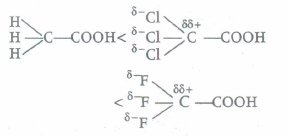
Fluorine has the highest electron-withdrawing inductive effect so, trifluoroacetic acid is the strongest acid and acetic acid is the weakest acid. Therefore, trifluoroacetic acid ionises to the greater extent and acetic acid ionises to the minimum extent. Greater the number of ions produced, greater is the depression in freezing point.

12th Standard CBSE Syllabus & Materials
12th Standard CBSE
CBSE 12th Computer Science Python Revision Tour I - New Previous year Question Papers Study Material - QB365 Set A
NEW12th Standard CBSE
CBSE 12th Business Studies Planning Important Questions And Answers Study Material - QB365 Set A
NEW12th Standard CBSE
CBSE 12th Business Studies Business Environment Important Questions And Answers Study Material - QB365 Set A
NEW12th Standard CBSE
CBSE 12th Business Studies Principles of Management Important Questions And Answers Study Material - QB365 Set A



NCERT Books

Syllabus

Exam Pattern

Sample Question Papers

Previous year Question Papers

Important Notes

MCQ Practice test

NCERT Exemplers

Case study Questions

Image Based Questions

Passage based Questions

HOT Questions

Value Based Questions

Model Questions Papers
NCERT ( Book Back ) Questions

Assertion and Reason
Important Questions And Answers

CBSE 12th Standard CBSE Subjects
CBSE Standards








