
 100% FREE ACCESS
12th Standard CBSE Syllabus & Materials
12th Standard CBSE
CBSE 12th Economics Government Budget and the Economy Previous year Question Papers Study Material - QB365 Set A
NEW12th Standard CBSE
CBSE 12th Computer Science Interface Python with MySQL - New Previous year Question Papers Study Material - QB365 Set A
NEW12th Standard CBSE
CBSE 12th Computer Science Database Concept - New Previous year Question Papers Study Material - QB365 Set A
NEW12th Standard CBSE
CBSE 12th Computer Science Data Communication - New Previous year Question Papers Study Material - QB365 Set A
NEW12th Standard CBSE
CBSE 12th Computer Science Data Structures - New Previous year Question Papers Study Material - QB365 Set A
NEW12th Standard CBSE
CBSE 12th Computer Science Functions - New Previous year Question Papers Study Material - QB365 Set A

Published on: 07/03/2026
Download CBSE Class 12th Standard CBSE Chemistry question papers, sample papers, important questions, and previous year solved papers in PDF format. Get free study materials, NCERT solutions, and exam preparation resources for Class 12th Standard CBSE Chemistry
Questions + Answers key
Take MCQ Chemistry Test
1.
How much charge is required for the reduction of 1 mole of Al3+ to AI?
2.
What happpens when :
(i) CH3 -CI is treated with aqueous KOH?
(ii) CH3 -CI is treated with KCN?
(iii) CH3 -Br is treated with Mg in the presence of dry ether ?
3.
Define Raoult's law for binary solutions.
4.
Write the structural formulae of compounds A, B and C and name the reagent D in the following reaction
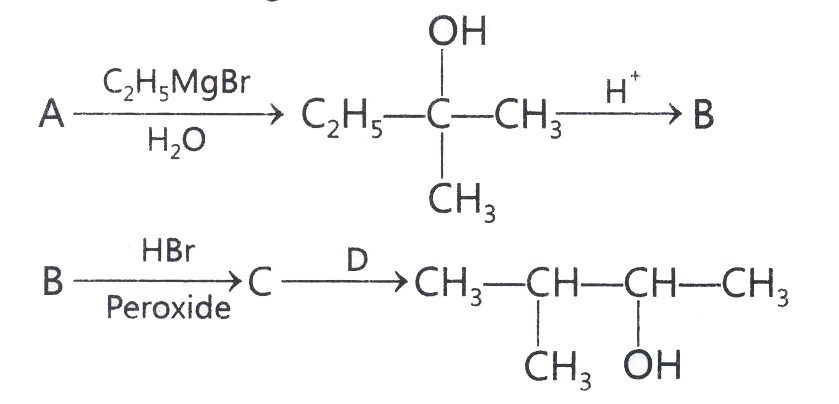
5.
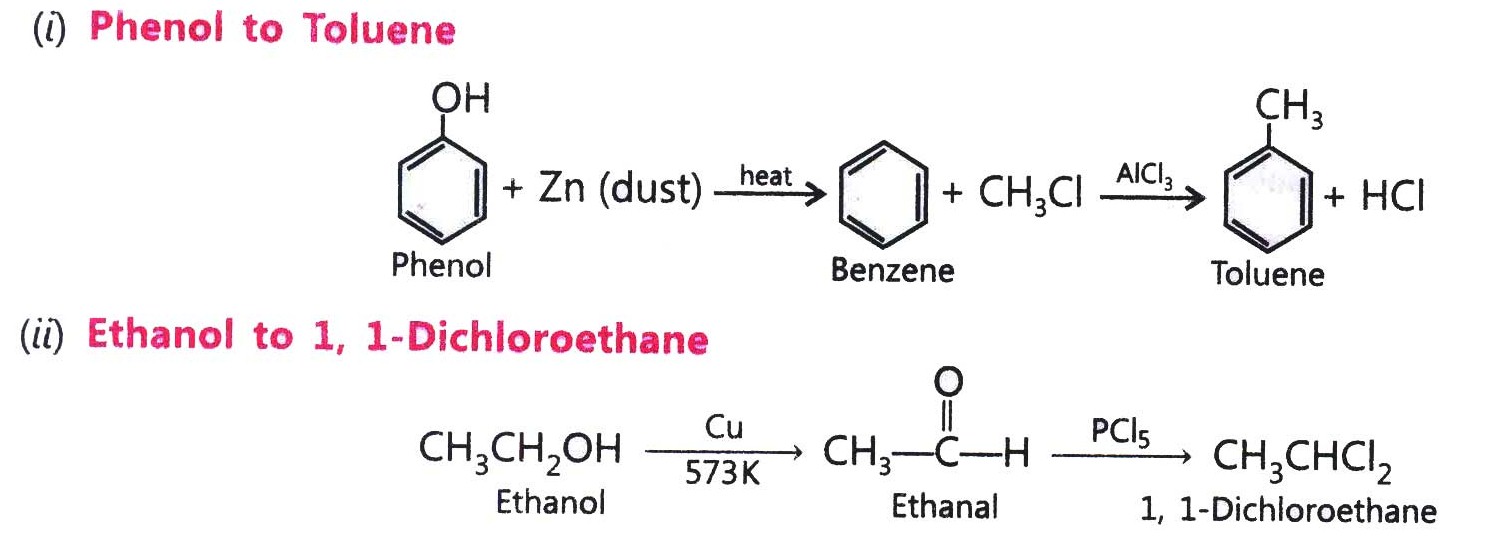
How are the following conversions carried out?
(i) Phenol to Toluene
(ii) Ethanol to 1,1-dichloroethane.
6.
Explain the following observations:
(i) Transition elements generally form colored compounds.
(ii) Zinc is not regarded as a transition element.
7.
A first order decomposition reaction takes 40 minutes for 30% decomposition. Calculates its t1/2 value.
8.
(i) Define:
(a) Metal carbonyls
(b) Chelate
(ii) (a) Give one chemical test as an evidence to show that [Co(NH3)5CI]SO4 and [Co(NH3)5(SO4)] Cl are ionisation isomers.
(b) [NiCl4]2- is paramagnetic while [Ni(CO4] is diamagnetic though both are tetrahedral. Why? (Atomic no. of Ni = 28)
(c) Write the electronic configuration of Fe(III) on the basis of crystal field theory when it forms an octahedral complex in the presence of (i) strong field ligand, and (ii) weak field ligand. (Atomic no. of Fe = 26)
9.
Write the IUPAC names of the following coordination compounds
(i) [Co(NH3)6]Cl3
(ii) [Co(NH3)5Cl]Cl2
(iii) K3[Fe(CN)6]
(iv) K3[Fe(C2O4)3] (v) K2[PdCl4]
(v) [Pt(NH3)2Cl(NH2CH3)]Cl
10.
(a) Describe the following giving linked chemical equations:
(i) Cannizzaro reaction
(ii) Decarboxylation
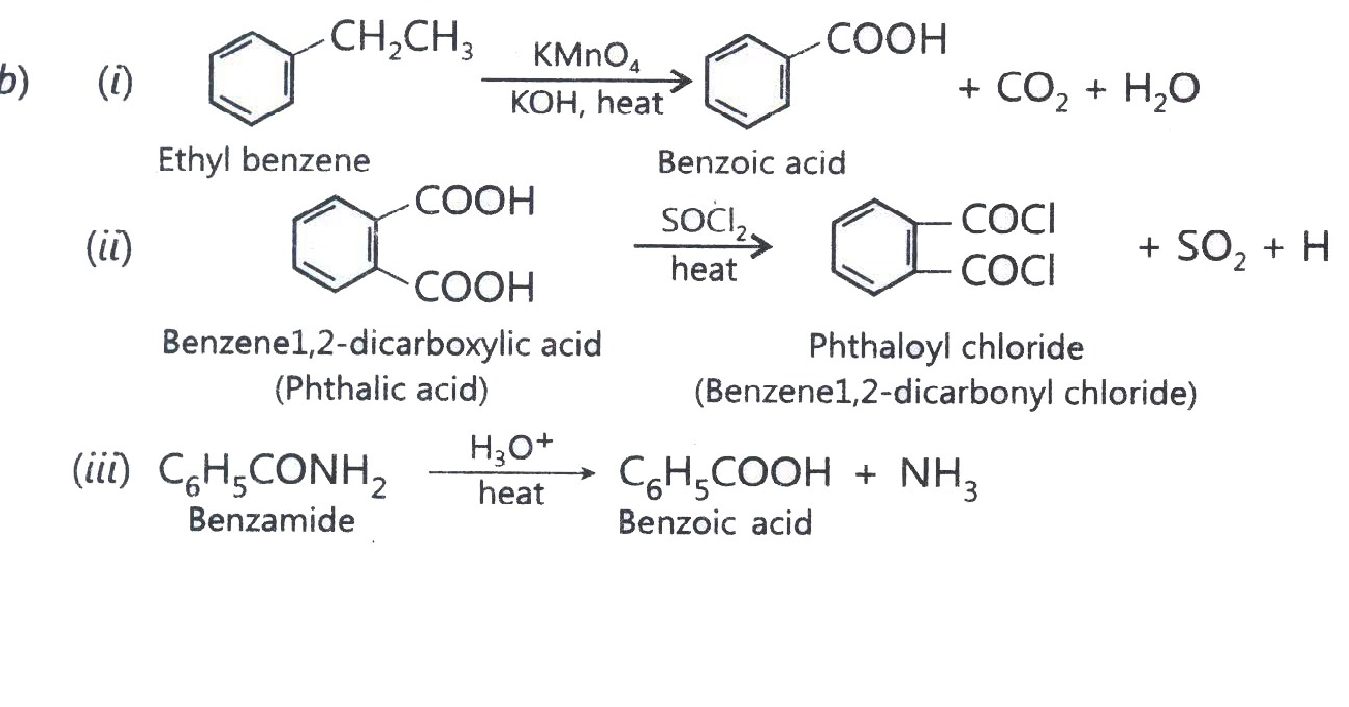
(b) Complete the following chemical equations:
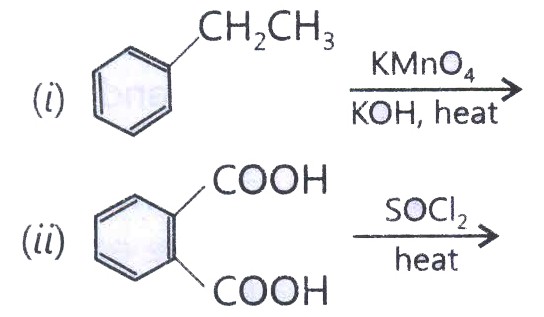
(iii) \(C_6H_5CONH_2 \xrightarrow [heat] {H_3O^+}\)
11.
Predict the correct intermediate and the product in the following reaction:

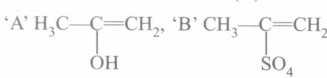
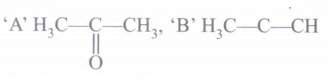
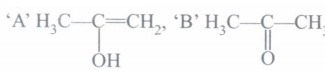
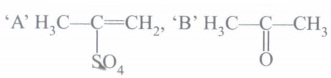
12.
The stability of Mn2+, Fe2+,Cr2+, Co2+ is in order of (At o. of Mn = 25, Fe = 26, Cr = 24, Co = 27)
Mn2+ > Fe2+ > Cr2+ > CO2+
Fe2+ > Mn2+ > Co2+ > Cr2+
Co2+ > Mn2+ > Fe2+ > Cr2+
Cr2+ > Mn2+ > Co2+ > Fe2+
13.
The reagent(s) used for the reduction of aldehydes and ketone into alcohols is/are
fmely divided metals such as Pt/Pd/Ni
sodium borohydride
lithium aluminium hydride
All of the above
14.
Heterolyptic complex is
[Fe(CN)6]4-
[Co(NH3)5SO4]+
[HgI4]2-
[CO(NH3)6]3+
15.
Which of the following hormones is produced under the conditions of stress which stimulate glycogenolysis in the liver of human beings?
Thyroxin
Insulin
Adrenaine
Estradiol
16.
In context of the lanthanoids, which of the following statements is not correct ?
All the members exhibit +3 oxidation state
Because of similar properties, the separation of lanthanoids is not easy.
Availability of 4f electrons results in the formation of compounds in +4 state for all the members of series.
There is a gradual decrease in the radii of the members with increasing atomic number in the series.
17.
In the following reaction, X is \(X\overset { Bromination }{ \longrightarrow } Y\overset { NaNO_{ 2 }\quad /HCI }{ \longrightarrow } Z\overset { Boiling }{ \underset { { C }_{ 2 }{ H }_{ 5 }OH }{ \longrightarrow } } Tribromobenzene\)
Benzoic acid
Salicylic acid
Phenol
Aniline
18.
Which of the following compound/s on halo-generation give a racemic mixture of products ?
(CH3)4C
CH3CH2CH2CH3
CH3CH2CH3
CH3CH3
19.
Which of the following statements is not correct ?
Copper liberates hydrogen from acids
In its higher oxidation states, manganese forms stable compounds with oxygen and fluorine
Mn3+ and Co3+ are oxidising agents in aqueous solution
Ti2+ and Cr2+ are reducing agents in aqueous solution
20.
Which metal has highest density ?
Pt
Os
W
Hg
21.
75% of the first order reaction was completed in 32 min. 50% of the reaction was completed in
24 min
8 min
16 min
4 min
22.
The van't Hoff factor i for a compound which undergoes dissociation in one solvent and association in other solvent is respectively
Greater than one and greater than one
Less than one and greter than one
Less than one and less than one
Greater than one and less than one
23.
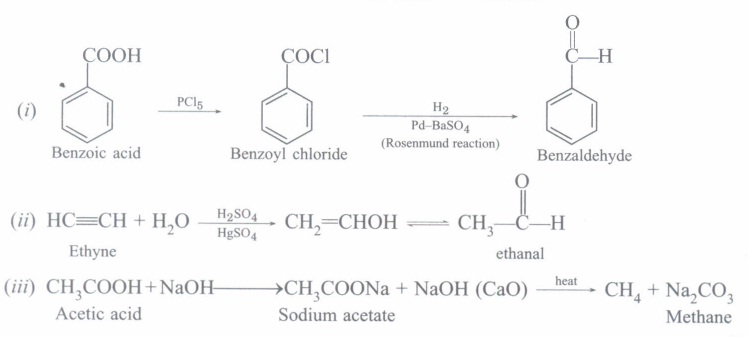
Convert:
(i) Benzoic acid to Benzaldehyde
(ii) Acetylene to Ethanal
(iii) Acetic acid to Methane
24.
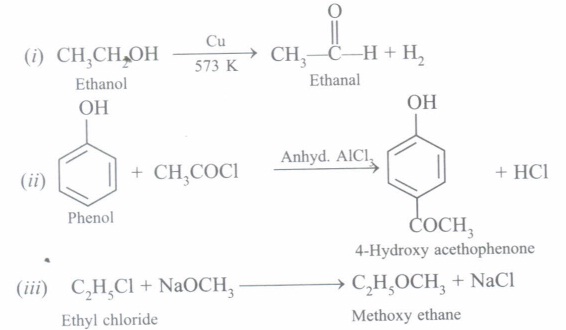
What happens when:
(i) Ethanol is treated with Cu at 573 K.
(ii) Phenol is treated with CH3COCl / anhydrous AlCl3.
(iii) Ethyl chloride is treated with NaOCH3?
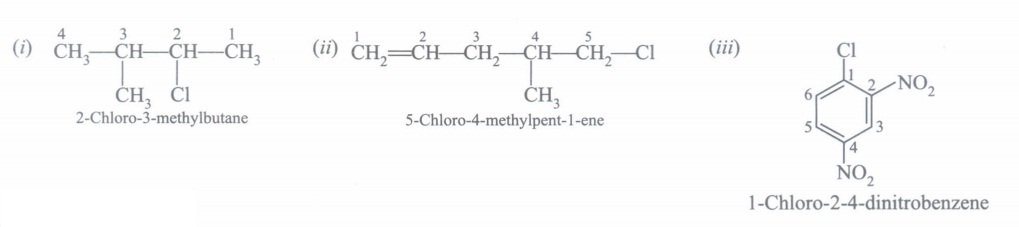
25.
Write the IUPAC name of the following compounds:
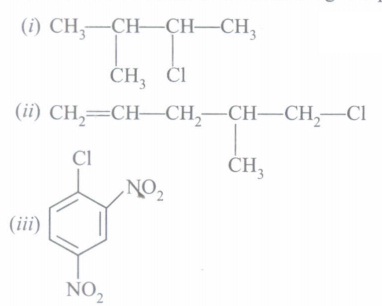
26.
Explain the following observations:
(i) With the same d-orbital configuration (d4), Cr2+ ion is a reducing agent while Mn3+ ion is an oxidising agent.
(ii) Cu+ ion is not stable in aqueous solutions.
(iii) Among the 3d series of transition elements, the largest number of oxidation states are exhibited by manganese.
27.
Give the structure of A, B and C in the following reactions:
(i) \({ C }{ H }_{ 3 }Br\overset { KCN }{ \longrightarrow } A\overset { LiAIH_{ 4 } }{ \longrightarrow } B\overset { { HNO }_{ 2 } }{ \underset { 273K }{ \longrightarrow } } C\)
(ii) \({ C }{ H }_{ 3 }COOH\overset { { NH }_{ 3 } }{ \underset { \triangle }{ \longrightarrow } } A\overset { Br_{ 2 }+KOH }{ \longrightarrow } B\overset { { CHCI }_{ 3 }+NaOH }{ \longrightarrow } C\)
28.
Write the types of isomerism exhibited by the following complexes:
(i) \(\left[ Co{ \left( { NH }_{ 3 } \right) }_{ 5 }Cl \right] { SO }_{ 4 }\)
(ii) \({ \left[ Co{ \left( en \right) }_{ 3 } \right] }^{ 3+ }\)
(iii) \(\left[ Co{ \left( { NH }_{ 3 } \right) }_{ 6 } \right] \left[ Cr{ \left( CN \right) }_{ 6 } \right] \\ \)
29.
30.
Assertion: Aldol condensation can be catalysed both by acids and bases.
Reason: \(\beta\)-Hydroxy aldehydes or ketones readily undergo acid catalysed dehydration.
Codes:
(a) Assertion and reason both are correct statements and reason is correct explanation for assertion.
(b) Assertion and reason both are correct statements but reason is not correct explanation for assertion.
(c) Assertion is correct statement but reason is wrong statement.
(d) Assertion is wrong statement but reason is correct statement.
31.
Assertion: Fe2+ is paramagnetic.
Reason: Fe2+ contains four unpaired electrons
Codes:
(a) Assertion and reason both are correct statements and reason is correct explanation for assertion.
(b) Assertion and reason both are correct statements but reason is not correct explanation for assertion.
(c) Assertion is correct statement but reason is wrong statement.
(d) Assertion is wrong statement but reason is correct statement
32.

33.
Read the passage given below and answer the following questions :
Carboxylic acids dissociate in water to give carboxylate ion and hydronium ion.
RCOOH + H2O \(\longrightarrow\) RCOO- + H3O+
The acidity of carboxyl group is due to the presence of positive charge on oxygen which liberates proton. The carboxylate ion formed is resonance stabilised.

Carboxylic acids are stronger acids than phenols. Electron withdrawing groups (EWG) increase the acidity of carboxylic acids by stabilising the conjugate base through delocalisation of negative charge by inductive and/ or resonance effects. Electron donating group (EDG) decrease the acidity by destabilising the conjugate base.
The following questions are multiple choice questions. Choose the most appropriate answer :
(i) Which of the following reactions is showing the acidic property of carboxylic acid?

(ii) Which one of the following is the correct order of acidic strength?
| (a) CF3COOH > CHCl2COOH > HCOOH > C6H5CH2COOH > CH3COOH |
| (b) CH3COOH > HCOOH > CF3COOH > CHCl2COOH > C6H5CH2COOH |
| (c) HCOOH > C6H5CH2COOH > CF3COOH > CHCl2COOH > CH3COOH |
| (d) CF3COOH > CH3COOH > HCOOH > CHCl2COOH > C6H5CH2COOH |
(iii) Which of the following acids has the smallest dissociation constant?
| (a) CH3CHFCOOH | (b) FCH2CH2COOH |
| (c) BrCH2CH2COOH | (d) CH3CHBrCOOH |
(iv) The correct order of acidity for the following compounds is
| (a) I > II > III > IV | (b) III > I > II > IV |
| (c) III> IV > II> I | (d) I > III > IV > II |
1.
The number of electrons involved in the reaction is three.
Therefore, the amount of electricity required for one mole
of AI3+ ions = 3F or 3 x 96500C = 289500C
2.
(i) CH3 - CI + KOH\(\rightarrow\)CH3OH + KCI
(aq) Methanol
(ii) CH3 - CI + KCM \(\rightarrow\) CH3 CN + KCI
Methyl cyanide
(iii) CH3 Br + Mg \(\overset { Dry\ ether }{ \longrightarrow } \)CH3MgBr
Methyl magnesium bromide
3.
Define Raoult's law for binary solutions may be defined as: at a given temperature, for a solution of two volatile liquids the partial vapour pressure of each component of the solution is equal to the product of the vapour pressure of the pure component and its mole fraction in solution. Thus,
\(P_A=P_A \quad{ }^{\circ} \times x_a \text { and } P_B=P_B \quad{ }^{\circ} \times x_B\)
4.
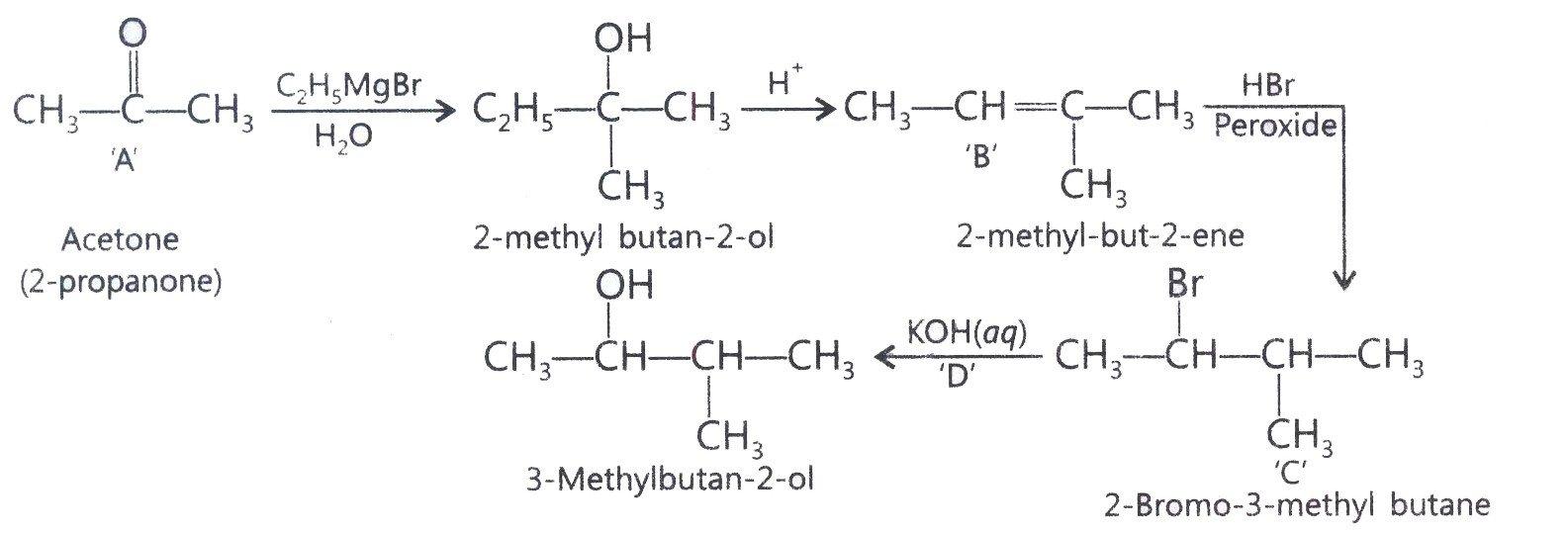
5.
6.
(i) It is due to presence of unpaired electrons in d-orbitals therefore, they undergo d-d transitions by absorbing light from visible region and rediate complementary colour.
(ii) It is because neither Zn nor Zn2+ ion has incompletely filled d-orbital.
7.
\(k=\frac { 2.303 }{ { t }_{ { 1 }/{ 2 } } } \log { \frac { { [R] }_{ 0 } }{ { { [R] } } } }\)
\(k=\frac { 2.303 }{ 40 } \log { \frac { { [R] }_{ 0 } }{ { \frac { 70 }{ 100 } { [R] }_{ 0 } } } } \)
[30% is decomposed, 70% is left]
\(k=\frac { 2.303 }{ 40 } \left( \log { 10 } -\log { 7 } \right) \)
\(k=\frac { 2.303 }{ 40 } [1.0000-0.8451]\)
\(k=\frac { 2.303 }{ 40 } \times 0.1549\)
\(k=\frac { 0.3567 }{ 40 } =8.917\times { 10 }^{ -3 }{ min }^{ -1 }\)
\({ t }_{ { 1 }/{ 2 } }=\frac { 0.693 }{ k } =\frac { 0.693 }{ 8.917\times { 10 }^{ -3 } } \)
\(=\frac { 0.693 }{ 8.917 } =77.716 \ min\)
8.
(i) (a) Metal carbonyls: Metal carbonyls are the compounds in which carbon monoxide (CO) acts as the ligand. The metal-carbon bond in metal carbonyls possesses both \(\sigma\) and \(\pi\) characters, e.g. N(CO)4[nickeltetracarbonyl]. Its IUPAC name is tetra carbonyl nickel(0).
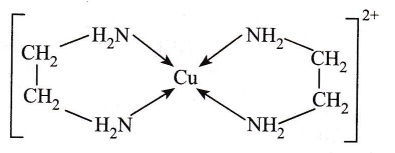
(b) Chelate: An inorganic metal complex in which there is a close ring of atoms caused by attachment of a ligand to a metal atom at two points. An example is the complex ion formed between ethylene diamine and cupric ion,[Cu(NH2CH2CH2NH2)2]2+.
(ii) (a) Add BaCl2 solution. [Co(NH3)]5Cl]SO4 will give white ppt. of BaSO4.
\(\left[\mathrm{Co}\left(\mathrm{NH}_{3}\right)_{5} \mathrm{Cl}\right] \mathrm{SO}_{4}+\mathrm{BaCl}_{2}(a q) \)\( \longrightarrow\left[\mathrm{Co}\left(\mathrm{NH}_{3}\right)_{5} \mathrm{Cl}\right] \mathrm{Cl}_{2}+\mathrm{BaSO}_{4} \downarrow \)
\(\text { (White ppt.) }\)
Add AgNO3(aq) solution [Co(NH3)5SO4] Cl will give white ppt. of AgCl.
\( {\left[\mathrm{Co}\left(\mathrm{NH}_{3}\right)_{5} \mathrm{SO}_{4}\right] \mathrm{Cl}+\mathrm{AgNO}_{3}(a q)} \) \(\longrightarrow \mathrm{AgCl}+\left[\mathrm{Co}\left(\mathrm{NH}_{3}\right)_{5} \mathrm{SO}_{4}\right] \mathrm{NO}_{3} \)
\(\text { (White ppt) }\)
(c) Fe3+ (4s03d5) In strong field \( \Delta_{0}>P t_{2 g}^{5} e g^{0} \)
In weak field \(\Delta_{0}
9.
(i) Pentaamminechloridocobalt(III) chloride.
(ii) Pentaamminechloridocobalt(III) chloride.
(iii) Potassium hexacyanoferrate(III).
(iv) Potassium tetrachloridopalladate(II).
(v) Diamminechlorido(methylamine)platinum(II) chloride.
10.
(a) (i) Cannizzaro's reaction:
When aldehydes which do not have \(\alpha\)-hydrogen gets oxidised as well as reduced in presence of conc. alkali, it is called Cannizzaro's reaction.
\(\underset { Methanal }{ 2HCHO } \overset { 50%NaOH }{ \longrightarrow } \underset { Sodium\quad Methanoate }{ HCOONa } +\underset { Methanol }{ CH_{ 3 }OH } \)
(ii) Decarboxylation : Sodium salts of acids when heated with soda lime, lower alkanes are formed
\(\underset { Sodium\quad acetate }{ CH_{ 3 }COONa } +\underset { Sodalime }{ NaOH } \longrightarrow \underset { Methane }{ CH_{ 4 } } +\underset { sodium\quad carbonate }{ Na_{ 2 }CO_{ 3 } } \)
11.
(c)
12.
(a)
Mn2+ > Fe2+ > Cr2+ > CO2+
13.
(d)
All of the above
14.
(b)
[Co(NH3)5SO4]+
15.
(c)
Adrenaine
16.
(c)
Availability of 4f electrons results in the formation of compounds in +4 state for all the members of series.
17.
(d)
Aniline
18.
(b)
CH3CH2CH2CH3
19.
(a)
Copper liberates hydrogen from acids
20.
(b)
Os
21.
(c) : 75% of reaction is completed in two half-lived i.e., 2 \(\times\) t 12 = 32 min or t 1/2 = 16 min
22.
In case of dissociation, i>1 and in case of association, i>1.
23.
24.
25.
26.
(iii) Manganese exhibits all the oxidation states from + 2 to + 7. It shows largest number of oxidation states as it has the maximum number of unpaired electrons.
27.
(i) \({ C }{ H }_{ 3 }Br\overset { KCN }{ \longrightarrow } { C }{ H }_{ 3 }CN\overset { LiAIH_{ 4 } }{ \longrightarrow } { C }{ H }_{ 3 }{ C }{ H }_{ 2 }{ NH }_{ 2 }\overset { { HNO }_{ 2 } }{ \underset { 273K }{ \longrightarrow } } { C }{ H }_{ 3 }{ C }{ H }_{ 2 }-OH\)
(ii) \({ C }{ H }_{ 3 }COOH\overset { { NH }_{ 3 } }{ \underset { \triangle }{ \longrightarrow } } { C }{ H }_{ 3 }{ C }{ ONH }_{ 2 }\overset { Br_{ 2 }+KOH }{ \longrightarrow } { C }{ H }_{ 3 }{ NH }_{ 2 }\overset { { CHCI }_{ 3 }+NaOH }{ \longrightarrow } { C }{ H }_{ 3 }NC\)
28.
(i) ionisation isomerism
(ii) optical isomerism
(iii) coordination isomerism
29.
30.
(b): Both carbanions (formed in presence of base) and enol form (formed in presence of an acid) act as nucleophiles and hence add on the carbonyl group of aldehydes and ketones to give aldols.
31.
(a): Fe has atomic number 26. So, its electronic configuration is [Ar]3d64s2.
Fe2+ has electronic configuration [Ar]3d6.
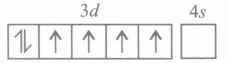
It has four unpaired electrons and it is paramagnetic.
32.
33.
(i) (d): All the reactions are showing the acidic properties of carboxylic acid. Carboxylic acid forms the sodium salts with all i.e., alkali metals, NaOH and Na2CO3 etc. and removes the acidic proton from the carboxylic acid.
(ii) (a): In general, greater the +I effect of the group attached to the carboxyl group, lesser will be the acidic strength and greater the -I effect ofthe group, greater will be acidic strength. As number of halogen atoms and electronegativity of halogen atom increases, acidic strength increases. Thus, correct order of acidic strength is
CF3COOH> CHCl2COOH > HCOOH > C6H5CH2COOH > CH3COOH
(iii) (c) : Stronger -I group attached closer to - COOH makes the acid stronger, i.e., acid has the larger dissociation constant. - Br shows poor (-I) effect and also far away from -COOH group i.e., option (c) has smallest dissociation constant.
(iv) (a): Due to ortho-effect, (I) and (II) are stronger acids than (III) and (IV). Due to two ortho-hydroxyl groups in (I), it is stronger acid than (II). (III) is a stronger acid than (IV) because at m-position, -OH group cannot exert its +R effect but can only exert its -I effect while at p-position, -OH group exerts its strong +R effect. Thus, the correct order of acidity is : I > II > III > IV.

12th Standard CBSE Syllabus & Materials
12th Standard CBSE
CBSE 12th Computer Science Python Revision Tour I - New Previous year Question Papers Study Material - QB365 Set A
NEW12th Standard CBSE
CBSE 12th Business Studies Planning Important Questions And Answers Study Material - QB365 Set A
NEW12th Standard CBSE
CBSE 12th Business Studies Business Environment Important Questions And Answers Study Material - QB365 Set A
NEW12th Standard CBSE
CBSE 12th Business Studies Principles of Management Important Questions And Answers Study Material - QB365 Set A



NCERT Books

Syllabus

Exam Pattern

Sample Question Papers

Previous year Question Papers

Important Notes

MCQ Practice test

NCERT Exemplers

Case study Questions

Image Based Questions

Passage based Questions

HOT Questions

Value Based Questions

Model Questions Papers
NCERT ( Book Back ) Questions

Assertion and Reason
Important Questions And Answers

CBSE 12th Standard CBSE Subjects
CBSE Standards








