
 100% FREE ACCESS
12th Standard CBSE Syllabus & Materials
12th Standard CBSE
CBSE 12th Economics Government Budget and the Economy Previous year Question Papers Study Material - QB365 Set A
NEW12th Standard CBSE
CBSE 12th Computer Science Interface Python with MySQL - New Previous year Question Papers Study Material - QB365 Set A
NEW12th Standard CBSE
CBSE 12th Computer Science Database Concept - New Previous year Question Papers Study Material - QB365 Set A
NEW12th Standard CBSE
CBSE 12th Computer Science Data Communication - New Previous year Question Papers Study Material - QB365 Set A
NEW12th Standard CBSE
CBSE 12th Computer Science Data Structures - New Previous year Question Papers Study Material - QB365 Set A
NEW12th Standard CBSE
CBSE 12th Computer Science Functions - New Previous year Question Papers Study Material - QB365 Set A

Published on: 07/03/2026
Download CBSE Class 12th Standard CBSE Chemistry question papers, sample papers, important questions, and previous year solved papers in PDF format. Get free study materials, NCERT solutions, and exam preparation resources for Class 12th Standard CBSE Chemistry
Questions + Answers key
Take MCQ Chemistry Test
1.
Write the equations involved in the following reactions:
(i) Reimer-Tiemann reaction
(ii) Williamson synthesis
2.
The rate constant for the decomposition of a hydrocarbon is 2.418 \(\times 10^{-5}\) s-1 at 546 K. If the energy of activation is 179.9 kJ/mol, what will be value of pre-exponential factor?
3.
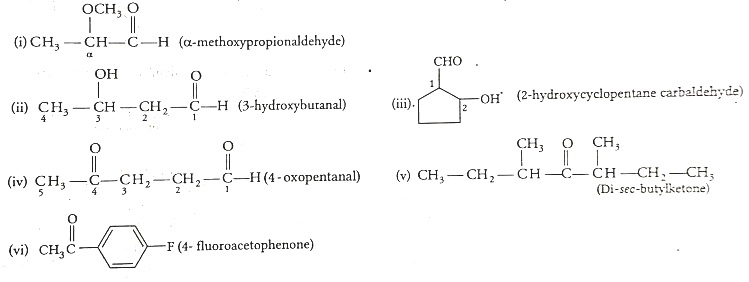
Write the structures of the following compounds:
(i) \(\alpha\)-Methoxypropionaldehyde
(ii) 3-Hydroybutanal
(iii) 2-Hydroxycyclopentane carboldehyde
(iv) 4-Oxopentanal
(v) Di-sec-butylketone
(vi) 4-Fluoroacetophenone
4.
The two strands in DNA are not identical but are complementary. Explain.
5.
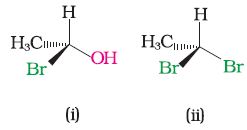
Identify chiral and achiral molecules in each of the following pair of compounds. (Wedge and Dash representations)
(i)
(ii)
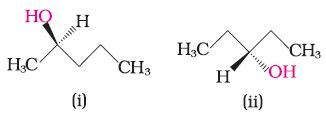
(iii)
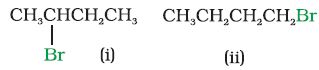
6.
For the cell
\(Zn(s)\left| { Zn }^{ 2+ }(2M) \right| \left| { Cu }^{ 2+ }(0.5M) \right| Cu(s)\)
(a) Write equation for each half-reaction.
(b) Calculate the cell potential at 25 oC.
[Given: \({ E }_{ { Zn }^{ 2+ }/Zn }^{ o }=-0.76V;{ E }_{ { Cu }^{ 2+ }/Cu }^{ o }=+0.34V\)]
7.
If N2 gas is bubbled through water at 293 K, how many millimoles of N2 gas would dissolve in 1 liter of water? Assume that N2 exerts a partial pressure of 0.987 bar. Given Henry's law constant for N2 at 293 K is 76.48 kbar.
8.
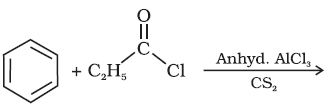
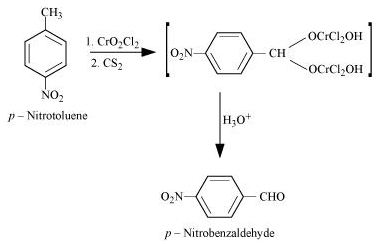
Write the structures of products of the following reactions;
(i)
(ii) \(\begin{equation} \left(\mathrm{C}_{6} \mathrm{H}_{5} \mathrm{CH}_{2}\right)_{2} \mathrm{Cd}+2 \mathrm{CH}_{3} \mathrm{COCl} \rightarrow \end{equation}\)
(iii)

(iv)
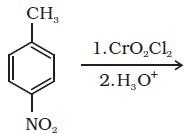
9.
(i) The conductivity of 0.001 mol L-1 solution of CH3COOH is 3.905 x 10⁻⁵ S cm-1. Calculate its molar conductivity and degree of dissociation. Given \(\lambda ^{ 0 }\left( H^{ + } \right) =349.6 \ Scm^{ 2 } \ mol^{ -1 }\) and \(\lambda ^{ 0 }\left( CH_{ 3 }COO^{ - } \right) =40.9 \ scm^{ 2 }mol^{ -1 }\)
(ii) Define electrochemical cell. What happens if external potential applied becomes greater than E0cell of electrochemical cell?
10.
When a chromite ore(A) is fused with sodium carbonate in free excess of air and the product is dissolved in water, a yellow solution of compound (B) is obtained. After treatment of this yellow solution with sulphuric acid, compound (C) can be crystallised from the solution. When compound (C) is treated with KCl, orange crystals of compound (D) crystallise out. Identify (A) (B) (C) and write the reactions.
11.
The boiling point of benzene is 353.23 K. When 1.80 g of a non-volatile solute was dissolved in 90 g of benzene, the boiling point is raised to 354.11 K. Calculate the molar mass of the solute. Kb for benzene is 2.53 K kg mol–1.
12.
Why are vitamin A and vitamin C essential to us ? Give their important sources ?
13.
Sucrose decomposes in acid solution into glucose and fructose according to the first order rate law with t1/2 = 3.00 hours. What fraction of the sample of sucrose remains after 8 hours?
14.
Which compound in each of the following pairs will react faste in SN2 reaction with OH-?
(a) CH3Br or CH3I
(b) (CH3)3CCl or CH3Cl
15.
CoSO4Cl. 5NH3 exists in ywo isomeric forms 'A' and 'B' . Isomer 'A' reacts with AgNO3 to give white precipitate, but does not react with BaCl2. Isomer 'B' gives white precipitate with BaCl2 but does not react with AgNO3. Answer the following questions.
(i) Identify 'A' and 'B' and write their structural formulae.
(ii) Name the type of isomerism involved.
(iii) Give the IUPAC name of 'A' and 'B'.
16.
Which of the following compound will not undergo azo coupling reaction with benzene diazonium chloride?
Aniline
Phenol
Anisole
Nitrobenzene
17.
Freons, hydrofluorocarbons and fluorocarbons are stable in the stratosphere which are used in
aerosol propellants
air conditioning equipments
refrigeration
All of the above
18.
When one reactant is present in large excess in a chemical reaction between two substances, then the reaction is known as
first order reaction
second order reaction
zero order reaction
pseudo first order reaction
19.
In the given reaction,
2Cu+(aq) \(\rightleftharpoons\) Cu2+(aq) + Cu(s)
EOCu+/Cu = 0.6 V and EoCu2+/Cu = 0.41 V
Find out the equilibrium constant.
2.76 x 10²
2.76 X 10⁴
2.76 X 10⁶
2.76 x 10⁸
20.
For the reaction, Mn+(aq) + ne- ⇾ M(s), select the best suitable representation of Nernst equation, when the solid M is taken.
\(\begin{array}{l} E_{M^{n+} / M}=E_{M^{n+} / M}^{0}-\frac{R T}{n F} \ln \frac{[M]}{\left[M^{n+}\right]} \\ \end{array}\)
\(E_{M^{n+} / M}=E_{M^{n+} / M}^{\circ}-\frac{R T}{n F} \ln \frac{1}{\left[M^{n+}\right]} \\ \)
\(E_{M^{n+} / M}=E_{M^{n+} / M}^{0}-\frac{R T}{n F} \ln \frac{\left[M^{n+}\right]}{[M]} \\ \)
\(E_{M^{n+} / M}=E_{M^{n+} / M}^{\circ}-\frac{R T}{n F} \ln \left[M^{n+1}\right]\)
21.
Which sugar is present in DNA ?
Ribose
2-Deoxyribose
Flucose
Fructose
22.
Identify the combination of compounds that undergo Aldol condensation followed by dehydration to produce but-2-enal.
methanal and ethanal
two moles of ethanal
methanal and propanone
two moles of ethanol
23.
The molecular formula of ethers is:
CnH2nO
CnH2n+1O
CnH2+1O
CnH2nOCnH2n
24.
With which of the following reagents, carbonyl compound shows addition cum elimination reaction?
PCl5
Brady's reagent
HCN
all of these
25.
In nitroprusside ion, iron and NO exist as Fe (II) and NO+ rather than Fe (III) and NO. These forms can be differentiated by
estimating the concentration of iron
measuring the concentration of CN-
measuring the solid state magnetic moment
thermally decomposing the compound
26.
KMnO4, oxidation number of Mn is
+ 2
+ 4
+ 6
+ 7
27.
In which mode of expression, the concentration of solution remains independent of temperature ?
Molarity
Normality
Formality
Molality
28.
29.
30.
31.
Assertion: [Ti (H2O)6]3+ is a coloured ion.
Reason: Ti shows +2, +3, +4 oxidation states.
Codes:
(a) Assertion and reason both are correct statements and reason is correct explanation for assertion.
(b) Assertion and reason both are correct statements but reason is not correct explanation for assertion.
(c) Assertion is correct statement but reason is wrong statement.
(d) Assertion is wrong statement but reason is correct statement
32.
Amines are classified as primary, secondary and tertiary amines. Primary amines cannot be obtained by ammonolysis of alkyl halide because we will get mixture of 1°, 2 c and 3° amines. Cyanides, on reduction give primary amines where as isocyanides on reduction give secondary amines. Nitro compounds, on reduction also give primary amines. Primary amines react with CHCI3 and KOH to form foul smelling isocyanide. They react with HNO2 and liberate N2 gas. They react with Hinsberg's reagent to form salt soluble in KOH. Secondary amine form yellow oily compounds with HNO2 and salt formed with C6H5SO2CI, is insoluble in KOH. 3° amines form salt soluble in water with HNO2 but does not react with C6Hs SO2CI.
Diazonium salts are prepared by reaction of Aniline with NaNO2 and conc. HCI at 0 - 5 0c. Aromatic diazonium salts are more stable because phenyl diazonium ion is stabilized by resonance. Benzene diazonium chloride can be used to prepare halo benzene, phenol, nitro benzene, benzene, p-hydroxy azo benzene (azo dye) and large number of useful compounds.
(a) Write the isomer of C3H9N which does not react with Hinsberg reagent.
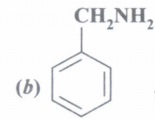 on heating with CHCI3 and KOH gives 'X'. Identify 'X'.
(c) Convert Aniline to phenol.
(d) Distinguish between Aniline and ethyl amine.
(e) Complete the following reaction
\(\mathrm{C}_{6} \mathrm{H}_{5} \mathrm{NO}_{2} \stackrel{\mathrm{Fe} / \mathrm{HCl}}{\longrightarrow} \mathrm{A} \frac{\mathrm{NaNO}_{2}+\mathrm{HCl}}{0-5^{\circ} \mathrm{C}} \mathrm{B}\) Identify' A' and 'B'.
(f) \(\mathrm{C}_{6} \mathrm{H}_{5} \mathrm{~N}_{2}^{+} \mathrm{Cl}^{\mathrm{CuCN}} \longrightarrow \mathrm{A} \stackrel{\mathrm{H}_{2} \mathrm{O} / \mathrm{H}^{+}}{\longrightarrow} \mathrm{B}\) Identify 'A' and 'B'.
(g) What is use of quarternary ammonium salts of long chain tertiary amines?
33.
Read the passage given below and answer the following questions:
Coordination compounds are formulated and named according to the IUPAC system.
Few rules for naming coordination compounds are:
(I) In ionic complex, the cation is named first and then the anion.
(II) In the coordination entity, the ligands are named first and then the central metal ion.
(III) When more than one type of ligands are present, they are named in alphabetical order of preference without any consideration of charge.
The following questions are multiple choice questions. Choose the most appropriate answer:
(i) The IUPAC name of the complex \(\left[\mathrm{Pt}\left(\mathrm{NH}_{3}\right)_{3} \mathrm{Br}\left(\mathrm{NO}_{2}\right) \mathrm{Cl}\right] \mathrm{Cl}\) is
| (a) triamminechlorobromonitroplatinum (IV) chloride |
| (b) triamminebromonitrochloroplatinum (IV) chloride |
| (c) triamminebromidochloridonitroplatinum (IV) chloride |
| (d) triamminenitrochlorobromoplatinum (IV) chloride |
(ii) The lUPAC name of [Ni(CO)4] is
| (a) tetracarbonylnickel (II) | (b) tetracarbonylnickel (0) |
| (c) tetracarbonylnickelate (II) | (d) tetracarbonylnickelate (0). |
(iii) As per IUPAC nomenclature, the name of the complex \(\left[\mathrm{Co}\left(\mathrm{H}_{2} \mathrm{O}\right)_{4}\left(\mathrm{NH}_{3}\right)_{2}\right] \mathrm{Cl}_{3}\) is
| (a) tetraaquadiamminecobalt (II) chloride | (b) tetraaquadiamminecobalt (III) chloride |
| (c) diamminetetraaquacobalt (II) chloride | (d) diamminetetraaquacobalt (III) chloride |
(iv) Which of the following represents correct formula of dichloridobis( ethane-1, 2-diamine ) cobalt (III) ion?
| (a) [CoCl2(en)]2+ | (b) [Co(ONO)(NH3)5]SO4 | (c) [Co(NO2)(NH3)4] (SO4)2 | (d) [Co(NO)(NH3)4] (SO4)2 |
1.
(i) Reimer-Tiemann reaction
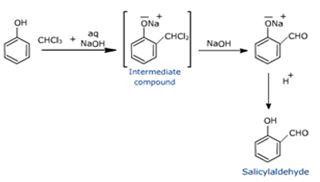
(ii) Williamson syntheses:
\(\underset { Alkyl halide\ Sodium\ alkoxide }{ R-X+\overset { + }{ Na } -\overset { - }{ O } -{ R }' } \longrightarrow R-O-{ R }'+NaX\)
\(\underset { Alkyl\ halide\ Sodium\ alkoxide }{ { CH }_{ 3 }-{ CH }_{ 2 }-Br } +\underset { sodium\ ethoxide }{ \overset { + }{ Na } -\overset { - }{ O } -{ CH }_{ 2 }-{ CH }_{ 3 } } \longrightarrow \underset { Diethyl\ ether }{ { CH }_{ 3 }-{ CH }_{ 2 }-O-{ CH }_{ 2 }-{ CH }_{ 3 } } +NaBr\)
2.
Here, \(k=2.418\times { 10 }^{ -5 }{ s }^{ -1 },{ E }_{ a }=179.9\quad kJ\quad { mol }^{ -1 },\quad T=546K.\)
\(or \ logA=logk+\frac { { E }_{ a } }{ 2.303RT } =log(2.418\times { 10 }^{ -5 }{ s }^{ -1 })+\frac { 179.9 \ kJ \ { mol }^{ -1 } \ }{ 2.303\times 8.314\times { 10 }^{ -3 }kJ \ { K }^{ -1 } \ { mol }^{ -1 }\times 546K } \)
\(\\=(-5+0.3834){ s }^{ -1 }+17.2081=12.5924{ s }^{ -1 }\)
\(A=Antilog(12.5924){ s }^{ -1 }=3.912\times { 10 }^{ 12 }{ s }^{ -1 }\)
According to Arrhenius equation,
\(k=A{ e }^{ { -{ E }_{ a } }/{ RT } }or \ ln \ k=lnA-\frac { { E }_{ a } }{ RT } or \ logk=logA-\frac { { E }_{ a } }{ 2.303RT }\)
3.
4.
Each strand consist of 4 bases which are Adenine, Guanine, Thymine and Cytosine.
These complementary bases are the following:
Adenine (A) ⇔ Thymine (T)
Cytosine (C) ⇔ Guanine (G)
⇔ This symbol represents that both the left and right hand side bases are complementary to each other.
The two strands are internally connected by hydrogen bonding between complementary bases. The two strands of DNA are not identical because their sequence of bases has to be complementary to each other. Ex- If one sequence is ATCG the other has to be TAGC.
5.
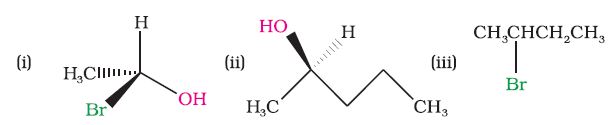
6.
Zn(s) ➝ Zn2+ (aq) + 2e-
Cu2+(aq) + 2e- ➝ Cu(s)
______________________________________
Zn(s) + Cu2+(aq) ➝ Zn2+(aq) + Cu(s)
______________________________________
\(E_{cell}=E^0_{cell}-{0.0591\over 2}log{[Zn^{2+}]\over [Cu^{2+}]}\)
\(=\left(E^0_{cu^{2+}/Cu}-E^0_{Zn^{2+}/Zn}\right)-{0.0591V\over 2}log{2\over 0.5}\)
\(=[+0.34V+0.76]-{0.0591V\over v2}log4\)
\(=+1.10V-{0 0591V\over 2}\times0.6021\)
= 1.10 V - 0.018 V = 1.082 V
7.
The solubility of gas is related to the mole fraction in aqueous solution. The mole fraction of the gas in the solution is calculated by applying Henry’s law. Thus:
\(x(\text { Nitrogen })=\frac{p \text { (nitrogen) }}{K_{\mathrm{H}}}=\frac{0.987 \mathrm{bar}}{76,480 \mathrm{bar}}=1.29 \times 10^{-5}\)
As 1 litre of water contains 55.5 mol of it, therefore if n represents number of moles of N2 in solution,
\(x(\text { Nitrogen })=\frac{n \text { mol }}{n \text { mol }+55.5 \text { mol }}=\frac{n}{55.5}=1.29 \times 10^{-5}\)
(n in denominator is neglected as it is < < 55.5)
Thus n = 1.29 × 10⁻⁵ \(\times\) 55.5 mol = 7.16\(\times\) 10–4 mol
\(=\frac{7.16 \times 10^{-4} \mathrm{~mol} \times 1000 \mathrm{ \ mmol}}{1 \mathrm{~mol}}=0.716 \mathrm{ \ mmol}\)
8.
(i)
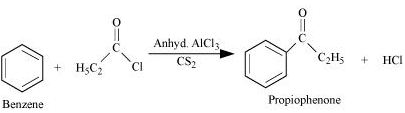
(ii)
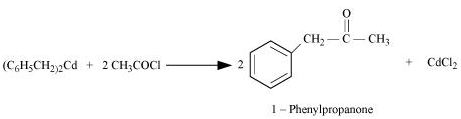
(iii)
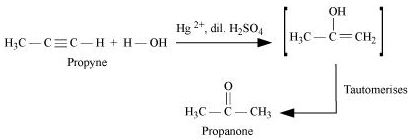
(iv)
9.
Given: Conductivity of CH3COOH solution,
K= 3.905 x 10⁻⁵ S cm-1
Concentration of CH3COOH solution,
C = 0.001 mol L-I ,
Molar conductivity,
\(\lambda _{ m }=k\times \frac { 1000 }{ C } \)
\(=\frac { \left( 3.905\times 10^{ -5 }Scm^{ -1 } \right) \times \left( 1000\quad cm^{ 3 }L^{ -1 } \right) }{ 0.001molL^{ -1 } } \)
= 39.05 S cm2mol-1
Molar conductivity at infinite dilution \(\left( \lambda ^{ 0 }_{ m } \right) \) for CH3COOH
\(\lambda ^{ 0 }_{ m }CH_{ 3 }COOH=\lambda ^{ 0 }_{ m }CH_{ 3 }COO^{ - }+\lambda ^{ 0 }_{ H+ }\)
= 40.9 + 349.6 S cm2 mol-1
= 390.5 S cm2 mol-1
Degree of dissociation, \(\alpha =\frac { \lambda _{ m } }{ \lambda ^{ 0 }_{ m } } \)
\(=\frac { 39.05\quad s\quad cm^{ 2 }mol^{ -1 } }{ 39.05\quad s\quad cm^{ 2 }mol^{ -1 } } =0.1\)
(ii) A device used to convert the chemical energy produced in a spontaneous redox reaction into electrical energy is called an electrochemical cell.
When external potential applied becomes greater than E0cell of electrochemical cell. electrons flow from cathode to anode, i.e. electrochemical cell behaves like an I electrolytic cell.
10.
'A' is iron chromite (FeCr2 04 ), '8' is sodium chromate (Na2CrO4 ), 'C' is sodium dichromate (Na2CrO7) and 'D' is potassium dichromate (K2Cr2O7).
\(4 \mathrm{FeCr}_{2} \mathrm{O}_{4}+8 \mathrm{Na}_{2} \mathrm{CO}_{3}+7 \mathrm{O}_{2} \longrightarrow 8 \mathrm{Na}_{2} \mathrm{CrO}_{4}\) + 2Fe2O3 + 8CO2 (g)
'A' 'B'
(Chromite ore) (Yellow solution)
\(2 \mathrm{Na}_{2} \mathrm{CrO}_{4}+\mathrm{H}_{2} \mathrm{SO}_{4} \longrightarrow \mathrm{Na}_{2} \mathrm{Cr}_{2} \mathrm{O}_{7}+\mathrm{Na}_{2} \mathrm{SO}_{4}+\mathrm{H}_{2} \mathrm{O}\) \(\mathrm{Na}_{2} \mathrm{Cr}_{2} \mathrm{O}_{7}+2 \mathrm{KCl} \longrightarrow 2 \mathrm{NaCl}+\mathrm{K}_{2} \mathrm{Cr}_{2} \mathrm{O}_{7}\)
'C' 'C' 'D'
(Orange crystals)
11.
The elevation (\(\triangle\)Tb) in the boiling point = 354.11 K – 353. 23 K = 0.88 K
\(M_{2}=\frac{2.53 \mathrm{~K} \mathrm{~kg} \mathrm{~mol}^{-1} \times 1.8 \mathrm{~g} \times 1000 \mathrm{~g} \mathrm{~kg}^{-1}}{0.88 \mathrm{~K} \times 90 \mathrm{~g}}=58 \mathrm{~g} \mathrm{~mol}^{-1}\)
Therefore, molar mass of the solute, M2 = 58 g mol–1.
12.
Vitamin A is essential to us because its deficiency causes xerophthalmia (hardening of cornea of eye) and night blindness.
Sources: Fish liver oil, carrots, butter, and milk.
Vitamin C. Vitamin C is essential to us because its deficiency causes scurvy (bleeding gums) and pyorrhea (loosening and bleeding of teeth).
Sources: Citrous fruits; arnIa, green leafy vegetables.
13.
As sucrose decomposes according to first order rate law, \(k=\frac { 2.303 }{ t } \log { \frac { { \left[ A \right] }_{ 0 } }{ { \left[ A \right] } } } \)
The aim is to find \({ \left[ A \right] }/{ { \left[ A \right] }_{ 0 } }\)
As \({ t }_{ { 1 }/{ 2 } }=3.0\quad hour,\quad \therefore k=\frac { 0.693 }{ { t }_{ { 1 }/{ 2 } } } =\frac { 0.693 }{ 3\quad hr } =0.231\quad { hr }^{ -1 }\)
Hence, \(0.231 \ { hr }^{ -1 }\)\(=\frac { 2.303 }{ 8\quad hr } \log { \frac { { \left[ A \right] }_{ 0 } }{ { \left[ A \right] } } } \) or \(\frac { { \left[ A \right] }_{ 0 } }{ { \left[ A \right] } } =0.8024\quad \)or \(\frac { { \left[ A \right] }_{ 0 } }{ { \left[ A \right] } } =Antilog\quad (0.8024)=6.345\)or \(\frac { { \left[ A \right] } }{ { { \left[ A \right] }_{ 0 } } } =\frac { 1 }{ 6.345 } =0.158\)
14.
In the SN2 mechanism, the reactivity of halides for same halides group increase down the group. Because increase in size increase, the halide becomes a better leaving group. Therefore, CH3I will react faster than CH3Br in SN2 reactions with OH-.
15.
\((i)\ \left[ Co{ \left( { NH }_{ 3 } \right) }_{ 5 }{ SO }_{ 4 } \right] Cl+{ AgNO }_{ 3 }(aq)\longrightarrow AgCl(s)+\left[ Co{ \left( { NH }_{ 3 } \right) }{ SO }_{ 4 } \right] { NO }_{ 3 }\\ \quad \quad \quad \quad \quad \quad \quad \quad \quad 'A'\quad \ \quad \quad \quad \quad \quad \quad \quad \quad \quad \quad white\ ppt\)
\( \left[ Co{ \left( { NH }_{ 3 } \right) }_{ 5 }Cl \right] { SO }_{ 4 }+{ BaCl }_{ 2 }\longrightarrow { BaSO }_{ 4 }(s)+\left[ Co{ \left( { NH }_{ 3 } \right) }_{ 5 }Cl \right] { Cl }_{ 2 }\\ \quad \quad \quad \quad \quad \quad \quad \quad \quad 'B'\quad \quad \quad \quad \quad \quad \quad \quad \quad \quad \quad \quad \quad \quad \quad white\ ppt\)
(ii) Ionisation isomerism
(iii) 'N' is pentaamrnine chloridocobalt(III) sulphate.
'B' is pentaammine sulphatocobalt(III) chloride.
16.
(d)
Nitrobenzene
17.
(d)
All of the above
18.
(d)
pseudo first order reaction
19.
(c)
2.76 X 10⁶
20.
(b)
\(E_{M^{n+} / M}=E_{M^{n+} / M}^{\circ}-\frac{R T}{n F} \ln \frac{1}{\left[M^{n+}\right]} \\ \)
21.
(b)
2-Deoxyribose
22.
(b)
two moles of ethanal
23.
(c)
CnH2+1O
24.
(b)
Brady's reagent
25.
(c)
measuring the solid state magnetic moment
26.
(d)
+ 7
27.
(d)
Molality
28.
29.
30.
31.
(b): Ti3+ has [Ar]3d1 configuration. Thus, d-d transition is possible and thereby it shows colour.
32.
(a) (CH3)3N, N, N-dimethyl methanamine.
(b)
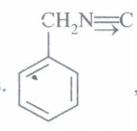 a foul smelling compound.
(c)
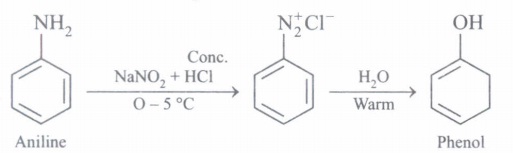
(d) Add NaNO2 and cone. HCI. Cool it to 0 to 5° C. Then add alkaline solution of phenol. Aniline gives orange dye where as ethyl amino does not.
(e) \(\begin{array}{ll}
\mathrm{A}^{\prime} \text { is } \mathrm{C}_{6} \mathrm{H}_{5} \mathrm{NH}_{2} & { }^{\prime} \mathrm{B}^{\prime} \text { is } \mathrm{C}_{6} \mathrm{H}_{5} \mathrm{~N}_{2}^{+} \mathrm{Cl}^{-}
\end{array}\)
(f) 'A' is C6H5CN, 'B' is C6H5COOH
(g) It is used as cationic detergents used in hair conditioners and shampoo.
33.
(i) (c): Ligands are named in alphabetical order irrespective of their charge.
(ii) (b)
(iii) (d)
(iv) (d)

12th Standard CBSE Syllabus & Materials
12th Standard CBSE
CBSE 12th Computer Science Python Revision Tour I - New Previous year Question Papers Study Material - QB365 Set A
NEW12th Standard CBSE
CBSE 12th Business Studies Planning Important Questions And Answers Study Material - QB365 Set A
NEW12th Standard CBSE
CBSE 12th Business Studies Business Environment Important Questions And Answers Study Material - QB365 Set A
NEW12th Standard CBSE
CBSE 12th Business Studies Principles of Management Important Questions And Answers Study Material - QB365 Set A



NCERT Books

Syllabus

Exam Pattern

Sample Question Papers

Previous year Question Papers

Important Notes

MCQ Practice test

NCERT Exemplers

Case study Questions

Image Based Questions

Passage based Questions

HOT Questions

Value Based Questions

Model Questions Papers
NCERT ( Book Back ) Questions

Assertion and Reason
Important Questions And Answers

CBSE 12th Standard CBSE Subjects
CBSE Standards








